Back
NM_000465.4:c.496C>T
p.Gln166Ter · BARD1
Generic ACMG/AMP 2015 with ClinGen SVI recommendations
0%
complete
Final classification
Likely Pathogenic
PVS1PM2
BARD1
c.496C>T
p.Gln166Ter
nonsense · exon 4

BARD1 encodes a protein that partners with BRCA1 to form a complex essential for repairing damaged DNA, particularly double-stranded breaks, and for maintaining genome stability through cell-cycle checkpoints and chromatin regulation. Germline mutations in BARD1 predispose to breast and ovarian cancer, among other cancers, and the gene is generally regarded as a tumor suppressor, although some evidence suggests it can also promote cancer in certain cellular contexts.

This variant

BARD1 partners with BRCA1 in double-strand-break repair and genome stability, and germline loss-of-function changes predispose to breast and ovarian cancer.

Transcript
NM_000465.4
HGVS · transcript:coding
NM_000465.4:c.496C>T
GRCh38
chr2:214781378 G>A
GRCh37
chr2:215646102 G>A
Likely Pathogenic: PVS1 (very strong) plus PM2 (supporting) satisfy the generic ACMG/AMP 2015 fallback combination rule.
Classification rationale
PVS1PM2 Likely Pathogenic
BARD1 c.496C>T nonsense · exon 4

Likely Pathogenic: PVS1 very strong supports loss of function from the early BARD1 truncation. Likely Pathogenic: PM2 supporting reflects an extremely rare gnomAD v4.1 allele frequency with zero homozygotes.

PVS1 + PM2 → Likely Pathogenic
LYFE Sciences is an AI system, and it can make mistakes. Criteria may be applied incorrectly, sources may be misread, and a confident-looking classification can still be wrong. Double-check every criterion and its underlying evidence before relying on any call.
Gene diagram · NM_000465.4 · variants mapped to exon structure
BARD1 NM_000465.4
Fetching transcript structure from UCSC…
Applied criteria · 2 applied · 15 assessed
MetEvidence satisfies this criterion.
Not metEvaluated against available evidence; threshold not reached.
Not assessedApplies in principle, but no evidence was found to evaluate it.
N/ADoesn't apply to this variant type.
Applied · 2
Strength Supporting Moderate Strong Very strong
PVS1 very strong Pathogenic
Met at very strong: the nonsense variant truncates BARD1 at p.Gln166 of 778 residues within an internal coding exon, supporting loss of function without a named downgrade.
pvs1_variant_assessment.json: NM_000465.4:c.496C>T is classified as a nonsense variant with protein consequence NP_000456.2:p.(Gln166Ter), and the suggested default strength is very strong.prefetch.json transcript model: NM_000465.4 encodes a 778-amino-acid reference protein, the predicted protein terminates at position 166, and c.496 lies within the internal coding interval c.365-c.1314 rather than the terminal coding interval c.2002-c.5478.pvs1_gene_context.json: BARD1 loss of function is assessed as a supported germline disease mechanism and the generic PVS1 gate is eligible.
PM2 supporting Pathogenic
Met at supporting strength: gnomAD v4.1 AF is 1.23947e-06 with zero homozygotes, below the PM2 threshold of <= 0.0001.
gnomAD v2.1 all-comers: 1/250,964 alleles, AF=3.98464e-06, homozygotes=0; highest subpopulation AF=8.81135e-06.gnomAD v4.1 all-comers: 2/1,613,598 alleles, AF=1.23947e-06, homozygotes=0; highest subpopulation AF=1.69506e-06 and grpmax FAF=2.8e-07.gnomAD v2.1 non-cancer exomes: AF=4.22965e-06, 1/236,426 alleles, homozygotes=0; gnomAD v3.1 non-cancer is reported absent.
Assessed · not applied · 5 not met · 10 not assessed
Pathogenic
PS2 Not assessed: no documented maternity and paternity confirmation, parental negative testing, or disease-consistent absence of family history is available for this variant.
PS3 Not assessed: no reviewed study performed a validated functional assay on BARD1 c.496C>T (p.Gln166Ter), so damaging functional evidence cannot be calibrated for PS3.
PS4 Not met: aggregated BARD1 risk ratio 1.28 is below the >5.0 threshold, and its 95% CI 0.55–2.51 includes 1.0.
PM6 Not assessed: no assumed de novo occurrence, negative parental testing, or family history consistent with de novo inheritance is documented for this variant.
PP1 Not assessed: zero variant-specific affected-relative genotypes, unaffected-relative genotypes, or informative meioses are documented for cosegregation.
PP4 Not assessed: no case-specific phenotype or family-history evidence is available to establish a highly specific single-etiology disease presentation.
PP5 Not met: the exact ClinVar variant has Pathogenic laboratory submissions but zero expert-panel submissions required for PP5.
Benign
BA1 Not met: gnomAD v4.1 allele frequency is 1.23947e-06, far below the BA1 stand-alone threshold of >= 0.05.
BS1 Not met: gnomAD v2.1 maximum subgroup frequency is 8.81135e-06, below the generic BS1 threshold of >= 0.01.
BS2 Not assessed: gnomAD shows heterozygous alleles but does not document healthy adult status or full early-age penetrance for BS2.
BS3 Not assessed: no validated assay on BARD1 c.496C>T (p.Gln166Ter) demonstrated a normal protein function or splicing result required for BS3.
BS4 Not assessed: no affected family member with a documented negative genotype for NM_000465.4:c.496C>T is reported.
BP2 Not assessed: no parent/offspring or other phase data establishes the variant in trans or cis with a pathogenic variant.
BP5 Not assessed: the case evidence does not identify an alternate molecular basis for the patient's disease.
BP6 Not met: the exact ClinVar record has no expert-panel submission and reports Pathogenic rather than Benign or Likely benign.
N/A · 11 PS1 · PM1 · PM3 · PM4 · PM5 · PP2 · PP3 · BP1 · BP3 · BP4 · BP7
Research & evidence
Population frequency · supports pathogenic
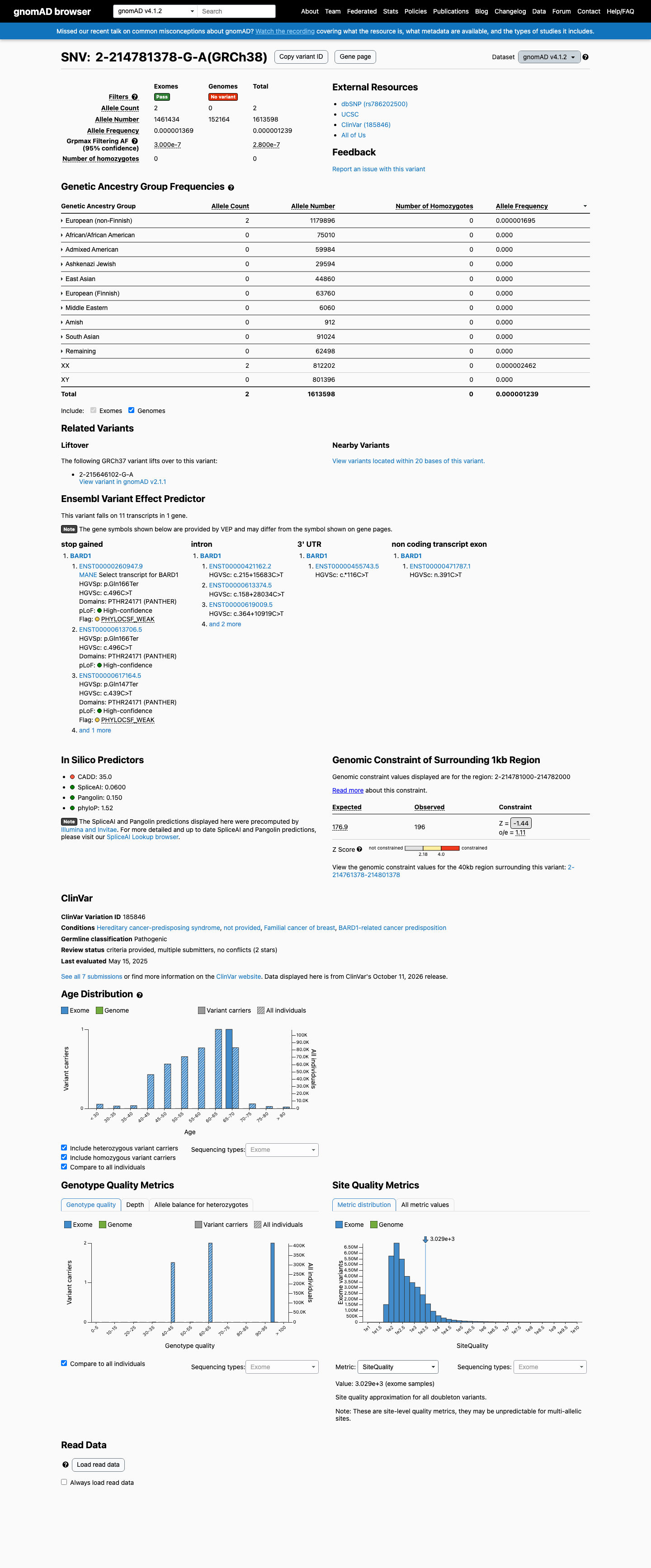
gnomAD v4.1 screenshot
gnomAD v4.1
gnomAD v2.1 screenshot
gnomAD v2.1
v4.1
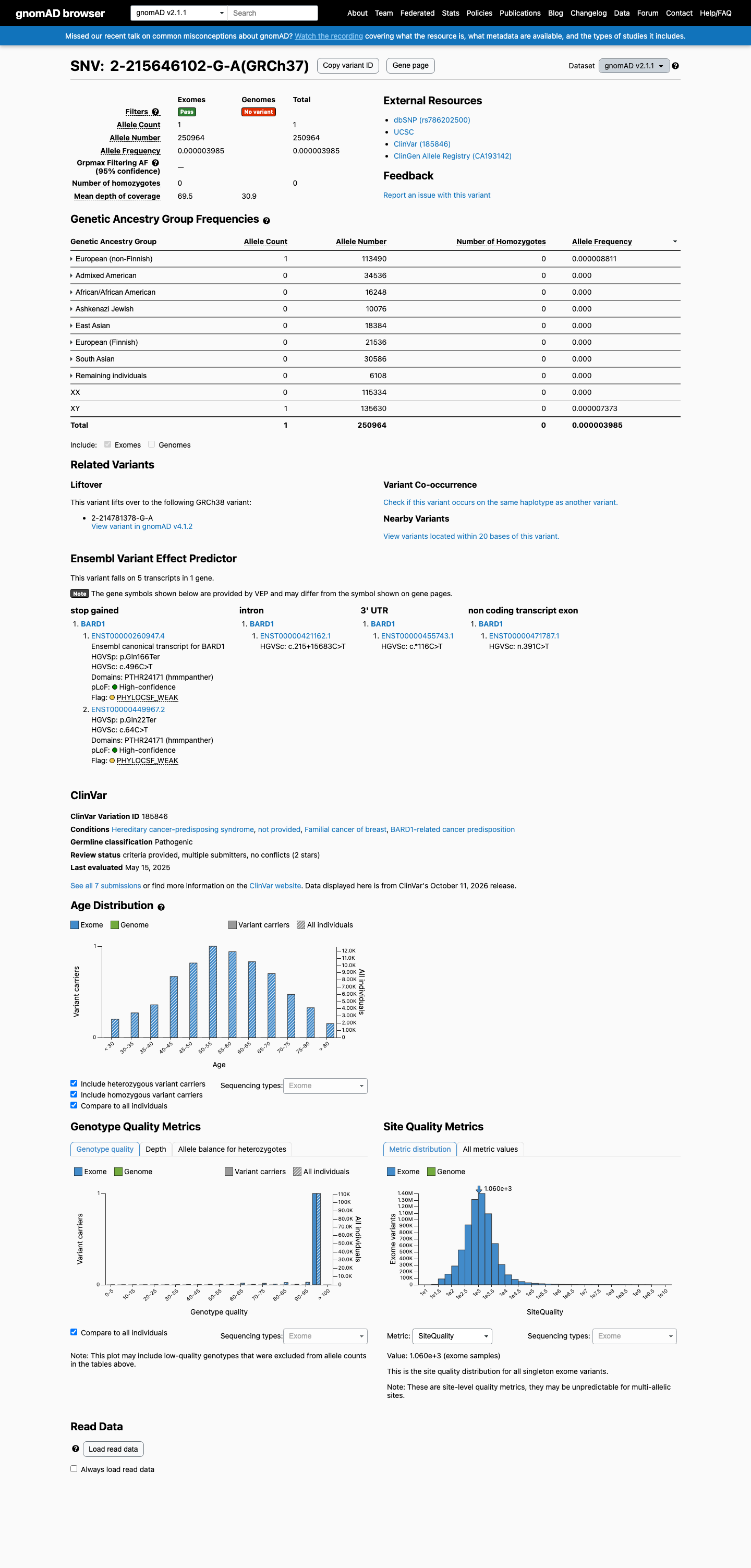
This variant is present in gnomAD v4.1 (AF= 1.23947e-06; MAF= 0.00012%, 2/1613598 alleles, homozygotes = 0) and has highest observed frequency in the European (non-Finnish) population (AF= 1.69506e-06; MAF= 0.00017%, 2/1179896 alleles, homozygotes = 0); grpmax FAF= 2.8e-07.
v2.1
This variant is present in gnomAD v2.1 (AF= 3.98464e-06; MAF= 0.00040%, 1/250964 alleles, homozygotes = 0) and has highest observed frequency in the European (non-Finnish) population (AF= 8.81135e-06; MAF= 0.00088%, 1/113490 alleles, homozygotes = 0).
🇨🇦 CA
Absent from gnomAD-Canada v1.0.
Allele frequency by ancestry
three datasets · side by side
gnomAD v4.1
0.00012% · 2 / 1,613,598
0 hom · FAF 2.8e-05%
European (non-Finnish)
2 / 1,179,896
0.00017%
+ 9 not observed (Remaining individuals, Admixed American, European (Finnish), Amish, East Asian, Middle Eastern, South Asian, Ashkenazi Jewish, African/African American)
gnomAD v2.1
0.0004% · 1 / 250,964
0 hom
European (non-Finnish)
1 / 113,490
0.00088%
+ 7 not observed (African/African American, Admixed American, Ashkenazi Jewish, East Asian, European (Finnish), Remaining individuals, South Asian)
gnomAD Canada 🇨🇦
Absent · 0 / ?
0 hom
Not observed in any ancestry group.
ClinVar screenshot
ClinVar
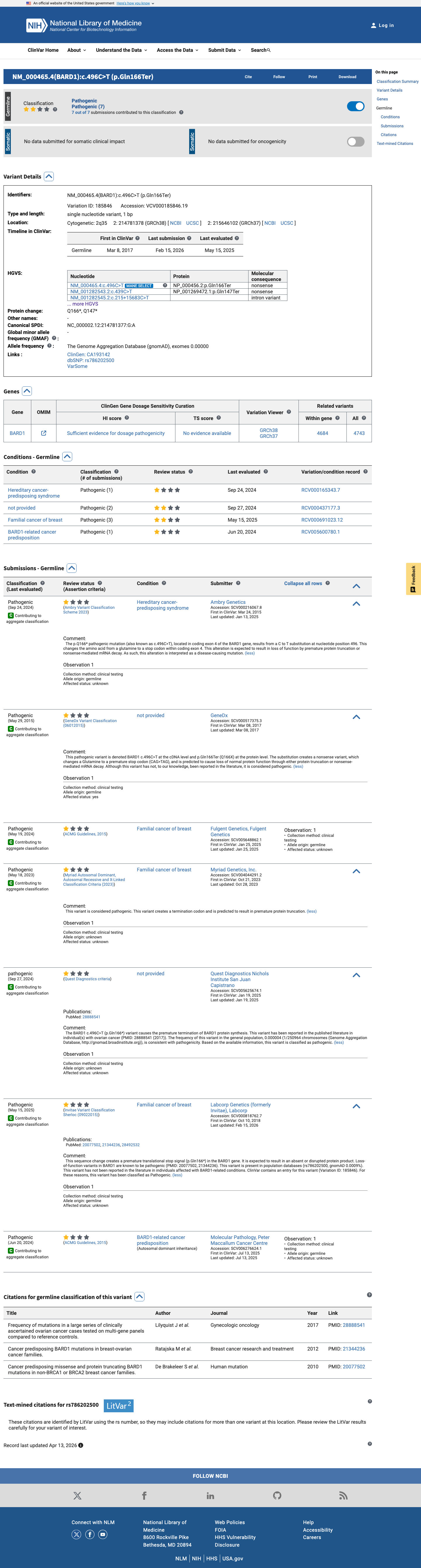
This variant has been reported in ClinVar as Pathogenic (6 clinical laboratories) and as pathogenic (1 clinical laboratory). (ClinVarID = 185846)
SpliceAI screenshot
In silico
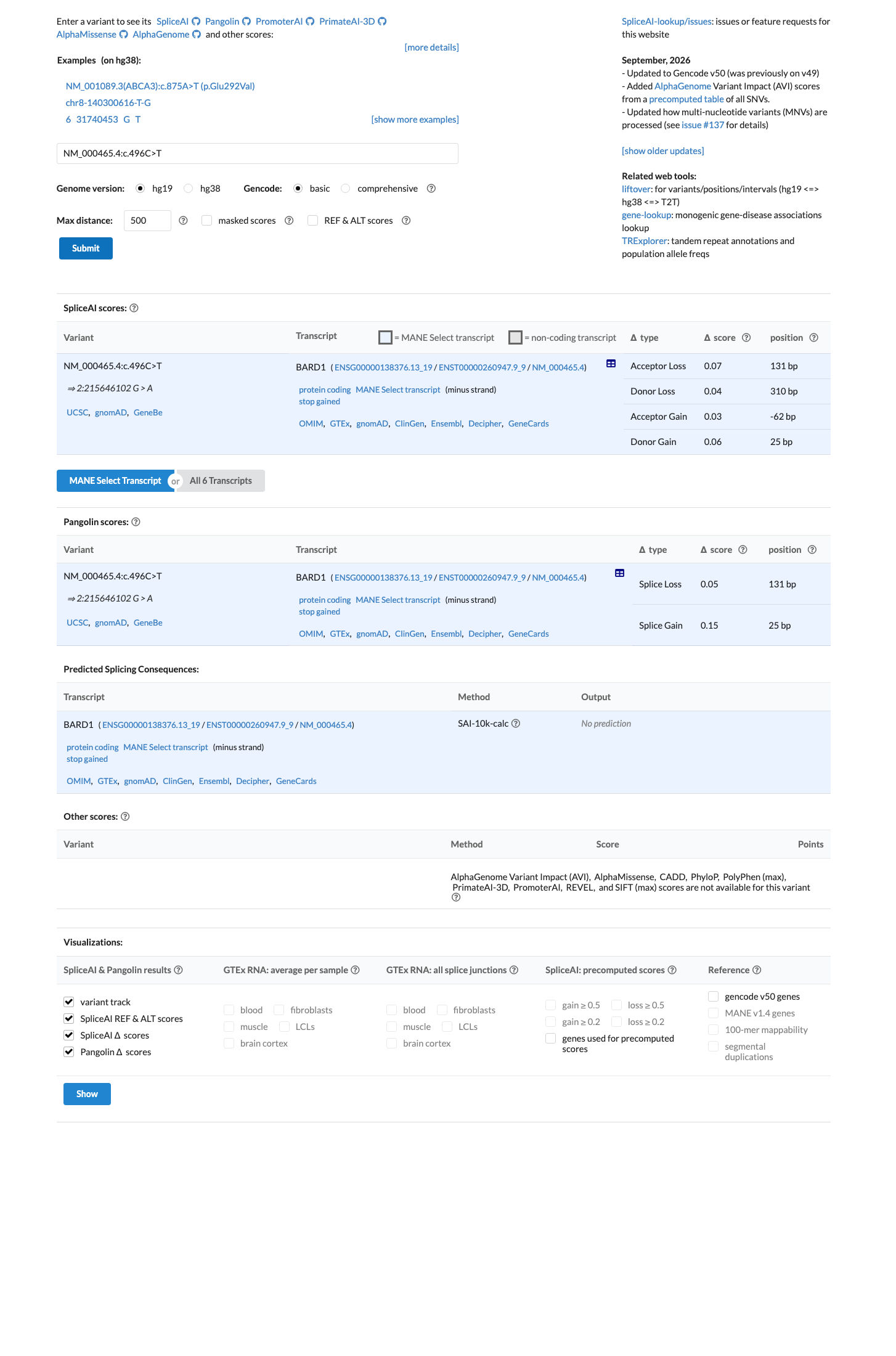
SpliceAI predicts no significant splice impact for this variant (max delta score = 0.07). BayesDel score = 0.60222.
Functional / OncoKB screenshot
Functional Likely Oncogenic
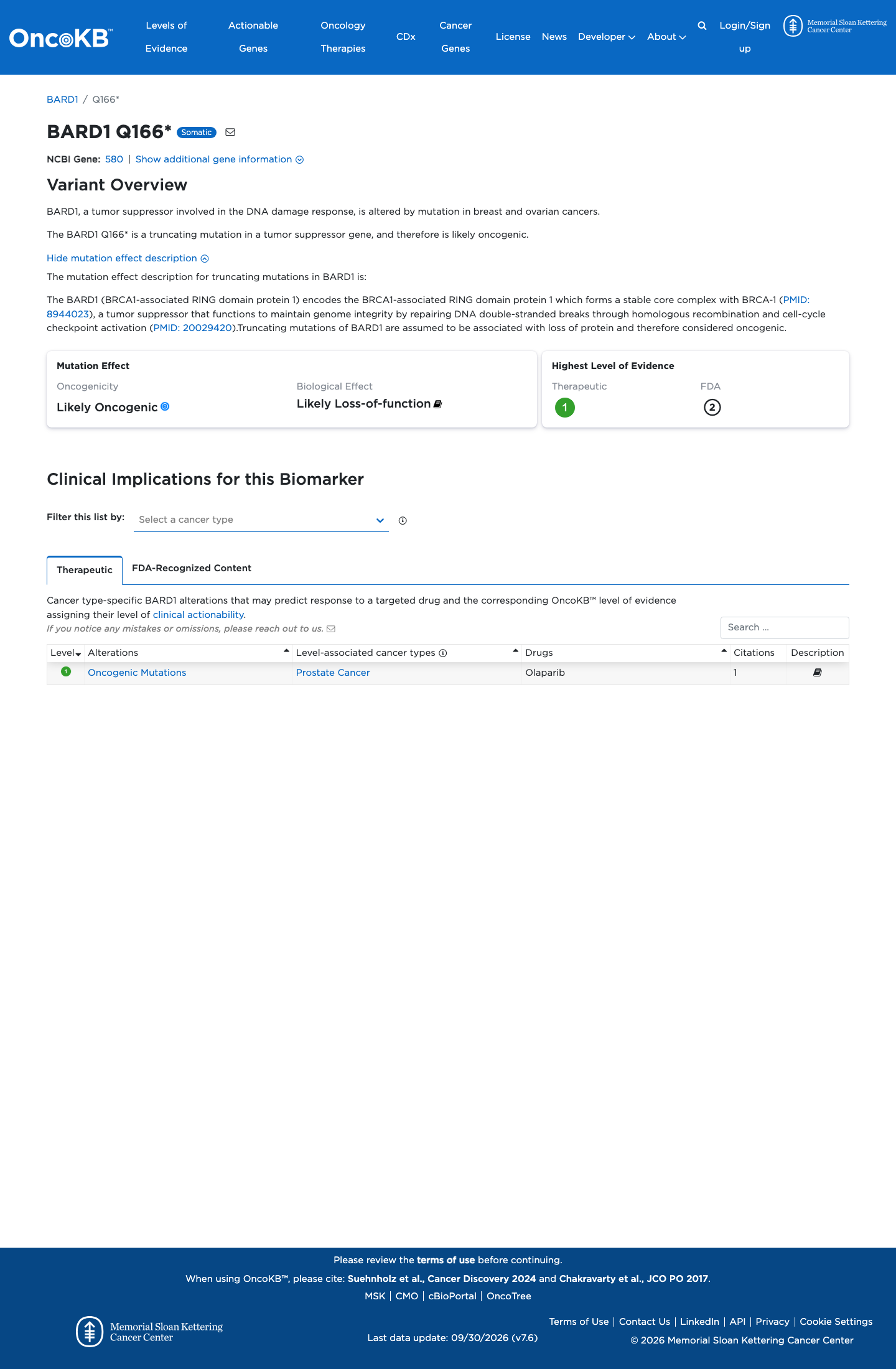
OncoKB identified variant-specific curated literature and context relevant to functional review; biological-effect context: Likely Loss-of-function; curated oncogenicity label: Likely Oncogenic.
OncoKB ↗
COSMIC screenshot
COSMIC
Cancer hotspots screenshot
Cancer hotspots
Somatic evidence Not in COSMIC / hotspots
COSMIC
This variant does not lie in a statistically significant hotspot. This variant has not previously been reported in somatic cancers (COSMIC).
Hotspots
This variant does not lie in a statistically significant hotspot.
Literature · how each cited paper was used
1papers cited
Each card is an audit: what was searched, what was found, whether it names the variant, which criteria it fed, and why. 7 further PMIDs triaged but not cited — see Sources & references.
Standards and guidelines for the interpretation of sequence variants: a joint consensus recommendation of the American College of Medical Genetics and Genomics and the Association for Molecular Pathology.
Found
Generic ACMG/ClinGen-SVI calibration supplied for this case: PM2 supporting threshold <= 0.0001 (ClinGen SVI 2020 recommendation, identified in the prompt with PMID:25741868).
Applied to
→PVS1 very strong
→PM2 supporting
Sources & reference links
8Sources
ClinVar
gnomAD v2.1
gnomAD v4.1
gnomAD-Canada
SpliceAI
OncoKB
COSMIC
Cancer hotspots
Triaged references · 7 PMIDs not cited in assessment
20029420 ↗ BRCA1 and its toolbox for the maintenance of genome integrity. ONCOKB
8944023 ↗ Identification of a RING protein that can interact in vivo with the BRCA1 gene product. ONCOKB
21344236 ↗ Cancer predisposing BARD1 mutations in breast-ovarian cancer families. CLINVAR
26467025 ↗ A Standardized DNA Variant Scoring System for Pathogenicity Assessments in Mendelian Disorders. CLINVAR
28888541 ↗ Frequency of mutations in a large series of clinically ascertained ovarian cancer cases tested on multi-gene panels compared to reference controls. CLINVAR
34242744 ↗ Customizing local and systemic therapies for women with early breast cancer: the St. Gallen International Consensus Guidelines for treatment of early breast cancer 2021. CLINVAR
20077502 ↗ Cancer predisposing missense and protein truncating BARD1 mutations in non-BRCA1 or BRCA2 breast cancer families. CLINVAR