MLH1 encodes a DNA mismatch repair protein that, together with partners such as PMS2, corrects errors that arise during DNA replication. Loss of this repair function leads to the accumulation of mutations, particularly in repetitive microsatellite sequences, and tumors with defective MLH1 typically show high microsatellite instability. Germline mutations in MLH1 cause Lynch syndrome (hereditary non-polyposis colorectal cancer), which strongly predisposes to colorectal, endometrial, ovarian, and other cancers, while biallelic mutations cause constitutional mismatch repair deficiency (CMMRD). Because it normally protects against cancer by maintaining genomic stability, MLH1 acts as a tumor suppressor, and mismatch-repair-deficient tumors often respond well to immunotherapy.
This variant
MLH1 encodes a DNA mismatch repair protein whose loss of function causes Lynch syndrome and, when both alleles are affected, constitutional mismatch repair deficiency.
Transcript
NM_000249.4
HGVS · transcript:coding
NM_000249.4:c.1897-7C>T
GRCh38
chr3:37048510 C>T
GRCh37
chr3:37090001 C>T
VUS: BP4 (supporting) is the only applied criterion, so the MLH1 VCEP's requirement for at least two benign supporting criteria is not met.
Classification rationale
BP4VUS
MLH1 c.1897-7C>Tunknown · exon 16i
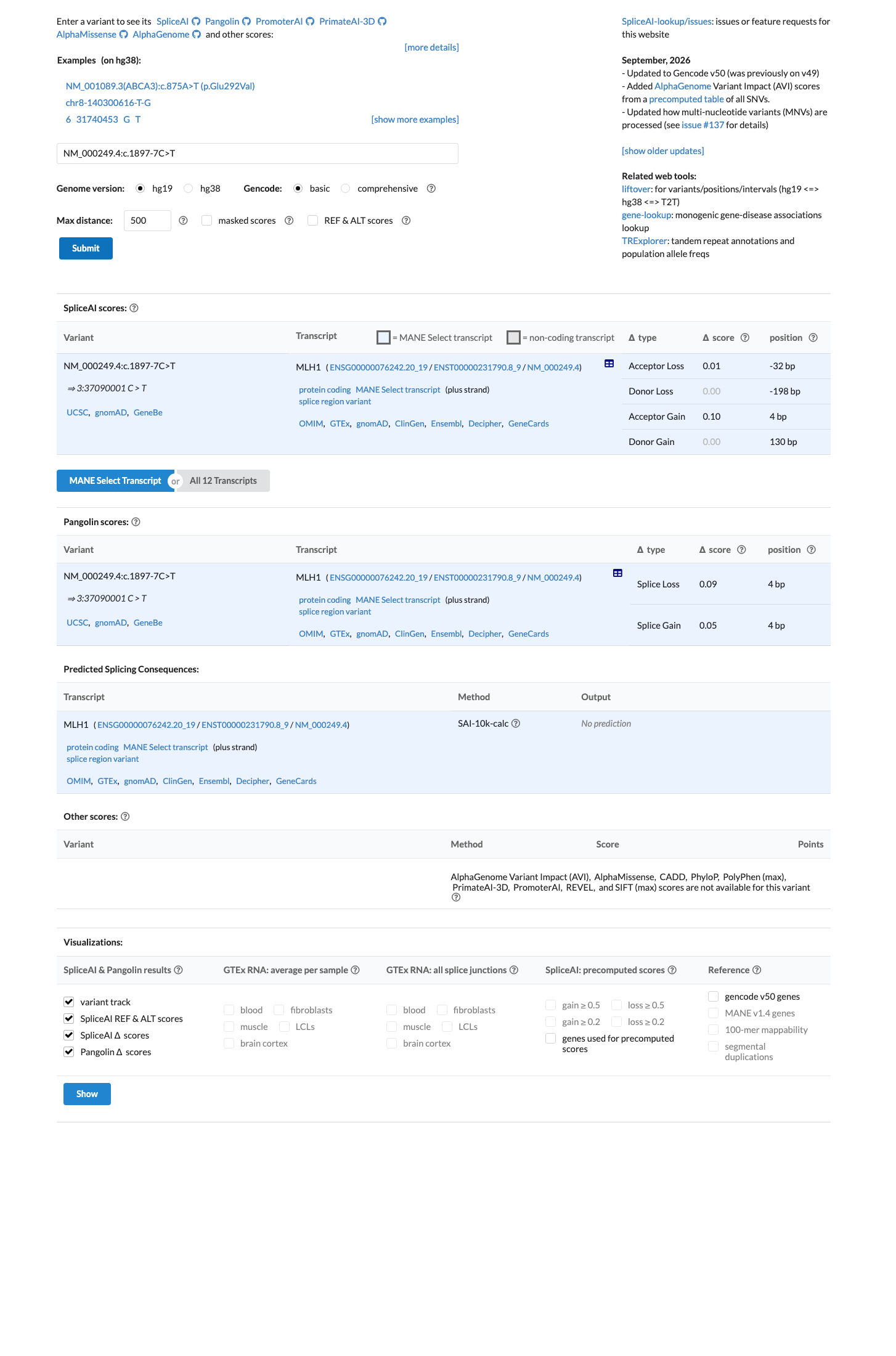
VUS: BP4 supporting is met because SpliceAI's maximum delta score is 0.099, at or below the VCEP no-impact cutoff of 0.1.
BP4→VUS
LYFE Sciences is an AI system, and it can make mistakes. Criteria
may be applied incorrectly, sources may be misread, and a confident-looking
classification can still be wrong. Double-check every criterion and
its underlying evidence before relying on any call.
Gene diagram
· NM_000249.4 · variants mapped to exon structure
MLH1NM_000249.4
Fetching transcript structure from UCSC…
Exons
—
Transcript span
—
Strand
—
Variants mapped
—
Source
UCSC ncbiRefSeqCurated
All variants in MLH1—click a row to locate it on the plot · use the link column to open its page
Protein
Location
Classification
Link
Applied criteria · 1 applied · 14 assessed
MetEvidence satisfies this criterion.
Not metEvaluated against available evidence; threshold not reached.
Not assessedApplies in principle, but no evidence was found to evaluate it.
N/ADoesn't apply to this variant type.
Applied · 1
Strength Supporting Moderate Strong Very strong
✓
BP4supportingBenign
Met at Supporting: SpliceAI maximum delta score 0.099 meets the VCEP BP4 no-impact cutoff of <=0.1 for intronic variants.
NM_000249.4:c.1897-7C>T is an intronic variant, so the VCEP intronic SpliceAI path applies.SpliceAI scores for the exact variant are DS_AG 0.099, DS_AL 0.005, DS_DG 0.001, and DS_DL 0.001; maximum delta score = 0.099, at or below the VCEP BP4 cutoff of 0.1.HCI-PRIORS-MLH1.txt.txt was searched for c.1897-7C>T and p.?; no exact row was found, and the index defines that table for missense substitutions.
Assessed · not applied
· 4 not met · 10 not assessed
Pathogenic
PS1Not assessed: PS1 requires a qualifying pathogenic same-amino-acid or same-nucleotide splice comparator, but none was identified for c.1897-7C>T.
PS2Not assessed: no documented de novo result, parental confirmation, qualifying tumor findings, or VCEP de novo point total is available.
PS3Not assessed: no variant-specific calibrated functional odds, MMR assay readout, or patient RNA expression result is available for c.1897-7C>T.
PM2Not met: gnomAD v4.1 total AF is 2.36104e-05, exceeding the VCEP PM2 cutoff of <0.00002.
PM3Not assessed: no documented second pathogenic MLH1 allele or phase, and gnomAD v4.1 grpmax 0.00002081 exceeds the PM2 threshold of <0.00002.
PP1Not assessed: no pedigree segregation data, informative meioses, family count, or combined Bayes Likelihood Ratio is available.
PP3Not met: SpliceAI maximum delta score 0.099 is below the VCEP PP3 threshold of 0.2 for a predicted non-canonical splice defect.
PP4Not assessed: no patient-specific MSI-H tumor, MLH1-consistent protein loss, or promoter-methylation exclusion is available to satisfy the PP4 supporting rule.
Benign
BA1Not met: gnomAD v4.1 grpmax FAF is 2.081e-05, below the VCEP BA1 threshold of 0.001 (0.1%).
BS1Not met: gnomAD v4.1 grpmax FAF is 2.081e-05, below the VCEP BS1 lower threshold of 0.0001.
BS2Not assessed: no confirmed in-trans co-occurrence, phase, cancer-age, or CMMRD information is available for BS2.
BS3Not assessed: no variant-specific calibrated odds or NMD-inhibited protein/mRNA assay result demonstrates proficient function for c.1897-7C>T.
BS4Not assessed: no non-segregation pedigree data, informative meioses, or combined Bayes Likelihood Ratio is available.
BP5Not assessed: no patient-specific MSS, absent or inconsistent MMR-protein loss, BRAF V600E, or MLH1-methylation tumor evidence is available.
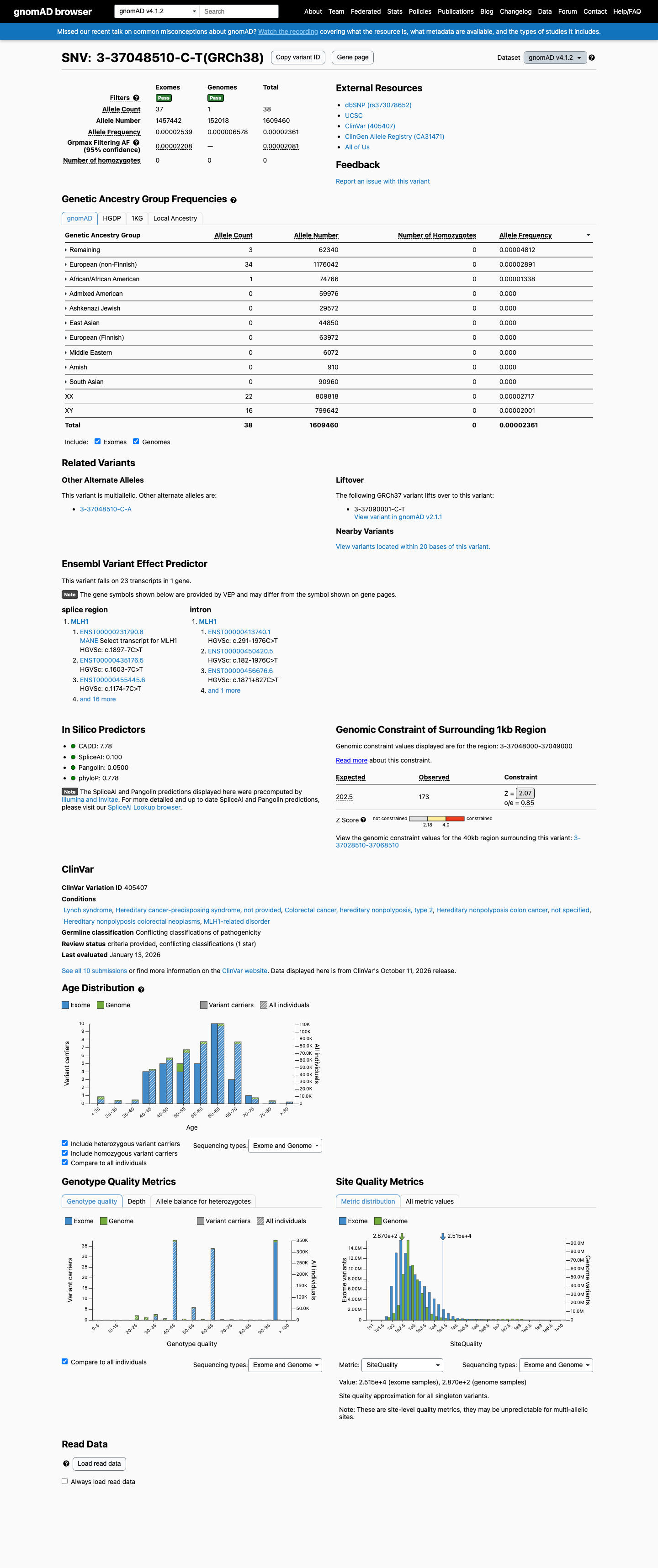
This variant is present in gnomAD v4.1 (AF= 2.36104e-05; MAF= 0.00236%, 38/1609460 alleles, homozygotes = 0) and has highest observed frequency in the Remaining individuals population (AF= 4.81232e-05; MAF= 0.00481%, 3/62340 alleles, homozygotes = 0); grpmax FAF= 2.081e-05.
v2.1
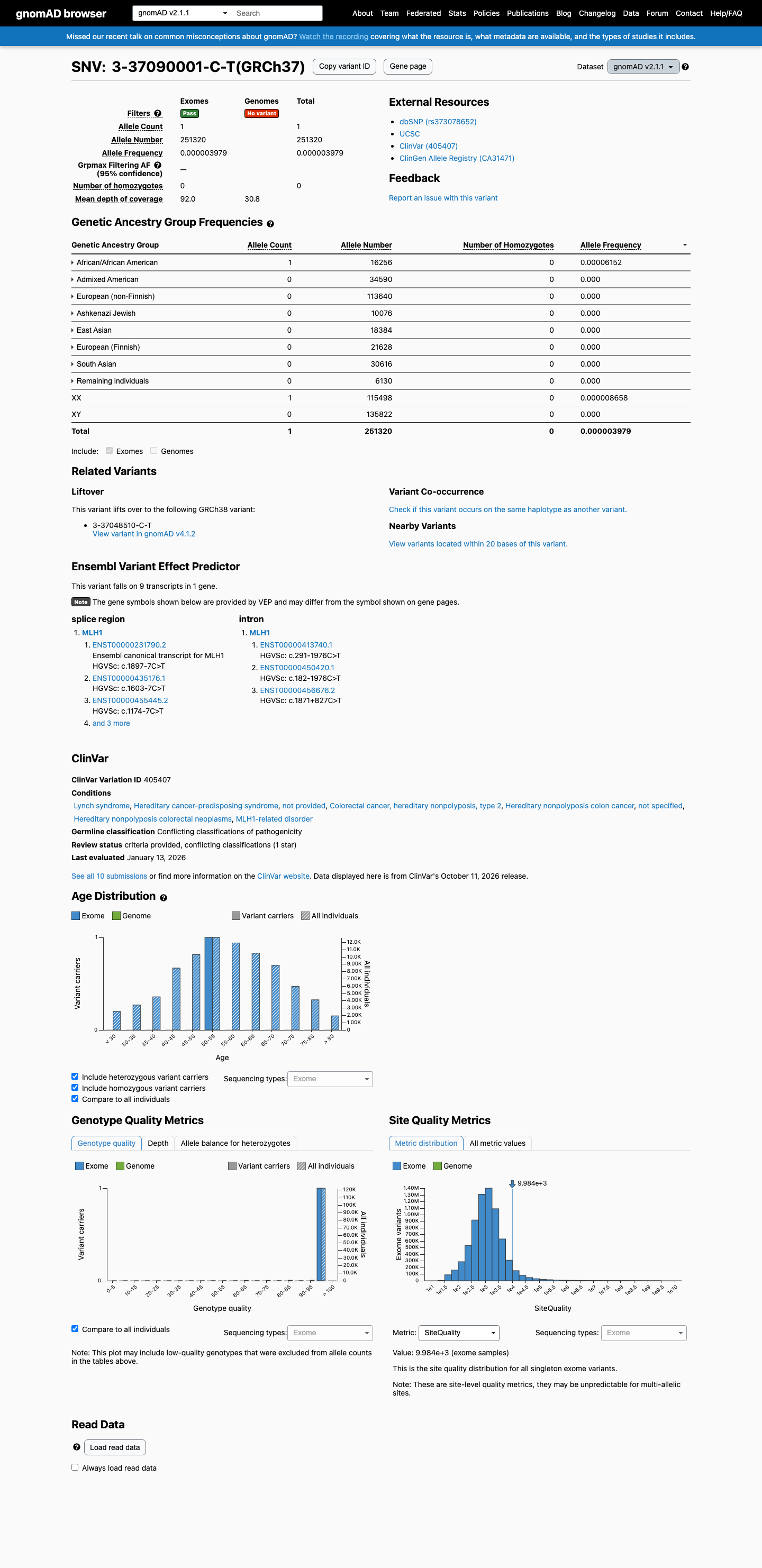
This variant is present in gnomAD v2.1 (AF= 3.97899e-06; MAF= 0.00040%, 1/251320 alleles, homozygotes = 0) and has highest observed frequency in the African/African American population (AF= 6.15157e-05; MAF= 0.00615%, 1/16256 alleles, homozygotes = 0).
🇨🇦 CA
Absent from gnomAD-Canada v1.0.
Allele frequency by ancestry
three datasets · side by side
gnomAD v4.1
0.0024%
· 38 / 1,609,460
0 hom · FAF 0.0021%
Remaining individuals
3 / 62,340
0.0048%
European (non-Finnish)
34 / 1,176,042
0.0029%
African/African American
1 / 74,766
0.0013%
+ 7 not observed (Admixed American, European (Finnish), Amish, East Asian, Middle Eastern, South Asian, Ashkenazi Jewish)
gnomAD v2.1
0.0004%
· 1 / 251,320
0 hom
African/African American
1 / 16,256
0.0062%
+ 7 not observed (Admixed American, Ashkenazi Jewish, East Asian, European (Finnish), European (non-Finnish), Remaining individuals, South Asian)
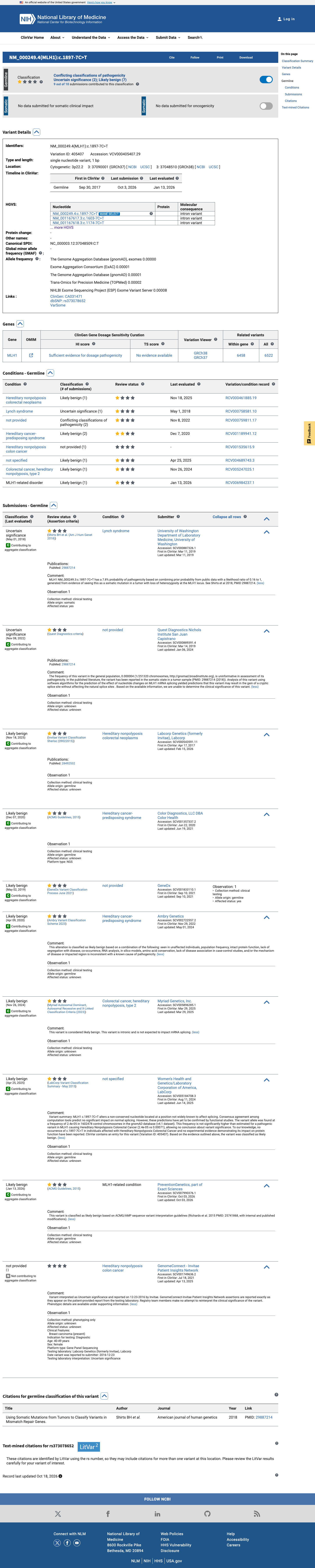
This variant has been reported in ClinVar as Likely benign (7 clinical laboratories) and as Uncertain significance (2 clinical laboratories). (ClinVarID = 405407)
Triaged references · 9 PMIDs not cited in assessment
25741868 ↗Standards and guidelines for the interpretation of sequence variants: a joint consensus recommendation of the American College of Medical Genetics and Genomics and the Association for Molecular Pathology.CLINVAR
26467025 ↗A Standardized DNA Variant Scoring System for Pathogenicity Assessments in Mendelian Disorders.CLINVAR
29887214 ↗Using Somatic Mutations from Tumors to Classify Variants in Mismatch Repair Genes.CLINVAR
22167527 ↗Identification of individuals at risk for Lynch syndrome using targeted evaluations and genetic testing: National Society of Genetic Counselors and the Collaborative Group of the Americas on Inherited Colorectal Cancer joint practice guideline.CLINVAR
23408351 ↗Revised guidelines for the clinical management of Lynch syndrome (HNPCC): recommendations by a group of European experts.CLINVAR
24493721 ↗American Society of Clinical Oncology Expert Statement: collection and use of a cancer family history for oncology providers.CLINVAR
31302137 ↗Lynch Syndrome in Urologic Malignancies - What Does the Urologist Need to Know?CLINVAR
28492532 ↗Sherloc: a comprehensive refinement of the ACMG-AMP variant classification criteria.CLINVAR