This variant was interpreted by pipeline
7.2.0.
The current version is
11.0.02.
Re-running queues a fresh interpretation; the result replaces this page when complete.
Re-runs are not free. Blank = draws on today's public interpretation allowance.
With a code = uses 1 of that code's uses.
ATM encodes a kinase that acts as a master controller of the cellular DNA damage response: it detects double-strand breaks and coordinates DNA repair, cell cycle arrest, or apoptosis through downstream targets including p53, BRCA1, and CHK2. Loss-of-function mutations in both copies of ATM cause ataxia telangiectasia, an autosomal recessive disorder characterized by neurological problems, immune deficiency, and cancer predisposition. ATM functions as a tumor suppressor: individuals with ataxia telangiectasia are prone to childhood lymphomas, leukemias, and breast cancer, while carriers of a single altered copy have increased risk of breast, pancreatic, prostate, and other cancers. Somatic ATM mutations also occur in lymphoid malignancies and solid tumors, and ATM-deficient cancers are often especially sensitive to DNA-damaging treatments.
This variant
ATM is a DNA-damage-response kinase whose loss of function causes ataxia telangiectasia and predisposes carriers to cancer. Because p.Leu480Phe is classified as a VUS, current evidence neither establishes nor excludes an ATM-related disease role, so this variant alone should not guide diagnosis, carrier risk, or treatment decisions.
Transcript
NM_000051.4
HGVS · transcript:coding
NM_000051.4:c.1440A>C
GRCh38
chr11:108250905 A>C
GRCh37
chr11:108121632 A>C
No pathogenic or benign criterion is met, so no ATM VCEP v1.5 criteria-combination rule is satisfied and the variant is a VUS.
Classification rationale
VUS
ATM c.1440A>Cmissense · exon 10
VUS: no pathogenic or benign criterion is met under the ATM VCEP v1.5 framework, so no criteria-combination rule is satisfied.
LYFE Sciences is an AI system, and it can make mistakes. Criteria
may be applied incorrectly, sources may be misread, and a confident-looking
classification can still be wrong. Double-check every criterion and
its underlying evidence before relying on any call.
Gene diagram
· NM_000051.4 · variants mapped to exon structure
ATMNM_000051.4
Fetching transcript structure from UCSC…
Exons
—
Transcript span
—
Strand
—
Variants mapped
—
Source
UCSC ncbiRefSeqCurated
All variants in ATM—click a row to locate it on the plot · use the link column to open its page
Protein
Location
Classification
Link
Applied criteria · 0 applied · 14 assessed
MetEvidence satisfies this criterion.
Not metEvaluated against available evidence; threshold not reached.
Not assessedApplies in principle, but no evidence was found to evaluate it.
N/ADoesn't apply to this variant type.
Applied · 0
No criteria were applied for this variant.
Assessed · not applied
· 8 not met · 6 not assessed
Pathogenic
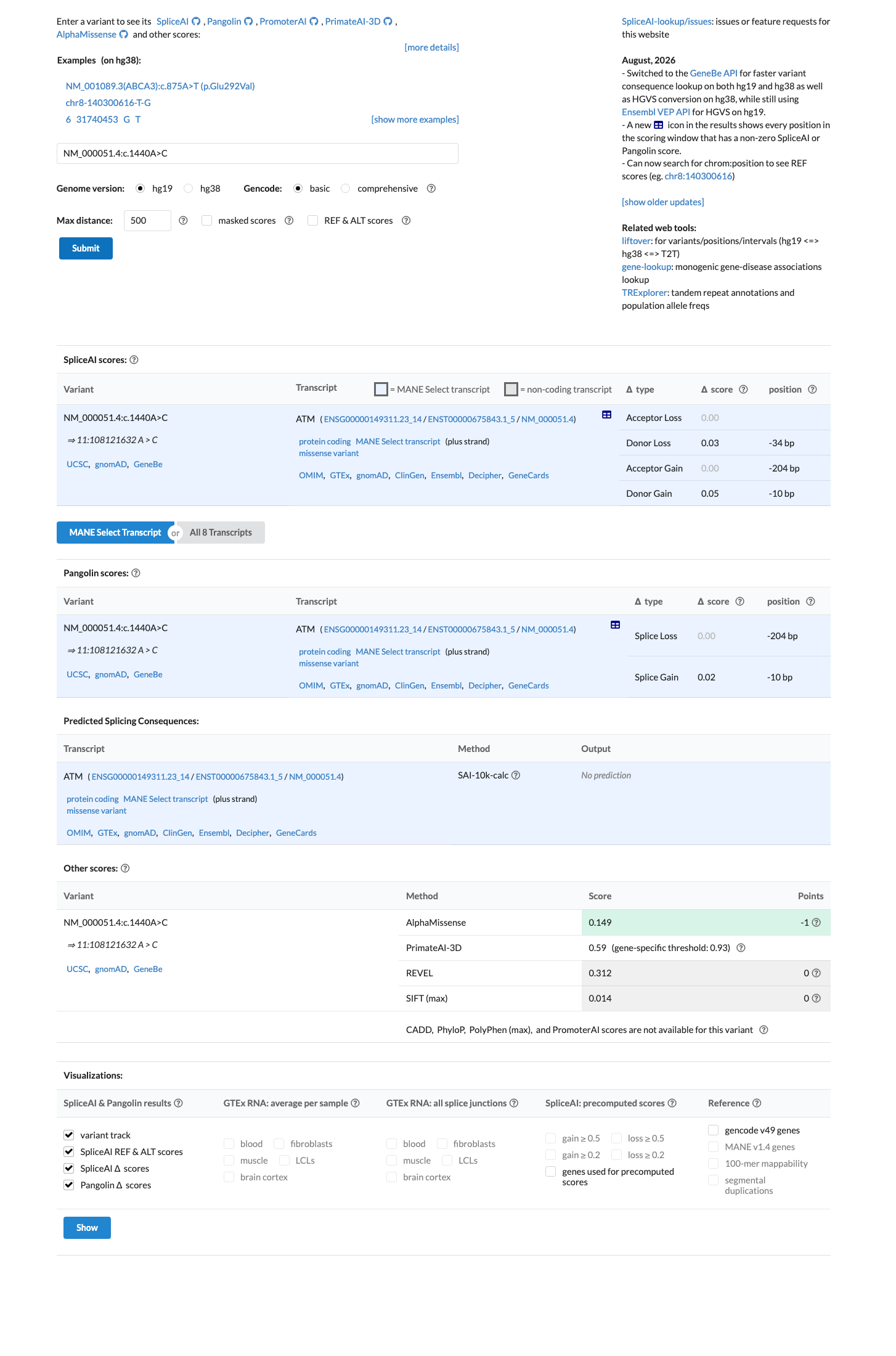
PVS1Not met: p.Leu480Phe is a missense substitution, not a loss-of-function null variant, and SpliceAI predicts no splice impact (max delta 0.053).
PS1Not met: L480F reported in one prostate brachytherapy patient (PMID 19638463) is not established pathogenic, so no qualifying same-amino-acid P/LP comparator exists.
PS3Not assessed: no variant-specific functional assay result for p.Leu480Phe was available; the sole report is a patient observation, not an engineered assay.
PS4Not assessed: no qualifying case-control enrichment was available; p.Leu480Phe appeared in 1/21 high- versus 0/20 low-radiotoxicity patients without a significant association.
PM2Not met: gnomAD v4.1 frequency 0.00589% (grpmax FAF 0.006641%) exceeds the VCEP's <=0.001% PM2 threshold.
PM3Not assessed: no ataxia-telangiectasia affected-proband observation, in-trans pathogenic variant, or phase information for p.Leu480Phe was available.
PM4Not met: p.Leu480Phe is a single amino-acid substitution with no protein-length change, and PM4 is restricted to stop-loss variants.
PP1Not assessed: no family segregation or phase data for p.Leu480Phe was available; the single report documents no segregation with an ATM phenotype.
PP3Not met: REVEL 0.312 and SpliceAI max delta 0.053 are below the PP3 thresholds of >0.7333 and >=0.2.
Benign
BA1Not met: gnomAD v4.1 grpmax FAF 0.006641% is far below the >0.5% BA1 threshold.
BS1Not met: gnomAD v4.1 grpmax FAF 0.006641% is below the >0.05% BS1 threshold.
BS3Not assessed: no variant-specific rescue or ATM phosphorylation result for p.Leu480Phe was available; computational predictions do not substitute for functional data.
BP2Not assessed: no qualifying unaffected carrier with a pathogenic ATM variant in trans, and no phase or homozygosity data, was available.
BP4Not met: REVEL 0.312 exceeds the <=0.249 BP4 threshold, so the clean SpliceAI result (0.053) cannot support BP4 for this missense.
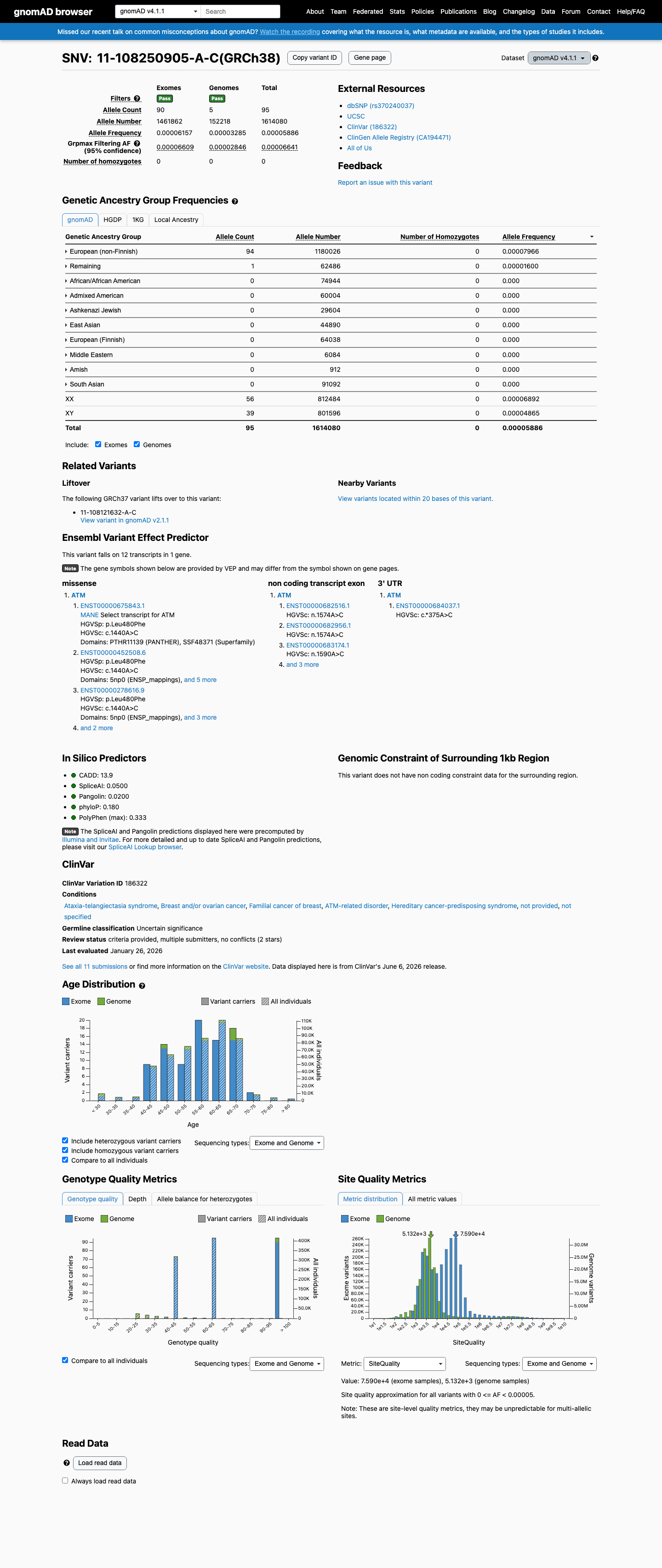
This variant is present in gnomAD v4.1 (AF= 5.88571e-05; MAF= 0.00589%, 95/1614080 alleles, homozygotes = 0) and has highest observed frequency in the European (non-Finnish) population (AF= 7.96593e-05; MAF= 0.00797%, 94/1180026 alleles, homozygotes = 0); grpmax FAF= 6.641e-05.
v2.1
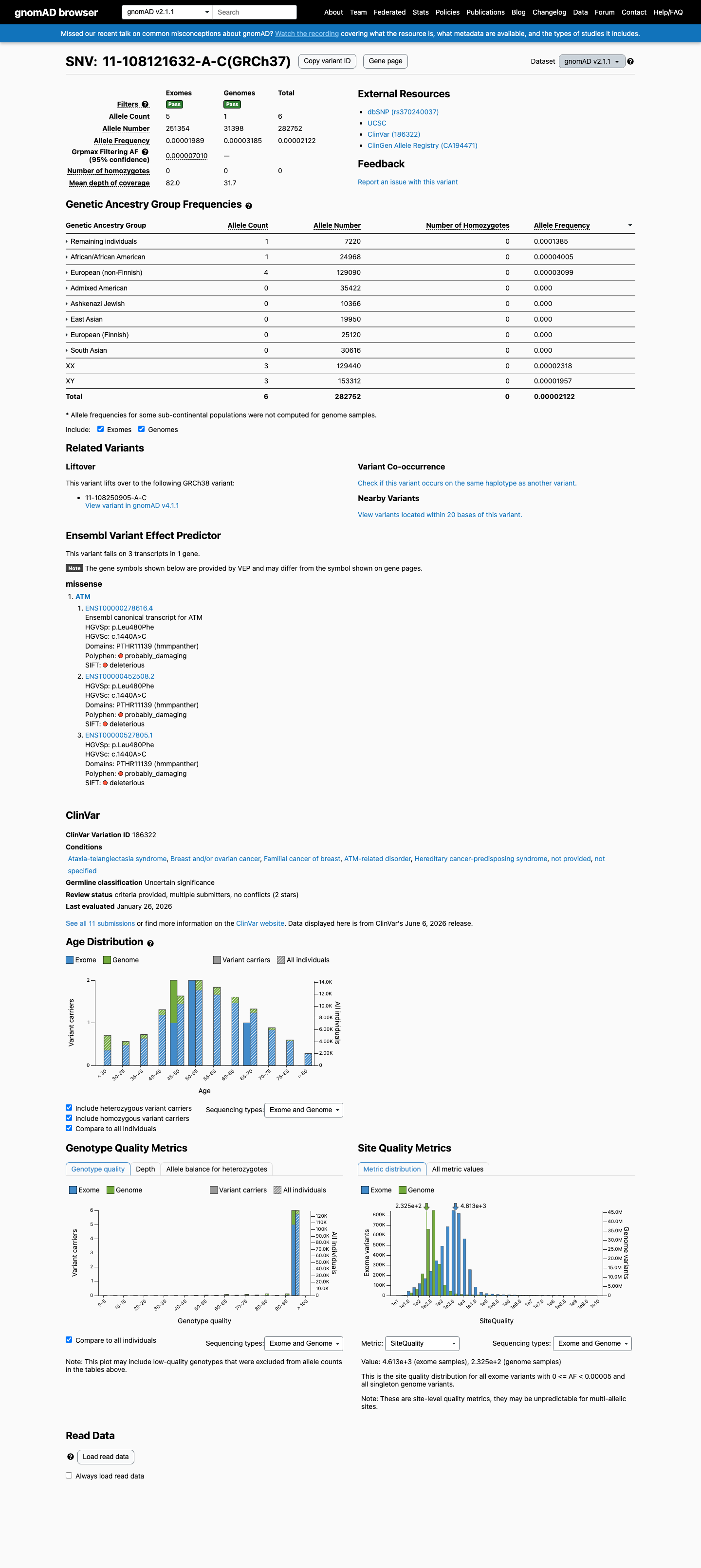
This variant is present in gnomAD v2.1 (AF= 2.122e-05; MAF= 0.00212%, 6/282752 alleles, homozygotes = 0) and has highest observed frequency in the Remaining individuals population (AF= 0.000138504; MAF= 0.01385%, 1/7220 alleles, homozygotes = 0); grpmax FAF= 7.01e-06.
🇨🇦 CA
Absent from gnomAD-Canada v1.0.
Allele frequency by ancestry
three datasets · side by side
gnomAD v4.1
0.0059%
· 95 / 1,614,080
0 hom · FAF 0.0066%
European (non-Finnish)
94 / 1,180,026
0.008%
Remaining individuals
1 / 62,486
0.0016%
+ 8 not observed (Admixed American, European (Finnish), Amish, East Asian, Middle Eastern, South Asian, Ashkenazi Jewish, African/African American)
gnomAD v2.1
0.0021%
· 6 / 282,752
0 hom · FAF 0.0007%
Remaining individuals
1 / 7,220
0.014%
African/African American
1 / 24,968
0.004%
European (non-Finnish)
4 / 129,090
0.0031%
+ 5 not observed (Admixed American, Ashkenazi Jewish, East Asian, European (Finnish), South Asian)
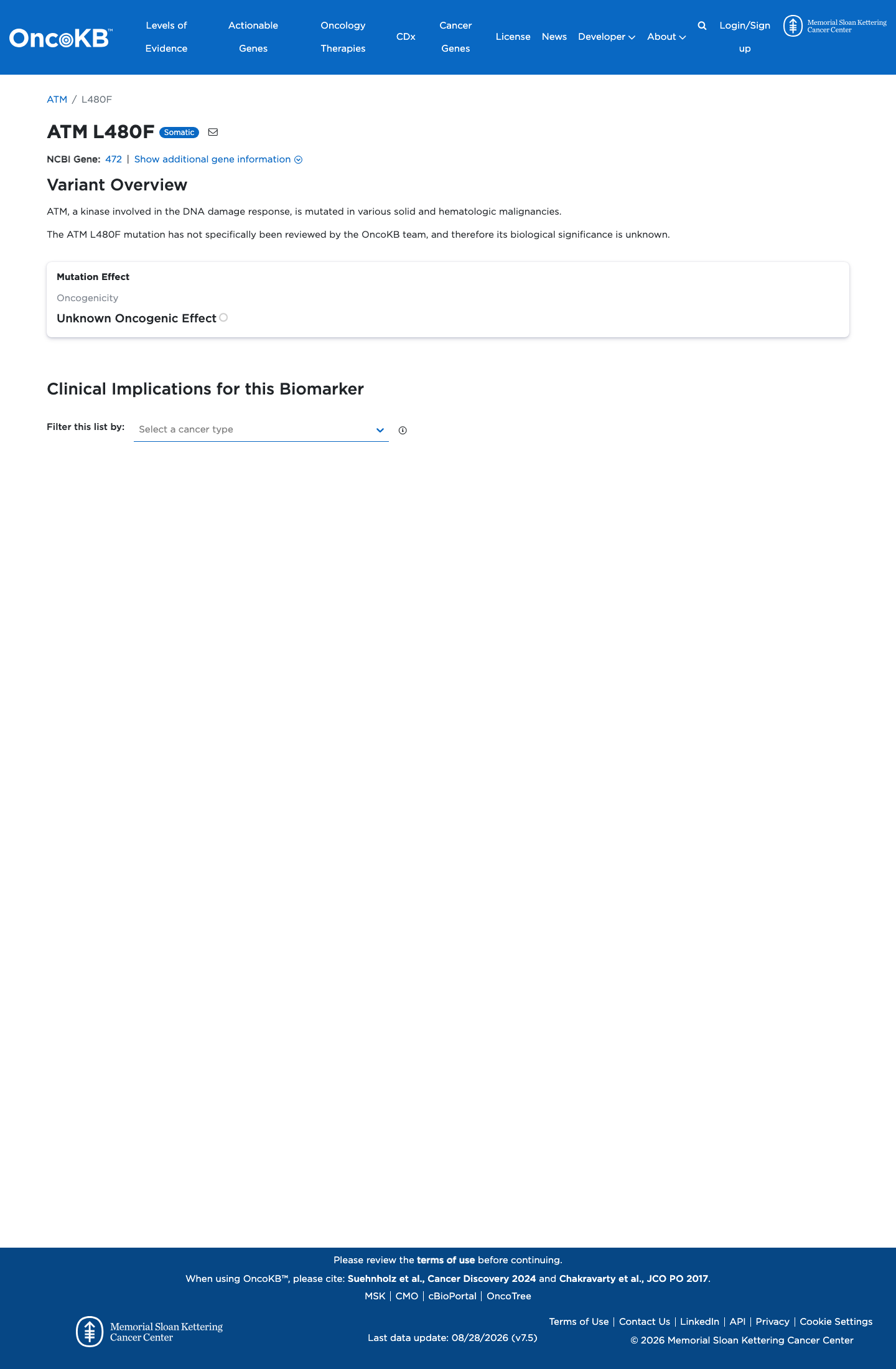
OncoKB did not identify variant-specific reviewed functional evidence for this variant; gene-level curated context is available for reviewer follow-up. ATM, a kinase involved in the DNA damage response, is mutated in various solid and hematologic malignancies.
Triaged references · 9 PMIDs not cited in assessment
24448499 ↗Integrated analysis of germline and somatic variants in ovarian cancer.CLINVAR
25741868 ↗Standards and guidelines for the interpretation of sequence variants: a joint consensus recommendation of the American College of Medical Genetics and Genomics and the Association for Molecular Pathology.CLINVAR
26689913 ↗Patterns and functional implications of rare germline variants across 12 cancer types.CLINVAR
28779002 ↗Rare, protein-truncating variants in ATM, CHEK2 and PALB2, but not XRCC2, are associated with increased breast cancer risks.CLINVAR
32832836 ↗Pathogenic Variants in Cancer Predisposition Genes and Prostate Cancer Risk in Men of African Ancestry.CLINVAR
36029002 ↗Rare germline ATM variants of uncertain significance in chronic lymphocytic leukaemia and other cancers.CLINVAR
18163131 ↗The emerging landscape of breast cancer susceptibility.CLINVAR
19638463 ↗Sequence variant discovery in DNA repair genes from radiosensitive and radiotolerant prostate brachytherapy patients.CLINVAR
20050888 ↗EFNS guidelines on the molecular diagnosis of ataxias and spastic paraplegias.CLINVAR