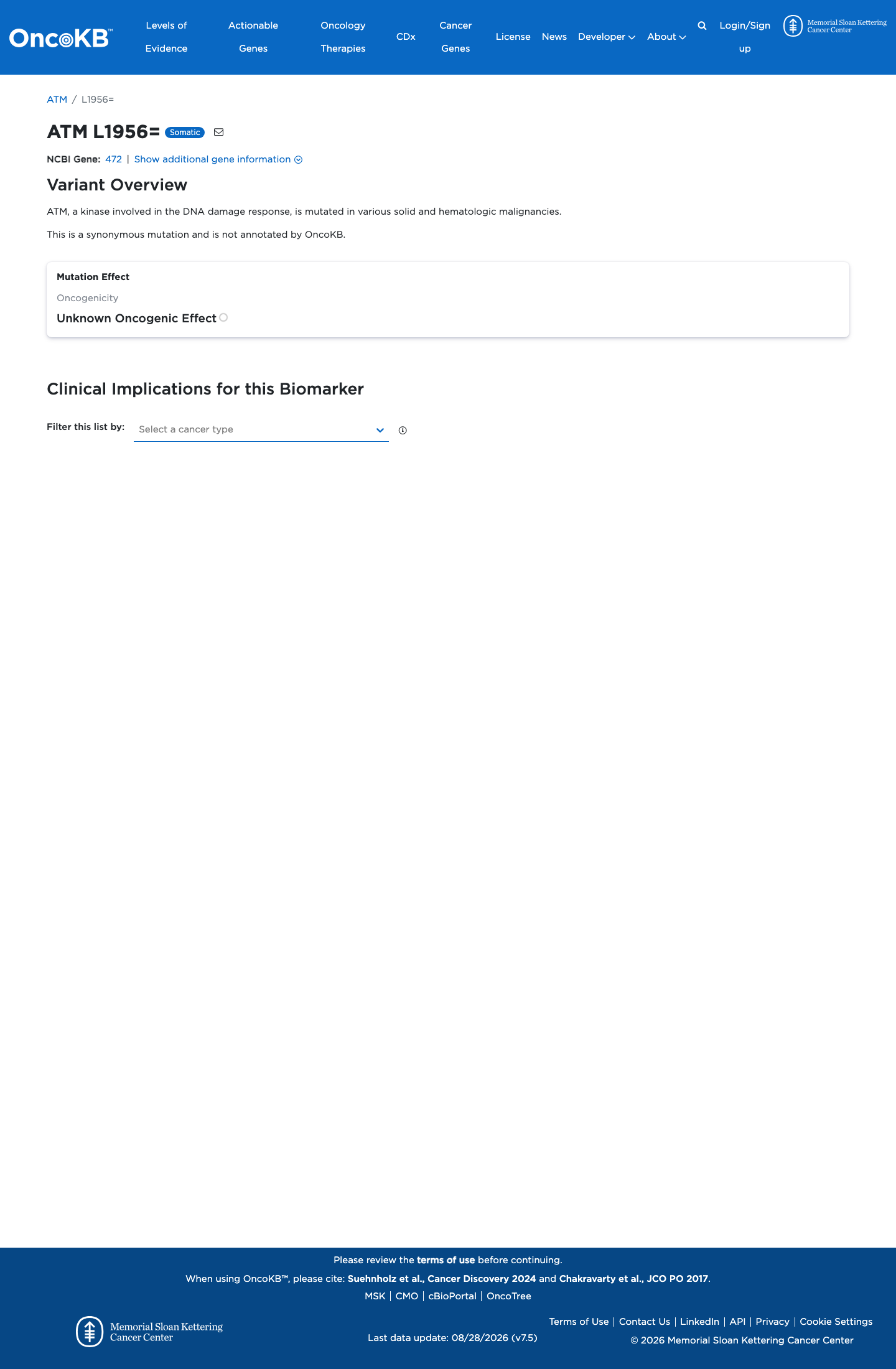
ATM encodes a kinase that acts as a master controller of the cellular DNA damage response: it detects double-strand breaks and coordinates DNA repair, cell cycle arrest, or apoptosis through downstream targets including p53, BRCA1, and CHK2. Loss-of-function mutations in both copies of ATM cause ataxia telangiectasia, an autosomal recessive disorder characterized by neurological problems, immune deficiency, and cancer predisposition. ATM functions as a tumor suppressor: individuals with ataxia telangiectasia are prone to childhood lymphomas, leukemias, and breast cancer, while carriers of a single altered copy have increased risk of breast, pancreatic, prostate, and other cancers. Somatic ATM mutations also occur in lymphoid malignancies and solid tumors, and ATM-deficient cancers are often especially sensitive to DNA-damaging treatments.
This variant
ATM c.5868C>T is a synonymous change (p.Leu1956=) with no predicted splice effect, so it would not be expected to impair the ATM DNA-damage-response kinase that, when lost from both copies, causes ataxia-telangiectasia and, when lost from one copy, raises breast, pancreatic and prostate cancer risk.
Transcript
NM_000051.4
HGVS · transcript:coding
NM_000051.4:c.5868C>T
GRCh38
chr11:108310265 C>T
GRCh37
chr11:108180992 C>T
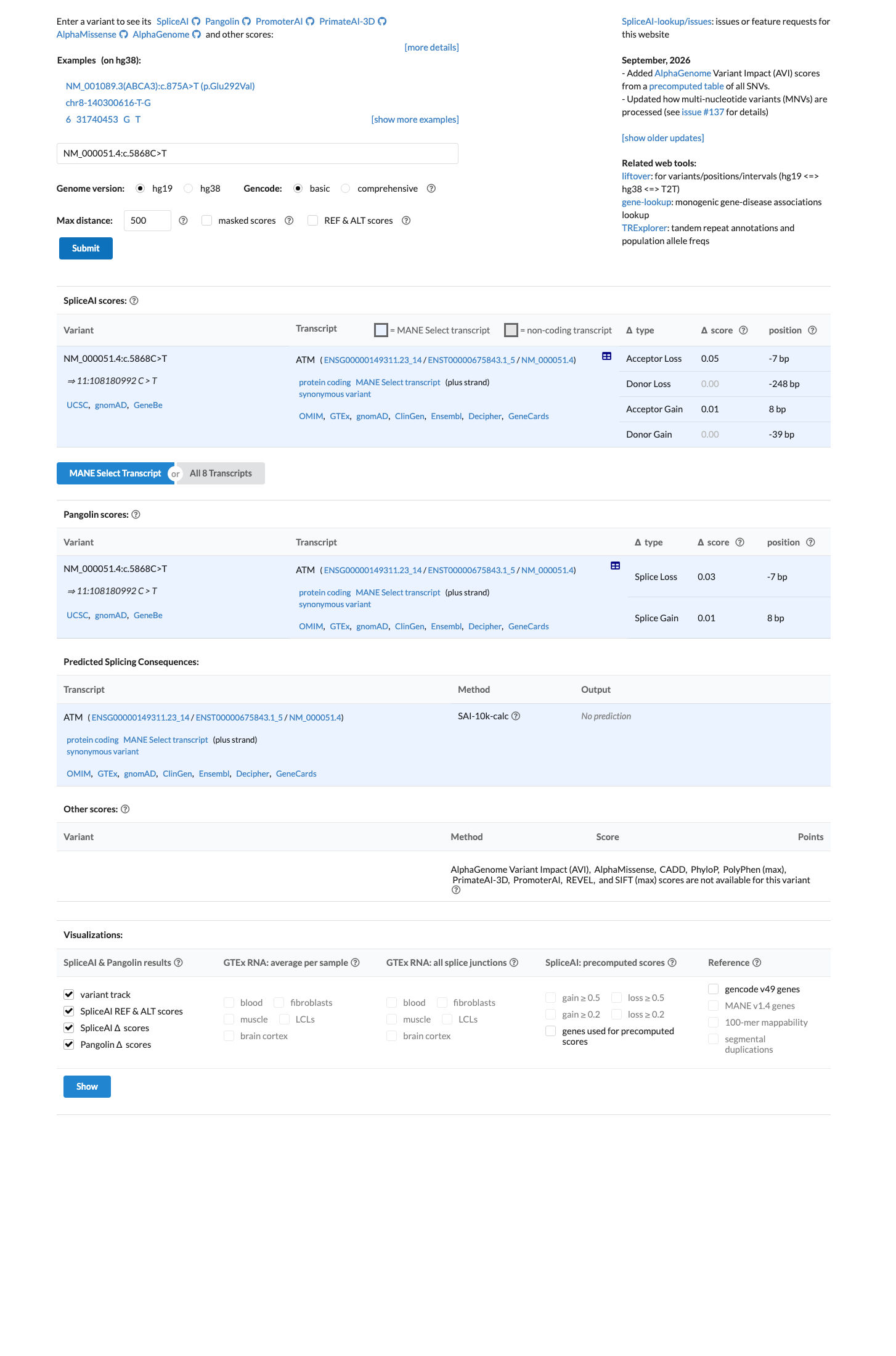
Likely Benign: BP4 (supporting, SpliceAI 0.053) plus BP7 (supporting, synonymous outside the splice region) meet the ATM Expert Panel's Rule19 for two benign supporting criteria.
Classification rationale
BP4BP7Likely Benign
ATM c.5868C>Tsynonymous · exon 39
Likely Benign: BP4 supporting - SpliceAI maximum delta score 0.053 is at or below the ATM VCEP's <=0.1 no-predicted-splice-impact cutoff for a synonymous variant. Likely Benign: BP7 supporting - synonymous p.(Leu1956=) sits 55-110 nt from the nearest splice site, outside the +7/-21 window, with no predicted splice impact.
BP4 + BP7→Likely Benign
LYFE Sciences is an AI system, and it can make mistakes. Criteria
may be applied incorrectly, sources may be misread, and a confident-looking
classification can still be wrong. Double-check every criterion and
its underlying evidence before relying on any call.
Gene diagram
· NM_000051.4 · variants mapped to exon structure
ATMNM_000051.4
Fetching transcript structure from UCSC…
Exons
—
Transcript span
—
Strand
—
Variants mapped
—
Source
UCSC ncbiRefSeqCurated
All variants in ATM—click a row to locate it on the plot · use the link column to open its page
Protein
Location
Classification
Link
Applied criteria · 2 applied · 14 assessed
MetEvidence satisfies this criterion.
Not metEvaluated against available evidence; threshold not reached.
Not assessedApplies in principle, but no evidence was found to evaluate it.
N/ADoesn't apply to this variant type.
Applied · 2
Strength Supporting Moderate Strong Very strong
✓
BP4supportingBenign
Met at supporting: SpliceAI maximum delta 0.053 is at or below the ATM VCEP BP4 no-impact threshold of <=0.1.
Variant consequence settled before scoring: NM_000051.4:c.5868C>T is synonymous (NP_000042.3:p.(Leu1956=)), a non-missense change for which splicing is the primary plausible mechanism, so BP4 was evaluated only through the SpliceAI path and no missense predictor was used; prefetch confirms REVEL found=false.ClinGen HBOP ATM VCEP v1.6 BP4 supporting rule: 'Missense: REVEL score <=.249; Splicing: No predicted impact via splicing (SpliceAI <=0.1).' The VCEP instructions state SpliceAI is its sole splice predictor and that PP3 applies at SpliceAI >=0.2 while BP4 applies at SpliceAI <=0.1 (Walker et al. 2023; Jaganathan et al. 2019, Cell, PMID:30661751).Lab curator note in the ATM VCEP materials (BP4 missense/splicing policy): for BP4 evaluate exactly one applicable mechanism per variant; missense variants use only the REVEL sub-path, while non-missense variants for which splicing is the primary plausible mechanism (synonymous, intronic outside the canonical +/-1,2 donor/acceptor positions) use the splicing sub-path as the VCEP specifies. This variant is synonymous, so the splicing sub-path is the correct choice and the override does not change the outcome.
Met at supporting: synonymous p.Leu1956= variant, 55-110 nt from the nearest splice site, with SpliceAI maximum delta 0.053 showing no splice impact.
NM_000051.4:c.5868C>T normalises to NP_000042.3:p.(Leu1956=) (p.L1956=) - a synonymous, non-protein-changing change - which brings it inside BP7's scope.ClinGen HBOP ATM VCEP v1.6 BP7 supporting rule: 'Use for synonymous and deep intronic variants defined as further than (but not including) +7 and further than (but not including) -21 at donor and acceptor sites, respectively', with the VCEP's own instructions adding that BP7 'is not considered a conflicting piece of evidence against a body of evidence supporting a pathogenic splice defect' and that BP4 may be applied alongside it.Exon 39 in the governing ATM table (Suppl_TableS1_PMID 40580951.xlsx) spans hg38 chr11:108310155-108310320 (166 positions, 498 SNV rows, three per position, confirming the table is complete across the exon); the variant at hg38 chr11:108310265 is therefore exon position 111, i.e. 110 nt from the acceptor boundary and 55 nt from the donor boundary, well outside the +7/-21 splice region.
Assessed · not applied
· 13 not met · 1 not assessed
Pathogenic
PS1Not met: c.5868C>T is synonymous with SpliceAI max delta 0.053, below the 0.2 threshold needed to enter the PS1 splicing table, and no pathogenic variant exists at residue 1956.
PS3Not met: the only Table S1 entry for c.5868C>T is DeepATM_predicted=Yes, a computational extrapolation, so no functional assay supports PS3.
PS4Not met: no case-control study exists for c.5868C>T, so the VCEP-required p ≤ 0.05 with odds ratio or relative risk ≥ 2 cannot be shown.
PM2Not met: highest gnomAD subpopulation frequency 0.0294% (South Asian) is ~29-fold above the ATM VCEP's <=0.001% PM2 threshold.
PM3Not met: zero PM3 points from unrelated A-T probands (VCEP threshold 1 point), and gnomAD grpmax filtering AF 0.0118% exceeds the VCEP's 0.01% PM3 frequency ceiling.
PM5Not met: PM5 applies only to NMD-prone truncating variants receiving PVS1 at Very Strong, and c.5868C>T is a synonymous change with no premature stop codon.
PP1Not assessed: no affected-relative genotypes or pedigree data exist, so PP1's autosomal-recessive threshold of >=1 affected relative cannot be tested.
PP3Not met: SpliceAI maximum delta 0.053 is below the ATM VCEP PP3 supporting threshold of >=0.2.
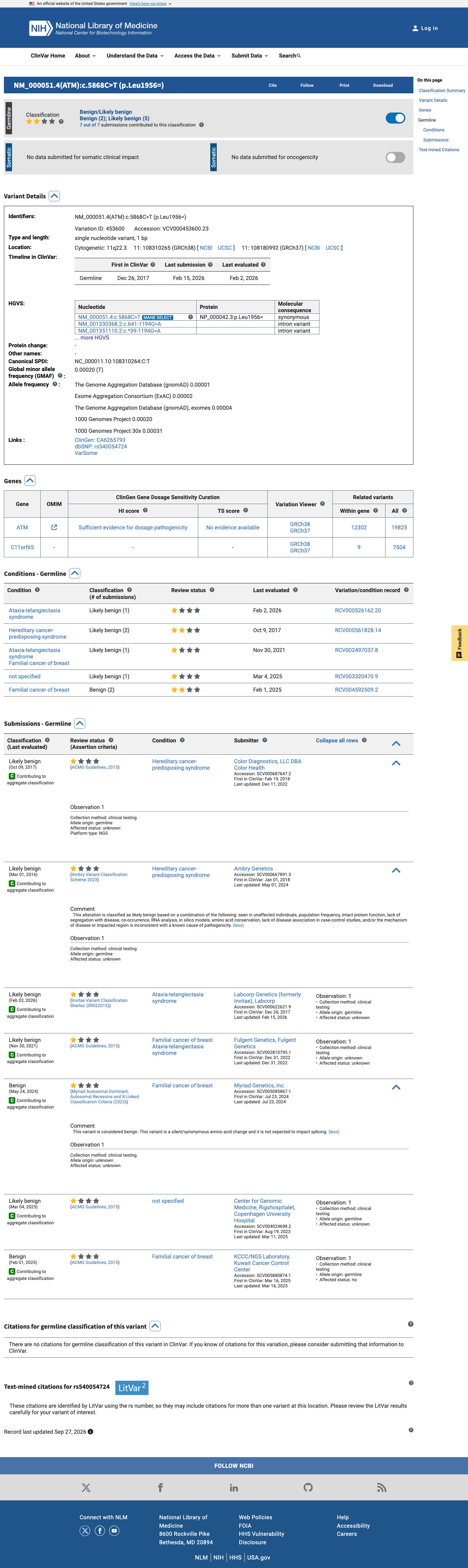
PP5Not met: ClinVar VCV000453600 has zero expert-panel submissions, all seven entries being single-submitter laboratory assertions, so PP5 cannot trigger.
Benign
BA1Not met: highest gnomAD Grpmax Filtering AF 0.0153% versus the ATM VCEP's >0.5% BA1 threshold.
BS1Not met: highest gnomAD Grpmax Filtering AF 0.0153% versus the ATM VCEP's >0.05% BS1 threshold.
BS3Not met: the sole Table S1 entry for c.5868C>T is a computational prediction (DeepATM_predicted=Yes), not a measured rescue of ATM function.
BP2Not met: zero BP2 points — no unaffected adult carrier in trans with a pathogenic ATM variant, and gnomAD reports 0 homozygotes (threshold -1 point).
BP6Not met: no expert-panel ClinVar classification exists for c.5868C>T; the aggregate two-star Benign/Likely benign label from seven laboratories does not qualify.
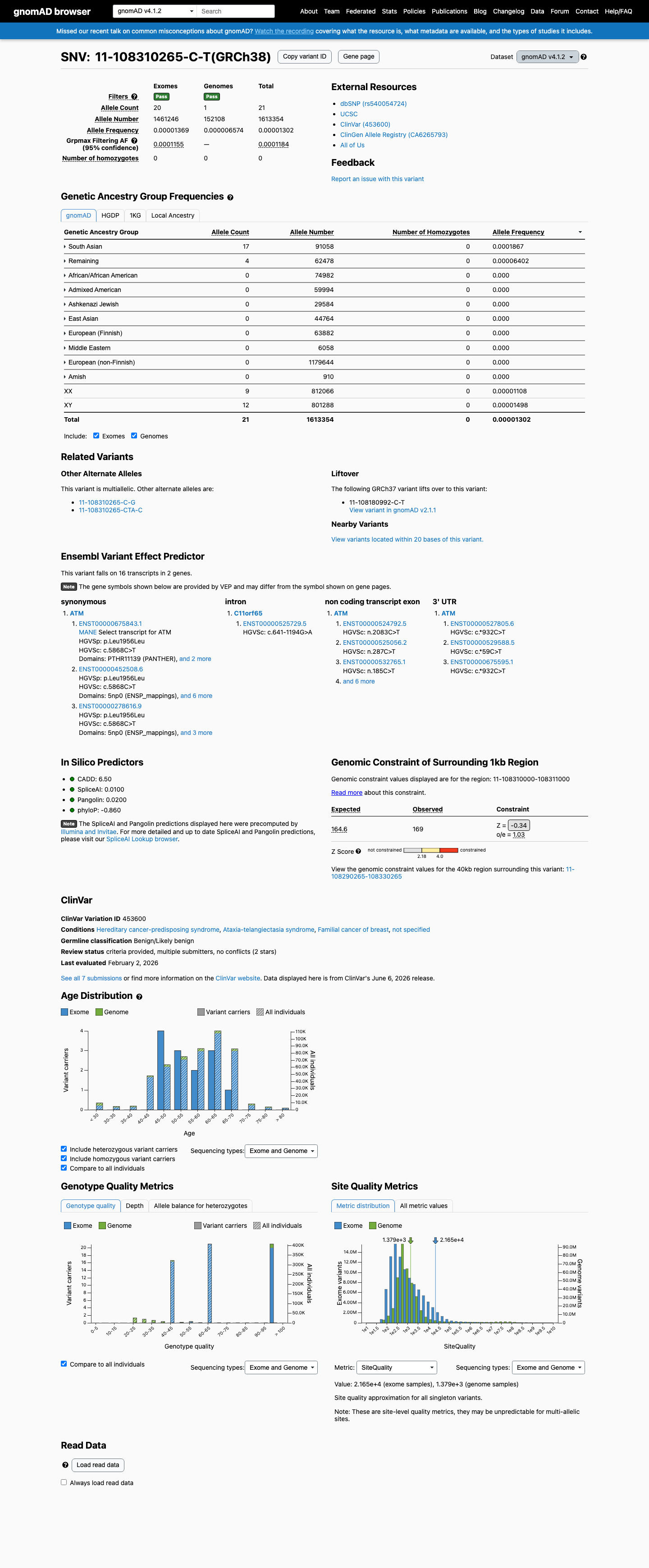
This variant is present in gnomAD v4.1 (AF= 1.30164e-05; MAF= 0.00130%, 21/1613354 alleles, homozygotes = 0) and has highest observed frequency in the South Asian population (AF= 0.000186694; MAF= 0.01867%, 17/91058 alleles, homozygotes = 0); grpmax FAF= 0.00011841.
v2.1
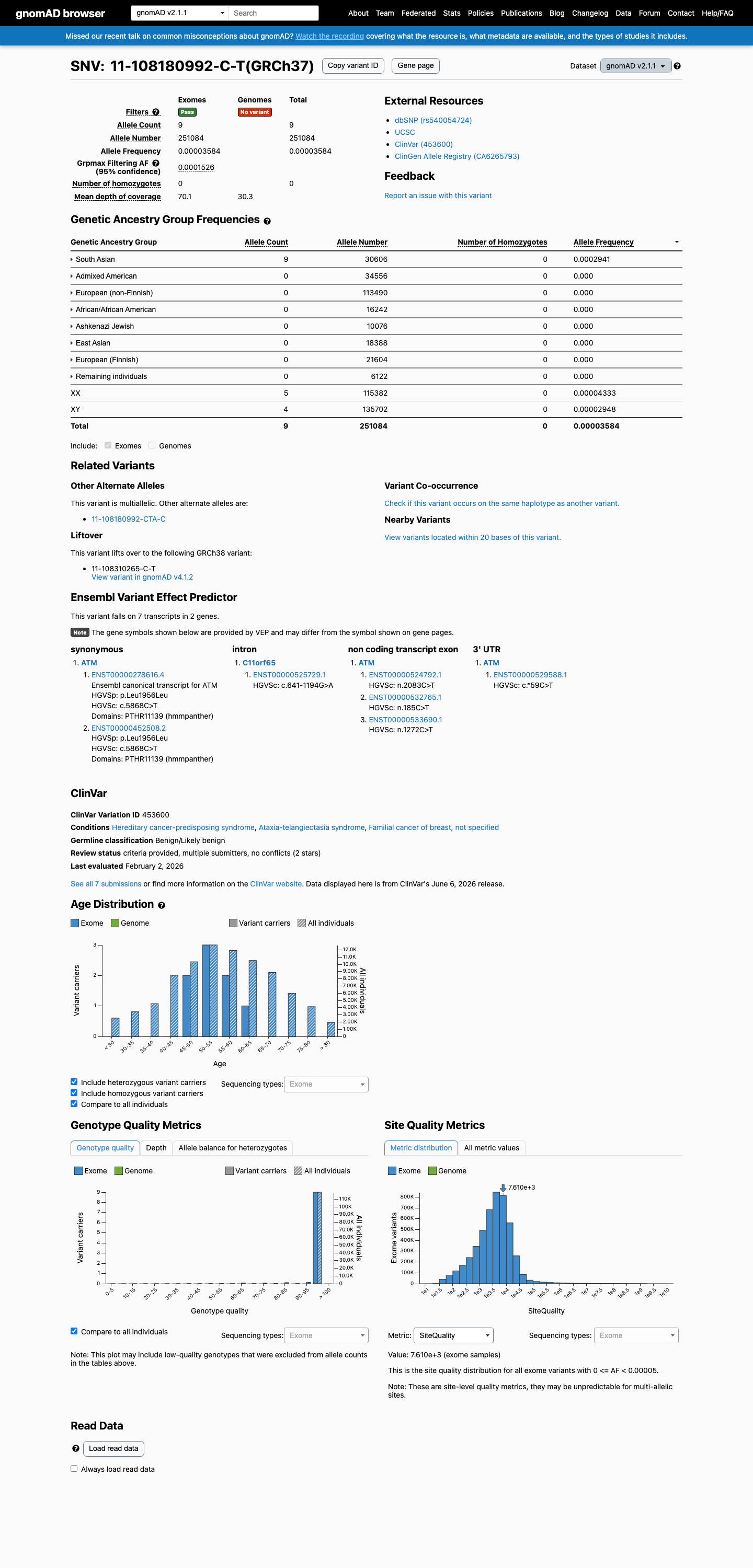
This variant is present in gnomAD v2.1 (AF= 3.58446e-05; MAF= 0.00358%, 9/251084 alleles, homozygotes = 0) and has highest observed frequency in the South Asian population (AF= 0.00029406; MAF= 0.02941%, 9/30606 alleles, homozygotes = 0); grpmax FAF= 0.0001526.
🇨🇦 CA
Absent from gnomAD-Canada v1.0.
Allele frequency by ancestry
three datasets · side by side
gnomAD v4.1
0.0013%
· 21 / 1,613,354
0 hom · FAF 0.012%
South Asian
17 / 91,058
0.019%
Remaining individuals
4 / 62,478
0.0064%
+ 8 not observed (Admixed American, European (Finnish), Amish, East Asian, Middle Eastern, Ashkenazi Jewish, African/African American, European (non-Finnish))
gnomAD v2.1
0.0036%
· 9 / 251,084
0 hom · FAF 0.015%
South Asian
9 / 30,606
0.029%
+ 7 not observed (African/African American, Admixed American, Ashkenazi Jewish, East Asian, European (Finnish), European (non-Finnish), Remaining individuals)
Each card is an audit: what was searched, what was found, whether it names the variant, which criteria it fed, and why. 7 further PMIDs triaged but not cited — see Sources & references.
Structured finding pending for this record — see source link.
Applied to
→BP4
supporting
Searched for a pre-assigned BP4 code; none is assigned, and the row's DeepATM model call (Computational prediction, not a direct assay) is weak non-independent corroboration of the benign direction only.
→BP7
supporting
Confirms the variant is a synonymous L1956L change in exon 39, which is what brings it into BP7 scope, and supplies the hg38 exon 39 coordinates used for the splice-region position check; assigns no BP7 code.
Sources & reference links
9Sources
CSpec VCEP
ClinVar
gnomAD v2.1
gnomAD v4.1
gnomAD-Canada
SpliceAI
OncoKB
COSMIC
Cancer hotspots
Triaged references · 7 PMIDs not cited in assessment
25741868 ↗Standards and guidelines for the interpretation of sequence variants: a joint consensus recommendation of the American College of Medical Genetics and Genomics and the Association for Molecular Pathology.CLINVAR
24366376 ↗Risk assessment, genetic counseling, and genetic testing for BRCA-related cancer in women: U.S. Preventive Services Task Force recommendation statement.CLINVAR
24366402 ↗Summaries for patients. Assessing the genetic risk for BRCA-related breast or ovarian cancer in women: recommendations from the U.S. Preventive Services Task Force.CLINVAR
25394175 ↗A practice guideline from the American College of Medical Genetics and Genomics and the National Society of Genetic Counselors: referral indications for cancer predisposition assessment.CLINVAR
26389258 ↗Cancer Genetics Risk Assessment and Counseling (PDQ®): Health Professional Version.CLINVAR
31429903 ↗Risk Assessment, Genetic Counseling, and Genetic Testing for BRCA-Related Cancer: US Preventive Services Task Force Recommendation Statement.CLINVAR
28492532 ↗Sherloc: a comprehensive refinement of the ACMG-AMP variant classification criteria.CLINVAR