ATM encodes a kinase that acts as a master controller of the cellular DNA damage response: it detects double-strand breaks and coordinates DNA repair, cell cycle arrest, or apoptosis through downstream targets including p53, BRCA1, and CHK2. Loss-of-function mutations in both copies of ATM cause ataxia telangiectasia, an autosomal recessive disorder characterized by neurological problems, immune deficiency, and cancer predisposition. ATM functions as a tumor suppressor: individuals with ataxia telangiectasia are prone to childhood lymphomas, leukemias, and breast cancer, while carriers of a single altered copy have increased risk of breast, pancreatic, prostate, and other cancers. Somatic ATM mutations also occur in lymphoid malignancies and solid tumors, and ATM-deficient cancers are often especially sensitive to DNA-damaging treatments.
This variant
ATM is a master DNA damage-response kinase whose biallelic loss of function causes ataxia telangiectasia and whose monoallelic loss-of-function alleles increase breast, pancreatic and prostate cancer risk, so a rare ATM missense change such as p.Asn2106Ile is assessed for both the recessive ataxia-telangiectasia mechanism and the dominant cancer-predisposition mechanism, with the variant's rarity in gnomAD currently its only supporting evidence.
Transcript
NM_000051.4
HGVS · transcript:coding
NM_000051.4:c.6317A>T
GRCh38
chr11:108317491 A>T
GRCh37
chr11:108188218 A>T
VUS: only PM2 (supporting) is met, and no criteria-combination rule in the ATM VCEP v1.6 framework is satisfied by that single supporting criterion.
Classification rationale
PM2VUS
ATM c.6317A>Tmissense · exon 43
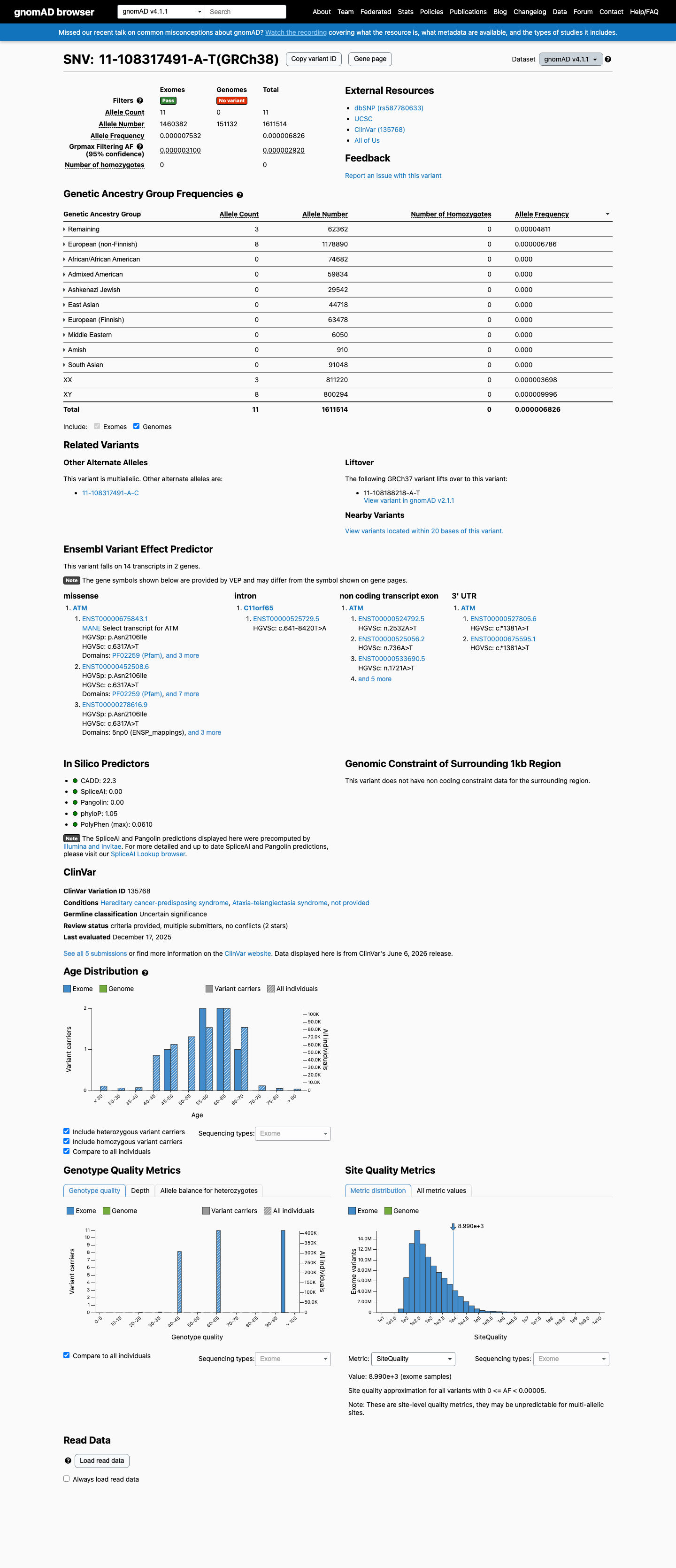
PM2 (supporting) met: the variant is below the ATM VCEP's 0.001% frequency ceiling in every gnomAD population (group-max filtering AF 0.000292%), with no homozygotes observed. No pathogenic combination reached: PM2 supporting alone falls short of the weakest ATM VCEP pathogenic rule, which requires one moderate plus four supporting criteria. No benign combination reached: no benign criterion is met at any strength, so the benign and conflicting-evidence rules cannot fire.
PM2→VUS
LYFE Sciences is an AI system, and it can make mistakes. Criteria
may be applied incorrectly, sources may be misread, and a confident-looking
classification can still be wrong. Double-check every criterion and
its underlying evidence before relying on any call.
Gene diagram
· NM_000051.4 · variants mapped to exon structure
ATMNM_000051.4
Fetching transcript structure from UCSC…
Exons
—
Transcript span
—
Strand
—
Variants mapped
—
Source
UCSC ncbiRefSeqCurated
All variants in ATM—click a row to locate it on the plot · use the link column to open its page
Protein
Location
Classification
Link
Applied criteria · 1 applied · 13 assessed
MetEvidence satisfies this criterion.
Not metEvaluated against available evidence; threshold not reached.
Not assessedApplies in principle, but no evidence was found to evaluate it.
N/ADoesn't apply to this variant type.
Applied · 1
Strength Supporting Moderate Strong Very strong
✓
PM2supportingreviewPathogenic
Met at supporting: gnomAD v4.1 group-max filtering AF 0.000292% in European (non-Finnish) is below the VCEP 0.001% threshold, with zero homozygotes.
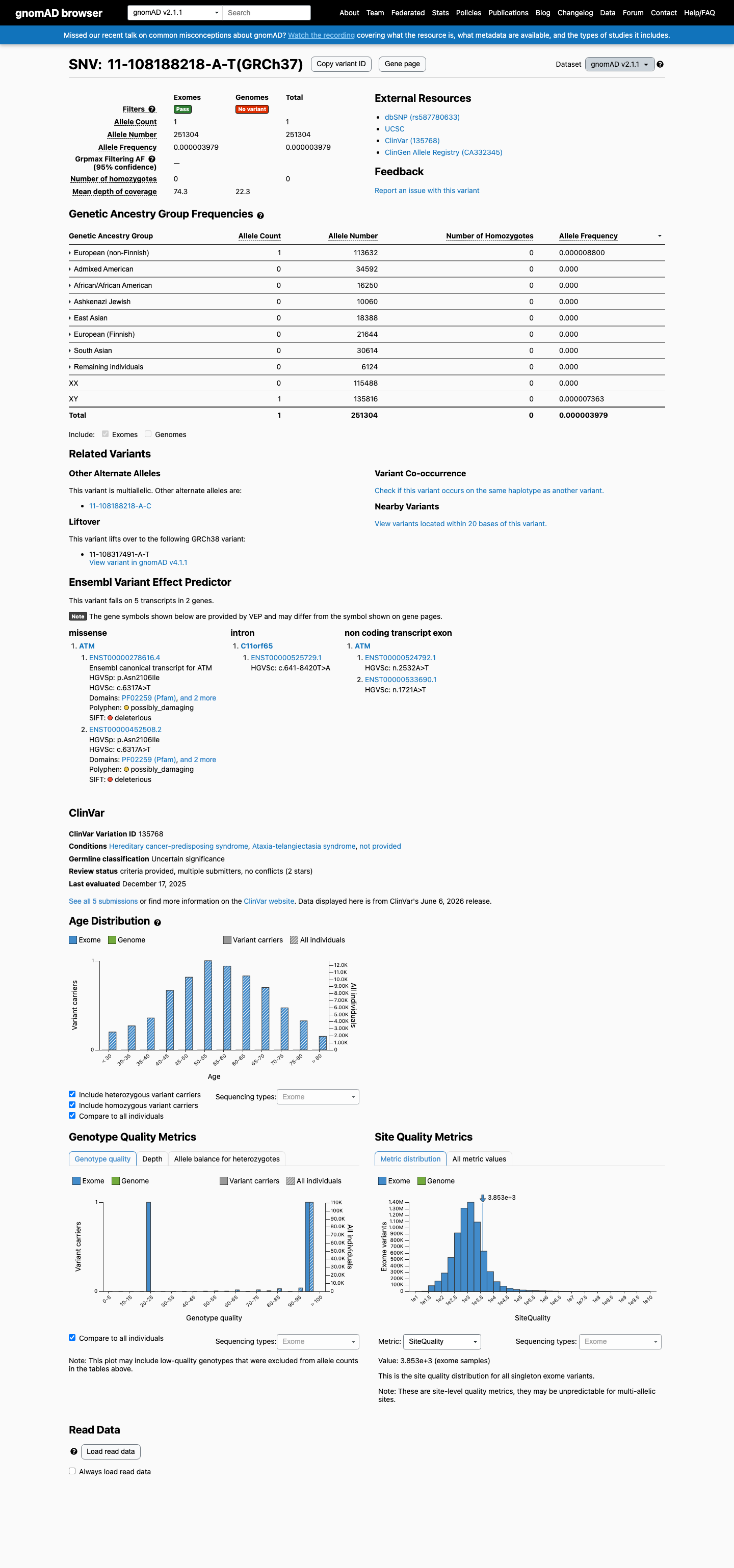
ATM VCEP v1.6 PM2 rule: frequency <=0.001% in the gnomAD subpopulation with the highest frequency, applied as PM2_Supporting (not moderate), with the exception that >0.001% attributable to n=1 in a single subpopulation not present elsewhere is still sufficiently rare for PM2_Supporting.gnomAD v4.1: total AF 6.82588e-06 (11/1,611,514 alleles), 0 homozygotes; exome AC 11/AN 1,460,382; genome AC 0; group-max filtering AF 2.92e-06 (joint) and 3.1e-06 (exome), maximum carried by European (non-Finnish).gnomAD v2.1 (exome data): total AF 3.97924e-06 (1/251,304 alleles), 0 homozygotes; highest population frequency 8.80034e-06 (European non-Finnish, 1/113,632 alleles).
Assessed · not applied
· 10 not met · 3 not assessed
Pathogenic
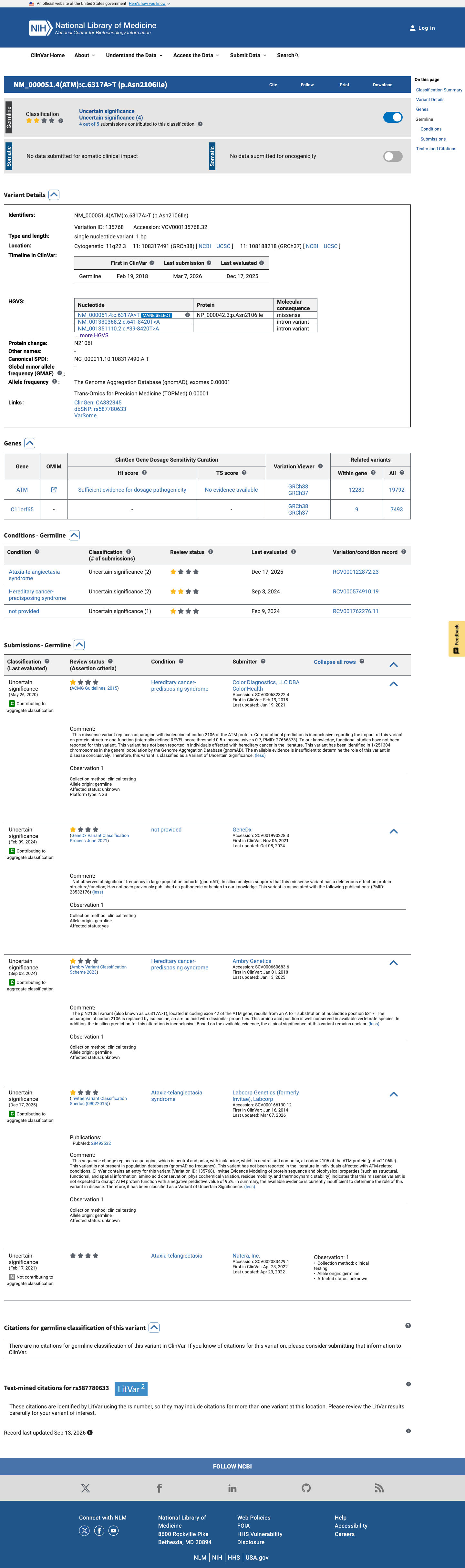
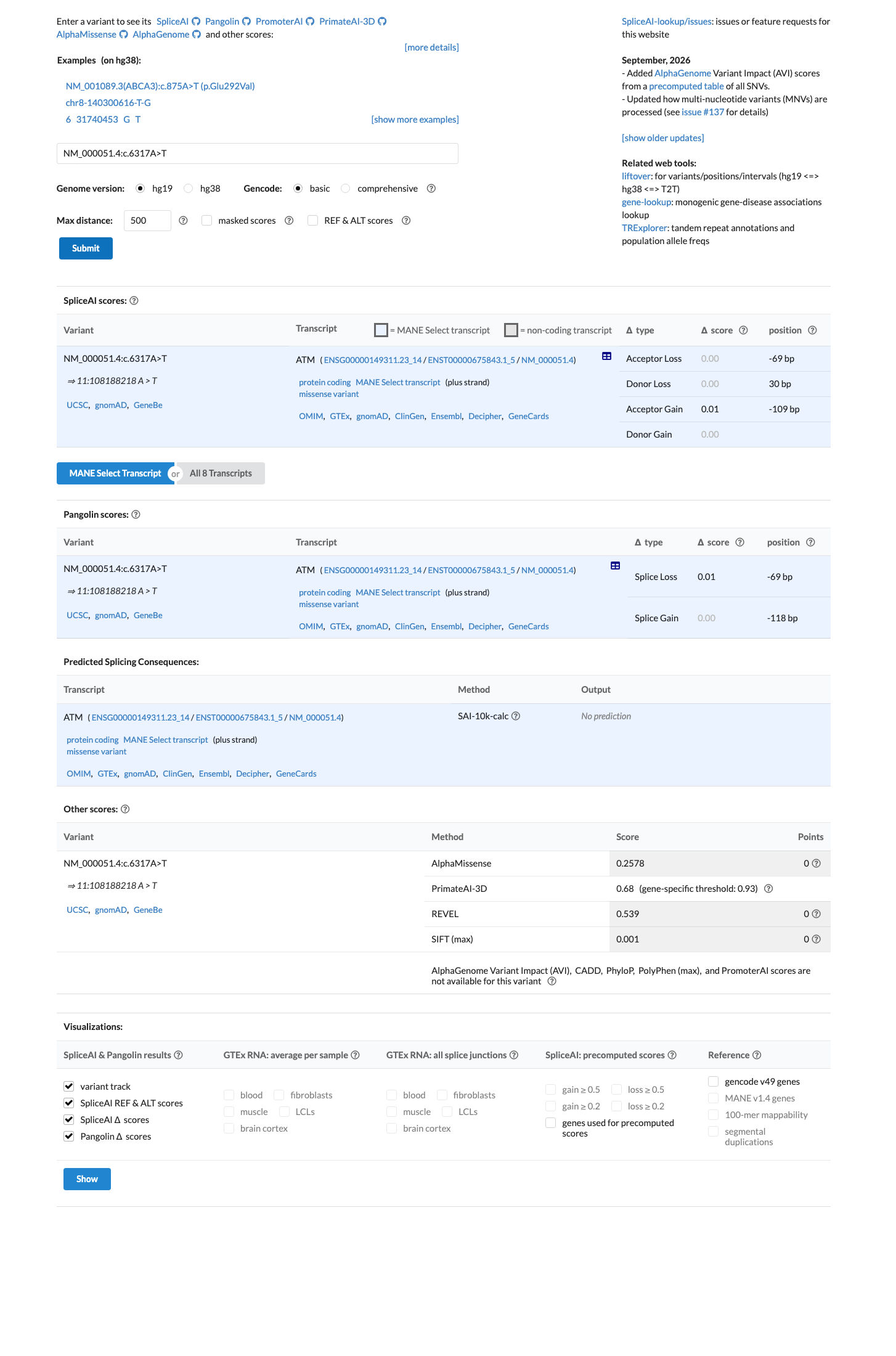
PS1Not met: no established pathogenic variant shares the p.Asn2106Ile change (ClinVar 135768 is a 2-star VUS) and SpliceAI max delta 0.005 bars the splicing table.
PS3Not met: the only functional result is the Sun 2025 prime-editing screen (PMID 40580951), which scores this variant Functional, and no VCEP-approved kinase or radiosensitivity assay was reported.
PS4Not met: no case-control odds ratio, hazard ratio or relative risk is reported for ATM c.6317A>T, so the VCEP's OR >=2 (or lower CI >=1.5) threshold has nothing to satisfy it.
PM3Not assessed: no A-T proband carries c.6317A>T with a second ATM pathogenic variant in trans, so the VCEP table's minimum 1.0 PM3 point is unattainable.
PP1Not assessed: no affected-relative segregations are documented for this variant, versus the ATM VCEP threshold of one affected relative for PP1 supporting.
PP3Not met: missense REVEL 0.539 sits in the gray zone, below the ATM VCEP PP3 threshold of REVEL >0.7333.
PP5Not met: ClinVar VCV000135768 is Uncertain significance at two stars with five ordinary laboratory submissions and zero expert-panel submissions.
Benign
BA1Not met: gnomAD v4.1 group-max filtering AF 0.000292% is roughly 1,700-fold below the VCEP stand-alone benign threshold of 0.5%.
BS1Not met: the highest gnomAD frequency, group-max filtering AF 0.000292%, is about 170-fold below the VCEP strong benign threshold of 0.05%.
BS3Not met: the prime-editing screen directly measures this variant as Functional (Combined score -0.754, above the -0.912 Functional boundary), but that assay is not a VCEP-approved or calibrated ATM test.
BP2Not assessed: no unaffected adult carries c.6317A>T in trans or cis with a pathogenic ATM variant, so no negative BP2 points from the VCEP table can be assigned.
BP4Not met: missense REVEL 0.539 exceeds the ATM VCEP BP4 cutoff of REVEL <=0.249, and the clean SpliceAI score cannot substitute.
BP6Not met: no expert-panel submission or Benign classification exists for c.6317A>T; VCV000135768 is Uncertain significance at two stars.
This variant is present in gnomAD v4.1 (AF= 6.82588e-06; MAF= 0.00068%, 11/1611514 alleles, homozygotes = 0) and has highest observed frequency in the Remaining individuals population (AF= 4.81062e-05; MAF= 0.00481%, 3/62362 alleles, homozygotes = 0); grpmax FAF= 2.92e-06.
v2.1
This variant is present in gnomAD v2.1 (AF= 3.97924e-06; MAF= 0.00040%, 1/251304 alleles, homozygotes = 0) and has highest observed frequency in the European (non-Finnish) population (AF= 8.80034e-06; MAF= 0.00088%, 1/113632 alleles, homozygotes = 0).
🇨🇦 CA
Absent from gnomAD-Canada v1.0.
Allele frequency by ancestry
three datasets · side by side
gnomAD v4.1
0.00068%
· 11 / 1,611,514
0 hom · FAF 0.00029%
Remaining individuals
3 / 62,362
0.0048%
European (non-Finnish)
8 / 1,178,890
0.00068%
+ 8 not observed (Admixed American, European (Finnish), Amish, East Asian, Middle Eastern, South Asian, Ashkenazi Jewish, African/African American)
gnomAD v2.1
0.0004%
· 1 / 251,304
0 hom
European (non-Finnish)
1 / 113,632
0.00088%
+ 7 not observed (African/African American, Admixed American, Ashkenazi Jewish, East Asian, European (Finnish), Remaining individuals, South Asian)
OncoKB did not identify variant-specific reviewed functional evidence for this variant; gene-level curated context is available for reviewer follow-up. ATM, a kinase involved in the DNA damage response, is mutated in various solid and hematologic malignancies.
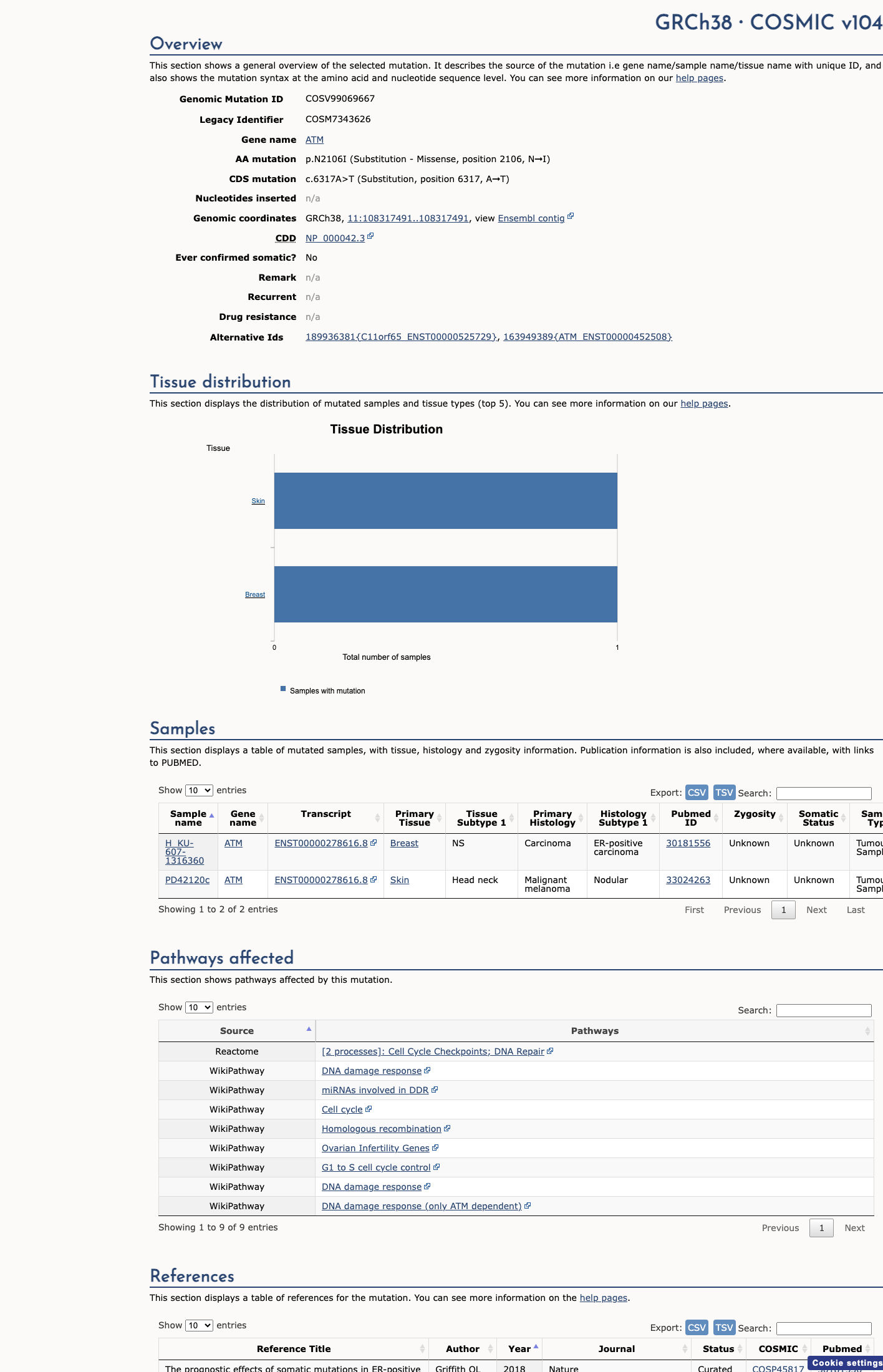
This variant does not lie in a statistically significant hotspot. This variant has previously been reported in somatic cancers (COSMIC; COSV99069667, n = 2 times).
Hotspots
This variant does not lie in a statistically significant hotspot.
Each card is an audit: what was searched, what was found, whether it names the variant, which criteria it fed, and why. 5 further PMIDs triaged but not cited — see Sources & references.
Rule & framework references · cited for criterion definitions, not variant evidence
25741868 ↗Standards and guidelines for the interpretation of sequence variants: a joint consensus recommendation of the American College of Medical Genetics and Genomics and the Association for Molecular Pathology.
Sources & reference links
9Sources
CSpec VCEP
ClinVar
gnomAD v2.1
gnomAD v4.1
gnomAD-Canada
SpliceAI
OncoKB
COSMIC
Cancer hotspots
Triaged references · 5 PMIDs not cited in assessment
24418350 ↗EFNS/ENS Consensus on the diagnosis and management of chronic ataxias in adulthood.CLINVAR
25394175 ↗A practice guideline from the American College of Medical Genetics and Genomics and the National Society of Genetic Counselors: referral indications for cancer predisposition assessment.CLINVAR
20050888 ↗EFNS guidelines on the molecular diagnosis of ataxias and spastic paraplegias.CLINVAR