ATM encodes a kinase that acts as a master controller of the cellular DNA damage response: it detects double-strand breaks and coordinates DNA repair, cell cycle arrest, or apoptosis through downstream targets including p53, BRCA1, and CHK2. Loss-of-function mutations in both copies of ATM cause ataxia telangiectasia, an autosomal recessive disorder characterized by neurological problems, immune deficiency, and cancer predisposition. ATM functions as a tumor suppressor: individuals with ataxia telangiectasia are prone to childhood lymphomas, leukemias, and breast cancer, while carriers of a single altered copy have increased risk of breast, pancreatic, prostate, and other cancers. Somatic ATM mutations also occur in lymphoid malignancies and solid tumors, and ATM-deficient cancers are often especially sensitive to DNA-damaging treatments.
This variant
ATM encodes a DNA-damage-response kinase and tumor suppressor, and loss of ATM function underlies ataxia-telangiectasia and contributes to inherited cancer susceptibility.
Transcript
NM_000051.4
HGVS · transcript:coding
NM_000051.4:c.2377-18T>C
GRCh38
chr11:108258968 T>C
GRCh37
chr11:108129695 T>C
VUS: BP4 (supporting) indicates no predicted splice impact, but no pathogenic or benign combination rule is satisfied under the ATM VCEP framework.
Classification rationale
BP4VUS
ATM c.2377-18T>Cunknown · exon 15i
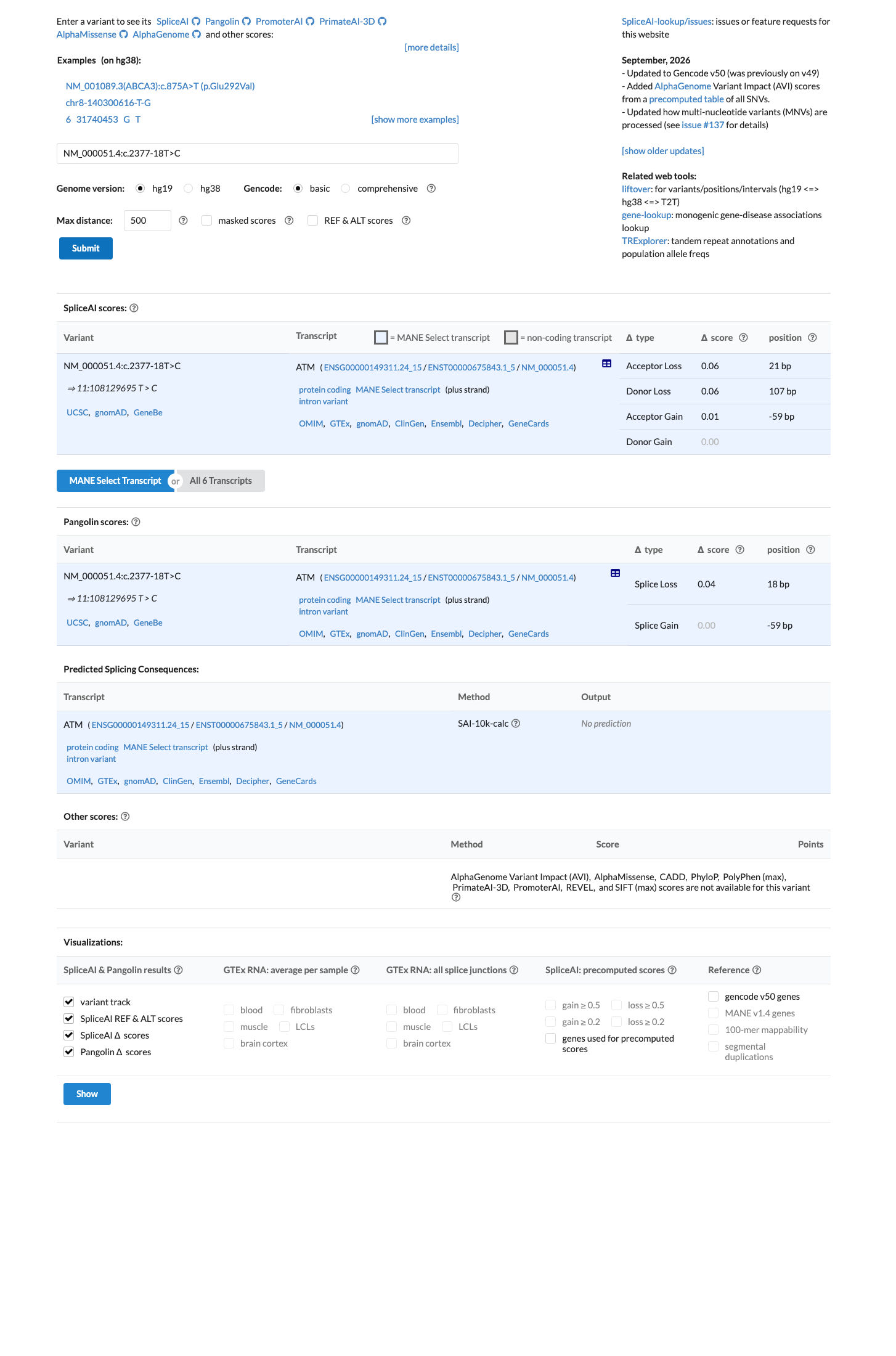
BP4 supporting: SpliceAI maximum delta 0.059 is below the ATM VCEP threshold of 0.1 for no predicted splice impact.
BP4→VUS
LYFE Sciences is an AI system, and it can make mistakes. Criteria
may be applied incorrectly, sources may be misread, and a confident-looking
classification can still be wrong. Double-check every criterion and
its underlying evidence before relying on any call.
Gene diagram
· NM_000051.4 · variants mapped to exon structure
ATMNM_000051.4
Fetching transcript structure from UCSC…
Exons
—
Transcript span
—
Strand
—
Variants mapped
—
Source
UCSC ncbiRefSeqCurated
All variants in ATM—click a row to locate it on the plot · use the link column to open its page
Protein
Location
Classification
Link
Applied criteria · 1 applied · 12 assessed
MetEvidence satisfies this criterion.
Not metEvaluated against available evidence; threshold not reached.
Not assessedApplies in principle, but no evidence was found to evaluate it.
N/ADoesn't apply to this variant type.
Applied · 1
Strength Supporting Moderate Strong Very strong
✓
BP4supportingBenign
Met at supporting: SpliceAI maximum delta 0.059 meets the ATM VCEP BP4 splicing threshold of <=0.1.
ClinGen HBOP ATM VCEP Version 1.6 assigns BP4 Supporting for splicing when SpliceAI is <=0.1; the variant is intronic and therefore uses the SpliceAI path.The case SpliceAI result reports DS_AG 0.007, DS_AL 0.059, DS_DG 0.000, and DS_DL 0.055, with maximum delta 0.059.The governing Suppl_TableS1_PMID 40580951 full-text conversion was searched for c.2377-18T>C, c.2377-18, 2377-18, and p.?; no exact entry was found, so no pre-assigned BP4 code was available from that file.
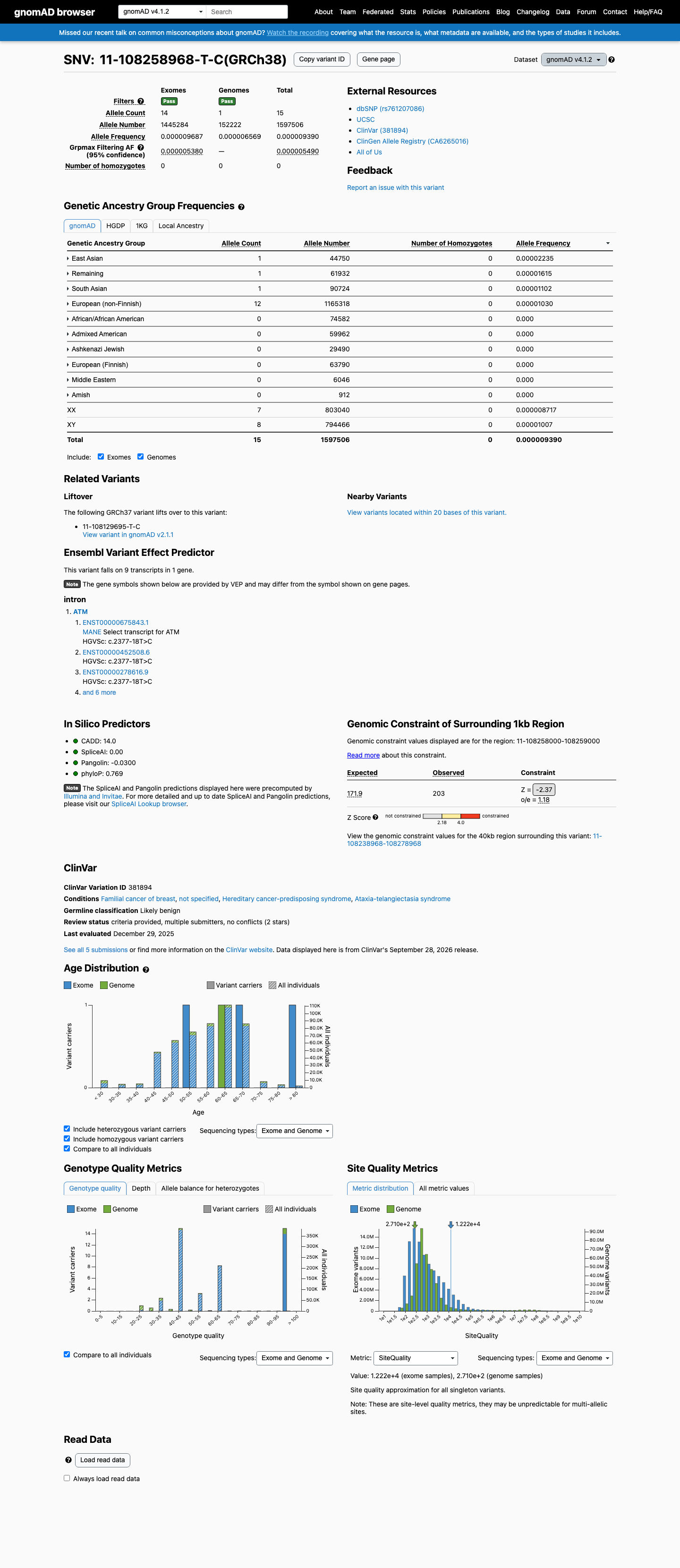
This variant is present in gnomAD v4.1 (AF= 9.38964e-06; MAF= 0.00094%, 15/1597506 alleles, homozygotes = 0) and has highest observed frequency in the East Asian population (AF= 2.23464e-05; MAF= 0.00223%, 1/44750 alleles, homozygotes = 0); grpmax FAF= 5.49e-06.
v2.1
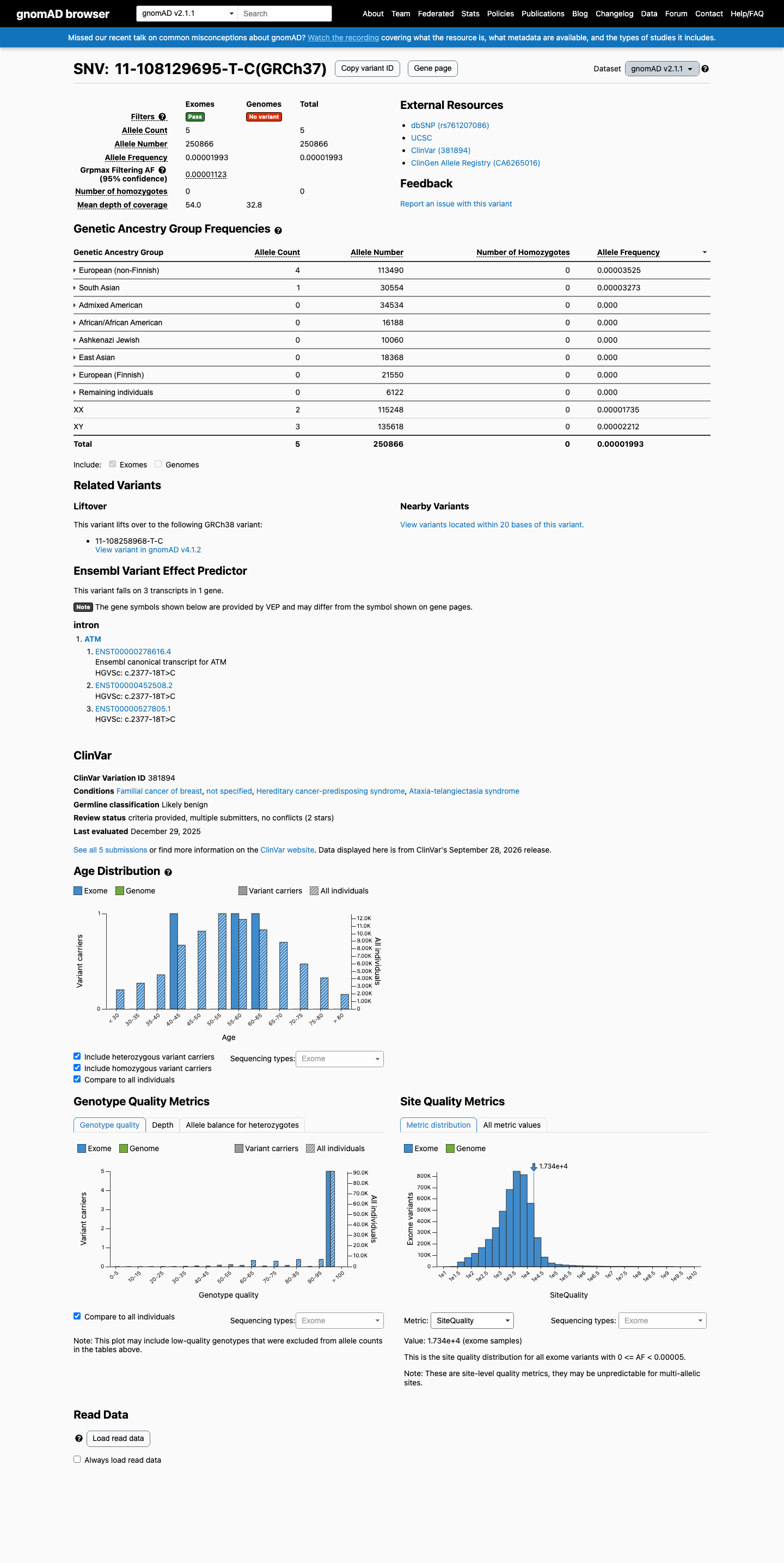
This variant is present in gnomAD v2.1 (AF= 1.9931e-05; MAF= 0.00199%, 5/250866 alleles, homozygotes = 0) and has highest observed frequency in the European (non-Finnish) population (AF= 3.52454e-05; MAF= 0.00352%, 4/113490 alleles, homozygotes = 0); grpmax FAF= 1.123e-05.
🇨🇦 CA
Absent from gnomAD-Canada v1.0.
Allele frequency by ancestry
three datasets · side by side
gnomAD v4.1
0.00094%
· 15 / 1,597,506
0 hom · FAF 0.00055%
East Asian
1 / 44,750
0.0022%
Remaining individuals
1 / 61,932
0.0016%
South Asian
1 / 90,724
0.0011%
European (non-Finnish)
12 / 1,165,318
0.001%
+ 6 not observed (Admixed American, European (Finnish), Amish, Middle Eastern, Ashkenazi Jewish, African/African American)
gnomAD v2.1
0.002%
· 5 / 250,866
0 hom · FAF 0.0011%
European (non-Finnish)
4 / 113,490
0.0035%
South Asian
1 / 30,554
0.0033%
+ 6 not observed (African/African American, Admixed American, Ashkenazi Jewish, East Asian, European (Finnish), Remaining individuals)
Triaged references · 7 PMIDs not cited in assessment
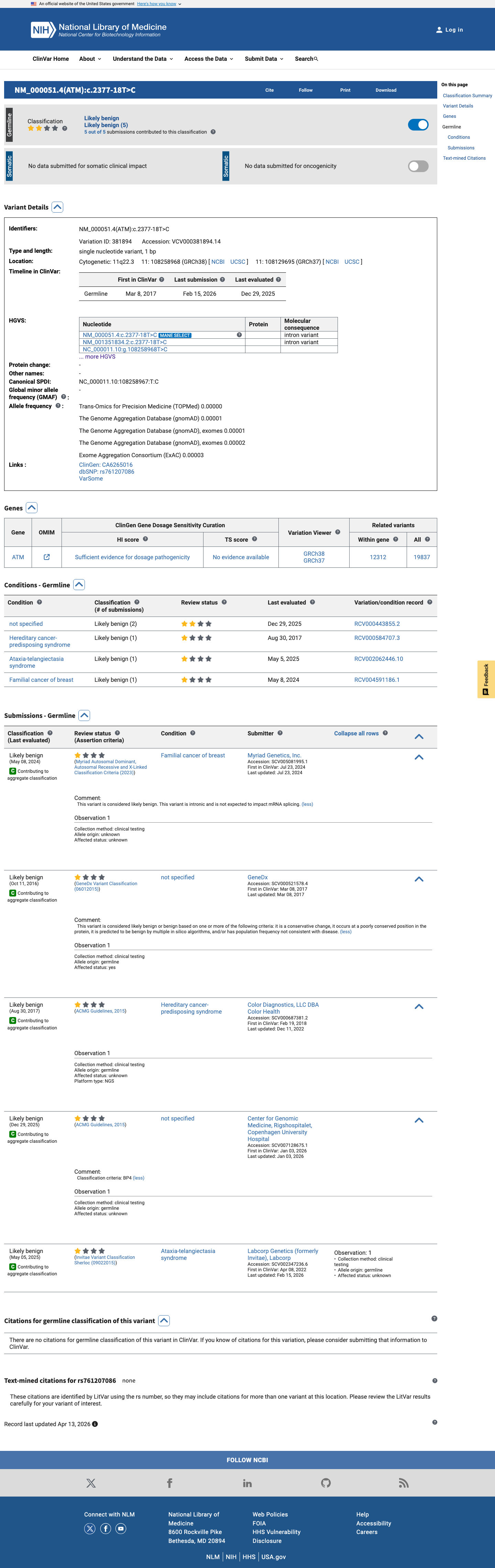
25741868 ↗Standards and guidelines for the interpretation of sequence variants: a joint consensus recommendation of the American College of Medical Genetics and Genomics and the Association for Molecular Pathology.CLINVAR
34242744 ↗Customizing local and systemic therapies for women with early breast cancer: the St. Gallen International Consensus Guidelines for treatment of early breast cancer 2021.CLINVAR
15604628 ↗Genetic cancer risk assessment and counseling: recommendations of the national society of genetic counselors.CLINVAR
18163131 ↗The emerging landscape of breast cancer susceptibility.CLINVAR
20301425 ↗BRCA1- and BRCA2-Associated Hereditary Breast and Ovarian Cancer.CLINVAR
34012068 ↗ACMG SF v3.0 list for reporting of secondary findings in clinical exome and genome sequencing: a policy statement of the American College of Medical Genetics and Genomics (ACMG).CLINVAR
28492532 ↗Sherloc: a comprehensive refinement of the ACMG-AMP variant classification criteria.CLINVAR