This variant was interpreted by pipeline
7.1.5.
The current version is
8.0.0.
Re-running queues a fresh interpretation; the result replaces this page when complete.
Re-runs are not free. Blank = draws on today's public interpretation allowance.
With a code = uses 1 of that code's uses.
ATM encodes a kinase that acts as a master controller of the cellular DNA damage response: it detects double-strand breaks and coordinates DNA repair, cell cycle arrest, or apoptosis through downstream targets including p53, BRCA1, and CHK2. Loss-of-function mutations in both copies of ATM cause ataxia telangiectasia, an autosomal recessive disorder characterized by neurological problems, immune deficiency, and cancer predisposition. ATM functions as a tumor suppressor: individuals with ataxia telangiectasia are prone to childhood lymphomas, leukemias, and breast cancer, while carriers of a single altered copy have increased risk of breast, pancreatic, prostate, and other cancers. Somatic ATM mutations also occur in lymphoid malignancies and solid tumors, and ATM-deficient cancers are often especially sensitive to DNA-damaging treatments.
This variant
ATM's loss of function causes ataxia telangiectasia and raises cancer risk in carriers, but this missense change (p.Tyr1442His) does not clearly fit that loss-of-function pattern. Its population frequency and computational scores fall just short of supporting either pathogenicity or benignity, leaving its effect on ATM's DNA-repair function unresolved. The VUS classification therefore means this variant's impact on cancer risk is currently unknown and requires further evidence.
Transcript
NM_000051.4
HGVS · transcript:coding
NM_000051.4:c.4324T>C
GRCh38
chr11:108289689 T>C
GRCh37
chr11:108160416 T>C
No criterion meets the governing ATM VCEP v1.5 thresholds (closest: REVEL 0.733 vs 0.7333), so the classification is Uncertain Significance.
Classification rationale
VUS
ATM c.4324T>Cmissense · exon 29
Overall classification: Uncertain Significance (VUS) - no ACMG/VCEP criterion was met, so no combination rule was satisfied.
LYFE Sciences is an AI system, and it can make mistakes. Criteria
may be applied incorrectly, sources may be misread, and a confident-looking
classification can still be wrong. Double-check every criterion and
its underlying evidence before relying on any call.
Gene diagram
· NM_000051.4 · variants mapped to exon structure
ATMNM_000051.4
Fetching transcript structure from UCSC…
Exons
—
Transcript span
—
Strand
—
Variants mapped
—
Source
UCSC ncbiRefSeqCurated
All variants in ATM—click a row to locate it on the plot · use the link column to open its page
Protein
Location
Classification
Link
Applied criteria · 0 applied · 14 assessed
MetEvidence satisfies this criterion.
Not metEvaluated against available evidence; threshold not reached.
Not assessedApplies in principle, but no evidence was found to evaluate it.
N/ADoesn't apply to this variant type.
Applied · 0
No criteria were applied for this variant.
Assessed · not applied
· 7 not met · 7 not assessed
Pathogenic
PS1Not assessed: no established pathogenic variant producing the same p.Tyr1442His change was available for comparison.
PS3Not assessed: no VCEP-approved functional assay tested this variant, and a ClinVar submission notes functional studies are lacking.
PS4Not assessed: reported in two contralateral breast-cancer and two CLL cases, but no case-control effect estimate met the p<=0.05, OR>=2 threshold.
PM2Not met: gnomAD v4.1 overall frequency 0.03911% (631/1,613,474 alleles) exceeds the 0.001% PM2 threshold.
PM3Not assessed: the reported breast-cancer and CLL cases are not A-T probands and provide no in-trans pathogenic allele evidence.
PP1Not assessed: the breast-cancer and CLL reports contain no variant-specific family segregation evidence.
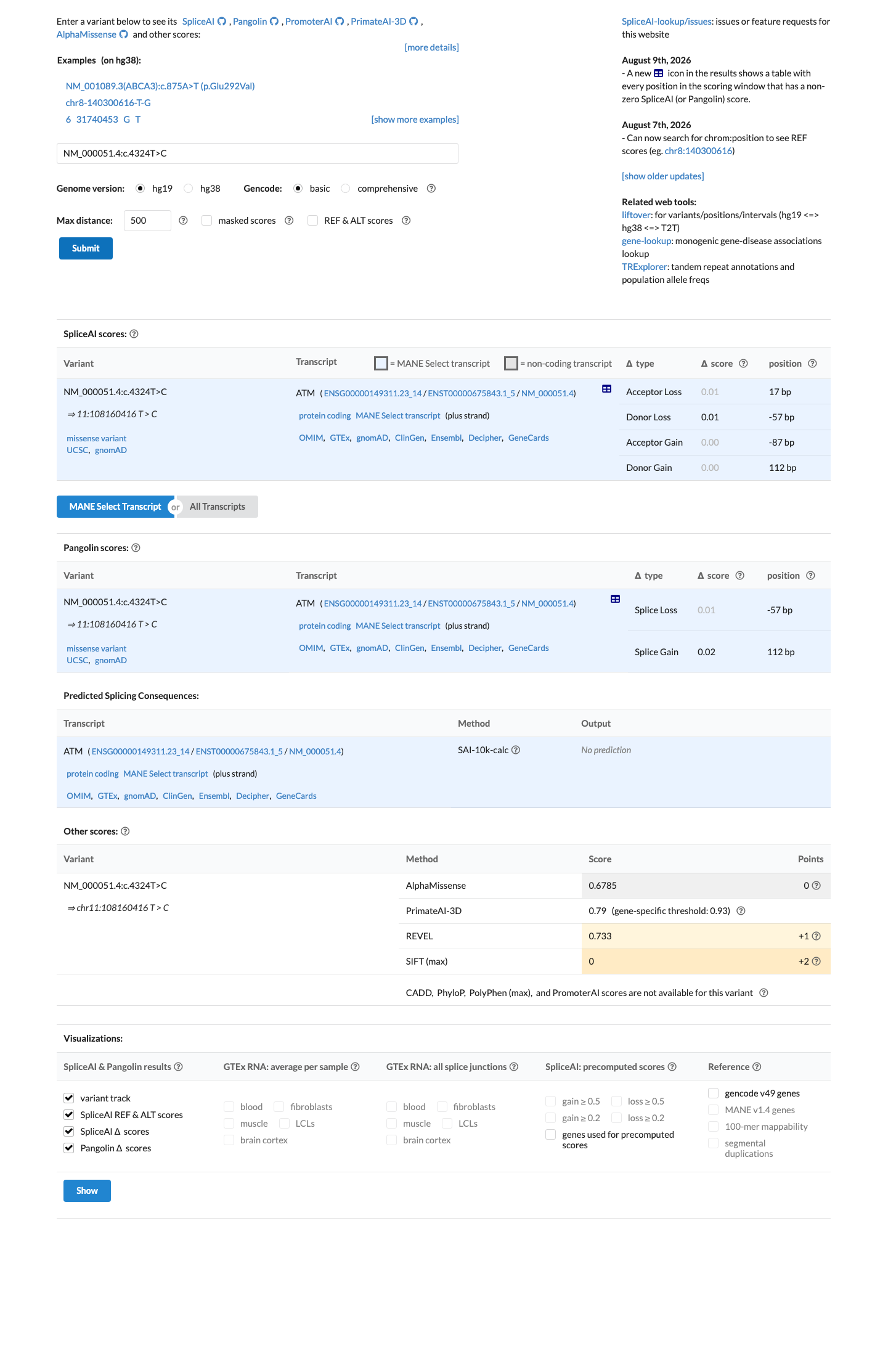
PP3Not met: REVEL 0.733 falls just below the 0.7333 PP3 missense threshold.
PP5Not met: no ClinVar expert-panel pathogenic or likely pathogenic assertion exists for this variant.
Benign
BA1Not met: grpmax FAF 0.047375% is below the 0.5% BA1 threshold.
BS1Not met: grpmax FAF 0.047375% is just below the 0.05% BS1 threshold.
BS3Not assessed: no VCEP-approved functional assay or rescue data for this variant was available.
BP2Not assessed: no unaffected carrier with a pathogenic ATM variant in trans was documented.
BP4Not met: REVEL 0.733 falls in the 0.249-0.7333 gray zone, above the 0.249 BP4 benign cutoff.
BP6Not met: no ClinVar expert-panel benign or likely benign assertion exists for this variant.
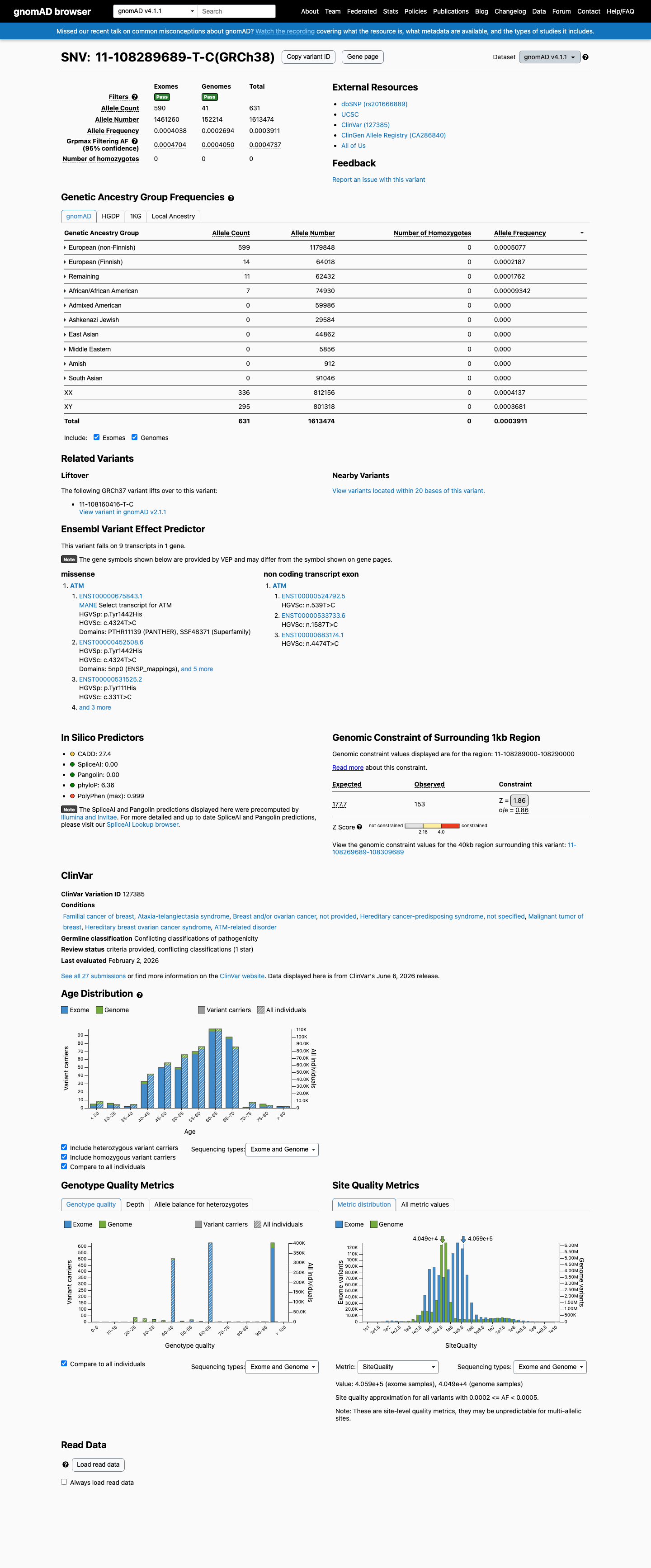
This variant is present in gnomAD v4.1 (AF= 0.000391082; MAF= 0.03911%, 631/1613474 alleles, homozygotes = 0) and has highest observed frequency in the European (non-Finnish) population (AF= 0.000507693; MAF= 0.05077%, 599/1179848 alleles, homozygotes = 0); grpmax FAF= 0.00047375.
v2.1
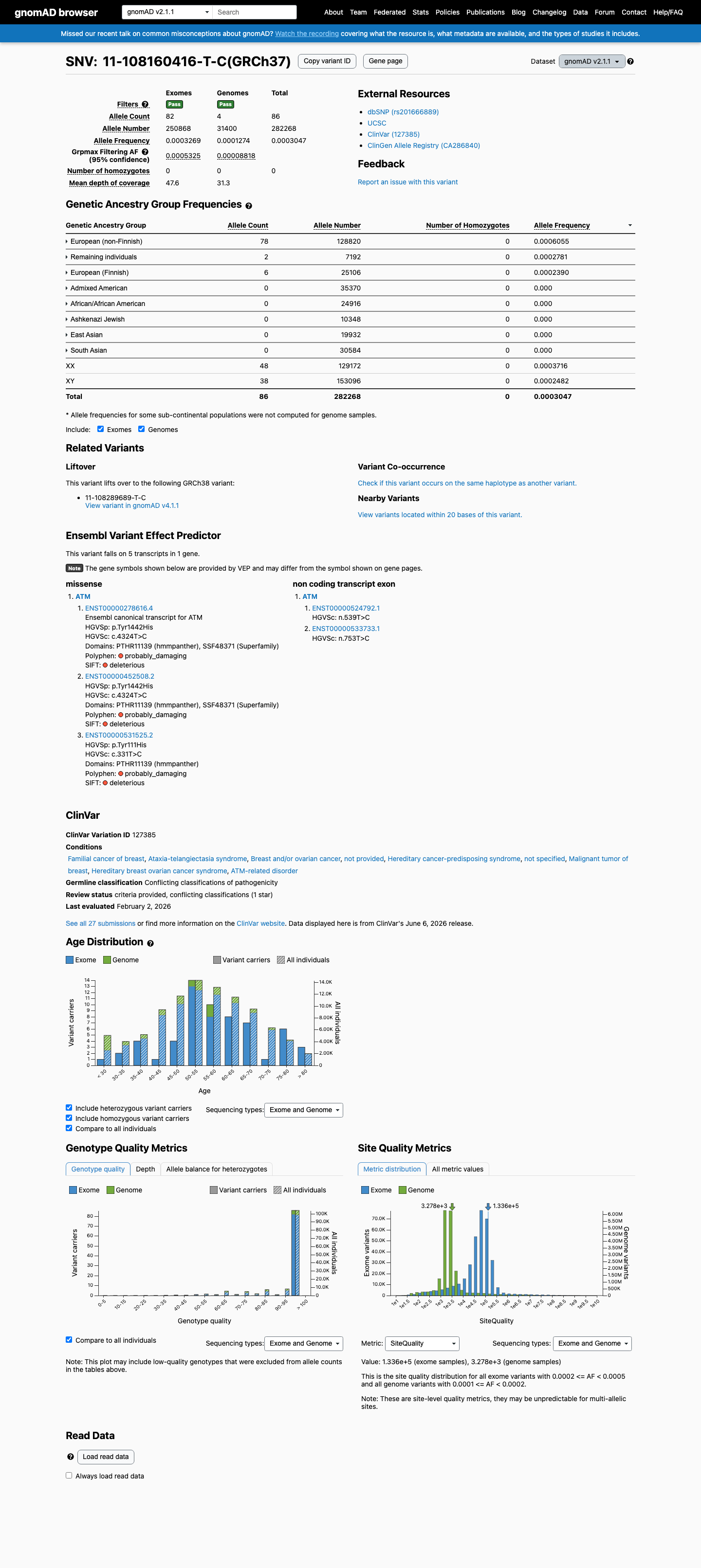
This variant is present in gnomAD v2.1 (AF= 0.000304675; MAF= 0.03047%, 86/282268 alleles, homozygotes = 0) and has highest observed frequency in the European (non-Finnish) population (AF= 0.000605496; MAF= 0.06055%, 78/128820 alleles, homozygotes = 0); grpmax FAF= 0.00053252.
🇨🇦 CA
This variant is present in gnomAD-Canada v1.0 (AF= 0.0002171788467803236, 4/18418 alleles, homozygotes = 0).
Allele frequency by ancestry
three datasets · side by side
gnomAD v4.1
0.039%
· 631 / 1,613,474
0 hom · FAF 0.047%
European (non-Finnish)
599 / 1,179,848
0.051%
European (Finnish)
14 / 64,018
0.022%
Remaining individuals
11 / 62,432
0.018%
African/African American
7 / 74,930
0.0093%
+ 6 not observed (Admixed American, Amish, East Asian, Middle Eastern, South Asian, Ashkenazi Jewish)
gnomAD v2.1
0.03%
· 86 / 282,268
0 hom · FAF 0.053%
European (non-Finnish)
78 / 128,820
0.061%
Remaining individuals
2 / 7,192
0.028%
European (Finnish)
6 / 25,106
0.024%
+ 5 not observed (African/African American, Admixed American, Ashkenazi Jewish, East Asian, South Asian)
gnomAD Canada 🇨🇦
0.022%
· 4 / 18,418
0 hom · FAF 0.012%
European (non-Finnish)
4 / 11,740
0.034%
+ 8 not observed (African/African American, Latino/Admixed American, Ashkenazi Jewish, East Asian, European (Finnish), Middle Eastern, Remaining individuals, South Asian)
This variant has been reported in ClinVar as Uncertain significance (16 clinical laboratories) and as Likely benign (5 clinical laboratories) and as Benign (2 clinical laboratories) and as likely benign (1 clinical laboratory) and as Likely Benign (1 clinical laboratory). (ClinVarID = 127385)
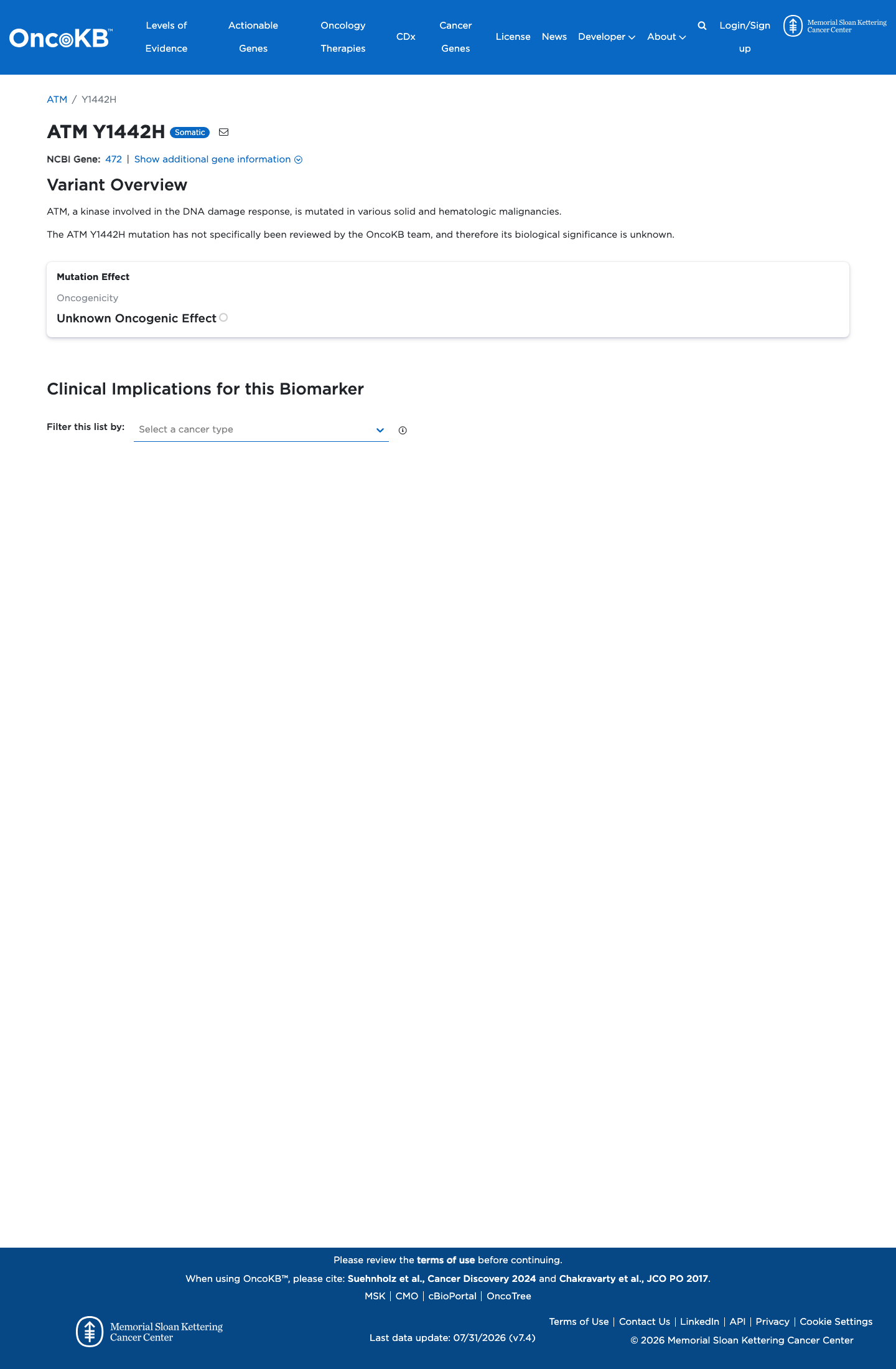
OncoKB did not identify variant-specific reviewed functional evidence for this variant; gene-level curated context is available for reviewer follow-up. ATM, a kinase involved in the DNA damage response, is mutated in various solid and hematologic malignancies.
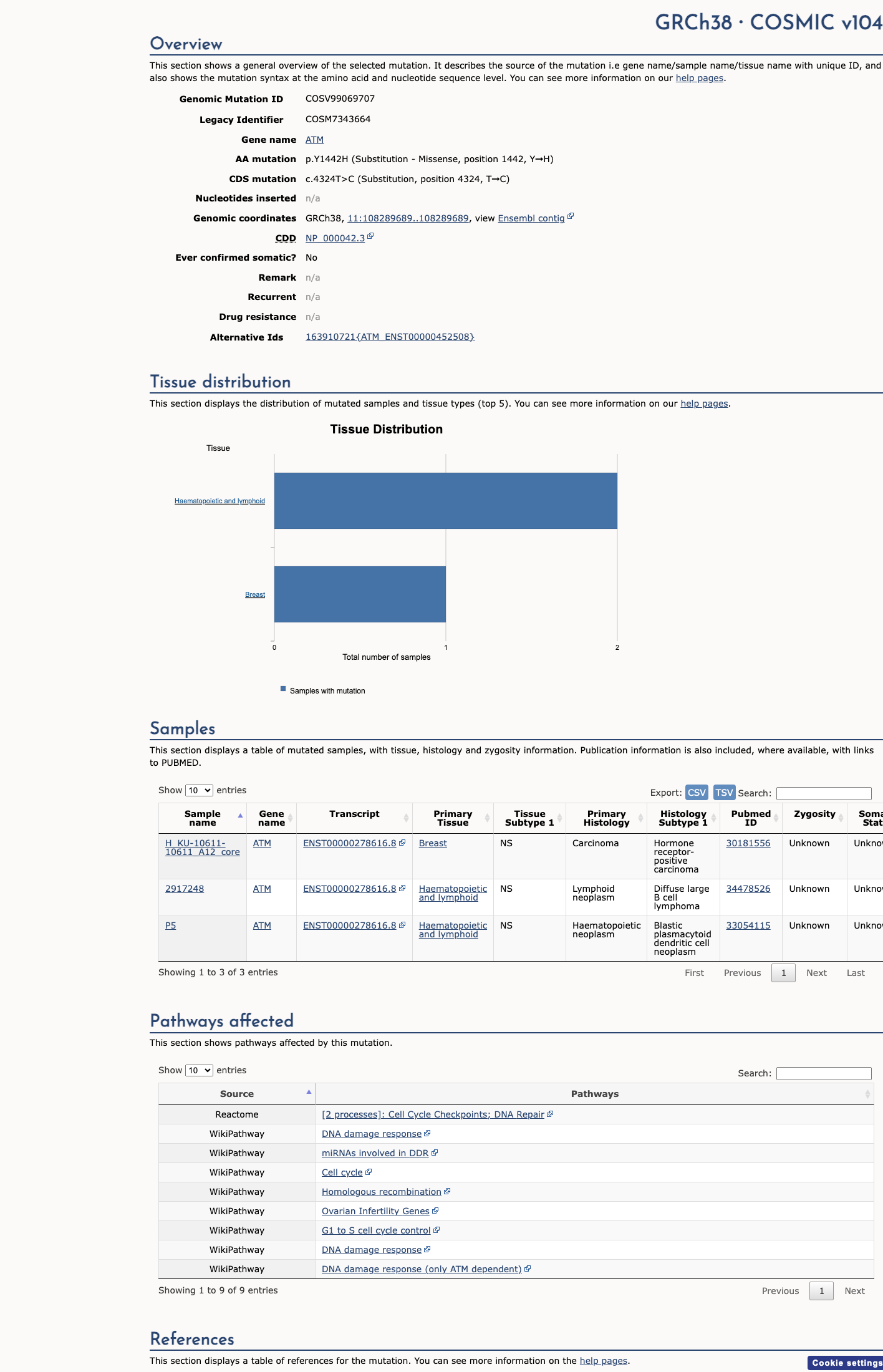
This variant does not lie in a statistically significant hotspot. This variant has previously been reported in somatic cancers (COSMIC; COSV99069707, n = 3 times).
Hotspots
This variant does not lie in a statistically significant hotspot.
Triaged references · 8 PMIDs not cited in assessment
19781682 ↗Rare, evolutionarily unlikely missense substitutions in ATM confer increased risk of breast cancer.CLINVAR
21787400 ↗Rare variants in the ATM gene and risk of breast cancer.CLINVAR
25741868 ↗Standards and guidelines for the interpretation of sequence variants: a joint consensus recommendation of the American College of Medical Genetics and Genomics and the Association for Molecular Pathology.CLINVAR
27153395 ↗Evaluation of ACMG-Guideline-Based Variant Classification of Cancer Susceptibility and Non-Cancer-Associated Genes in Families Affected by Breast Cancer.CLINVAR
30303537 ↗Familial breast cancer and DNA repair genes: Insights into known and novel susceptibility genes from the GENESIS study, and implications for multigene panel testing.CLINVAR
17393301 ↗The spectrum of ATM missense variants and their contribution to contralateral breast cancer.CLINVAR
24172824 ↗Feasibility of targeted next-generation sequencing of the TP53 and ATM genes in chronic lymphocytic leukemia.CLINVAR