ATM encodes a kinase that acts as a master controller of the cellular DNA damage response: it detects double-strand breaks and coordinates DNA repair, cell cycle arrest, or apoptosis through downstream targets including p53, BRCA1, and CHK2. Loss-of-function mutations in both copies of ATM cause ataxia telangiectasia, an autosomal recessive disorder characterized by neurological problems, immune deficiency, and cancer predisposition. ATM functions as a tumor suppressor: individuals with ataxia telangiectasia are prone to childhood lymphomas, leukemias, and breast cancer, while carriers of a single altered copy have increased risk of breast, pancreatic, prostate, and other cancers. Somatic ATM mutations also occur in lymphoid malignancies and solid tumors, and ATM-deficient cancers are often especially sensitive to DNA-damaging treatments.
This variant
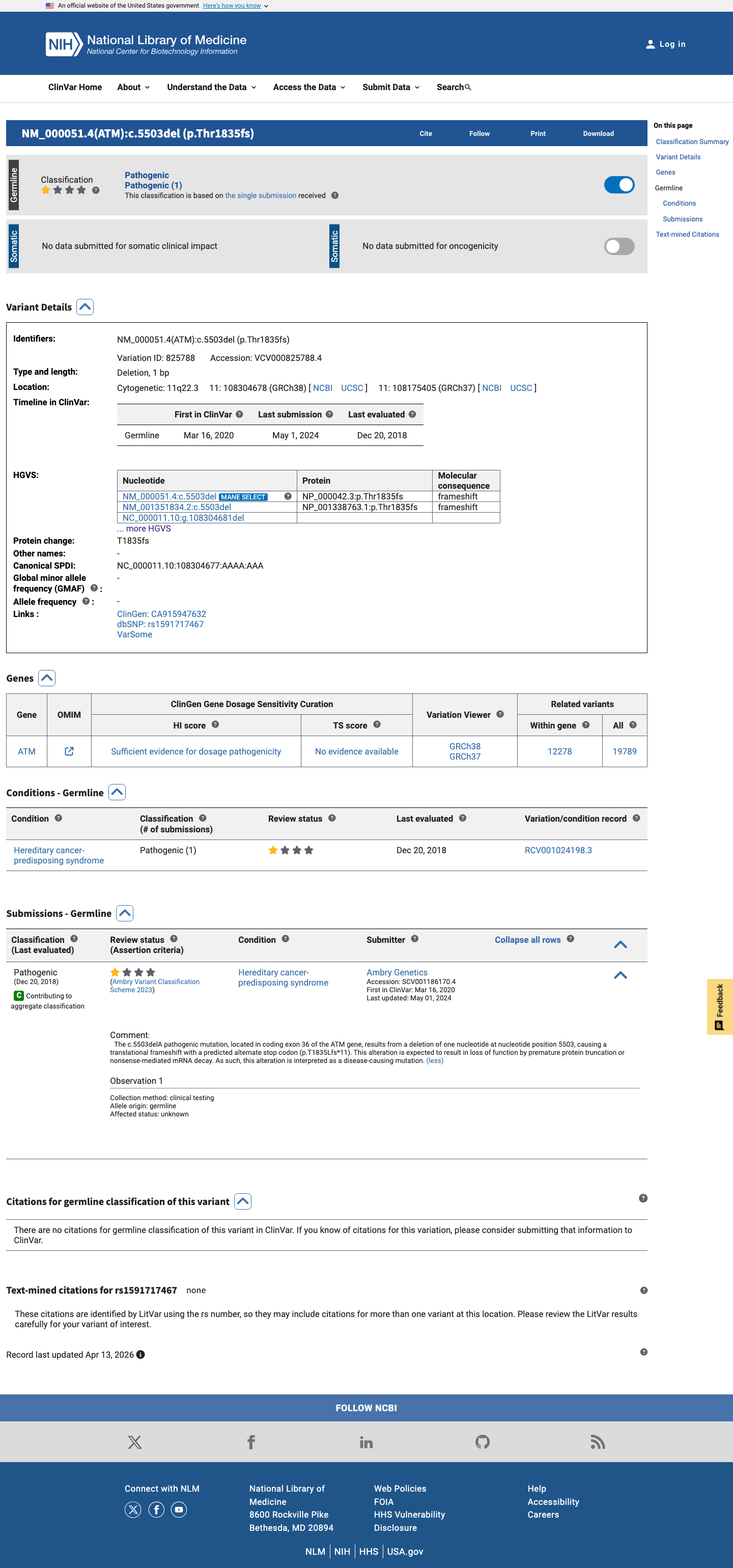
ATM is a tumor suppressor whose loss of function causes ataxia telangiectasia and raises cancer risk in carriers. This frameshift is a loss-of-function allele predicted to abolish ATM kinase activity, so its pathogenic classification aligns with the gene's established recessive disease mechanism and cancer predisposition. In a patient, a second damaging ATM allele would be expected to produce the full recessive phenotype.
Transcript
NM_000051.4
HGVS · transcript:coding
NM_000051.4:c.5503del
GRCh38
chr11:108304677 GA>G
GRCh37
chr11:108175404 GA>G
BasisPathogenic: PVS1 at very strong plus PM2 and PM5 at supporting satisfies the VCEP combination rule requiring one very strong and at least two supporting criteria.▾
Pathogenic: PVS1 at very strong plus PM2 and PM5 at supporting satisfies the VCEP combination rule requiring one very strong and at least two supporting criteria.
Classification rationale
PVS1PM2PM5Pathogenic
ATM c.5503delframeshift · exon 37
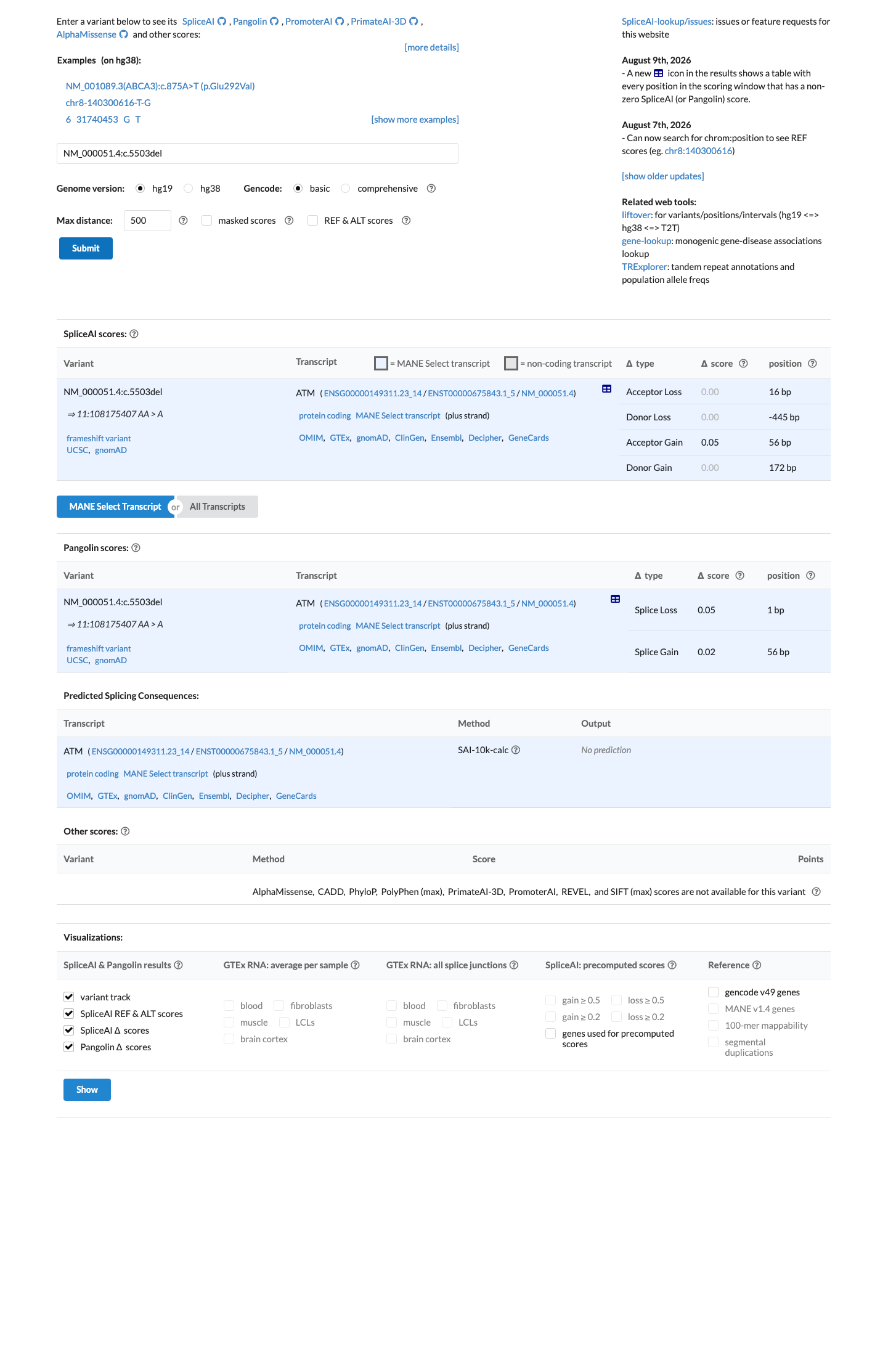
PVS1 (Very Strong): frameshift p.(Thr1835LeufsTer11) is predicted to trigger nonsense-mediated decay and removes the critical FAT/PI3K/FATC domain. PM2 (Supporting): absent from gnomAD v4.1 (AF=0), below the VCEP <=0.001% threshold, corroborated by gnomAD v2.1 and gnomAD-Canada. PM5 (Supporting): truncating variant with premature stop upstream of the VCEP cutoff residue p.Arg3047. Final classification: Pathogenic, produced by the VCEP combination rule (one very strong plus at least two supporting criteria).
PVS1 + PM2 + PM5→Pathogenic
Gene diagram
· NM_000051.4 · variants mapped to exon structure
ATMNM_000051.4
Fetching transcript structure from UCSC…
Exons
—
Transcript span
—
Strand
—
Variants mapped
—
Source
UCSC ncbiRefSeqCurated
All variants in ATM—click a row to locate it on the plot · use the link column to open its page
Variant ↕
Protein
Location
Classification
Link
Applied criteria · 3 applied · 10 assessed
MetEvidence satisfies this criterion.
Not metEvaluated against available evidence; threshold not reached.
Not assessedApplies in principle, but no evidence was found to evaluate it.
N/ADoesn't apply to this variant type.
Applied · 3
Strength Supporting Moderate Strong Very strong
✓
PVS1very strongPathogenic
Met at very strong: frameshift p.(Thr1835LeufsTer11) is predicted to trigger nonsense-mediated decay and removes the critical FAT/PI3K/FATC domain.
ClinGen HBOP ATM VCEP v1.5 CSPEC: PVS1 rule 'Use ATM PVS1 Decision Tree' with Very Strong default; PM5 truncation boundary at p.Arg3047 cited as the most C-terminal pathogenic residue context.ATM PVS1 v1.5 decision guide (ATM_PVS1_1.5.pdf): frameshift is a PVS1-eligible null variant class; caveats are extreme-3'-end variants and splice variants leaving remainder of protein intact, neither of which applies; FAT/PI3K/FATC (FATKIN) treated as one contiguous critical domain (PMID 28508083); all exons of NM_000051.3 considered constitutive; NMD-escaping alterations adversely affecting FATKIN can still be granted PVS1.pvs1_variant_assessment: variant classified as frameshift (variant_bucket 'frameshift'), generic PVS1 framework applicable, default strength PVS1, no exon-skipping/3'-end downgrade triggers identified; transcript NM_000051.4:c.5503del normalized to p.(Thr1835LeufsTer11) (Mutalyzer).
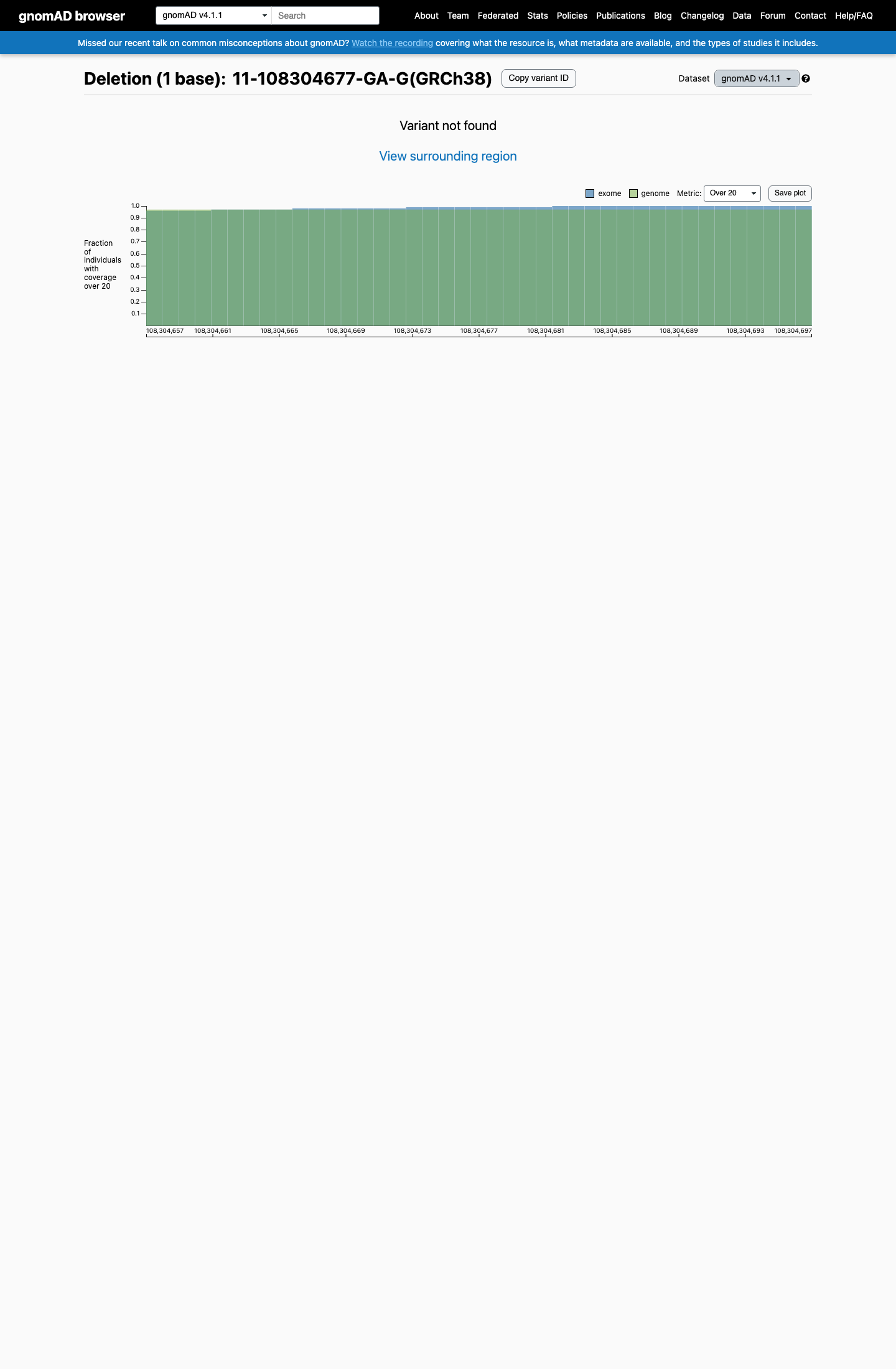
Met at supporting: absent from gnomAD v4.1 (AF=0), below the VCEP <=0.001% threshold.
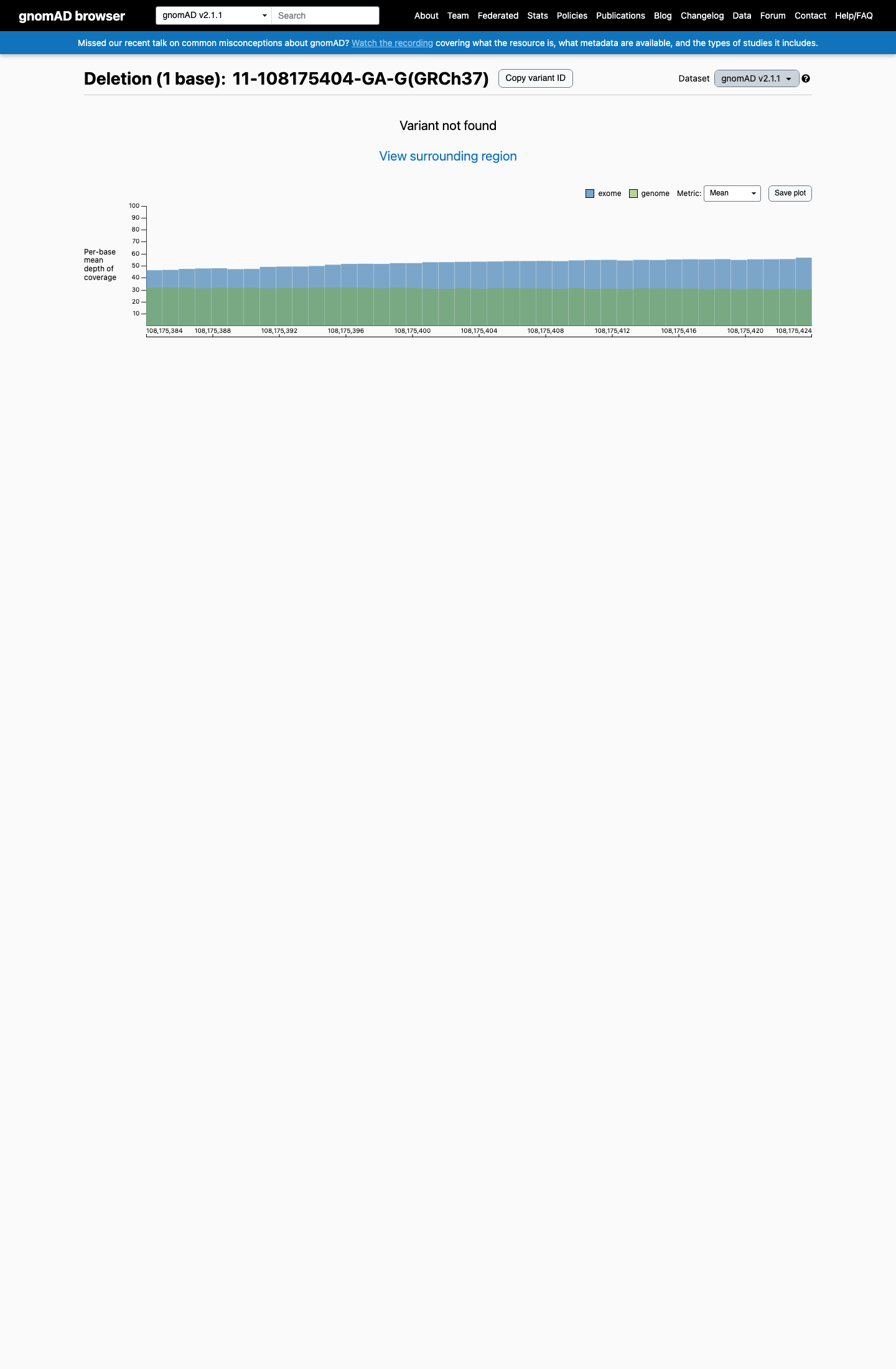
ClinGen HBOP ATM VCEP v1.5 (cspec, svi doc 639508985) specifies PM2 as: 'Frequency <=.001% in gnomAD v4 dataset. If n=1 in a single sub population, that is sufficiently rare and PM2_supporting would apply.' The cspec rule payload maps this to PM2_Supporting.gnomAD v4.1 (exome) direct variant lookup for chr11-108304677-GA-G returned 'Absent from gnomAD v4.1.' (0 alleles; no homozygotes).gnomAD v2.1 (exome) direct variant lookup for 11-108175404-GA-G returned 'Absent from gnomAD v2.1.'
Met at supporting: truncating variant with premature stop upstream of the VCEP cutoff residue p.Arg3047.
The ATM VCEP v1.5 PM5 rule states that PM5 Supporting applies to frameshifting or truncating variants with premature termination codons upstream of p.Arg3047.The case normalization identifies NM_000051.4:c.5503del as p.(Thr1835LeufsTer11), which terminates upstream of p.Arg3047.The PM5 candidate artifact reports that classic same-residue missense searching is ineligible for this non-missense, truncation-cutoff framework; it does not provide independent classification evidence.
Each card is an audit: what was searched, what was found, whether it names the variant, which criteria it fed, and why.
Rule & framework references · cited for criterion definitions, not variant evidence
25394175 ↗A practice guideline from the American College of Medical Genetics and Genomics and the National Society of Genetic Counselors: referral indications for cancer predisposition assessment.
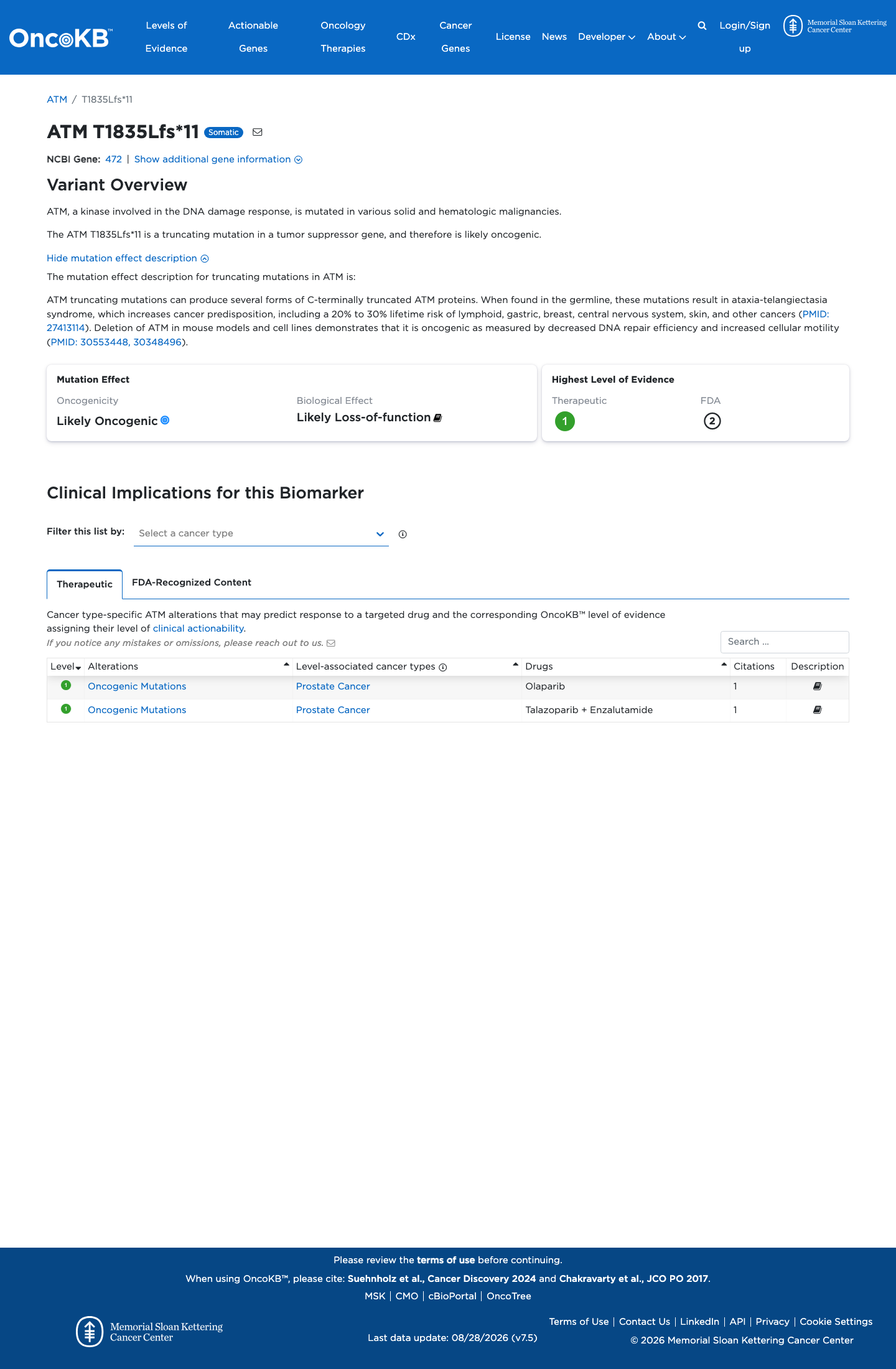
27413114 ↗ATM Mutations in Cancer: Therapeutic Implications.
30348496 ↗Inactive Atm abrogates DSB repair in mouse cerebellum more than does Atm loss, without causing a neurological phenotype.
30553448 ↗Loss of ATM positively regulates Rac1 activity and cellular migration through oxidative stress.