Analysis in progress
Initialising…
0%
complete
This report is still being assembled — sections appear as each stage finishes. It isn't final yet.
ATM
Final classification
Pathogenic
PVS1PM2PM3PM5PP5
ATM
c.5692C>T
p.Arg1898Ter
nonsense · exon 38

ATM encodes a kinase that acts as a master controller of the cellular DNA damage response: it detects double-strand breaks and coordinates DNA repair, cell cycle arrest, or apoptosis through downstream targets including p53, BRCA1, and CHK2. Loss-of-function mutations in both copies of ATM cause ataxia telangiectasia, an autosomal recessive disorder characterized by neurological problems, immune deficiency, and cancer predisposition. ATM functions as a tumor suppressor: individuals with ataxia telangiectasia are prone to childhood lymphomas, leukemias, and breast cancer, while carriers of a single altered copy have increased risk of breast, pancreatic, prostate, and other cancers. Somatic ATM mutations also occur in lymphoid malignancies and solid tumors, and ATM-deficient cancers are often especially sensitive to DNA-damaging treatments.

This variant

ATM is a tumor-suppressor kinase: biallelic loss of function causes ataxia telangiectasia, and single-copy carriers face elevated cancer risk. This variant destroys ATM function and was identified in ataxia-telangiectasia patients, so its pathogenic classification directly reflects the gene's established disease mechanism.

Transcript
NM_000051.4
HGVS · transcript:coding
NM_000051.4:c.5692C>T
GRCh38
chr11:108307914 C>T
GRCh37
chr11:108178641 C>T
Basis Pathogenic: PVS1 (very strong, truncating null variant) plus PM3 (strong, 6.0 points from two A-T probands) satisfies the ATM VCEP's Pathogenic rule.
Pathogenic: PVS1 (very strong, truncating null variant) plus PM3 (strong, 6.0 points from two A-T probands) satisfies the ATM VCEP's Pathogenic rule.
Classification rationale
PVS1PM2PM3PM5PP5 Pathogenic
ATM c.5692C>T nonsense · exon 38

PVS1 (Very Strong): nonsense change p.Arg1898Ter in exon 38 of 63 predicted to trigger nonsense-mediated decay. PM2 (Supporting): essentially absent from population databases — gnomAD v4.1 AF 3.72e-06, well below the 0.001% rarity threshold. PM3 (Strong): two unrelated ataxia-telangiectasia probands carry the variant in trans with other null alleles (6.0 points). PM5 (Supporting): truncation at p.Arg1898Ter lies upstream of the VCEP's p.Arg3047 boundary. PP5 (Supporting): ClinGen HBOP expert panel classified this exact variant as Pathogenic. Synthesis: PVS1 very strong plus PM3 strong satisfies the VCEP Pathogenic rule; final classification: Pathogenic.

PVS1 + PM2 + PM3 + PM5 + PP5 Pathogenic
Gene diagram · NM_000051.4 · variants mapped to exon structure
ATM NM_000051.4
Fetching transcript structure from UCSC…
Applied criteria · 5 applied · 8 assessed
MetEvidence satisfies this criterion.
Not metEvaluated against available evidence; threshold not reached.
Not assessedApplies in principle, but no evidence was found to evaluate it.
N/ADoesn't apply to this variant type.
Applied · 5
Strength Supporting Moderate Strong Very strong
PVS1 very strong Pathogenic
Met: the nonsense change c.5692C>T creates a premature stop (p.Arg1898Ter) in exon 38 of 63, predicted to trigger nonsense-mediated decay.
ATM VCEP v1.5 (cspec) assigns PVS1 via the ATM PVS1 Decision Tree with strengths from Supporting to Very Strong; the decision guide covers nonsense null variants and its only caveats concern extreme-3'-end LOF variants and splice variants causing in-frame exon skipping that leaves the remainder of the protein intact - neither applies to this variant.The VCEP decision guide uses default transcript NM_000051.3/ENST00000278616.8; the input annotation NM_000051.4 encodes the identical NP_000042.3 protein, so transcript relevance is confirmed and c.5692C>T maps to the same coding position.c.5692C>T creates a premature termination codon at residue 1898 of 3056 (exon 38 of 63, per Sun et al. 2025 Table S1 row for c.5692C>T); the PTC is upstream of the p.Arg3047 boundary the VCEP treats as the NMD-prone region, and upstream of the last exon, so NMD is expected.
PM2 supporting Pathogenic
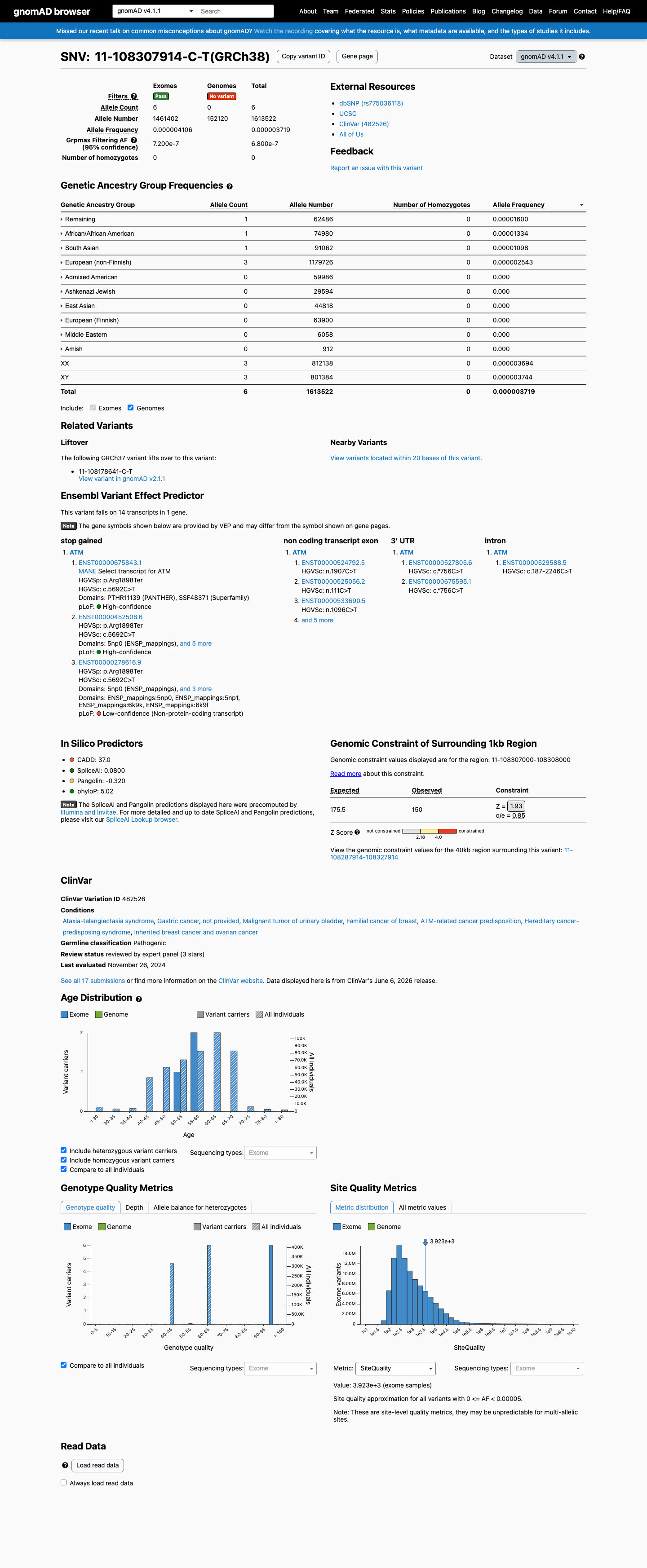
Met: the allele is essentially absent from population databases (gnomAD v4.1 AF 3.72e-06, 6/1,613,522 alleles), below the 0.001% rarity threshold.
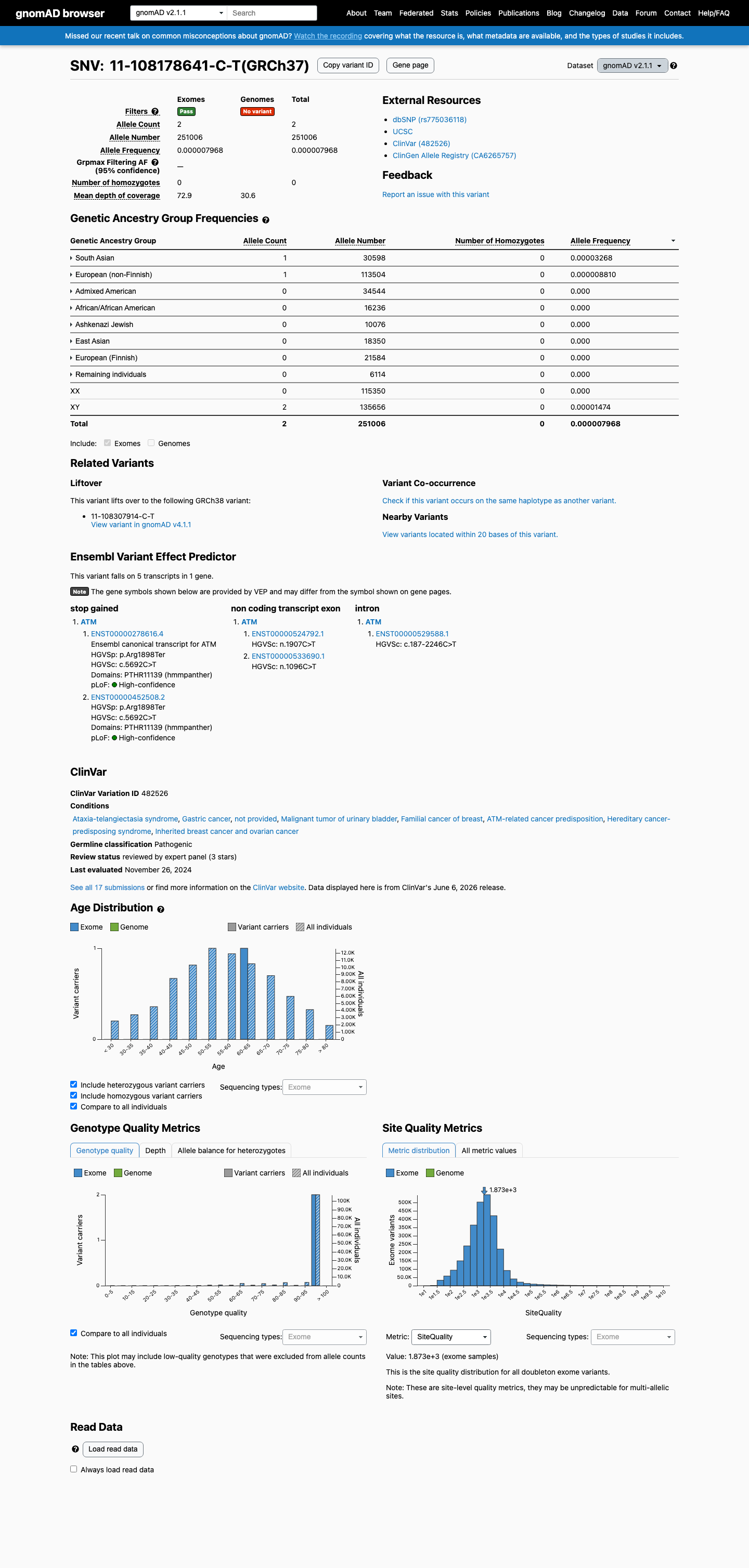
ATM VCEP v1.5 (cspec) PM2 rule: 'Frequency <=.001% in gnomAD v4 dataset. If n=1 in a single sub population, that is sufficiently rare and PM2_supporting would apply.' The rule row is calibrated at Supporting strength.gnomAD v4.1 (gnomad_v4): total AF 3.718573406498331e-06 = 0.00037%, which is <= 0.001%; AC 6/1,613,522; per-subpopulation AC: Remaining individuals 1/62,486 (AF 1.60e-05), SAS 1/91,062 (AF 1.10e-05), AFR 1/74,980 (AF 1.33e-05), NFE 3/1,179,726 (AF 2.54e-06); homozygotes 0 in all populations.gnomAD v2.1 (gnomad_v2): total AF 7.967937021425783e-06 = 0.0008%; AC 2/251,006; n=1 in SAS (1/30,598) and n=1 in NFE (1/113,504); homozygotes 0.
PM3 strong Pathogenic
Met: two unrelated ataxia-telangiectasia probands carry this allele in trans with other null variants (6.0 points on the VCEP table, strong).
ATM VCEP v1.5 PM3/BP2 points table: points per unrelated A-T proband - confident phenotype 4.0 (confirmed in trans) / 2.0 (phase unknown) / 1.0 (second variant unidentified or VUS) / 2.0 (homozygous, max 2 individuals); consistent phenotype = half those values. Point-to-strength: PM3 Supporting=1.0, Moderate=2.0, Strong=4.0, Very Strong=8.0. Multiple unrelated cases are additive; publications claiming a clinical diagnosis of A-T are taken at face value and granted a confident diagnosis; variant may not exceed general population frequency >0.01%; if the variant has co-occurred with at least 2 different P/LP variants, one co-occurrence is weighed as phase unknown while the remaining can be assumed in trans.PMID:17124347 (Magliozzi et al. 2006): patient AT50RM from a cohort of 22 classical A-T patients (Italian A-T Registry; inclusion criteria progressive cerebellar ataxia, oculocutaneous telangiectasias, increased alpha-fetoprotein, chromosomal instability, cellular radiosensitivity) is heterozygous for c.5692C>T (p.R1898X, reported as novel nonsense/truncated protein) and heterozygous for IVS37+2T>C (splicing/truncated protein, previously reported). Both are null alleles in a classical A-T patient; phase was not determined by parental testing, so scored as phase unknown: 2.0 points.PMID:25077176 (A-TWinnipeg paper): AT213LA, one of 10 Mennonite ataxia-telangiectasia patients, is a compound heterozygote for c.6200C>A (p.A2067D) and c.5692C>T (p.R1898*); c.5692C>T was only detectable after cycloheximide inhibition of NMD and was confirmed by genomic DNA sequencing, with STR/SNP haplotyping showing the c.6200C>A-associated haplotype segregated in trans in AT213LA. Confirmed in trans, A-T clinical diagnosis claimed -> 4.0 points. c.6200C>A is the founder A-TWinnipeg variant with functional evidence of loss of ATM kinase activity (no detectable ATM pSer1981 autophosphorylation in patient LCLs; site-directed construct failed to rescue).
PM5 supporting Pathogenic
Met: the truncation at p.Arg1898Ter lies upstream of the VCEP's p.Arg3047 boundary, meeting the gene-specific PM5 rule.
The ATM VCEP v1.5 PM5 rule states: apply to frameshifting or truncating variants with premature termination codons upstream of p.Arg3047, with the criterion's listed strength of Supporting.Magliozzi et al. report c.5692C>T as R1898X in exon 40 and classify it as a nonsense mutation producing a truncated protein (Table 3, patient AT50RM).A-TWinnipeg reports c.5692C>T as the second mutation in patient-derived AT213LA cells, confirmed by genomic DNA sequencing after inhibition of nonsense-mediated decay; the case normalization identifies this change as p.Arg1898Ter.
PP5 supporting Pathogenic
Met: the ClinGen HBOP expert panel (3-star) classified this exact variant as Pathogenic.
ClinVar VCV000482526 source_data: variant title NM_000051.4(ATM):c.5692C>T (p.Arg1898Ter); classification Pathogenic; api_review_status 'reviewed by expert panel'; review stars 3; expert_panels: {'Pathogenic': 'ClinGen Hereditary Breast, Ovarian and Pancreatic Cancer Variant Curation Expert Panel, ClinGen'}.ClinVar submission audit: SCV005627280 (ClinGen HBOP VCEP, ClinGen) classification Pathogenic, review_status 'reviewed by expert panel', method curation, origin germline, exact_variant_match true, is_expert_panel true, trust_tier expert_panel, usable_for_classification true.Global PP5/BP6 rule applied: exact-variant ClinVar expert-panel Pathogenic classification -> PP5 supporting strength, regardless of the VCEP 'Not Applicable' flag (ClinGen HBOP ATM VCEP v1.5 cspec lists PP5 as Not Applicable).
Assessed · not applied · 6 not met · 2 not assessed
Pathogenic
PS3 Not assessed: no VCEP-approved functional assay result exists for this variant; the only functional-screen entry was a computational prediction.
PS4 Not met: no case-control study of this variant exists; only individual ataxia-telangiectasia case reports, which cannot meet the VCEP's statistical threshold.
PP1 Not met: no affected relative carrying this variant is reported, so no segregation evidence exists.
Benign
BA1 Not met: grpmax filtering allele frequency is 6.8e-07 (0.000068%), about four orders of magnitude below the 0.5% BA1 threshold.
BS1 Not met: grpmax filtering allele frequency 6.8e-07 (0.000068%) is nearly three orders of magnitude below the 0.05% BS1 threshold.
BS3 Not assessed: no VCEP-approved assay result showing preserved ATM function or normal radiosensitivity is available.
BP2 Not met: no unaffected individual carrying this variant with a pathogenic variant in trans was identified (0 points).
BP6 Not met: no expert-panel benign classification exists; the only expert-panel call for this variant is Pathogenic.
N/A · 15 PS1 · PS2 · PM1 · PM4 · PM6 · PP2 · PP3 · PP4 · BS2 · BS4 · BP1 · BP3 · BP4 · BP5 · BP7
Research & evidence
Population frequency · supports pathogenic
gnomAD v4.1 screenshot
gnomAD v4.1
gnomAD v2.1 screenshot
gnomAD v2.1
v4.1
This variant is present in gnomAD v4.1 (AF= 3.71857e-06; MAF= 0.00037%, 6/1613522 alleles, homozygotes = 0) and has highest observed frequency in the Remaining individuals population (AF= 1.60036e-05; MAF= 0.00160%, 1/62486 alleles, homozygotes = 0); grpmax FAF= 6.8e-07.
v2.1
This variant is present in gnomAD v2.1 (AF= 7.96794e-06; MAF= 0.00080%, 2/251006 alleles, homozygotes = 0) and has highest observed frequency in the South Asian population (AF= 3.26819e-05; MAF= 0.00327%, 1/30598 alleles, homozygotes = 0).
🇨🇦 CA
Absent from gnomAD-Canada v1.0.
Allele frequency by ancestry
three datasets · side by side
gnomAD v4.1
0.00037% · 6 / 1,613,522
0 hom · FAF 6.8e-05%
Remaining individuals
1 / 62,486
0.0016%
African/African American
1 / 74,980
0.0013%
South Asian
1 / 91,062
0.0011%
European (non-Finnish)
3 / 1,179,726
0.00025%
+ 6 not observed (Admixed American, European (Finnish), Amish, East Asian, Middle Eastern, Ashkenazi Jewish)
gnomAD v2.1
0.0008% · 2 / 251,006
0 hom
South Asian
1 / 30,598
0.0033%
European (non-Finnish)
1 / 113,504
0.00088%
+ 6 not observed (African/African American, Admixed American, Ashkenazi Jewish, East Asian, European (Finnish), Remaining individuals)
gnomAD Canada 🇨🇦
Absent · 0 / ?
0 hom
Not observed in any ancestry group.
ClinVar screenshot
ClinVar
This variant has been reported in ClinVar as Pathogenic (14 clinical laboratories) and as Pathogenic by ClinGen Hereditary Breast, Ovarian and Pancreatic Cancer Variant Curation Expert Panel, ClinGen (expert panel). (ClinVarID = 482526)
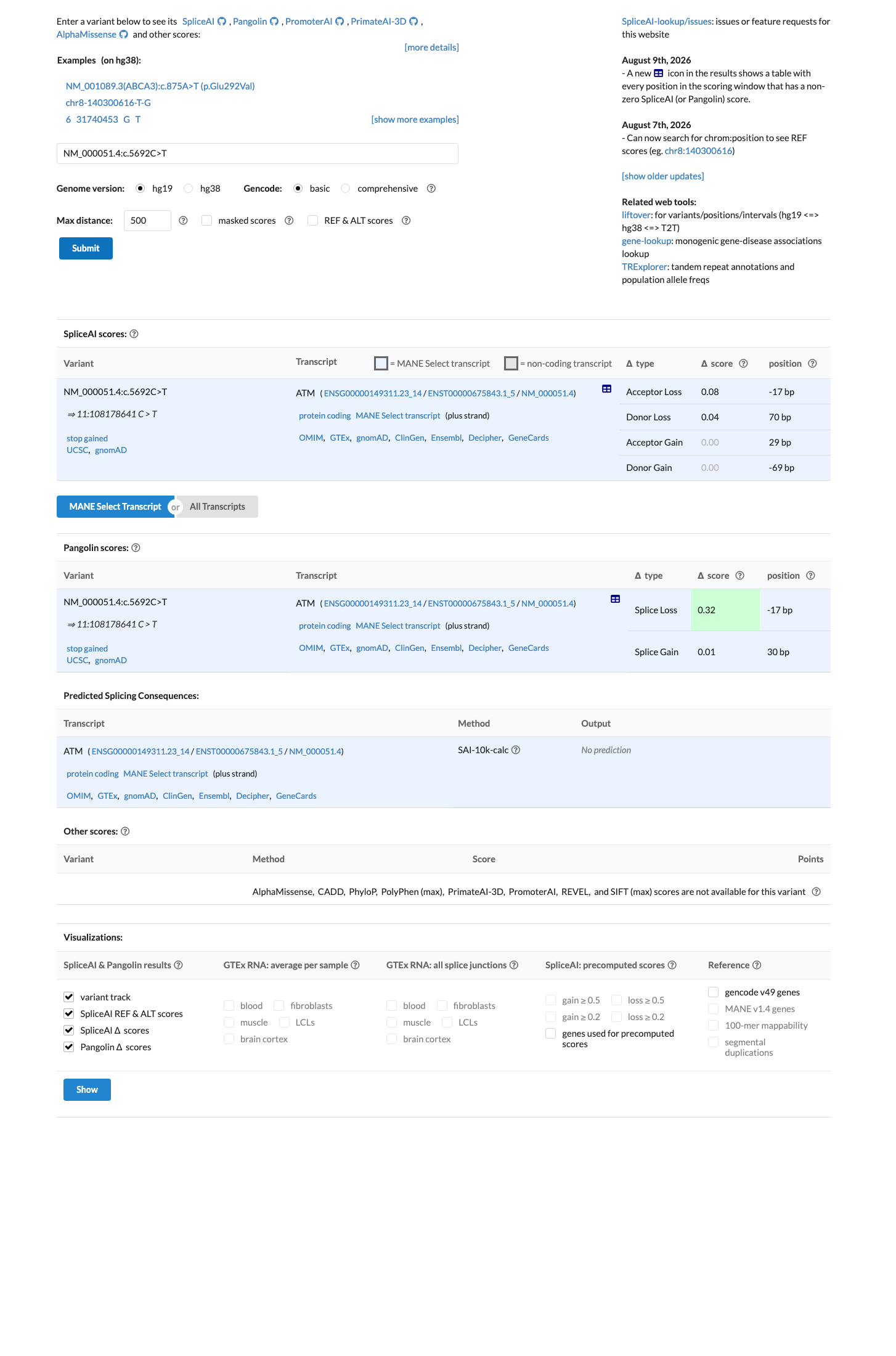
SpliceAI screenshot
In silico
SpliceAI predicts no significant splice impact for this variant (max delta score = 0.08). BayesDel score = 0.295247.
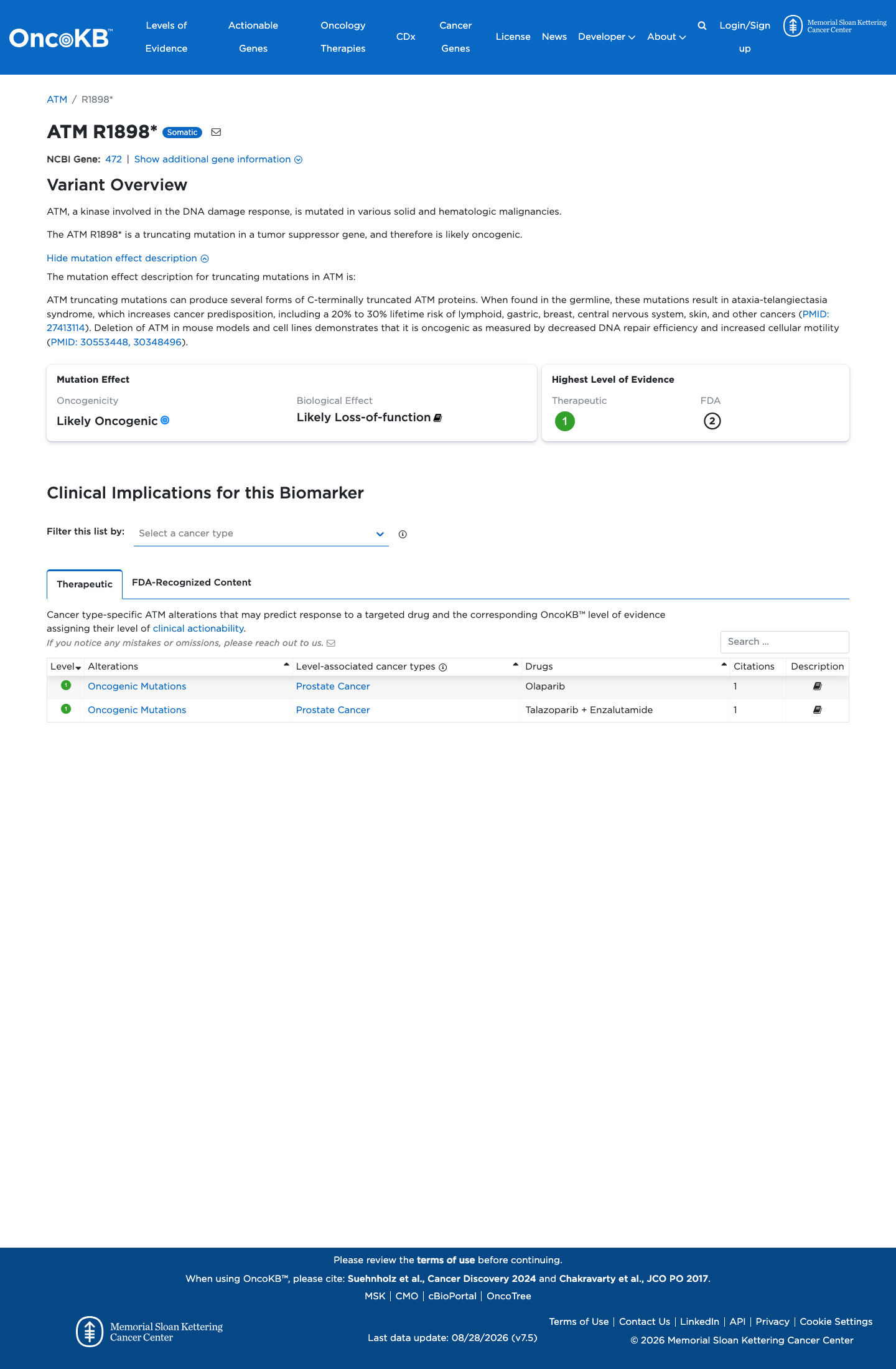
Functional / OncoKB screenshot
Functional Likely Oncogenic
OncoKB identified variant-specific curated literature and context relevant to functional review; biological-effect context: Likely Loss-of-function; curated oncogenicity label: Likely Oncogenic.
OncoKB ↗
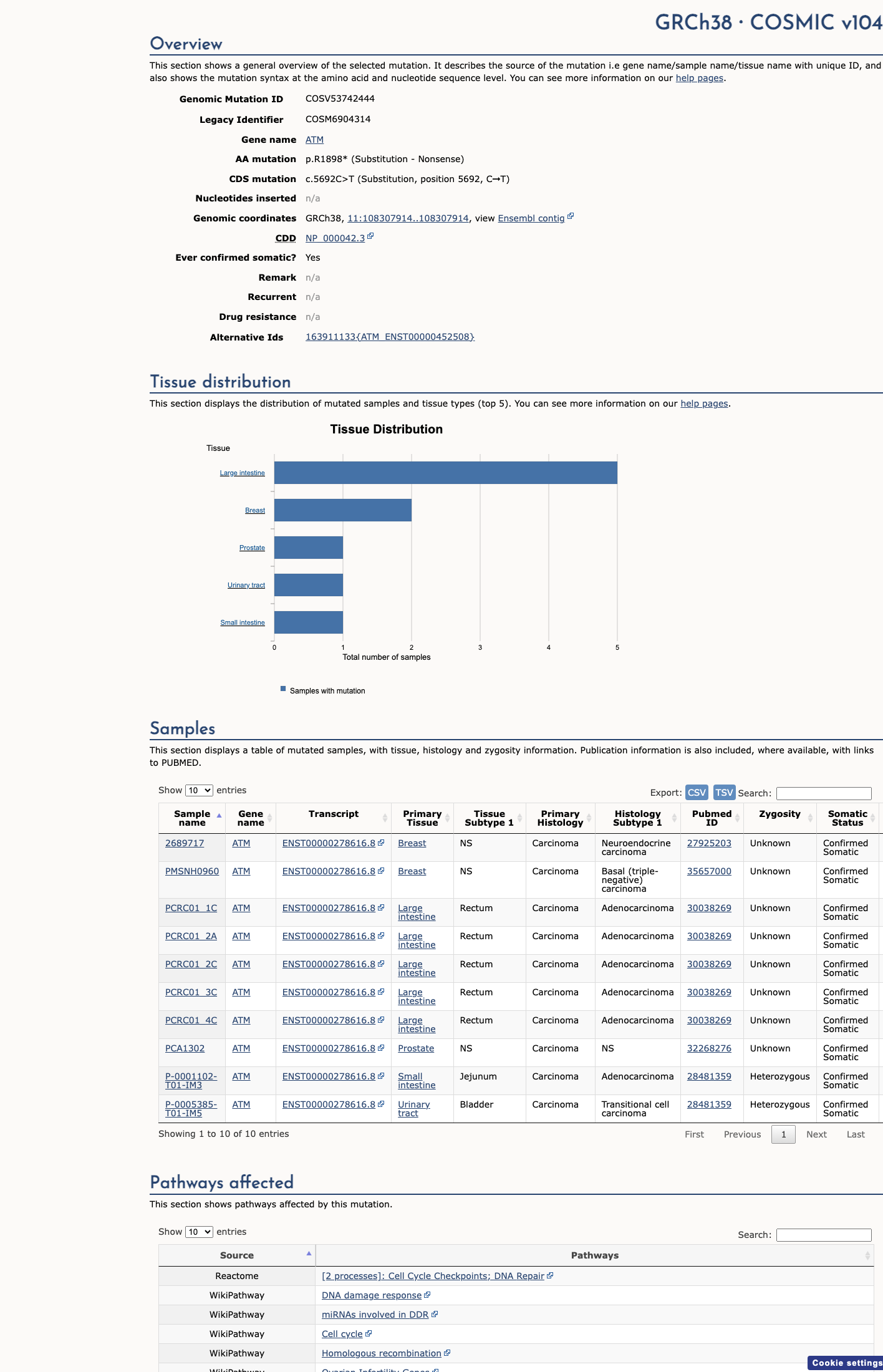
COSMIC screenshot
COSMIC
Cancer hotspots screenshot
Cancer hotspots
Somatic evidence Not in COSMIC / hotspots
COSMIC
This variant does not lie in a statistically significant hotspot. This variant has previously been reported in somatic cancers (COSMIC; COSV53742444, n = 10 times).
Hotspots
This variant does not lie in a statistically significant hotspot.
Literature · how each cited paper was used
7papers cited
Each card is an audit: what was searched, what was found, whether it names the variant, which criteria it fed, and why. 2 further PMIDs triaged but not cited — see Sources & references.
DHPLC screening of ATM gene in Italian patients affected by ataxia-telangiectasia: fourteen novel ATM mutations.
Searched
c.5692C>Tp.(R1898*)NP_000042.3:p.(R1898*)
Found
The paper reports the ATM c.5692C>T variant, corresponding to p.(R1898*) (shown as R1898X), in a patient with classical ataxia-telangiectasia (patient AT50RM, heterozygous). It was classified by the authors as a nonsense mutation with a predicted truncated protein effect and reported as a novel mutation in this study. This establishes the variant as a bona fide germline null allele in an A-T patient.
Variant
✓ Names this variant — characterised directly
Applied to
PVS1 very strong
Confirms c.5692C>T is a germline nonsense (truncating) ATM mutation identified in an A-T patient, supporting its classification as a null variant under the ATM VCEP PVS1 decision tree.
PM2 supporting
PM3 strong
A-T proband AT50RM is heterozygous for c.5692C>T together with a second null allele (IVS37+2T>C); scored as confident phenotype, phase unknown (2.0 PM3 points) since parental phase testing was not reported.
PM5 supporting
Directly documents c.5692C>T/p.R1898Ter as a nonsense variant with a truncated-protein consequence, satisfying the ATM VCEP PM5 variant-class and position rule.
40 AT50RM (het) 5692C>T R1898X Nonsense/Truncated protein This report
Location Table 3, Mutations detected in the ATM gene  ·  Context DHPLC screening followed by bidirectional direct sequencing of the ATM coding exons in 22 patients with classical ataxia-telangiectasia (21 Italian and 1 Japanese patient).  ·  full text
A-TWinnipeg: Pathogenesis of rare ATM missense mutation c.6200C&gt;A with decreased protein expression and downstream signaling, early-onset dystonia, cancer, and life-threatening radiotoxicity.
Searched
c.5692C>TNP_000042.3:p.(R1898*)
Found
The paper explicitly identifies ATM c.5692C>T as the second mutation in patient-derived lymphoblastoid cell line AT213LA, which also carried c.6200C>A (p.A2067D). The variant was discovered after cycloheximide treatment inhibited nonsense-mediated mRNA decay, allowing the c.5692C>T allele to be detected by RNA sequencing and confirmed by genomic DNA sequencing. This is direct experimental evidence that the c.5692C>T transcript is degraded by NMD, and that the variant acts in trans with another ATM mutation in a patient with an atypical A-T phenotype.
Variant
✓ Names this variant — characterised directly
Applied to
PVS1 very strong
Directly demonstrates this allele is NMD-prone (detectable only after cycloheximide NMD inhibition), satisfying the NMD requirement for PVS1_VeryStrong in the ATM VCEP decision tree.
PM2 supporting
PM3 strong
A-T proband AT213LA carries c.5692C>T confirmed in trans with the P/LP founder variant c.6200C>A (p.A2067D) by haplotyping; scored as confident phenotype, confirmed in trans (4.0 PM3 points).
PM5 supporting
Confirms the exact variant identity in a patient-derived sample; used with the case normalization and ATM VCEP rule for PM5.
This RNA showed the c.6200C>A variant as a heterozygous change (Fig. 3A, bottom) and we were subsequently able to identify the second mutation in AT213LA as c.5692C>T (Fig. 3B bottom sequencing panel).
Location Results, Measurement of nonsense-mediated mRNA decay, paragraph 1  ·  Context Mutation analysis of patient-derived lymphoblastoid cell-line RNA and genomic DNA, with cycloheximide treatment to inhibit nonsense-mediated mRNA decay; AT213LA carried c.5692C>T in trans with c.6200C>A.  ·  full text
Rule & framework references · cited for criterion definitions, not variant evidence
21665257 ↗ Morbidity and mortality from ataxia-telangiectasia are associated with ATM genotype.
23807571 ↗ Twelve novel Atm mutations identified in Chinese ataxia telangiectasia patients.
27413114 ↗ ATM Mutations in Cancer: Therapeutic Implications.
30348496 ↗ Inactive Atm abrogates DSB repair in mouse cerebellum more than does Atm loss, without causing a neurological phenotype.
30553448 ↗ Loss of ATM positively regulates Rac1 activity and cellular migration through oxidative stress.
Sources & reference links
9Sources
CSpec VCEP
ClinVar
gnomAD v2.1
gnomAD v4.1
gnomAD-Canada
SpliceAI
OncoKB
COSMIC
Cancer hotspots
Triaged references · 2 PMIDs not cited in assessment
23454770 ↗ p53 centrosomal localization diagnoses ataxia-telangiectasia homozygotes and heterozygotes. CLINVAR
28492532 ↗ Sherloc: a comprehensive refinement of the ACMG-AMP variant classification criteria. CLINVAR