Back
NM_000051.4:c.5937A>G
p.Glu1979= · ATM
0%
complete
Final classification
Likely Benign
PM2PP3BS3BP7
ATM
c.5937A>G
p.Glu1979=
synonymous · exon 40

ATM encodes a kinase that acts as a master controller of the cellular DNA damage response: it detects double-strand breaks and coordinates DNA repair, cell cycle arrest, or apoptosis through downstream targets including p53, BRCA1, and CHK2. Loss-of-function mutations in both copies of ATM cause ataxia telangiectasia, an autosomal recessive disorder characterized by neurological problems, immune deficiency, and cancer predisposition. ATM functions as a tumor suppressor: individuals with ataxia telangiectasia are prone to childhood lymphomas, leukemias, and breast cancer, while carriers of a single altered copy have increased risk of breast, pancreatic, prostate, and other cancers. Somatic ATM mutations also occur in lymphoid malignancies and solid tumors, and ATM-deficient cancers are often especially sensitive to DNA-damaging treatments.

This variant

ATM encodes a DNA-damage-response kinase and tumor suppressor whose inherited loss-of-function variation is relevant to ataxia-telangiectasia and cancer predisposition.

Transcript
NM_000051.4
HGVS · transcript:coding
NM_000051.4:c.5937A>G
GRCh38
chr11:108312429 A>G
GRCh37
chr11:108183156 A>G
Likely Benign: BS3 (supporting) and BP7 (supporting) satisfy ATM VCEP Version 1.6 Rule19; PM2 and PP3 are additionally applied at supporting strength.
Classification rationale
PM2PP3 BS3BP7 Likely Benign
ATM c.5937A>G synonymous · exon 40

Likely Benign: BS3 supporting reflects high-confidence functional data classifying c.5937A>G as Functional. Likely Benign: BP7 supporting applies because c.5937A>G is synonymous. Supporting evidence: PM2 reflects absence from available gnomAD datasets. Supporting evidence: PP3 reflects a SpliceAI maximum delta of 0.247.

PM2 + PP3 + BS3 + BP7 Likely Benign
LYFE Sciences is an AI system, and it can make mistakes. Criteria may be applied incorrectly, sources may be misread, and a confident-looking classification can still be wrong. Double-check every criterion and its underlying evidence before relying on any call.
Gene diagram · NM_000051.4 · variants mapped to exon structure
ATM NM_000051.4
Fetching transcript structure from UCSC…
Applied criteria · 4 applied · 9 assessed
MetEvidence satisfies this criterion.
Not metEvaluated against available evidence; threshold not reached.
Not assessedApplies in principle, but no evidence was found to evaluate it.
N/ADoesn't apply to this variant type.
Applied · 4
Strength Supporting Moderate Strong Very strong
PM2 supporting Pathogenic
Met at Supporting: variant absent from gnomAD v2.1/v4.1 and non-cancer subsets, satisfying ATM VCEP's ≤0.001% highest-subpopulation frequency rule.
ATM VCEP version 1.6 defines PM2 Supporting as frequency ≤0.001% in the gnomAD subpopulation with the highest frequency; it also permits the criterion when a variant is absent.The variant is reported absent from gnomAD v2.1 and gnomAD v4.1, and absent from the available gnomAD v2.1 non-cancer and gnomAD v3.1 non-cancer datasets.The available population observations therefore support an allele frequency of 0 in these datasets, below the VCEP threshold.
PP3 supporting Pathogenic
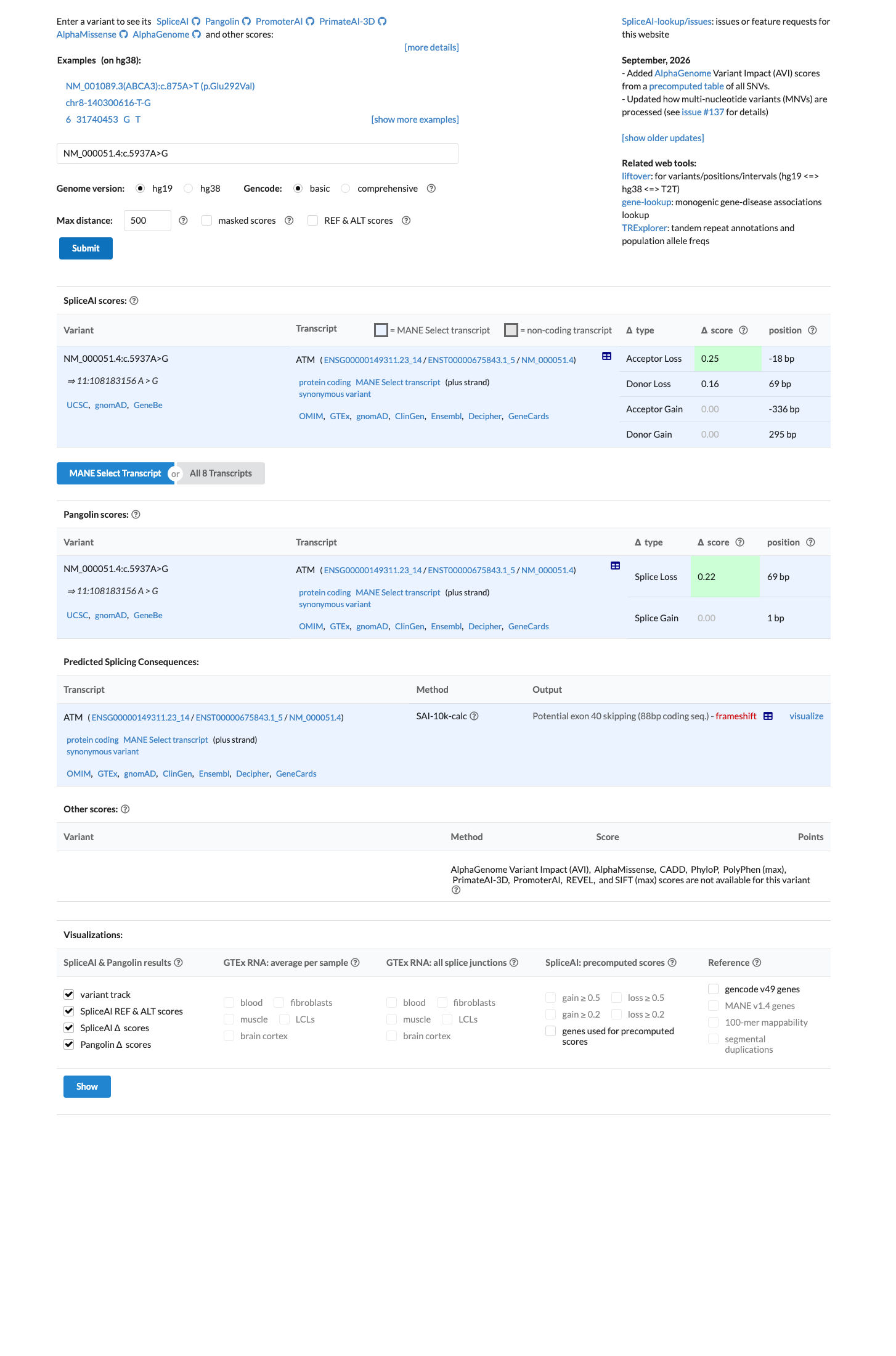
Met at supporting: SpliceAI maximum delta 0.247 meets the ATM VCEP PP3 threshold of >=0.2 for predicted splice impact.
ATM VCEP version 1.6 specifies PP3 supporting for silent variants with predicted splice impact by SpliceAI >=0.2.SpliceAI for NM_000051.4:c.5937A>G reports DS_AG 0.002, DS_AL 0.247, DS_DG 0.000, and DS_DL 0.157; the maximum delta is 0.247.The searched ATM VCEP file Suppl_TableS1_PMID 40580951.xlsx contains the exact c.5937A>G row but does not pre-assign PP3 or BP4 and has NA predictor fields for this synonymous row.
BS3 supporting review Benign
Met, Supporting: direct prime-editing data classify c.5937A>G as Functional with high confidence, but VCEP acceptance of this non-approved assay requires human review.
ATM VCEP BS3: use Moderate when a variant rescues both an ATM-specific feature and radiosensitivity, and Supporting when it rescues either an ATM-specific feature or radiosensitivity.Table S1 row 18967 for c.5937A>G / E1979E reports Variant_consequence=Synonymous, Combined_score=0.119400150926129, Classification=Functional, Confidence=High, and DeepATM_predicted=No.DeepATM_predicted=No indicates that the Table S1 classification is based on the underlying prime-editing saturation genome-editing measurement rather than a computational extrapolation.
BP7 supporting Benign
Met at supporting: ATM VCEP v1.6 assigns BP7 supporting to synonymous variants, and this variant is c.5937A>G (p.Glu1979=).
ATM VCEP version 1.6 specifies BP7 supporting for synonymous variants and states that BP7 is not considered conflicting evidence against a body of evidence supporting a pathogenic splice defect.NM_000051.4:c.5937A>G is annotated as synonymous, producing NP_000042.3:p.(Glu1979=).No variant-specific RNA evidence demonstrating lack of an aberrant splice defect was present, so BP7(RNA) was not assigned at a stronger variable strength.
Assessed · not applied · 4 not met · 5 not assessed
Pathogenic
PS1 Not assessed: SpliceAI max delta 0.247 exceeds the 0.2 splice-impact threshold, but no matching pathogenic reference event was found for the VCEP PS1 comparison.
PS3 Not met: Table S1 classifies c.5937A>G as Functional with high confidence, not as a loss-of-function result qualifying for ATM PS3.
PS4 Not assessed: no variant-specific case-control study, p-value, odds ratio, relative risk, hazard ratio, or confidence interval is available.
PM3 Not assessed: no affected-proband, homozygous, second-allele, or phase observation was available to assign the VCEP's PM3 points.
PP1 Not assessed: no affected-relative segregation, parental testing, or meiosis count is documented for applying the ATM VCEP PP1 thresholds.
Benign
BA1 Not met: gnomAD v2.1 and v4.1 report the variant as absent, not a group maximum filtering allele frequency above 0.5%.
BS1 Not met: gnomAD v2.1 and v4.1 report the variant as absent, not a group maximum filtering allele frequency above 0.05%.
BP2 Not assessed: no unaffected adult co-occurrence with a pathogenic ATM allele or phase evidence was available to assign the VCEP's BP2 points.
BP4 Not met: SpliceAI maximum delta 0.247 exceeds the ATM VCEP BP4 no-impact threshold of <=0.1.
N/A · 15 PVS1 · PS2 · PM1 · PM4 · PM5 · PM6 · PP2 · PP4 · PP5 · BS2 · BS4 · BP1 · BP3 · BP5 · BP6
Research & evidence
Population frequency · supports benign
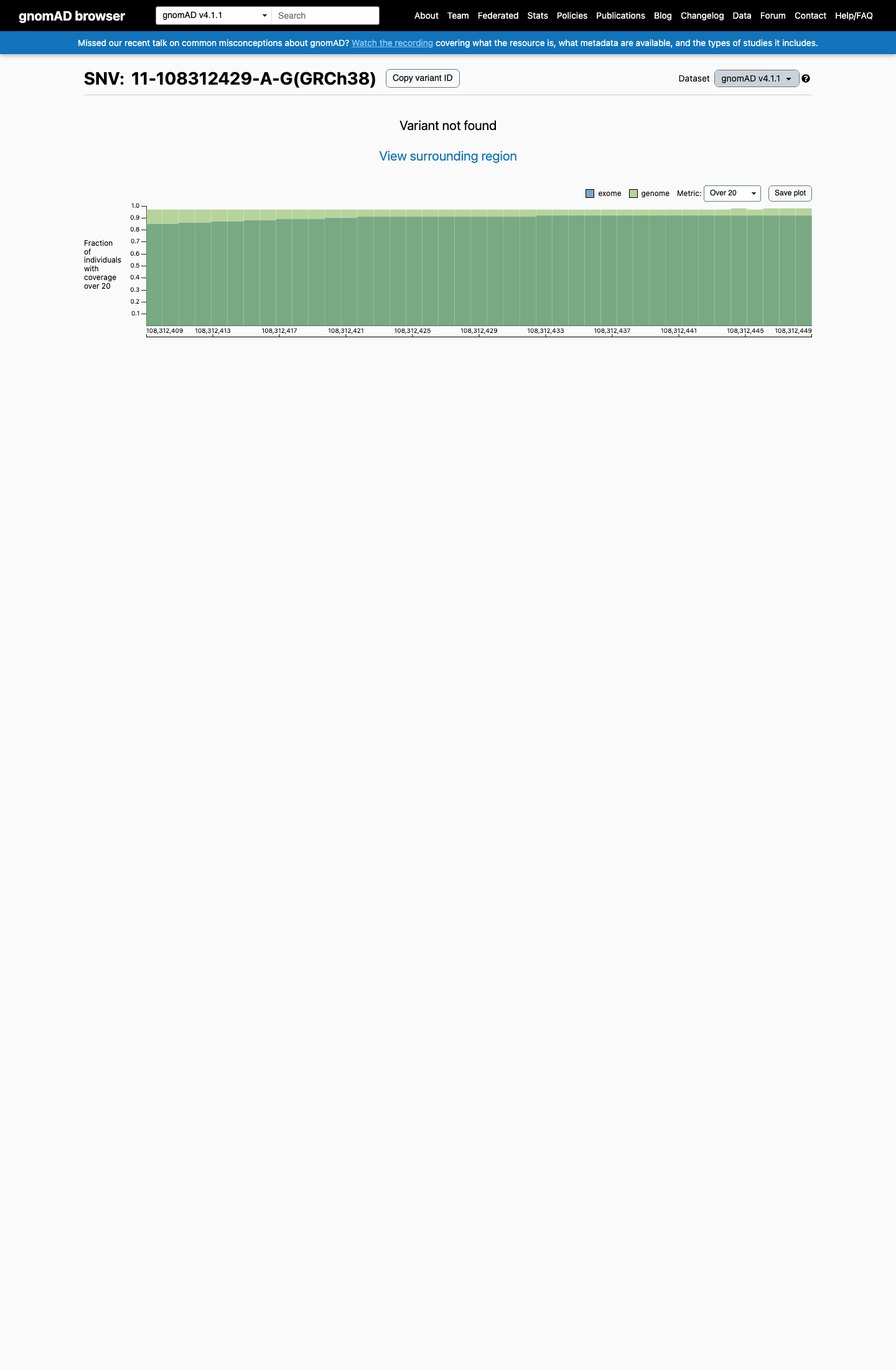
gnomAD v4.1 screenshot
gnomAD v4.1
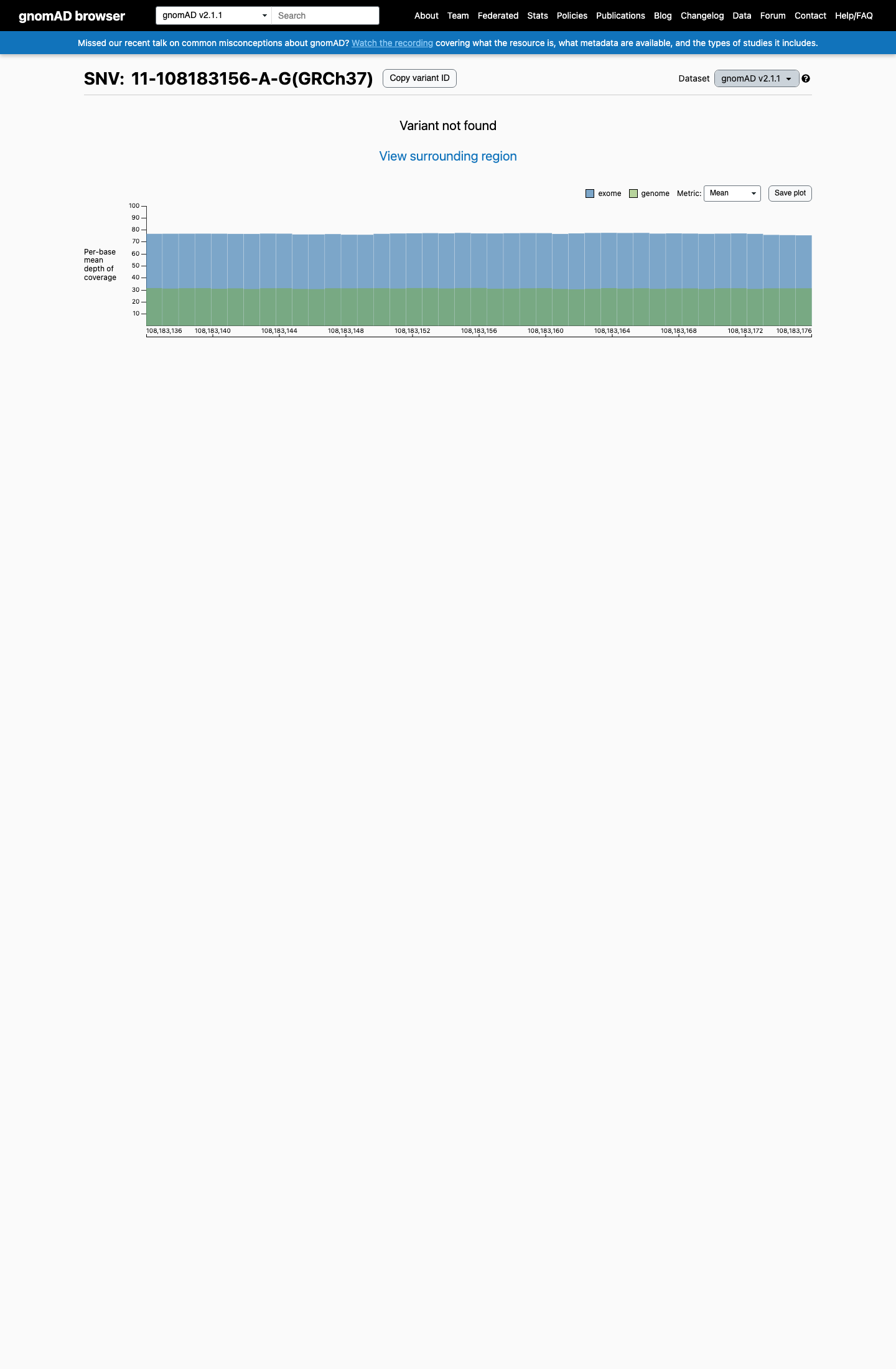
gnomAD v2.1 screenshot
gnomAD v2.1
v4.1
Absent from gnomAD v4.1.
v2.1
Absent from gnomAD v2.1.
🇨🇦 CA
Absent from gnomAD-Canada v1.0.
Allele frequency by ancestry
three datasets · side by side
gnomAD v4.1
Absent · 0 / ?
0 hom
Not observed in any ancestry group.
gnomAD v2.1
Absent · 0 / ?
0 hom
Not observed in any ancestry group.
gnomAD Canada 🇨🇦
Absent · 0 / ?
0 hom
Not observed in any ancestry group.
ClinVar screenshot
ClinVar
This variant has been reported in ClinVar as Likely benign (2 clinical laboratories) and as Benign (1 clinical laboratory). (ClinVarID = 1750598)
SpliceAI screenshot
In silico
SpliceAI predicts possible splice impact for this variant (max delta score = 0.25).
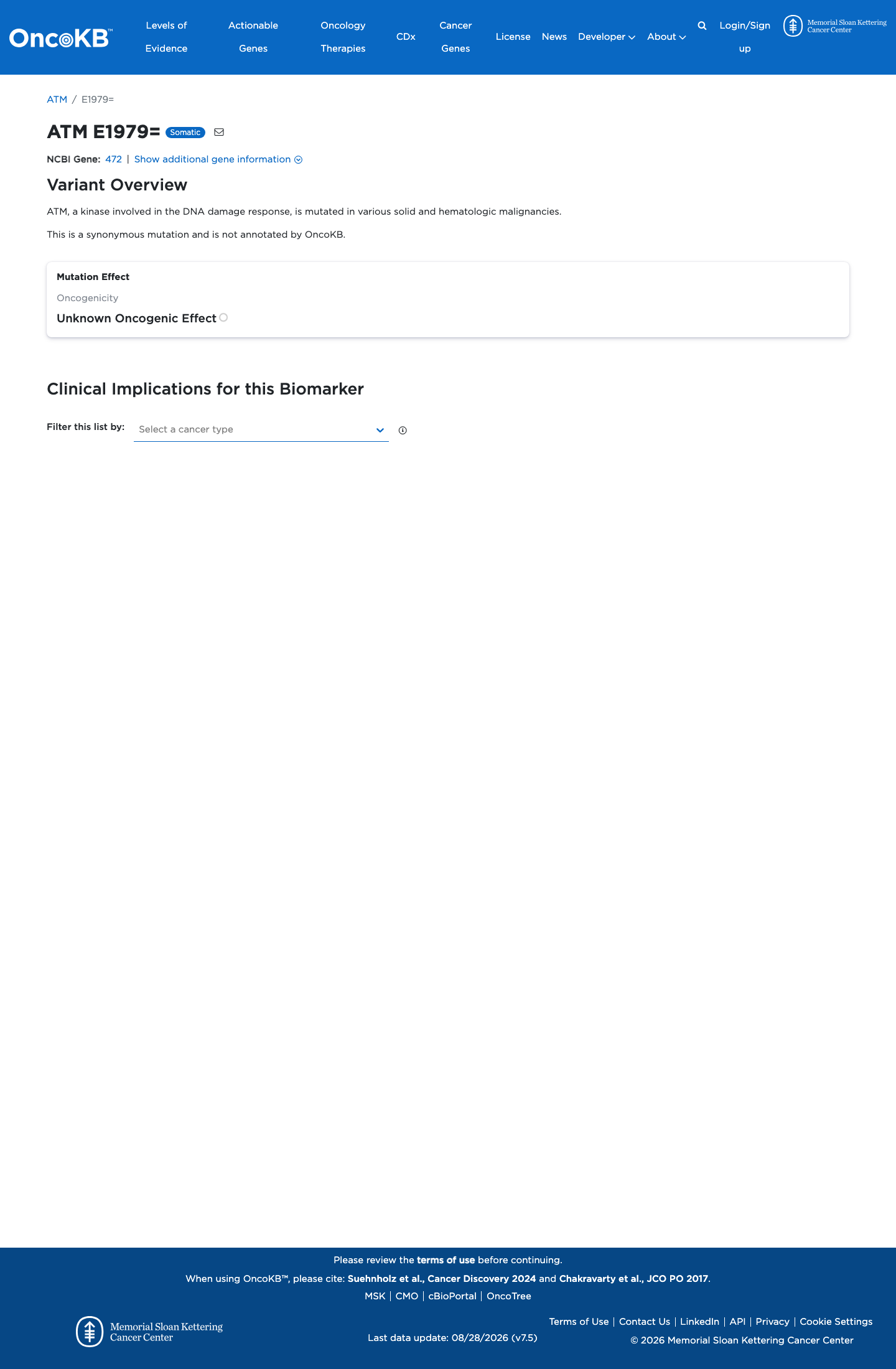
Functional / OncoKB screenshot
Functional Unknown Oncogenic Effect
OncoKB identified curated literature and non-variant-specific oncogenicity context for review; listed oncogenicity label: Unknown Oncogenic Effect.
OncoKB ↗
COSMIC screenshot
COSMIC
Cancer hotspots screenshot
Cancer hotspots
Somatic evidence Not in COSMIC / hotspots
COSMIC
This variant does not lie in a statistically significant hotspot. This variant has not previously been reported in somatic cancers (COSMIC).
Hotspots
This variant does not lie in a statistically significant hotspot.
Literature · how each cited paper was used
1papers cited
Each card is an audit: what was searched, what was found, whether it names the variant, which criteria it fed, and why. 6 further PMIDs triaged but not cited — see Sources & references.
PMID 40580951
Found
Structured finding pending for this record — see source link.
Applied to
BS3 supporting
The direct Functional/High/No result supports retained function and is the basis for tentative BS3_Supporting, pending VCEP acceptance of the assay.
Sources & reference links
9Sources
CSpec VCEP
ClinVar
gnomAD v2.1
gnomAD v4.1
gnomAD-Canada
SpliceAI
OncoKB
COSMIC
Cancer hotspots
Triaged references · 6 PMIDs not cited in assessment
24366402 ↗ Summaries for patients. Assessing the genetic risk for BRCA-related breast or ovarian cancer in women: recommendations from the U.S. Preventive Services Task Force. CLINVAR
24418350 ↗ EFNS/ENS Consensus on the diagnosis and management of chronic ataxias in adulthood. CLINVAR
31429903 ↗ Risk Assessment, Genetic Counseling, and Genetic Testing for BRCA-Related Cancer: US Preventive Services Task Force Recommendation Statement. CLINVAR
31479213 ↗ PMID 31479213 CLINVAR
34012068 ↗ ACMG SF v3.0 list for reporting of secondary findings in clinical exome and genome sequencing: a policy statement of the American College of Medical Genetics and Genomics (ACMG). CLINVAR
28492532 ↗ Sherloc: a comprehensive refinement of the ACMG-AMP variant classification criteria. CLINVAR