Analysis in progress
Initialising…
0%
complete
This report is still being assembled — sections appear as each stage finishes. It isn't final yet.
ATM
Final classification
Pathogenic
PVS1PM2PM5
ATM
c.7628dup
p.Asn2543LysfsTer5
frameshift · exon 51

ATM encodes a kinase that acts as a master controller of the cellular DNA damage response: it detects double-strand breaks and coordinates DNA repair, cell cycle arrest, or apoptosis through downstream targets including p53, BRCA1, and CHK2. Loss-of-function mutations in both copies of ATM cause ataxia telangiectasia, an autosomal recessive disorder characterized by neurological problems, immune deficiency, and cancer predisposition. ATM functions as a tumor suppressor: individuals with ataxia telangiectasia are prone to childhood lymphomas, leukemias, and breast cancer, while carriers of a single altered copy have increased risk of breast, pancreatic, prostate, and other cancers. Somatic ATM mutations also occur in lymphoid malignancies and solid tumors, and ATM-deficient cancers are often especially sensitive to DNA-damaging treatments.

This variant

ATM is a tumor suppressor whose loss-of-function mutations cause ataxia telangiectasia when biallelic and increase cancer risk in single-copy carriers. This Pathogenic frameshift truncates the ATM kinase and is predicted to trigger nonsense-mediated decay, so it is expected to abolish ATM function and carry clinical significance for cancer risk in this individual and family.

Transcript
NM_000051.4
HGVS · transcript:coding
NM_000051.4:c.7628dup
GRCh38
chr11:108331554 T>TA
GRCh37
chr11:108202281 T>TA
Basis Pathogenic: ATM VCEP v1.5 Rule4 is met by one very strong criterion (PVS1) and two supporting criteria (PM2, PM5).
Pathogenic: ATM VCEP v1.5 Rule4 is met by one very strong criterion (PVS1) and two supporting criteria (PM2, PM5).
Classification rationale
PVS1PM2PM5 Pathogenic
ATM c.7628dup frameshift · exon 51

PVS1 (Very Strong): one-base frameshift p.(Asn2543LysfsTer5) predicted to trigger nonsense-mediated decay, truncating about 510 residues. PM2 (Supporting): absent from gnomAD v4.1, below the <=0.001% population frequency threshold. PM5 (Supporting): premature termination upstream of the p.Arg3047 ATM truncation cutoff. Pathogenic: ATM VCEP v1.5 Rule4, combining 1 very strong and 2 supporting criteria.

PVS1 + PM2 + PM5 Pathogenic
Gene diagram · NM_000051.4 · variants mapped to exon structure
ATM NM_000051.4
Fetching transcript structure from UCSC…
Applied criteria · 3 applied · 8 assessed
MetEvidence satisfies this criterion.
Not metEvaluated against available evidence; threshold not reached.
Not assessedApplies in principle, but no evidence was found to evaluate it.
N/ADoesn't apply to this variant type.
Applied · 3
Strength Supporting Moderate Strong Very strong
PVS1 very strong Pathogenic
Met: one-base frameshift creates premature stop codon p.(Asn2543LysfsTer5) predicted to trigger nonsense-mediated decay, truncating about 510 residues.
Case normalization identifies NM_000051.4:c.7628dup as NP_000042.3:p.(Asn2543LysfsTer5), with the reference protein ending at residue 3057 and the predicted frameshift product ending at residue 2547 before the stop.Transcript exon coordinates place c.7628 in exon 51; multiple coding exons remain downstream, supporting nonsense-mediated decay of the premature-termination transcript.The ATM VCEP v1.5 PVS1 guide defines frameshift variants as null-variant candidates in ATM, states that loss of function is a known disease mechanism, and considers all exons of its default transcript constitutive; its caution concerns only loss-of-function variants at the extreme 3′ end or splice variants with in-frame exon skipping, neither of which describes this variant.
PM2 supporting Pathogenic
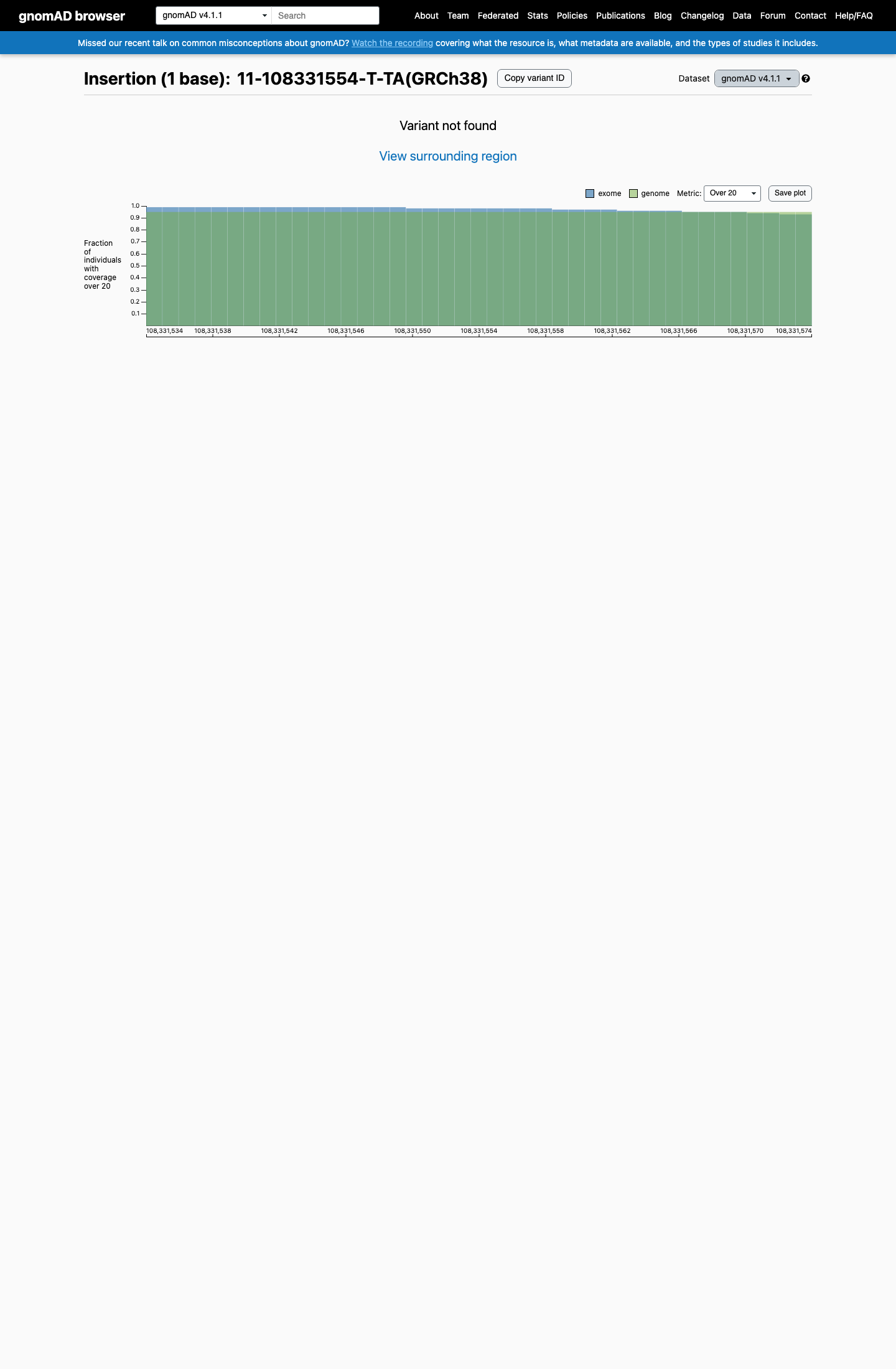
Met (supporting): absent from gnomAD v4.1, below the <=0.001% frequency threshold.
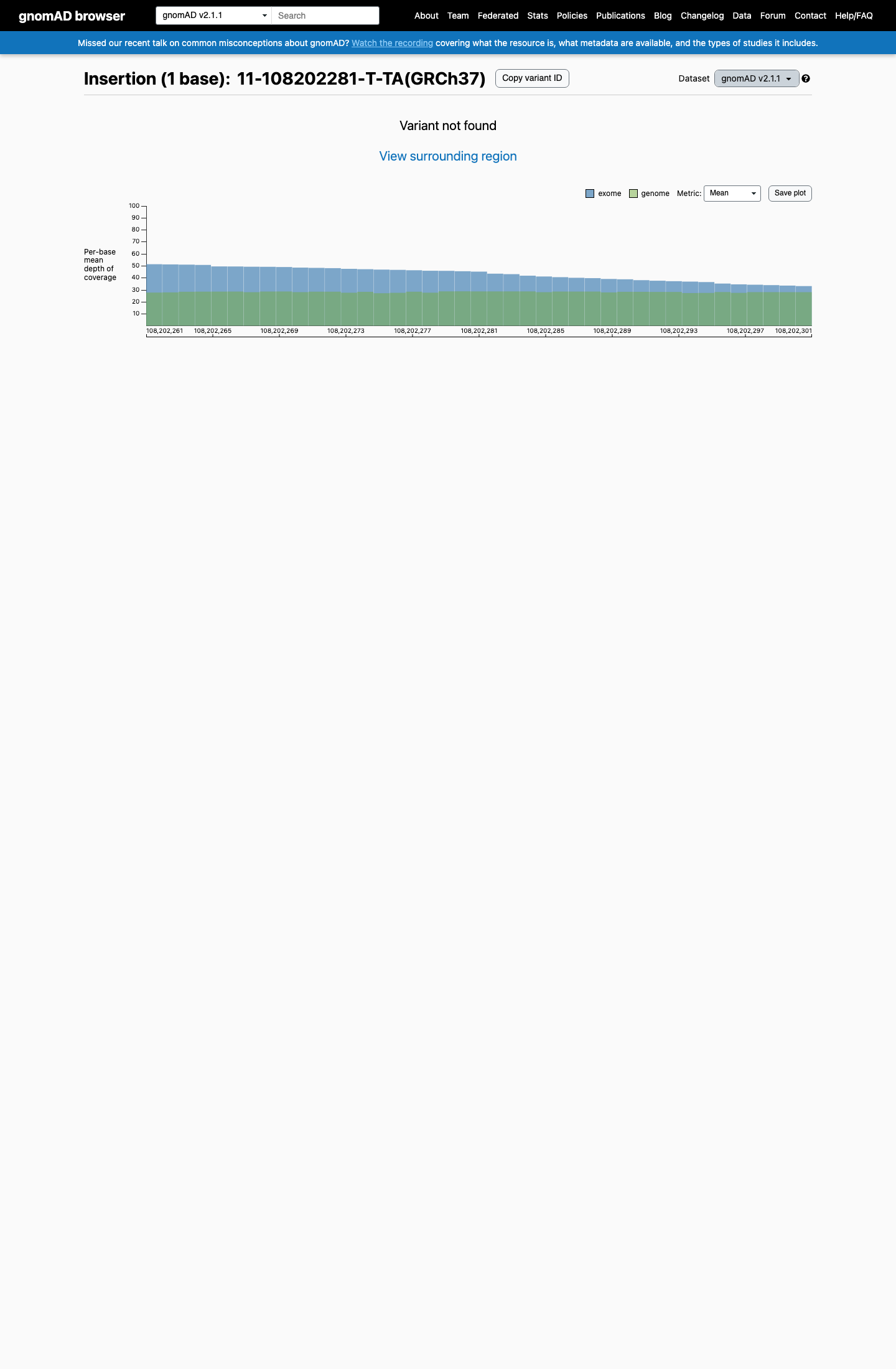
The ClinGen HBOP ATM VCEP version 1.5 PM2 rule applies at supporting strength when frequency is <=0.001% in gnomAD v4; n=1 in a single subpopulation is also sufficient for PM2_Supporting.gnomAD v4.1 reports the variant as absent.The variant is additionally reported absent from gnomAD v2.1 and gnomAD-Canada v1.0; no homozygote or ancestry-specific frequency is reported.
PM5 supporting Pathogenic
Met (supporting): the premature stop at approximately p.2547 lies upstream of the p.Arg3047 ATM truncation cutoff.
ClinGen HBOP ATM VCEP v1.5 PM5 rule: apply to frameshifting or truncating variants with premature termination codons upstream of p.Arg3047; the rule lists Supporting as the applicable strength.Case normalization identifies NM_000051.4:c.7628dup as NP_000042.3:p.(Asn2543LysfsTer5), placing the premature termination before p.Arg3047.pm5_candidates.json identifies the governing ATM PM5 mode as truncation_cutoff_gene_specific and states that classic same-residue missense searching is not eligible for this non-missense variant.
Assessed · not applied · 2 not met · 6 not assessed
Pathogenic
PS3 Not assessed: no variant-specific validated functional assay result was available.
PS4 Not assessed: no case-control study met the required threshold (p-value <=0.05 and odds/hazard/relative risk >=2).
PM3 Not assessed: no affected proband, second variant, or trans-phase observation was available to assign points.
PP1 Not assessed: no affected relatives, pedigree genotypes, or phase information was available for segregation analysis.
Benign
BA1 Not met: absent from gnomAD v4.1, far below the >0.5% filtering allele frequency threshold.
BS1 Not met: absent from gnomAD v4.1, below the >0.05% disease-compatible frequency threshold.
BS3 Not assessed: no variant-specific functional assay demonstrating normal ATM function was available.
BP2 Not assessed: no unaffected co-occurrence, second variant, or phase information was available.
N/A · 17 PS1 · PS2 · PM1 · PM4 · PM6 · PP2 · PP3 · PP4 · PP5 · BS2 · BS4 · BP1 · BP3 · BP4 · BP5 · BP6 · BP7
Research & evidence
Population frequency · supports pathogenic
gnomAD v4.1 screenshot
gnomAD v4.1
gnomAD v2.1 screenshot
gnomAD v2.1
v4.1
Absent from gnomAD v4.1.
v2.1
Absent from gnomAD v2.1.
🇨🇦 CA
Absent from gnomAD-Canada v1.0.
Allele frequency by ancestry
three datasets · side by side
gnomAD v4.1
Absent · 0 / ?
0 hom
Not observed in any ancestry group.
gnomAD v2.1
Absent · 0 / ?
0 hom
Not observed in any ancestry group.
gnomAD Canada 🇨🇦
Absent · 0 / ?
0 hom
Not observed in any ancestry group.
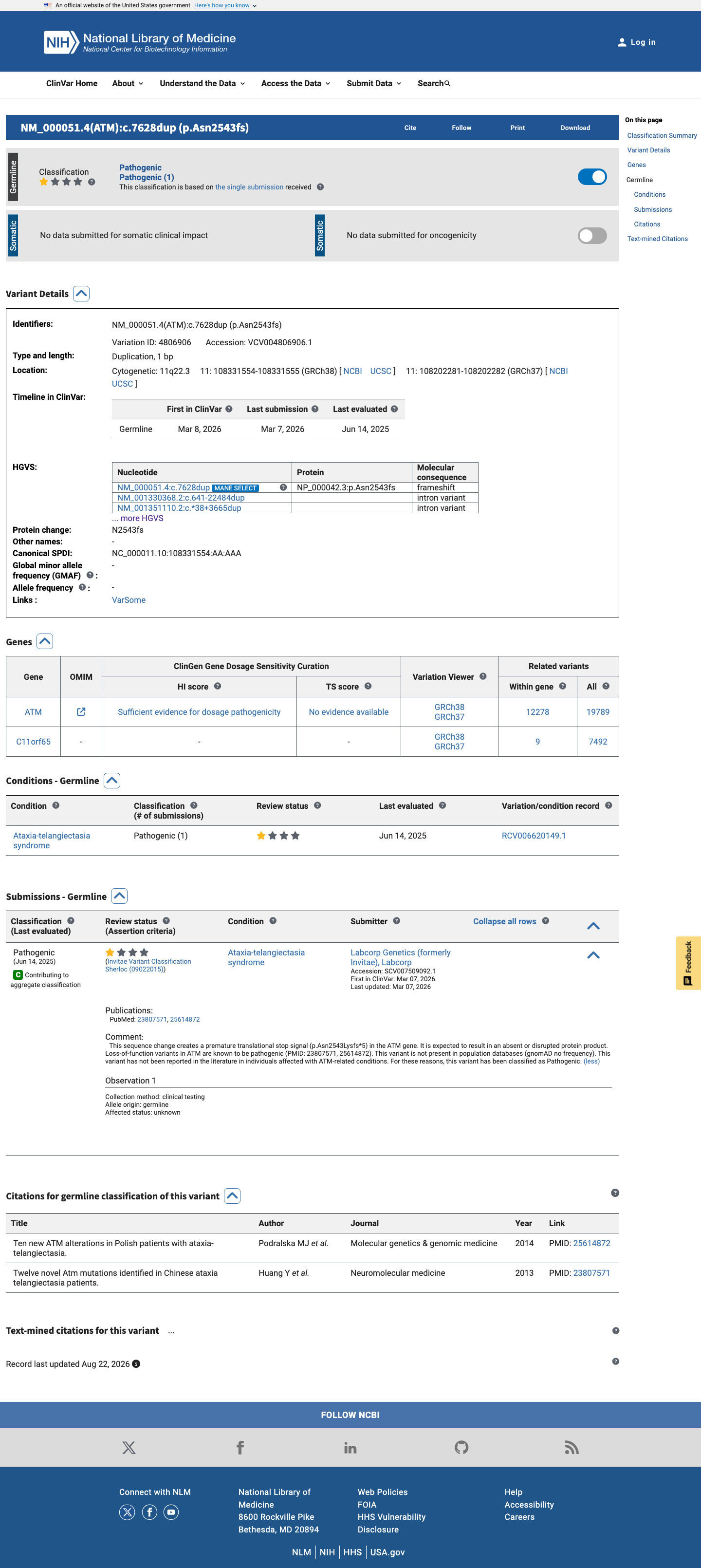
ClinVar screenshot
ClinVar
This variant has been reported in ClinVar as Pathogenic (1 clinical laboratory). (ClinVarID = 4806906)
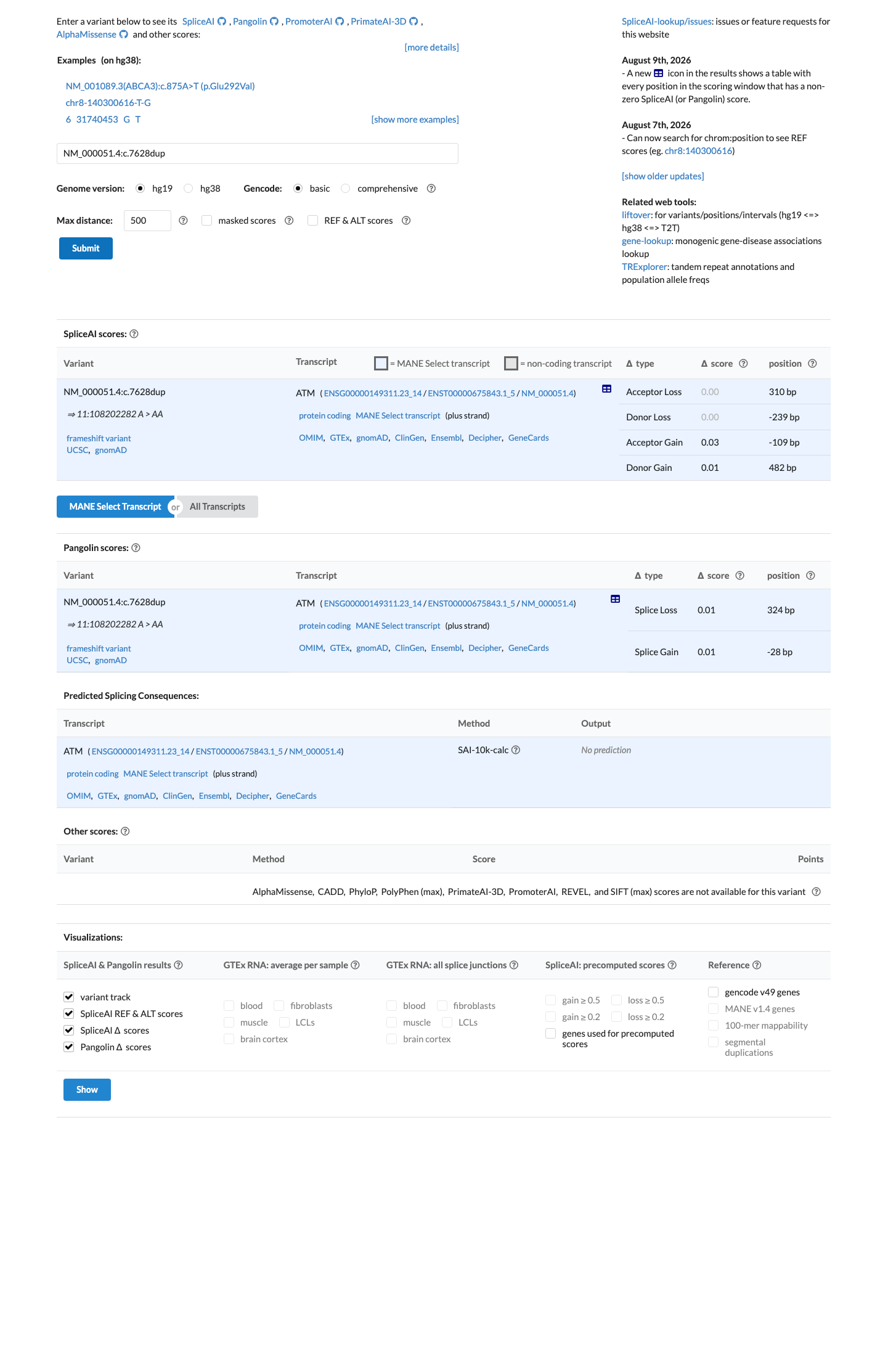
SpliceAI screenshot
In silico
SpliceAI predicts no significant splice impact for this variant (max delta score = 0.03).
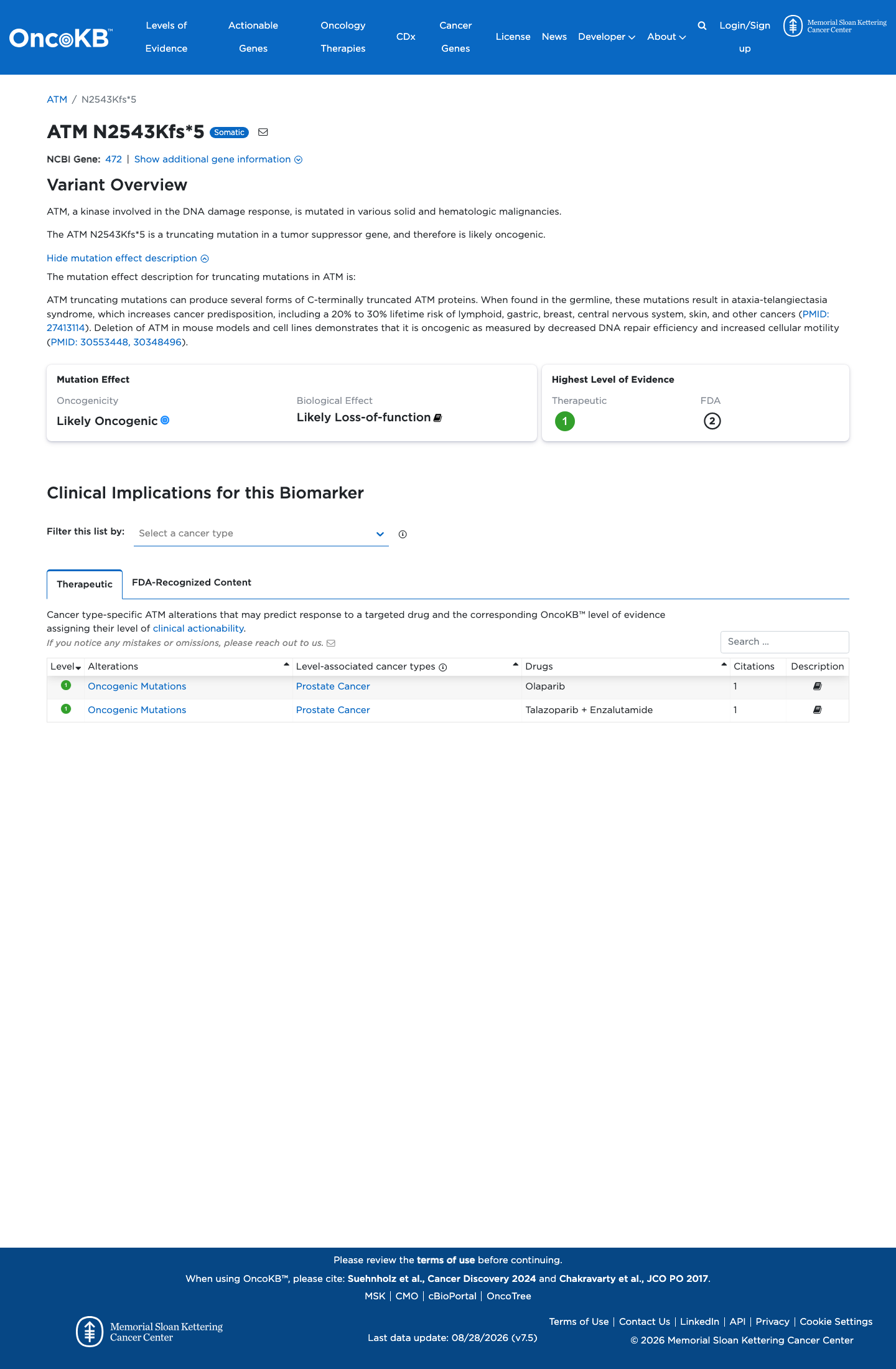
Functional / OncoKB screenshot
Functional Likely Oncogenic
OncoKB identified variant-specific curated literature and context relevant to functional review; biological-effect context: Likely Loss-of-function; curated oncogenicity label: Likely Oncogenic.
OncoKB ↗
COSMIC screenshot
COSMIC
Cancer hotspots screenshot
Cancer hotspots
Somatic evidence Not in COSMIC / hotspots
COSMIC
This variant does not lie in a statistically significant hotspot. This variant has not previously been reported in somatic cancers (COSMIC).
Hotspots
This variant does not lie in a statistically significant hotspot.
Sources & reference links
9Sources
CSpec VCEP
ClinVar
gnomAD v2.1
gnomAD v4.1
gnomAD-Canada
SpliceAI
OncoKB
COSMIC
Cancer hotspots
Triaged references · 9 PMIDs not cited in assessment
27413114 ↗ ATM Mutations in Cancer: Therapeutic Implications. ONCOKB
30348496 ↗ Inactive Atm abrogates DSB repair in mouse cerebellum more than does Atm loss, without causing a neurological phenotype. ONCOKB
30553448 ↗ Loss of ATM positively regulates Rac1 activity and cellular migration through oxidative stress. ONCOKB
23807571 ↗ Twelve novel Atm mutations identified in Chinese ataxia telangiectasia patients. CLINVAR
25614872 ↗ Ten new ATM alterations in Polish patients with ataxia-telangiectasia. CLINVAR
20301317 ↗ Hereditary Ataxia Overview. CLINVAR
20301790 ↗ Ataxia-Telangiectasia. CLINVAR
24418350 ↗ EFNS/ENS Consensus on the diagnosis and management of chronic ataxias in adulthood. CLINVAR
20050888 ↗ EFNS guidelines on the molecular diagnosis of ataxias and spastic paraplegias. CLINVAR