ATM encodes a kinase that acts as a master controller of the cellular DNA damage response: it detects double-strand breaks and coordinates DNA repair, cell cycle arrest, or apoptosis through downstream targets including p53, BRCA1, and CHK2. Loss-of-function mutations in both copies of ATM cause ataxia telangiectasia, an autosomal recessive disorder characterized by neurological problems, immune deficiency, and cancer predisposition. ATM functions as a tumor suppressor: individuals with ataxia telangiectasia are prone to childhood lymphomas, leukemias, and breast cancer, while carriers of a single altered copy have increased risk of breast, pancreatic, prostate, and other cancers. Somatic ATM mutations also occur in lymphoid malignancies and solid tumors, and ATM-deficient cancers are often especially sensitive to DNA-damaging treatments.
This variant
By disrupting ATM pre-mRNA splicing, this variant affects a tumor-suppressor gene whose loss of function contributes to ataxia-telangiectasia and cancer predisposition.
Transcript
NM_000051.4
HGVS · transcript:coding
NM_000051.4:c.7630-2A>C
GRCh38
chr11:108331877 A>C
GRCh37
chr11:108202604 A>C
VUS: PVS1 (very strong) and PM3 (very strong) are applied, but the ATM VCEP Version 1.6 has no satisfied combination rule for these criteria alone.
Classification rationale
PVS1PM3VUS
ATM c.7630-2A>Ccanonical_splice · exon 51i
PVS1 very strong: the canonical splice-site variant causes aberrant ATM splicing and absent ATM protein. PM3 very strong: 10.0 aggregated affected A-T observations exceed the ATM VCEP threshold of 8 points.
PVS1 + PM3→VUS
LYFE Sciences is an AI system, and it can make mistakes. Criteria
may be applied incorrectly, sources may be misread, and a confident-looking
classification can still be wrong. Double-check every criterion and
its underlying evidence before relying on any call.
Gene diagram
· NM_000051.4 · variants mapped to exon structure
ATMNM_000051.4
Fetching transcript structure from UCSC…
Exons
—
Transcript span
—
Strand
—
Variants mapped
—
Source
UCSC ncbiRefSeqCurated
All variants in ATM—click a row to locate it on the plot · use the link column to open its page
Protein
Location
Classification
Link
Applied criteria · 2 applied · 11 assessed
MetEvidence satisfies this criterion.
Not metEvaluated against available evidence; threshold not reached.
Not assessedApplies in principle, but no evidence was found to evaluate it.
N/ADoesn't apply to this variant type.
Applied · 2
Strength Supporting Moderate Strong Very strong
✓
PVS1very strongreviewPathogenic
Met, very strong: canonical -2 splice-site disruption caused aberrant transcripts and absent ATM protein, with no applicable VCEP downgrade rule.
NM_000051.4:c.7630-2A>C is annotated as a canonical splice acceptor (-2) variant with protein consequence NP_000042.3:p.?; the case-level assessment identifies affected exon 52 of 63, 159 coding nucleotides, and an in-frame exon-skipping prediction.ATM_PVS1_1.6.pdf governing text: the VCEP defines PVS1-eligible null variants to include canonical +/-1 or 2 splice sites and states that all exons of the default RefSeq transcript can be considered constitutive without major alternate splice isoforms that could rescue presumed loss-of-function events.PMID:10330348, Results and Table 2: exact variant IVS53-2A>C caused skipping of exon 54; the study used genomic sequencing, cDNA analysis, and ATM protein western blotting.
Met, 10.0 aggregated PM3 points from one confirmed-in-trans A-T case plus additional affected-family observations exceeds the VCEP Very Strong threshold of 8 points.
ATM_PM3_BP2_1.6.pdf, Ataxia Telangiectasia PM3/BP2 table: confident A-T phenotype with confirmed in-trans pathogenic variant = 4.0 points; phase unknown = 2.0; second variant unidentified or VUS = 1.0; homozygous = 2.0; PM3 Very Strong requires at least 8 points.PMID:25374739, case report molecular-study paragraph: c.5692C>T/c.7630-2A>C, with the mother carrying c.5692C>T and the father carrying c.7630-2A>C; the reported child had A-T clinical and laboratory findings. Assigned 4.0 points for confident phenotype and confirmed trans phase.PMID:9887333, Table 1 and results: c.7630-2A>C was found in Aa002, Aa009, Aa051 as heterozygous samples and Ac049 as a homozygous sample; assigned 3.0 points for the three heterozygous observations with second variant/phase not established and 2.0 points for the homozygous observation.
Assessed · not applied
· 4 not met · 7 not assessed
Pathogenic
PS1Not assessed: observed exon-54 splicing defects are documented, but no separate known pathogenic reference variant with the same event is identified in the governing PS1 table.
PS3Not assessed: the Sun Table S1 row has Confidence=NA and DeepATM_predicted=NA, while the VCEP routes observed RNA splice defects to PVS1_Strength(RNA), not PS3.
PS4Not assessed: reported cases are available, but no qualifying case-control p-value and odds ratio, hazard ratio, relative risk, or lower 95% confidence interval is reported.
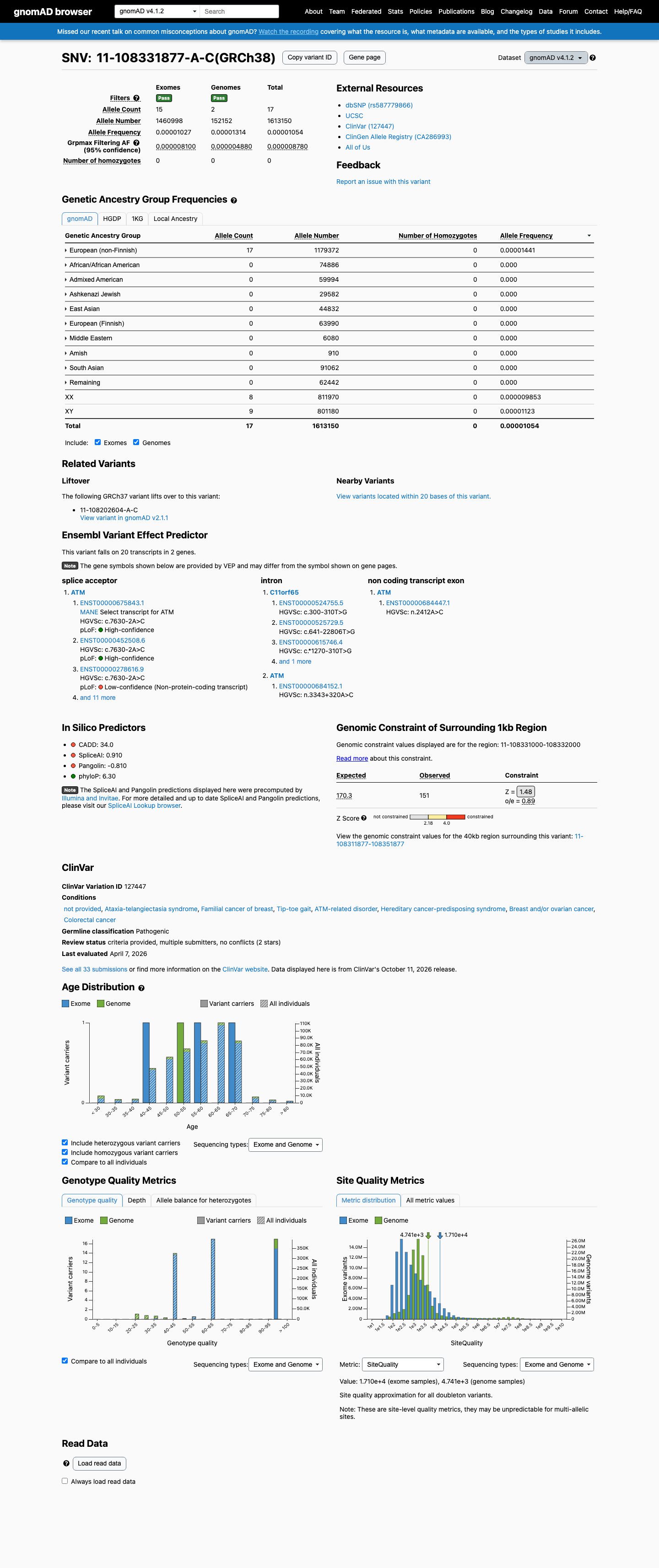
PM2Not met: the highest gnomAD subpopulation AF is 0.001441% (17 alleles), exceeding the VCEP's <=0.001% PM2 threshold and not qualifying for the n=1 exception.
PM5Not assessed: RNA confirms aberrant splicing, but the required VCEP PVS1(RNA) Very Strong assignment and NMD-prone truncating eligibility are not established.
PP1Not assessed: one affected child had paternal c.7630-2A>C, but no affected relative was documented for the VCEP's one-relative segregation threshold.
Benign
BA1Not met: gnomAD grpmax filtering AF is 8.78e-06 (0.000878%), below the VCEP's >0.5% BA1 threshold.
BS1Not met: gnomAD grpmax filtering AF is 8.78e-06 (0.000878%), below the VCEP's >0.05% BS1 threshold.
BS3Not assessed: no qualifying benign rescue result exists, and the exact Table S1 row is Pathogenic with Confidence=NA and DeepATM_predicted=NA.
BP2Not assessed: no qualifying unaffected adult observation with documented pathogenic-variant trans or cis phase is available for the VCEP BP2 table.
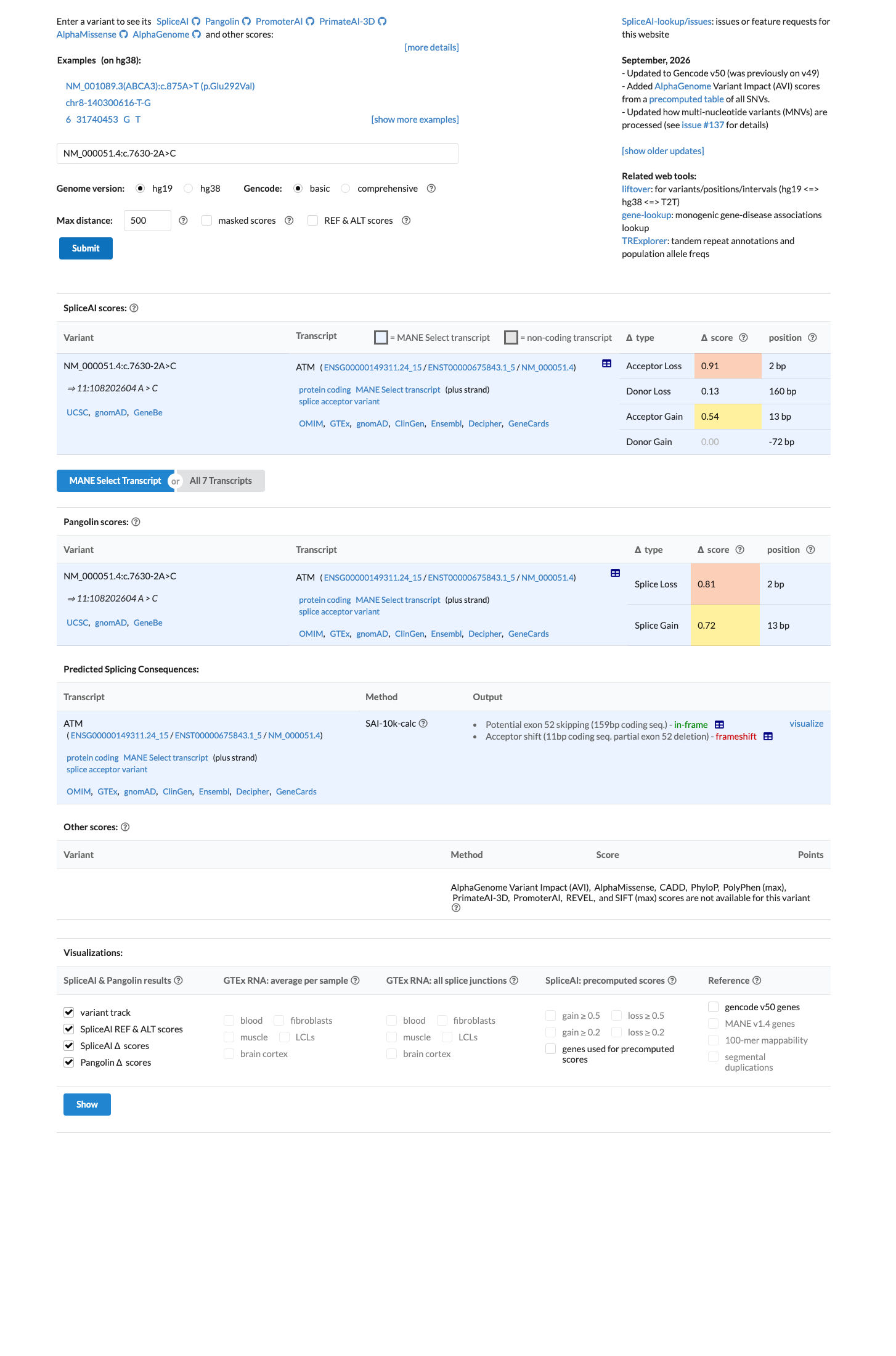
BP4Not met: SpliceAI maximum delta 0.907 exceeds the VCEP BP4 no-impact threshold of ≤0.1.
This variant is present in gnomAD v4.1 (AF= 1.05384e-05; MAF= 0.00105%, 17/1613150 alleles, homozygotes = 0) and has highest observed frequency in the European (non-Finnish) population (AF= 1.44145e-05; MAF= 0.00144%, 17/1179372 alleles, homozygotes = 0); grpmax FAF= 8.78e-06.
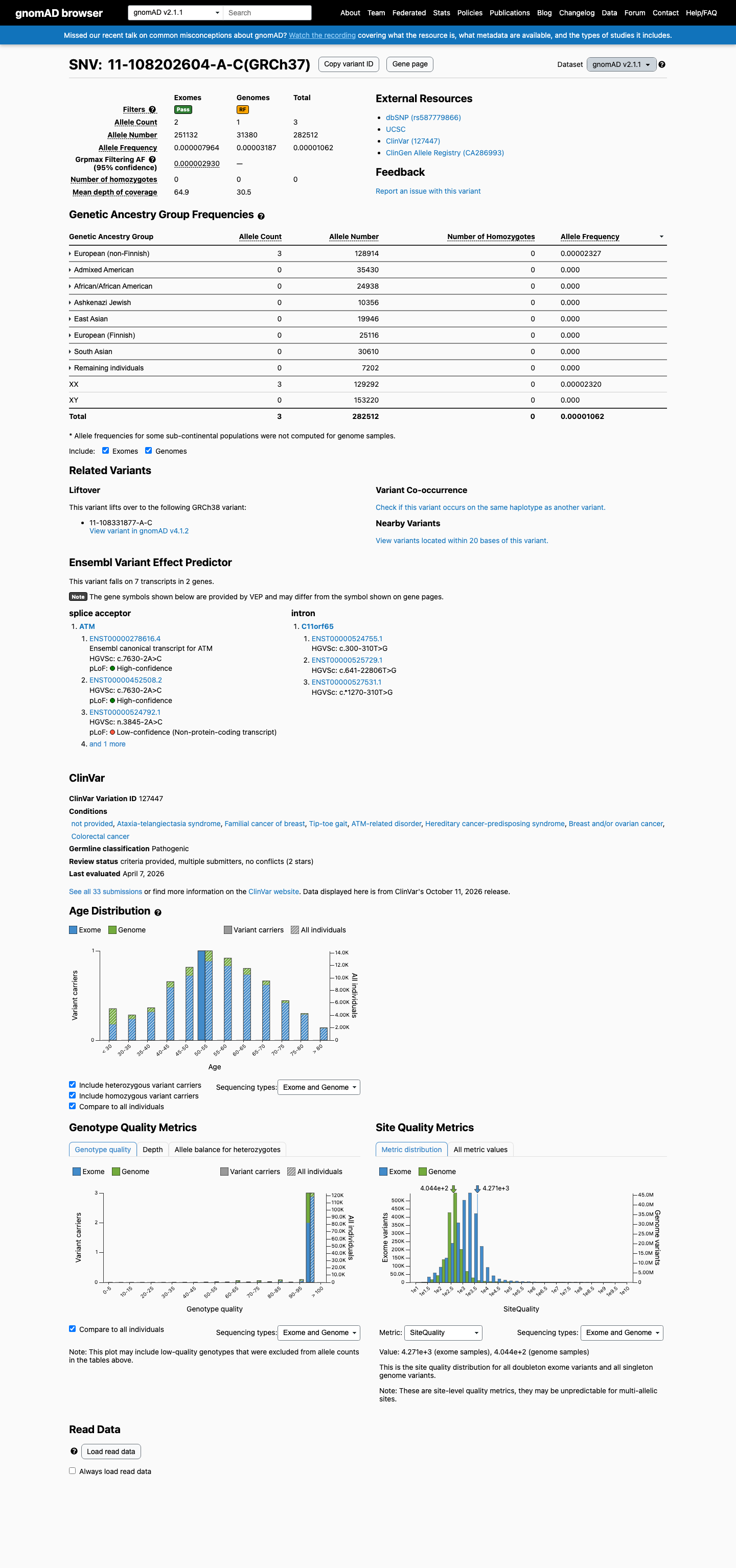
v2.1
This variant is present in gnomAD v2.1 (AF= 1.0619e-05; MAF= 0.00106%, 3/282512 alleles, homozygotes = 0) and has highest observed frequency in the European (non-Finnish) population (AF= 2.32713e-05; MAF= 0.00233%, 3/128914 alleles, homozygotes = 0); grpmax FAF= 2.93e-06.
🇨🇦 CA
Not available in gnomAD-Canada v1.0.
Allele frequency by ancestry
three datasets · side by side
gnomAD v4.1
0.0011%
· 17 / 1,613,150
0 hom · FAF 0.00088%
European (non-Finnish)
17 / 1,179,372
0.0014%
+ 9 not observed (Remaining individuals, Admixed American, European (Finnish), Amish, East Asian, Middle Eastern, South Asian, Ashkenazi Jewish, African/African American)
gnomAD v2.1
0.0011%
· 3 / 282,512
0 hom · FAF 0.00029%
European (non-Finnish)
3 / 128,914
0.0023%
+ 7 not observed (African/African American, Admixed American, Ashkenazi Jewish, East Asian, European (Finnish), Remaining individuals, South Asian)
This variant has been reported in ClinVar as Pathogenic (27 clinical laboratories) and as Likely pathogenic (2 clinical laboratories) and as pathogenic (2 clinical laboratories). (ClinVarID = 127447)
Each card is an audit: what was searched, what was found, whether it names the variant, which criteria it fed, and why. 5 further PMIDs triaged but not cited — see Sources & references.
Splicing defects in the ataxia-telangiectasia gene, ATM: underlying mutations and consequences.
PMID 10330348 ↗· Teraoka SN et al.
· 1999 Jun
CLINVAR· functional
Searched
c.7630-2A>CNP_000042.3:p.?
Found
The paper explicitly reports the ATM intronic variant IVS53-2A>C in patient cell line AT72LA. Table 2 associates this variant with an ATM cDNA deletion designated 7630del159 and reports skipping of exon 54. The study identified this consequence through cDNA analysis and genomic sequencing; no variant-specific segregation or population-frequency data are reported in the supplied text.
Variant
✓ Names this variant — characterised directly
Applied to
→PVS1
very strong
The exact canonical splice variant is experimentally shown to cause exon skipping, supporting a loss-of-function consequence.
→PM3
very strong
Documents the exact splice-site variant in an affected A-T patient cell line, supporting the affected-proband PM3 point assignment when phase is not established.
Two mutations, IVS9-1GrT (in AT134LA) and IVS53-2ArC (in AT72LA), resulted in skipping of exons 10 and 54, respectively (table 2).
Location Results, ‘Mutations in Canonical Splice Sites’; Table 2, AT72LA · Context ATM mutation study of 49 ataxia-telangiectasia patient cell lines; genomic DNA sequencing, cDNA SSCP/direct sequencing, and ATM protein western blotting. · full text
A precocious cerebellar ataxia and frequent Fever episodes in a 16-month-old infant revealing ataxia-telangiectasia syndrome.
PMID 25374739 ↗· Nespoli L et al.
· 2013
CLINVAR· functional
The paper reports ATM c.7630-2A>C in an affected child with ataxia-telangiectasia; the child inherited c.7630-2A>C from the father and c.5692C>T from the mother. This establishes parental phase but does not document segregation in an affected relative.
Variant
✓ Names this variant — characterised directly
Applied to
→PM3
very strong
Affected A-T case with parental evidence establishing the variant in trans with another ATM variant.
A blood sample was sent to the laboratory for the DNA molecular study of the ATM gene mutations which revealed 2 specific mutations (c.5692C > T/c.7630-2A > C) compatible with AT diagnosis (mother: c.5692C > T mutation; father: c.7630-2A > C on intron 53).
Location Case Report, paragraph describing the ATM molecular study · Context Single pediatric ataxia-telangiectasia case; ATM molecular genetic testing with parental origin reported; no additional affected-relative segregation analysis was described. · full text
Characterization of ATM gene mutations in 66 ataxia telangiectasia families.
The paper explicitly identifies ATM c.7630-2A>C as a splice-site mutation in intron 53, found in four AT families: three heterozygous samples (Aa002, Aa009, Aa051) and one homozygous sample (Ac049). RT-PCR analysis of B-lymphoblastoid cell lines showed two aberrant ATM transcripts: skipping of exon 54 in 60% of transcripts and use of a cryptic acceptor causing skipping of the first 11 nucleotides of exon 54 in 40%. In the homozygous cell line, no ATM protein was detected by immunoblotting. The paper also states that this mutation had been independently reported in Polish patients.
Variant
✓ Names this variant — characterised directly
Applied to
→PVS1
very strong
The exact variant has observed aberrant splicing, cryptic acceptor use, and absent ATM protein in a homozygous cell line.
→PM3
very strong
Provides multiple A-T observations with heterozygous and homozygous zygosity information used in the VCEP PM3 points table.
Location Table 1; Results, splice-site mutation paragraph; Table 3; Table 4; final Results paragraph · Context Cohort of 66 unrelated German ataxia-telangiectasia patients; genomic exon and flanking-intron sequencing; RT-PCR analysis of ATM mRNA from B-lymphoblastoid cell lines; ATM immunoblotting in cell lines. · full text
Sources & reference links
8Sources
CSpec VCEP
ClinVar
gnomAD v2.1
gnomAD v4.1
gnomAD-Canada
SpliceAI
OncoKB
COSMIC
Triaged references · 5 PMIDs not cited in assessment
10817650 ↗Mutations at the ataxia-telangiectasia locus and clinical phenotypes of A-T patients.CLINVAR
21833744 ↗Characterisation of ATM mutations in Slavic Ataxia telangiectasia patients.CLINVAR
25741868 ↗Standards and guidelines for the interpretation of sequence variants: a joint consensus recommendation of the American College of Medical Genetics and Genomics and the Association for Molecular Pathology.CLINVAR
30067863 ↗Prospective study of germline genetic testing in incident cases of pancreatic adenocarcinoma.CLINVAR
9443866 ↗Ataxia-telangiectasia: identification and detection of founder-effect mutations in the ATM gene in ethnic populations.CLINVAR