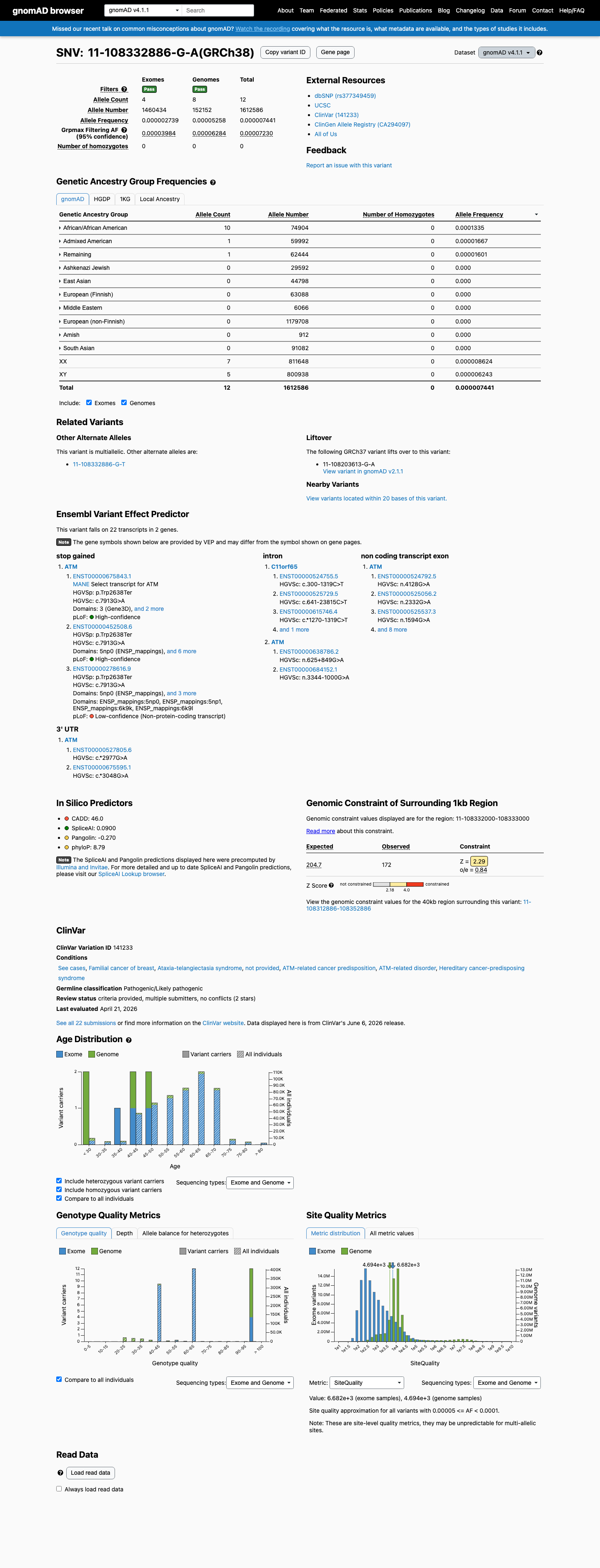
NM_000051.4:c.7913G>A is a nonsense variant (p.Trp2638Ter) in exon 53 of ATM, a gene for which loss of function is a well-established mechanism of disease. The premature termination codon is upstream of p.Arg3047, and NMD is expected. PVS1 is applied at very strong strength per the ClinGen HBOP VCEP ATM PVS1 decision tree.1 This variant is present at extremely low frequency in gnomAD v4.1 (AF = 0.00074%, 12/1,612,586 alleles, 0 homozygotes; grpmax FAF = 0.007%), meeting the VCEP PM2_Supporting threshold of ≤0.001%.2 The variant produces a premature termination codon at p.Trp2638, upstream of the most C-terminal known pathogenic variant p.Arg3047, satisfying the VCEP PM5_Supporting truncation cutoff rule.3 This variant has been observed in the literature in multiple unrelated AT patients: as a compound heterozygous mutation (with c.3802delG) in Brazilian AT patients (Coutinho et al. 2004, PMID:15039971), as a homozygous mutation in a consanguineous African-Brazilian patient with classical AT (Demuth et al. 2011, PMID:21965147), and as a homozygous mutation in an AT proband (Family 605) studied for gamma-H2AX radiosensitivity (Kato et al. 2006, PMID:16953663). These observations are consistent with biallelic pathogenicity for ataxia telangiectasia.4 The VCEP combination rule 4 is satisfied: 1 Very Strong criterion (PVS1) + ≥2 Supporting criteria (PM2_Supporting, PM5_Supporting) → Pathogenic classification.5
Final classification
Pathogenic
PVS1PM2PM5
ATM
c.7913G>A
p.Trp2638Ter
stop gained
This variant
NM_000051.4:c.7913G>A is a nonsense variant (p.Trp2638Ter) in exon 53 of ATM, a gene for which loss of function is a well-established mechanism of disease. The premature termination codon is upstream of p.Arg3047, and NMD is expected. PVS1 is applied at very strong strength per the ClinGen HBOP VCEP ATM PVS1 decision tree.
ClinGen Hereditary Breast, Ovarian and Pancreatic Cancer Expert Panel Specifications to the ACMG/AMP Variant Interpretation Guidelines for ATM Version 1.5 v1.5 criteria-combination framework: matched Rule4 (1 Pathogenic.Very Strong + Pathogenic.Supporting >=2) with applied criteria: PVS1 very strong, PM2 supporting, PM5 supporting; maps to Pathogenic.
Classification rationale
PVS1PM2PM5
Pathogenic
ATM c.7913G>A
stop gained
PVS1 + PM2 + PM5
→
Pathogenic
LYFE Sciences is an AI system, and it can make mistakes. Criteria
may be applied incorrectly, sources may be misread, and a confident-looking
classification can still be wrong. Double-check every criterion and
its underlying evidence before relying on any call.
Gene diagram
· NM_000051.4 · variants mapped to exon structure
ATM
NM_000051.4
Fetching transcript structure from UCSC…
Applied criteria · 3 applied · 9 assessed
MetEvidence satisfies this criterion.
Not metEvaluated against available evidence; threshold not reached.
Not assessedApplies in principle, but no evidence was found to evaluate it.
N/ADoesn't apply to this variant type.
Applied · 3
Strength
Supporting
Moderate
Strong
Very strong
PVS1
very strong
Pathogenic
NM_000051.4:c.7913G>A is a nonsense variant producing a premature termination codon at p.Trp2638 in exon 53 of ATM. Loss of function is a well-established disease mechanism for ATM, and the HBOP VCEP PVS1 decision tree supports application of PVS1 at very strong strength for this variant. The PTC is upstream of p.Arg3047 (the most C-terminal known pathogenic variant), and NMD is expected.
Nonsense variant (p.Trp2638Ter) in exon 53 of ATMLOF is established disease mechanism for ATM per ClinGen HBOP VCEPPTC at codon 2638 is upstream of most C-terminal pathogenic variant p.Arg3047
PM2
supporting
Pathogenic
c.7913G>A is present at extremely low frequency in gnomAD v4.1 (allele frequency = 0.00074%, 12/1,612,586 alleles, 0 homozygotes; grpmax FAF = 0.007%). This is well below the VCEP threshold of ≤0.001% for PM2_Supporting.
gnomAD v4.1 AF = 7.44e-06 (0.00074%)12/1612
PM5
supporting
Pathogenic
c.7913G>A produces a premature termination codon at p.Trp2638, which is upstream of p.Arg3047 — the most C-terminal known pathogenic variant in ATM. PM5_Supporting applied per VCEP truncation cutoff rule for frameshifting or truncating variants with PTCs upstream of p.Arg3047.
Nonsense variant produces PTC at p.Trp2638Most C-terminal known pathogenic variant: p.Arg3047PTC is upstream of cutoff — PM5_Supporting applies per VCEP
Assessed · not applied
· 8 not met · 1 not assessed
Pathogenic
PS3
No variant-specific experimental functional rescue data (ATM-specific kinase activity or radiosensitivity rescue) is available for c.7913G>A.
PS4
No case-control study with p-value ≤0.05 and OR ≥2 (or lower 95% CI ≥1.5) is available for this variant.
PP1
No co-segregation data in affected relatives is available for assessment.
PP3
PP3 under the ATM VCEP applies to missense variants with REVEL >0.7333 or splicing variants with SpliceAI ≥0.2.
Benign
BA1
gnomAD v4.1 grpmax filtering AF is 7.23e-05 (0.007%), well below the VCEP BA1 threshold of >0.5%.
BS1
gnomAD v4.1 grpmax filtering AF is 7.23e-05 (0.007%), well below the VCEP BS1 threshold of >0.05%.
BS3
No experimental evidence that c.7913G>A rescues ATM-specific function (kinase activity) or radiosensitivity.
BP2
No proband data with trans observations in unaffected individuals is available to assign BP2 points per the ATM PM3/BP2 table.
BP4
BP4 under the ATM VCEP applies to missense variants with REVEL ≤0.249 or splicing variants with SpliceAI ≤0.1.
N/A · 13
PS1 · PS2 · PM1 · PM6 · PP2 · PP4 · PP5 · BS2 · BS4 · BP1 · BP5 · BP6 · BP7
Research & evidence
Population frequency · supports pathogenic
gnomAD v4.1
gnomAD v2.1
v4.1
This variant is present in gnomAD v4.1 (AF= 7.44146e-06; MAF= 0.00074%, 12/1612586 alleles, homozygotes = 0) and has highest observed frequency in the African/African American population (AF= 0.000133504; MAF= 0.01335%, 10/74904 alleles, homozygotes = 0); grpmax FAF= 7.23e-05.
v2.1
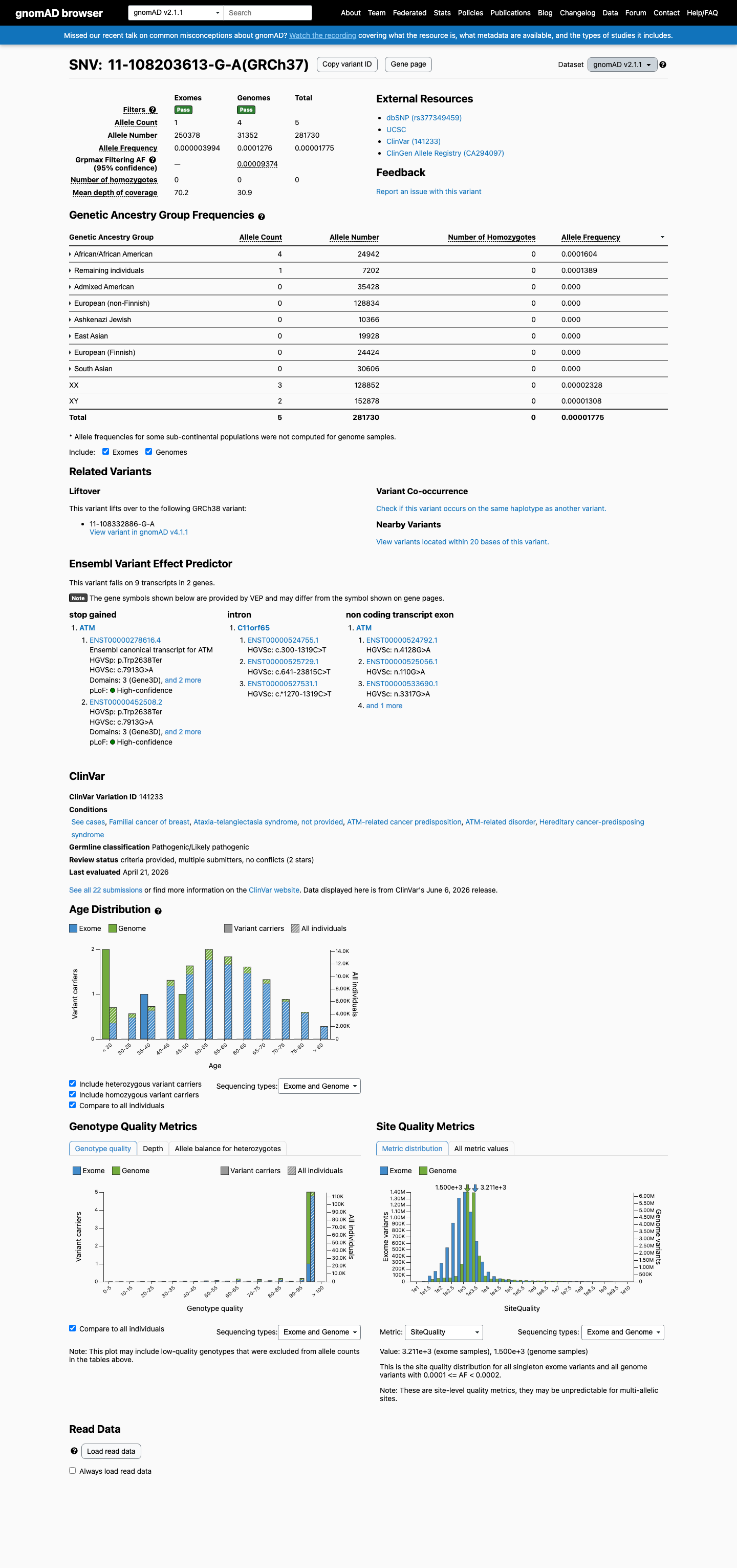
This variant is present in gnomAD v2.1 (AF= 1.77475e-05; MAF= 0.00177%, 5/281730 alleles, homozygotes = 0) and has highest observed frequency in the African/African American population (AF= 0.000160372; MAF= 0.01604%, 4/24942 alleles, homozygotes = 0); grpmax FAF= 9.374e-05.
🇨🇦 CA
Absent from gnomAD-Canada v1.0.
Allele frequency by ancestry
three datasets · side by side
gnomAD v4.1
0.00074%
· 12 / 1,612,586
0 hom · FAF 0.0072%
0 hom · FAF 0.0072%
African/African American 10 / 74,904 |
0.013% |
Admixed American 1 / 59,992 |
0.0017% |
Remaining individuals 1 / 62,444 |
0.0016% |
+ 7 not observed (European (Finnish), Amish, East Asian, Middle Eastern, South Asian, Ashkenazi Jewish, European (non-Finnish))
gnomAD v2.1
0.0018%
· 5 / 281,730
0 hom · FAF 0.0094%
0 hom · FAF 0.0094%
African/African American 4 / 24,942 |
0.016% |
Remaining individuals 1 / 7,202 |
0.014% |
+ 6 not observed (Admixed American, Ashkenazi Jewish, East Asian, European (Finnish), European (non-Finnish), South Asian)
gnomAD Canada 🇨🇦
Absent
· 0 / ?
0 hom
0 hom
Not observed in any ancestry group.

ClinVar
This variant has been reported in ClinVar as Pathogenic (19 clinical laboratories) and as Likely pathogenic (1 clinical laboratory) and as pathogenic (1 clinical laboratory). (ClinVarID = 141233)
In silico
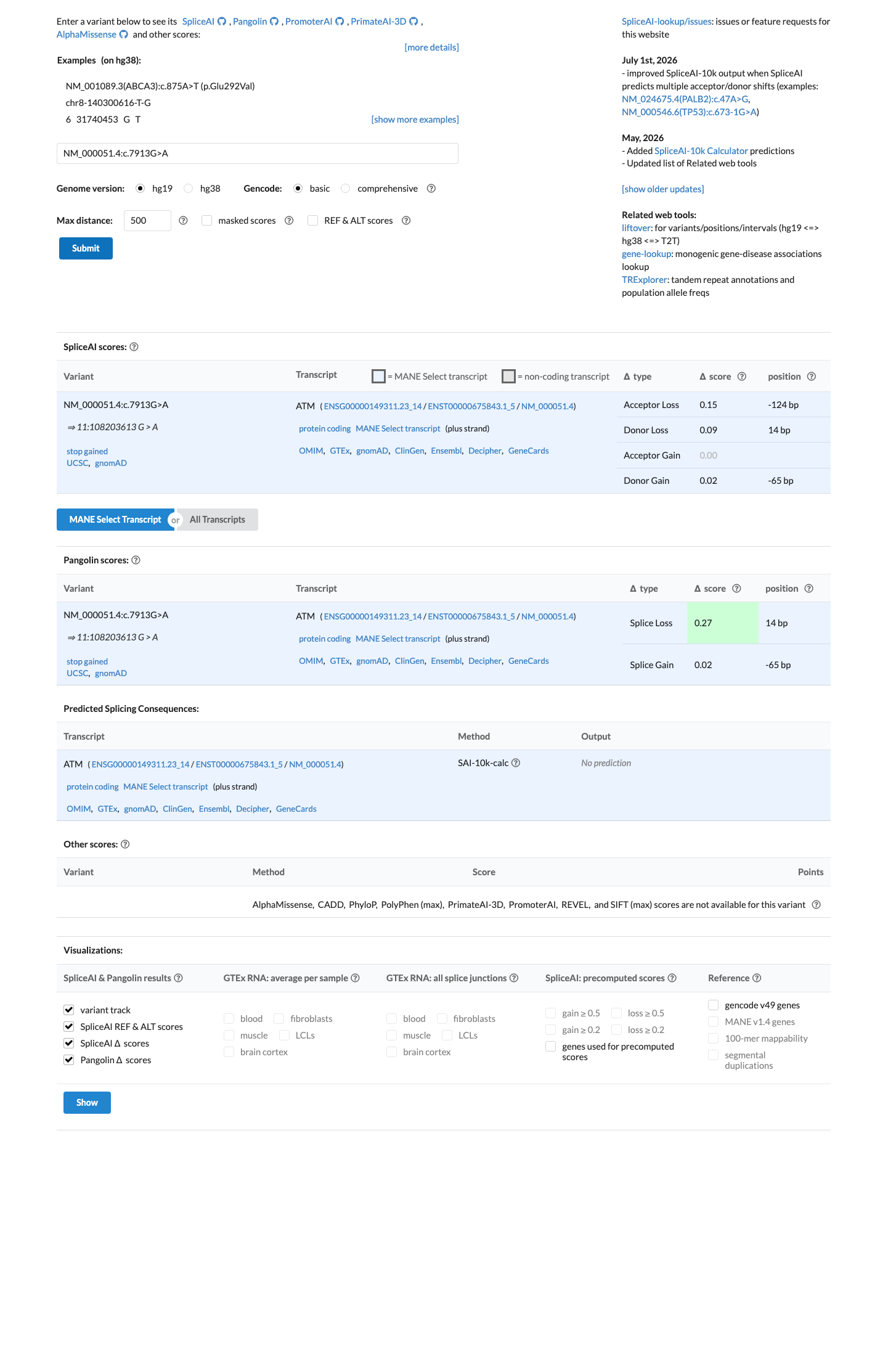
SpliceAI predicts no significant splice impact for this variant (max delta score = 0.15). BayesDel score = 0.61701.
Functional
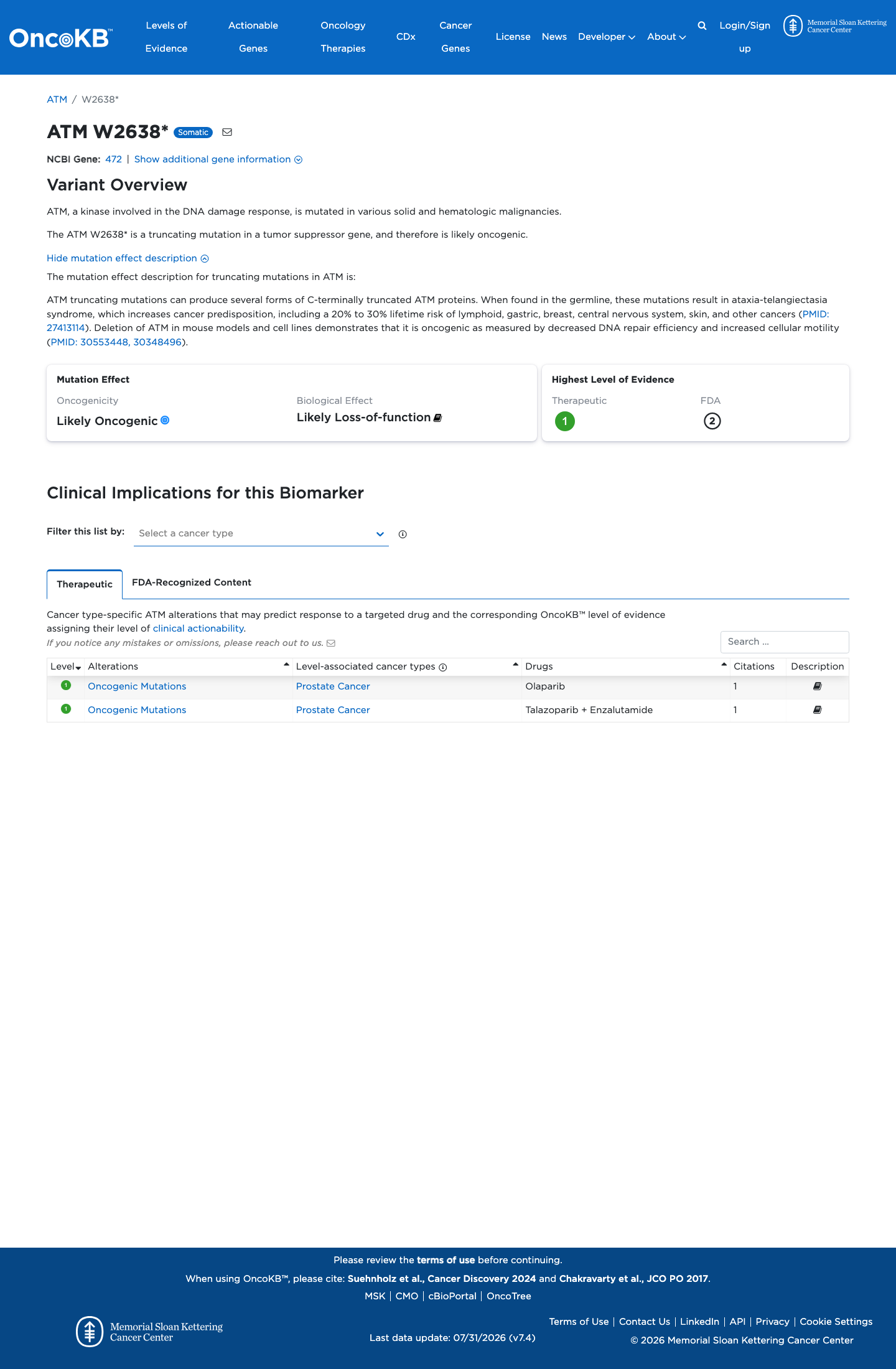
Likely Oncogenic
OncoKB identified variant-specific curated literature and context relevant to functional review; biological-effect context: Likely Loss-of-function; curated oncogenicity label: Likely Oncogenic.

COSMIC

Cancer hotspots
Somatic evidence
Not in COSMIC / hotspots
COSMIC
This variant does not lie in a statistically significant hotspot. This variant has not previously been reported in somatic cancers (COSMIC).
Hotspots
This variant does not lie in a statistically significant hotspot.
Literature · how each cited paper was used
3papers cited
Each card is an audit: what was searched, what was found, whether it names the variant, which criteria it fed, and why. 5 further PMIDs triaged but not cited — see Sources & references.
Five haplotypes account for fifty-five percent of ATM mutations in Brazilian patients with ataxia telangiectasia: seven new mutations.
Searched
7913G>Ac.7913G>AW2638*Trp2638Ter
Found
7913G>A (nonsense, p.Trp2638Ter) identified as a recurring founder mutation on haplotype [I] in three unrelated Brazilian AT patients (BRAT12-3, BRAT15-3, BRAT30-3), each compound heterozygous with c.3802delG. The mutation introduces a premature termination codon and was detected by SSCP after PTT failed to show a truncated band. Associated with the classical AT phenotype.
Variant
✓ Names this variant — characterised directly
Applied to
→PVS1
met
→PM5
met
Why
Variant confirmed as a truncating mutation in multiple AT patients; consistent with PVS1 and PM5 application.
The mutation 7913G > A, associated with the recurring haplotype [I], introduces a premature termination codon.
Location Table I (genotype/haplotype correlation table); Results, paragraph on mutations; Discussion, paragraph on founder mutations · Context Protein truncation testing (PTT), SSCP, dHPLC mutation screening in 27 Brazilian AT families; lymphoblastoid cell lines · full text
Levels of gamma-H2AX Foci after low-dose-rate irradiation reveal a DNA DSB rejoining defect in cells from human ATM heterozygotes in two at families and in another apparently normal individual.
Searched
7913G>Ac.7913G>A7913GW2638
Found
Family 605 proband is homozygous for the 7913G>A substitution. Both obligate heterozygous parents carry the same G>A substitution at nucleotide 7913. All three siblings were confirmed heterozygous. The study measured gamma-H2AX foci after low-dose-rate irradiation and demonstrated a DNA DSB rejoining defect in ATM heterozygotes from this family, confirming the functional impact of this variant on DNA damage response.
Variant
✓ Names this variant — characterised directly
Applied to
→PVS1
met
Why
Homozygous variant confirmed in AT proband with demonstrated DNA repair defect; consistent with loss-of-function pathogenicity.
The proband in family 605 is homozygous for a 7913G>A mutation.
Location Materials and Methods, Genotyping section; Results, Table 1 footnote; Discussion, sibling genotyping results · Context gamma-H2AX focus assay in primary fibroblasts after low-dose-rate (10 cGy/h) and acute (1 Gy) irradiation; Coriell cell strains from Family 605 · full text
New mutations in the ATM gene and clinical data of 25 AT patients.
Searched
c.7913G>Ap.W2638XW2638*7913G
Found
c.7913G>A (p.W2638X) identified in two AT patients: patient 15227 (Portuguese, compound heterozygous with c.3994-1413del3450) and patient 15106 (African-Brazilian, homozygous, consanguineous, classical AT phenotype with ataxia onset at 18 months, telangiectasia, choreoathetosis, infections, and elevated AFP).
Variant
✓ Names this variant — characterised directly
Applied to
→PVS1
met
→PM5
met
Why
Homozygous observation in a consanguineous patient with classical AT confirms biallelic pathogenicity; consistent with PVS1 and PM5.
c.7913G>A / p.W2638X
Location Table 2 (mutation list); Table 3 (clinical data for patient 15106) · Context Western blot for ATM protein, p53 phosphorylation after IR, cell cycle analysis in lymphoblastoid cell lines · full text
Sources & reference links
9Sources
Triaged references · 5 PMIDs not cited in assessment
30348496 ↗
Inactive Atm abrogates DSB repair in mouse cerebellum more than does Atm loss, without causing a neurological phenotype.
ONCOKB
30553448 ↗
Loss of ATM positively regulates Rac1 activity and cellular migration through oxidative stress.
ONCOKB
12815592 ↗
Independent mutational events are rare in the ATM gene: haplotype prescreening enhances mutation detection rate.
CLINVAR