ATM encodes a kinase that acts as a master controller of the cellular DNA damage response: it detects double-strand breaks and coordinates DNA repair, cell cycle arrest, or apoptosis through downstream targets including p53, BRCA1, and CHK2. Loss-of-function mutations in both copies of ATM cause ataxia telangiectasia, an autosomal recessive disorder characterized by neurological problems, immune deficiency, and cancer predisposition. ATM functions as a tumor suppressor: individuals with ataxia telangiectasia are prone to childhood lymphomas, leukemias, and breast cancer, while carriers of a single altered copy have increased risk of breast, pancreatic, prostate, and other cancers. Somatic ATM mutations also occur in lymphoid malignancies and solid tumors, and ATM-deficient cancers are often especially sensitive to DNA-damaging treatments.
This variant
This synonymous codon-286 change lies in ATM, the DNA-damage-response kinase whose biallelic loss of function causes ataxia telangiectasia and whose single-copy carriers have increased breast, pancreatic and prostate cancer risk.
Transcript
NM_000051.4
HGVS · transcript:coding
NM_000051.4:c.858A>G
GRCh38
chr11:108244983 A>G
GRCh37
chr11:108115710 A>G
VUS: one supporting pathogenic criterion (PP3) plus one supporting benign criterion (BS3) satisfy the ATM Expert Panel's Rule31 for conflicting supporting evidence.
Classification rationale
PP3BS3VUS
ATM c.858A>Gsynonymous · exon 7
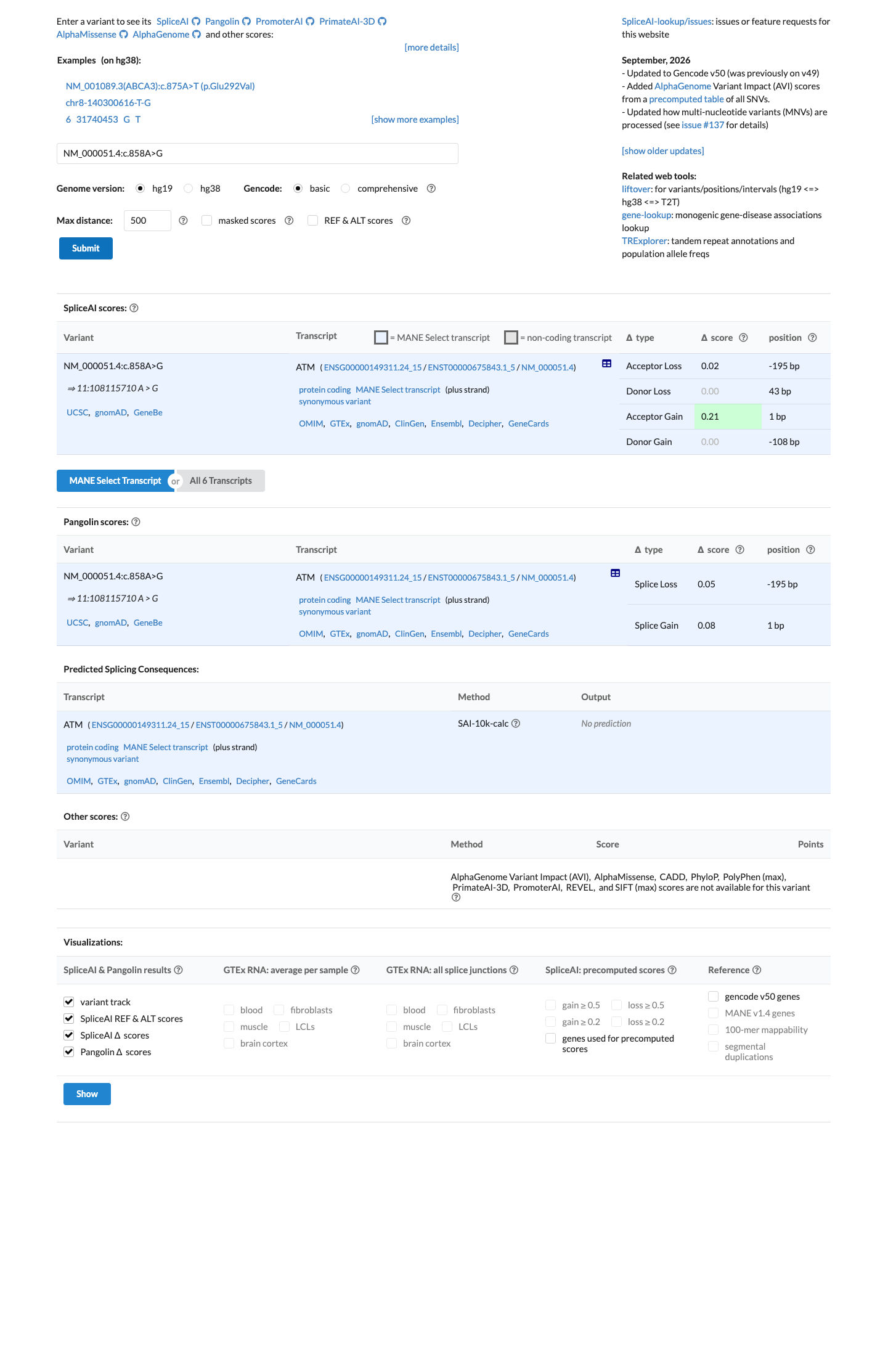
PP3 supporting: SpliceAI predicts a delta of 0.208 for the silent c.858A>G, at or above the ATM Expert Panel's 0.2 splice threshold. BS3 supporting: a direct prime-editing measurement scored the variant Functional (0.024), indicating retained ATM function.
PP3 + BS3→VUS
LYFE Sciences is an AI system, and it can make mistakes. Criteria
may be applied incorrectly, sources may be misread, and a confident-looking
classification can still be wrong. Double-check every criterion and
its underlying evidence before relying on any call.
Gene diagram
· NM_000051.4 · variants mapped to exon structure
ATMNM_000051.4
Fetching transcript structure from UCSC…
Exons
—
Transcript span
—
Strand
—
Variants mapped
—
Source
UCSC ncbiRefSeqCurated
All variants in ATM—click a row to locate it on the plot · use the link column to open its page
Protein
Location
Classification
Link
Applied criteria · 2 applied · 14 assessed
MetEvidence satisfies this criterion.
Not metEvaluated against available evidence; threshold not reached.
Not assessedApplies in principle, but no evidence was found to evaluate it.
N/ADoesn't apply to this variant type.
Applied · 2
Strength Supporting Moderate Strong Very strong
✓
PP3supportingPathogenic
Met at supporting: synonymous c.858A>G has SpliceAI max delta 0.208, at or above the ATM VCEP PP3 splice threshold of 0.2.
Variant scope: NM_000051.4:c.858A>G is synonymous (NP_000042.3:p.(Gln286=)/p.(Q286=)), codon 286, exon 7, so PP3 takes the splice path (SpliceAI) and not the missense REVEL path.ATM VCEP v1.6 PP3 (Pathogenic Supporting): 'Splicing: Predicted impact via splicing (SpliceAI >=0.2) for silent, missense/in-frame and for intronic variants outside of donor and acceptor 1,2 sites.'SpliceAI Lookup (NM_000051.4:c.858A>G, hg37 11-108115710-A-G, distance 500, mask 0) returned max delta score 0.208: DS_AG 0.208 at DP_AG +1 (cryptic acceptor gain one nucleotide downstream), DS_AL 0.018 at DP_AL -195, DS_DG 0.001 at DP_DG -108, DS_DL 0.002 at DP_DL +43.
Met at supporting strength: directly measured prime-editing score 0.024 places c.858A>G in the assay's Functional band (>= -0.912), indicating retained ATM function.
Governing specification consulted: ClinGen HBOP ATM VCEP v1.6 (cspec), BS3 rules - BS3_Moderate 'Use when a variant rescues both an ATM specific feature (e.g. phosphorylation of ATM-specific targets) AND radiosensitivity'; BS3_Supporting 'Use when a variant rescues EITHER an ATM specific feature OR rescues radiosensitivity'.Searched clingen_hbop_atm_supplementary_tables_1_and_2_v1.xlsx for 'c.858A>G', 'p.Gln286=' and 'p.Q286=': no match. The file supplies only the approved-assay methodology and proposed strengths (kinase assays: PS3_Supporting/BS3_Supporting, approved for Mitui 2009, Barone 2009, Scott 2002; radiosensitivity: adds no weight on its own and none if it conflicts with the kinase result), plus validation-controls that name other variants, not c.858A>G.Searched Suppl_TableS1_PMID 40580951.xlsx full text for 'c.858A>G', '858A', 'p.Gln286=' and 'p.Q286=': one row matched - hg38 108244983 / A / G / c.858A>G / Q286Q / exon_7 / Synonymous / residue 286 / Combined_score 0.0240282777808958 / Classification Functional / Confidence Medium-high / DeepATM_predicted No. DeepATM_predicted=No marks this as a direct result of the prime-editing saturation genome-editing screen rather than a DeepATM model extrapolation, which is the condition the VCEP file sets for routing a result to PS3/BS3.
Assessed · not applied
· 13 not met · 1 not assessed
Pathogenic
PS1Not met: synonymous p.Gln286= has no established P/LP reference variant at c.858 or within exon 7's splice motif to satisfy the PS1 prerequisite.
PS3Not met: the only direct functional measurement, a prime-editing screen score of 0.024, classified c.858A>G as Functional, and no VCEP-approved assay reports it.
PS4Not met: no case-control odds ratio, hazard ratio or relative-risk estimate exists for this variant to compare against the VCEP's p<=.05 and OR/HR/RR>=2 thresholds.
PM2Not met: the highest gnomAD ancestry frequency, 0.00808% in African/African American (v2.1, 2/24,766 alleles), exceeds the VCEP PM2 threshold of 0.001% and the n=1 exception does not apply.
PM3Not met: no A-T proband carries c.858A>G in trans with a P/LP ATM variant, giving 0 points versus the 1.0-point PM3_Supporting threshold.
PM5Not met: p.Gln286= is not a truncating PVS1 variant eligible under the ATM VCEP's PM5 rule, and no P/LP missense variant exists at residue 286.
PP1Not assessed: no pedigree or segregation data exist (zero informative meioses), so PP1's >=1-affected-relative threshold cannot be evaluated.
PP5Not met: ClinVar VCV000185146 is 1-star conflicting laboratory classifications with no expert-panel submission, so the expert-assertion requirement for PP5 is absent.
Benign
BA1Not met: the highest gnomAD ancestry frequency is 0.00808% (African/African American, v2.1), far below the VCEP stand-alone BA1 threshold of 0.5%.
BS1Not met: the highest gnomAD ancestry frequency is 0.00808% (African/African American, v2.1), below the VCEP BS1 strong threshold of 0.05%.
BP2Not met: no unaffected carrier of c.858A>G in trans with a P/LP ATM variant and zero gnomAD homozygotes, scoring 0 versus the -1.0-point BP2 threshold.
BP4Not met: SpliceAI max delta 0.208 exceeds the ATM VCEP BP4 threshold of <=0.1 for no predicted splice impact.
BP6Not met: ClinVar VCV000185146 has no expert-panel classification (1-star, conflicting), so the aggregate Likely-benign label cannot trigger BP6.
BP7Not met: c.858A>G is synonymous and in BP7 scope, but SpliceAI predicts a new acceptor site (max delta 0.208), so no splice impact cannot be asserted.
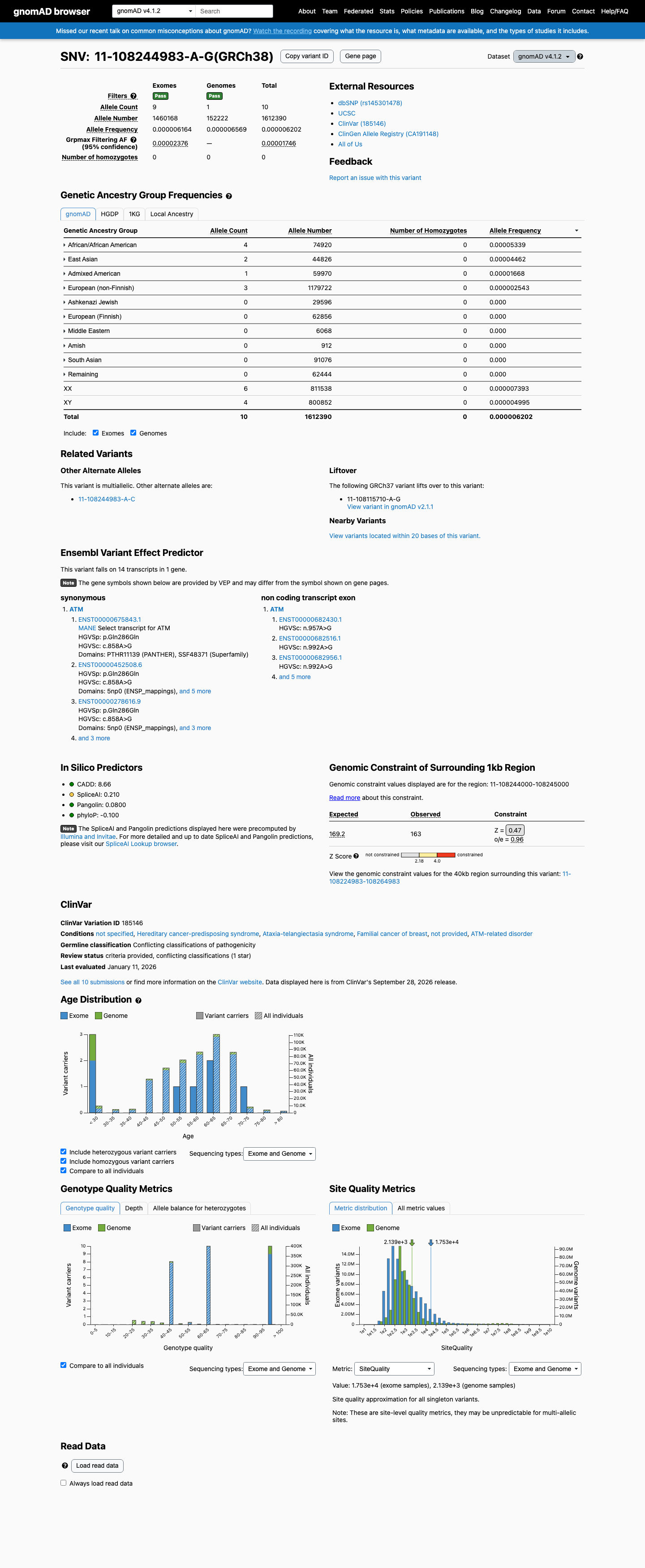
This variant is present in gnomAD v4.1 (AF= 6.20197e-06; MAF= 0.00062%, 10/1612390 alleles, homozygotes = 0) and has highest observed frequency in the African/African American population (AF= 5.33903e-05; MAF= 0.00534%, 4/74920 alleles, homozygotes = 0); grpmax FAF= 1.746e-05.
v2.1
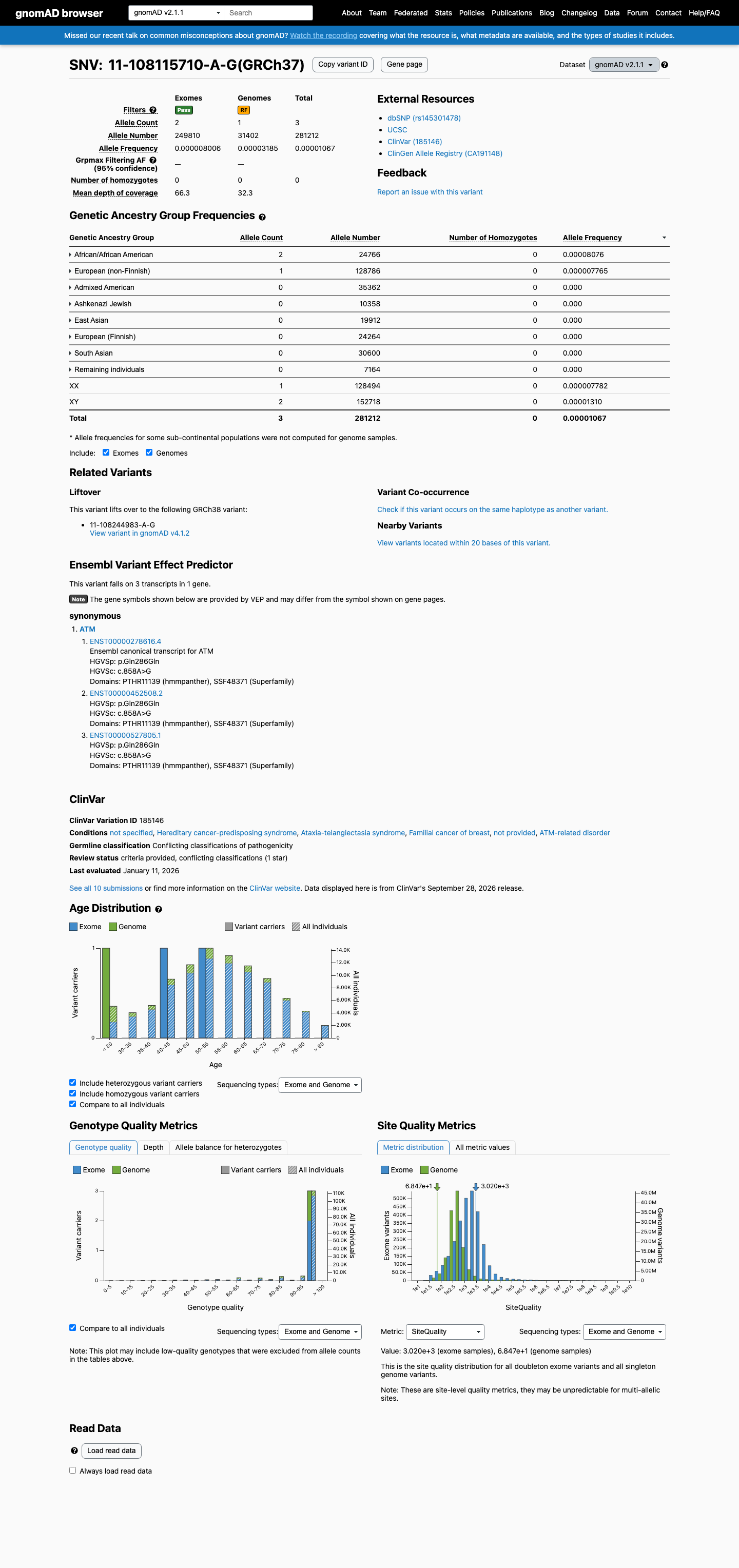
This variant is present in gnomAD v2.1 (AF= 1.06681e-05; MAF= 0.00107%, 3/281212 alleles, homozygotes = 0) and has highest observed frequency in the African/African American population (AF= 8.07559e-05; MAF= 0.00808%, 2/24766 alleles, homozygotes = 0).
🇨🇦 CA
Not available in gnomAD-Canada v1.0.
Allele frequency by ancestry
three datasets · side by side
gnomAD v4.1
0.00062%
· 10 / 1,612,390
0 hom · FAF 0.0017%
African/African American
4 / 74,920
0.0053%
East Asian
2 / 44,826
0.0045%
Admixed American
1 / 59,970
0.0017%
European (non-Finnish)
3 / 1,179,722
0.00025%
+ 6 not observed (Remaining individuals, European (Finnish), Amish, Middle Eastern, South Asian, Ashkenazi Jewish)
gnomAD v2.1
0.0011%
· 3 / 281,212
0 hom
African/African American
2 / 24,766
0.0081%
European (non-Finnish)
1 / 128,786
0.00078%
+ 6 not observed (Admixed American, Ashkenazi Jewish, East Asian, European (Finnish), Remaining individuals, South Asian)
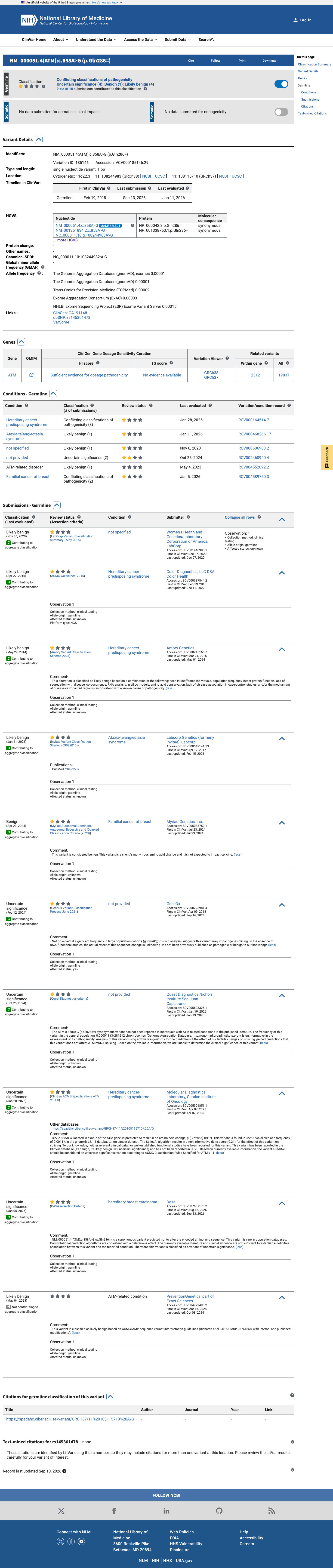
This variant has been reported in ClinVar as Likely benign (5 clinical laboratories) and as Uncertain significance (4 clinical laboratories) and as Benign (1 clinical laboratory). (ClinVarID = 185146)
Each card is an audit: what was searched, what was found, whether it names the variant, which criteria it fed, and why. 8 further PMIDs triaged but not cited — see Sources & references.
Structured finding pending for this record — see source link.
Applied to
→PP3
supporting
Row consulted to check for a VCEP pre-assigned PP3 code; all computational predictor columns are NA, so no code is pre-assigned and PP3 rests on the SpliceAI result.
→BS3
supporting
Directly measured prime-editing result classifies c.858A>G as Functional (Combined_score 0.024, DeepATM_predicted=No), i.e. no damaging effect on ATM function - benign-direction functional evidence, uncalibrated by the ATM VCEP, hence supporting strength with human review.
Sources & reference links
9Sources
CSpec VCEP
ClinVar
gnomAD v2.1
gnomAD v4.1
gnomAD-Canada
SpliceAI
OncoKB
COSMIC
Cancer hotspots
Triaged references · 8 PMIDs not cited in assessment
25741868 ↗Standards and guidelines for the interpretation of sequence variants: a joint consensus recommendation of the American College of Medical Genetics and Genomics and the Association for Molecular Pathology.CLINVAR
26467025 ↗A Standardized DNA Variant Scoring System for Pathogenicity Assessments in Mendelian Disorders.CLINVAR
17508274 ↗Risk assessment and genetic counseling for hereditary breast and ovarian cancer: recommendations of the National Society of Genetic Counselors.CLINVAR
24418350 ↗EFNS/ENS Consensus on the diagnosis and management of chronic ataxias in adulthood.CLINVAR