Back
NM_000051.4:c.8735_8751del
p.Arg2912AsnfsTer7 · ATM
0%
complete
Final classification
Pathogenic
PVS1PM2PM5
ATM
c.8735_8751del
p.Arg2912AsnfsTer7
frameshift · exon 60

ATM encodes a kinase that acts as a master controller of the cellular DNA damage response: it detects double-strand breaks and coordinates DNA repair, cell cycle arrest, or apoptosis through downstream targets including p53, BRCA1, and CHK2. Loss-of-function mutations in both copies of ATM cause ataxia telangiectasia, an autosomal recessive disorder characterized by neurological problems, immune deficiency, and cancer predisposition. ATM functions as a tumor suppressor: individuals with ataxia telangiectasia are prone to childhood lymphomas, leukemias, and breast cancer, while carriers of a single altered copy have increased risk of breast, pancreatic, prostate, and other cancers. Somatic ATM mutations also occur in lymphoid malignancies and solid tumors, and ATM-deficient cancers are often especially sensitive to DNA-damaging treatments.

This variant

This truncating ATM variant is relevant to a tumor-suppressor gene in which loss of function causes ataxia-telangiectasia when biallelic and contributes to inherited cancer predisposition when heterozygous.

Transcript
NM_000051.4
HGVS · transcript:coding
NM_000051.4:c.8735_8751del
GRCh38
chr11:108353828 AGAGATATTGTGGATGGC>A
GRCh37
chr11:108224555 AGAGATATTGTGGATGGC>A
Pathogenic: ATM VCEP Rule4 is met by PVS1 (very strong) plus PM2 and PM5 (supporting).
Classification rationale
PVS1PM2PM5 Pathogenic
ATM c.8735_8751del frameshift · exon 60

Pathogenic: PVS1 very strong supports a loss-of-function ATM truncation upstream of the VCEP pathogenic boundary. Pathogenic: PM2 supporting reflects the variant's absence from gnomAD v2.1 and v4.1. Pathogenic: PM5 supporting applies because the truncation ends upstream of ATM p.Leu3048 with PVS1 very strong.

PVS1 + PM2 + PM5 → Pathogenic
LYFE Sciences is an AI system, and it can make mistakes. Criteria may be applied incorrectly, sources may be misread, and a confident-looking classification can still be wrong. Double-check every criterion and its underlying evidence before relying on any call.
Gene diagram · NM_000051.4 · variants mapped to exon structure
ATM NM_000051.4
Fetching transcript structure from UCSC…
Applied criteria · 3 applied · 9 assessed
MetEvidence satisfies this criterion.
Not metEvaluated against available evidence; threshold not reached.
Not assessedApplies in principle, but no evidence was found to evaluate it.
N/ADoesn't apply to this variant type.
Applied · 3
Strength Supporting Moderate Strong Very strong
PVS1 very strong Pathogenic
Met at very strong: the 17-nucleotide deletion causes p.Arg2912AsnfsTer7, truncating ATM 139 residues before its 3057-residue normal length and upstream of the VCEP p.Arg3047 boundary.
The case normalization identifies NM_000051.4:c.8735_8751del as NP_000042.3:p.(Arg2912AsnfsTer7) / p.(R2912Nfs*7), a frameshift with predicted protein position 2918 and normal protein length 3057.The ATM HBOP VCEP PVS1 guide defines frameshift variants as null-variant candidates, states that all exons of the default NM_000051.3 transcript can be considered constitutive, and identifies loss of function as an established disease mechanism in the ATM framework.The ATM VCEP guide states that the most 3-prime/C-terminal residue considered pathogenic is p.Arg3047; this truncation terminates at p.2918, upstream of that boundary.
PM2 supporting Pathogenic
Met, supporting: the variant is absent from gnomAD v2.1 and v4.1, with observed frequency 0 versus the ATM VCEP PM2 threshold of <=0.001%.
ATM HBOP VCEP version 1.6 specifies PM2 Supporting at frequency <=0.001% in the gnomAD subpopulation with the highest frequency, with a single-observation exception.The variant is reported absent from gnomAD v2.1 and v4.1, and also absent from the available gnomAD v2.1 non-cancer and v3.1 non-cancer records; the observed allele frequency is therefore 0.The VCEP does not require a non-cancer or exome-only source for PM2, so the default all-comers gnomAD entries were used for the primary assessment.
PM5 supporting review Pathogenic
Met at supporting strength: the truncating product ends at approximately p.Asn2918, upstream of the ATM VCEP PM5 cutoff p.Leu3048, with PVS1 provisionally very strong.
ATM VCEP v1.6 PM5 rule: DNA variants must be NMD-prone, truncating, receive PVS1 at Very Strong strength, and have a premature termination codon upstream of p.Leu3048; the assigned strength is Supporting.The normalized protein consequence is p.(R2912Nfs*7), which predicts termination at approximately p.Asn2918 and therefore before p.Leu3048.The gene-level PVS1 context identifies ATM loss of function as an established disease mechanism, and the variant-level assessment supplies a suggested default PVS1 strength of Very Strong.
Assessed · not applied · 4 not met · 5 not assessed
Pathogenic
PS3 Not assessed: no variant-specific result was found in the approved ATM functional assays, and the 17-base deletion is absent from the SNV functional table.
PS4 Not met: no qualifying case-control p-value, effect estimate, confidence interval, or validated proband-count evidence was reported for this exact deletion.
PM3 Not assessed: no affected A-T proband, pathogenic variant in trans, phase information, or qualifying homozygous observation is documented for this variant.
PP1 Not assessed: zero affected relatives with documented segregation are available, below the ATM VCEP threshold of one affected relative for PP1 Supporting.
PP5 Not met: ClinVar contains no exact-variant expert-panel Pathogenic or Likely pathogenic classification for NM_000051.4:c.8735_8751del.
Benign
BA1 Not met: the variant is absent from gnomAD v2.1 and v4.1, far below the ATM VCEP BA1 threshold of >0.5%.
BS1 Not met: the variant is absent from gnomAD v2.1 and v4.1, below the ATM VCEP BS1 threshold of >0.05%.
BS3 Not assessed: no variant-specific benign functional result was found in the approved ATM assays, and the 17-base deletion is absent from the SNV functional table.
BP2 Not assessed: no unaffected adult carrier with a pathogenic or likely pathogenic ATM variant in trans, phase, or setting is documented.
N/A · 16 PS1 · PS2 · PM1 · PM4 · PM6 · PP2 · PP3 · PP4 · BS2 · BS4 · BP1 · BP3 · BP4 · BP5 · BP6 · BP7
Research & evidence
Population frequency · supports pathogenic
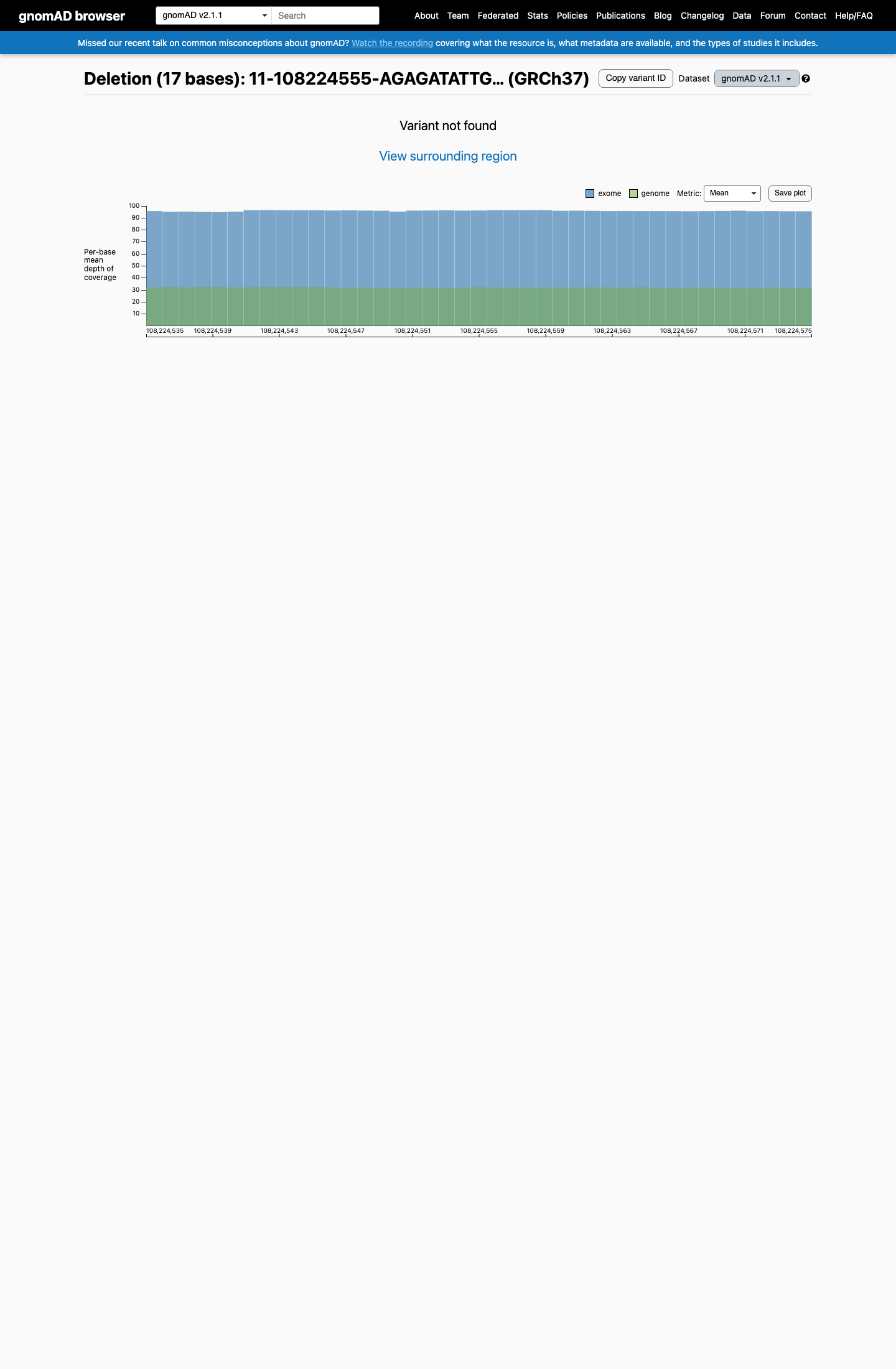
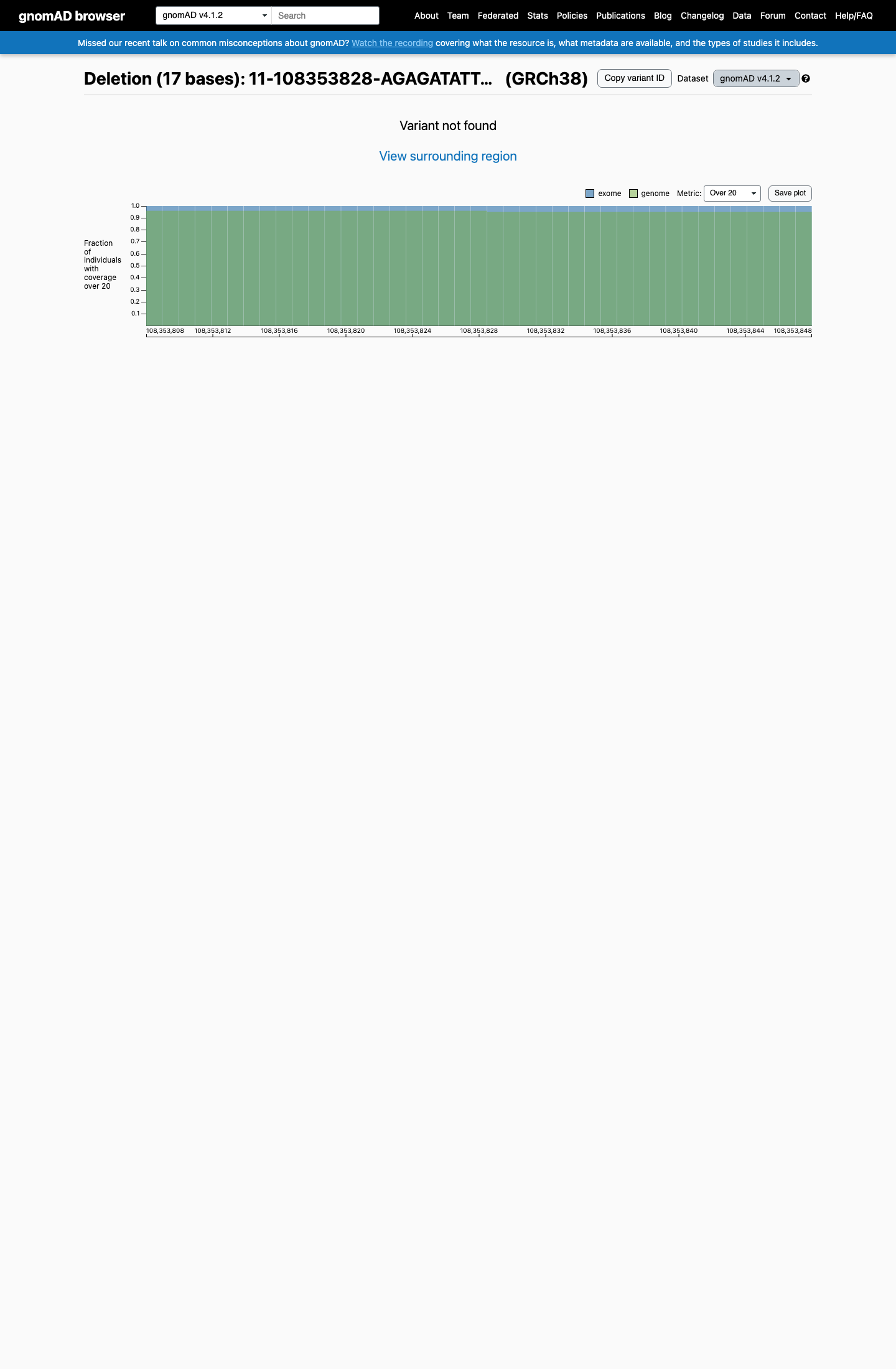
gnomAD v4.1 screenshot
gnomAD v4.1
gnomAD v2.1 screenshot
gnomAD v2.1
v4.1
Absent from gnomAD v4.1.
v2.1
Absent from gnomAD v2.1.
🇨🇦 CA
Absent from gnomAD-Canada v1.0.
Allele frequency by ancestry
three datasets · side by side
gnomAD v4.1
Absent · 0 / ?
0 hom
Not observed in any ancestry group.
gnomAD v2.1
Absent · 0 / ?
0 hom
Not observed in any ancestry group.
gnomAD Canada 🇨🇦
Absent · 0 / ?
0 hom
Not observed in any ancestry group.
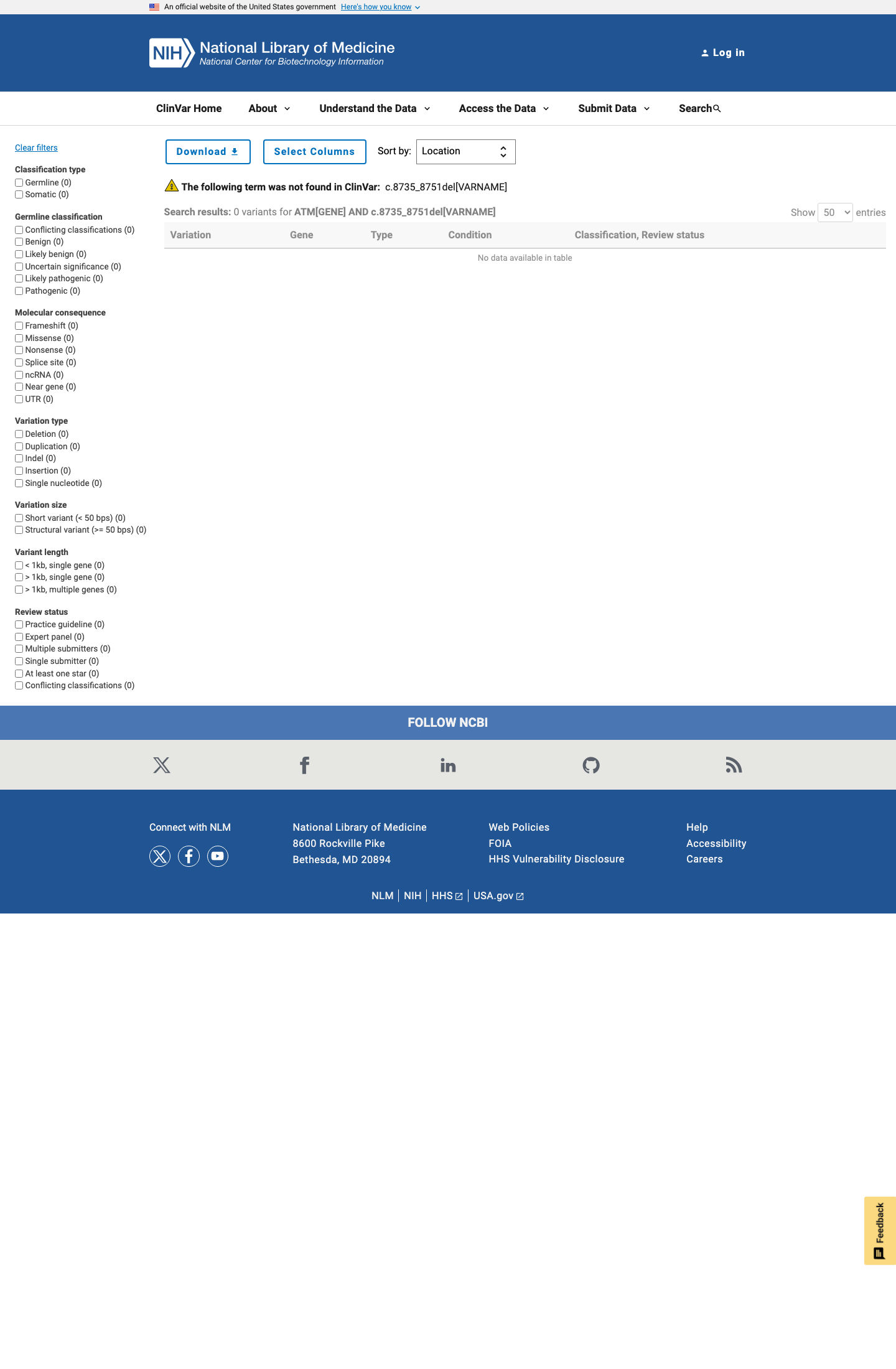
ClinVar screenshot
ClinVar
This variant is absent from ClinVar.
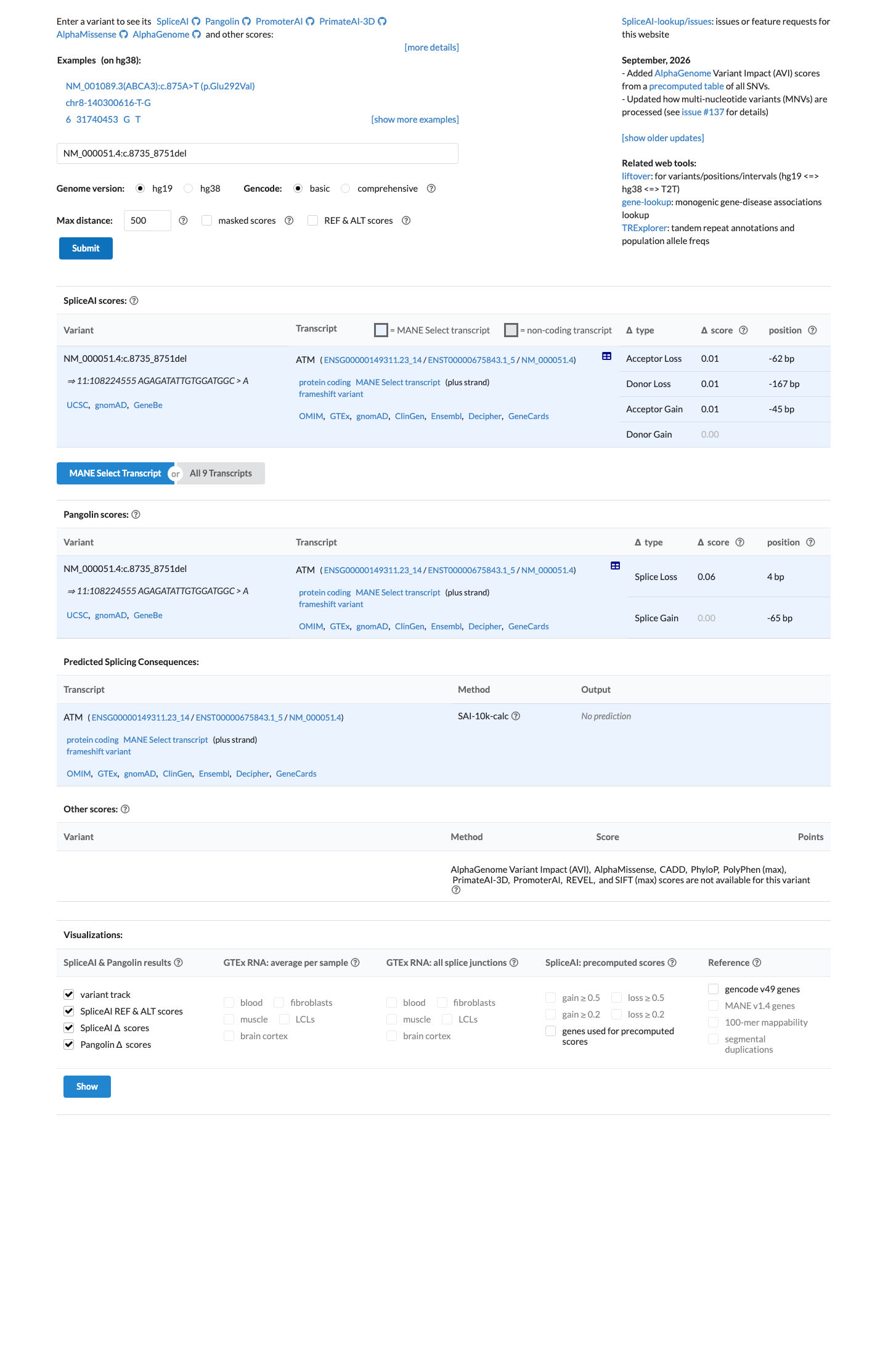
SpliceAI screenshot
In silico
SpliceAI predicts no significant splice impact for this variant (max delta score = 0.01).
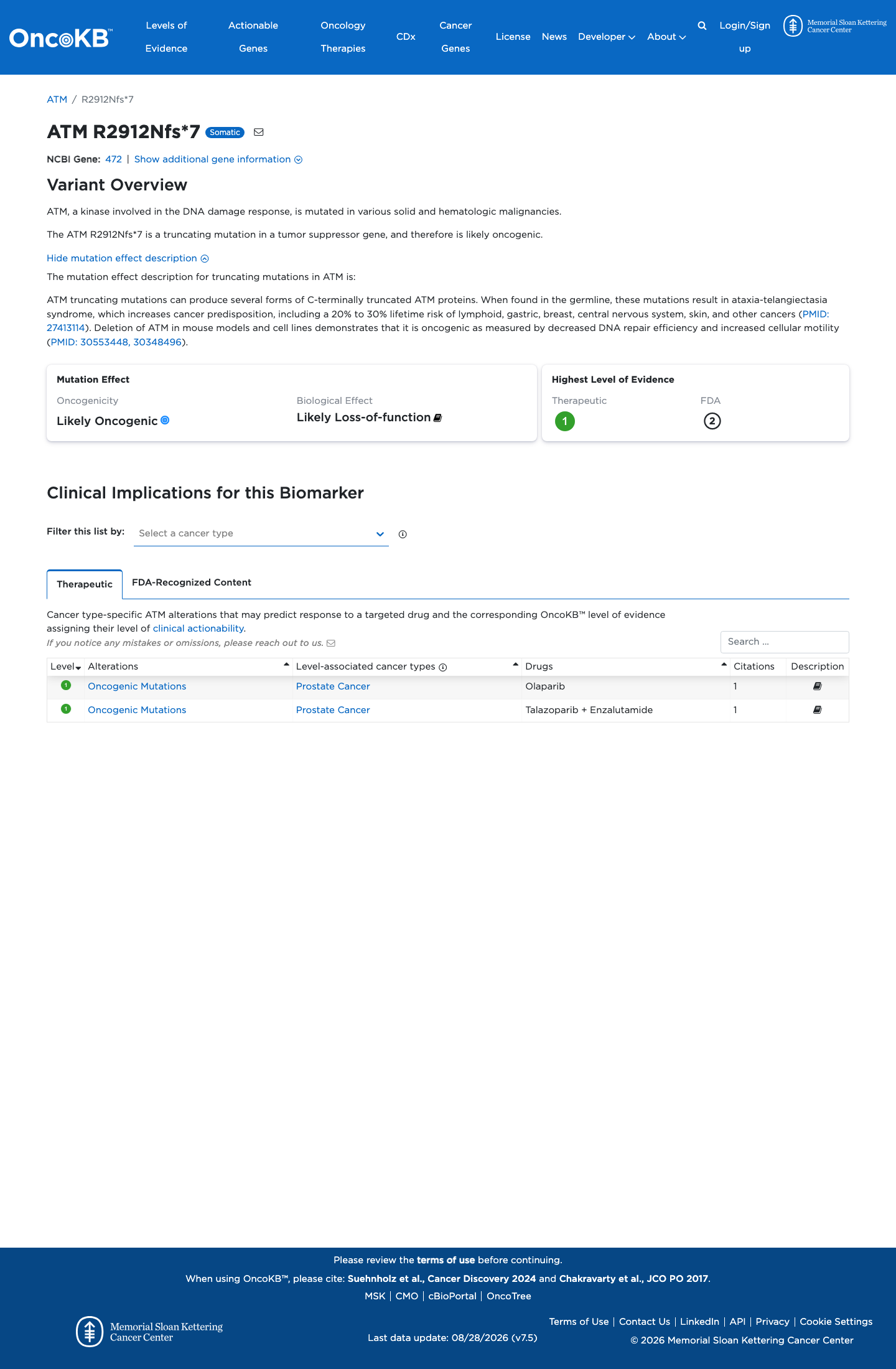
Functional / OncoKB screenshot
Functional Likely Oncogenic
OncoKB identified variant-specific curated literature and context relevant to functional review; biological-effect context: Likely Loss-of-function; curated oncogenicity label: Likely Oncogenic.
OncoKB ↗
COSMIC screenshot
COSMIC
Cancer hotspots screenshot
Cancer hotspots
Somatic evidence Not in COSMIC / hotspots
COSMIC
This variant does not lie in a statistically significant hotspot. This variant has not previously been reported in somatic cancers (COSMIC).
Hotspots
This variant does not lie in a statistically significant hotspot.
Sources & reference links
9Sources
CSpec VCEP
ClinVar
gnomAD v2.1
gnomAD v4.1
gnomAD-Canada
SpliceAI
OncoKB
COSMIC
Cancer hotspots
Triaged references · 3 PMIDs not cited in assessment
27413114 ↗ ATM Mutations in Cancer: Therapeutic Implications. ONCOKB
30348496 ↗ Inactive Atm abrogates DSB repair in mouse cerebellum more than does Atm loss, without causing a neurological phenotype. ONCOKB
30553448 ↗ Loss of ATM positively regulates Rac1 activity and cellular migration through oxidative stress. ONCOKB