This variant was interpreted by pipeline
7.2.0.
The current version is
11.0.02.
Re-running queues a fresh interpretation; the result replaces this page when complete.
Re-runs are not free. Blank = draws on today's public interpretation allowance.
With a code = uses 1 of that code's uses.
BRCA2 encodes a DNA repair protein that maintains genome stability by repairing double-strand breaks through homologous recombination and by protecting DNA replication forks. It acts as a tumor suppressor, and inherited loss-of-function changes cause hereditary breast and ovarian cancer syndrome, with elevated lifetime risks of breast, ovarian, prostate, and pancreatic cancers; biallelic changes cause Fanconi anemia complementation group D1. Reduced or altered BRCA2 activity is implicated in multiple tumor types, and PARP inhibitors are an approved treatment for BRCA2-associated ovarian and breast cancers.
This variant
BRCA2 loss-of-function variants cause hereditary breast and ovarian cancer syndrome, yet this variant is a missense change (p.Thr3371Ala) of uncertain significance: available evidence neither establishes nor rules out pathogenicity. Clinically, it means the variant cannot yet be used to confirm or exclude BRCA2-related cancer risk, and its classification may change as more evidence accumulates.
Transcript
NM_000059.4
HGVS · transcript:coding
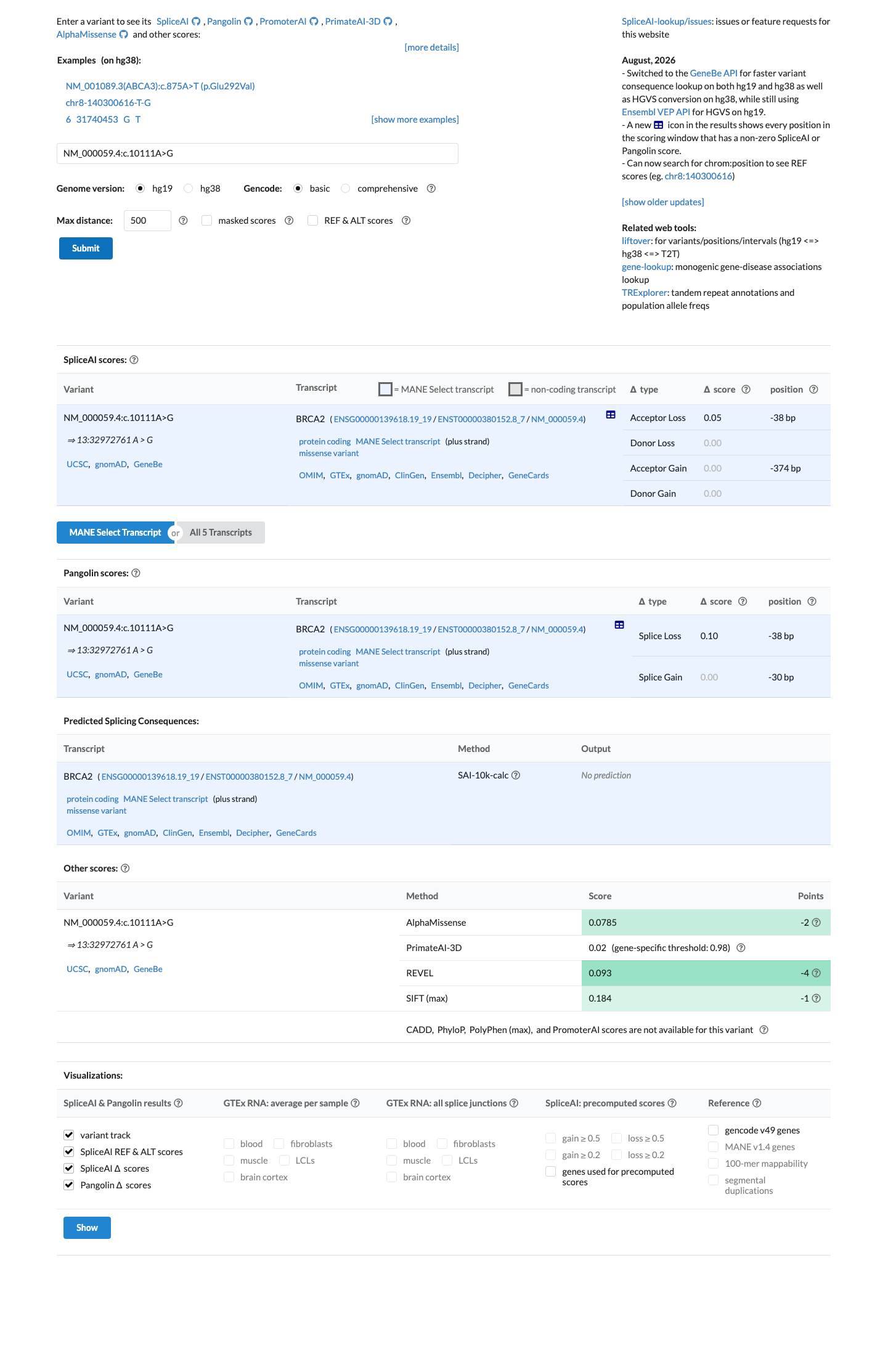
NM_000059.4:c.10111A>G
GRCh38
chr13:32398624 A>G
GRCh37
chr13:32972761 A>G
VUS: under the ENIGMA BRCA1/2 v1.2 rules no criterion was met, and the zero point score falls in the -1 to 5 VUS band. Flagged for human review: most criteria could not be evaluated from the available evidence, so this classification may change.
Classification rationale
VUS
BRCA2 c.10111A>Gmissense · exon 27
No ENIGMA BRCA1/2 v1.2 criteria-combination rule was satisfied because no criterion was met, and the zero evidence point score falls in the -1 to 5 VUS band, yielding a final classification of Variant of Uncertain Significance.
LYFE Sciences is an AI system, and it can make mistakes. Criteria
may be applied incorrectly, sources may be misread, and a confident-looking
classification can still be wrong. Double-check every criterion and
its underlying evidence before relying on any call.
Gene diagram
· NM_000059.4 · variants mapped to exon structure
BRCA2NM_000059.4
Fetching transcript structure from UCSC…
Exons
—
Transcript span
—
Strand
—
Variants mapped
—
Source
UCSC ncbiRefSeqCurated
All variants in BRCA2—click a row to locate it on the plot · use the link column to open its page
Protein
Location
Classification
Link
Applied criteria · 0 applied · 26 assessed
MetEvidence satisfies this criterion.
Not metEvaluated against available evidence; threshold not reached.
Not assessedApplies in principle, but no evidence was found to evaluate it.
N/ADoesn't apply to this variant type.
Applied · 0
No criteria were applied for this variant.
Assessed · not applied
· 0 not met · 26 not assessed
Pathogenic
PVS1Not assessed: insufficient evidence was available to evaluate this criterion.
PS1Not assessed: insufficient evidence was available to evaluate this criterion.
PS3Not assessed: insufficient evidence was available to evaluate this criterion.
PS4Not assessed: insufficient evidence was available to evaluate this criterion.
PM1Not assessed: insufficient evidence was available to evaluate this criterion.
PM2Not assessed: insufficient evidence was available to evaluate this criterion.
PM3Not assessed: insufficient evidence was available to evaluate this criterion.
PM4Not assessed: insufficient evidence was available to evaluate this criterion.
PM5Not assessed: insufficient evidence was available to evaluate this criterion.
PP1Not assessed: no co-segregation data were available; the ENIGMA multifactorial dataset records no segregation likelihood ratio for this variant.
PP2Not assessed: insufficient evidence was available to evaluate this criterion.
PP3Not assessed: insufficient evidence was available to evaluate this criterion.
PP4Not assessed: insufficient evidence was available to evaluate this criterion.
PP5Not assessed: insufficient evidence was available to evaluate this criterion.
Benign
BA1Not assessed: insufficient evidence was available to evaluate this criterion.
BS1Not assessed: insufficient evidence was available to evaluate this criterion.
BS2Not assessed: insufficient evidence was available to evaluate this criterion.
BS3Not assessed: insufficient evidence was available to evaluate this criterion.
BS4Not assessed: no non-segregation data were available; no segregation likelihood ratio or affected non-carriers are reported for this variant.
BP1Not assessed: insufficient evidence was available to evaluate this criterion.
BP2Not assessed: insufficient evidence was available to evaluate this criterion.
BP3Not assessed: insufficient evidence was available to evaluate this criterion.
BP4Not assessed: insufficient evidence was available to evaluate this criterion.
BP5Not assessed: insufficient evidence was available to evaluate this criterion.
BP6Not assessed: insufficient evidence was available to evaluate this criterion.
BP7Not assessed: insufficient evidence was available to evaluate this criterion.
N/A · 2PS2 · PM6
Research & evidence
Population frequency
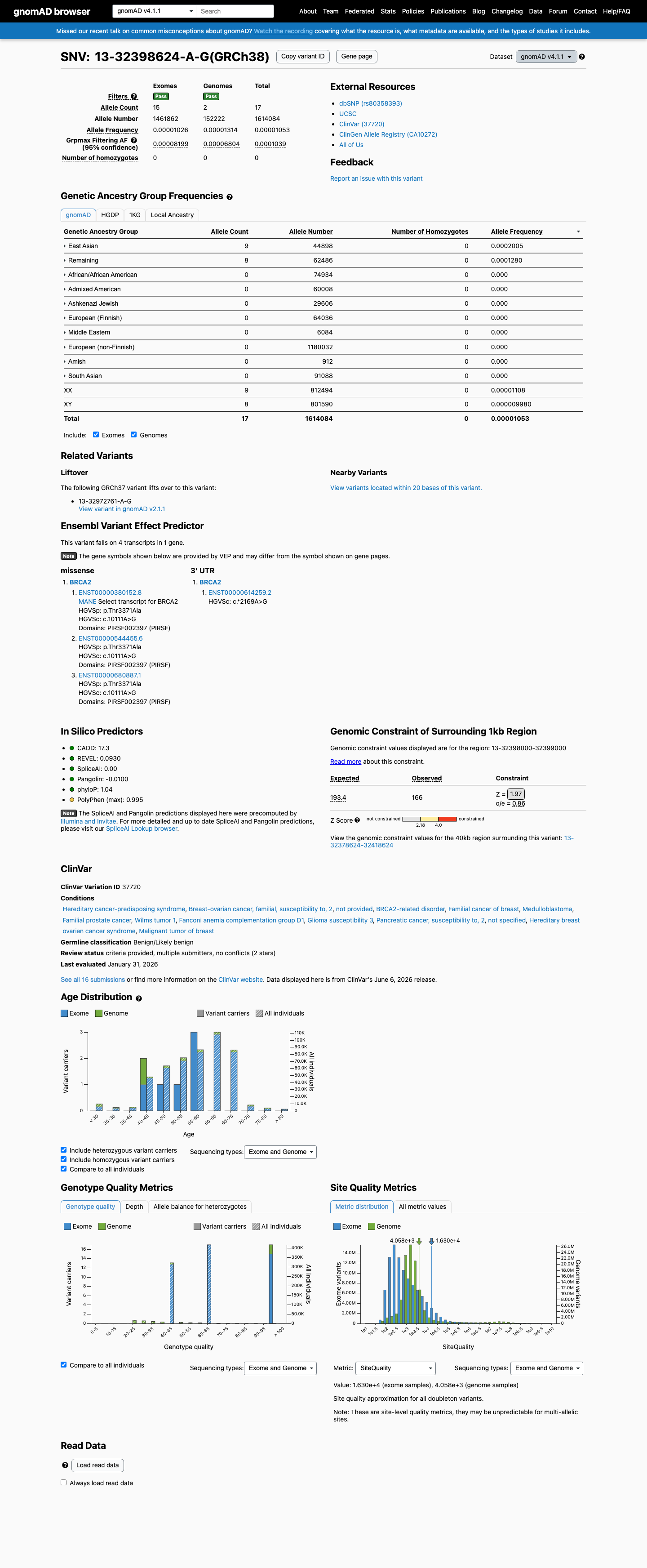
gnomAD v4.1
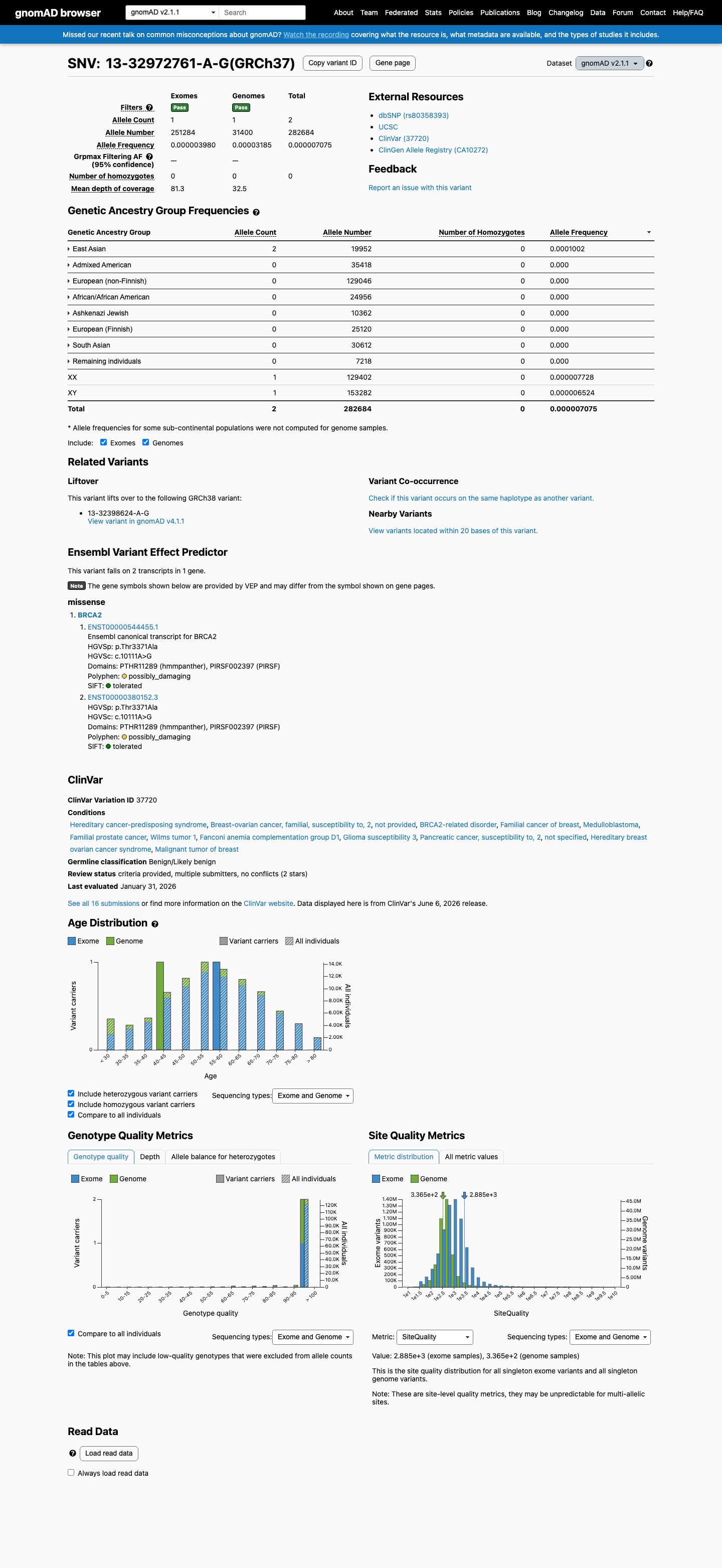
gnomAD v2.1
v4.1
This variant is present in gnomAD v4.1 (AF= 1.05323e-05; MAF= 0.00105%, 17/1614084 alleles, homozygotes = 0) and has highest observed frequency in the East Asian population (AF= 0.000200454; MAF= 0.02005%, 9/44898 alleles, homozygotes = 0); grpmax FAF= 0.00010391.
v2.1
This variant is present in gnomAD v2.1 (AF= 7.07504e-06; MAF= 0.00071%, 2/282684 alleles, homozygotes = 0) and has highest observed frequency in the East Asian population (AF= 0.000100241; MAF= 0.01002%, 2/19952 alleles, homozygotes = 0).
🇨🇦 CA
This variant is present in gnomAD-Canada v1.0 (AF= 0.00043426338074041906, 8/18422 alleles, homozygotes = 0).
Allele frequency by ancestry
three datasets · side by side
gnomAD v4.1
0.0011%
· 17 / 1,614,084
0 hom · FAF 0.01%
East Asian
9 / 44,898
0.02%
Remaining individuals
8 / 62,486
0.013%
+ 8 not observed (Admixed American, European (Finnish), Amish, Middle Eastern, South Asian, Ashkenazi Jewish, African/African American, European (non-Finnish))
gnomAD v2.1
0.00071%
· 2 / 282,684
0 hom
East Asian
2 / 19,952
0.01%
+ 7 not observed (African/African American, Admixed American, Ashkenazi Jewish, European (Finnish), European (non-Finnish), Remaining individuals, South Asian)
gnomAD Canada 🇨🇦
0.043%
· 8 / 18,422
0 hom · FAF 0.2%
East Asian
6 / 1,338
0.45%
Remaining individuals
2 / 1,138
0.18%
+ 7 not observed (African/African American, Latino/Admixed American, Ashkenazi Jewish, European (Finnish), Middle Eastern, European (non-Finnish), South Asian)
This variant has been reported in ClinVar as Likely benign (9 clinical laboratories) and as Uncertain significance (2 clinical laboratories) and as Benign (2 clinical laboratories). (ClinVarID = 37720)
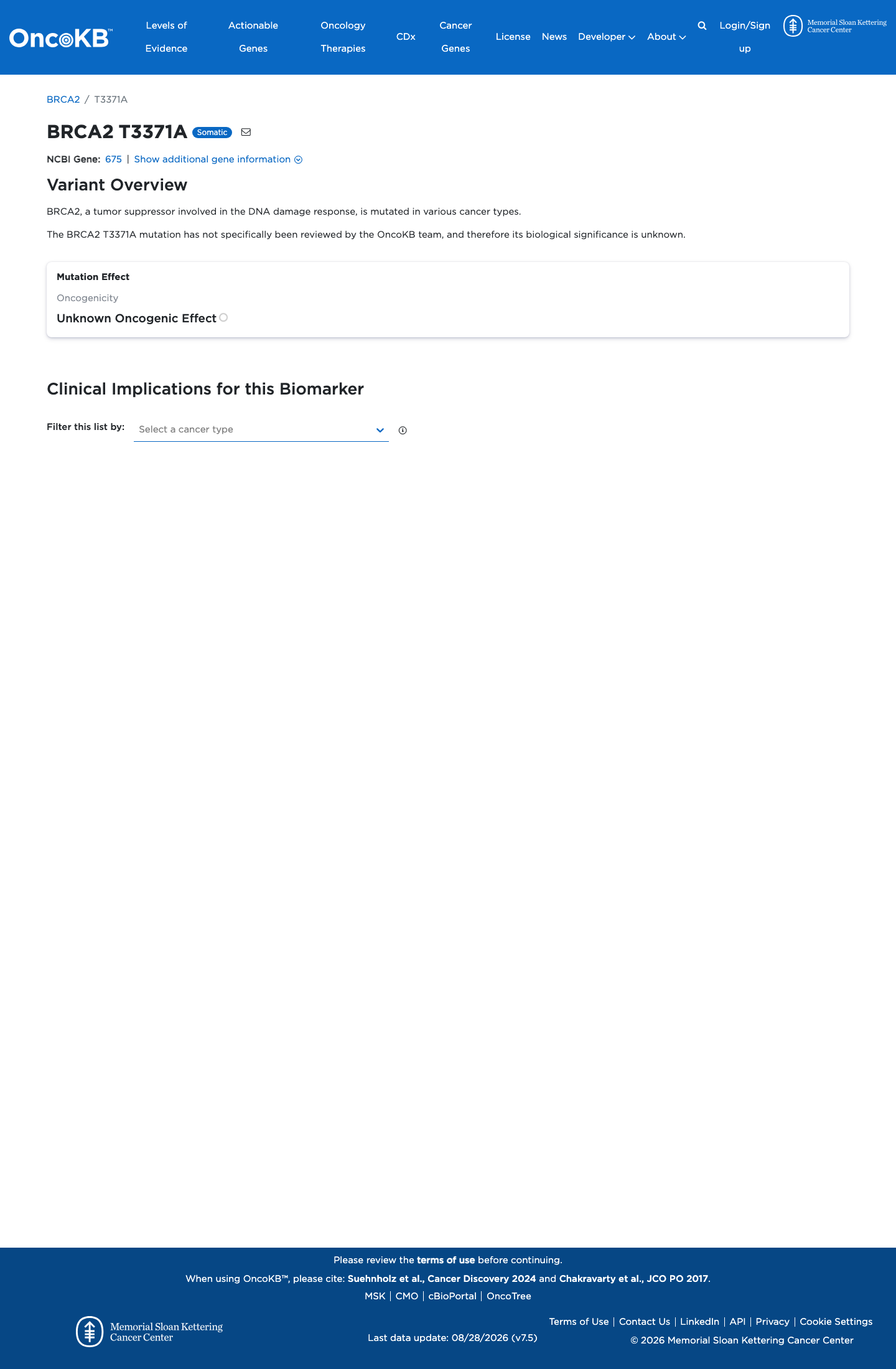
OncoKB did not identify variant-specific reviewed functional evidence for this variant; gene-level curated context is available for reviewer follow-up. BRCA2, a tumor suppressor involved in the DNA damage response, is mutated in various cancer types.
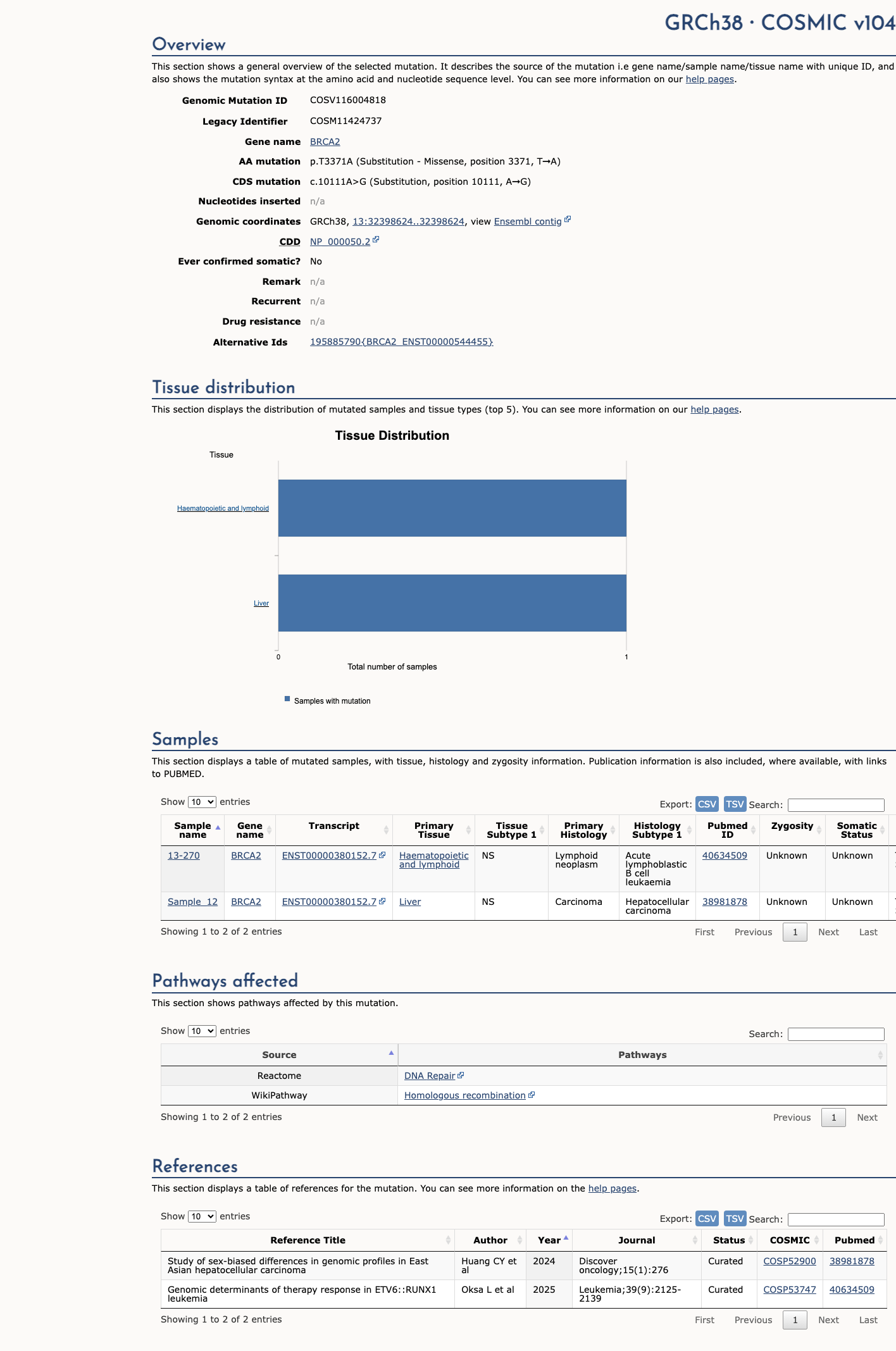
This variant does not lie in a statistically significant hotspot. This variant has previously been reported in somatic cancers (COSMIC; COSV116004818, n = 2 times).
Hotspots
This variant does not lie in a statistically significant hotspot.
Triaged references · 9 PMIDs not cited in assessment
20104584 ↗Characterization of BRCA1 and BRCA2 deleterious mutations and variants of unknown clinical significance in unilateral and bilateral breast cancer: the WECARE study.CLINVAR
24817641 ↗An integrated in silico approach to analyze the involvement of single amino acid polymorphisms in FANCD1/BRCA2-PALB2 and FANCD1/BRCA2-RAD51 complex.CLINVAR
25682074 ↗Prevalence of BRCA1 and BRCA2 germline mutations in patients with triple-negative breast cancer.CLINVAR
25741868 ↗Standards and guidelines for the interpretation of sequence variants: a joint consensus recommendation of the American College of Medical Genetics and Genomics and the Association for Molecular Pathology.CLINVAR
26467025 ↗A Standardized DNA Variant Scoring System for Pathogenicity Assessments in Mendelian Disorders.CLINVAR
27376475 ↗Clinical Next-Generation Sequencing Pipeline Outperforms a Combined Approach Using Sanger Sequencing and Multiplex Ligation-Dependent Probe Amplification in Targeted Gene Panel Analysis.CLINVAR
12692171 ↗American Society of Clinical Oncology policy statement update: genetic testing for cancer susceptibility.CLINVAR