Back
NM_000059.4:c.7484T>C
p.Ile2495Thr · BRCA2
0%
complete
Final classification
Likely Benign
PP3BS3
BRCA2
c.7484T>C
p.Ile2495Thr
missense · exon 15

BRCA2 encodes a DNA repair protein that maintains genome stability by repairing double-strand breaks through homologous recombination and by protecting DNA replication forks. It acts as a tumor suppressor, and inherited loss-of-function changes cause hereditary breast and ovarian cancer syndrome, with elevated lifetime risks of breast, ovarian, prostate, and pancreatic cancers; biallelic changes cause Fanconi anemia complementation group D1. Reduced or altered BRCA2 activity is implicated in multiple tumor types, and PARP inhibitors are an approved treatment for BRCA2-associated ovarian and breast cancers.

This variant

BRCA2 encodes a tumor-suppressor DNA-repair protein whose reduced or altered activity contributes to hereditary breast and ovarian cancer syndrome and related tumor risks.

Transcript
NM_000059.4
HGVS · transcript:coding
NM_000059.4:c.7484T>C
GRCh38
chr13:32356476 T>C
GRCh37
chr13:32930613 T>C
Likely Benign: ENIGMA assigns BS3 Strong and PP3 Supporting; the net conflicting-evidence score is −3, within the Likely Benign range.
Classification rationale
PP3 BS3 Likely Benign
BRCA2 c.7484T>C missense · exon 15

Likely Benign: BS3 Strong is assigned from two calibrated neutral functional studies. PP3 Supporting: REVEL 0.663 exceeds the 0.644 supporting threshold. Likely Benign: ENIGMA's conflicting-evidence score is −3 (BS3 −4 plus PP3 +1).

PP3 + BS3 → Likely Benign
LYFE Sciences is an AI system, and it can make mistakes. Criteria may be applied incorrectly, sources may be misread, and a confident-looking classification can still be wrong. Double-check every criterion and its underlying evidence before relying on any call.
Gene diagram · NM_000059.4 · variants mapped to exon structure
BRCA2 NM_000059.4
Fetching transcript structure from UCSC…
Applied criteria · 2 applied · 14 assessed
MetEvidence satisfies this criterion.
Not metEvaluated against available evidence; threshold not reached.
Not assessedApplies in principle, but no evidence was found to evaluate it.
N/ADoesn't apply to this variant type.
Applied · 2
Strength Supporting Moderate Strong Very strong
PP3 supporting Pathogenic
Met, Supporting: REVEL 0.663 meets the ClinGen SVI PP3 supporting threshold of 0.644 for missense variants.
The ENIGMA BRCA1/2 V1.2 specification defines PP3 for predicted deleterious computational impact and identifies the BRCA2 DNA-binding domain as a clinically important functional domain.The case-specific REVEL lookup reports a score of 0.663 for BRCA2 c.7484T>C (p.Ile2495Thr).The supplied ClinGen SVI REVEL calibration assigns PP3 Supporting at REVEL >=0.644 (Pejaver et al. 2022, PMID:36413997).
BS3 strong Benign
Met, Strong: ENIGMA Table 9 assigns BS3 Strong from two calibrated neutral studies, including Mesman results of 58% HDR and 84% cisplatin sensitivity versus wild type.
Specifications_Table9_V1.2_2024-11-18.xlsx: the exact c.7484T>C / p.(Ile2495Thr) row pre-assigns BS3 Strong and records two calibrated studies, Mesman 2019 (PMID:29988080) and Richardson 2021 (PMID:33609447), with benign/neutral functional results.Mesman et al. (PMID:29988080), Table 2 and Fig. 3b: c.7484T>C p.Ile2495Thr complemented the mESC phenotype after endogenous Brca2 loss; HDR was 58% and cisplatin sensitivity was 84% relative to wild type.ENIGMA Appendix E states that PS3 and BS3 are reserved for protein-function assays, that the selected mammalian assays were calibrated against clinically classified reference variants, and that no functional impact without conflicting damaging evidence supports Strong benign evidence.
Assessed · not applied · 9 not met · 5 not assessed
Pathogenic
PS1 Not met: no qualifying pathogenic variant producing the same Ile2495Thr amino-acid change was identified in the governing VCEP materials.
PS3 Not met: ENIGMA Table 9 assigns BS3 Strong after two calibrated studies found no damaging effect, including 58% HDR and 84% cisplatin sensitivity in Mesman et al.
PS4 Not assessed: the exact variant row lacks a qualifying PS4 case-control OR and p-value, and ENIGMA prohibits using its two observations as proband-counting evidence.
PM2 Not met: the variant is observed in both required non-cancer datasets, with 2 alleles in v2.1 exomes and 1 allele in v3.1 genomes.
PM3 Not assessed: no documented Fanconi anemia phenotype, qualifying BRCA2 co-occurring pathogenic variant, or phase information supports ENIGMA PM3 points.
PP1 Not assessed: the exact variant row has no segregation LR, and no quantitative co-segregation result or meiosis count is available for comparison with PP1 LR ≥2.08.
PP5 Not met: ClinVar has no exact-variant expert-panel classification; its available submissions are single-laboratory assertions, not eligible PP5 evidence.
Benign
BA1 Not met: maximum required non-cancer filter allele frequency was 3.23e-06, below the ENIGMA BA1 threshold of >0.001.
BS1 Not met: maximum required non-cancer filter allele frequency was 3.23e-06, below the ENIGMA BS1 Supporting threshold of >0.00002.
BS2 Not assessed: gnomAD reports zero homozygotes, but no qualifying phenotyped healthy-adult or clinical-cohort BS2 observations are available.
BS4 Not assessed: the exact variant row has no segregation LR, and the available combined LR 0.7333 is above the BS4 supporting threshold of ≤0.48.
BP1 Not met: Ile2495 lies inside the ENIGMA DNA-binding domain 2481-3186, whereas BP1 requires a missense variant outside a clinically important domain.
BP4 Not met: REVEL 0.663 exceeds the ClinGen SVI BP4 supporting threshold of <=0.29 for missense variants.
BP6 Not met: ClinVar has no exact-variant expert-panel classification; its available Likely benign submissions are ordinary laboratory assertions and cannot trigger BP6.
N/A · 12 PVS1 · PS2 · PM1 · PM4 · PM5 · PM6 · PP2 · PP4 · BP2 · BP3 · BP5 · BP7
Research & evidence
Population frequency · supports benign
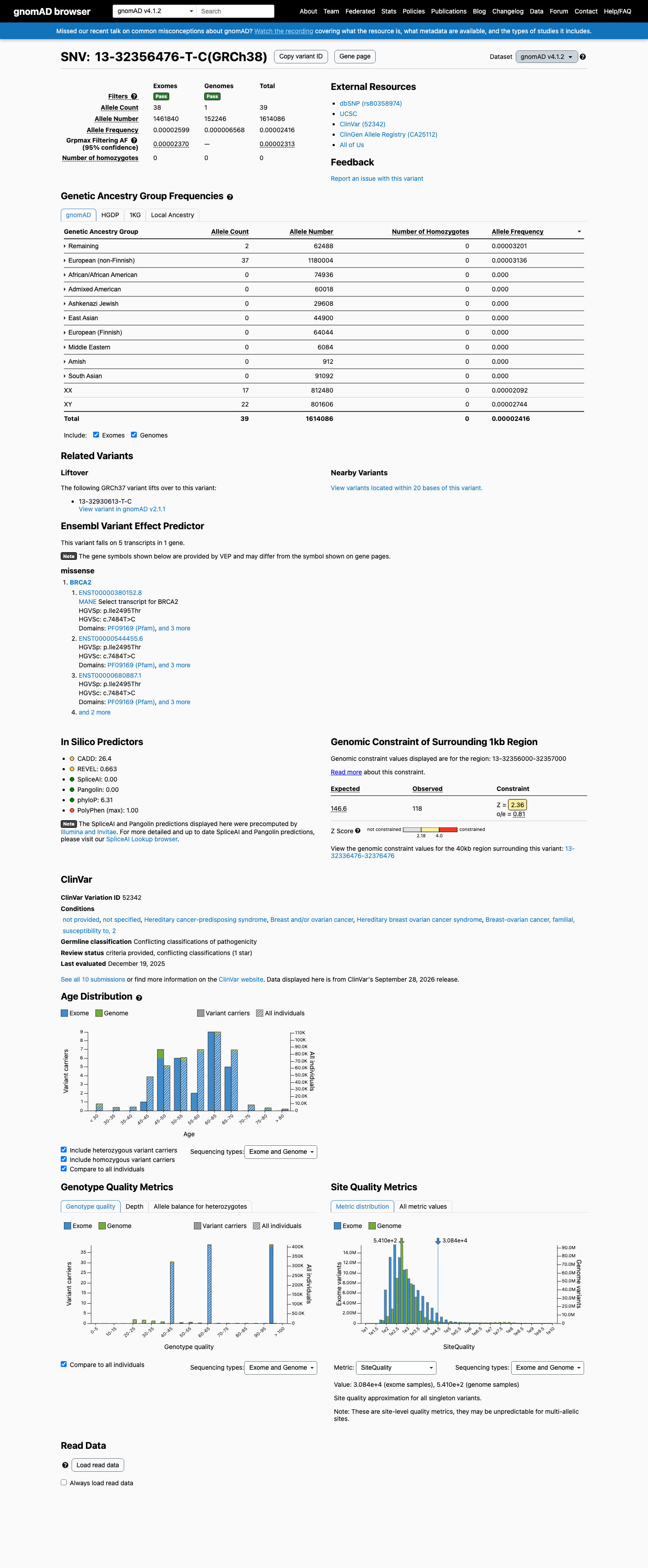
gnomAD v4.1 screenshot
gnomAD v4.1
gnomAD v2.1 screenshot
gnomAD v2.1
v4.1
This variant is present in gnomAD v4.1 (AF= 2.41623e-05; MAF= 0.00242%, 39/1614086 alleles, homozygotes = 0) and has highest observed frequency in the Remaining individuals population (AF= 3.20061e-05; MAF= 0.00320%, 2/62488 alleles, homozygotes = 0); grpmax FAF= 2.313e-05.
v2.1
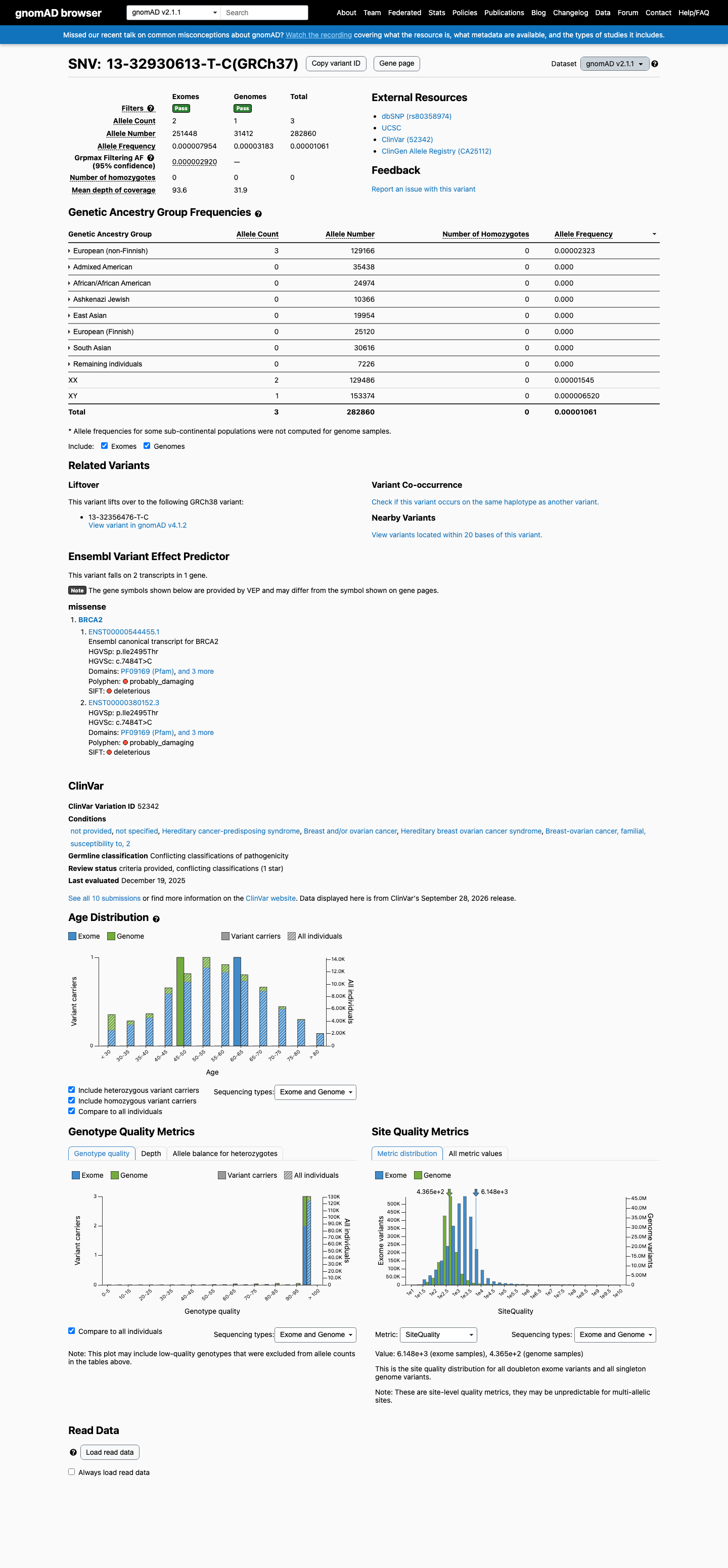
This variant is present in gnomAD v2.1 (AF= 1.0606e-05; MAF= 0.00106%, 3/282860 alleles, homozygotes = 0) and has highest observed frequency in the European (non-Finnish) population (AF= 2.32259e-05; MAF= 0.00232%, 3/129166 alleles, homozygotes = 0); grpmax FAF= 2.92e-06.
🇨🇦 CA
Absent from gnomAD-Canada v1.0.
Allele frequency by ancestry
three datasets · side by side
gnomAD v4.1
0.0024% · 39 / 1,614,086
0 hom · FAF 0.0023%
Remaining individuals
2 / 62,488
0.0032%
European (non-Finnish)
37 / 1,180,004
0.0031%
+ 8 not observed (Admixed American, European (Finnish), Amish, East Asian, Middle Eastern, South Asian, Ashkenazi Jewish, African/African American)
gnomAD v2.1
0.0011% · 3 / 282,860
0 hom · FAF 0.00029%
European (non-Finnish)
3 / 129,166
0.0023%
+ 7 not observed (African/African American, Admixed American, Ashkenazi Jewish, East Asian, European (Finnish), Remaining individuals, South Asian)
gnomAD Canada 🇨🇦
Absent · 0 / ?
0 hom
Not observed in any ancestry group.
ClinVar screenshot
ClinVar
This variant has been reported in ClinVar as Likely benign (5 clinical laboratories) and as Uncertain significance (4 clinical laboratories) and as Uncertain Significance (1 clinical laboratory). (ClinVarID = 52342)
SpliceAI screenshot
In silico
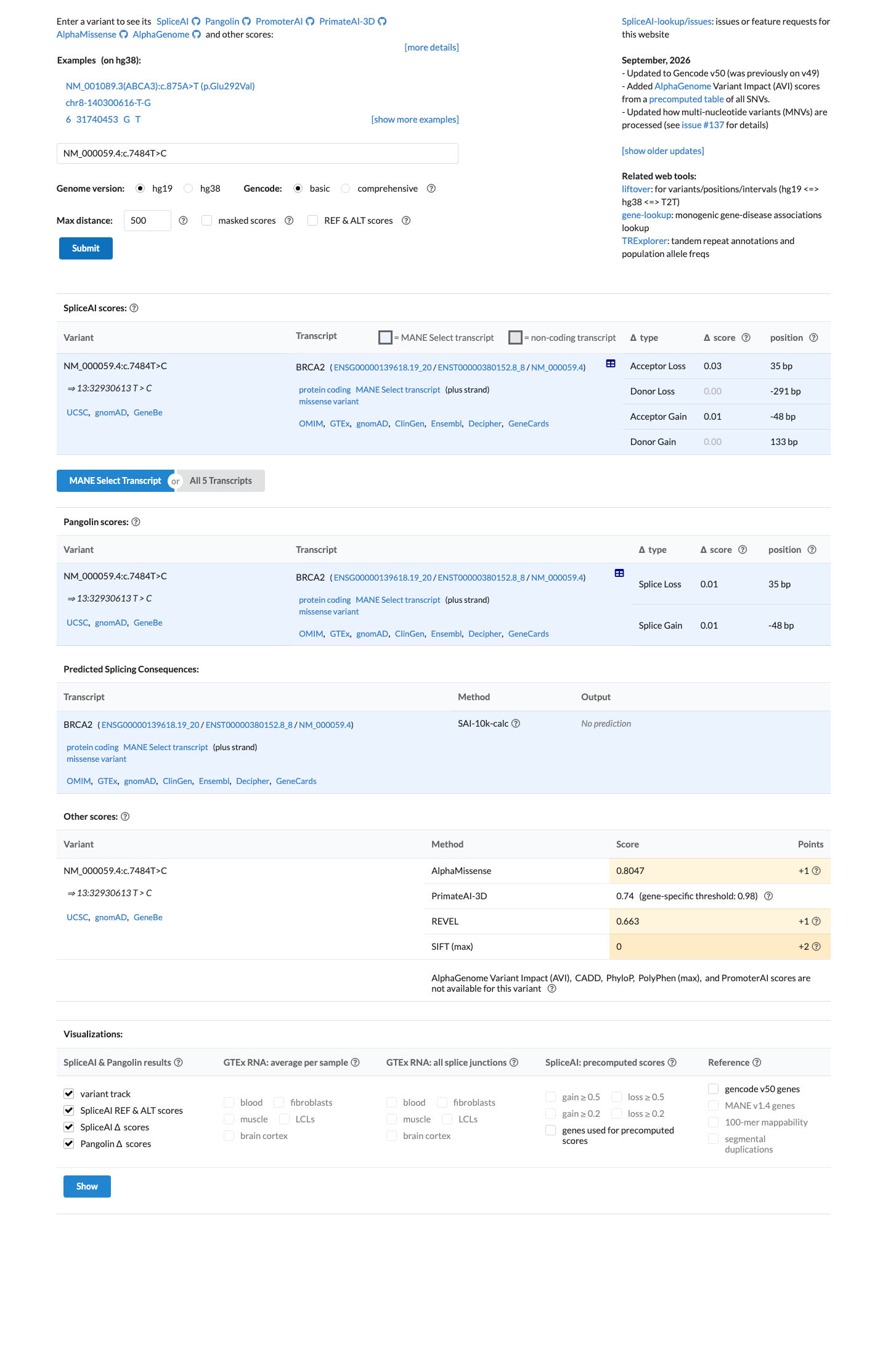
SpliceAI predicts no significant splice impact for this variant (max delta score = 0.03). REVEL score = 0.663. BayesDel score = 0.0999603.
Functional / OncoKB screenshot
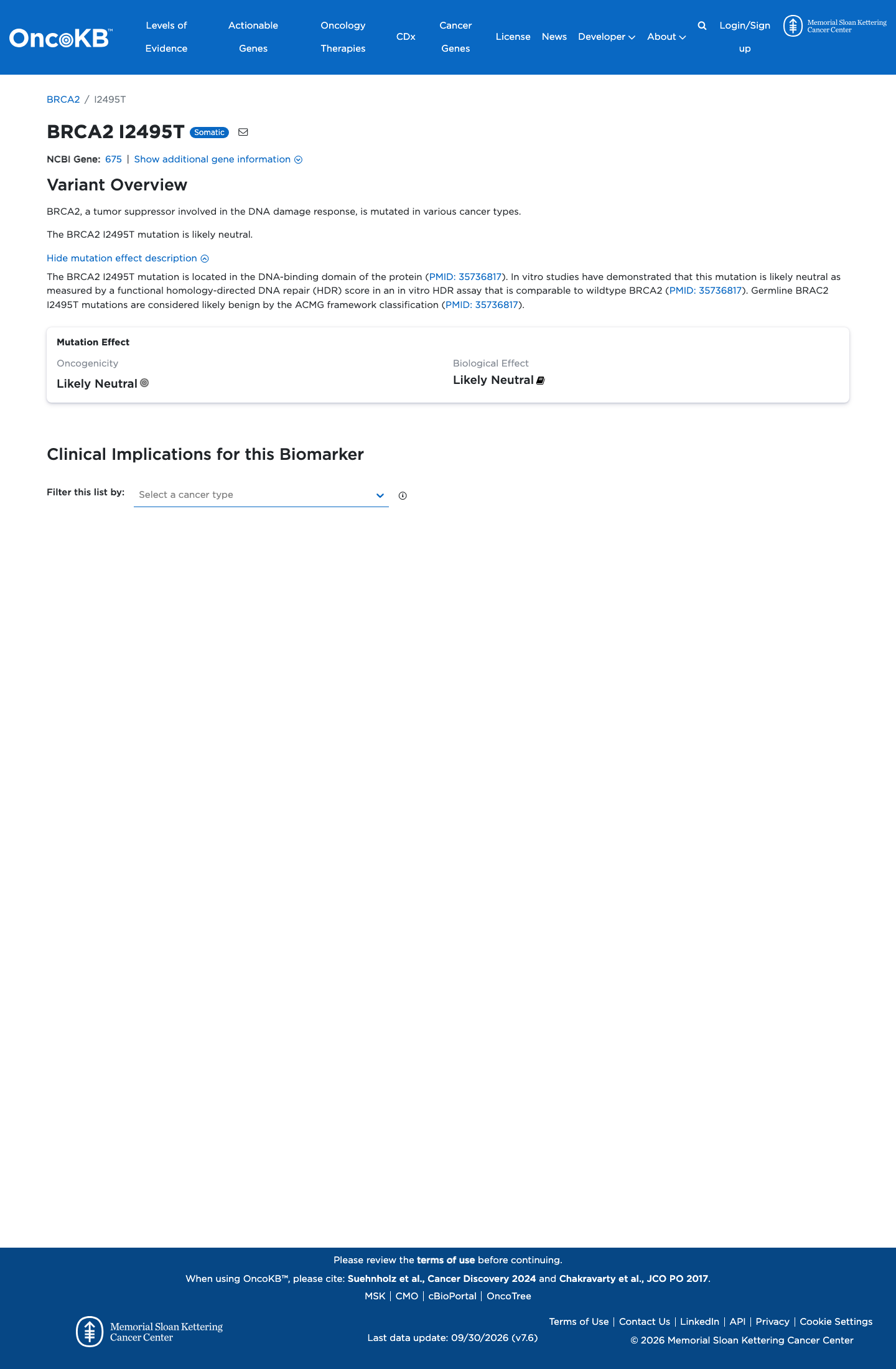
Functional Likely Neutral
OncoKB identified variant-specific curated literature and context relevant to functional review; biological-effect context: Likely Neutral; curated oncogenicity label: Likely Neutral.
OncoKB ↗
COSMIC screenshot
COSMIC
Cancer hotspots screenshot
Cancer hotspots
Somatic evidence Not in COSMIC / hotspots
COSMIC
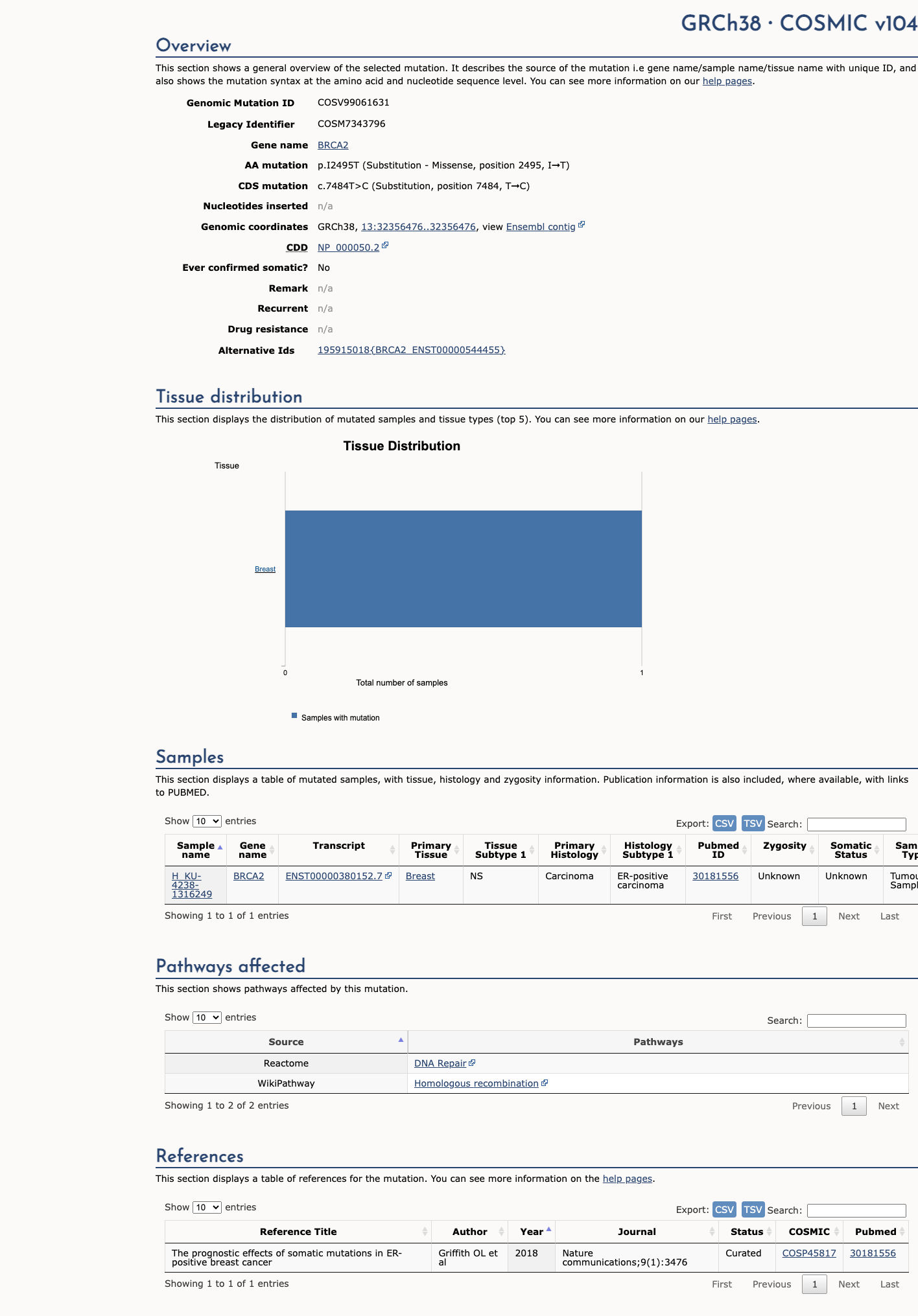
This variant does not lie in a statistically significant hotspot. This variant has previously been reported in somatic cancers (COSMIC; COSV99061631, n = 1 times).
Hotspots
This variant does not lie in a statistically significant hotspot.
Literature · how each cited paper was used
2papers cited
Each card is an audit: what was searched, what was found, whether it names the variant, which criteria it fed, and why. 6 further PMIDs triaged but not cited — see Sources & references.
Comprehensive annotation of BRCA1 and BRCA2 missense variants by functionally validated sequence-based computational prediction models.
Searched
c.7484T>CNP_000050.3:p.(I2495T)
Found
The exact protein variant I2495T is shown among the 207 BRCA2 missense variants evaluated in the study's homology-directed repair assay dataset and displayed in Figure 1, but the extracted paper text does not provide a variant-specific HDR value or categorical result for I2495T.
Variant
✓ Names this variant — characterised directly
Applied to
→BS3 strong
I2495T Fig. 1 Homology-directed repair (HDR) activity of 207 BRCA2 missense variants.
Location Figure 1; Results, "Functional characterization of 68 novel BRCA2 missense variants"  ·  Context Cell-based HDR assay in BRCA2-deficient V-C8 cells expressing mutant full-length BRCA2, using a DR-GFP reporter after induction of a DNA double-strand break; Figure 1 displays 207 BRCA2 missense variants.  ·  full text
The functional impact of variants of uncertain significance in BRCA2.
Searched
c.7484T>CNP_000050.3:p.(I2495T)
Found
The paper explicitly evaluated BRCA2 c.7484T>C, p.Ile2495Thr (NP_000050.3:p.(I2495T)) in an mESC-based functional assay. The variant complemented the lethal phenotype caused by loss of endogenous mouse Brca2, with HDR capacity of 58% relative to wild-type BRCA2 and cisplatin sensitivity of 84% of the wild-type control value.
Variant
✓ Names this variant — characterised directly
Applied to
→BS3 strong
Variant-specific calibrated mammalian functional results show complementation and near-neutral HDR and cisplatin responses rather than a damaging effect.
15 c.7484T>C p.Ile2495Thr Yes 58 84
Location Table 2, exon 15; HDR result also shown in Fig. 3b  ·  Context Mouse embryonic stem cell assay measuring complementation after Cre-mediated loss of endogenous Brca2, HDR capacity using an I-Sce1-induced double-strand-break DR-GFP reporter, and cisplatin sensitivity relative to wild-type BRCA2-expressing cells.  ·  full text
Sources & reference links
9Sources
CSpec VCEP
ClinVar
gnomAD v2.1
gnomAD v4.1
gnomAD-Canada
SpliceAI
OncoKB
COSMIC
Cancer hotspots
Triaged references · 6 PMIDs not cited in assessment
35736817 ↗ Classification of BRCA2 Variants of Uncertain Significance (VUS) Using an ACMG/AMP Model Incorporating a Homology-Directed Repair (HDR) Functional Assay. ONCOKB
25741868 ↗ Standards and guidelines for the interpretation of sequence variants: a joint consensus recommendation of the American College of Medical Genetics and Genomics and the Association for Molecular Pathology. CLINVAR
26467025 ↗ A Standardized DNA Variant Scoring System for Pathogenicity Assessments in Mendelian Disorders. CLINVAR
26689913 ↗ Patterns and functional implications of rare germline variants across 12 cancer types. CLINVAR
31131967 ↗ Large scale multifactorial likelihood quantitative analysis of BRCA1 and BRCA2 variants: An ENIGMA resource to support clinical variant classification. CLINVAR
28492532 ↗ Sherloc: a comprehensive refinement of the ACMG-AMP variant classification criteria. CLINVAR