Back
NM_000059.4:c.7908T>A
p.Cys2636Ter · BRCA2
0%
complete
Final classification
Pathogenic
PVS1PM5PP5
BRCA2
c.7908T>A
p.Cys2636Ter
nonsense · exon 17

BRCA2 encodes a DNA repair protein that maintains genome stability by repairing double-strand breaks through homologous recombination and by protecting DNA replication forks. It acts as a tumor suppressor, and inherited loss-of-function changes cause hereditary breast and ovarian cancer syndrome, with elevated lifetime risks of breast, ovarian, prostate, and pancreatic cancers; biallelic changes cause Fanconi anemia complementation group D1. Reduced or altered BRCA2 activity is implicated in multiple tumor types, and PARP inhibitors are an approved treatment for BRCA2-associated ovarian and breast cancers.

This variant

This BRCA2 truncating change is expected to reduce homologous-recombination DNA repair, the mechanism underlying inherited breast, ovarian, prostate, and pancreatic cancer risk.

Transcript
NM_000059.4
HGVS · transcript:coding
NM_000059.4:c.7908T>A
GRCh38
chr13:32362625 T>A
GRCh37
chr13:32936762 T>A
Pathogenic: ENIGMA Table 3's one Very Strong plus one Strong rule is met by PVS1 (very strong) and PM5 (strong, PTC).
Classification rationale
PVS1PM5PP5 Pathogenic
BRCA2 c.7908T>A nonsense · exon 17

PVS1 very strong: the ENIGMA exon 17 rule applies to this upstream BRCA2 protein-truncating variant. PM5 strong: ENIGMA assigns the exon 17 PTC code PM5_Strong (PTC). PP5 supporting: an exact-match ENIGMA expert-panel ClinVar classification is Pathogenic.

PVS1 + PM5 + PP5 → Pathogenic
LYFE Sciences is an AI system, and it can make mistakes. Criteria may be applied incorrectly, sources may be misread, and a confident-looking classification can still be wrong. Double-check every criterion and its underlying evidence before relying on any call.
Gene diagram · NM_000059.4 · variants mapped to exon structure
BRCA2 NM_000059.4
Fetching transcript structure from UCSC…
Applied criteria · 3 applied · 13 assessed
MetEvidence satisfies this criterion.
Not metEvaluated against available evidence; threshold not reached.
Not assessedApplies in principle, but no evidence was found to evaluate it.
N/ADoesn't apply to this variant type.
Applied · 3
Strength Supporting Moderate Strong Very strong
PVS1 very strong Pathogenic
Met, very strong: ENIGMA Table 4 assigns PVS1 to BRCA2 exon 17 PTCs, and p.Cys2636Ter truncates 783 of 3418 amino acids upstream of the terminal exon.
The case normalization identifies NM_000059.4:c.7908T>A as NP_000050.3:p.(Cys2636Ter)/p.(C2636*), a nonsense change, with the predicted protein ending at residue 2636 while the reference ends at residue 3418.Specifications Table 4 lists BRCA2 exon 17, coding interval c.7806-c.7976, PTC code PVS1, and exon 17 protein interval p.2602-p.2659; c.7908 lies within this exon.The ENIGMA specification defines PVS1_VariableWeight for null variants in genes where loss of function is a known disease mechanism and directs PTC variants to the exon-specific Table 4 decision tree.
PM5 strong Pathogenic
Met, Strong: ENIGMA Table 4 assigns PM5_Strong (PTC) to BRCA2 exon 17, which contains c.7908.
Specifications_Table4_V1.2_2024-11-18.xlsx.txt lists BRCA2 exon 17 as c.7806-c.7976 and assigns PVS1 for coding PTC variants plus PM5_Strong (PTC).c.7908 falls within the exon 17 coding interval, and the case normalization identifies the consequence as nonsense with p.Cys2636Ter.The ENIGMA Appendix D rule states that PM5(PTC) is exon-specific, applies to nonsense and frameshift changes meeting PVS1, and is distinct from classic same-residue missense PM5.
PP5 supporting Pathogenic
Met, Supporting: exact ClinVar variation 52433 has an ENIGMA expert-panel Pathogenic classification, satisfying the requested PP5 rule.
ClinVar variation 52433 exactly matches NM_000059.4(BRCA2):c.7908T>A (p.Cys2636Ter).ClinVar reports Pathogenic with review status reviewed by expert panel and three review stars; the expert panel is ENIGMA.Ordinary laboratory submissions and aggregate labels were not used to trigger PP5; only the exact-variant expert-panel assertion was used.
Assessed · not applied · 3 not met · 10 not assessed
Pathogenic
PS3 Not assessed: no calibrated damaging functional-assay result was found for c.7908T>A, p.Cys2636Ter, or p.C2636*.
PS4 Not assessed: no variant-specific case-control OR, confidence interval, p-value, or qualifying affected/control counts were available for the PS4 OR >=4 threshold.
PM2 Not assessed: the variant is absent from both required non-cancer gnomAD datasets, but the ENIGMA PM2 prerequisite of regional average read depth at least 25 is undocumented.
PM3 Not assessed: no Fanconi Anemia phenotype, same-gene pathogenic co-variant, or verified phase is documented for PM3 application.
PP1 Not assessed: no variant-specific pedigree or quantitative segregation LR was available to compare with the PP1 threshold of LR >=2.08.
PP4 Not assessed: the gene-specific clinical-history table has no c.7908T>A row, so no combined LR can be compared with the PP4 >=2.08 threshold.
Benign
BA1 Not met: the variant is absent from the governing non-cancer gnomAD datasets, so no filter allele frequency exceeds the ENIGMA BA1 threshold of 0.1%.
BS1 Not met: the variant is absent from both governing non-cancer gnomAD datasets, so its frequency does not reach the ENIGMA BS1 threshold of 0.01%.
BS2 Not assessed: no individual-level homozygote, healthy-carrier, age, follow-up, or Fanconi Anemia phenotype data are available to assign ENIGMA BS2 points.
BS3 Not assessed: no calibrated benign functional-assay result was found for c.7908T>A, p.Cys2636Ter, or p.C2636*.
BS4 Not assessed: no variant-specific non-segregation data or quantitative LR was available to compare with the BS4 supporting threshold of LR <=0.48.
BP5 Not assessed: no exact-variant clinical-history LR was available for comparison with the BP5 Supporting threshold LR <=0.48.
BP6 Not met: exact ClinVar variation 52433 is Pathogenic by an ENIGMA expert panel, not Benign or Likely Benign for BP6.
N/A · 12 PS1 · PS2 · PM1 · PM4 · PM6 · PP2 · PP3 · BP1 · BP2 · BP3 · BP4 · BP7
Research & evidence
Population frequency · supports pathogenic
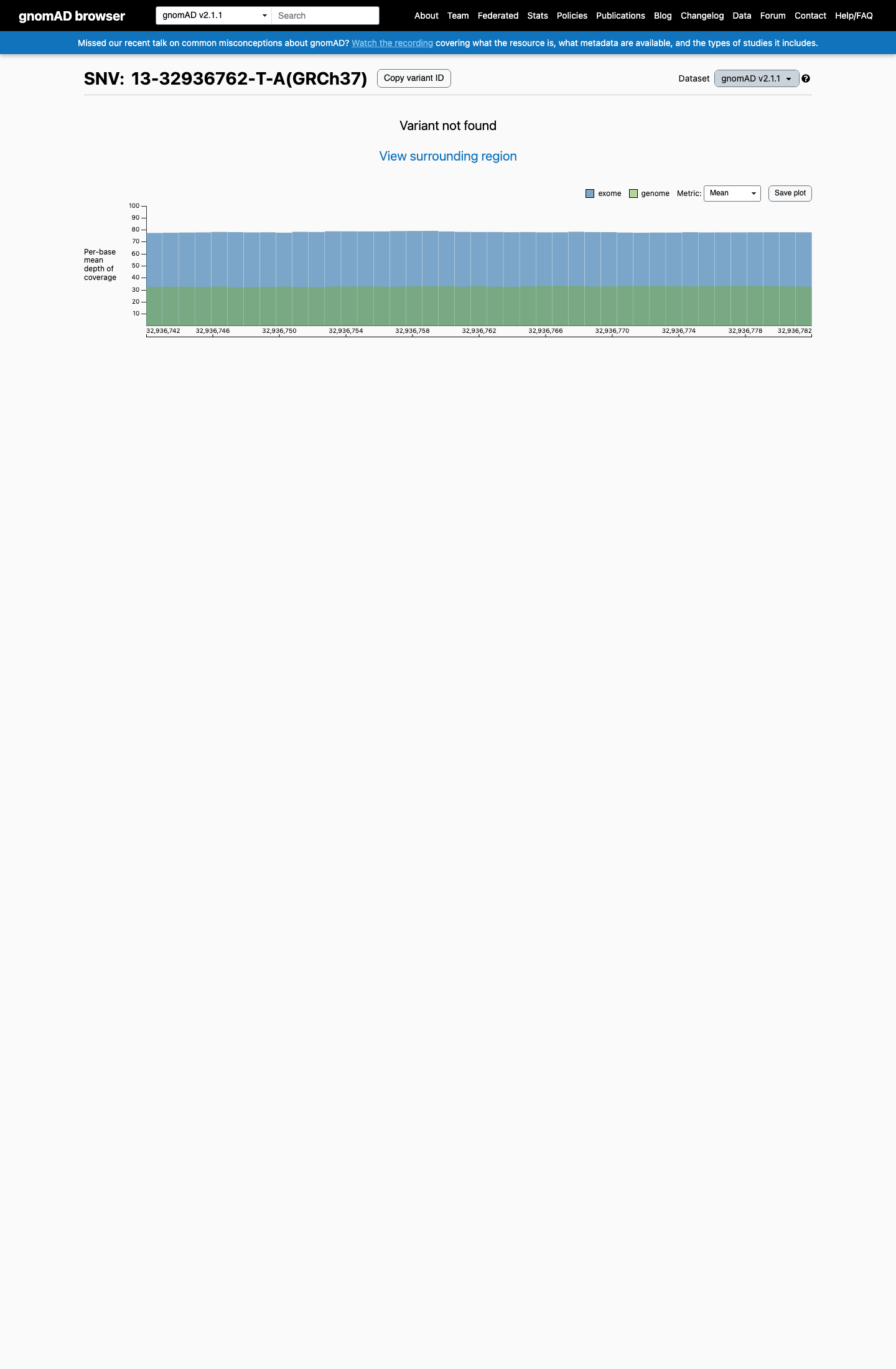
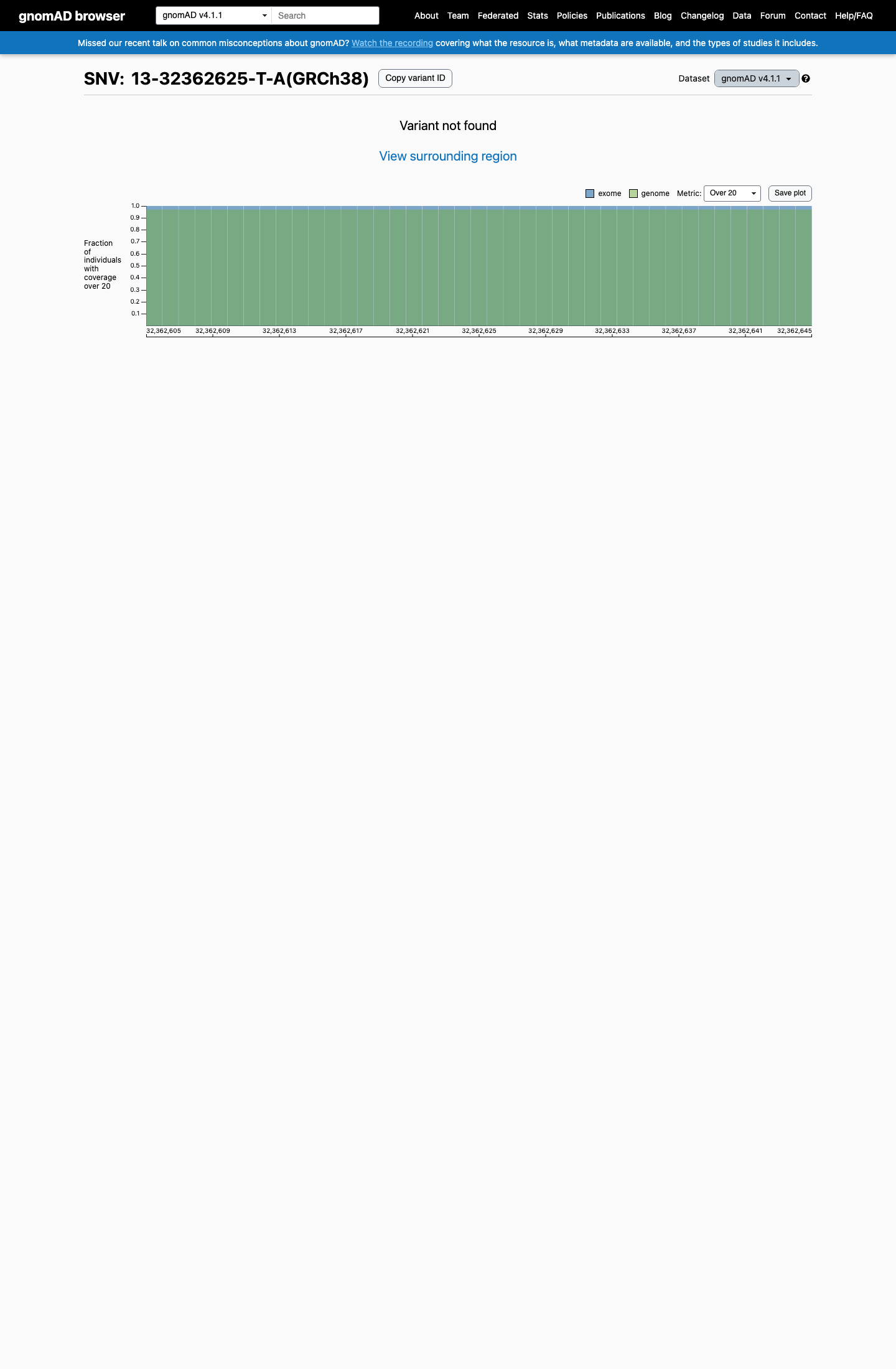
gnomAD v4.1 screenshot
gnomAD v4.1
gnomAD v2.1 screenshot
gnomAD v2.1
v4.1
Absent from gnomAD v4.1.
v2.1
Absent from gnomAD v2.1.
🇨🇦 CA
Absent from gnomAD-Canada v1.0.
Allele frequency by ancestry
three datasets · side by side
gnomAD v4.1
Absent · 0 / ?
0 hom
Not observed in any ancestry group.
gnomAD v2.1
Absent · 0 / ?
0 hom
Not observed in any ancestry group.
gnomAD Canada 🇨🇦
Absent · 0 / ?
0 hom
Not observed in any ancestry group.
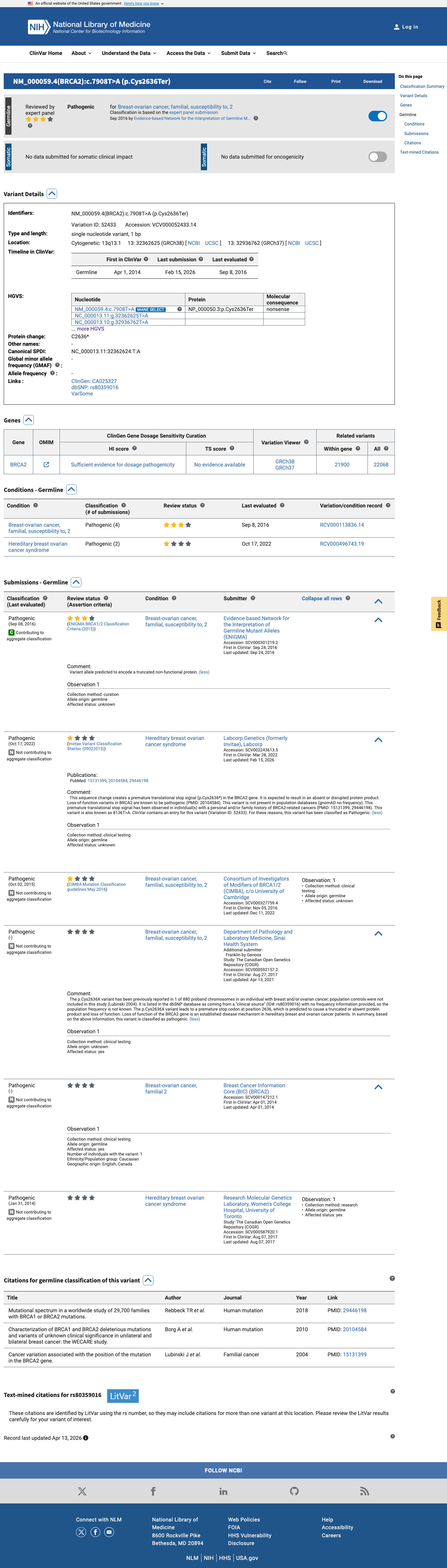
ClinVar screenshot
ClinVar
This variant has been reported in ClinVar as Pathogenic (4 clinical laboratories) and as Pathogenic by Evidence-based Network for the Interpretation of Germline Mutant Alleles (ENIGMA) (expert panel). (ClinVarID = 52433)
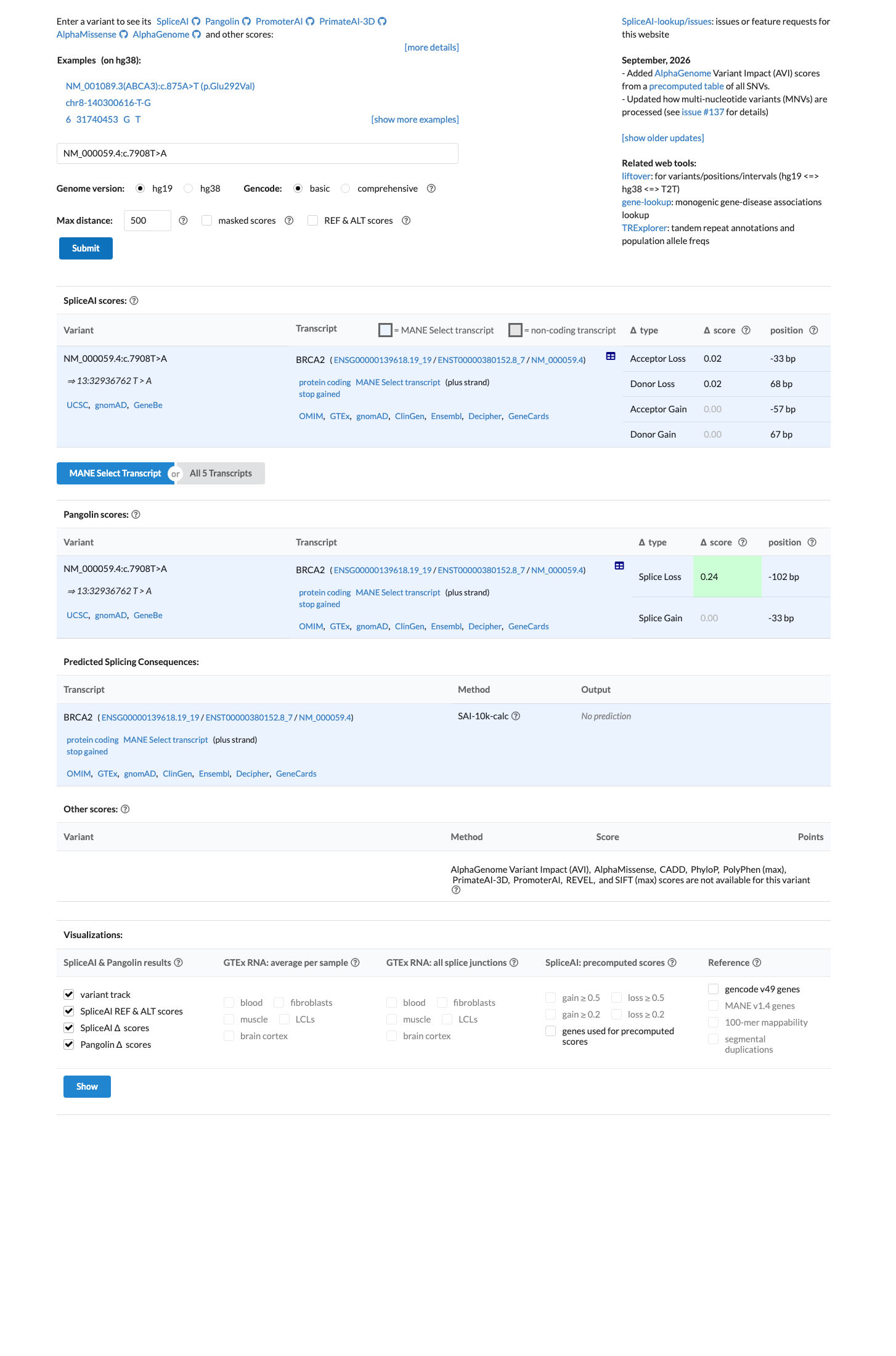
SpliceAI screenshot
In silico
SpliceAI predicts no significant splice impact for this variant (max delta score = 0.02). BayesDel score = 0.466048.
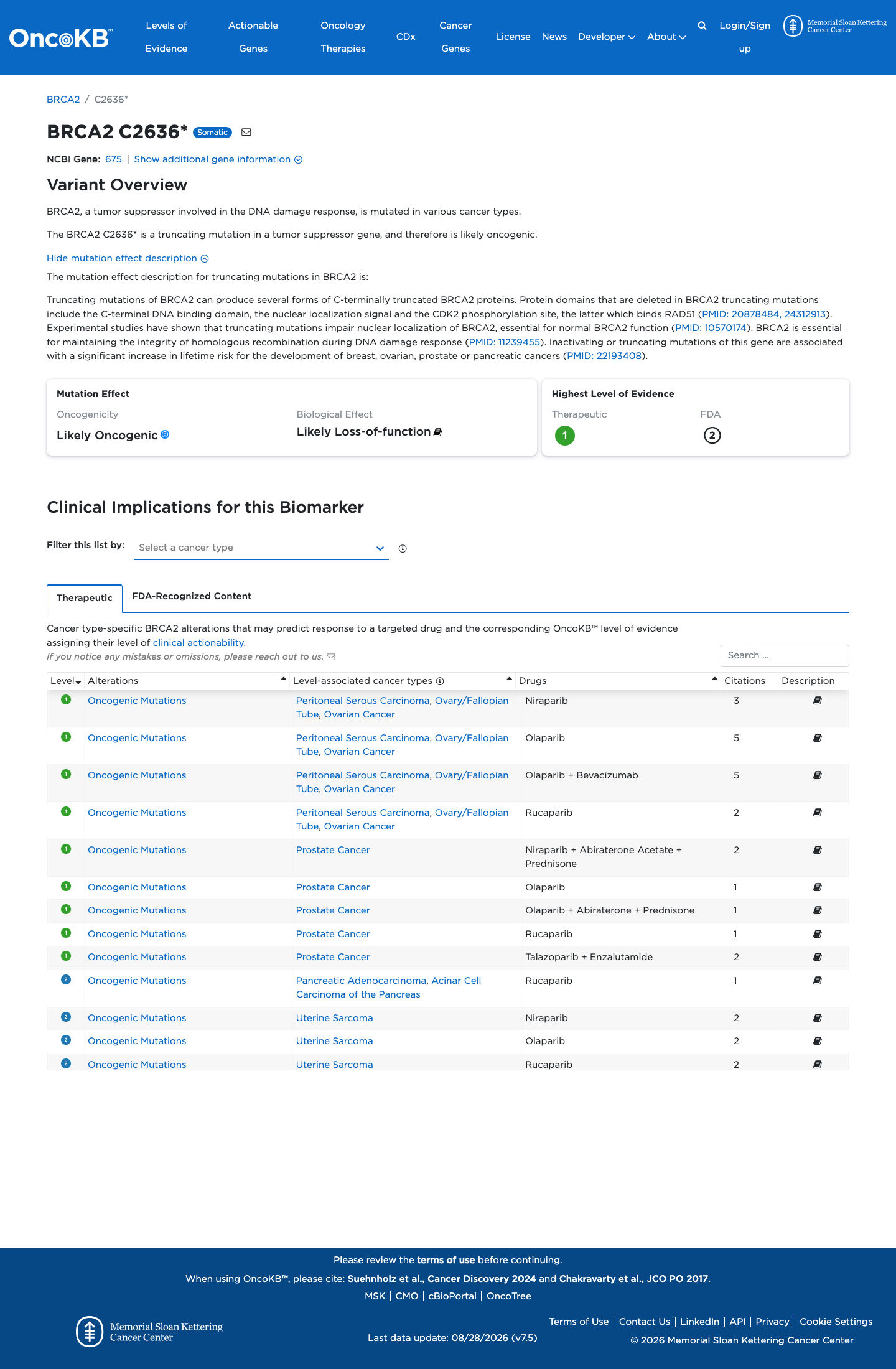
Functional / OncoKB screenshot
Functional Likely Oncogenic
OncoKB identified variant-specific curated literature and context relevant to functional review; biological-effect context: Likely Loss-of-function; curated oncogenicity label: Likely Oncogenic.
OncoKB ↗
COSMIC screenshot
COSMIC
Cancer hotspots screenshot
Cancer hotspots
Somatic evidence Not in COSMIC / hotspots
COSMIC
This variant does not lie in a statistically significant hotspot. This variant has not previously been reported in somatic cancers (COSMIC).
Hotspots
This variant does not lie in a statistically significant hotspot.
Sources & reference links
9Sources
CSpec VCEP
ClinVar
gnomAD v2.1
gnomAD v4.1
gnomAD-Canada
SpliceAI
OncoKB
COSMIC
Cancer hotspots
Triaged references · 8 PMIDs not cited in assessment
10570174 ↗ Truncated BRCA2 is cytoplasmic: implications for cancer-linked mutations. ONCOKB
11239455 ↗ BRCA2 is required for homology-directed repair of chromosomal breaks. ONCOKB
20878484 ↗ A new mutation of BRCA2 gene in an Italian healthy woman with familial breast cancer history. ONCOKB
22193408 ↗ BRCA1 and BRCA2: different roles in a common pathway of genome protection. ONCOKB
24312913 ↗ A comprehensive focus on global spectrum of BRCA1 and BRCA2 mutations in breast cancer. ONCOKB
20104584 ↗ Characterization of BRCA1 and BRCA2 deleterious mutations and variants of unknown clinical significance in unilateral and bilateral breast cancer: the WECARE study. CLINVAR
31672839 ↗ Management of patients with increased risk for familial pancreatic cancer: updated recommendations from the International Cancer of the Pancreas Screening (CAPS) Consortium. CLINVAR
12692171 ↗ American Society of Clinical Oncology policy statement update: genetic testing for cancer susceptibility. CLINVAR