Back
NM_000059.4:c.9257G>C
p.Gly3086Ala · BRCA2
0%
complete
Final classification
Likely Benign
BS1BP4
BRCA2
c.9257G>C
p.Gly3086Ala
missense · exon 25

BRCA2 encodes a DNA repair protein that maintains genome stability by repairing double-strand breaks through homologous recombination and by protecting DNA replication forks. It acts as a tumor suppressor, and inherited loss-of-function changes cause hereditary breast and ovarian cancer syndrome, with elevated lifetime risks of breast, ovarian, prostate, and pancreatic cancers; biallelic changes cause Fanconi anemia complementation group D1. Reduced or altered BRCA2 activity is implicated in multiple tumor types, and PARP inhibitors are an approved treatment for BRCA2-associated ovarian and breast cancers.

This variant

The p.Gly3086Ala substitution occurs in BRCA2, a tumor-suppressor DNA-repair protein whose inherited loss of function causes hereditary breast and ovarian cancer syndrome.

Transcript
NM_000059.4
HGVS · transcript:coding
NM_000059.4:c.9257G>C
GRCh38
chr13:32394689 G>C
GRCh37
chr13:32968826 G>C
Likely Benign: BS1 (strong) plus BP4 (supporting) satisfy the ENIGMA BRCA2 VCEP Table 3 Strong(Benign)+Supporting(Benign) rule.
Classification rationale
BS1BP4 Likely Benign
BRCA2 c.9257G>C missense · exon 25

BS1 Strong: the maximum non-cancer filter allele frequency is 0.00043582, above the ENIGMA threshold of 0.0001. BP4 Supporting: BayesDel -0.0288497 and SpliceAI 0.011 meet the ENIGMA BRCA2 no-impact thresholds.

BS1 + BP4 → Likely Benign
LYFE Sciences is an AI system, and it can make mistakes. Criteria may be applied incorrectly, sources may be misread, and a confident-looking classification can still be wrong. Double-check every criterion and its underlying evidence before relying on any call.
Gene diagram · NM_000059.4 · variants mapped to exon structure
BRCA2 NM_000059.4
Fetching transcript structure from UCSC…
Applied criteria · 2 applied · 13 assessed
MetEvidence satisfies this criterion.
Not metEvaluated against available evidence; threshold not reached.
Not assessedApplies in principle, but no evidence was found to evaluate it.
N/ADoesn't apply to this variant type.
Applied · 2
Strength Supporting Moderate Strong Very strong
BS1 strong Benign
Met at strong: maximum non-cancer grpmax FAF was 0.00043582, exceeding the ENIGMA BS1 threshold of 0.0001.
gnomAD v2.1 non-cancer exomes: maximum non-cancer grpmax FAF 0.00043582, from 20 alternate alleles among 235466, with one homozygote.gnomAD v3.1 non-cancer genomes: maximum non-cancer grpmax FAF 0.00028352, from 4 alternate alleles among 147624, with zero homozygotes.The governing ENIGMA BRCA2 specification assigns BS1 Strong above FAF 0.0001 and BS1 Supporting only above 0.00002 through 0.0001.
BP4 supporting Benign
Met, Supporting: BayesDel -0.0288497 is <=0.18 and SpliceAI 0.011 is <=0.1, satisfying both BRCA2 BP4 no-impact requirements.
The ENIGMA VCEP defines BP4 for missense variants inside a clinically important functional domain only when BayesDel predicts no impact and SpliceAI is <=0.1; BRCA2 no-impact BayesDel cutoff is 0.18.BayesDel no-AF score for NM_000059.4:c.9257G>C is -0.0288497, meeting the VCEP BRCA2 no-impact cutoff of <=0.18.SpliceAI maximum delta score is 0.011, meeting the VCEP no-predicted-splicing cutoff of <=0.1.
Assessed · not applied · 4 not met · 9 not assessed
Pathogenic
PS1 Not assessed: SpliceAI max delta 0.011 meets the <=0.1 requirement, but no qualifying pathogenic same-amino-acid reference variant was found.
PS3 Not assessed: no qualifying calibrated protein-function result was found, while the available variant-specific assay was mRNA-only and showed no splicing abnormality.
PS4 Not assessed: no exact variant-level case-control p-value, OR, or confidence interval was available to test the ENIGMA PS4 thresholds.
PM2 Not met: the variant is present in gnomAD v2.1 non-cancer exomes at AF 8.4938e-05 and gnomAD v3.1 non-cancer genomes at AF 2.7096e-05.
PM3 Not met: gnomAD maximum FAF is 0.00043457, exceeding the VCEP benign-evidence threshold of 0.0001, and no Fanconi-anemia proband with a same-gene co-occurring variant is documented.
PP1 Not assessed: no variant-specific pedigree or quantitative segregation likelihood ratio was available to compare with the VCEP's PP1 threshold of LR ≥2.08:1.
PP3 Not met: BayesDel -0.0288497 is below the 0.30 PP3 threshold and SpliceAI 0.011 is below the 0.2 splice threshold.
PP4 Not assessed: no exact combined clinical likelihood ratio was available to test the ENIGMA PP4 threshold of LR ≥2.08:1.
Benign
BA1 Not met: maximum non-cancer grpmax FAF was 0.00043582, below the ENIGMA BA1 threshold of 0.001.
BS2 Not assessed: one gnomAD homozygote lacks the VCEP-required phenotyped-individual and age/follow-up data for BS2.
BS3 Not assessed: the only variant-specific assay was mRNA-only, showing no splicing abnormality but providing no calibrated evidence that the encoded protein is functionally benign.
BS4 Not assessed: no variant-specific pedigree or quantitative negative-segregation likelihood ratio was available to compare with the VCEP's BS4 threshold of LR ≤0.48:1.
BP5 Not assessed: no exact combined clinical LR was available to test the ENIGMA BP5 operator LR ≤0.48:1.
N/A · 13 PVS1 · PS2 · PM1 · PM4 · PM5 · PM6 · PP2 · PP5 · BP1 · BP2 · BP3 · BP6 · BP7
Research & evidence
Population frequency · supports benign
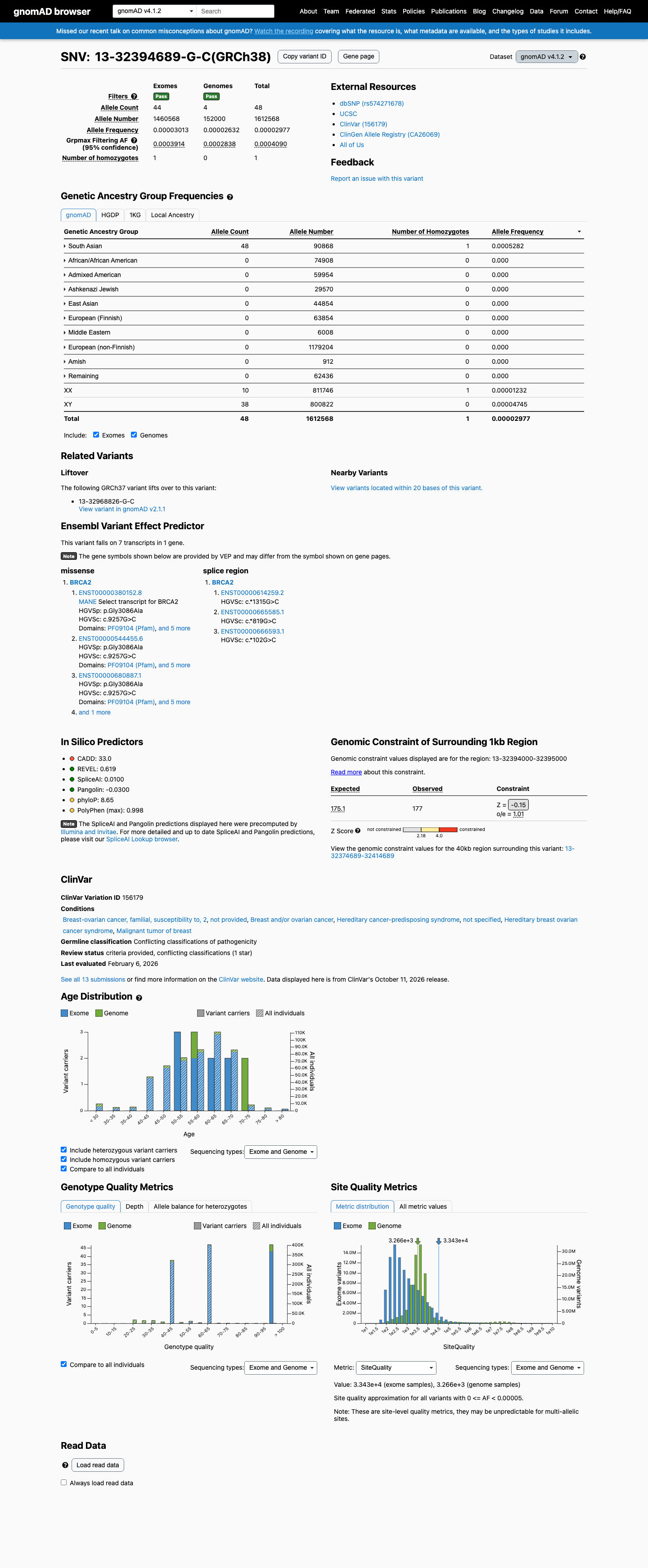
gnomAD v4.1 screenshot
gnomAD v4.1
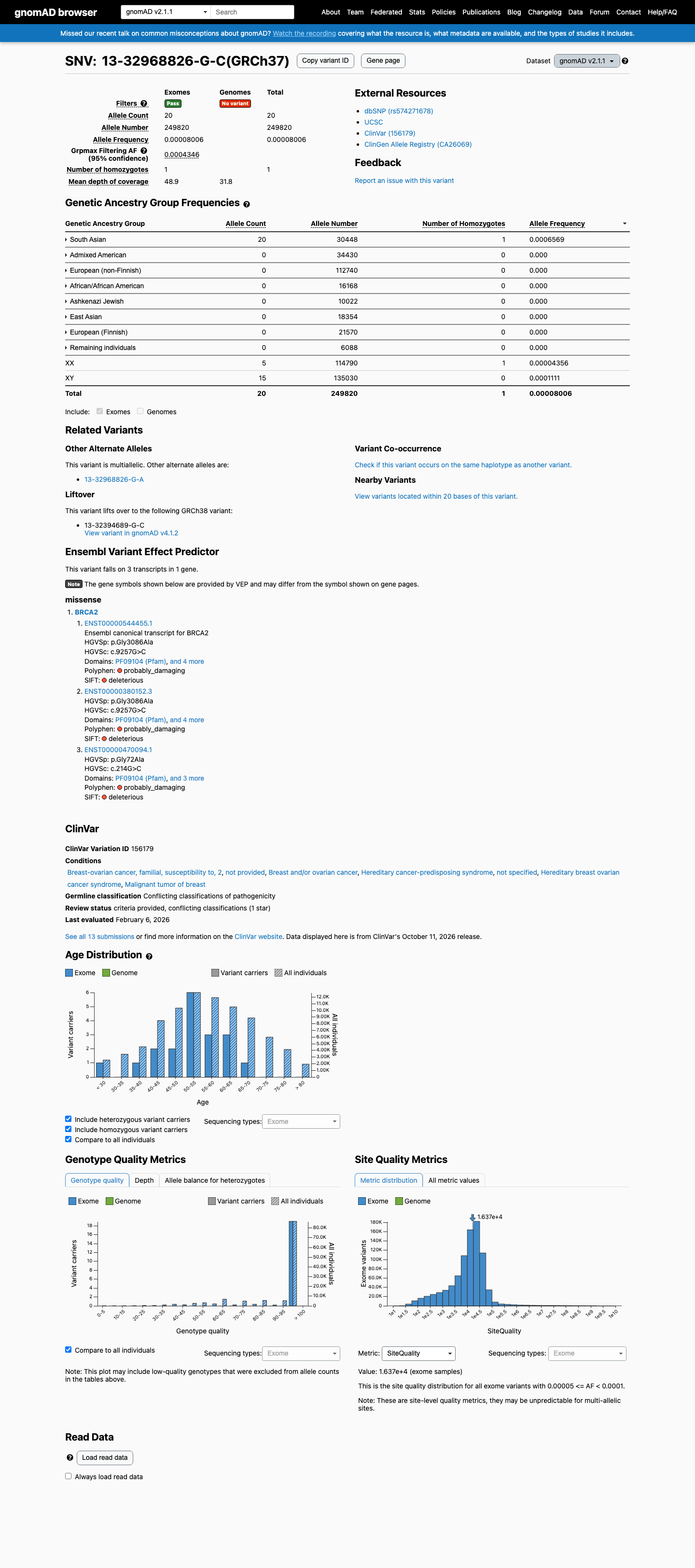
gnomAD v2.1 screenshot
gnomAD v2.1
v4.1
This variant is present in gnomAD v4.1 (AF= 2.97662e-05; MAF= 0.00298%, 48/1612568 alleles, homozygotes = 1) and has highest observed frequency in the South Asian population (AF= 0.000528239; MAF= 0.05282%, 48/90868 alleles, homozygotes = 1); grpmax FAF= 0.00040896.
v2.1
This variant is present in gnomAD v2.1 (AF= 8.00576e-05; MAF= 0.00801%, 20/249820 alleles, homozygotes = 1) and has highest observed frequency in the South Asian population (AF= 0.000656858; MAF= 0.06569%, 20/30448 alleles, homozygotes = 1); grpmax FAF= 0.00043457.
🇨🇦 CA
Absent from gnomAD-Canada v1.0.
Allele frequency by ancestry
three datasets · side by side
gnomAD v4.1
0.003% · 48 / 1,612,568
1 hom · FAF 0.041%
South Asian
48 / 90,868
0.053%
1 hom
+ 9 not observed (Remaining individuals, Admixed American, European (Finnish), Amish, East Asian, Middle Eastern, Ashkenazi Jewish, African/African American, European (non-Finnish))
gnomAD v2.1
0.008% · 20 / 249,820
1 hom · FAF 0.043%
South Asian
20 / 30,448
0.066%
1 hom
+ 7 not observed (African/African American, Admixed American, Ashkenazi Jewish, East Asian, European (Finnish), European (non-Finnish), Remaining individuals)
gnomAD Canada 🇨🇦
Absent · 0 / ?
0 hom
Not observed in any ancestry group.
ClinVar screenshot
ClinVar
This variant has been reported in ClinVar as Uncertain significance (6 clinical laboratories) and as Likely benign (4 clinical laboratories) and as Benign (2 clinical laboratories) and as Uncertain Significance (1 clinical laboratory). (ClinVarID = 156179)
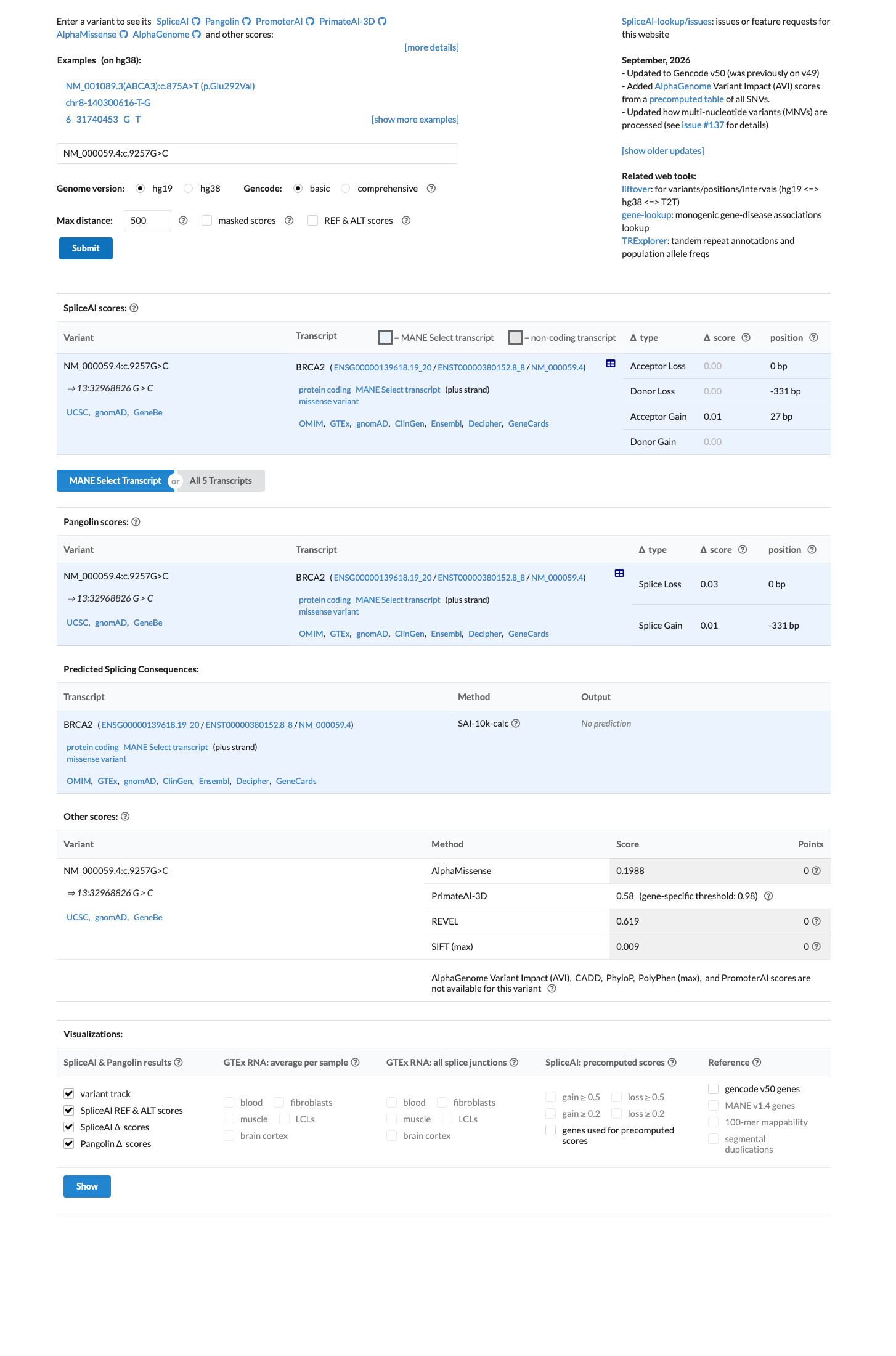
SpliceAI screenshot
In silico
SpliceAI predicts no significant splice impact for this variant (max delta score = 0.01). REVEL score = 0.619. BayesDel score = -0.0288497.
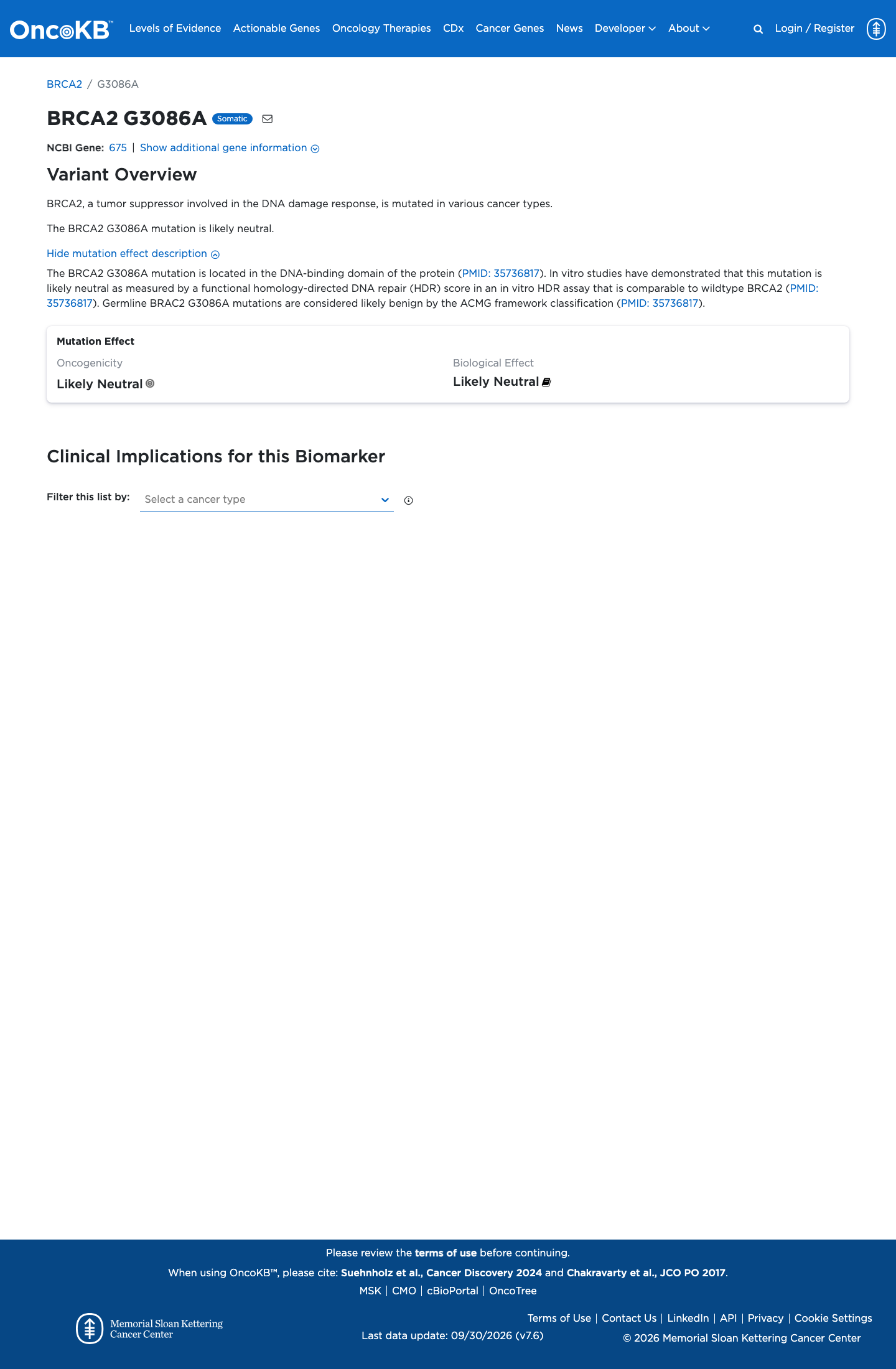
Functional / OncoKB screenshot
Functional Likely Neutral
OncoKB identified variant-specific curated literature and context relevant to functional review; biological-effect context: Likely Neutral; curated oncogenicity label: Likely Neutral.
OncoKB ↗
COSMIC screenshot
COSMIC
Cancer hotspots screenshot
Cancer hotspots
Somatic evidence Not in COSMIC / hotspots
COSMIC
This variant does not lie in a statistically significant hotspot. This variant has not previously been reported in somatic cancers (COSMIC).
Hotspots
This variant does not lie in a statistically significant hotspot.
Literature · how each cited paper was used
1papers cited
Each card is an audit: what was searched, what was found, whether it names the variant, which criteria it fed, and why. 7 further PMIDs triaged but not cited — see Sources & references.
Diagnostic mRNA splicing assay for variants in BRCA1 and BRCA2 identified two novel pathogenic splicing aberrations.
Searched
c.9257G>Cc.9257G > Cp.(Gly3086Ala)p.Gly3086Alap.G3086A
Found
The paper explicitly reports BRCA2 c.9257G>C, p.(Gly3086Ala) as an exonic amino-acid substitution analyzed by an mRNA splicing assay. It was classified as splice class 1S, indicating no observed effect on splicing with both alleles identified using informative SNPs; the authors state that protein-function impact requires separate assessment.
Variant
✓ Names this variant — characterised directly
Applied to
→BP4 supporting
Variant-specific mRNA assay context reports normal splicing and is concordant with the BP4 no-splice prediction, without replacing the VCEP SpliceAI requirement.
BRCA2 c.9257G > C p.(Gly3086Ala)
Location Table 2; Discussion, paragraph beginning ‘Sixteen variants showed normal splicing.’  ·  Context Patient blood RNA mRNA splicing assay using reverse transcription-PCR, fragment analysis, sequencing, and assessment of biallelic expression; variant reported as splice class 1S.  ·  full text
Sources & reference links
9Sources
CSpec VCEP
ClinVar
gnomAD v2.1
gnomAD v4.1
gnomAD-Canada
SpliceAI
OncoKB
COSMIC
Cancer hotspots
Triaged references · 7 PMIDs not cited in assessment
35736817 ↗ Classification of BRCA2 Variants of Uncertain Significance (VUS) Using an ACMG/AMP Model Incorporating a Homology-Directed Repair (HDR) Functional Assay. ONCOKB
23918944 ↗ Tamoxifen and risk of contralateral breast cancer for BRCA1 and BRCA2 mutation carriers. CLINVAR
25741868 ↗ Standards and guidelines for the interpretation of sequence variants: a joint consensus recommendation of the American College of Medical Genetics and Genomics and the Association for Molecular Pathology. CLINVAR
38417439 ↗ Functional analysis and clinical classification of 462 germline BRCA2 missense variants affecting the DNA binding domain. CLINVAR
18163131 ↗ The emerging landscape of breast cancer susceptibility. CLINVAR
24493721 ↗ American Society of Clinical Oncology Expert Statement: collection and use of a cancer family history for oncology providers. CLINVAR
28492532 ↗ Sherloc: a comprehensive refinement of the ACMG-AMP variant classification criteria. CLINVAR