BRCA2 encodes a DNA repair protein that maintains genome stability by repairing double-strand breaks through homologous recombination and by protecting DNA replication forks. It acts as a tumor suppressor, and inherited loss-of-function changes cause hereditary breast and ovarian cancer syndrome, with elevated lifetime risks of breast, ovarian, prostate, and pancreatic cancers; biallelic changes cause Fanconi anemia complementation group D1. Reduced or altered BRCA2 activity is implicated in multiple tumor types, and PARP inhibitors are an approved treatment for BRCA2-associated ovarian and breast cancers.
This variant
BRCA2 is a tumor suppressor whose loss-of-function variants are established causes of hereditary breast and ovarian cancer syndrome. This frameshift deletion truncates the protein and is predicted to eliminate normal DNA repair function through the same loss-of-function mechanism seen in known pathogenic BRCA2 variants, supporting its Likely Pathogenic classification despite a low but detectable population frequency.
Transcript
NM_000059.4
HGVS · transcript:coding
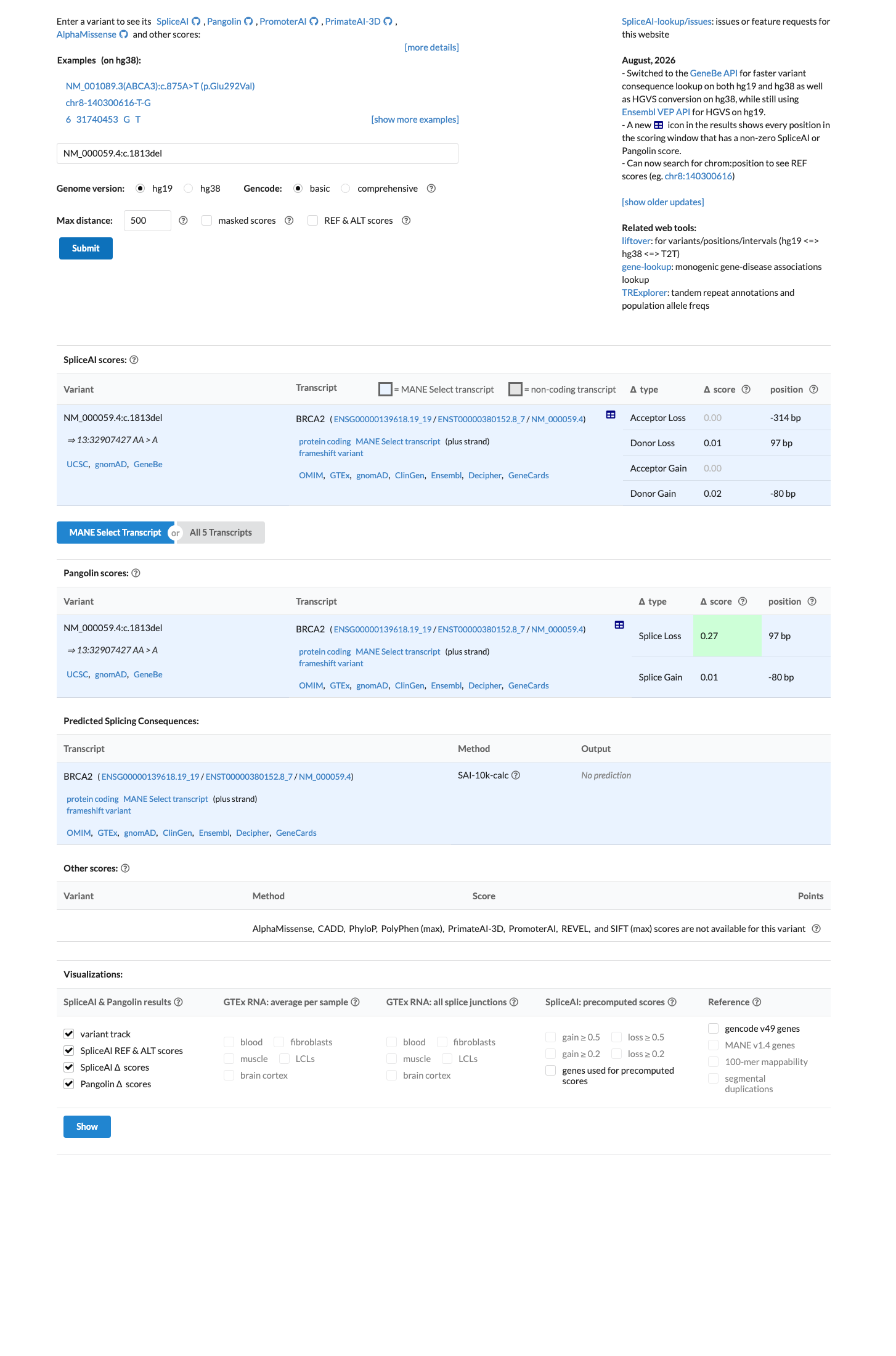
NM_000059.4:c.1813del
GRCh38
chr13:32333283 GA>G
GRCh37
chr13:32907420 GA>G
Very Strong loss-of-function evidence (PVS1) plus supporting pathogenic (PP5) and supporting benign (BS1) evidence combine to a net score of 8, yielding Likely Pathogenic under the ENIGMA point system.
Classification rationale
PVS1PP5BS1Likely Pathogenic
BRCA2 c.1813delframeshift · exon 10
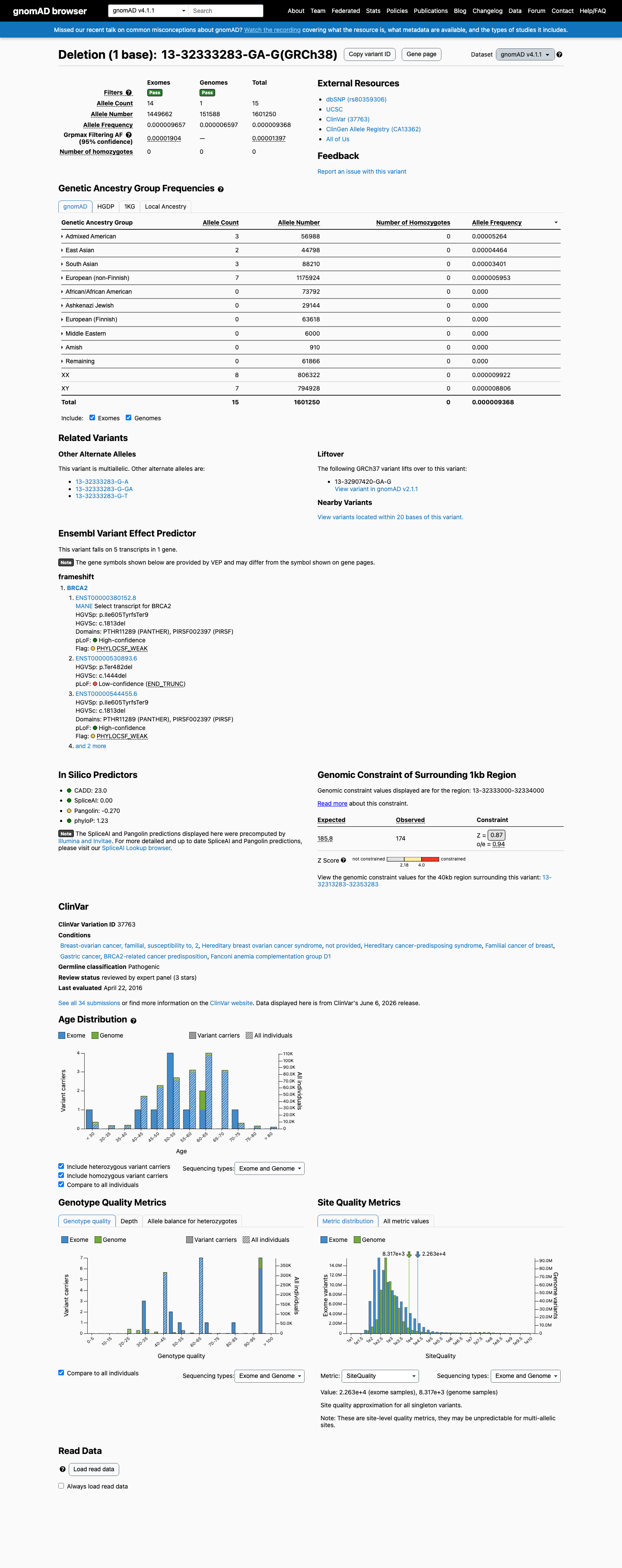
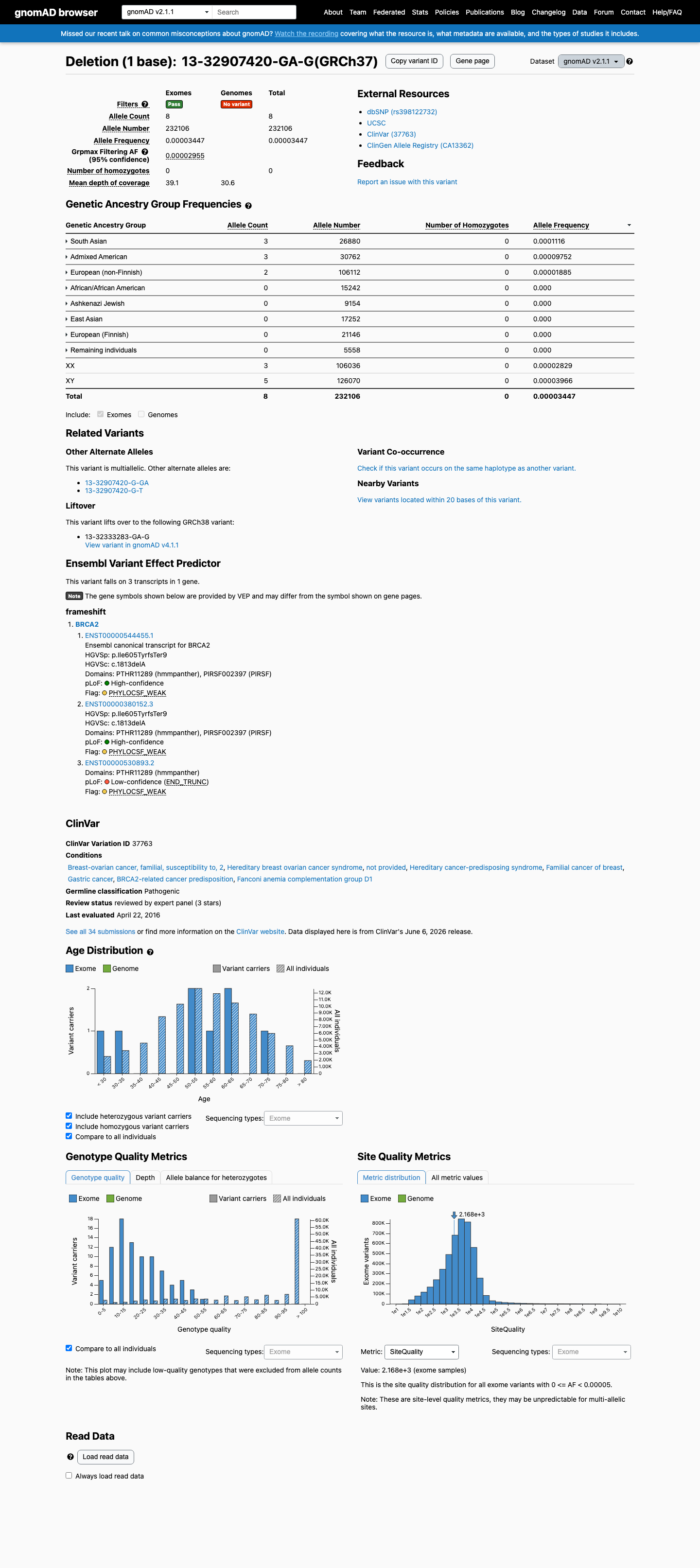
PVS1 (Very Strong): frameshift deletion in exon 11 creates a premature stop predicted to trigger nonsense-mediated decay. PP5 (Supporting): the ENIGMA expert panel classifies this variant as Pathogenic in ClinVar. BS1 (Supporting, benign-direction): population frequency (gnomAD grpmax FAF 2.96x10^-5) falls within the benign supporting range. Overall: combining these criteria under the ENIGMA point-based system yields a net score of 8, supporting Likely Pathogenic.
PVS1 + PP5 + BS1→Likely Pathogenic
Gene diagram
· NM_000059.4 · variants mapped to exon structure
BRCA2NM_000059.4
Fetching transcript structure from UCSC…
Exons
—
Transcript span
—
Strand
—
Variants mapped
—
Source
UCSC ncbiRefSeqCurated
All variants in BRCA2—click a row to locate it on the plot · use the link column to open its page
Protein
Location
Classification
Link
Applied criteria · 3 applied · 14 assessed
MetEvidence satisfies this criterion.
Not metEvaluated against available evidence; threshold not reached.
Not assessedApplies in principle, but no evidence was found to evaluate it.
N/ADoesn't apply to this variant type.
Applied · 3
Strength Supporting Moderate Strong Very strong
✓
PVS1very strongPathogenic
Met (Very Strong): frameshift creates a premature stop at codon 613 in exon 11, predicted to trigger nonsense-mediated decay.
cspec (ENIGMA BRCA2 Specification v1.2): PVS1 default strength Very Strong for null variants including frameshift in a gene with established LOF mechanism.pvs1_gene_context.json: germline LOF mechanism confirmed for BRCA2 based on CSPEC/VCEP PVS1 guidance presence (pvs1_gene_gate = eligible).pvs1_variant_assessment.json: variant classified as frameshift consequence class, generic PVS1 framework (PMC6185798) applies, suggested default strength PVS1 (Very Strong), pending confirmation of transcript relevance/NMD/exon importance.
Met (Supporting): the ENIGMA expert panel classifies this variant as Pathogenic in ClinVar.
ClinVar VCV000037763 shows an ENIGMA expert-panel (SCV000282362) submission classifying NM_000059.4:c.1813del as Pathogenic, review status 'reviewed by expert panel' (3-star), date last evaluated 2016-04-22, in addition to 26 other clinical-laboratory Pathogenic submissions.Per case policy: PP5 applies at supporting strength for any exact-variant ClinVar 3-star expert-panel Pathogenic/Likely pathogenic classification, overriding the ENIGMA VCEP's internal 'Not Applicable' flag for PP5 (which exists only to prevent double-counting within ENIGMA's own scoring, not to negate ClinVar EP evidence generally).ClinVar expert panel classification
Met (Supporting): gnomAD v2.1 grpmax frequency of 2.96x10^-5 falls within the benign supporting frequency range.
gnomAD v2.1 grpmax FAF = 2.955e-05 (South Asian subpopulation, 3/26880 alleles), within the BS1_Supporting band (0.00002, 0.0001].gnomAD v4.1 grpmax FAF = 1.397e-05 (Admixed American subpopulation, 3/56988 alleles), below the 0.00002 lower bound on its own.
This variant is present in gnomAD v4.1 (AF= 9.36768e-06; MAF= 0.00094%, 15/1601250 alleles, homozygotes = 0) and has highest observed frequency in the Admixed American population (AF= 5.26427e-05; MAF= 0.00526%, 3/56988 alleles, homozygotes = 0); grpmax FAF= 1.397e-05.
v2.1
This variant is present in gnomAD v2.1 (AF= 3.4467e-05; MAF= 0.00345%, 8/232106 alleles, homozygotes = 0) and has highest observed frequency in the South Asian population (AF= 0.000111607; MAF= 0.01116%, 3/26880 alleles, homozygotes = 0); grpmax FAF= 2.955e-05.
🇨🇦 CA
Absent from gnomAD-Canada v1.0.
Allele frequency by ancestry
three datasets · side by side
gnomAD v4.1
0.00094%
· 15 / 1,601,250
0 hom · FAF 0.0014%
Admixed American
3 / 56,988
0.0053%
East Asian
2 / 44,798
0.0045%
South Asian
3 / 88,210
0.0034%
European (non-Finnish)
7 / 1,175,924
0.0006%
+ 6 not observed (Remaining individuals, European (Finnish), Amish, Middle Eastern, Ashkenazi Jewish, African/African American)
gnomAD v2.1
0.0034%
· 8 / 232,106
0 hom · FAF 0.003%
South Asian
3 / 26,880
0.011%
Admixed American
3 / 30,762
0.0098%
European (non-Finnish)
2 / 106,112
0.0019%
+ 5 not observed (African/African American, Ashkenazi Jewish, East Asian, European (Finnish), Remaining individuals)
This variant has been reported in ClinVar as Pathogenic (26 clinical laboratories) and as pathogenic (1 clinical laboratory) and as Pathogenic by Evidence-based Network for the Interpretation of Germline Mutant Alleles (ENIGMA) (expert panel). (ClinVarID = 37763)
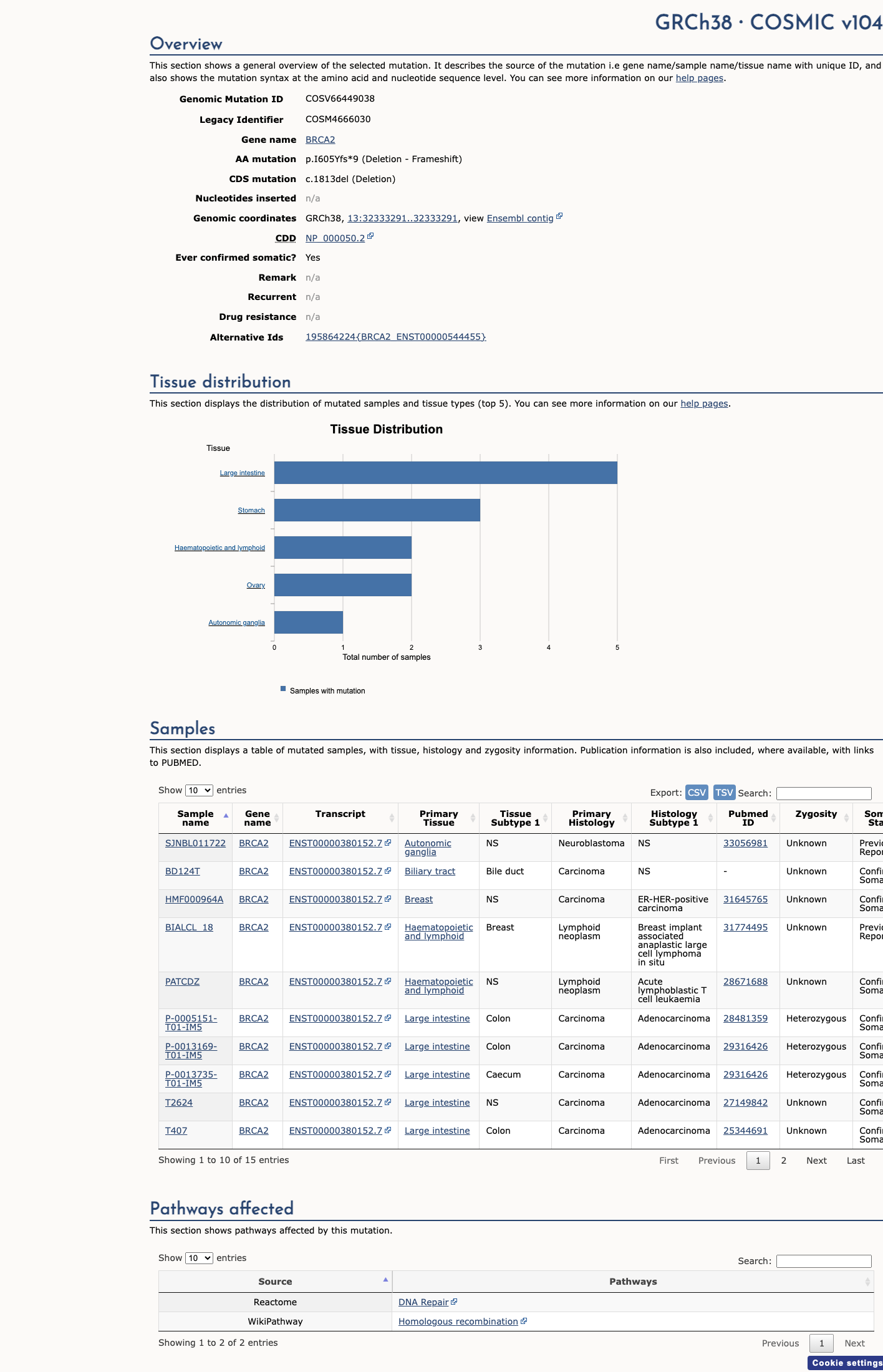
This variant does not lie in a statistically significant hotspot. This variant has previously been reported in somatic cancers (COSMIC; COSV66449038, n = 15 times).
Hotspots
This variant does not lie in a statistically significant hotspot.
Triaged references · 8 PMIDs not cited in assessment
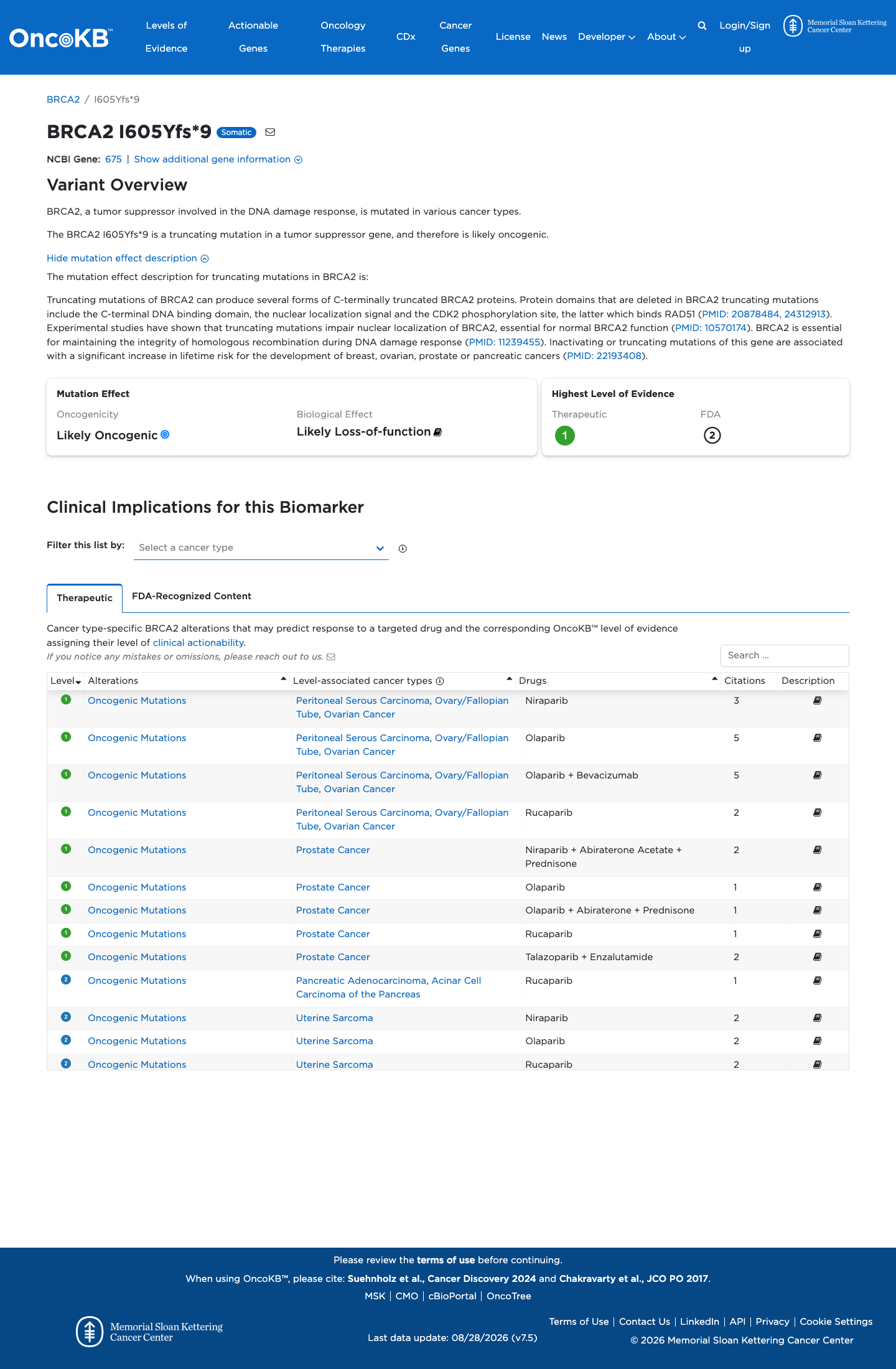
10570174 ↗Truncated BRCA2 is cytoplasmic: implications for cancer-linked mutations.ONCOKB
11239455 ↗BRCA2 is required for homology-directed repair of chromosomal breaks.ONCOKB
20878484 ↗A new mutation of BRCA2 gene in an Italian healthy woman with familial breast cancer history.ONCOKB
22193408 ↗BRCA1 and BRCA2: different roles in a common pathway of genome protection.ONCOKB
24312913 ↗A comprehensive focus on global spectrum of BRCA1 and BRCA2 mutations in breast cancer.ONCOKB
11802209 ↗Comprehensive analysis of 989 patients with breast or ovarian cancer provides BRCA1 and BRCA2 mutation profiles and frequencies for the German population.CLINVAR
18824701 ↗Clinically applicable models to characterize BRCA1 and BRCA2 variants of uncertain significance.CLINVAR
19016756 ↗Cross-sectional analysis of germline BRCA1 and BRCA2 mutations in Japanese patients suspected to have hereditary breast/ovarian cancer.CLINVAR