Analysis in progress
Initialising…
0%
complete
This report is still being assembled — sections appear as each stage finishes. It isn't final yet.
BRCA2
Final classification
Likely Benign
BP1BP4BP6BP7
BRCA2
c.2133C>T
p.Cys711=
synonymous · exon 11

BRCA2 encodes a DNA repair protein that maintains genome stability by repairing double-strand breaks through homologous recombination and by protecting DNA replication forks. It acts as a tumor suppressor, and inherited loss-of-function changes cause hereditary breast and ovarian cancer syndrome, with elevated lifetime risks of breast, ovarian, prostate, and pancreatic cancers; biallelic changes cause Fanconi anemia complementation group D1. Reduced or altered BRCA2 activity is implicated in multiple tumor types, and PARP inhibitors are an approved treatment for BRCA2-associated ovarian and breast cancers.

This variant

BRCA2's tumor-suppressor role means loss-of-function variants drive hereditary breast and ovarian cancer risks, but this synonymous c.2133C>T change is classified Likely Benign: it does not alter the Cys711 residue, is not predicted to affect splicing, and lies outside BRCA2's clinically important functional domains. It is therefore not expected to disrupt BRCA2 DNA-repair function or confer the elevated breast, ovarian, prostate, and pancreatic cancer risks associated with pathogenic BRCA2 variants.

Transcript
NM_000059.4
HGVS · transcript:coding
NM_000059.4:c.2133C>T
GRCh38
chr13:32336488 C>T
GRCh37
chr13:32910625 C>T
Basis Likely Benign under ENIGMA BRCA1/BRCA2 VCEP v1.2: BP1 (Strong) plus BP4, BP6, BP7 (Supporting) satisfy the 1 Strong + ≥1 Supporting benign rule, short of Benign (requires Very Strong or ≥2 Strong).
Likely Benign under ENIGMA BRCA1/BRCA2 VCEP v1.2: BP1 (Strong) plus BP4, BP6, BP7 (Supporting) satisfy the 1 Strong + ≥1 Supporting benign rule, short of Benign (requires Very Strong or ≥2 Strong).
Classification rationale
BP1BP4BP6BP7 Likely Benign
BRCA2 c.2133C>T synonymous · exon 11

BP1 (Strong): silent substitution outside clinically important functional domains (PALB2 binding aa 10-40, DNA binding aa 2481-3186) with no predicted splice impact (SpliceAI max delta 0.011 ≤0.1). BP4 (Supporting): SpliceAI max delta 0.011 meets the ≤0.1 no-splicing-impact threshold for silent variants. BP6 (Supporting): ENIGMA expert panel classified this exact variant as Likely benign. BP7 (Supporting): silent variant with no predicted splice impact; no mRNA assay data were available to elevate to Strong. Overall: Likely Benign — no pathogenic-direction criteria met; BP1 (Strong) plus three Supporting benign codes satisfy the VCEP rule 1 Strong (Benign) + ≥1 Supporting (Benign).

BP1 + BP4 + BP6 + BP7 Likely Benign
Gene diagram · NM_000059.4 · variants mapped to exon structure
BRCA2 NM_000059.4
Fetching transcript structure from UCSC…
Applied criteria · 4 applied · 14 assessed
MetEvidence satisfies this criterion.
Not metEvaluated against available evidence; threshold not reached.
Not assessedApplies in principle, but no evidence was found to evaluate it.
N/ADoesn't apply to this variant type.
Applied · 4
Strength Supporting Moderate Strong Very strong
BP1 strong review Benign
Met (Strong): silent substitution outside clinically important functional domains (aa 10-40, 2481-3186) with no predicted splice impact (SpliceAI max delta 0.011 ≤0.1).
cspec BP1 rule: 'Apply BP1_Strong for silent substitution, missense or in-frame insertion, deletion or delins variants outside a (potentially) clinically important functional domain AND no splicing predicted (SpliceAI ≤0.1). ... clinically important functional domains are defined as: BRCA2 PALB2 binding domain aa 10-40; BRCA2 DNA binding aa 2481-3186.'Variant residue is Cys711 (NP_000050.3:p.(Cys711=)), which falls outside both the PALB2 binding domain (aa 10-40) and the DNA binding domain (aa 2481-3186) defined by this VCEP as clinically important functional domains.SpliceAI evidence_sentence: 'SpliceAI predicts no significant splice impact for this variant (max delta score = 0.01)', satisfying the SpliceAI ≤0.1 threshold required for BP1_Strong.
BP4 supporting Benign
Met (Supporting): SpliceAI max delta 0.011, below the ≤0.1 no-splicing-impact threshold for silent variants.
ENIGMA BRCA1/BRCA2 v1.2 specification (cspec), BP4 rule: 'Silent variant inside a (potentially) clinically important functional domain, if no predicted impact via splicing (SpliceAI <=0.1).' The rule structure and Figure 1A apply the SpliceAI <=0.1 no-impact threshold to silent variants generally, regardless of domain location.SpliceAI Lookup evidence_sentence: 'SpliceAI predicts no significant splice impact for this variant (max delta score = 0.01).' Scores: DS_AG=0.011, DS_AL=0.001, DS_DG=0.005, DS_DL=0.0, max_delta=0.011, satisfying the SpliceAI <=0.1 no-impact criterion for BP4.
BP6 supporting Benign
Met (Supporting): ENIGMA expert panel classified this exact variant as Likely benign.
ClinVar variation 185999 is NM_000059.4(BRCA2):c.2133C>T (p.Cys711=) and includes ENIGMA submission SCV000578995, classified Likely benign with review status 'reviewed by expert panel'.ClinVar expert panel classification
BP7 supporting Benign
Met (Supporting): silent variant with no predicted splice impact; no mRNA assay data were available to elevate to Strong.
ENIGMA BRCA1/BRCA2 v1.2 specification (cspec), BP7 rule: 'Silent variant inside a (potentially) clinically important functional domain, IF BP4 met... Following convention, this code is applied in addition to BP4 (no splicing prediction, SpliceAI <=0.1) to capture the low prior probability of pathogenicity of silent variants.' BP7_Strong (RNA) requires well-established in vitro/in vivo mRNA transcript-profile functional data, which was not identified for this variant in the bundle.SpliceAI Lookup evidence_sentence: 'SpliceAI predicts no significant splice impact for this variant (max delta score = 0.01).' max_delta=0.011, confirming the BP4-met precondition for BP7_Supporting.
Assessed · not applied · 4 not met · 10 not assessed
Pathogenic
PS3 Not assessed: no variant-specific functional assay results were identified, so insufficient evidence was available.
PS4 Not assessed: no exact-variant case-control study meeting the ENIGMA threshold (p≤0.05, OR≥4) was identified.
PM2 Not met: observed in gnomAD (11/251,022 alleles; grpmax FAF 0.00029), so not absent from population controls.
PM3 Not assessed: no Fanconi-anemia proband observation, second BRCA2 variant, or phase data were available.
PP1 Not assessed: no family genotype and phenotype data or co-segregation likelihood ratio was available.
PP3 Not met: SpliceAI max delta 0.011, far below the ≥0.2 threshold required for silent variants.
PP4 Not assessed: no calibrated multifactorial likelihood ratio toward pathogenicity (LR ≥2.08) was available.
PP5 Not met: the ClinVar expert-panel assertion is Likely benign, not Pathogenic/Likely pathogenic, so it cannot support PP5.
Benign
BA1 Not met: gnomAD grpmax FAF 0.00029, below the BA1 threshold of >0.001.
BS1 Not assessed: FAF 0.00029 exceeds the BS1_Strong threshold of >0.0001, but the required gnomAD non-cancer subset was not documented.
BS2 Not assessed: no observations in individuals without Fanconi anemia were available; absence of homozygotes alone is insufficient.
BS3 Not assessed: no variant-specific functional assay result was identified; the SpliceAI prediction is bioinformatic only and cannot substitute.
BS4 Not assessed: no quantitative evidence of non-segregation in affected family members was available.
BP5 Not assessed: no calibrated multifactorial likelihood ratio against pathogenicity (LR ≤0.48) was available.
N/A · 10 PVS1 · PS1 · PS2 · PM1 · PM4 · PM5 · PM6 · PP2 · BP2 · BP3
Research & evidence
Population frequency · supports benign
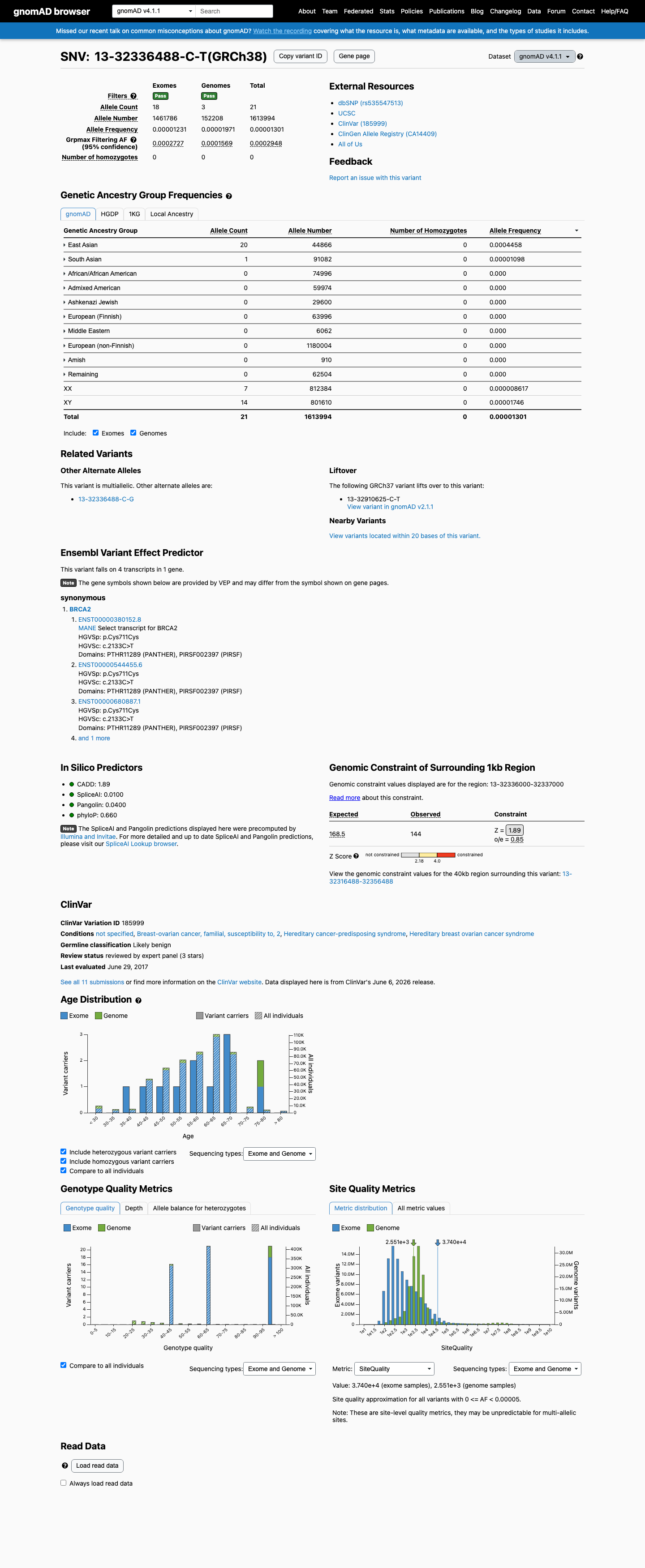
gnomAD v4.1 screenshot
gnomAD v4.1
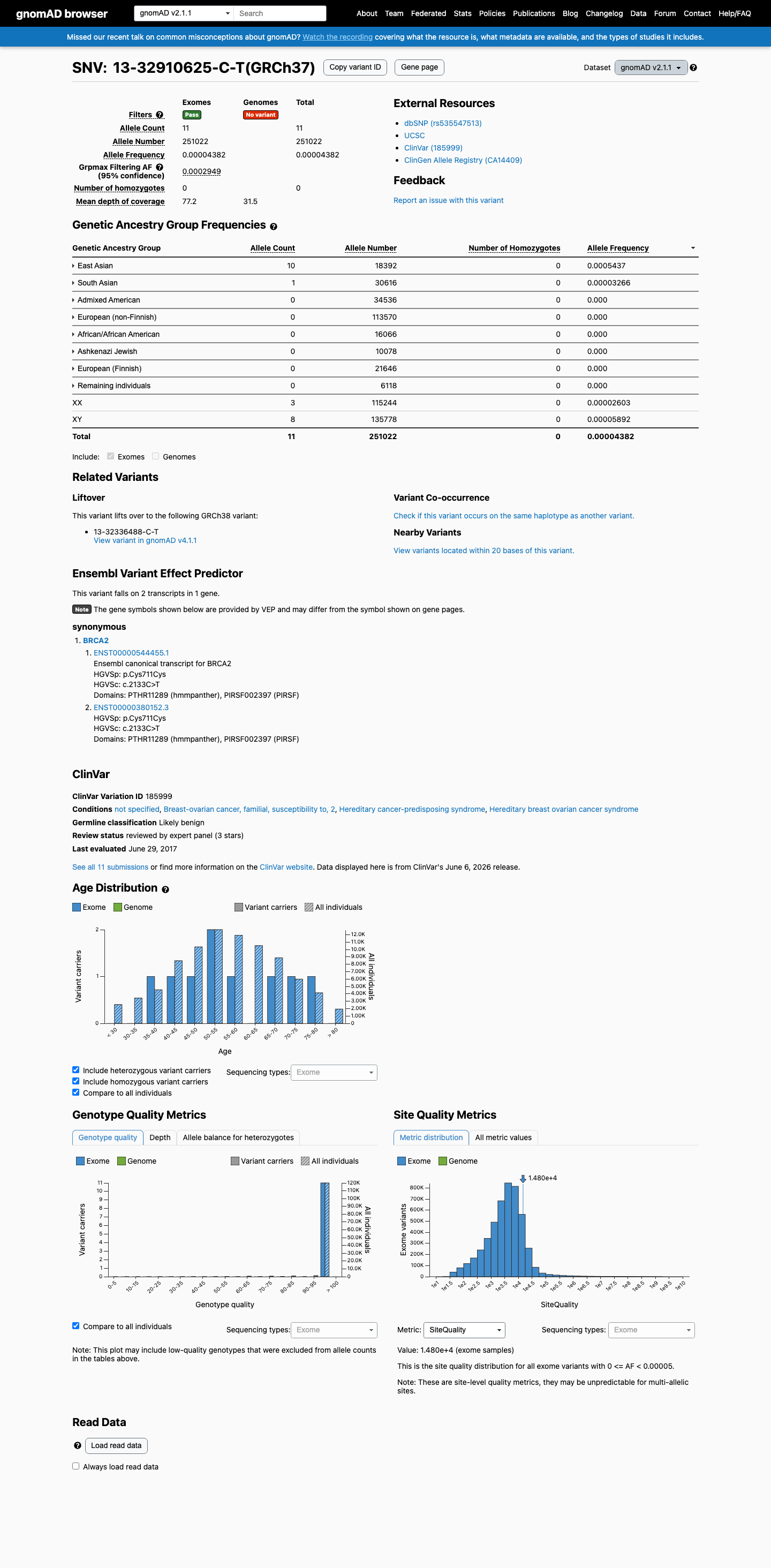
gnomAD v2.1 screenshot
gnomAD v2.1
v4.1
This variant is present in gnomAD v4.1 (AF= 1.30112e-05; MAF= 0.00130%, 21/1613994 alleles, homozygotes = 0) and has highest observed frequency in the East Asian population (AF= 0.000445772; MAF= 0.04458%, 20/44866 alleles, homozygotes = 0); grpmax FAF= 0.00029482.
v2.1
This variant is present in gnomAD v2.1 (AF= 4.38209e-05; MAF= 0.00438%, 11/251022 alleles, homozygotes = 0) and has highest observed frequency in the East Asian population (AF= 0.000543715; MAF= 0.05437%, 10/18392 alleles, homozygotes = 0); grpmax FAF= 0.00029491.
🇨🇦 CA
Not available in gnomAD-Canada v1.0.
Allele frequency by ancestry
three datasets · side by side
gnomAD v4.1
0.0013% · 21 / 1,613,994
0 hom · FAF 0.029%
East Asian
20 / 44,866
0.045%
South Asian
1 / 91,082
0.0011%
+ 8 not observed (Remaining individuals, Admixed American, European (Finnish), Amish, Middle Eastern, Ashkenazi Jewish, African/African American, European (non-Finnish))
gnomAD v2.1
0.0044% · 11 / 251,022
0 hom · FAF 0.029%
East Asian
10 / 18,392
0.054%
South Asian
1 / 30,616
0.0033%
+ 6 not observed (African/African American, Admixed American, Ashkenazi Jewish, European (Finnish), European (non-Finnish), Remaining individuals)
gnomAD Canada 🇨🇦
Absent · 0 / ?
0 hom
Not observed in any ancestry group.
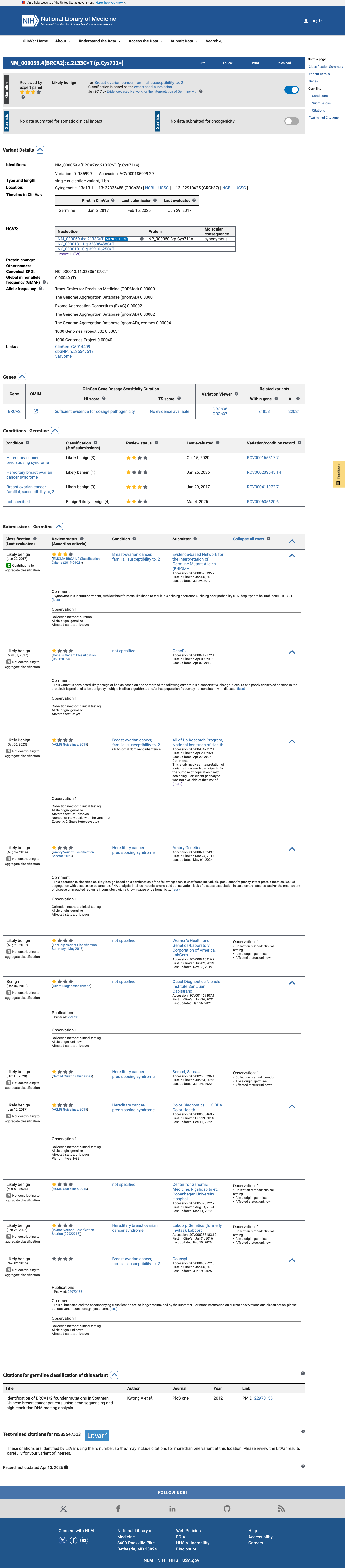
ClinVar screenshot
ClinVar
This variant has been reported in ClinVar as Likely benign (7 clinical laboratories) and as Likely Benign (1 clinical laboratory) and as Benign (1 clinical laboratory) and as Likely benign by Evidence-based Network for the Interpretation of Germline Mutant Alleles (ENIGMA) (expert panel). (ClinVarID = 185999)
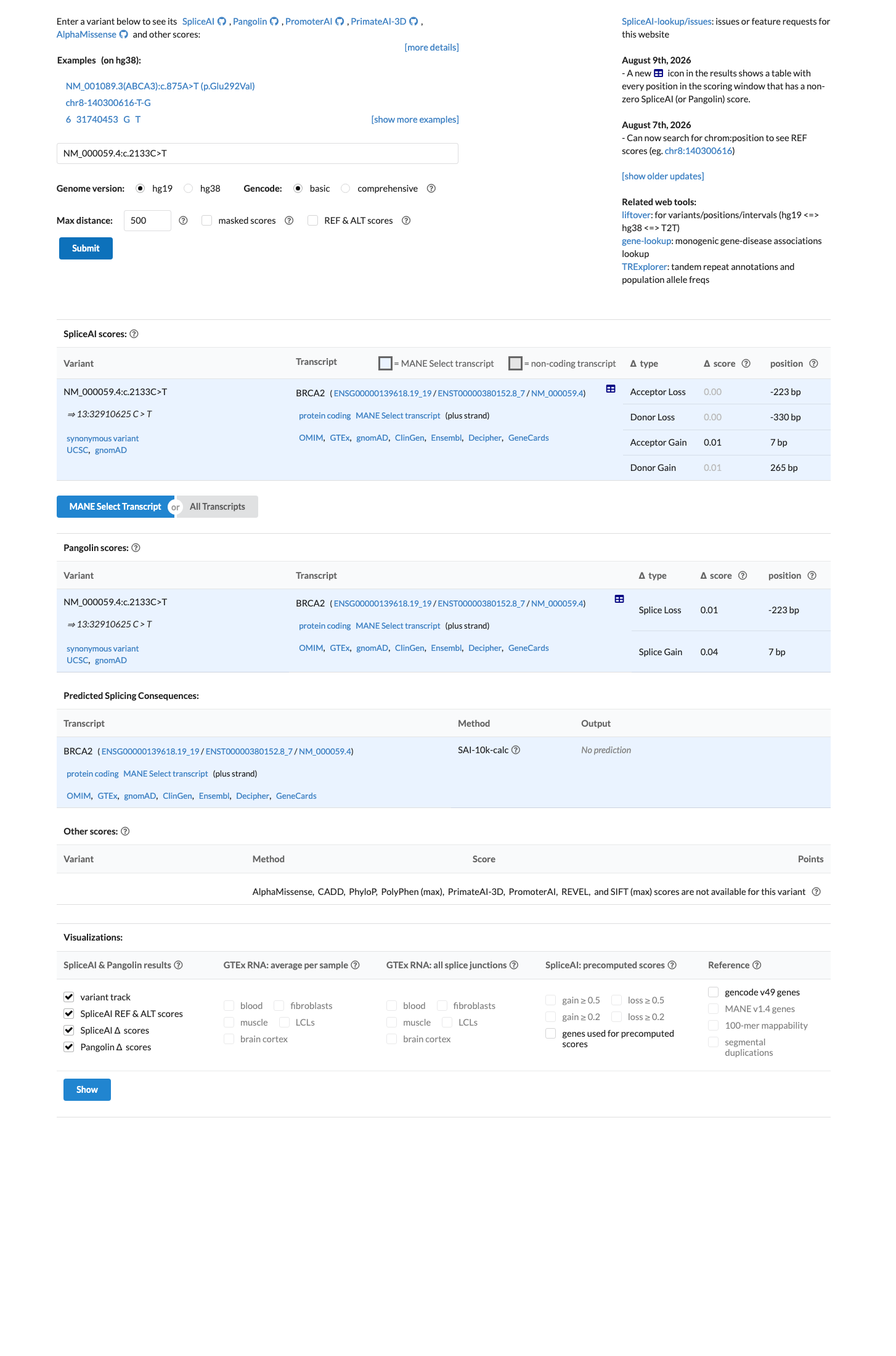
SpliceAI screenshot
In silico
SpliceAI predicts no significant splice impact for this variant (max delta score = 0.01).
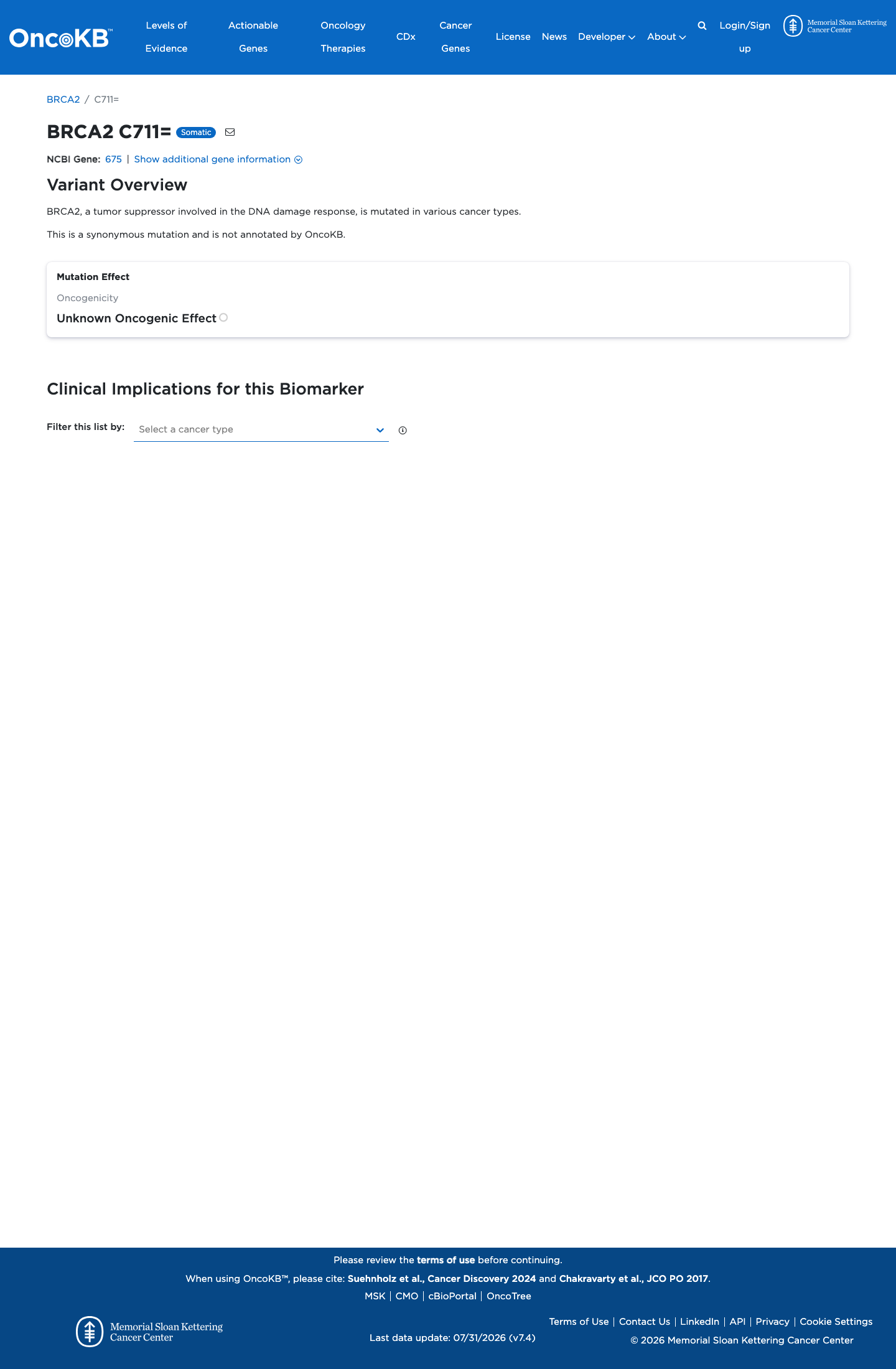
Functional / OncoKB screenshot
Functional Unknown Oncogenic Effect
OncoKB identified curated literature and non-variant-specific oncogenicity context for review; listed oncogenicity label: Unknown Oncogenic Effect.
OncoKB ↗
COSMIC screenshot
COSMIC
Cancer hotspots screenshot
Cancer hotspots
Somatic evidence Not in COSMIC / hotspots
COSMIC
This variant does not lie in a statistically significant hotspot. This variant has not previously been reported in somatic cancers (COSMIC).
Hotspots
This variant does not lie in a statistically significant hotspot.
Sources & reference links
9Sources
CSpec VCEP
ClinVar
gnomAD v2.1
gnomAD v4.1
gnomAD-Canada
SpliceAI
OncoKB
COSMIC
Cancer hotspots
Triaged references · 9 PMIDs not cited in assessment
25741868 ↗ Standards and guidelines for the interpretation of sequence variants: a joint consensus recommendation of the American College of Medical Genetics and Genomics and the Association for Molecular Pathology. CLINVAR
26467025 ↗ A Standardized DNA Variant Scoring System for Pathogenicity Assessments in Mendelian Disorders. CLINVAR
17392385 ↗ American Cancer Society guidelines for breast screening with MRI as an adjunct to mammography. CLINVAR
22970155 ↗ Identification of BRCA1/2 founder mutations in Southern Chinese breast cancer patients using gene sequencing and high resolution DNA melting analysis. CLINVAR
24366376 ↗ Risk assessment, genetic counseling, and genetic testing for BRCA-related cancer in women: U.S. Preventive Services Task Force recommendation statement. CLINVAR
27854360 ↗ Recommendations for reporting of secondary findings in clinical exome and genome sequencing, 2016 update (ACMG SF v2.0): a policy statement of the American College of Medical Genetics and Genomics. CLINVAR
31429903 ↗ Risk Assessment, Genetic Counseling, and Genetic Testing for BRCA-Related Cancer: US Preventive Services Task Force Recommendation Statement. CLINVAR
33410258 ↗ Risk assessment and genetic counseling for hereditary breast and ovarian cancer syndromes-Practice resource of the National Society of Genetic Counselors. CLINVAR
28492532 ↗ Sherloc: a comprehensive refinement of the ACMG-AMP variant classification criteria. CLINVAR