BRCA2 encodes a DNA repair protein that maintains genome stability by repairing double-strand breaks through homologous recombination and by protecting DNA replication forks. It acts as a tumor suppressor, and inherited loss-of-function changes cause hereditary breast and ovarian cancer syndrome, with elevated lifetime risks of breast, ovarian, prostate, and pancreatic cancers; biallelic changes cause Fanconi anemia complementation group D1. Reduced or altered BRCA2 activity is implicated in multiple tumor types, and PARP inhibitors are an approved treatment for BRCA2-associated ovarian and breast cancers.
This variant
BRCA2 maintains genome stability by repairing double-strand breaks, and inherited loss-of-function changes cause hereditary breast and ovarian cancer syndrome. Because this missense change lies outside BRCA2's critical functional domains, is observed in general-population controls, and shows no evidence of cosegregation with disease, it is not expected to impair BRCA2's tumor-suppressor activity; the Likely Benign classification means this variant is not a plausible cause of hereditary cancer in this family.
Transcript
NM_000059.4
HGVS · transcript:coding
NM_000059.4:c.3073A>G
GRCh38
chr13:32337428 A>G
GRCh37
chr13:32911565 A>G
Likely Benign: benign criteria BP1 (Strong), BS1 (Supporting), and BS4 (Supporting) yield an ENIGMA score of -6, inside the -6 to -2 Likely Benign range.
Classification rationale
BS1BS4BP1Likely Benign
BRCA2 c.3073A>Gmissense · exon 11
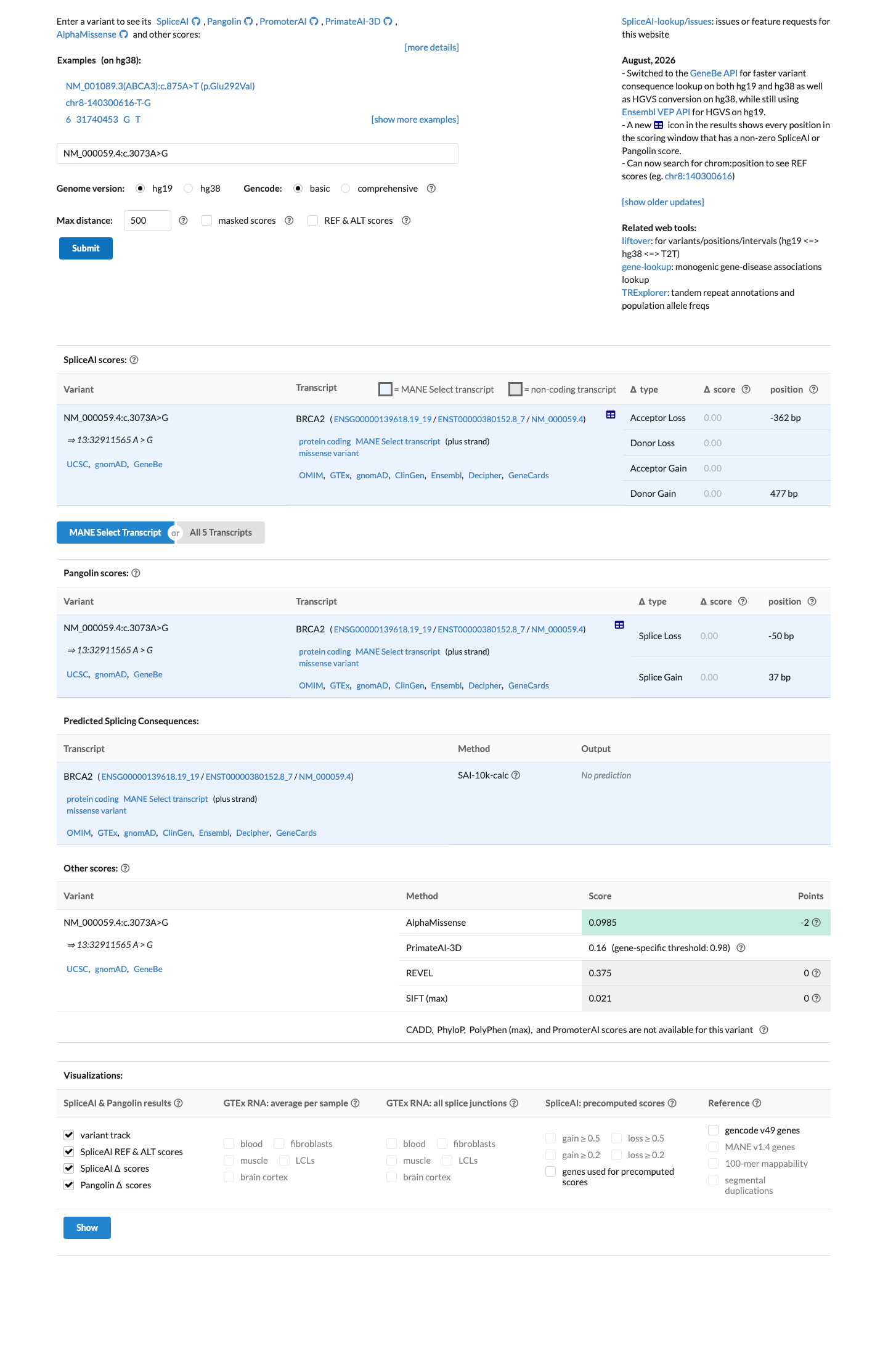
BP1 (Strong): missense change outside both clinically important BRCA2 domains with no predicted splice impact (SpliceAI max delta 0.00). BS1 (Supporting): gnomAD allele frequency 5.795e-05 in v4.1 falls within the 0.00002-0.0001 supporting range. BS4 (Supporting): ENIGMA segregation likelihood ratio 0.445 meets the <=0.48 threshold, favoring lack of cosegregation. Overall Likely Benign: BP1_Strong plus BS1 and BS4 Supporting satisfies the one-Strong-plus-one-Supporting benign combination rule (ENIGMA score -6).
BS1 + BS4 + BP1→Likely Benign
Gene diagram
· NM_000059.4 · variants mapped to exon structure
BRCA2NM_000059.4
Fetching transcript structure from UCSC…
Exons
—
Transcript span
—
Strand
—
Variants mapped
—
Source
UCSC ncbiRefSeqCurated
All variants in BRCA2—click a row to locate it on the plot · use the link column to open its page
Protein
Location
Classification
Link
Applied criteria · 3 applied · 17 assessed
MetEvidence satisfies this criterion.
Not metEvaluated against available evidence; threshold not reached.
Not assessedApplies in principle, but no evidence was found to evaluate it.
N/ADoesn't apply to this variant type.
Applied · 3
Strength Supporting Moderate Strong Very strong
✓
BS1supportingBenign
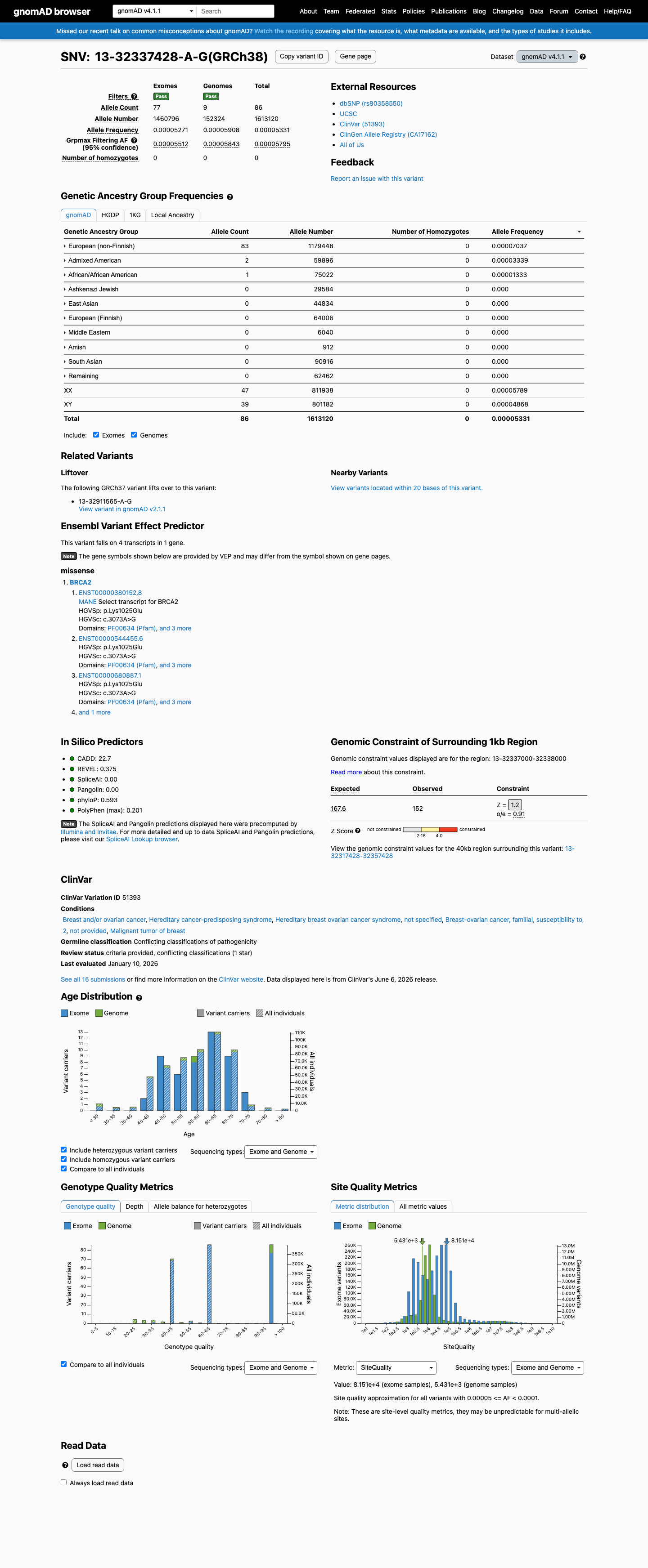
Met (Supporting): the highest gnomAD allele frequency, 5.795e-05, falls within the ENIGMA supporting range of 0.00002 to 0.0001.
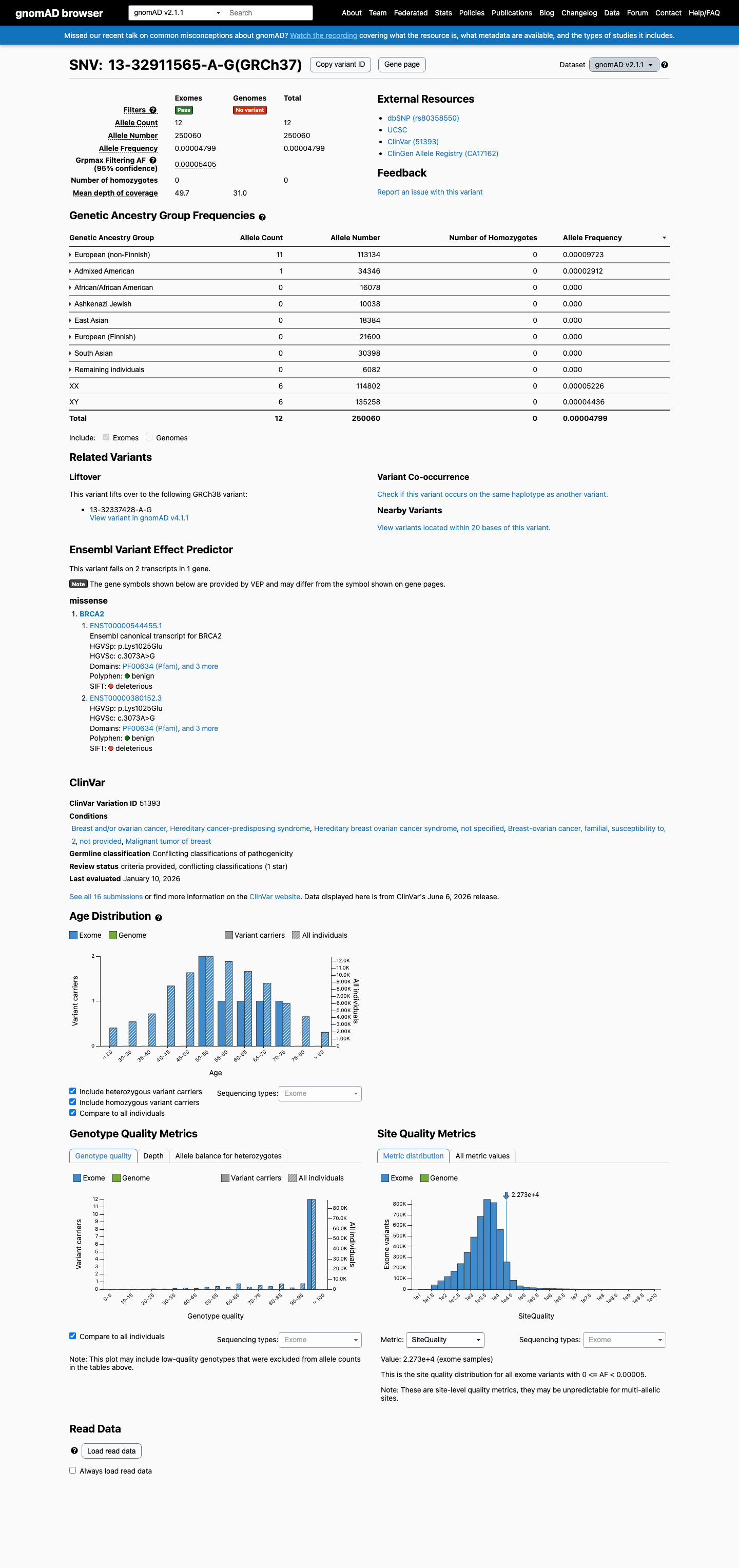
The applicable ClinGen ENIGMA BRCA1/2 specification v1.2 defines BS1 Supporting as maximum non-founder gnomAD FAF above 0.002% and at or below 0.01% (0.00002 < FAF <= 0.0001).gnomAD v2.1 reports maximum group FAF 5.405e-05 (0.005405%), with 12/250060 total alleles and zero homozygotes; gnomAD v4.1 reports maximum group FAF 5.795e-05 (0.005795%), with 86/1613120 total alleles and zero homozygotes.The gnomAD v2.1 and v4.1 FAF values are above the Supporting lower threshold and below the Strong threshold of FAF >0.0001; the small-subgroup raw AF values are not substituted for FAF.
Met (Supporting): segregation likelihood ratio 0.445 meets the <=0.48 supporting threshold for lack of segregation.
ENIGMA BRCA2 v1.2 specifies BS4 Supporting for quantitative lack-of-segregation LR <=0.48, Moderate for LR <=0.23, Strong for LR <=0.05, and Very Strong for LR <=0.00285.The exact-variant ENIGMA multifactorial row for BRCA2 c.3073A>G (p.Lys1025Glu) reports Segregation LR = 0.445, meeting the Supporting threshold.The variant-specific paper extraction for PMID:32599251 reports one observation of rs80358550 (p.K1025E) but no segregation analysis; it therefore does not independently establish BS4.
Met (Strong): missense change outside both clinically important BRCA2 domains with no predicted splice impact (SpliceAI delta 0.00).
ENIGMA BRCA2 v1.2 specifies BP1_Strong for silent, missense, or in-frame insertion/deletion/delins variants outside a clinically important domain when SpliceAI is <=0.1.The variant is NP_000050.3:p.(Lys1025Glu), and Lys1025 is outside the ENIGMA domains aa 10-40 and aa 2481-3186.SpliceAI maximum delta score is 0.00, below the ENIGMA threshold of 0.1.
This variant is present in gnomAD v4.1 (AF= 5.33128e-05; MAF= 0.00533%, 86/1613120 alleles, homozygotes = 0) and has highest observed frequency in the European (non-Finnish) population (AF= 7.03719e-05; MAF= 0.00704%, 83/1179448 alleles, homozygotes = 0); grpmax FAF= 5.795e-05.
v2.1
This variant is present in gnomAD v2.1 (AF= 4.79885e-05; MAF= 0.00480%, 12/250060 alleles, homozygotes = 0) and has highest observed frequency in the European (non-Finnish) population (AF= 9.72298e-05; MAF= 0.00972%, 11/113134 alleles, homozygotes = 0); grpmax FAF= 5.405e-05.
🇨🇦 CA
Absent from gnomAD-Canada v1.0.
Allele frequency by ancestry
three datasets · side by side
gnomAD v4.1
0.0053%
· 86 / 1,613,120
0 hom · FAF 0.0058%
European (non-Finnish)
83 / 1,179,448
0.007%
Admixed American
2 / 59,896
0.0033%
African/African American
1 / 75,022
0.0013%
+ 7 not observed (Remaining individuals, European (Finnish), Amish, East Asian, Middle Eastern, South Asian, Ashkenazi Jewish)
gnomAD v2.1
0.0048%
· 12 / 250,060
0 hom · FAF 0.0054%
European (non-Finnish)
11 / 113,134
0.0097%
Admixed American
1 / 34,346
0.0029%
+ 6 not observed (African/African American, Ashkenazi Jewish, East Asian, European (Finnish), Remaining individuals, South Asian)
This variant has been reported in ClinVar as Likely benign (6 clinical laboratories) and as Uncertain significance (5 clinical laboratories) and as Benign (2 clinical laboratories). (ClinVarID = 51393)
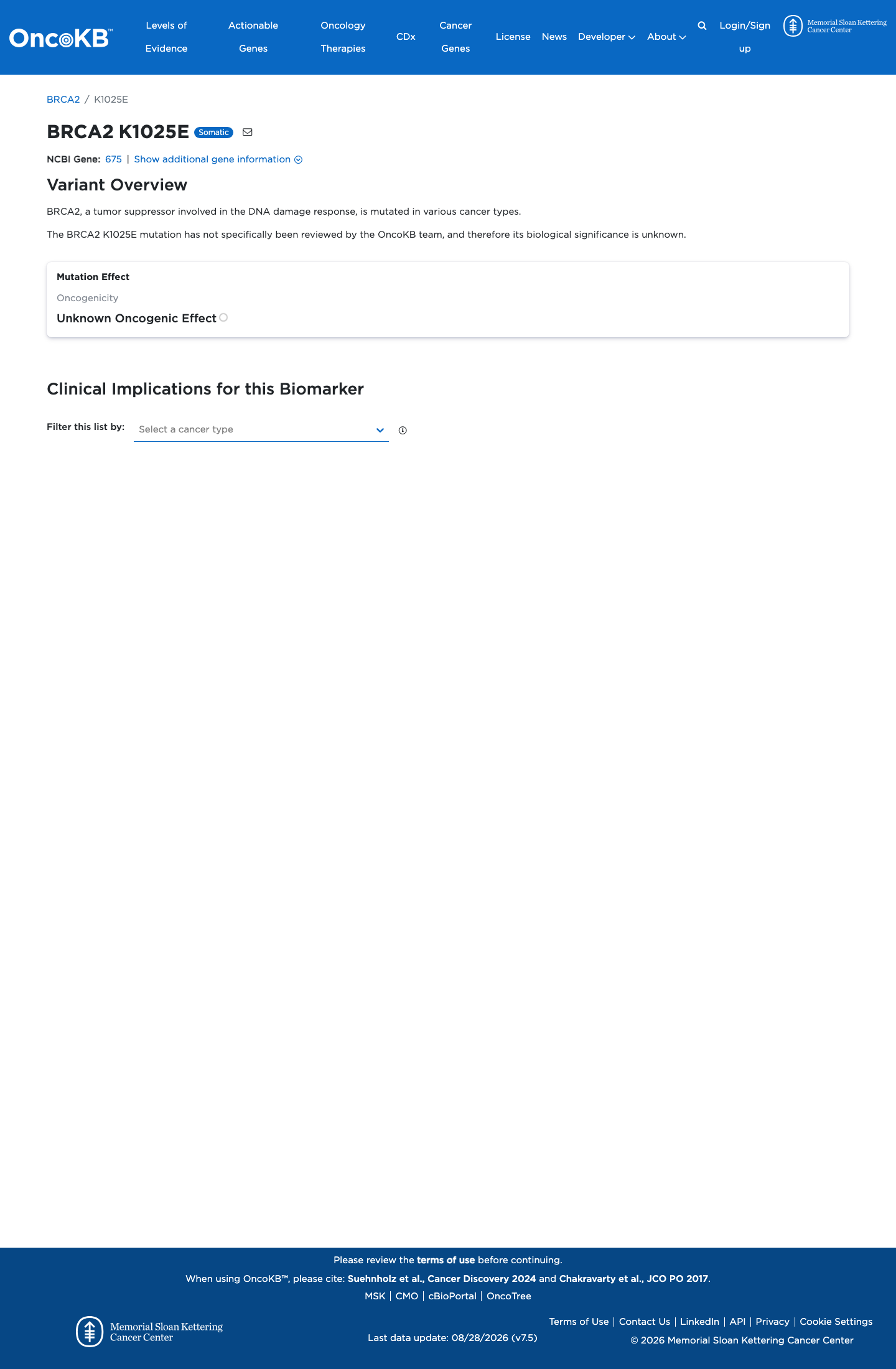
OncoKB did not identify variant-specific reviewed functional evidence for this variant; gene-level curated context is available for reviewer follow-up. BRCA2, a tumor suppressor involved in the DNA damage response, is mutated in various cancer types.
25741868 ↗Standards and guidelines for the interpretation of sequence variants: a joint consensus recommendation of the American College of Medical Genetics and Genomics and the Association for Molecular Pathology.CLINVAR
26467025 ↗A Standardized DNA Variant Scoring System for Pathogenicity Assessments in Mendelian Disorders.CLINVAR
31131967 ↗Large scale multifactorial likelihood quantitative analysis of BRCA1 and BRCA2 variants: An ENIGMA resource to support clinical variant classification.CLINVAR
31911673 ↗Systematic misclassification of missense variants in BRCA1 and BRCA2 "coldspots".CLINVAR
32123317 ↗Blood RNA analysis can increase clinical diagnostic rate and resolve variants of uncertain significance.CLINVAR
32599251 ↗Characterization and in silico analyses of the BRCA1/2 variants identified in individuals with personal and/or family history of BRCA-related cancers.CLINVAR
28492532 ↗Sherloc: a comprehensive refinement of the ACMG-AMP variant classification criteria.CLINVAR