Back
NM_000059.4:c.3270G>C
p.Met1090Ile · BRCA2
0%
complete
Final classification
Likely Benign
PM2BP1
BRCA2
c.3270G>C
p.Met1090Ile
missense · exon 11

BRCA2 encodes a DNA repair protein that maintains genome stability by repairing double-strand breaks through homologous recombination and by protecting DNA replication forks. It acts as a tumor suppressor, and inherited loss-of-function changes cause hereditary breast and ovarian cancer syndrome, with elevated lifetime risks of breast, ovarian, prostate, and pancreatic cancers; biallelic changes cause Fanconi anemia complementation group D1. Reduced or altered BRCA2 activity is implicated in multiple tumor types, and PARP inhibitors are an approved treatment for BRCA2-associated ovarian and breast cancers.

This variant

BRCA2 maintains genome stability by repairing DNA double-strand breaks through homologous recombination, and inherited loss-of-function changes cause hereditary breast and ovarian cancer syndrome, so a rare missense change in a region outside its key functional domains is relevant to BRCA2-related cancer risk assessment.

Transcript
NM_000059.4
HGVS · transcript:coding
NM_000059.4:c.3270G>C
GRCh38
chr13:32337625 G>C
GRCh37
chr13:32911762 G>C
Likely Benign: BP1 (strong) contributes -4 points and PM2 (supporting) +1 under the ENIGMA BRCA2 point system, totalling -3.
Classification rationale
PM2 BP1 Likely Benign
BRCA2 c.3270G>C missense · exon 11

Likely Benign: BP1 (strong) because p.Met1090Ile lies outside BRCA2's clinically important functional domains (aa 10-40 and aa 2481-3186) with SpliceAI max delta 0.00. Likely Benign: PM2 (supporting) because the variant is absent from the VCEP-specified gnomAD v2.1 non-cancer exome and gnomAD v3.1 non-cancer control sources.

PM2 + BP1 → Likely Benign
LYFE Sciences is an AI system, and it can make mistakes. Criteria may be applied incorrectly, sources may be misread, and a confident-looking classification can still be wrong. Double-check every criterion and its underlying evidence before relying on any call.
Gene diagram · NM_000059.4 · variants mapped to exon structure
BRCA2 NM_000059.4
Fetching transcript structure from UCSC…
Applied criteria · 2 applied · 16 assessed
MetEvidence satisfies this criterion.
Not metEvaluated against available evidence; threshold not reached.
Not assessedApplies in principle, but no evidence was found to evaluate it.
N/ADoesn't apply to this variant type.
Applied · 2
Strength Supporting Moderate Strong Very strong
PM2 supporting Pathogenic
Met at Supporting: absent from both VCEP-specified control sources, gnomAD v2.1 non-cancer exome and gnomAD v3.1 non-cancer, versus the PM2_Supporting absence rule.
ENIGMA specification v1.2, PM2 (default assigned weight: Supporting): 'Absent from controls in an outbred population, from gnomAD v2.1 (non-cancer, exome only subset) and gnomAD v3.1 (non-cancer). Region around the variant must have an average read depth >=25. See Appendix G for details.'ENIGMA specification v1.2 instructions for PM2: 'Observation of a variant only once in a gnomAD outbred population is not informative. Do not apply for insertion, deletion or delins variants. Do not apply if read depth <25 at region around the variant.' This variant is a single-nucleotide substitution, so the indel exclusion does not apply.Appendices v1.2, Appendix G: absent-in-controls calibrated to PM2_Supporting (175/609 likely-benign vs 116/140 likely-pathogenic variants, LR 2.88, 95% CI 2.49-3.34); read depth >25 recommended for PM2_Supporting.
BP1 strong Benign
Met, strong: missense at residue 1090 lies outside BRCA2's clinically important domains (aa 10-40, aa 2481-3186) with SpliceAI max delta 0.0 (<=0.1).
ENIGMA Table 1 (Specifications v1.2) and Appendix J Table 16 direct that BP1_Strong be applied for silent, missense or in-frame insertion/deletion variants outside a (potentially) clinically important functional domain with no splicing predicted (SpliceAI <= 0.1).ENIGMA Appendix C (Table 4) and Appendix J define the (potentially) clinically important BRCA2 functional domains as PALB2 binding aa 10-40 and DNA binding aa 2481-3186; residue 1090 (Met1090Ile) is outside both, and Appendix C notes the additional conserved region aa 1103-1183 with no pathogenic missense substitutions recorded.The case evidence reports SpliceAI maximum delta 0.00 for c.3270G>C, satisfying the SpliceAI <= 0.1 no-splicing condition of BP1_Strong.
Assessed · not applied · 13 not met · 3 not assessed
Pathogenic
PS1 Not met: no pathogenic variant producing p.Met1090Ile via a different nucleotide change exists; ClinVar lists only conflicting VUS/likely-benign submissions for this change.
PS3 Not met: no calibrated damaging-effect functional assay for p.Met1090Ile appears in the ENIGMA v1.2 Table 9 curated results.
PS4 Not met: no case-control odds ratio exists for this variant to test against the ENIGMA PS4 threshold of OR >=4.0.
PM3 Not met: no BRCA2-related Fanconi Anemia proband with a co-occurring BRCA2 pathogenic variant was found, yielding 0 of the >=2 PM3 points required.
PP1 Not assessed: no family pedigree or co-segregation likelihood ratio for c.3270G>C exists, so the ENIGMA PP1 thresholds (supporting LR>=2.08) cannot be evaluated.
PP3 Not met: p.Met1090Ile lies outside BRCA2's functional domains and its BayesDel no-AF score of -0.50 is far below the ENIGMA BRCA2 PP3 threshold of >=0.30.
PP4 Not met: no variant-level combined clinical likelihood ratio exists for this variant to test against the PP4 threshold of LR >=2.08.
PP5 Not met: ClinVar has no expert-panel classification for this variant (1 star, six single-laboratory submissions, 0 expert panels).
Benign
BA1 Not met: absent from gnomAD v2.1 non-cancer exome and v3.1 non-cancer, and the v4.1 all-comers AF of 1.26e-06 is far below the 0.001 BA1 threshold.
BS1 Not met: absent from the VCEP-specified gnomAD v2.1 non-cancer exome and v3.1 non-cancer sources, versus the >0.00002 BS1_Supporting threshold.
BS2 Not assessed: no proband co-occurrence or age-at-diagnosis data; gnomAD shows zero homozygotes, which Appendix H bars from BS2 application.
BS3 Not met: no calibrated assay showing normal protein function for p.Met1090Ile is listed in the ENIGMA v1.2 Table 9 curated results.
BS4 Not assessed: no non-segregation likelihood ratio is available; the BS4-governing ENIGMA posterior-probability file could not be converted and no variant row was found in any searched table.
BP4 Not met: the ENIGMA BRCA2 BP4 missense rule requires location inside a clinically important functional domain, and p.Met1090Ile lies outside both domains.
BP5 Not met: no variant-level combined clinical likelihood ratio exists for this variant to test against the BP5 threshold of LR <=0.48.
BP6 Not met: the two Likely benign ClinVar submissions are ordinary laboratories, not an expert panel (0 expert panels, 1 star).
N/A · 10 PVS1 · PS2 · PM1 · PM4 · PM5 · PM6 · PP2 · BP2 · BP3 · BP7
Research & evidence
Population frequency · supports benign
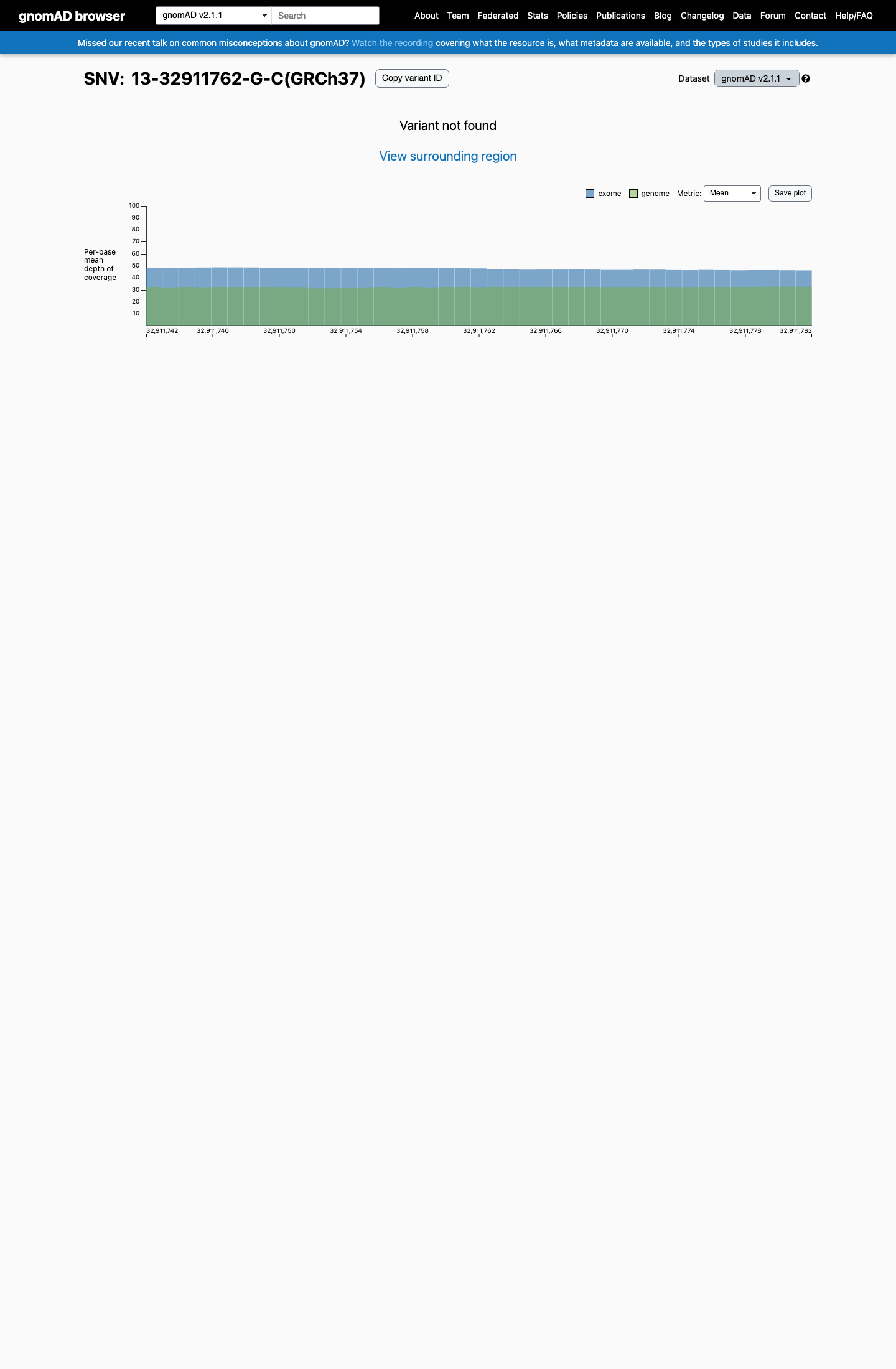
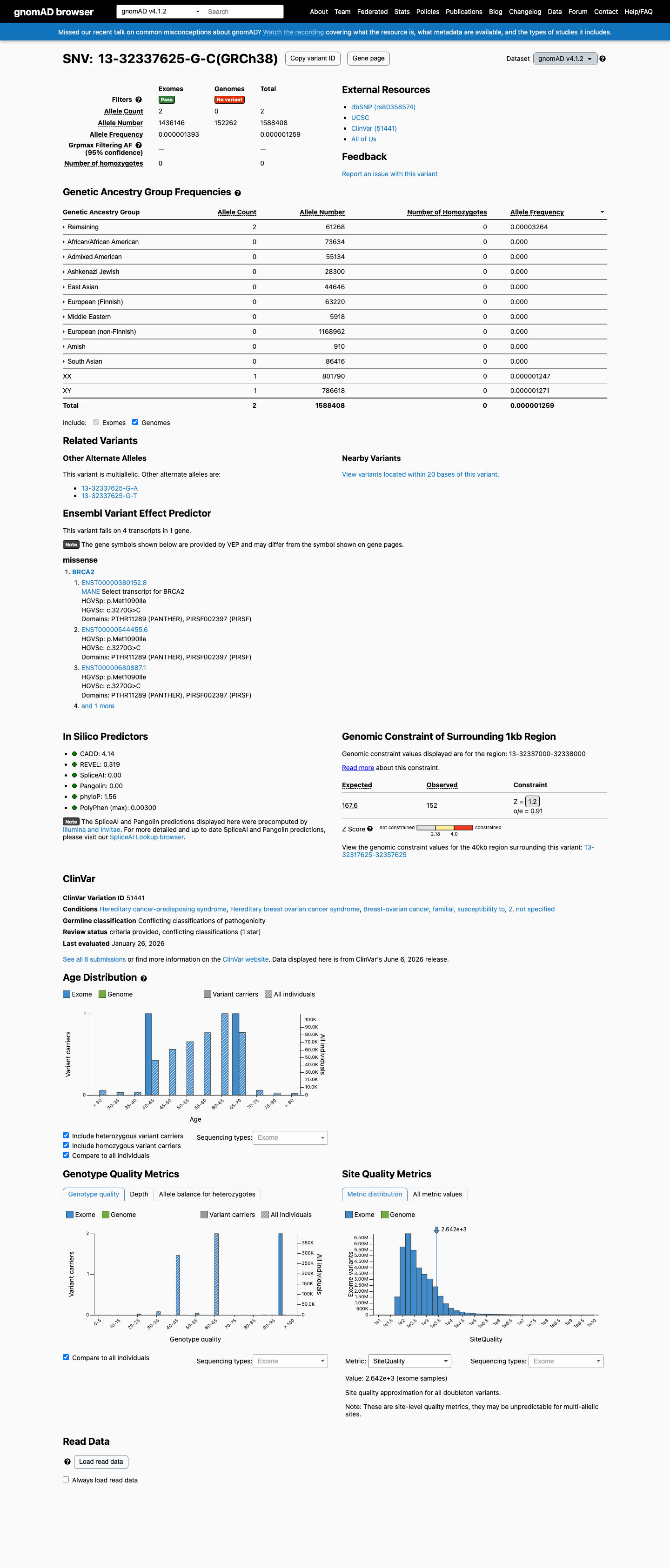
gnomAD v4.1 screenshot
gnomAD v4.1
gnomAD v2.1 screenshot
gnomAD v2.1
v4.1
This variant is present in gnomAD v4.1 (AF= 1.25912e-06; MAF= 0.00013%, 2/1588408 alleles, homozygotes = 0) and has highest observed frequency in the Remaining individuals population (AF= 3.26435e-05; MAF= 0.00326%, 2/61268 alleles, homozygotes = 0).
v2.1
Absent from gnomAD v2.1.
🇨🇦 CA
Not available in gnomAD-Canada v1.0.
Allele frequency by ancestry
three datasets · side by side
gnomAD v4.1
0.00013% · 2 / 1,588,408
0 hom
Remaining individuals
2 / 61,268
0.0033%
+ 9 not observed (Admixed American, European (Finnish), Amish, East Asian, Middle Eastern, South Asian, Ashkenazi Jewish, African/African American, European (non-Finnish))
gnomAD v2.1
Absent · 0 / ?
0 hom
Not observed in any ancestry group.
gnomAD Canada 🇨🇦
Absent · 0 / ?
0 hom
Not observed in any ancestry group.
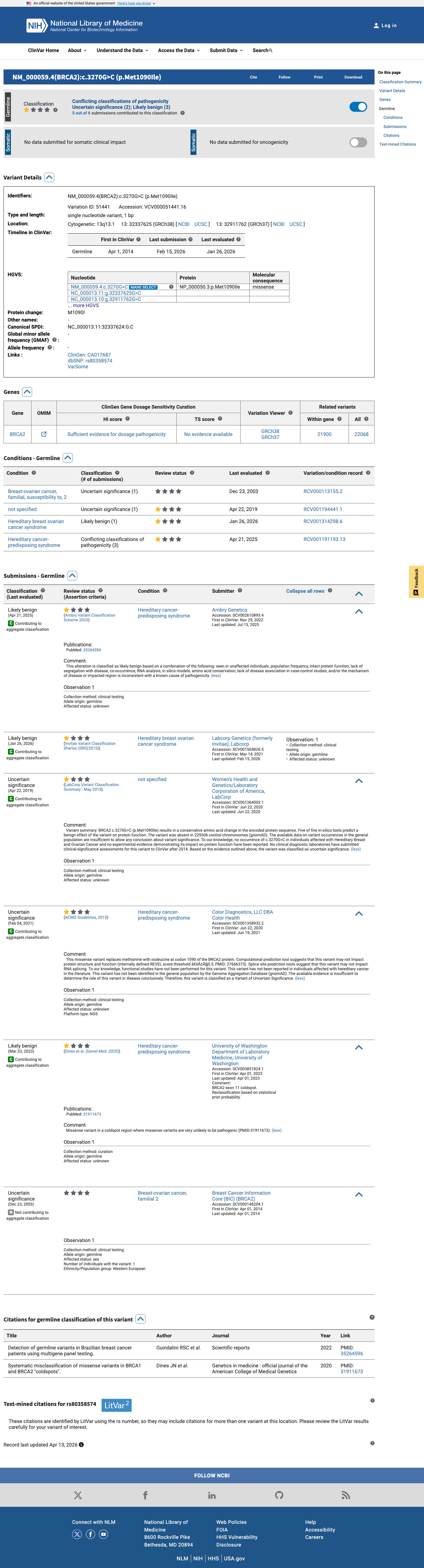
ClinVar screenshot
ClinVar
This variant has been reported in ClinVar as Uncertain significance (3 clinical laboratories) and as Likely benign (2 clinical laboratories). (ClinVarID = 51441)
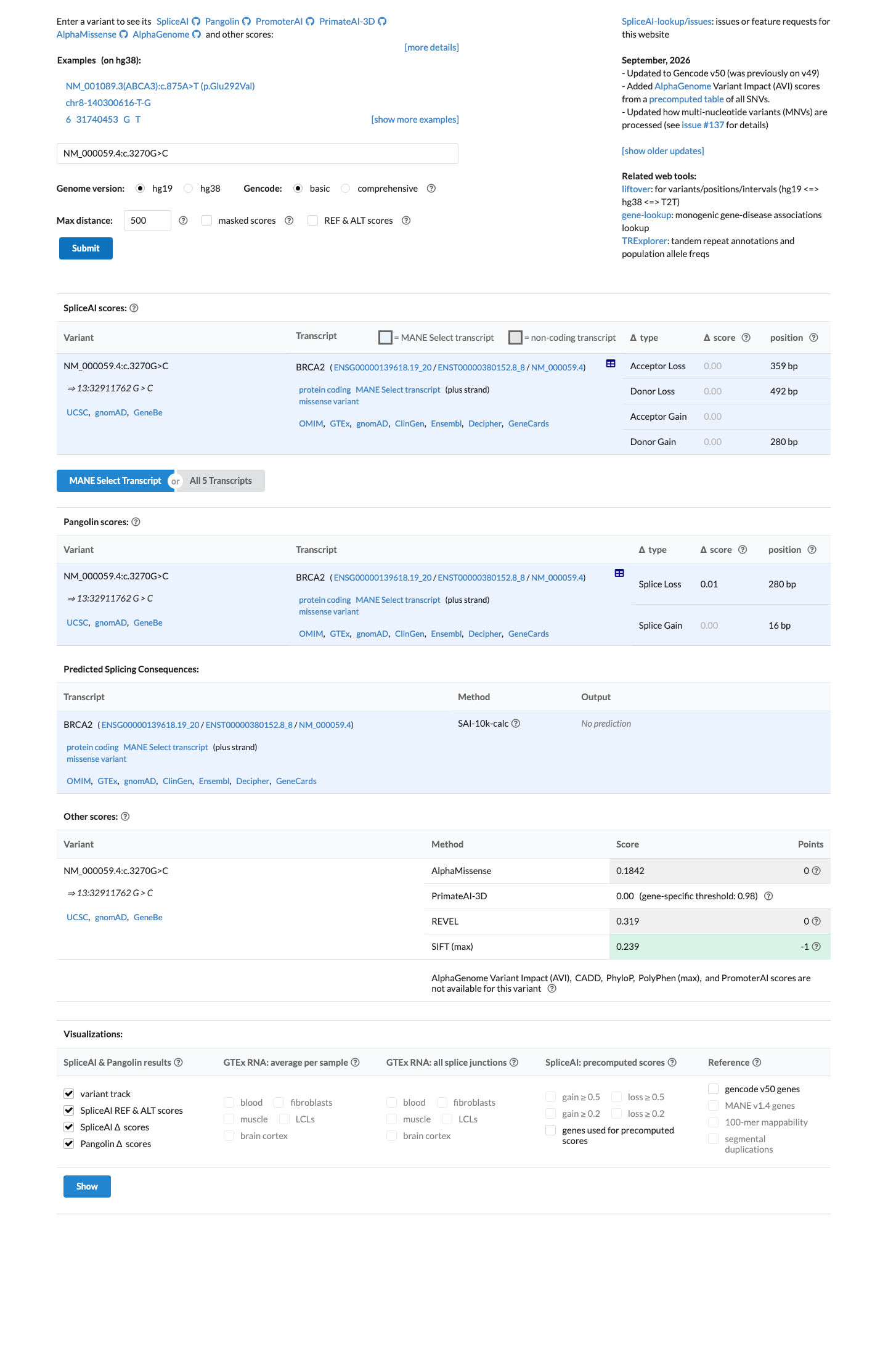
SpliceAI screenshot
In silico
SpliceAI predicts no significant splice impact for this variant (max delta score = 0.00). REVEL score = 0.319. BayesDel score = -0.499525.
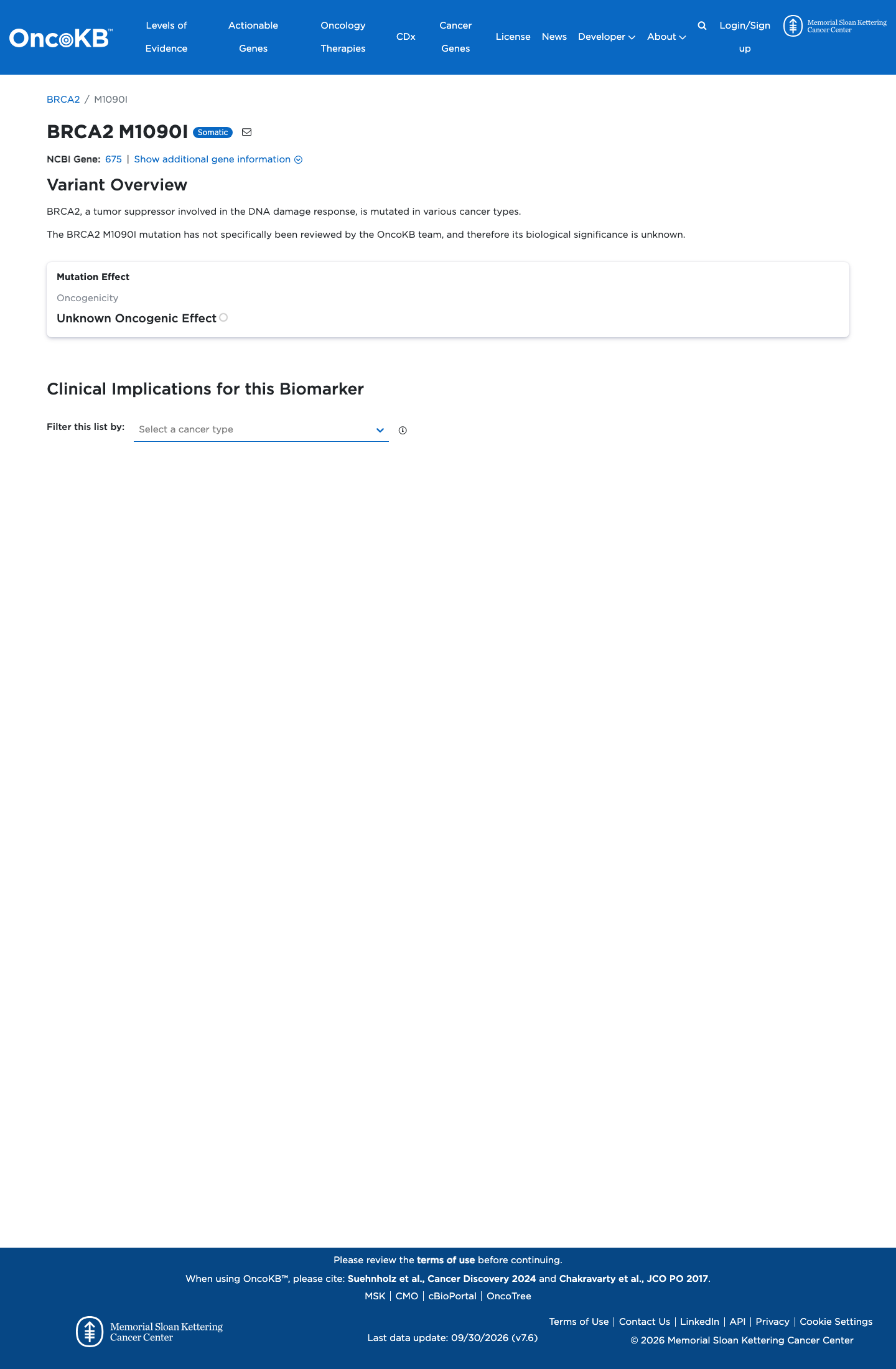
Functional / OncoKB screenshot
Functional Unknown Oncogenic Effect
OncoKB did not identify variant-specific reviewed functional evidence for this variant; gene-level curated context is available for reviewer follow-up. BRCA2, a tumor suppressor involved in the DNA damage response, is mutated in various cancer types.
OncoKB ↗
COSMIC screenshot
COSMIC
Cancer hotspots screenshot
Cancer hotspots
Somatic evidence Not in COSMIC / hotspots
COSMIC
This variant does not lie in a statistically significant hotspot. This variant has not previously been reported in somatic cancers (COSMIC).
Hotspots
This variant does not lie in a statistically significant hotspot.
Literature · how each cited paper was used
1papers cited
Each card is an audit: what was searched, what was found, whether it names the variant, which criteria it fed, and why. 8 further PMIDs triaged but not cited — see Sources & references.
Rule & framework references · cited for criterion definitions, not variant evidence
31911673 ↗ Systematic misclassification of missense variants in BRCA1 and BRCA2 "coldspots".
Sources & reference links
9Sources
CSpec VCEP
ClinVar
gnomAD v2.1
gnomAD v4.1
gnomAD-Canada
SpliceAI
OncoKB
COSMIC
Cancer hotspots
Triaged references · 8 PMIDs not cited in assessment
23918944 ↗ Tamoxifen and risk of contralateral breast cancer for BRCA1 and BRCA2 mutation carriers. CLINVAR
25741868 ↗ Standards and guidelines for the interpretation of sequence variants: a joint consensus recommendation of the American College of Medical Genetics and Genomics and the Association for Molecular Pathology. CLINVAR
31672839 ↗ Management of patients with increased risk for familial pancreatic cancer: updated recommendations from the International Cancer of the Pancreas Screening (CAPS) Consortium. CLINVAR
12692171 ↗ American Society of Clinical Oncology policy statement update: genetic testing for cancer susceptibility. CLINVAR
24366402 ↗ Summaries for patients. Assessing the genetic risk for BRCA-related breast or ovarian cancer in women: recommendations from the U.S. Preventive Services Task Force. CLINVAR
26389258 ↗ Cancer Genetics Risk Assessment and Counseling (PDQ®): Health Professional Versi CLINVAR
35264596 ↗ Detection of germline variants in Brazilian breast cancer patients using multigene panel testing. CLINVAR
28492532 ↗ Sherloc: a comprehensive refinement of the ACMG-AMP variant classification criteria. CLINVAR