Back
NM_000059.4:c.5857G>T
p.Glu1953Ter · BRCA2
0%
complete
Final classification
Pathogenic
PVS1PM5PP4PP5
BRCA2
c.5857G>T
p.Glu1953Ter
nonsense · exon 11

BRCA2 encodes a DNA repair protein that maintains genome stability by repairing double-strand breaks through homologous recombination and by protecting DNA replication forks. It acts as a tumor suppressor, and inherited loss-of-function changes cause hereditary breast and ovarian cancer syndrome, with elevated lifetime risks of breast, ovarian, prostate, and pancreatic cancers; biallelic changes cause Fanconi anemia complementation group D1. Reduced or altered BRCA2 activity is implicated in multiple tumor types, and PARP inhibitors are an approved treatment for BRCA2-associated ovarian and breast cancers.

This variant

BRCA2 encodes a tumor-suppressor DNA-repair protein, and inherited loss-of-function changes impair homologous recombination and cause hereditary breast and ovarian cancer syndrome.

Transcript
NM_000059.4
HGVS · transcript:coding
NM_000059.4:c.5857G>T
GRCh38
chr13:32340212 G>T
GRCh37
chr13:32914349 G>T
Pathogenic: PVS1 (very strong) plus PM5 (strong) satisfy the ENIGMA BRCA2 VCEP Table 3 Pathogenic rule, with additional PP4 and PP5 supporting evidence.
Classification rationale
PVS1PM5PP4PP5 Pathogenic
BRCA2 c.5857G>T nonsense · exon 11

Pathogenic: PVS1 (very strong) applies to the exon 11 nonsense variant p.Glu1953Ter under ENIGMA Table 4. Pathogenic: PM5 (strong) is pre-assigned by ENIGMA Table 4 for BRCA2 exon 11 protein-termination-codon variants. Pathogenic: PP4 (supporting) is met because the exact-variant clinical-history LR is 2.7664, above 2.08. Pathogenic: PP5 (supporting) is met because ClinVar records an exact-variant ENIGMA expert-panel Pathogenic classification with three stars.

PVS1 + PM5 + PP4 + PP5 → Pathogenic
LYFE Sciences is an AI system, and it can make mistakes. Criteria may be applied incorrectly, sources may be misread, and a confident-looking classification can still be wrong. Double-check every criterion and its underlying evidence before relying on any call.
Gene diagram · NM_000059.4 · variants mapped to exon structure
BRCA2 NM_000059.4
Fetching transcript structure from UCSC…
Applied criteria · 4 applied · 12 assessed
MetEvidence satisfies this criterion.
Not metEvaluated against available evidence; threshold not reached.
Not assessedApplies in principle, but no evidence was found to evaluate it.
N/ADoesn't apply to this variant type.
Applied · 4
Strength Supporting Moderate Strong Very strong
PVS1 very strong Pathogenic
Met: exon 11 nonsense variant p.Glu1953Ter receives the ENIGMA Table 4 PVS1 assignment, with no exon-specific downgrade, so strength is very strong.
The case normalization identifies NM_000059.4:c.5857G>T as NP_000050.3:p.(Glu1953Ter) / p.(E1953*), a nonsense consequence.The ENIGMA BRCA2 specification states that PVS1 variable weight applies to null variants in a gene where loss of function is a known disease mechanism and directs protein-termination-codon variants to exon-specific Table 4 weights.Specifications_Table4_V1.2_2024-11-18.xlsx lists BRCA2 exon 11 as PTC: PVS1; exon 11 spans c.1910-c.6841 and its PM5-PTC field is applicable, with no PVS1_N/A designation.
PM5 strong Pathogenic
Met, strong: ENIGMA Table 4 pre-assigns PM5_Strong (PTC) for BRCA2 exon 11, which contains c.5857G>T.
Case normalization identifies NM_000059.4:c.5857G>T as p.(Glu1953Ter), a genomic protein-termination-codon variant.The exon 11 interval in Specifications Table 4 spans c.1910 through c.6841, placing c.5857 in exon 11.Specifications Table 4 assigns PM5_Strong (PTC) to exon 11; its listed BRCA2 PM5_N/A exons are E6, E12, and E27, so exon 11 is eligible.
PP4 supporting Pathogenic
Met, supporting: exact-variant clinical-history LR 2.7664 >= the ENIGMA PP4 Supporting threshold of 2.08.
ENIGMA states PP4 Supporting: LR >=2.08:1 and limits PP4 to combined multifactorial clinical likelihood evidence.The exact BRCA2 c.5857G>T row reports LOG(LR) 1.017532587051392, 7 probands, and LR 2.766360582136327.Exact comparison using the criterion-specific operator: 2.766360582136327 >= 2.08? yes.
PP5 supporting Pathogenic
Met, supporting: exact-variant ClinVar expert-panel classification is Pathogenic with three-star review status.
ClinVar exact-match record NM_000059.4(BRCA2):c.5857G>T (p.Glu1953Ter) is Pathogenic, reviewed by expert panel, with three stars.The expert-panel submitter is ENIGMA; this exact expert-panel classification, rather than laboratory submissions or the aggregate label, is the basis for PP5.The specification says PP5 is not used, but the requested adjudication rule explicitly requires PP5 Supporting for an exact-variant ClinVar expert-panel Pathogenic or Likely pathogenic classification.
Assessed · not applied · 2 not met · 10 not assessed
Pathogenic
PS3 Not assessed: no exact calibrated protein-function assay or ENIGMA Table 9 PS3 assignment was found for c.5857G>T.
PS4 Not assessed: qualifying PS4 requires OR >=4, p-value <=0.05, and a lower confidence limit above 2.0, but these case-control metrics are unavailable.
PM2 Not assessed: the variant appears at 2/250950 alleles in all-comers gnomAD v2.1, but required non-cancer v2.1/v3.1 absence and depth data were unavailable.
PM3 Not assessed: no documented Fanconi anemia phenotype, second BRCA2 pathogenic variant, or phase evidence supports assignment of the ENIGMA PM3 point thresholds.
PP1 Not assessed: four affected relatives are reported, but no quantitative co-segregation LR is available to meet the ENIGMA PP1 thresholds, including LR ≥2.08 for supporting evidence.
Benign
BA1 Not assessed: available all-comers gnomAD AFs are 7.97e-06 and 2.48e-06, but required non-cancer FAF data were unavailable for the VCEP >0.001 threshold.
BS1 Not assessed: reported all-comers maximum AFs are 1.76e-05 and 3.39e-06, but required non-cancer FAF values were unavailable for the VCEP >0.00002 threshold.
BS2 Not assessed: gnomAD shows zero homozygotes, but no qualifying phenotyped healthy-adult or Fanconi-Anemia-negative clinical observations were provided for BS2.
BS3 Not assessed: no exact calibrated protein-function assay or ENIGMA Table 9 BS3 assignment was found for c.5857G>T.
BS4 Not assessed: no non-segregating affected relatives or benign-direction LR is available, with ENIGMA BS4 supporting evidence requiring LR ≤0.48.
BP5 Not met: clinical-history LR 2.7664 <= 0.48? no, so it does not meet the ENIGMA BP5 Supporting threshold.
BP6 Not met: the exact-variant ClinVar expert-panel classification is Pathogenic, not Benign or Likely benign.
N/A · 12 PS1 · PS2 · PM1 · PM4 · PM6 · PP2 · PP3 · BP1 · BP2 · BP3 · BP4 · BP7
Research & evidence
Population frequency · supports pathogenic
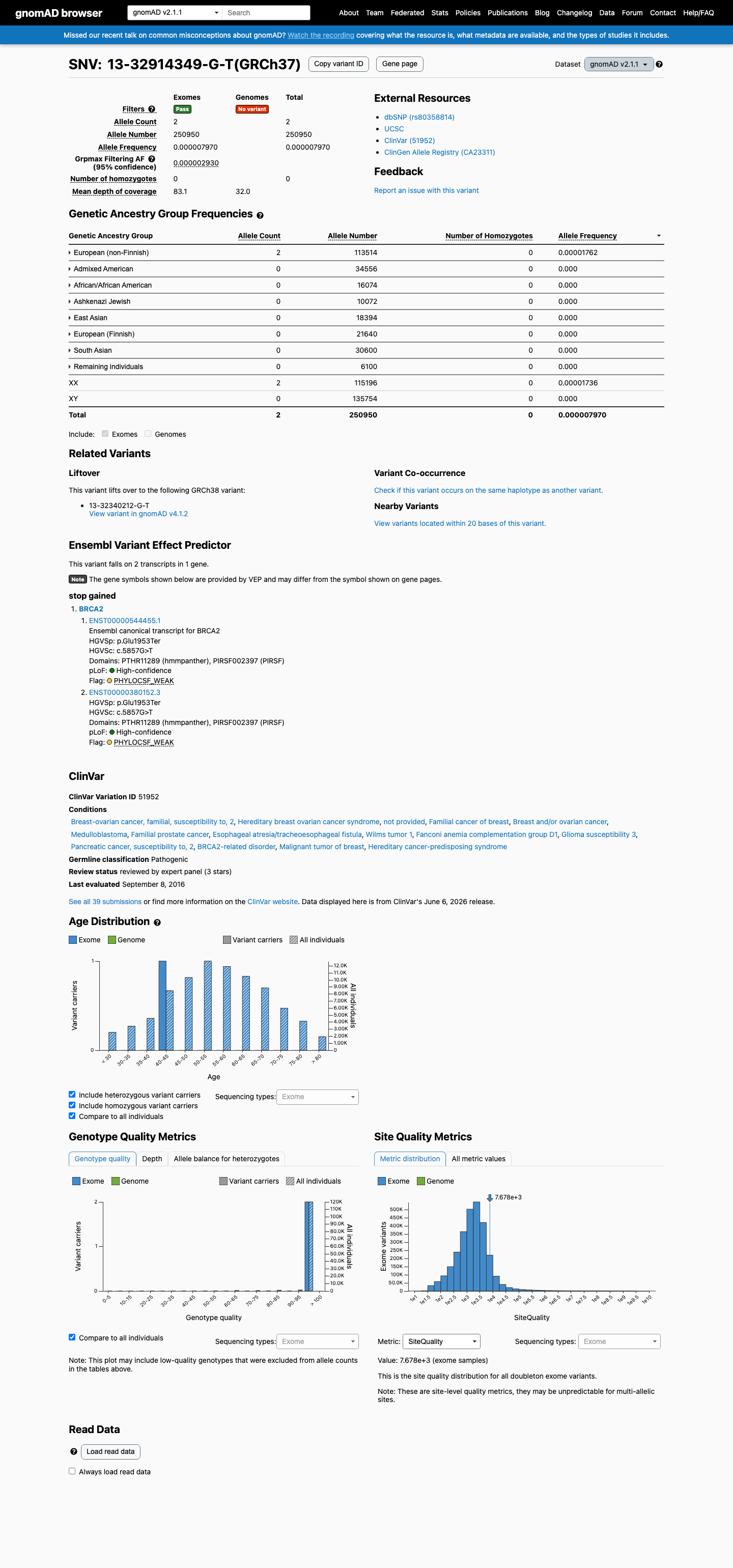
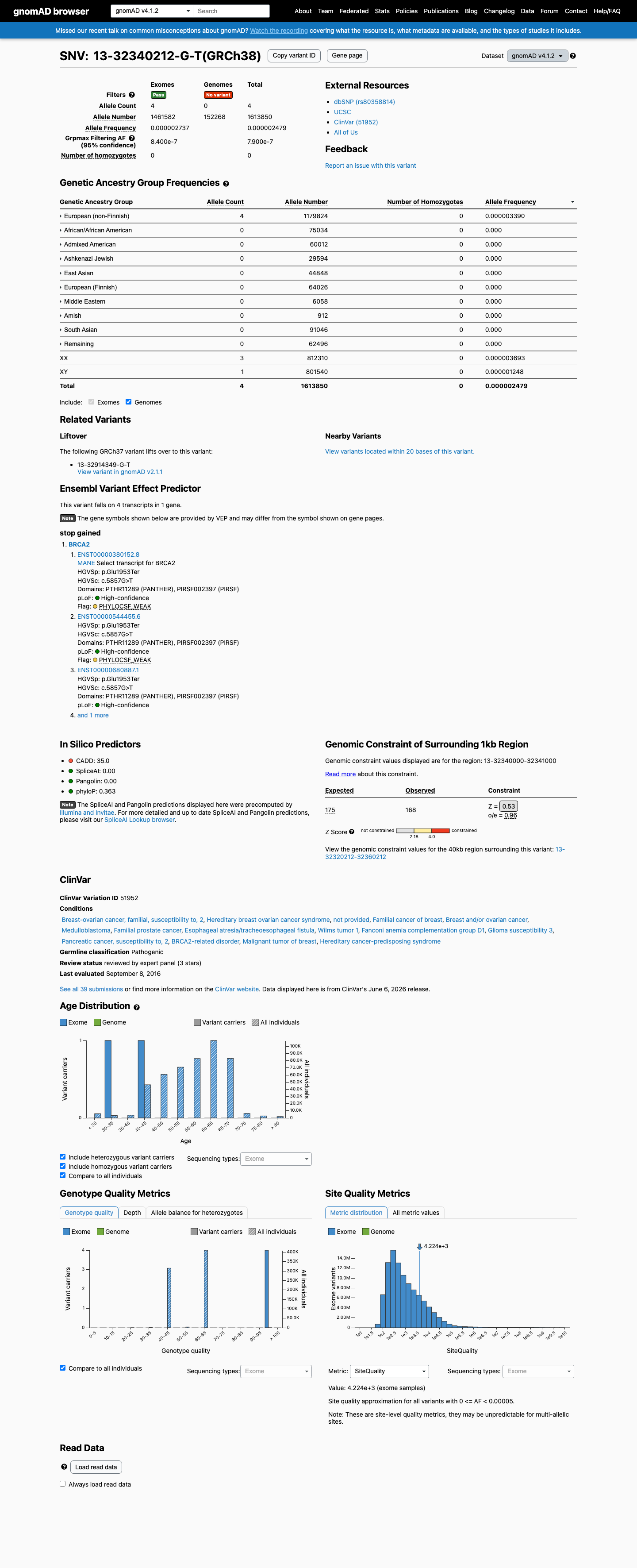
gnomAD v4.1 screenshot
gnomAD v4.1
gnomAD v2.1 screenshot
gnomAD v2.1
v4.1
This variant is present in gnomAD v4.1 (AF= 2.47855e-06; MAF= 0.00025%, 4/1613850 alleles, homozygotes = 0) and has highest observed frequency in the European (non-Finnish) population (AF= 3.39034e-06; MAF= 0.00034%, 4/1179824 alleles, homozygotes = 0); grpmax FAF= 7.9e-07.
v2.1
This variant is present in gnomAD v2.1 (AF= 7.96972e-06; MAF= 0.00080%, 2/250950 alleles, homozygotes = 0) and has highest observed frequency in the European (non-Finnish) population (AF= 1.7619e-05; MAF= 0.00176%, 2/113514 alleles, homozygotes = 0); grpmax FAF= 2.93e-06.
🇨🇦 CA
Not available in gnomAD-Canada v1.0.
Allele frequency by ancestry
three datasets · side by side
gnomAD v4.1
0.00025% · 4 / 1,613,850
0 hom · FAF 7.9e-05%
European (non-Finnish)
4 / 1,179,824
0.00034%
+ 9 not observed (Remaining individuals, Admixed American, European (Finnish), Amish, East Asian, Middle Eastern, South Asian, Ashkenazi Jewish, African/African American)
gnomAD v2.1
0.0008% · 2 / 250,950
0 hom · FAF 0.00029%
European (non-Finnish)
2 / 113,514
0.0018%
+ 7 not observed (African/African American, Admixed American, Ashkenazi Jewish, East Asian, European (Finnish), Remaining individuals, South Asian)
gnomAD Canada 🇨🇦
Absent · 0 / ?
0 hom
Not observed in any ancestry group.
ClinVar screenshot
ClinVar
This variant has been reported in ClinVar as Pathogenic (39 clinical laboratories) and as Pathogenic by Evidence-based Network for the Interpretation of Germline Mutant Alleles (ENIGMA) (expert panel). (ClinVarID = 51952)
SpliceAI screenshot
In silico
SpliceAI predicts no significant splice impact for this variant (max delta score = 0.00). BayesDel score = 0.287735.
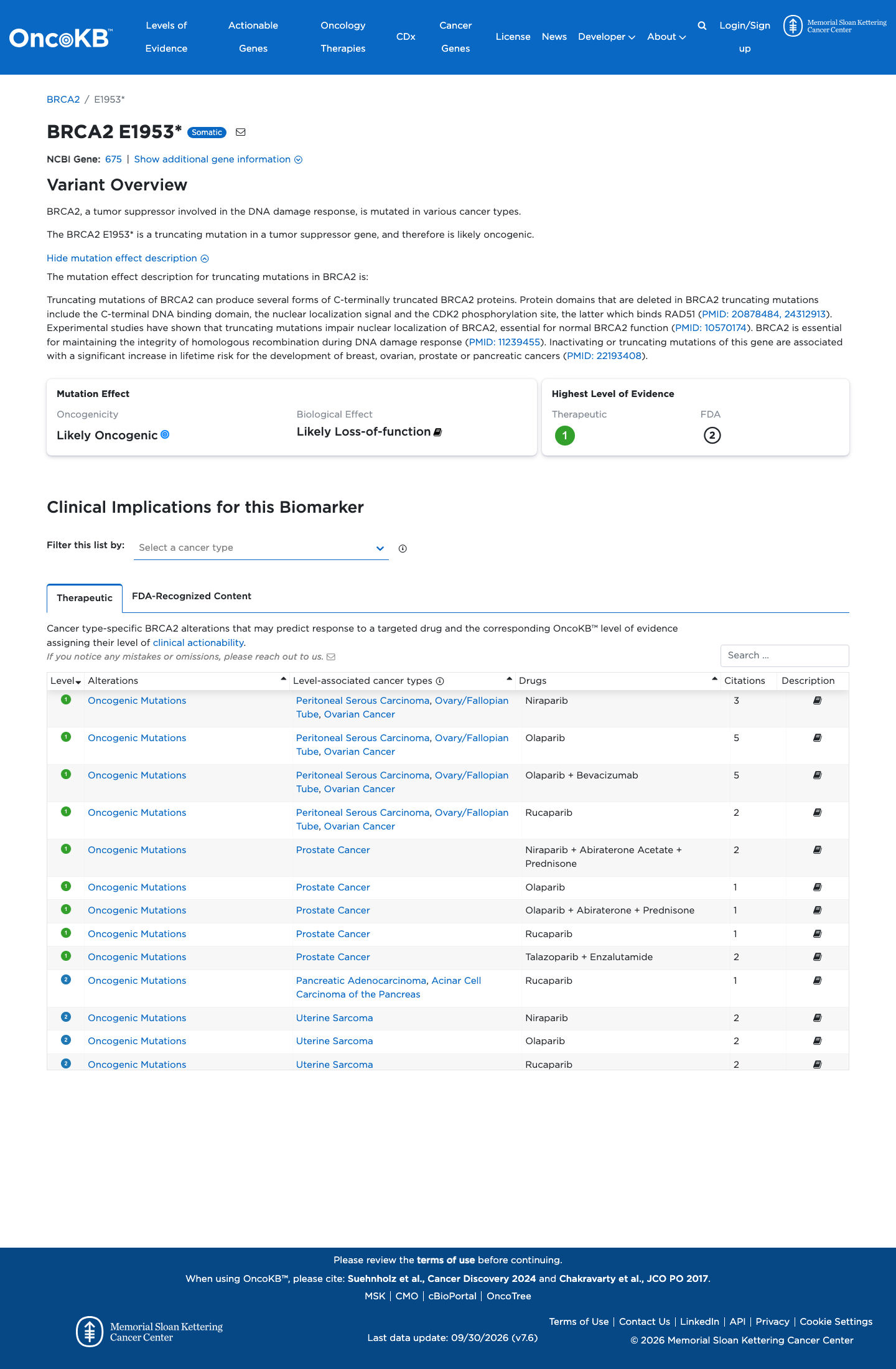
Functional / OncoKB screenshot
Functional Likely Oncogenic
OncoKB identified variant-specific curated literature and context relevant to functional review; biological-effect context: Likely Loss-of-function; curated oncogenicity label: Likely Oncogenic.
OncoKB ↗
COSMIC screenshot
COSMIC
Cancer hotspots screenshot
Cancer hotspots
Somatic evidence Not in COSMIC / hotspots
COSMIC
This variant does not lie in a statistically significant hotspot. This variant has not previously been reported in somatic cancers (COSMIC).
Hotspots
This variant does not lie in a statistically significant hotspot.
Literature · how each cited paper was used
2papers cited
Each card is an audit: what was searched, what was found, whether it names the variant, which criteria it fed, and why. 7 further PMIDs triaged but not cited — see Sources & references.
A DGGE system for comprehensive mutation screening of BRCA1 and BRCA2: application in a Dutch cancer clinic setting.
Searched
c.5857G>Tp.Glu1953Terp.E1953*c.5857G4Tp.Glu1953X
Found
The Dutch hereditary breast and ovarian cancer screening paper explicitly lists the variant as c.5857G4T (6085G4T), p.Glu1953X, and reports it in four families among deleterious BRCA2 changes.
Variant
✓ Names this variant — characterised directly
Applied to
→PVS1 very strong
Provides variant-level confirmation of the reported nonsense/PTC notation; the PVS1 strength itself is assigned by the ENIGMA exon-specific rule.
11-15k c.5857G4T (6085G4T) p.Glu1953X 4
Location Table 5, Deleterious Changes in BRCA2  ·  Context Dutch hereditary breast and ovarian cancer clinic cohort; BRCA1/BRCA2 mutation screening using DGGE, protein truncation testing for parts of exon 11, and sequencing of aberrant fragments.  ·  full text
Li et al. 2020 BRCA1/2 clinical-history likelihood-ratio model
Searched
c.5857G>Tp.Glu1953Terp.E1953*
Found
The BRCA2 clinical-history likelihood table contains an exact c.5857G>T row with seven probands and LR 2.766360582136327, calibrated evidence used for ENIGMA PP4/BP5 direction and strength.
Variant
✓ Names this variant — characterised directly
Applied to
→PP4 supporting
Exact LR 2.766360582136327 meets PP4 Supporting.
BRCA2 | c.5857G>T | c.5857G>T | 1.017532587051392 | 7 | 2.766360582136327
Location MOESM3-converted clinical-history LR table, exact BRCA2 c.5857G>T row  ·  Context ENIGMA multifactorial clinical-history likelihood model based on personal and family cancer history; exact variant-level table entry with seven probands.  ·  full text
Sources & reference links
9Sources
CSpec VCEP
ClinVar
gnomAD v2.1
gnomAD v4.1
gnomAD-Canada
SpliceAI
OncoKB
COSMIC
Cancer hotspots
Triaged references · 7 PMIDs not cited in assessment
10570174 ↗ Truncated BRCA2 is cytoplasmic: implications for cancer-linked mutations. ONCOKB
11239455 ↗ BRCA2 is required for homology-directed repair of chromosomal breaks. ONCOKB
20878484 ↗ A new mutation of BRCA2 gene in an Italian healthy woman with familial breast cancer history. ONCOKB
22193408 ↗ BRCA1 and BRCA2: different roles in a common pathway of genome protection. ONCOKB
24312913 ↗ A comprehensive focus on global spectrum of BRCA1 and BRCA2 mutations in breast cancer. ONCOKB
20104584 ↗ Characterization of BRCA1 and BRCA2 deleterious mutations and variants of unknown clinical significance in unilateral and bilateral breast cancer: the WECARE study. CLINVAR
23199084 ↗ Founder BRCA1/2 mutations in the Europe: implications for hereditary breast-ovarian cancer prevention and control. CLINVAR