Analysis in progress
Initialising…
0%
complete
This report is still being assembled — sections appear as each stage finishes. It isn't final yet.
BRCA2
Final classification
Benign
BS1BP1BP5BP6
BRCA2
c.6748A>G
p.Thr2250Ala
missense · exon 11

BRCA2 encodes a DNA repair protein that maintains genome stability by repairing double-strand breaks through homologous recombination and by protecting DNA replication forks. It acts as a tumor suppressor, and inherited loss-of-function changes cause hereditary breast and ovarian cancer syndrome, with elevated lifetime risks of breast, ovarian, prostate, and pancreatic cancers; biallelic changes cause Fanconi anemia complementation group D1. Reduced or altered BRCA2 activity is implicated in multiple tumor types, and PARP inhibitors are an approved treatment for BRCA2-associated ovarian and breast cancers.

This variant

BRCA2 is a tumor suppressor whose loss-of-function changes cause hereditary breast and ovarian cancer syndrome. This missense change (p.Thr2250Ala) is classified as Benign, meaning it does not impair BRCA2's DNA-repair function and is not expected to raise cancer risk.

Transcript
NM_000059.4
HGVS · transcript:coding
NM_000059.4:c.6748A>G
GRCh38
chr13:32341103 A>G
GRCh37
chr13:32915240 A>G
Basis Benign: three Strong benign criteria (BS1, BP1, BP5) and one Supporting benign criterion (BP6), with no met pathogenic criteria, satisfy the ENIGMA BRCA2 v1.2 rule requiring at least two Strong benign criteria.
Benign: three Strong benign criteria (BS1, BP1, BP5) and one Supporting benign criterion (BP6), with no met pathogenic criteria, satisfy the ENIGMA BRCA2 v1.2 rule requiring at least two Strong benign criteria.
Classification rationale
BS1BP1BP5BP6 Benign
BRCA2 c.6748A>G missense · exon 11

BS1 (Strong): gnomAD v2.1 non-cancer grpmax FAF 0.00010864 exceeds the 0.01% threshold. BP1 (Strong): missense at residue 2250 lies outside the clinically important functional domains, with SpliceAI max delta 0.016 (<=0.1). BP5 (Strong): multifactorial odds >100:1 in favor of neutrality (LR<0.01) meet the <=0.05 threshold. BP6 (Supporting): the ENIGMA expert panel classified this variant as Benign. Overall: Benign, per the ENIGMA BRCA2 v1.2 rule requiring at least two Strong benign criteria.

BS1 + BP1 + BP5 + BP6 Benign
Gene diagram · NM_000059.4 · variants mapped to exon structure
BRCA2 NM_000059.4
Fetching transcript structure from UCSC…
Applied criteria · 4 applied · 15 assessed
MetEvidence satisfies this criterion.
Not metEvaluated against available evidence; threshold not reached.
Not assessedApplies in principle, but no evidence was found to evaluate it.
N/ADoesn't apply to this variant type.
Applied · 4
Strength Supporting Moderate Strong Very strong
BS1 strong Benign
Met (Strong): gnomAD v2.1 non-cancer grpmax FAF 0.00010864 exceeds the 0.01% BS1 Strong threshold.
The ENIGMA BRCA1/2 specification, version 1.2, defines BS1 Strong as FAF >0.0001 (0.01%) in gnomAD v2.1 non-cancer exome and/or gnomAD v3.1 non-cancer non-founder populations; BS1 Supporting applies only when FAF is >0.00002 and <=0.0001.gnomAD v2.1 reports grpmax FAF 0.00010864 (0.010864%), exceeding the BS1 Strong cutoff; the highest observed subpopulation AF is 0.000173481 in Admixed American individuals, with zero homozygotes.
BP1 strong Benign
Met (Strong): missense at residue 2250 lies outside the clinically important domains, with SpliceAI max delta 0.016 (<=0.1).
The ENIGMA BRCA2 v1.2 BP1_Strong rule applies to missense variants outside the clinically important functional domains when SpliceAI is <=0.1.The case variant is NP_000050.3:p.(Thr2250Ala), so the altered residue is 2250; the specified domains are aa 10-40 and aa 2481-3186, placing residue 2250 outside the domains.SpliceAI reports a maximum delta score of 0.016, below the ENIGMA threshold of 0.1.
BP5 strong Benign
Met (Strong): multifactorial odds >100:1 in favor of neutrality (LR<0.01) meet the <=0.05 BP5 Strong threshold.
ENIGMA BRCA2 v1.2 directs BP5 to capture only combined clinical-data LR against pathogenicity; Strong requires LR<=0.05.PMID:23683081 explicitly reports BRCA2 c.6748A>G among variants with odds >100:1 in favor of neutrality according to a multifactorial model.
BP6 supporting Benign
Met (Supporting): the ENIGMA expert panel classified this variant as Benign.
ClinVar variation 38064 exactly matches NM_000059.4:c.6748A>G (p.Thr2250Ala) and records a Benign ENIGMA assertion with review status 'reviewed by expert panel'.No ordinary laboratory submission or aggregate ClinVar label was used to trigger BP6.ClinVar expert panel classification
Assessed · not applied · 7 not met · 8 not assessed
Pathogenic
PVS1 Not met: c.6748A>G is a missense change (p.Thr2250Ala), not a null or canonical splice-site variant.
PS1 Not met: no pathogenic or likely pathogenic variant producing the same amino-acid change at residue 2250 was reported.
PS3 Not assessed: the variant is not in the ENIGMA calibrated functional-assay table, and no qualifying assay result was available.
PS4 Not assessed: no ethnicity- and country-matched case-control study meeting ENIGMA thresholds was identified.
PM2 Not met: the variant is present in population controls (gnomAD v2.1 28/251,358 and v4.1 175/1,613,990 alleles), where absence is required.
PM3 Not assessed: no affected proband with a Fanconi anemia phenotype or second BRCA2 pathogenic variant was documented.
PP1 Not assessed: no quantitative co-segregation data (likelihood ratio, meiosis count, affected-relative genotypes) were available.
PP3 Not met: SpliceAI maximum delta 0.016 is below the >=0.20 PP3 splicing threshold.
PP4 Not met: the multifactorial clinical evidence favors neutrality, not the pathogenicity PP4 requires.
PP5 Not met: the ClinVar expert-panel assertion is Benign, not Pathogenic or Likely pathogenic.
Benign
BA1 Not met: gnomAD v2.1 grpmax FAF 0.00010864 (0.0109%) is below the 0.1% BA1 threshold.
BS2 Not assessed: no adequately documented Fanconi anemia phenotype assessment or Table 8 point data were available.
BS3 Not assessed: no ENIGMA-calibrated benign functional assay result for this variant was available.
BS4 Not assessed: no quantitative segregation data (affected non-carriers, likelihood ratio) were available.
BP7 Not assessed: BP7 sequence-based paths apply only to silent or intronic variants, and no mRNA-only assay result was available.
N/A · 9 PS2 · PM1 · PM4 · PM5 · PM6 · PP2 · BP2 · BP3 · BP4
Research & evidence
Population frequency · supports benign
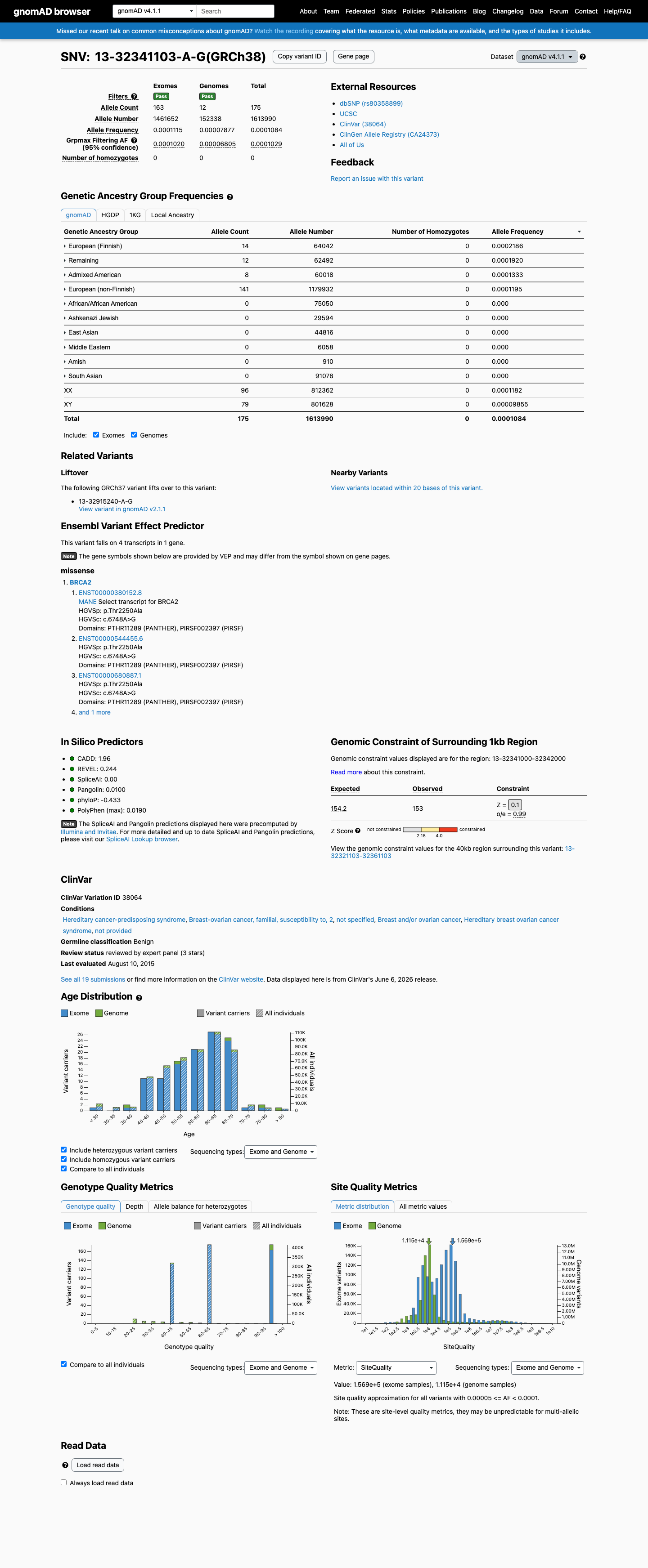
gnomAD v4.1 screenshot
gnomAD v4.1
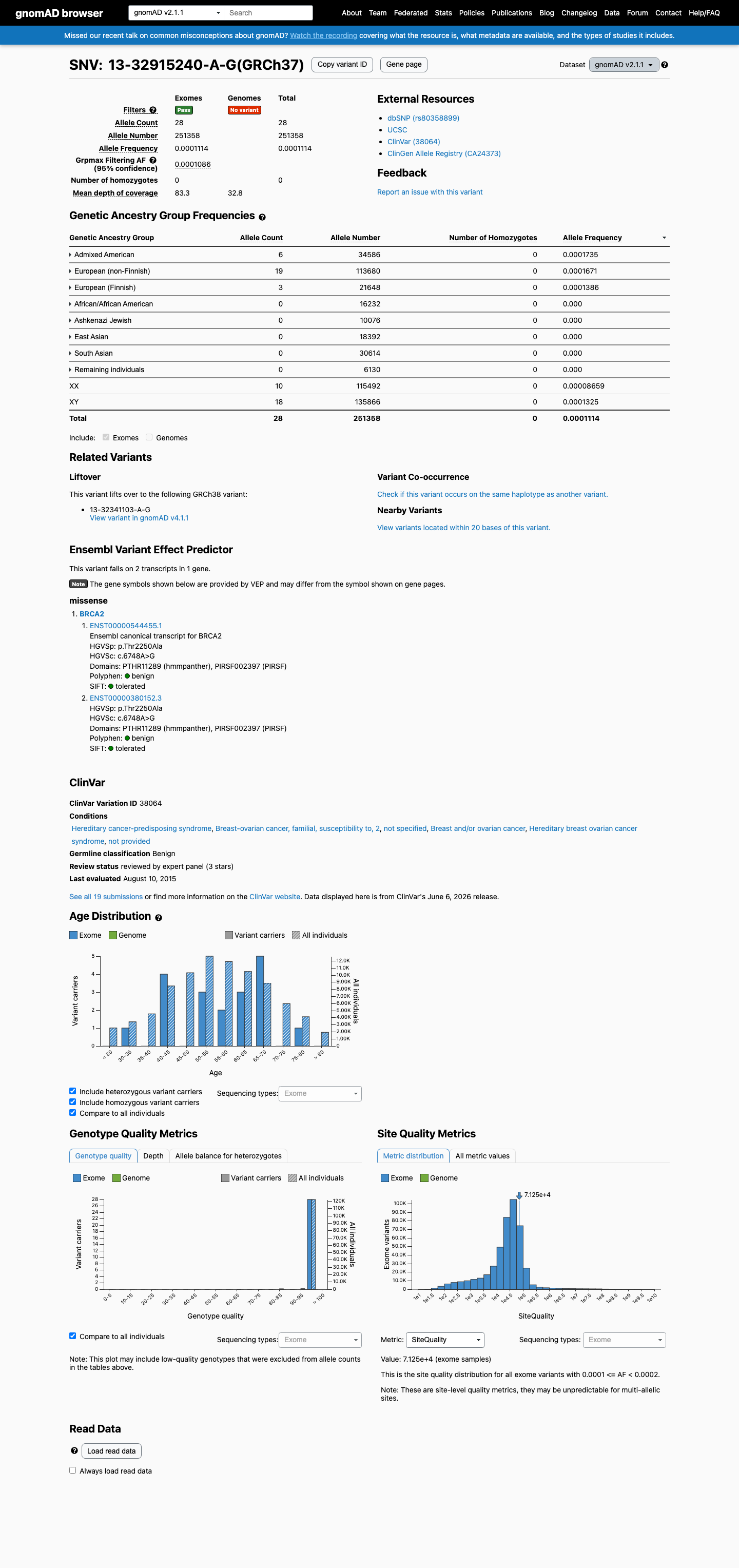
gnomAD v2.1 screenshot
gnomAD v2.1
v4.1
This variant is present in gnomAD v4.1 (AF= 0.000108427; MAF= 0.01084%, 175/1613990 alleles, homozygotes = 0) and has highest observed frequency in the European (Finnish) population (AF= 0.000218607; MAF= 0.02186%, 14/64042 alleles, homozygotes = 0); grpmax FAF= 0.00010293.
v2.1
This variant is present in gnomAD v2.1 (AF= 0.000111395; MAF= 0.01114%, 28/251358 alleles, homozygotes = 0) and has highest observed frequency in the Admixed American population (AF= 0.000173481; MAF= 0.01735%, 6/34586 alleles, homozygotes = 0); grpmax FAF= 0.00010864.
🇨🇦 CA
Not available in gnomAD-Canada v1.0.
Allele frequency by ancestry
three datasets · side by side
gnomAD v4.1
0.011% · 175 / 1,613,990
0 hom · FAF 0.01%
European (Finnish)
14 / 64,042
0.022%
Remaining individuals
12 / 62,492
0.019%
Admixed American
8 / 60,018
0.013%
European (non-Finnish)
141 / 1,179,932
0.012%
+ 6 not observed (Amish, East Asian, Middle Eastern, South Asian, Ashkenazi Jewish, African/African American)
gnomAD v2.1
0.011% · 28 / 251,358
0 hom · FAF 0.011%
Admixed American
6 / 34,586
0.017%
European (non-Finnish)
19 / 113,680
0.017%
European (Finnish)
3 / 21,648
0.014%
+ 5 not observed (African/African American, Ashkenazi Jewish, East Asian, Remaining individuals, South Asian)
gnomAD Canada 🇨🇦
Absent · 0 / ?
0 hom
Not observed in any ancestry group.
ClinVar screenshot
ClinVar
This variant has been reported in ClinVar as Benign (12 clinical laboratories) and as Likely benign (4 clinical laboratories) and as Uncertain significance (1 clinical laboratory) and as Benign by Evidence-based Network for the Interpretation of Germline Mutant Alleles (ENIGMA) (expert panel). (ClinVarID = 38064)
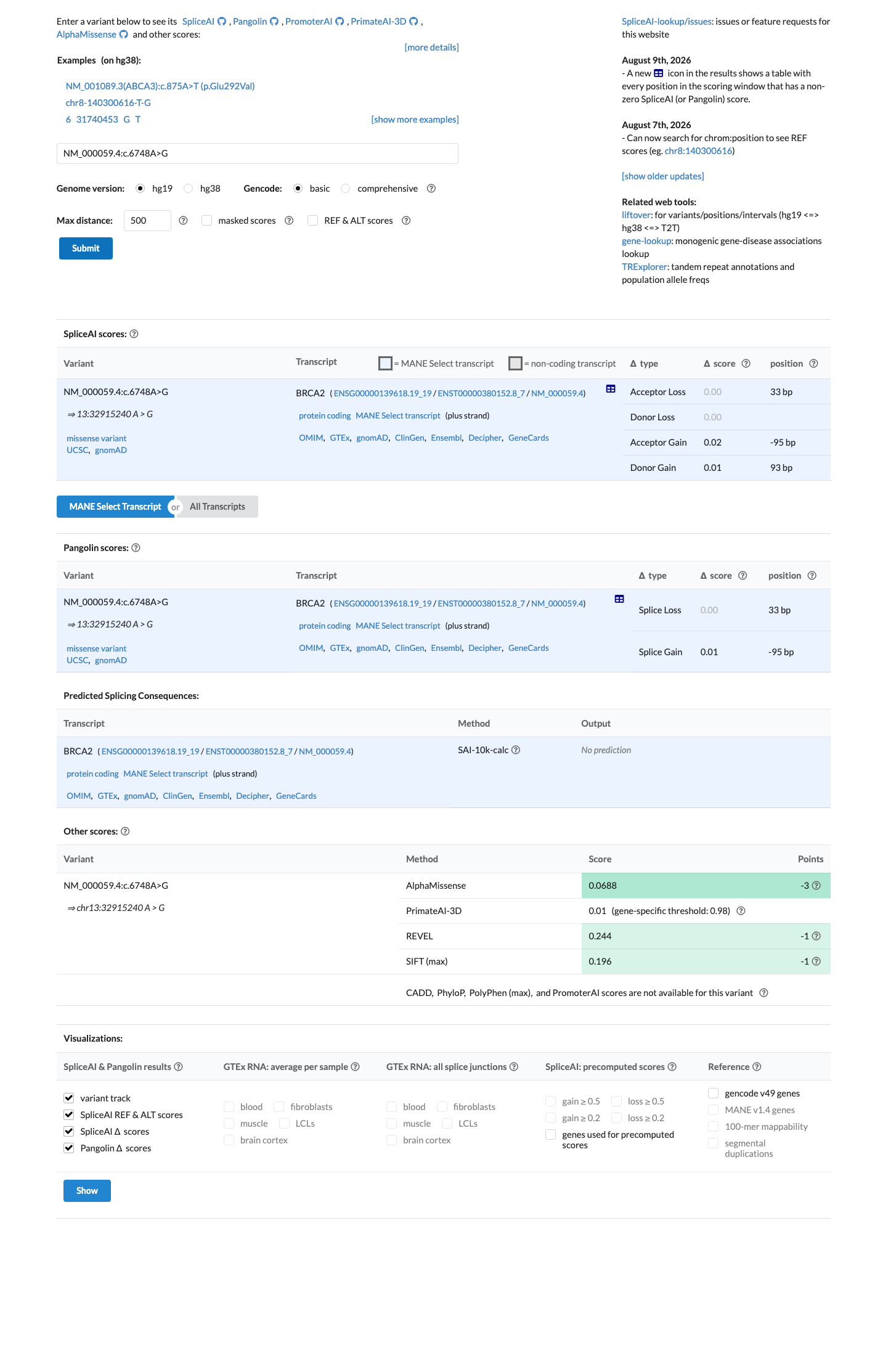
SpliceAI screenshot
In silico
SpliceAI predicts no significant splice impact for this variant (max delta score = 0.02). REVEL score = 0.244. BayesDel score = -0.341156.
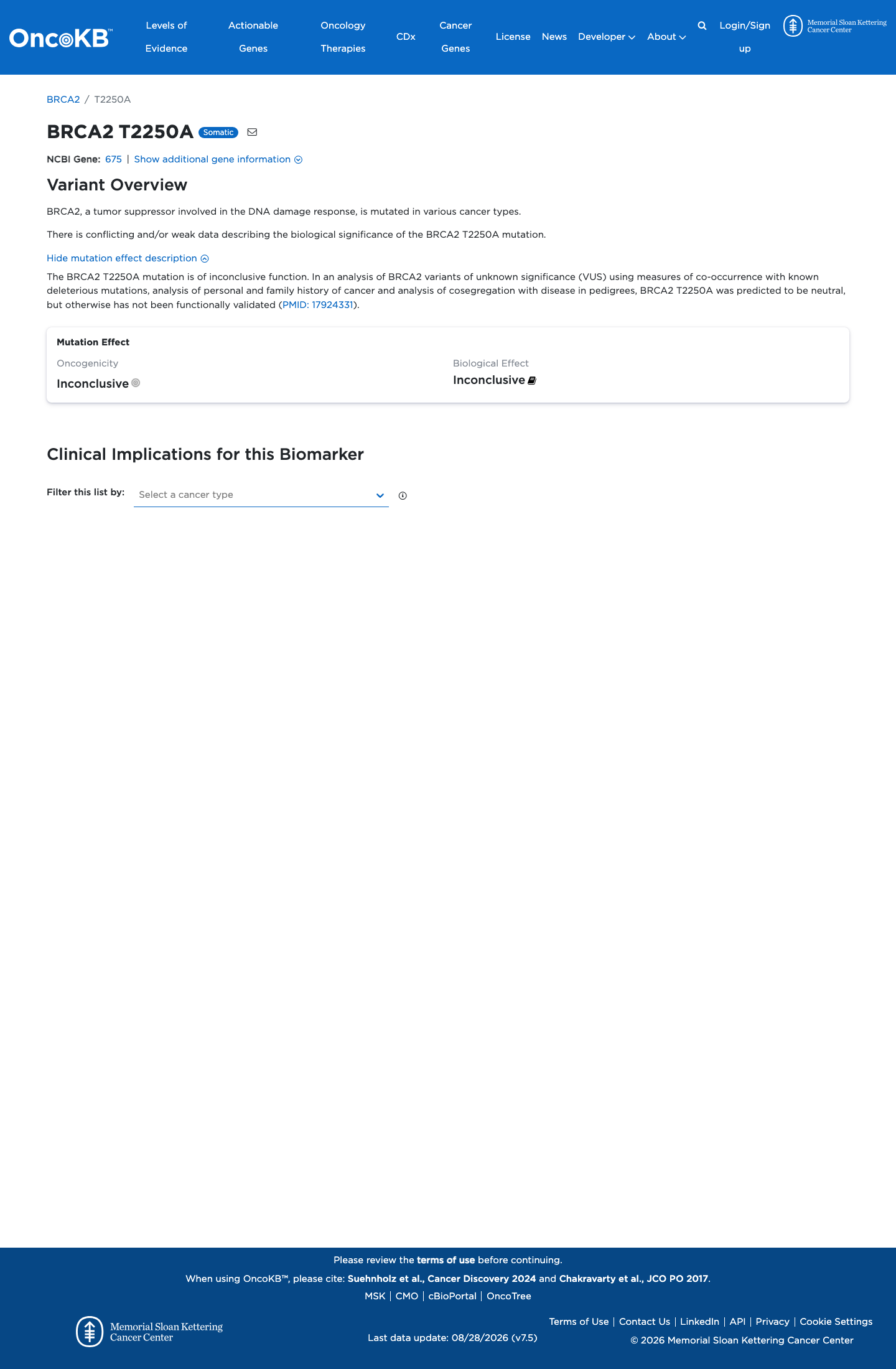
Functional / OncoKB screenshot
Functional Inconclusive
OncoKB identified variant-specific curated literature and context relevant to functional review; biological-effect context: Inconclusive; curated oncogenicity label: Inconclusive.
OncoKB ↗
COSMIC screenshot
COSMIC
Cancer hotspots screenshot
Cancer hotspots
Somatic evidence Not in COSMIC / hotspots
COSMIC
This variant does not lie in a statistically significant hotspot. This variant has not previously been reported in somatic cancers (COSMIC).
Hotspots
This variant does not lie in a statistically significant hotspot.
Literature · how each cited paper was used
1papers cited
Each card is an audit: what was searched, what was found, whether it names the variant, which criteria it fed, and why. 7 further PMIDs triaged but not cited — see Sources & references.
Mutational analysis of BRCA1 and BRCA2 in hereditary breast and ovarian cancer families from Asturias (Northern Spain).
Searched
c.6748A>Gp.Thr2250Ala
Found
This paper explicitly reports BRCA2 c.6748A>G (p.Thr2250Ala) as a previously reported variant of unknown significance identified in one affected index case/family. It groups the variant with probably non-pathogenic variants based on a multifactorial model, with odds greater than 100:1 in favor of neutrality.
Variant
✓ Names this variant — characterised directly
Applied to
BP5 strong
Reports exact-variant multifactorial odds >100:1 in favor of neutrality, exceeding the BP5_Strong benign-direction LR threshold.
Some other variants are probably non-pathogenic, with odds of >100:1 in favor of neutrality according to multifactorial model by Easton et al. [44]. This can be the case of BRCA1 c.199G>T (p.Asp67Tyr) and BRCA2 c.6748A>G (p.Thr2250Ala) and c.8850G>T (p.Lys2950Asn).
Location Results and discussion, Unclassified variants section; Table 6  ·  Context 256 unrelated high-risk breast and/or ovarian cancer families from Asturias were screened by Sanger sequencing of BRCA1/2 coding exons and exon-intron boundaries, with MLPA for large genomic rearrangements; the variant was listed in one family.  ·  full text
Sources & reference links
9Sources
CSpec VCEP
ClinVar
gnomAD v2.1
gnomAD v4.1
gnomAD-Canada
SpliceAI
OncoKB
COSMIC
Cancer hotspots
Triaged references · 7 PMIDs not cited in assessment
17924331 ↗ A systematic genetic assessment of 1,433 sequence variants of unknown clinical significance in the BRCA1 and BRCA2 breast cancer-predisposition genes. ONCOKB
16683254 ↗ A DGGE system for comprehensive mutation screening of BRCA1 and BRCA2: application in a Dutch cancer clinic setting. CLINVAR
20104584 ↗ Characterization of BRCA1 and BRCA2 deleterious mutations and variants of unknown clinical significance in unilateral and bilateral breast cancer: the WECARE study. CLINVAR
24323938 ↗ Functional assays for analysis of variants of uncertain significance in BRCA2. CLINVAR
25348012 ↗ Benchmarking mutation effect prediction algorithms using functionally validated cancer-related missense mutations. CLINVAR
25741868 ↗ Standards and guidelines for the interpretation of sequence variants: a joint consensus recommendation of the American College of Medical Genetics and Genomics and the Association for Molecular Pathology. CLINVAR
28492532 ↗ Sherloc: a comprehensive refinement of the ACMG-AMP variant classification criteria. CLINVAR