This variant was interpreted by pipeline
8.0.0.
The current version is
7.2.0.
Re-running queues a fresh interpretation; the result replaces this page when complete.
Re-runs are not free. Blank = draws on today's public interpretation allowance.
With a code = uses 1 of that code's uses.
BRCA2 encodes a DNA repair protein that maintains genome stability by repairing double-strand breaks through homologous recombination and by protecting DNA replication forks. It acts as a tumor suppressor, and inherited loss-of-function changes cause hereditary breast and ovarian cancer syndrome, with elevated lifetime risks of breast, ovarian, prostate, and pancreatic cancers; biallelic changes cause Fanconi anemia complementation group D1. Reduced or altered BRCA2 activity is implicated in multiple tumor types, and PARP inhibitors are an approved treatment for BRCA2-associated ovarian and breast cancers.
This variant
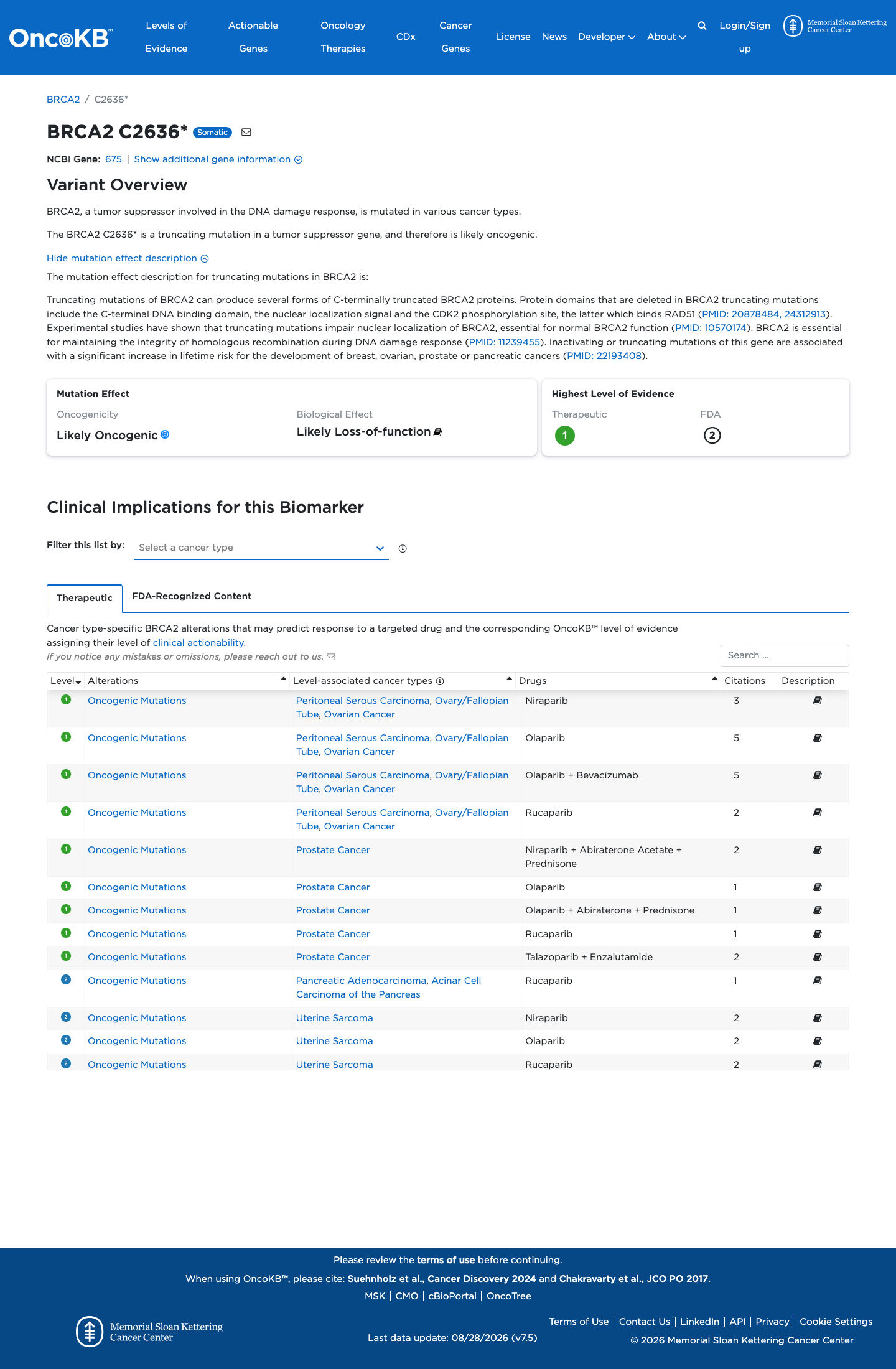
This BRCA2 truncating change is expected to reduce homologous-recombination DNA repair, the mechanism underlying inherited breast, ovarian, prostate, and pancreatic cancer risk.
Transcript
NM_000059.4
HGVS · transcript:coding
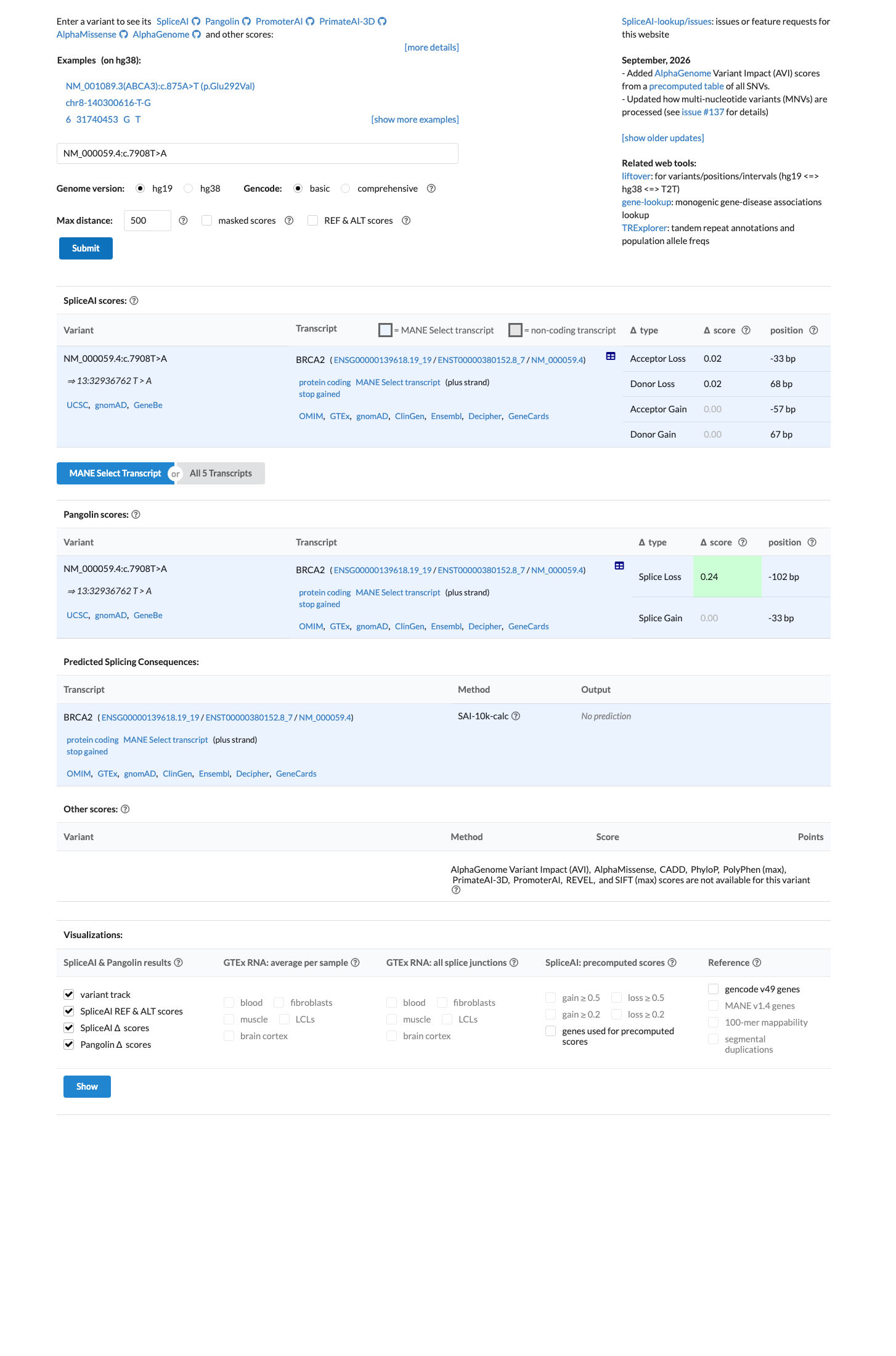
NM_000059.4:c.7908T>A
GRCh38
chr13:32362625 T>A
GRCh37
chr13:32936762 T>A
Pathogenic: ENIGMA Table 3's one Very Strong plus one Strong rule is met by PVS1 (very strong) and PM5 (strong, PTC).
Classification rationale
PVS1PM5PP5Pathogenic
BRCA2 c.7908T>Anonsense · exon 17
PVS1 very strong: the ENIGMA exon 17 rule applies to this upstream BRCA2 protein-truncating variant. PM5 strong: ENIGMA assigns the exon 17 PTC code PM5_Strong (PTC). PP5 supporting: an exact-match ENIGMA expert-panel ClinVar classification is Pathogenic.
PVS1 + PM5 + PP5→Pathogenic
LYFE Sciences is an AI system, and it can make mistakes. Criteria
may be applied incorrectly, sources may be misread, and a confident-looking
classification can still be wrong. Double-check every criterion and
its underlying evidence before relying on any call.
Gene diagram
· NM_000059.4 · variants mapped to exon structure
BRCA2NM_000059.4
Fetching transcript structure from UCSC…
Exons
—
Transcript span
—
Strand
—
Variants mapped
—
Source
UCSC ncbiRefSeqCurated
All variants in BRCA2—click a row to locate it on the plot · use the link column to open its page
Protein
Location
Classification
Link
Applied criteria · 3 applied · 13 assessed
MetEvidence satisfies this criterion.
Not metEvaluated against available evidence; threshold not reached.
Not assessedApplies in principle, but no evidence was found to evaluate it.
N/ADoesn't apply to this variant type.
Applied · 3
Strength Supporting Moderate Strong Very strong
✓
PVS1very strongPathogenic
Met, very strong: ENIGMA Table 4 assigns PVS1 to BRCA2 exon 17 PTCs, and p.Cys2636Ter truncates 783 of 3418 amino acids upstream of the terminal exon.
The case normalization identifies NM_000059.4:c.7908T>A as NP_000050.3:p.(Cys2636Ter)/p.(C2636*), a nonsense change, with the predicted protein ending at residue 2636 while the reference ends at residue 3418.Specifications Table 4 lists BRCA2 exon 17, coding interval c.7806-c.7976, PTC code PVS1, and exon 17 protein interval p.2602-p.2659; c.7908 lies within this exon.The ENIGMA specification defines PVS1_VariableWeight for null variants in genes where loss of function is a known disease mechanism and directs PTC variants to the exon-specific Table 4 decision tree.
Met, Strong: ENIGMA Table 4 assigns PM5_Strong (PTC) to BRCA2 exon 17, which contains c.7908.
Specifications_Table4_V1.2_2024-11-18.xlsx.txt lists BRCA2 exon 17 as c.7806-c.7976 and assigns PVS1 for coding PTC variants plus PM5_Strong (PTC).c.7908 falls within the exon 17 coding interval, and the case normalization identifies the consequence as nonsense with p.Cys2636Ter.The ENIGMA Appendix D rule states that PM5(PTC) is exon-specific, applies to nonsense and frameshift changes meeting PVS1, and is distinct from classic same-residue missense PM5.
✓
PP5supportingPathogenic
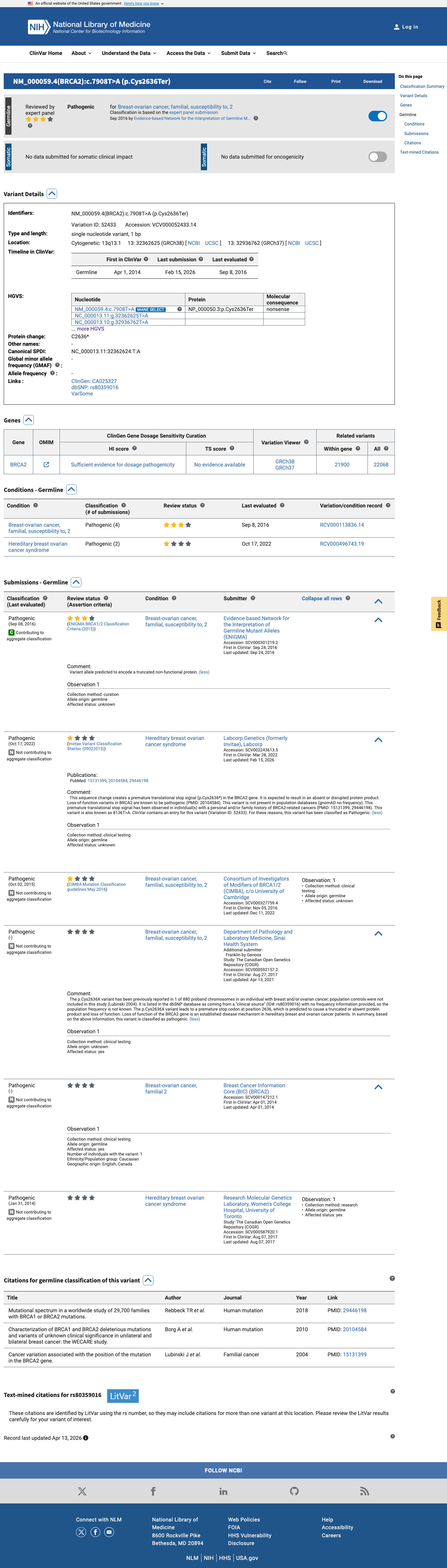
Met, Supporting: exact ClinVar variation 52433 has an ENIGMA expert-panel Pathogenic classification, satisfying the requested PP5 rule.
ClinVar variation 52433 exactly matches NM_000059.4(BRCA2):c.7908T>A (p.Cys2636Ter).ClinVar reports Pathogenic with review status reviewed by expert panel and three review stars; the expert panel is ENIGMA.Ordinary laboratory submissions and aggregate labels were not used to trigger PP5; only the exact-variant expert-panel assertion was used.
Assessed · not applied
· 3 not met · 10 not assessed
Pathogenic
PS3Not assessed: no calibrated damaging functional-assay result was found for c.7908T>A, p.Cys2636Ter, or p.C2636*.
PS4Not assessed: no variant-specific case-control OR, confidence interval, p-value, or qualifying affected/control counts were available for the PS4 OR >=4 threshold.
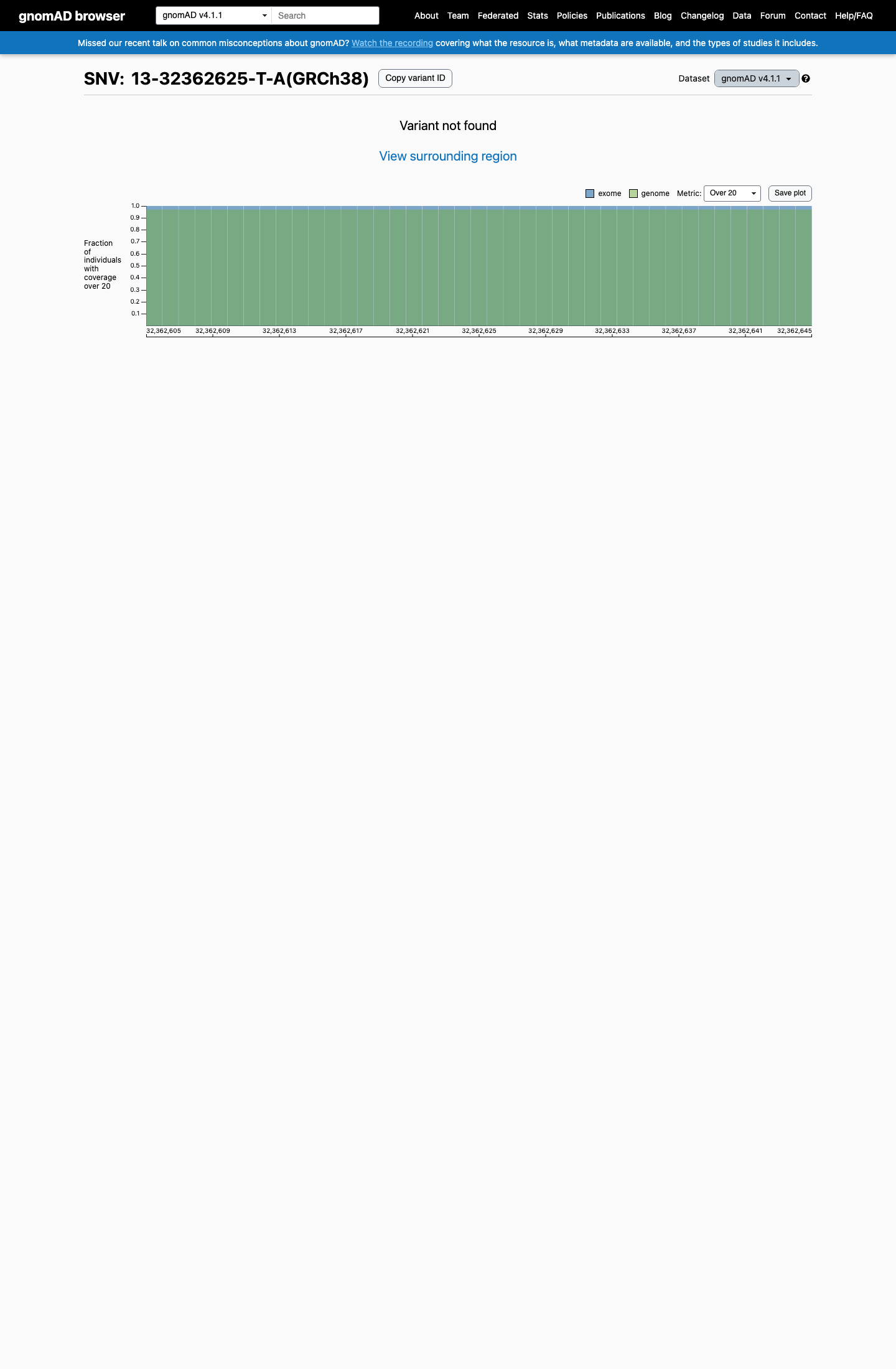
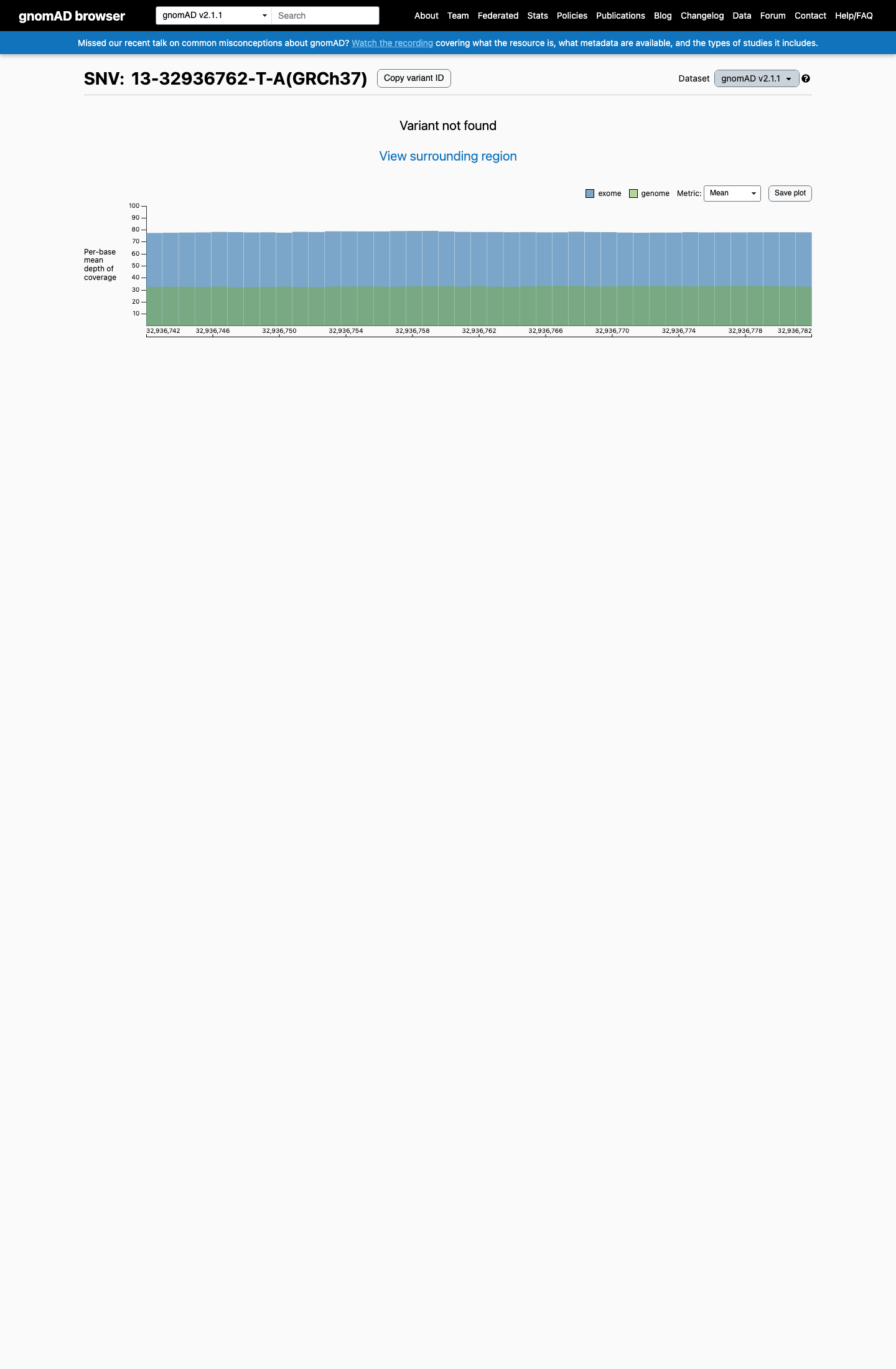
PM2Not assessed: the variant is absent from both required non-cancer gnomAD datasets, but the ENIGMA PM2 prerequisite of regional average read depth at least 25 is undocumented.
PM3Not assessed: no Fanconi Anemia phenotype, same-gene pathogenic co-variant, or verified phase is documented for PM3 application.
PP1Not assessed: no variant-specific pedigree or quantitative segregation LR was available to compare with the PP1 threshold of LR >=2.08.
PP4Not assessed: the gene-specific clinical-history table has no c.7908T>A row, so no combined LR can be compared with the PP4 >=2.08 threshold.
Benign
BA1Not met: the variant is absent from the governing non-cancer gnomAD datasets, so no filter allele frequency exceeds the ENIGMA BA1 threshold of 0.1%.
BS1Not met: the variant is absent from both governing non-cancer gnomAD datasets, so its frequency does not reach the ENIGMA BS1 threshold of 0.01%.
BS2Not assessed: no individual-level homozygote, healthy-carrier, age, follow-up, or Fanconi Anemia phenotype data are available to assign ENIGMA BS2 points.
BS3Not assessed: no calibrated benign functional-assay result was found for c.7908T>A, p.Cys2636Ter, or p.C2636*.
BS4Not assessed: no variant-specific non-segregation data or quantitative LR was available to compare with the BS4 supporting threshold of LR <=0.48.
BP5Not assessed: no exact-variant clinical-history LR was available for comparison with the BP5 Supporting threshold LR <=0.48.
BP6Not met: exact ClinVar variation 52433 is Pathogenic by an ENIGMA expert panel, not Benign or Likely Benign for BP6.
This variant has been reported in ClinVar as Pathogenic (4 clinical laboratories) and as Pathogenic by Evidence-based Network for the Interpretation of Germline Mutant Alleles (ENIGMA) (expert panel). (ClinVarID = 52433)
Triaged references · 8 PMIDs not cited in assessment
10570174 ↗Truncated BRCA2 is cytoplasmic: implications for cancer-linked mutations.ONCOKB
11239455 ↗BRCA2 is required for homology-directed repair of chromosomal breaks.ONCOKB
20878484 ↗A new mutation of BRCA2 gene in an Italian healthy woman with familial breast cancer history.ONCOKB
22193408 ↗BRCA1 and BRCA2: different roles in a common pathway of genome protection.ONCOKB
24312913 ↗A comprehensive focus on global spectrum of BRCA1 and BRCA2 mutations in breast cancer.ONCOKB
20104584 ↗Characterization of BRCA1 and BRCA2 deleterious mutations and variants of unknown clinical significance in unilateral and bilateral breast cancer: the WECARE study.CLINVAR
31672839 ↗Management of patients with increased risk for familial pancreatic cancer: updated recommendations from the International Cancer of the Pancreas Screening (CAPS) Consortium.CLINVAR
12692171 ↗American Society of Clinical Oncology policy statement update: genetic testing for cancer susceptibility.CLINVAR