Analysis in progress
Initialising…
0%
complete
This report is still being assembled — sections appear as each stage finishes. It isn't final yet.
CDK4
Final classification
VUS
PM2BP4
CDK4
c.122A>G
p.Asn41Ser
missense · exon 2

CDK4 (cyclin-dependent kinase 4) is a serine/threonine kinase that drives cell cycle progression through the G1 to S phase transition. Together with its partner cyclin D, it phosphorylates and inactivates the retinoblastoma (RB) protein, releasing the E2F transcription program that promotes cell division, and its activity is held in check by the inhibitor p16(INK4a). Disruption of CDK4 and its related regulators is associated with tumorigenesis in a wide range of cancers, and amplification or overexpression of CDK4 is seen in sarcomas, glioblastoma, and breast cancer. CDK4/6 inhibitors have shown clinical benefit in certain solid tumors, including breast and non-small cell lung cancer.

This variant

CDK4 drives the G1-to-S cell-cycle transition, and its amplification or overexpression is associated with sarcomas, glioblastoma, and breast cancer, where CDK4/6 inhibitors are used clinically. The p.Asn41Ser missense change is classified as a VUS: it is rare in population databases and in silico predictors lean benign, but no functional, segregation, or case-level evidence establishes whether it affects CDK4 kinase activity, leaving its cancer relevance uncertain.

Transcript
NM_000075.4
HGVS · transcript:coding
NM_000075.4:c.122A>G
GRCh38
chr12:57751596 T>C
GRCh37
chr12:58145379 T>C
Basis No CDK4-specific framework existed, so generic ACMG/AMP 2015 rules applied; the only met criteria, PM2 (supporting) and BP4 (moderate), conflict, so no combination threshold was reached and the variant is a VUS.
No CDK4-specific framework existed, so generic ACMG/AMP 2015 rules applied; the only met criteria, PM2 (supporting) and BP4 (moderate), conflict, so no combination threshold was reached and the variant is a VUS.
Classification rationale
PM2 BP4 VUS
CDK4 c.122A>G missense · exon 2

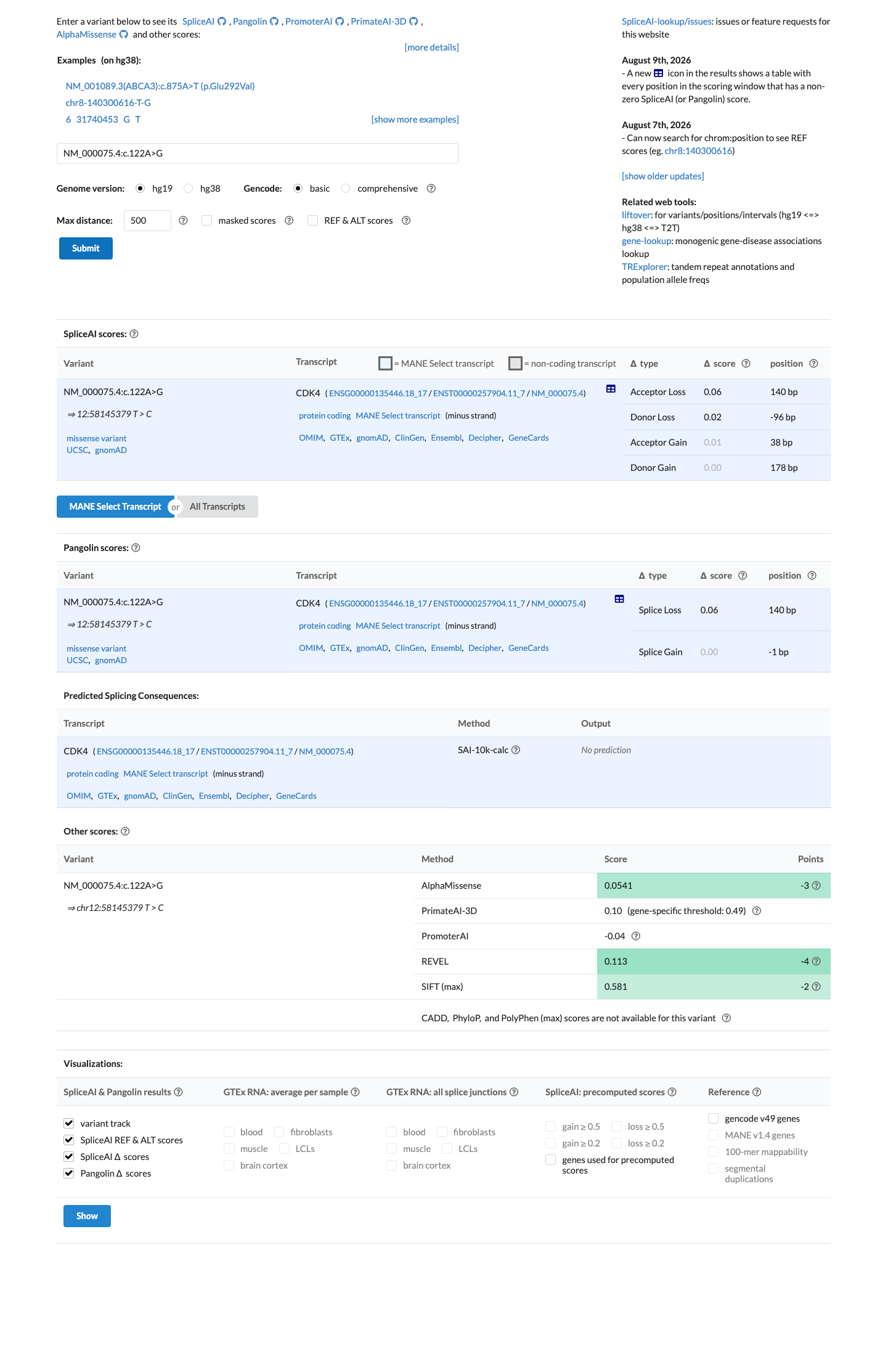
PM2 (Supporting): rare in population databases - gnomAD v4.1 allele frequency 0.02534% with no homozygotes, below the 0.1% rare-variant cutoff. BP4 (Moderate): REVEL 0.113, at or below the 0.183 benign-supporting/moderate cutoff, predicting a benign-leaning missense effect; SpliceAI corroborates (max delta 0.061). Overall classification: VUS - PM2 (supporting) and BP4 (moderate) point in opposite directions, so no ACMG/AMP 2015 combination rule is satisfied.

PM2 + BP4 VUS
Gene diagram · NM_000075.4 · variants mapped to exon structure
CDK4 NM_000075.4
Fetching transcript structure from UCSC…
Applied criteria · 2 applied · 22 assessed
MetEvidence satisfies this criterion.
Not metEvaluated against available evidence; threshold not reached.
Not assessedApplies in principle, but no evidence was found to evaluate it.
N/ADoesn't apply to this variant type.
Applied · 2
Strength Supporting Moderate Strong Very strong
PM2 supporting Pathogenic
Met (supporting): rare in gnomAD v4.1 - allele frequency 0.02534%, below the 0.1% cutoff, with no homozygotes.
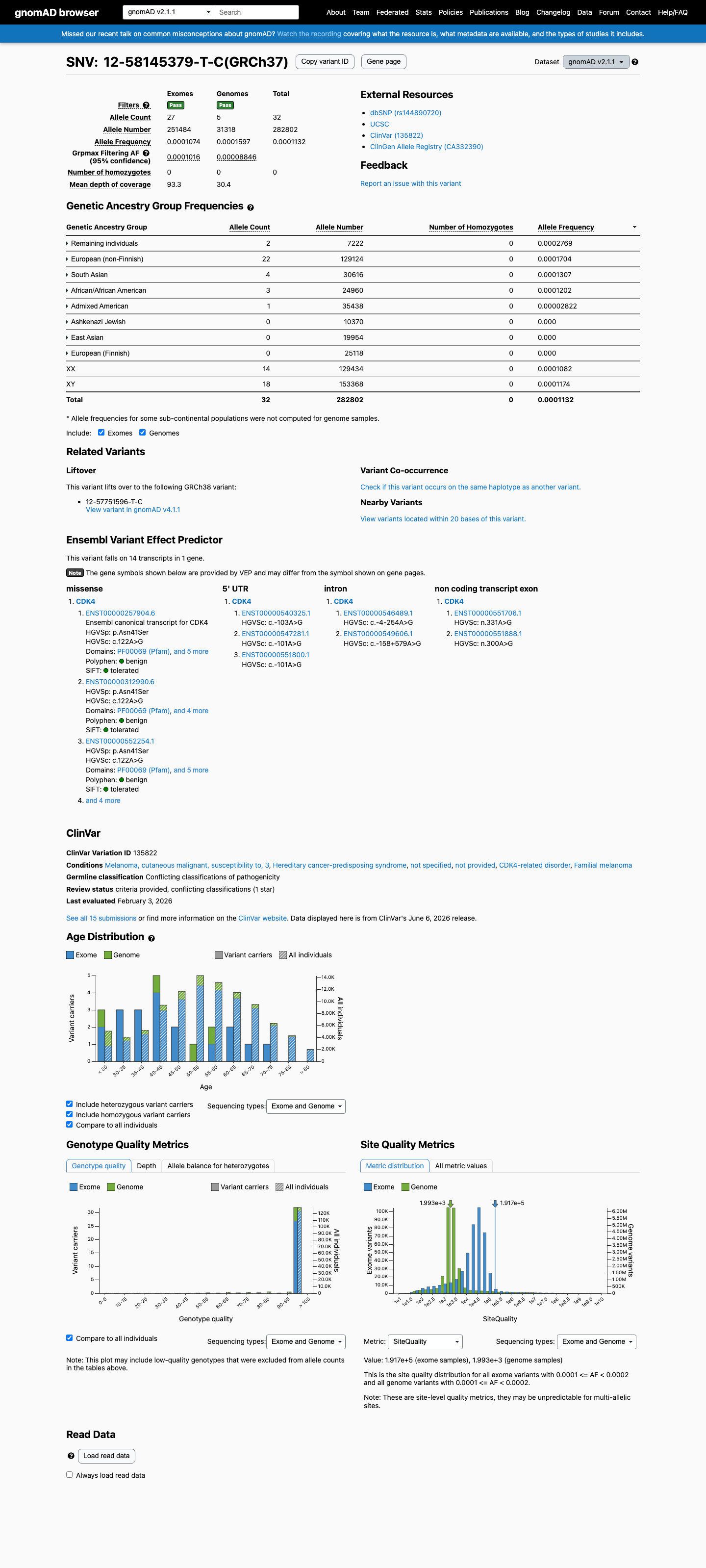
gnomAD v4.1 reports 409/1,614,004 alleles, overall AF 0.000253407 (0.02534%), highest subpopulation AF 0.000659848 (0.06598%), and 0 homozygotes.gnomAD v2.1 reports 32/282,802 alleles, overall AF 0.000113153 (0.01132%), highest subpopulation AF 0.000276932 (0.02769%), and 0 homozygotes.gnomAD-Canada v1.0 reports the variant as absent.
BP4 moderate Benign
Met (moderate): REVEL 0.113, at or below the 0.183 benign-supporting/moderate cutoff; SpliceAI max delta 0.061, no splice impact.
REVEL score = 0.113 (source_registry key 'revel') is below the Pejaver et al. 2022 (PMID 36413997) ClinGen SVI-recommended BP4_Moderate threshold of REVEL <=0.183, supporting BP4 at moderate strength.SpliceAI predicts no significant splice impact for this variant (max delta score = 0.061; DS_AG 0.005, DS_AL 0.061, DS_DG 0.004, DS_DL 0.023), below the 0.2 splice-impact threshold, corroborating a benign in silico prediction without an alternate splice mechanism.
Assessed · not applied · 7 not met · 15 not assessed
Pathogenic
PS1 Not assessed: no established pathogenic variant producing the identical amino acid change p.Asn41Ser via a different nucleotide substitution was identified.
PS2 Not assessed: no confirmed de novo occurrence of p.Asn41Ser with verified maternity and paternity was documented.
PS3 Not assessed: no validated functional assay (e.g., kinase activity, Rb phosphorylation) specifically testing p.Asn41Ser was available.
PS4 Not assessed: no case-control enrichment analysis or count of unrelated affected carriers of p.Asn41Ser was available.
PM1 Not met: not in a statistically significant hotspot - cancerhotspots.org found no result and COSMIC shows a single somatic observation (n=1).
PM3 Not assessed: no affected-proband observation in a recessive disorder, no second pathogenic variant, and no phasing evidence were available.
PM5 Not assessed: no pathogenic or likely pathogenic amino acid changes at codon 41 (same-residue comparators) were identified.
PM6 Not assessed: no presumed de novo occurrence of p.Asn41Ser with sufficient phenotype and family context was documented.
PP1 Not assessed: no segregation data - affected or unaffected relatives, informative meioses, or genotype-phenotype results - were available.
PP2 Not assessed: no gene-level missense constraint metric (e.g., missense Z-score or o/e ratio) was available for CDK4.
PP3 Not met: REVEL 0.113, far below the 0.644 pathogenic-supporting cutoff; SpliceAI max delta 0.061.
PP4 Not assessed: no patient-specific phenotype establishing CDK4-related disease specificity was provided.
PP5 Not met: no ClinVar expert-panel Pathogenic or Likely pathogenic submission exists for this variant.
Benign
BA1 Not met: gnomAD v4.1 allele frequency 0.02534% (max subpopulation 0.06598%), below the 1% stand-alone threshold.
BS1 Not met: highest gnomAD v4.1 subpopulation frequency 0.06598%, below the 0.3% benign threshold.
BS2 Not met: zero homozygotes in gnomAD v2.1 and v4.1, and no documented series of healthy adult carriers.
BS3 Not assessed: no well-established functional assay showing no damaging effect of p.Asn41Ser on CDK4 was available.
BS4 Not assessed: no unaffected relatives with reliable phenotype assessment and confirmed absence of the variant were documented.
BP1 Not assessed: without a gene-specific framework, CDK4's disease mechanism could not be established to evaluate this missense variant.
BP2 Not assessed: no genotype, inheritance, or phase information was available to evaluate the variant's configuration.
BP5 Not assessed: no alternative molecular diagnosis explaining the patient's phenotype was documented.
BP6 Not met: no ClinVar expert-panel Benign or Likely benign submission exists for this variant.
N/A · 4 PVS1 · PM4 · BP3 · BP7
Research & evidence
Population frequency
gnomAD v4.1 screenshot
gnomAD v4.1
gnomAD v2.1 screenshot
gnomAD v2.1
v4.1
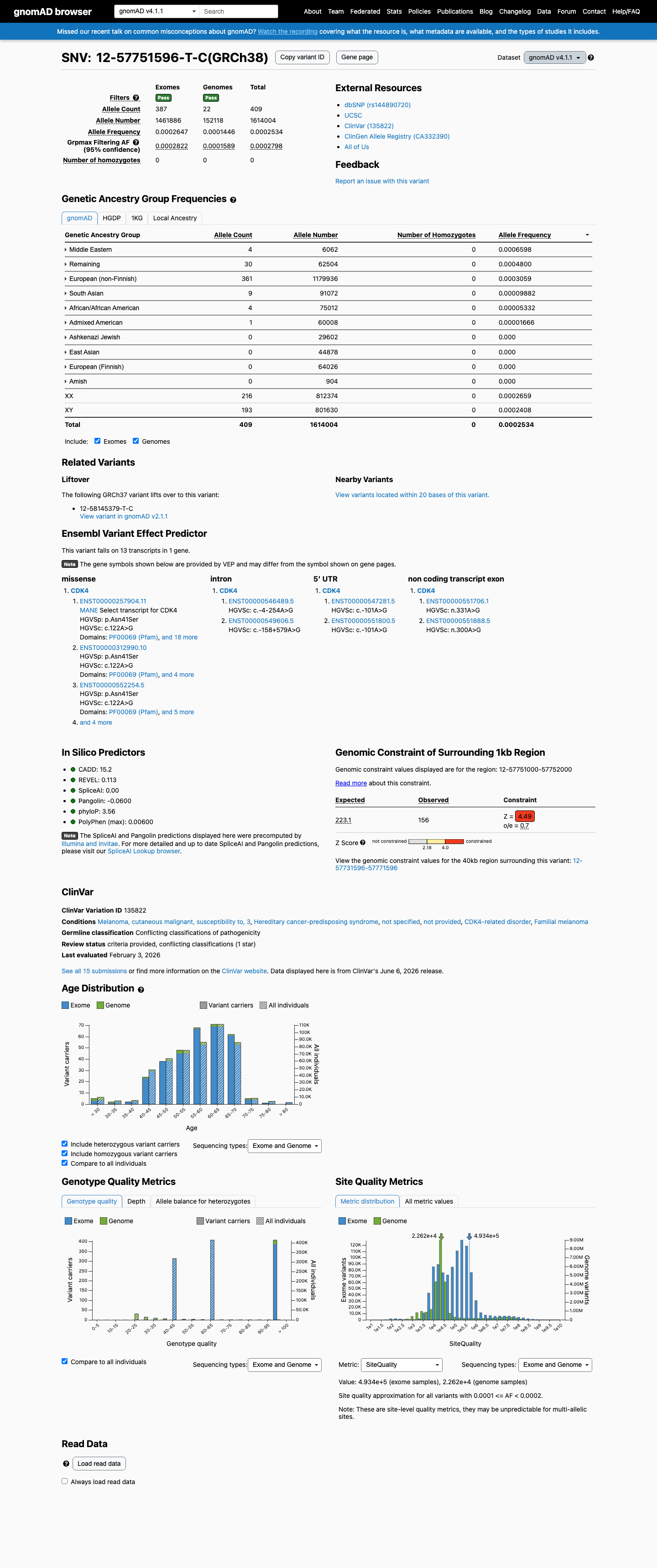
This variant is present in gnomAD v4.1 (AF= 0.000253407; MAF= 0.02534%, 409/1614004 alleles, homozygotes = 0) and has highest observed frequency in the Middle Eastern population (AF= 0.000659848; MAF= 0.06598%, 4/6062 alleles, homozygotes = 0); grpmax FAF= 0.00027981.
v2.1
This variant is present in gnomAD v2.1 (AF= 0.000113153; MAF= 0.01132%, 32/282802 alleles, homozygotes = 0) and has highest observed frequency in the Remaining individuals population (AF= 0.000276932; MAF= 0.02769%, 2/7222 alleles, homozygotes = 0); grpmax FAF= 0.00010165.
🇨🇦 CA
Absent from gnomAD-Canada v1.0.
Allele frequency by ancestry
three datasets · side by side
gnomAD v4.1
0.025% · 409 / 1,614,004
0 hom · FAF 0.028%
Middle Eastern
4 / 6,062
0.066%
Remaining individuals
30 / 62,504
0.048%
European (non-Finnish)
361 / 1,179,936
0.031%
South Asian
9 / 91,072
0.0099%
African/African American
4 / 75,012
0.0053%
Admixed American
1 / 60,008
0.0017%
+ 4 not observed (European (Finnish), Amish, East Asian, Ashkenazi Jewish)
gnomAD v2.1
0.011% · 32 / 282,802
0 hom · FAF 0.01%
Remaining individuals
2 / 7,222
0.028%
European (non-Finnish)
22 / 129,124
0.017%
South Asian
4 / 30,616
0.013%
African/African American
3 / 24,960
0.012%
Admixed American
1 / 35,438
0.0028%
+ 3 not observed (Ashkenazi Jewish, East Asian, European (Finnish))
gnomAD Canada 🇨🇦
Absent · 0 / ?
0 hom
Not observed in any ancestry group.
ClinVar screenshot
ClinVar
This variant has been reported in ClinVar as Uncertain significance (9 clinical laboratories) and as Likely benign (5 clinical laboratories) and as Benign (2 clinical laboratories). (ClinVarID = 135822)
SpliceAI screenshot
In silico
SpliceAI predicts no significant splice impact for this variant (max delta score = 0.06). REVEL score = 0.113. BayesDel score = -0.569204.
Functional / OncoKB screenshot
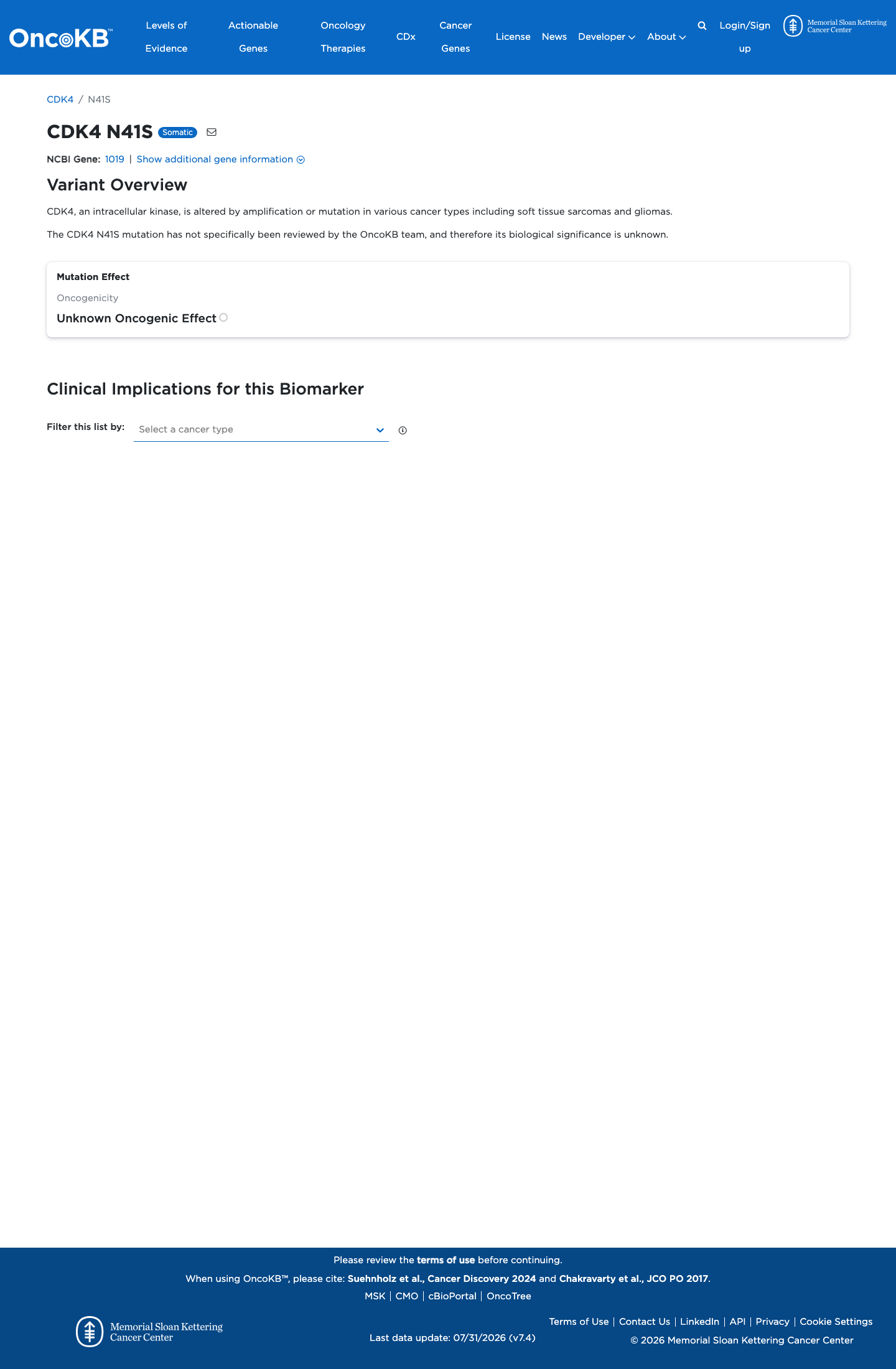
Functional Unknown Oncogenic Effect
OncoKB did not identify variant-specific reviewed functional evidence for this variant; gene-level curated context is available for reviewer follow-up. CDK4, an intracellular kinase, is altered by amplification or mutation in various cancer types including soft tissue sarcomas and gliomas.
OncoKB ↗
COSMIC screenshot
COSMIC
Cancer hotspots screenshot
Cancer hotspots
Somatic evidence Not in COSMIC / hotspots
COSMIC
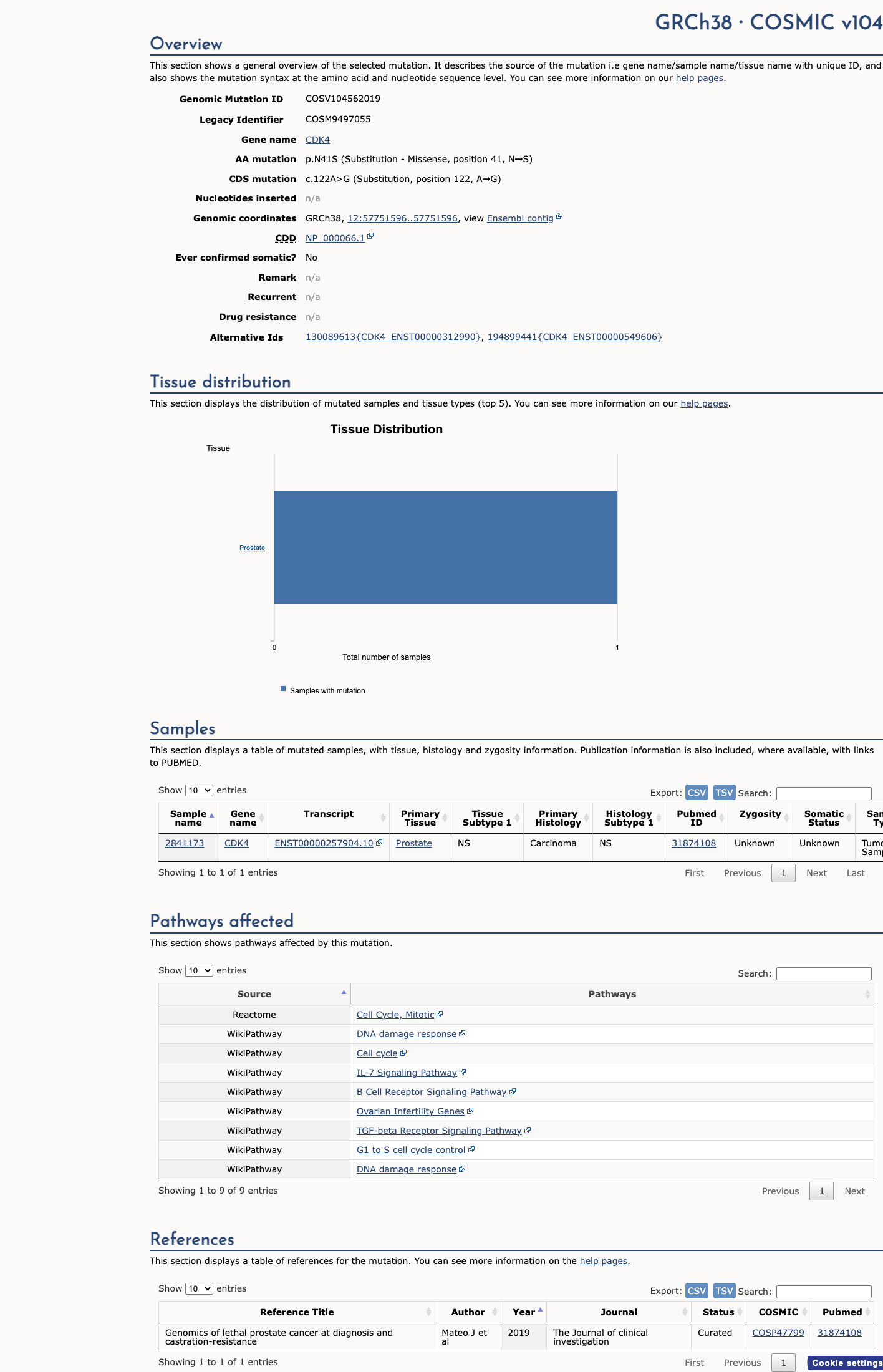
This variant does not lie in a statistically significant hotspot. This variant has previously been reported in somatic cancers (COSMIC; COSV104562019, n = 1 times).
Hotspots
This variant does not lie in a statistically significant hotspot.
Sources & reference links
8Sources
ClinVar
gnomAD v2.1
gnomAD v4.1
gnomAD-Canada
SpliceAI
OncoKB
COSMIC
Cancer hotspots
Triaged references · 9 PMIDs not cited in assessment
14621993 ↗ An NF-kappaB-specific inhibitor, IkappaBalpha, binds to and inhibits cyclin-dependent kinase 4. CLINVAR
16201750 ↗ Dissection of CDK4-binding and transactivation activities of p34(SEI-1) and comparison between functions of p34(SEI-1) and p16(INK4A). CLINVAR
19888216 ↗ Edgetic perturbation models of human inherited disorders. CLINVAR
24162924 ↗ Mapping differential interactomes by affinity purification coupled with data-independent mass spectrometry acquisition. CLINVAR
25741868 ↗ Standards and guidelines for the interpretation of sequence variants: a joint consensus recommendation of the American College of Medical Genetics and Genomics and the Association for Molecular Pathology. CLINVAR
26467025 ↗ A Standardized DNA Variant Scoring System for Pathogenicity Assessments in Mendelian Disorders. CLINVAR
28135145 ↗ Cancer Susceptibility Gene Mutations in Individuals With Colorectal Cancer. CLINVAR
31570899 ↗ Integrated genomic profiling expands clinical options for patients with cancer. CLINVAR
28492532 ↗ Sherloc: a comprehensive refinement of the ACMG-AMP variant classification criteria. CLINVAR