Back
NM_000075.4:c.736C>T
p.Arg246Cys · CDK4
ACMG/AMP
0%
complete
Final classification
VUS
PM2
CDK4
c.736C>T
p.Arg246Cys
missense · exon 7

CDK4 (cyclin-dependent kinase 4) is a serine/threonine kinase that drives cell cycle progression through the G1 to S phase transition. Together with its partner cyclin D, it phosphorylates and inactivates the retinoblastoma (RB) protein, releasing the E2F transcription program that promotes cell division, and its activity is held in check by the inhibitor p16(INK4a). Disruption of CDK4 and its related regulators is associated with tumorigenesis in a wide range of cancers, and amplification or overexpression of CDK4 is seen in sarcomas, glioblastoma, and breast cancer. CDK4/6 inhibitors have shown clinical benefit in certain solid tumors, including breast and non-small cell lung cancer.

This variant

CDK4 encodes a cyclin-dependent kinase that regulates the G1-to-S cell-cycle transition through RB phosphorylation and E2F activation, linking altered CDK4 activity to tumorigenesis.

Transcript
NM_000075.4
HGVS · transcript:coding
NM_000075.4:c.736C>T
GRCh38
chr12:57749265 G>A
GRCh37
chr12:58143048 G>A
VUS: PM2 (supporting) was the only applied criterion and does not meet generic ACMG/AMP thresholds for a definitive pathogenic or benign classification.
Classification rationale
PM2 VUS
CDK4 c.736C>T missense · exon 7

PM2 supporting: gnomAD v4.1 AF 9.91304e-06 is below the generic threshold of 0.0001, with zero homozygotes.

PM2 VUS
LYFE Sciences is an AI system, and it can make mistakes. Criteria may be applied incorrectly, sources may be misread, and a confident-looking classification can still be wrong. Double-check every criterion and its underlying evidence before relying on any call.
Gene diagram · NM_000075.4 · variants mapped to exon structure
CDK4 NM_000075.4
Fetching transcript structure from UCSC…
Applied criteria · 1 applied · 23 assessed
MetEvidence satisfies this criterion.
Not metEvaluated against available evidence; threshold not reached.
Not assessedApplies in principle, but no evidence was found to evaluate it.
N/ADoesn't apply to this variant type.
Applied · 1
Strength Supporting Moderate Strong Very strong
PM2 supporting Pathogenic
Met at supporting strength: gnomAD v4.1 AF 9.91304e-06 is below the generic PM2 threshold of 0.0001, with zero homozygotes.
gnomAD v2.1 reports AF 2.78567e-05 from 7/251286 alleles and zero homozygotes.gnomAD v4.1 reports AF 9.91304e-06 from 16/1614036 alleles and zero homozygotes.The supplied generic ClinGen SVI PM2 supporting calibration is AF <=0.0001 (PMID:25741868).
Assessed · not applied · 8 not met · 15 not assessed
Pathogenic
PS1 Not met: the available report describes the exact c.736C>T change, not a different nucleotide substitution producing CDK4 p.Arg246Cys.
PS2 Not assessed: no documented proband-parent genotypes or confirmed de novo testing are available for CDK4 c.736C>T.
PS3 Not assessed: the only variant-specific study used computational predictions and molecular dynamics, not a validated functional assay with experimental controls.
PS4 Not assessed: no case-control counts or validated enrichment statistic is available for the exact CDK4 c.736C>T variant.
PM1 Not assessed: no approved CDK4 domain table or residue-specific hotspot evidence establishes that Arg246 lies in a PM1-qualifying critical region.
PM3 Not assessed: no affected-proband observation, second pathogenic allele, phase result, or validated recessive CDK4 inheritance context is available.
PM5 Not assessed: no independently classified pathogenic alternate missense change at CDK4 residue Arg246 was documented.
PM6 Not assessed: no documented presumed de novo occurrence or parental testing context is available for CDK4 c.736C>T.
PP1 Not assessed: zero informative family meioses or variant-positive and variant-negative relatives are documented for CDK4 c.736C>T.
PP2 Not assessed: the evidence lacks validated CDK4 missense-mechanism and benign-missense-constraint data required for PP2.
PP3 Not met: REVEL 0.386 is below the supporting PP3 threshold of 0.644, and BayesDel lacks an applicable generic calibration.
PP4 Not assessed: no patient phenotype, family history, or disease-specific clinical presentation is documented for this exact variant.
PP5 Not met: the exact-variant ClinVar record has zero expert-panel submissions and an aggregate Uncertain significance classification.
Benign
BA1 Not met: gnomAD v4.1 overall AF 9.91304e-06 is far below the generic BA1 threshold of 0.05.
BS1 Not met: the highest reported gnomAD v4.1 population AF is 3.33322e-05, below the generic BS1 threshold of 0.01.
BS2 Not met: gnomAD v4.1 reports zero homozygotes among 16 observed variant alleles, with no qualifying healthy-carrier observation provided.
BS3 Not assessed: no validated controlled assay demonstrates normal CDK4 p.Arg246Cys function; the available study is computational only.
BS4 Not assessed: no tested unaffected relatives lacking CDK4 c.736C>T or informative non-segregation observations are documented.
BP1 Not assessed: no validated CDK4 framework shows truncating variants predominate while missense variants are generally benign.
BP2 Not assessed: no second pathogenic variant, cis/trans phase determination, affected-proband genotype, or family segregation result is available.
BP4 Not met: REVEL 0.386 exceeds the supporting BP4 threshold of 0.29, while BayesDel has no applicable generic benign calibration.
BP5 Not assessed: no patient phenotype or alternative pathogenic molecular explanation is documented for this case.
BP6 Not met: no exact-variant ClinVar expert panel classified this variant as Benign or Likely benign.
N/A · 4 PVS1 · PM4 · BP3 · BP7
Research & evidence
Population frequency
gnomAD v4.1 screenshot
gnomAD v4.1
gnomAD v2.1 screenshot
gnomAD v2.1
v4.1
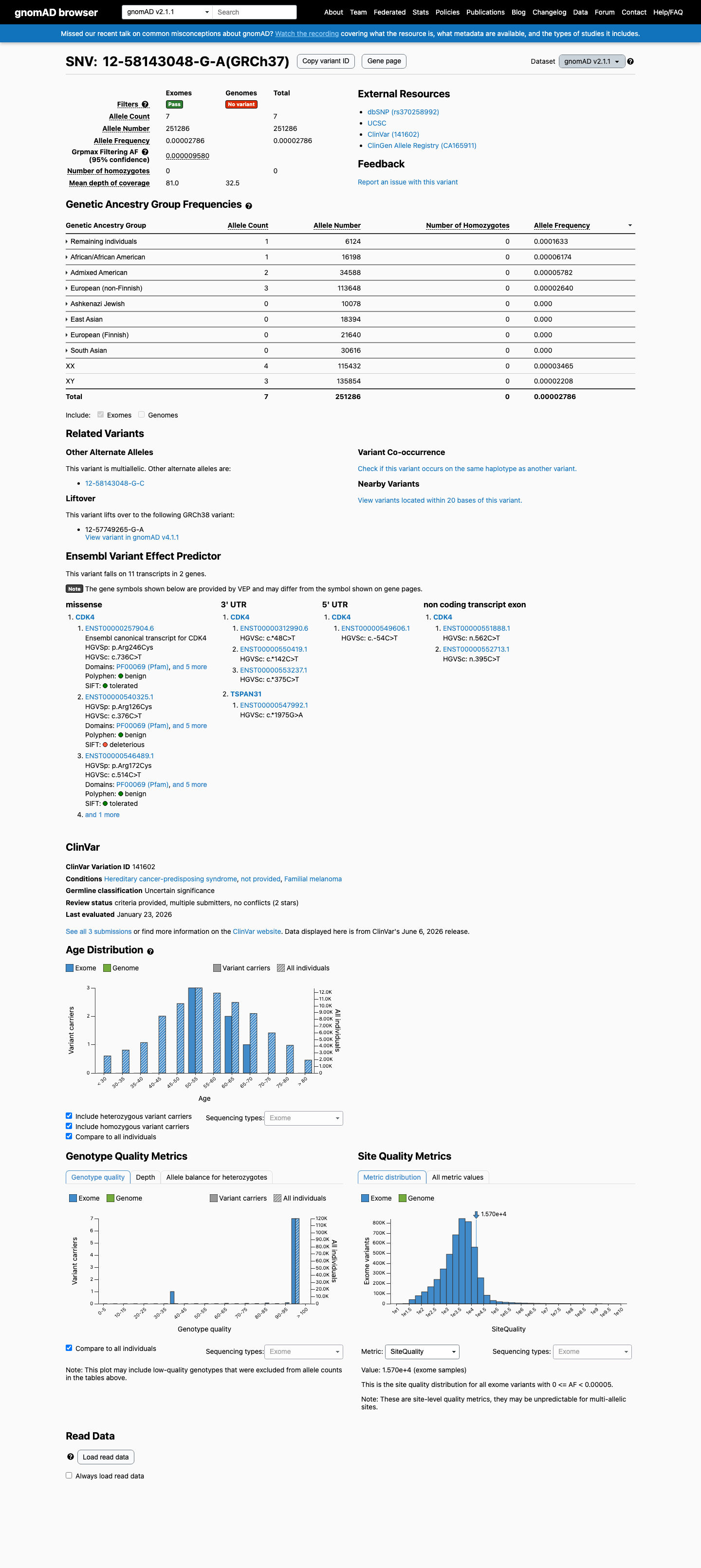
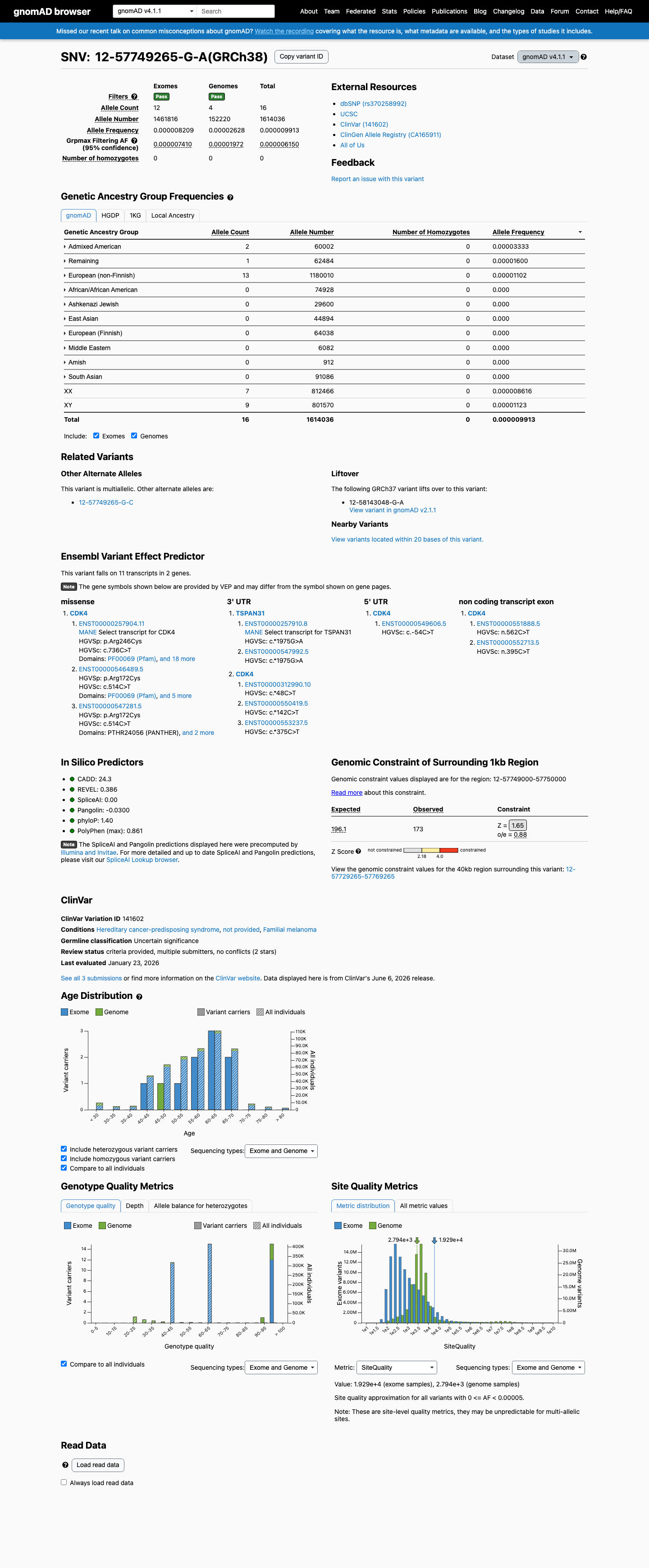
This variant is present in gnomAD v4.1 (AF= 9.91304e-06; MAF= 0.00099%, 16/1614036 alleles, homozygotes = 0) and has highest observed frequency in the Admixed American population (AF= 3.33322e-05; MAF= 0.00333%, 2/60002 alleles, homozygotes = 0); grpmax FAF= 6.15e-06.
v2.1
This variant is present in gnomAD v2.1 (AF= 2.78567e-05; MAF= 0.00279%, 7/251286 alleles, homozygotes = 0) and has highest observed frequency in the Remaining individuals population (AF= 0.000163292; MAF= 0.01633%, 1/6124 alleles, homozygotes = 0); grpmax FAF= 9.58e-06.
🇨🇦 CA
Not available in gnomAD-Canada v1.0.
Allele frequency by ancestry
three datasets · side by side
gnomAD v4.1
0.00099% · 16 / 1,614,036
0 hom · FAF 0.00062%
Admixed American
2 / 60,002
0.0033%
Remaining individuals
1 / 62,484
0.0016%
European (non-Finnish)
13 / 1,180,010
0.0011%
+ 7 not observed (European (Finnish), Amish, East Asian, Middle Eastern, South Asian, Ashkenazi Jewish, African/African American)
gnomAD v2.1
0.0028% · 7 / 251,286
0 hom · FAF 0.00096%
Remaining individuals
1 / 6,124
0.016%
African/African American
1 / 16,198
0.0062%
Admixed American
2 / 34,588
0.0058%
European (non-Finnish)
3 / 113,648
0.0026%
+ 4 not observed (Ashkenazi Jewish, East Asian, European (Finnish), South Asian)
gnomAD Canada 🇨🇦
Absent · 0 / ?
0 hom
Not observed in any ancestry group.
ClinVar screenshot
ClinVar
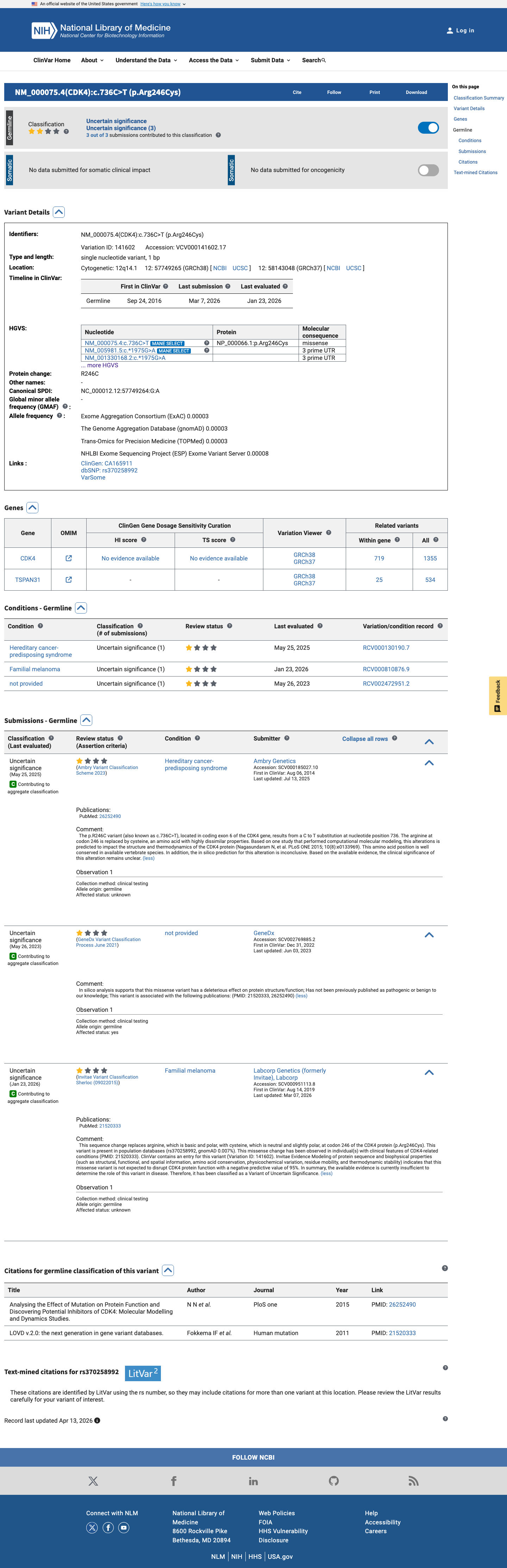
This variant has been reported in ClinVar as Uncertain significance (3 clinical laboratories). (ClinVarID = 141602)
SpliceAI screenshot
In silico
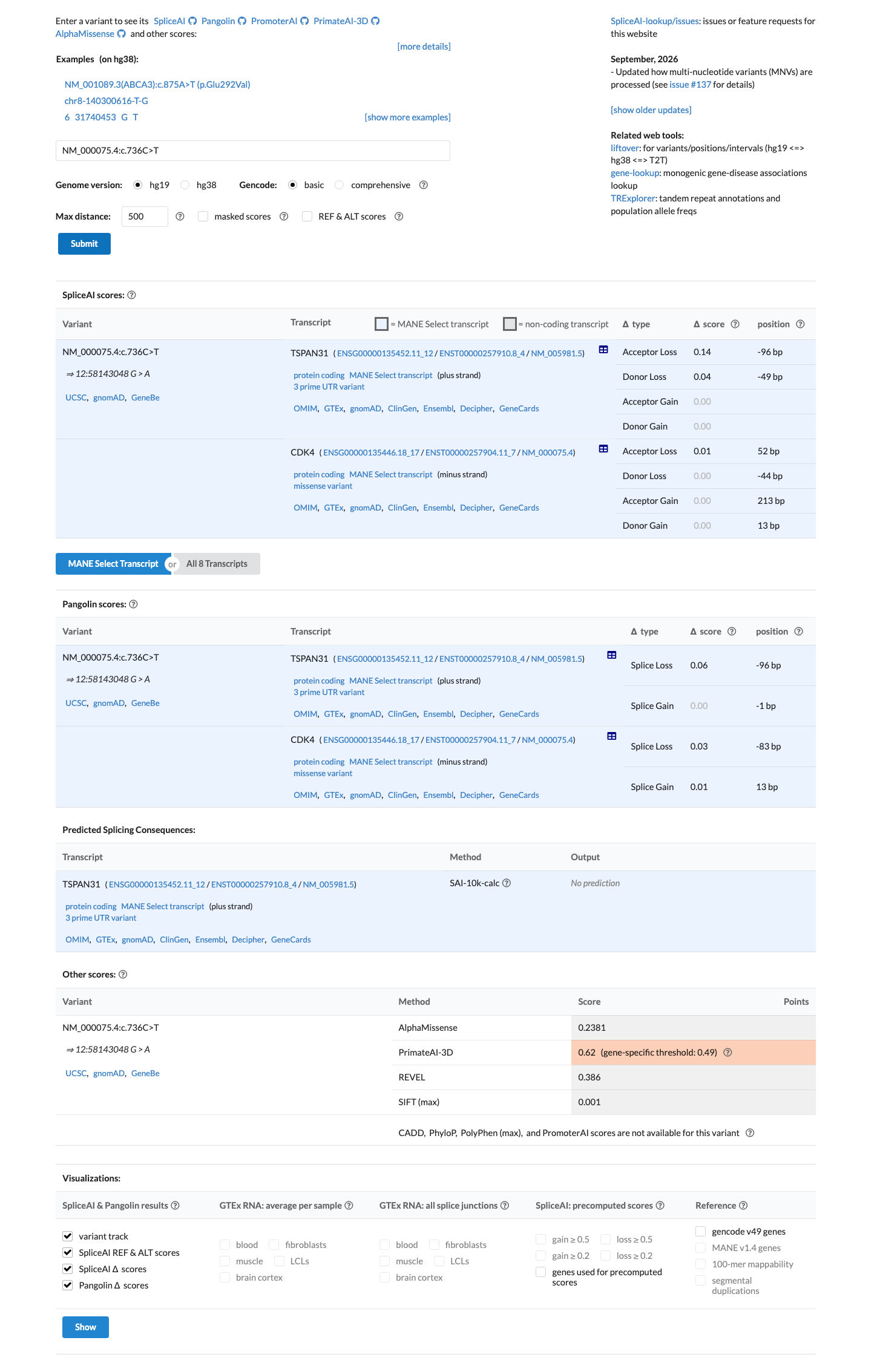
SpliceAI returned NO scores for this variant, so no SpliceAI-based splice prediction is available. This is missing data, NOT evidence of absent splice impact: it must not be used to support BP4 or to argue against PP3/PVS1. Pangolin scores may be present but are not calibrated for PP3/BP4 here. REVEL score = 0.386. BayesDel score = -0.141968.
Functional / OncoKB screenshot
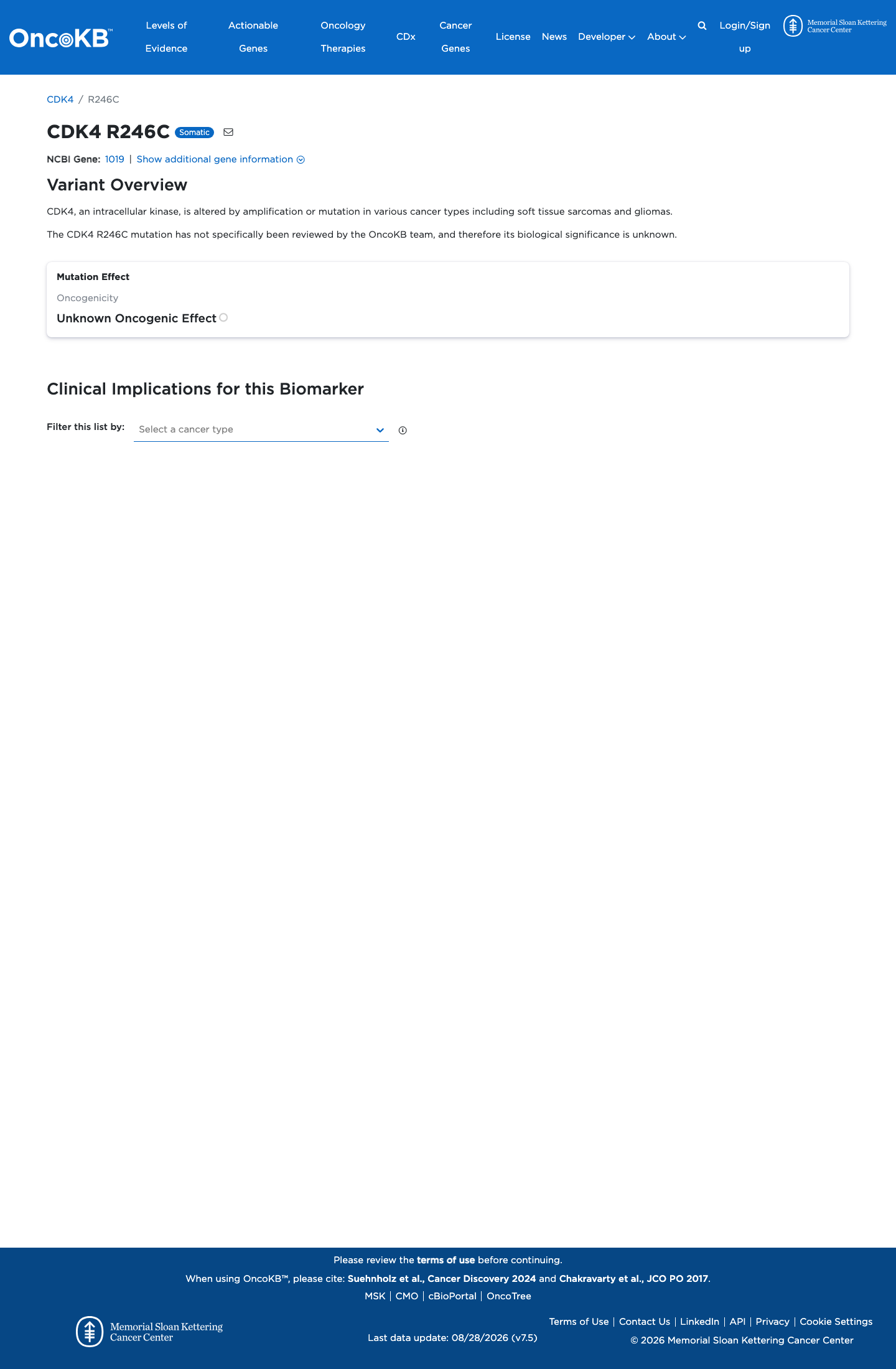
Functional Unknown Oncogenic Effect
OncoKB did not identify variant-specific reviewed functional evidence for this variant; gene-level curated context is available for reviewer follow-up. CDK4, an intracellular kinase, is altered by amplification or mutation in various cancer types including soft tissue sarcomas and gliomas.
OncoKB ↗
COSMIC screenshot
COSMIC
Cancer hotspots screenshot
Cancer hotspots
Somatic evidence Not in COSMIC / hotspots
COSMIC
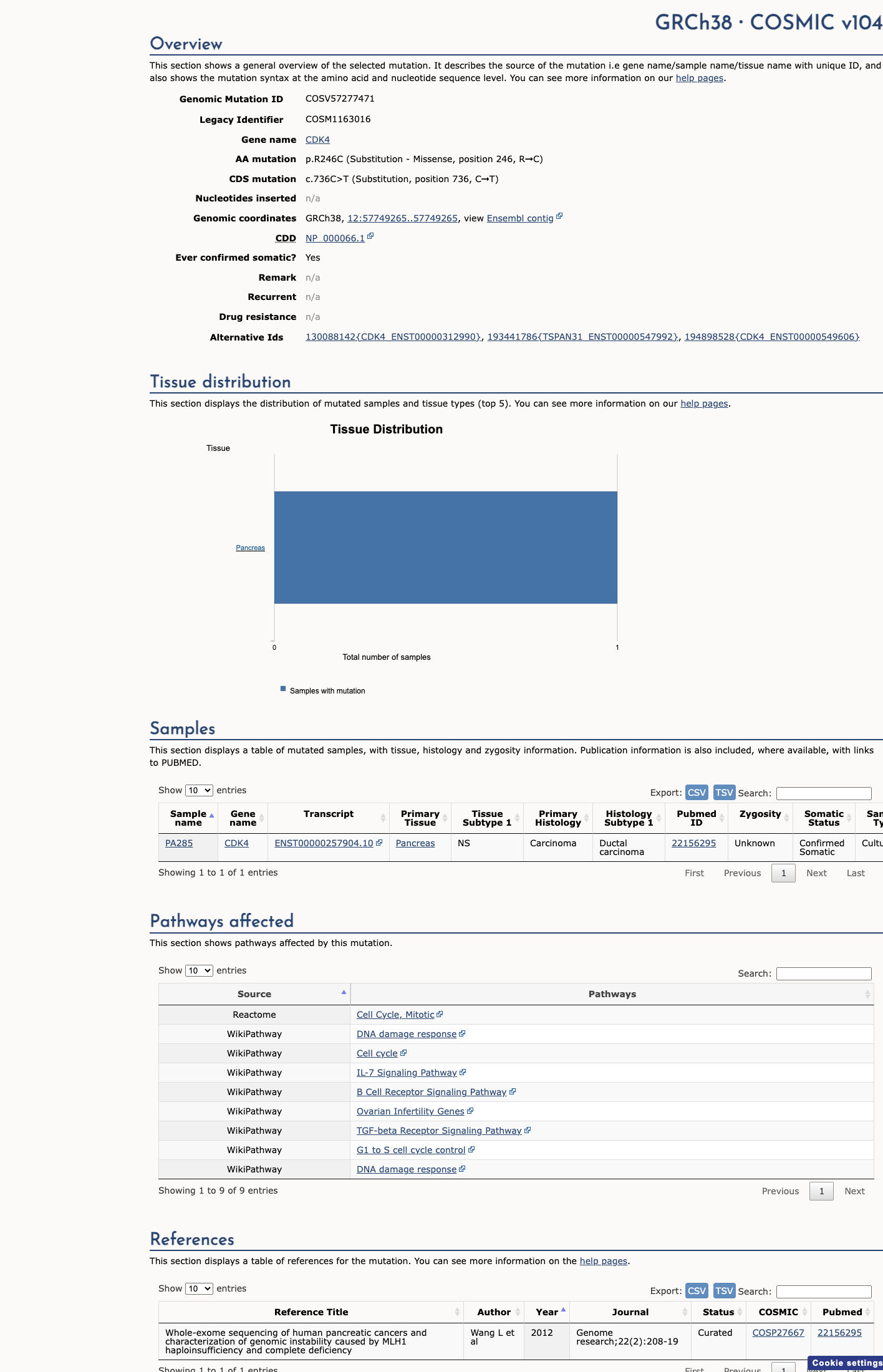
This variant does not lie in a statistically significant hotspot. This variant has previously been reported in somatic cancers (COSMIC; COSV57277471, n = 1 times).
Hotspots
This variant does not lie in a statistically significant hotspot.
Sources & reference links
8Sources
ClinVar
gnomAD v2.1
gnomAD v4.1
gnomAD-Canada
SpliceAI
OncoKB
COSMIC
Cancer hotspots
Triaged references · 5 PMIDs not cited in assessment
21520333 ↗ LOVD v.2.0: the next generation in gene variant databases. CLINVAR
25394175 ↗ A practice guideline from the American College of Medical Genetics and Genomics and the National Society of Genetic Counselors: referral indications for cancer predisposition assessment. CLINVAR
26252490 ↗ Analysing the Effect of Mutation on Protein Function and Discovering Potential Inhibitors of CDK4: Molecular Modelling and Dynamics Studies. CLINVAR
26389258 ↗ Cancer Genetics Risk Assessment and Counseling (PDQ®): Health Professional Version. CLINVAR
26389333 ↗ Genetics of Skin Cancer (PDQ®): Health Professional Version. CLINVAR