Analysis in progress
Initialising…
0%
complete
This report is still being assembled — sections appear as each stage finishes. It isn't final yet.
CDKN2A
Final classification
VUS
PM2PP3
CDKN2A
c.221A>T
p.Asp74Val
missense · exon 2

CDKN2A encodes two key proteins, p16(INK4a) and p14(ARF), that help control cell division. p16 blocks the cell cycle by inhibiting CDK4 and CDK6, preventing progression from the G1 to S phase, while p14 stabilizes the tumor suppressor p53 by preventing its degradation. CDKN2A is an important tumor suppressor: it is frequently mutated, deleted, or silenced in many cancers, including melanoma, lymphoma, and pancreatic and lung cancer, and inherited changes in the gene can predispose people to familial melanoma and pancreatic cancer.

This variant

CDKN2A is a tumor suppressor whose inherited alterations predispose to familial melanoma and pancreatic cancer. This p.Asp74Val missense change is absent from population databases and scores strongly pathogenic in silico (REVEL 0.903), yet that evidence is insufficient to establish pathogenicity, so the variant remains a variant of uncertain significance pending further functional or familial data.

Transcript
NM_000077.4
HGVS · transcript:coding
NM_000077.4:c.221A>T
GRCh38
chr9:21971138 T>A
GRCh37
chr9:21971137 T>A
Basis No CDKN2A ClinGen VCEP/CSPEC framework exists, so generic ACMG/AMP 2015 rules (PMID 25741868) applied; only PM2 (Supporting; absent from gnomAD) and PP3 (Moderate; REVEL 0.903) were met, yielding VUS.
No CDKN2A ClinGen VCEP/CSPEC framework exists, so generic ACMG/AMP 2015 rules (PMID 25741868) applied; only PM2 (Supporting; absent from gnomAD) and PP3 (Moderate; REVEL 0.903) were met, yielding VUS.
Classification rationale
PM2PP3 VUS
CDKN2A c.221A>T missense · exon 2

PM2 (Supporting): variant is absent from gnomAD v2.1, v4.1, and gnomAD-Canada v1.0. PP3 (Moderate): REVEL 0.903 meets the calibrated >=0.773 pathogenic threshold (PMID 36413997). Overall classification: VUS, per generic ACMG/AMP 2015 combination rules (PMID 25741868) with only supporting-to-moderate evidence.

PM2 + PP3 VUS
Gene diagram · NM_000077.4 · variants mapped to exon structure
CDKN2A NM_000077.4
Fetching transcript structure from UCSC…
Applied criteria · 2 applied · 22 assessed
MetEvidence satisfies this criterion.
Not metEvaluated against available evidence; threshold not reached.
Not assessedApplies in principle, but no evidence was found to evaluate it.
N/ADoesn't apply to this variant type.
Applied · 2
Strength Supporting Moderate Strong Very strong
PM2 supporting Pathogenic
Met (Supporting): absent from gnomAD v2.1, v4.1, and gnomAD-Canada v1.0.
Independent GRCh37 and GRCh38 gnomAD queries for the normalized variant returned absent.The gnomAD-Canada v1.0 query also returned absent.
PP3 moderate Pathogenic
Met (Moderate): REVEL 0.903 meets the calibrated >=0.773 pathogenic threshold; SpliceAI predicts no splice impact (max delta 0.00).
compact_evidence.revel.score = 0.903, found=true (local REVEL v1.3 predictor lookup, source_registry key 'revel').REVEL >=0.773 meets the ClinGen SVI-recommended PP3_Moderate threshold from Pejaver et al. 2022, 'Calibration of computational tools for missense variant pathogenicity classification and ClinGen recommendation for PP3/BP4 criteria' (PMID 36413997); score 0.903 does not reach the >=0.932 PP3_Strong threshold from the same publication.compact_evidence.spliceai.evidence_sentence: 'SpliceAI predicts no significant splice impact for this variant (max delta score = 0.00).' -- confirms the splice-impact sub-path is uninformative for this missense variant and is not being double-counted toward PP3.
Assessed · not applied · 7 not met · 15 not assessed
Pathogenic
PS1 Not assessed: no established pathogenic variant causing the identical p.Asp74Val amino acid change via a different nucleotide substitution was identified.
PS2 Not assessed: no confirmed de novo occurrence is documented for this variant.
PS3 Not assessed: no well-established functional assay data for p.Asp74Val were available.
PS4 Not assessed: no case-control or cohort enrichment data for p.Asp74Val were available.
PM1 Not assessed: no citable evidence established position 74 as a mutational hotspot or critical functional-domain residue.
PM3 Not assessed: no affected proband with a second pathogenic CDKN2A variant or recessive disease context was documented.
PM5 Not assessed: no pathogenic missense variant at the same codon 74 was identified for comparison.
PM6 Not assessed: no presumed de novo occurrence without confirmed parentage is documented.
PP1 Not assessed: no informative relatives, pedigree, or segregation data were available.
PP2 Not assessed: no missense-constraint metric was available to establish a low benign missense rate in CDKN2A.
PP4 Not assessed: no individual-level phenotype or family-history data were provided.
PP5 Not met: no ClinVar expert-panel pathogenic classification exists for this variant.
Benign
BA1 Not met: variant is absent from gnomAD, so the stand-alone high-frequency benign threshold is not reached.
BS1 Not met: no population allele frequency was observed, so the disease-compatible BS1 threshold is not exceeded.
BS2 Not met: no healthy adult homozygotes or other population observations support BS2.
BS3 Not assessed: no well-established assay demonstrating normal p.Asp74Val function was available.
BS4 Not assessed: no informative non-segregation observation was available.
BP1 Not met: OncoKB curates p.Asp74Val as 'Likely Oncogenic', indicating missense is not inherently benign in CDKN2A.
BP2 Not assessed: no observation of the variant in cis or trans with a pathogenic variant was available.
BP4 Not met: REVEL 0.903 falls in the pathogenic-supporting range (>=0.773), not the benign range.
BP5 Not assessed: no affected individual with an independently established alternative molecular diagnosis was documented.
BP6 Not met: no ClinVar expert-panel benign classification exists for this variant.
N/A · 4 PVS1 · PM4 · BP3 · BP7
Research & evidence
Population frequency
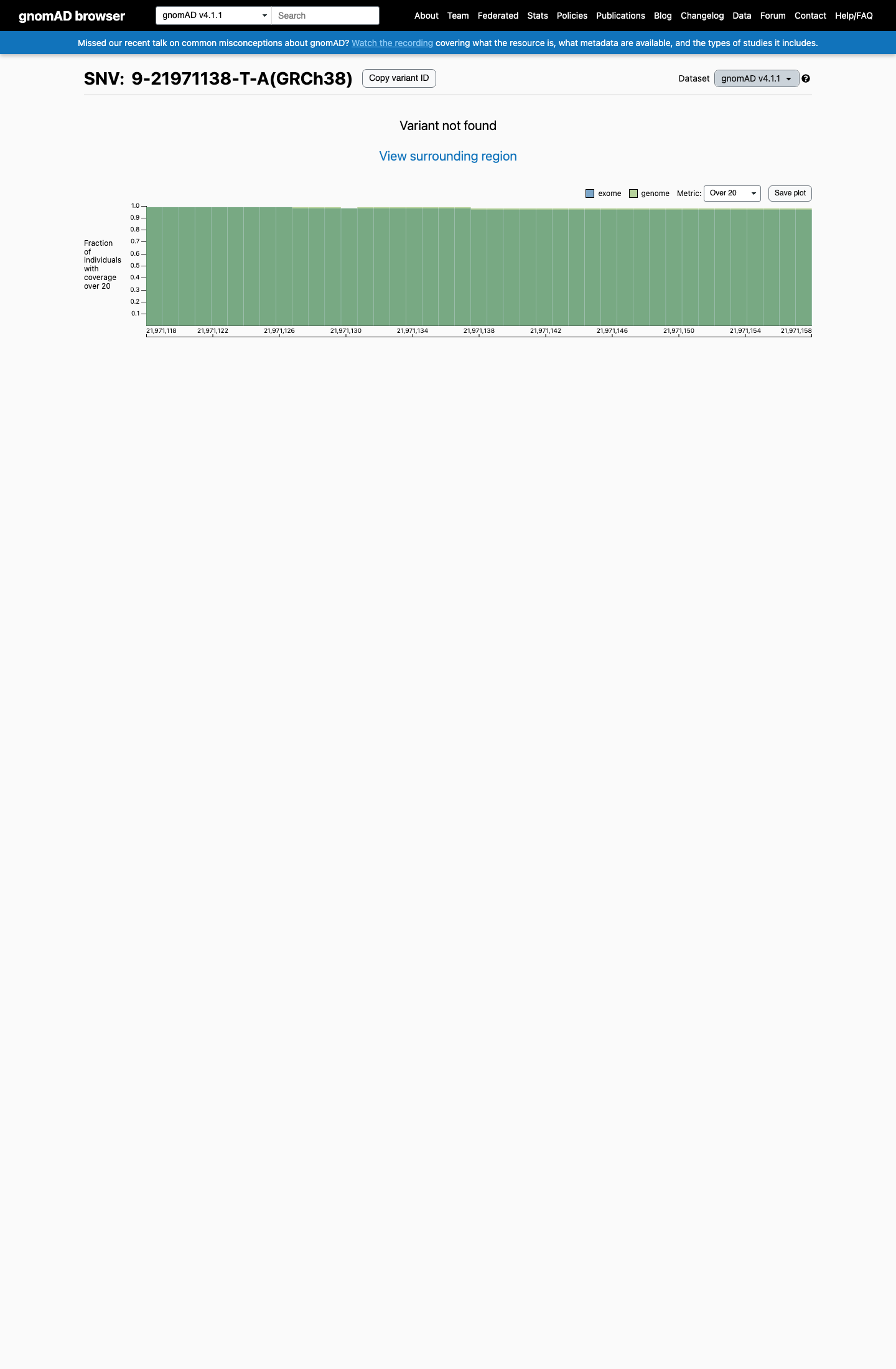
gnomAD v4.1 screenshot
gnomAD v4.1
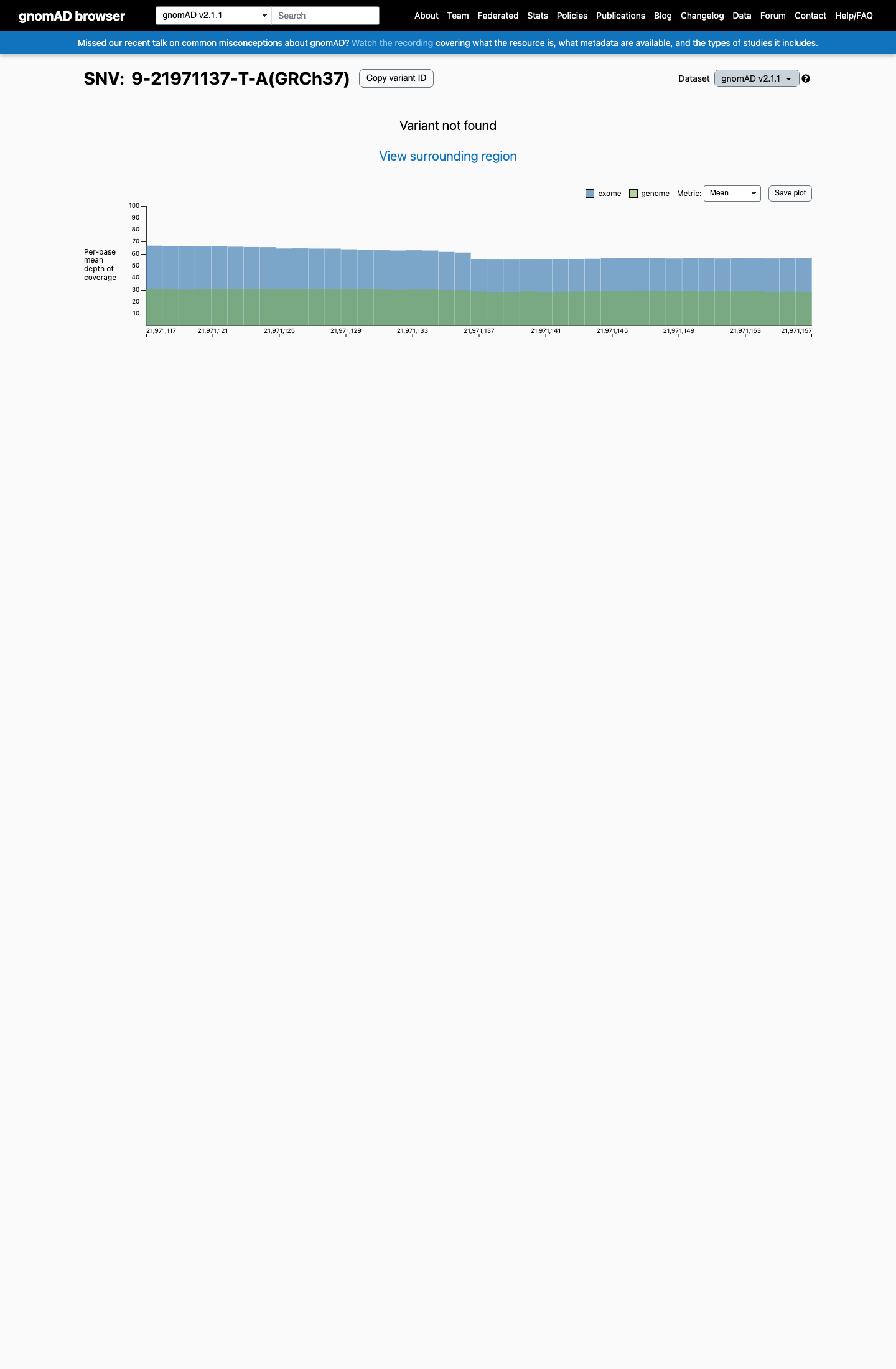
gnomAD v2.1 screenshot
gnomAD v2.1
v4.1
Absent from gnomAD v4.1.
v2.1
Absent from gnomAD v2.1.
🇨🇦 CA
Absent from gnomAD-Canada v1.0.
Allele frequency by ancestry
three datasets · side by side
gnomAD v4.1
Absent · 0 / ?
0 hom
Not observed in any ancestry group.
gnomAD v2.1
Absent · 0 / ?
0 hom
Not observed in any ancestry group.
gnomAD Canada 🇨🇦
Absent · 0 / ?
0 hom
Not observed in any ancestry group.
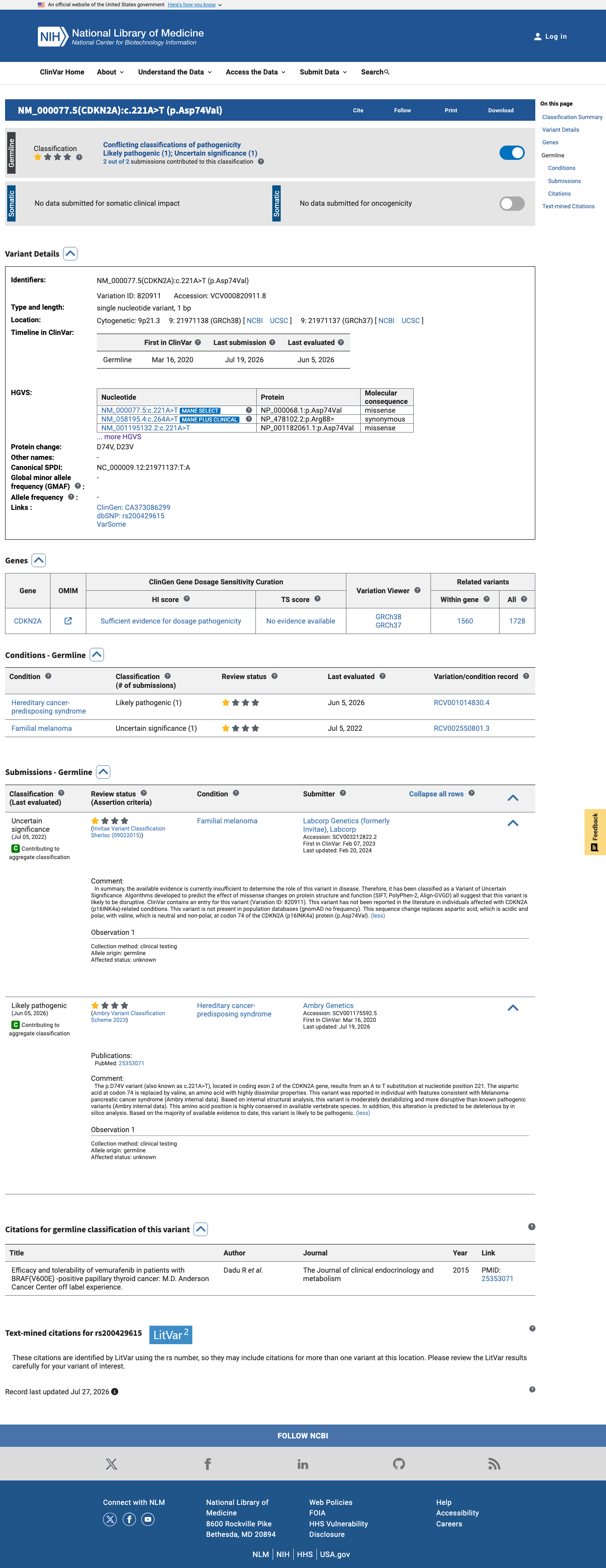
ClinVar screenshot
ClinVar
This variant has been reported in ClinVar as Uncertain significance (1 clinical laboratory) and as Likely pathogenic (1 clinical laboratory). (ClinVarID = 820911)
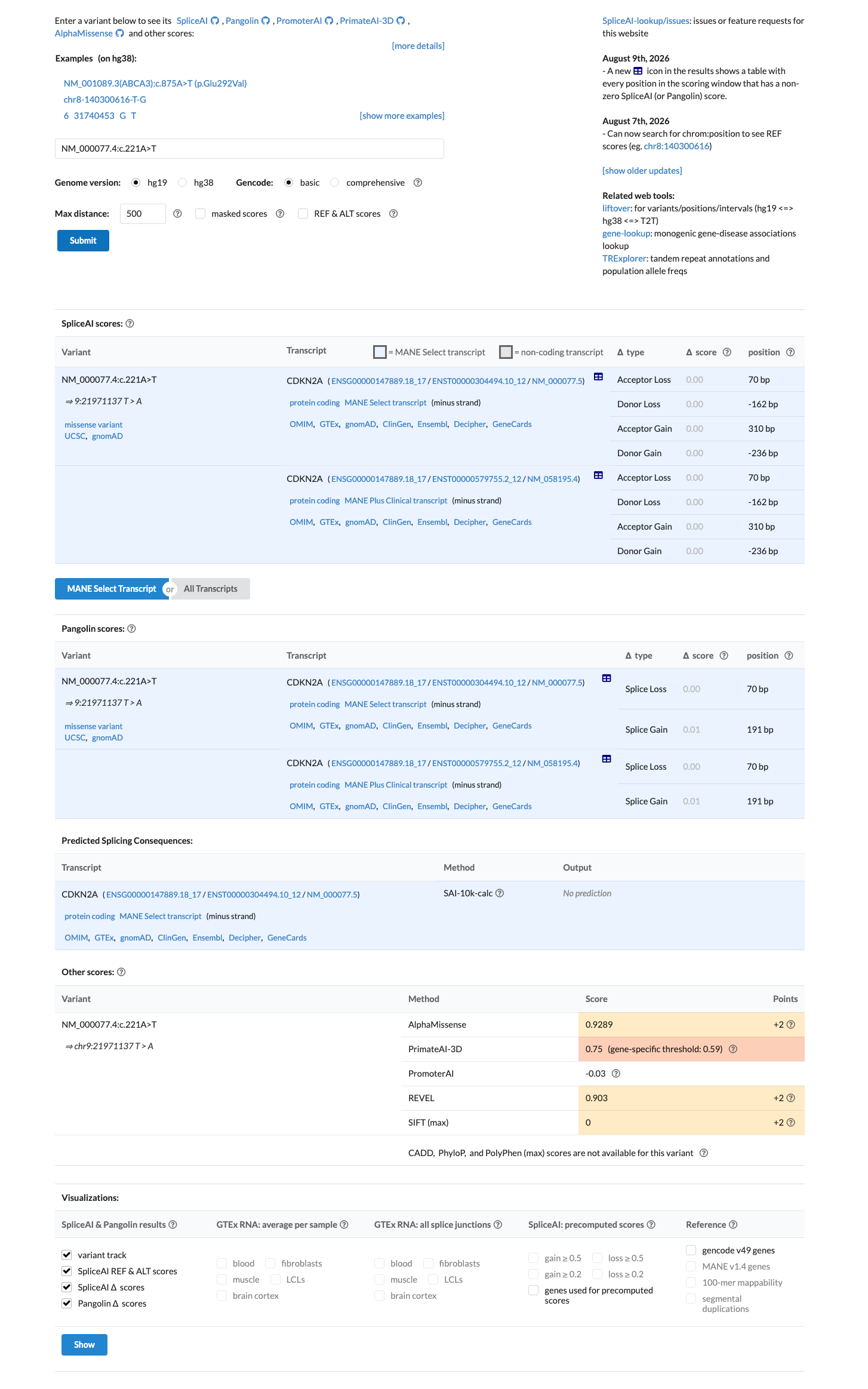
SpliceAI screenshot
In silico
SpliceAI predicts no significant splice impact for this variant (max delta score = 0.00). REVEL score = 0.903. BayesDel score = 0.514125.
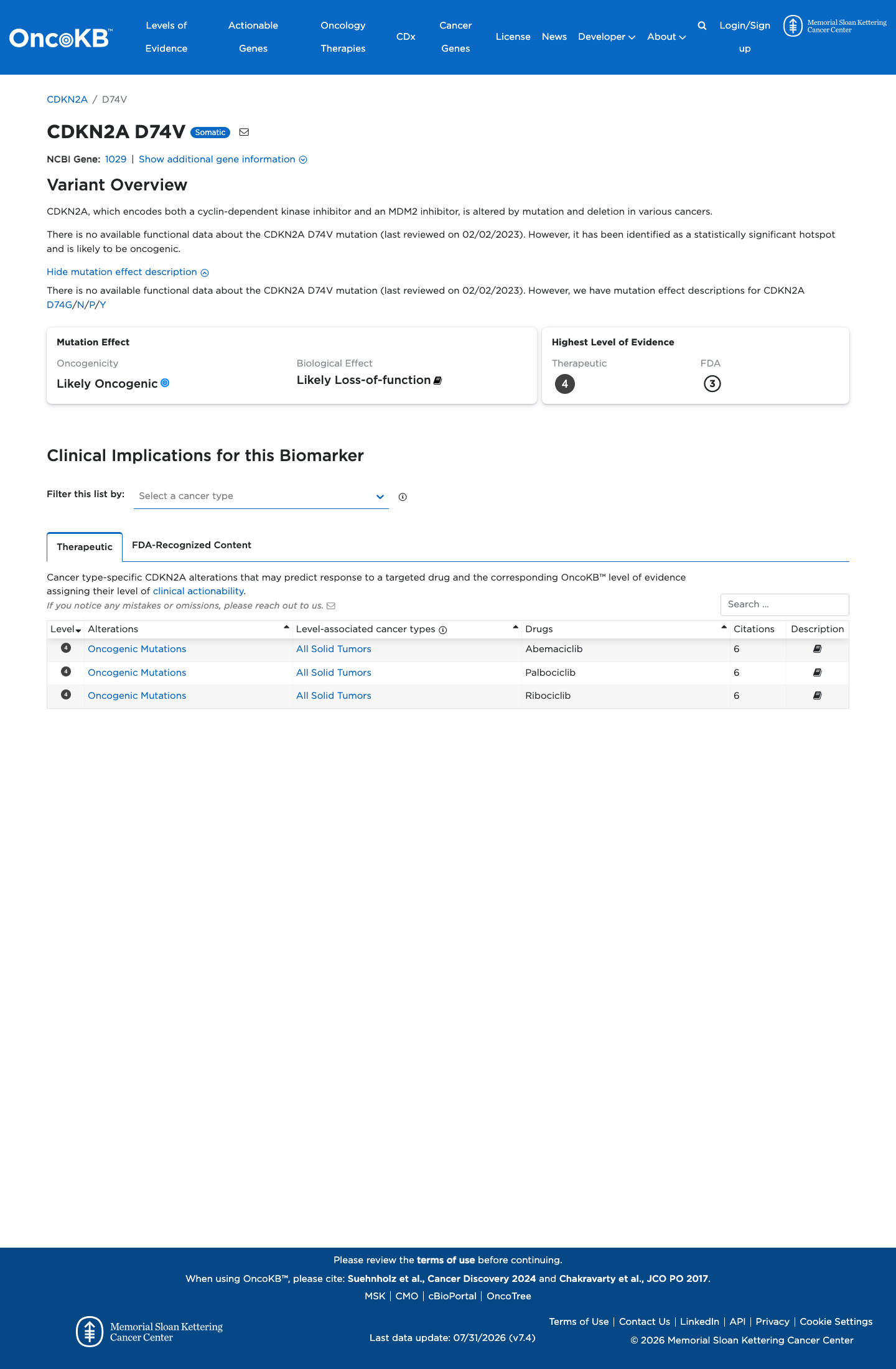
Functional / OncoKB screenshot
Functional Likely Oncogenic
OncoKB identified variant-specific curated literature and context relevant to functional review; biological-effect context: Likely Loss-of-function; curated oncogenicity label: Likely Oncogenic.
OncoKB ↗
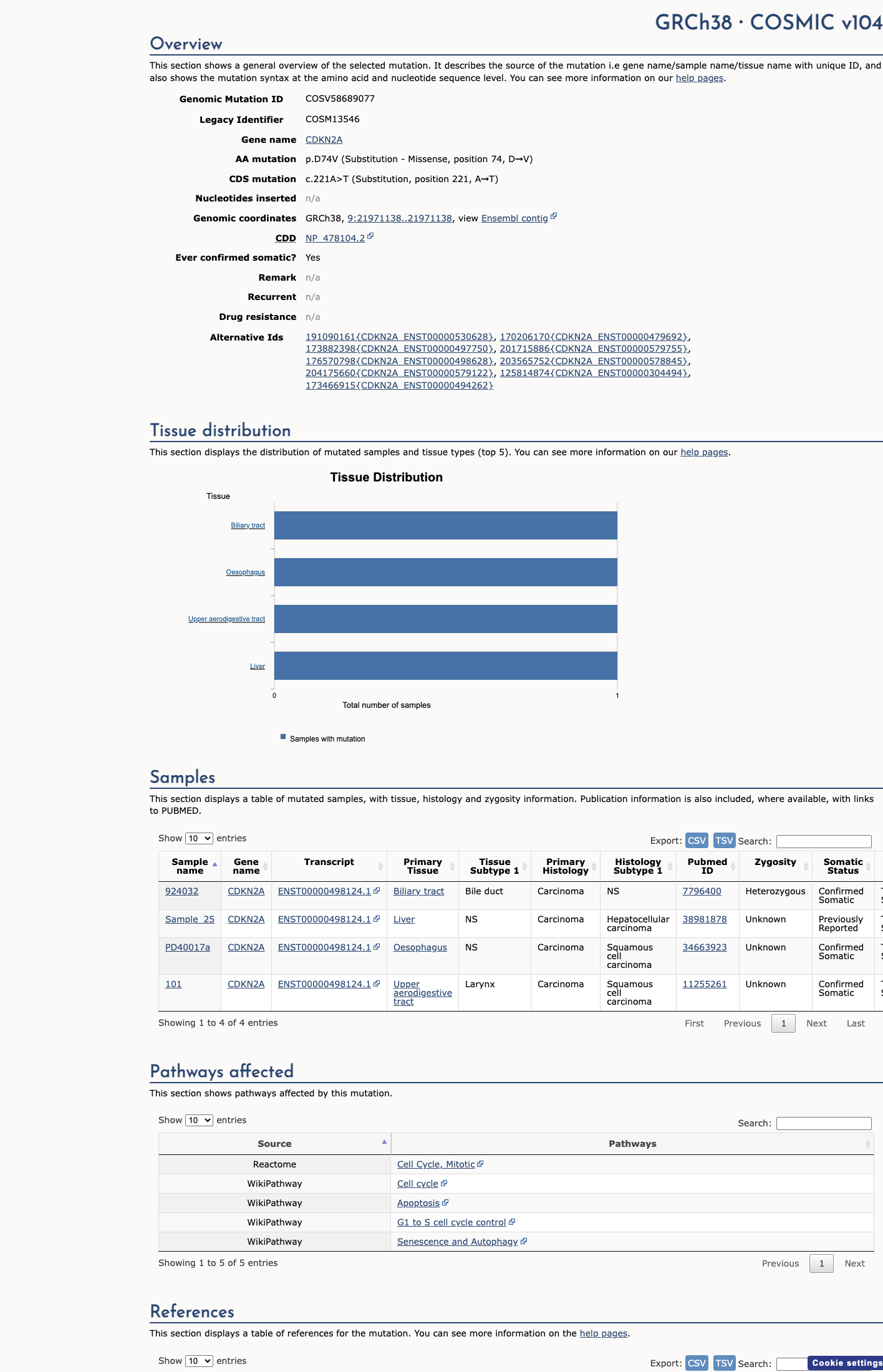
COSMIC screenshot
COSMIC
Cancer hotspots screenshot
Cancer hotspots
Somatic evidence Hotspot
COSMIC
This variant lies in a statistically significant hotspot. This variant has previously been reported in somatic cancers (COSMIC; COSV58689077, n = 4 times).
Hotspots
This variant lies in a statistically significant hotspot.
Sources & reference links
8Sources
ClinVar
gnomAD v2.1
gnomAD v4.1
gnomAD-Canada
SpliceAI
OncoKB
COSMIC
Cancer hotspots
Triaged references · 4 PMIDs not cited in assessment
25353071 ↗ Efficacy and tolerability of vemurafenib in patients with BRAF(V600E) -positive papillary thyroid cancer: M.D. Anderson Cancer Center off label experience. CLINVAR
25394175 ↗ A practice guideline from the American College of Medical Genetics and Genomics and the National Society of Genetic Counselors: referral indications for cancer predisposition assessment. CLINVAR
26389258 ↗ Cancer Genetics Risk Assessment and Counseling (PDQ®): Health Professional Version. CLINVAR
26389333 ↗ Genetics of Skin Cancer (PDQ®): Health Professional Version. CLINVAR