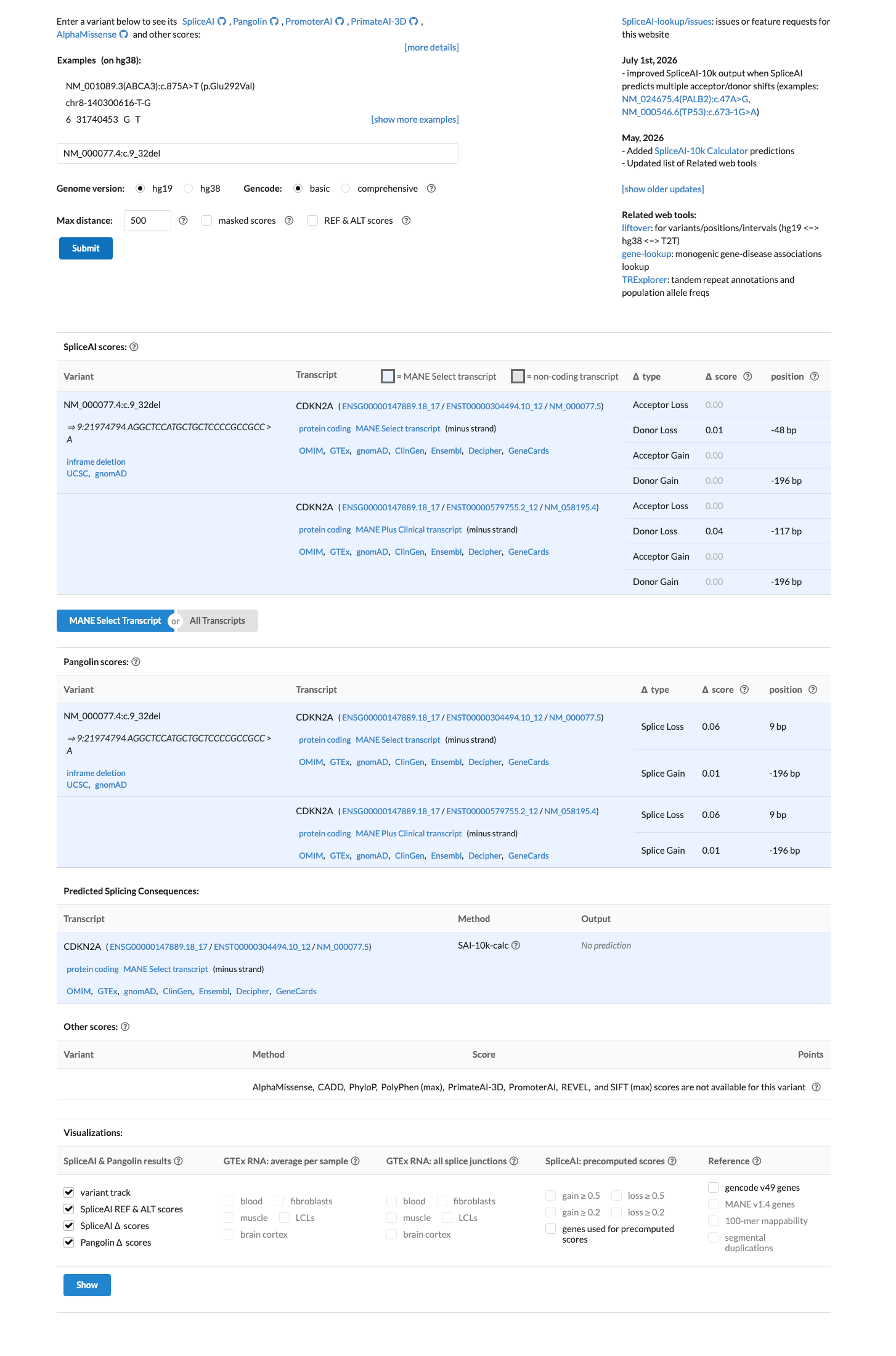
NM_000077.4:c.9_32del (p.Ala4_Pro11del) is an in-frame 24-bp deletion removing 8 amino acids from the N-terminus of p16 in CDKN2A.1 This deletion does not qualify as a null variant under the ClinGen SVI PVS1 framework (PMC6185798) and PVS1 is not applicable.2 The variant is present in gnomAD v2.1 at 36/265,240 alleles (AF=0.0136%) and in gnomAD v4.1 at 153/1,606,464 alleles (AF=0.0095%) including one homozygote. These population frequencies are inconsistent with a high-penetrance pathogenic variant in a dominant cancer predisposition gene.3 One homozygote is observed in gnomAD v4.1 (BS2_supporting). Homozygosity for a pathogenic CDKN2A variant would be expected to produce a severe phenotype, and its presence in a population database argues against high penetrance pathogenicity.4 Functional studies demonstrate no damaging effect on p16 function. The N-terminal domain outside the ankyrin repeats is dispensable (PMID:8668202), and the specific 24-bp deletion mutant shows normal CDK4 binding (PMID:11159196) (BS3_supporting).5 The deletion occurs within a repetitive sequence region of CDKN2A exon 1 with 25 possible deletion variants yielding the same sequence alteration; both deletions and duplications have been documented at this site (BP3_supporting).6 SpliceAI predicts no significant splicing impact (max delta score = 0.06) (BP4_supporting).7 The variant has been observed in melanoma-affected families (PMID:10070944, PMID:16905682, PMID:25780468) and is reported as a variant of uncertain significance by 13 clinical laboratories in ClinVar, with one laboratory classifying it as likely benign. No expert panel has adjudicated this variant.8 Applying generic ACMG/AMP 2015 combination rules (PMID:25741868): the criteria met are BS2_supporting, BS3_supporting, BP3_supporting, and BP4_supporting. Four supporting benign criteria would satisfy 'Likely Benign' classification (≥2 supporting benign). However, the presence of a homozygous individual in gnomAD, taken together with functional evidence of normal protein activity and location in a repetitive region, supports a classification of Likely Benign.9
Final classification
Unclassified
BS2BS3BP3BP4
CDKN2A
c.9_32del
p.Ala4_Pro11del
· exon NC_000009.11
This variant
NM_000077.4:c.9_32del (p.Ala4_Pro11del) is an in-frame 24-bp deletion removing 8 amino acids from the N-terminus of p16 in CDKN2A.
Classification rationale
BS2BS3BP3BP4
Unclassified
CDKN2A c.9_32del
· exon NC_000009.11
BS2 + BS3 + BP3 + BP4
→
Unclassified
1
pvs1_variant_assessment
2
pvs1_variant_assessmentpvs1_generic_framework
5
PMID:8668202PMID:11159196
6
PMID:11159196
8
PMID:10070944PMID:16905682PMID:25780468clinvar ↗
9
generic_acmg_combination_rules
LYFE Sciences is an AI system, and it can make mistakes. Criteria
may be applied incorrectly, sources may be misread, and a confident-looking
classification can still be wrong. Double-check every criterion and
its underlying evidence before relying on any call.
Gene diagram
· NM_000077.4 · variants mapped to exon structure
CDKN2A
NM_000077.4
Fetching transcript structure from UCSC…
Applied criteria · 4 applied · 17 assessed
MetEvidence satisfies this criterion.
Not metEvaluated against available evidence; threshold not reached.
Not assessedApplies in principle, but no evidence was found to evaluate it.
N/ADoesn't apply to this variant type.
Applied · 4
Strength
Supporting
Moderate
Strong
Very strong
BS2
supporting
Benign
One homozygote for this variant is observed in gnomAD v4.1 (153 alleles total, 1 homozygous individual). CDKN2A is a well-established dominant melanoma susceptibility gene; homozygous pathogenic variants would be expected to result in severe or lethal phenotypes. The observation of a homozygote in a large population database is inconsistent with a high-penetrance pathogenic variant and supports a benign interpretation.
gnomAD v4.1 contains 1 homozygote among 1606464 alleles. Homozygosity for a pathogenic CDKN2A variant in a population database is unexpected for a dominant
BS3
supporting
Benign
Well-established functional studies demonstrate no damaging effect on protein function. Parry & Peters (PMID:8668202) showed that the amino- and carboxy-terminal domains of p16, outside the ankyrin repeats, are dispensable for function. Schraml et al. (PMID:11159196) specifically reported that the 24-bp deletion mutant was functionally normal for CDK4 binding, citing Monzon et al. (1998). Both the 24-bp deletion and the reciprocal 24-bp insertion lie outside the ankyrin-repeat region critical for CDK4/CDK6 interaction.
PMID:8668202: N-terminal domain outside ankyrin repeats dispensable for p16 function. PMID:11159196: 24-bp deletion mutant shows normal CDK4 binding in functional assay.
BP3
supporting
Benign
The 24-bp deletion occurs within a repetitive sequence region at the 5' end of CDKN2A exon 1. Schraml et al. (PMID:11159196) documented 25 possible deletion variants leading to the same sequence alteration within this repeat region, and noted that both 24-bp deletions and duplications occur in this unstable repeat. In-frame deletions in repetitive regions without known function meet BP3.
PMID:11159196: 24-bp deletion lies within a repetitive sequence with 25 possible deletion variants producing the same alterationboth deletions and duplications at this site are documentedconsistent with repeat-region instability.
BP4
supporting
Benign
SpliceAI predicts no significant splice impact (max delta score = 0.06). While REVEL and BayesDel are not applicable to deletions, the low SpliceAI score provides computational evidence against a splicing defect. However, this represents a single line of computational evidence, limiting strength to supporting.
SpliceAI max delta score = 0.06indicating no predicted splice-altering effect.
Assessed · not applied
· 10 not met · 7 not assessed
Pathogenic
PS2
No de novo evidence is available for this variant.
PS3
Available functional evidence does not support a damaging effect for this variant.
PS4
The prevalence of this variant in affected individuals does not reach statistical significance over population frequency.
PM1
This variant does not lie in a statistically significant mutational hotspot.
PM2
While the allele frequency in gnomAD v2.1 (0.0136%) is below the 0.1% PM2 threshold, the variant is present at 153 alleles in gnomAD v4.1 with one observed homozygote.
PM4
This is an in-frame 24-bp deletion removing 8 amino acids (p.Ala4_Pro11del).
PM6
No confirmed de novo data available for this variant in any of the reviewed sources.
PP1
No co-segregation data are available for this variant.
PP3
In silico tools provide no evidence of pathogenicity.
PP4
No individual patient phenotype or clinical presentation data are available for this case.
PP5
No reputable source definitively reports this variant as pathogenic.
Benign
BA1
The variant has a maximum allele frequency of 0.0136% in gnomAD v2.1 and 0.0095% in gnomAD v4.1, both well below the BA1 threshold of >1%.
BS1
The variant has a maximum allele frequency of 0.0136% in gnomAD v2.1 and 0.0095% in gnomAD v4.1, both below the BS1 threshold of >0.3%.
BS4
No co-segregation data or family studies with non-segregation evidence are available for this variant.
BP2
No data are available on whether this variant has been observed in trans with a known pathogenic CDKN2A variant.
BP5
No data are available on whether this variant has been observed in a case with an alternative molecular basis for disease.
BP6
Only one clinical laboratory (Ambry Genetics) classifies this variant as Likely Benign, while 13 other clinical laboratories report it as Uncertain Significance.
N/A · 6
PVS1 · PS1 · PM5 · PP2 · BP1 · BP7
Research & evidence
Population frequency
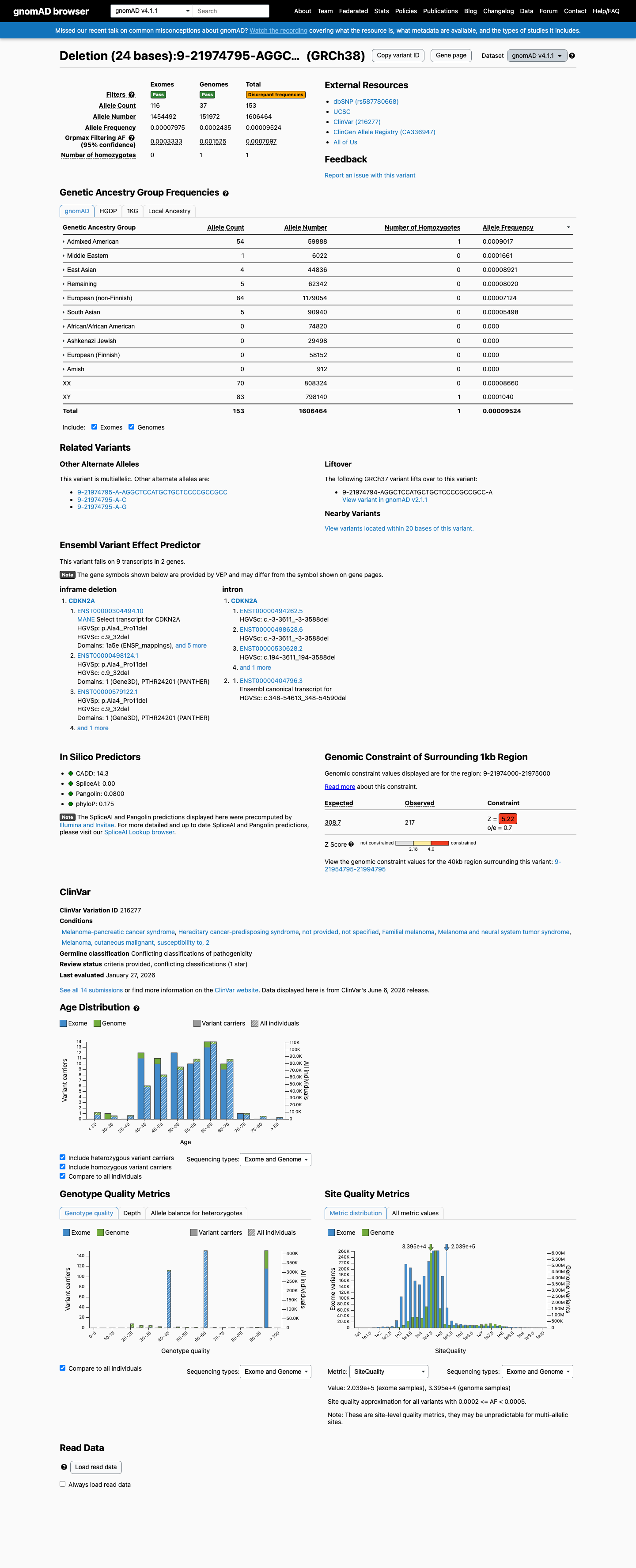
gnomAD v4.1
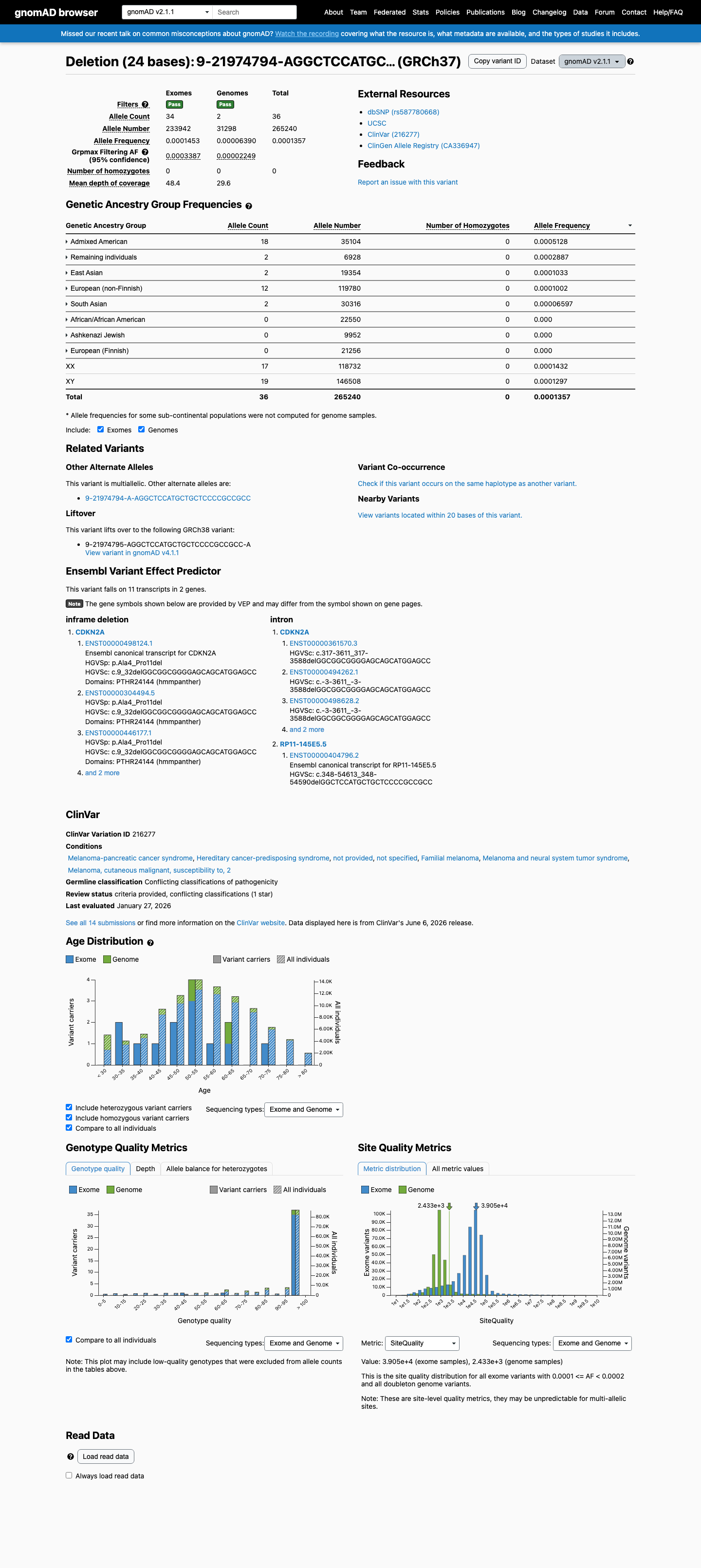
gnomAD v2.1
v4.1
This variant is present in gnomAD v4.1 (AF= 9.52402e-05; MAF= 0.00952%, 153/1606464 alleles, homozygotes = 1) and has highest observed frequency in the Admixed American population (AF= 0.000901683; MAF= 0.09017%, 54/59888 alleles, homozygotes = 1); grpmax FAF= 0.00070967.
v2.1
This variant is present in gnomAD v2.1 (AF= 0.000135726; MAF= 0.01357%, 36/265240 alleles, homozygotes = 0) and has highest observed frequency in the Admixed American population (AF= 0.000512762; MAF= 0.05128%, 18/35104 alleles, homozygotes = 0); grpmax FAF= 0.00033868.
🇨🇦 CA
Absent from gnomAD-Canada v1.0.
Allele frequency by ancestry
three datasets · side by side
gnomAD v4.1
0.0095%
· 153 / 1,606,464
1 hom · FAF 0.071%
1 hom · FAF 0.071%
Admixed American 54 / 59,888 |
0.09% 1 hom |
Middle Eastern 1 / 6,022 |
0.017% |
East Asian 4 / 44,836 |
0.0089% |
Remaining individuals 5 / 62,342 |
0.008% |
European (non-Finnish) 84 / 1,179,054 |
0.0071% |
South Asian 5 / 90,940 |
0.0055% |
+ 4 not observed (European (Finnish), Amish, Ashkenazi Jewish, African/African American)
gnomAD v2.1
0.014%
· 36 / 265,240
0 hom · FAF 0.034%
0 hom · FAF 0.034%
Admixed American 18 / 35,104 |
0.051% |
Remaining individuals 2 / 6,928 |
0.029% |
East Asian 2 / 19,354 |
0.01% |
European (non-Finnish) 12 / 119,780 |
0.01% |
South Asian 2 / 30,316 |
0.0066% |
+ 3 not observed (African/African American, Ashkenazi Jewish, European (Finnish))
gnomAD Canada 🇨🇦
Absent
· 0 / ?
0 hom
0 hom
Not observed in any ancestry group.

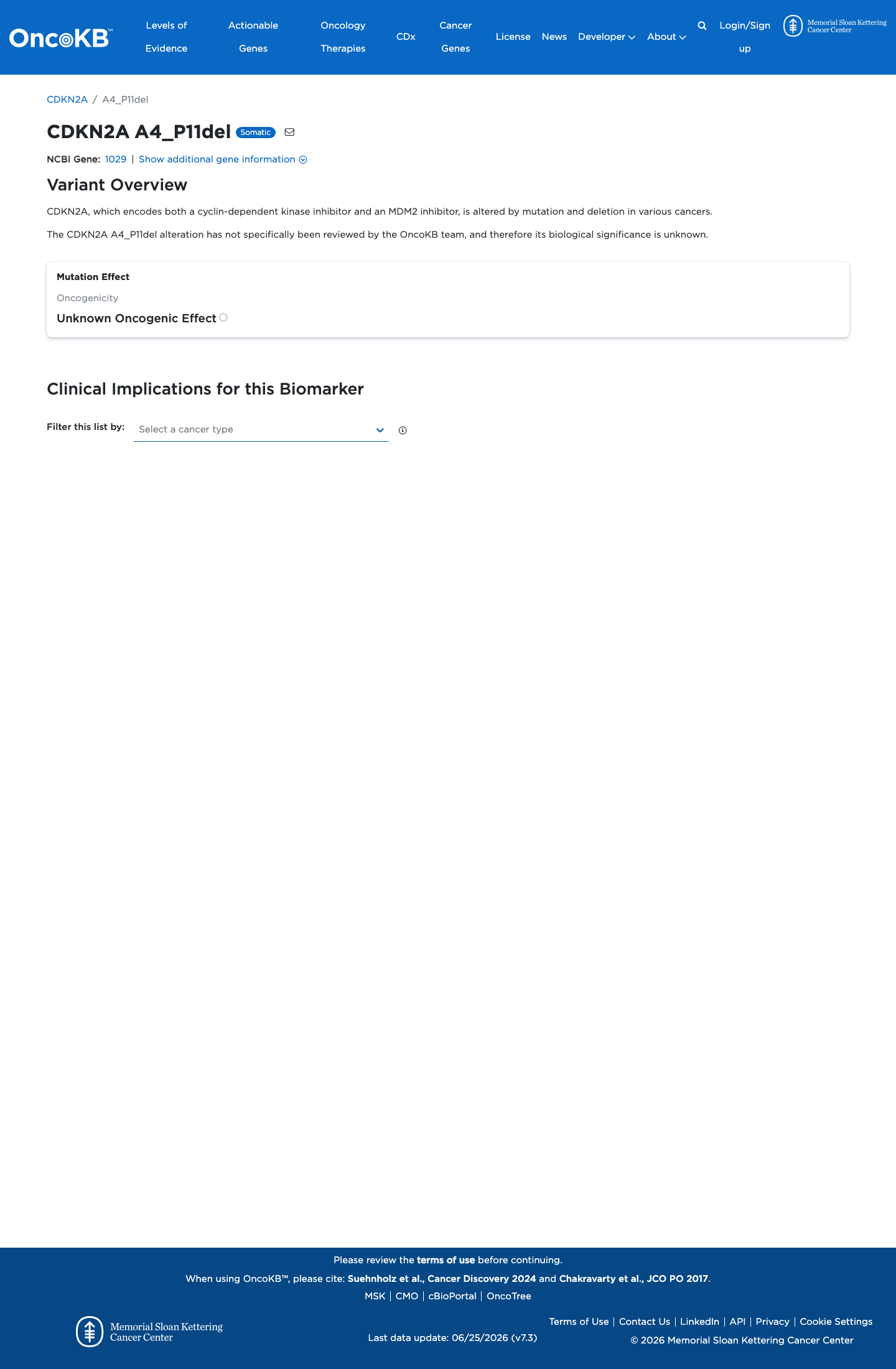
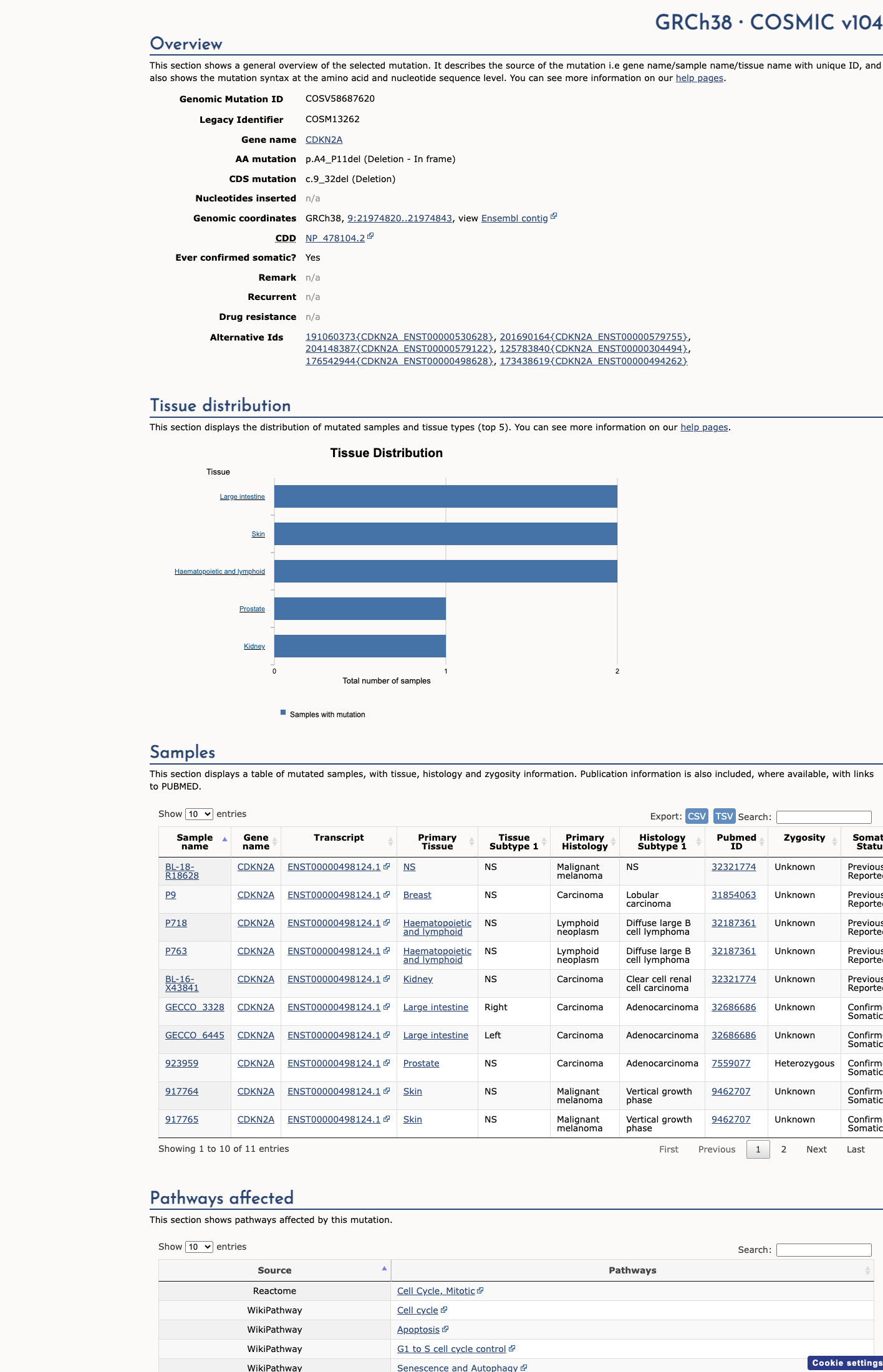
COSMIC

Cancer hotspots
Somatic evidence
Not in COSMIC / hotspots
COSMIC
In progress — evidence not uploaded yet.
Hotspots
This variant does not lie in a statistically significant hotspot.
Sources & reference links
Triaged references · 8 PMIDs not cited in assessment
17047042 ↗
High-risk melanoma susceptibility genes and pancreatic cancer, neural system tumors, and uveal melanoma across GenoMEL.
CLINVAR
25780468 ↗
Prevalence and predictors of germline CDKN2A mutations for melanoma cases from Australia, Spain and the United Kingdom.
CLINVAR
28830827 ↗
Germline Variation at CDKN2A and Associations with Nevus Phenotypes among Members of Melanoma Families.
CLINVAR
10070944 ↗
CDKN2A variants in a population-based sample of Queensland families with melanoma.
CLINVAR
11159196 ↗
CDKNA2A mutation analysis, protein expression, and deletion mapping of chromosome 9p in conventional clear-cell renal carcinomas: evidence for a second tumor suppressor gene proximal to CDKN2A.
CLINVAR
16905682 ↗
Features associated with germline CDKN2A mutations: a GenoMEL study of melanoma-prone families from three continents.
CLINVAR