0%
complete
Final classification
VUS
PM2PP3
CDKN2A
c.253G>T
p.Ala85Ser
missense · exon 2

CDKN2A encodes two key proteins, p16(INK4a) and p14(ARF), that help control cell division. p16 blocks the cell cycle by inhibiting CDK4 and CDK6, preventing progression from the G1 to S phase, while p14 stabilizes the tumor suppressor p53 by preventing its degradation. CDKN2A is an important tumor suppressor: it is frequently mutated, deleted, or silenced in many cancers, including melanoma, lymphoma, and pancreatic and lung cancer, and inherited changes in the gene can predispose people to familial melanoma and pancreatic cancer.

This variant

CDKN2A is a tumor-suppressor gene whose inherited changes predispose to familial melanoma and pancreatic cancer, so an ultra-rare missense change like p.Ala85Ser is directly relevant to cancer-risk assessment. The variant is essentially absent from population databases and is predicted damaging in silico, but with no functional, de novo, or family-segregation evidence it remains a Variant of Uncertain Significance and should not alone determine clinical management.

Transcript
NM_000077.5
HGVS · transcript:coding
NM_000077.5:c.253G>T
GRCh38
chr9:21971106 C>A
GRCh37
chr9:21971105 C>A
Variant of Uncertain Significance: with no gene-specific framework available, the generic ACMG/AMP 2015 rules apply, and the only criteria met (PM2 moderate, PP3 supporting) satisfy no classification rule.
Classification rationale
PM2PP3 VUS
CDKN2A c.253G>T missense · exon 2

PM2 (Moderate): ultra-rare population frequency (gnomAD v4.1 AF 3.12e-06, 0 homozygotes), more than 10-fold below the 0.1% rarity threshold. PP3 (Supporting): REVEL 0.796 predicts a damaging effect, above the 0.750 missense threshold. Synthesis: PM2 (moderate) plus PP3 (supporting) satisfies no pathogenic or benign rule in the generic ACMG/AMP 2015 framework, so the variant is classified as a Variant of Uncertain Significance.

PM2 + PP3 VUS
Gene diagram · NM_000077.5 · variants mapped to exon structure
CDKN2A NM_000077.5
Fetching transcript structure from UCSC…
Applied criteria · 2 applied · 20 assessed
MetEvidence satisfies this criterion.
Not metEvaluated against available evidence; threshold not reached.
Not assessedApplies in principle, but no evidence was found to evaluate it.
N/ADoesn't apply to this variant type.
Applied · 2
Strength Supporting Moderate Strong Very strong
PM2 moderate Pathogenic
Met (moderate): ultra-rare population frequency, gnomAD v4.1 allele frequency 3.12e-06 with 0 homozygotes, more than 10-fold below the 0.1% rarity threshold.
gnomAD v4.1: total AF 3.12e-06 (0.00031%; 5/1,604,348 joint exome+genome alleles), 0 homozygotes, grpmax FAF 1.77e-05 (0.0018%); distribution limited to East Asian (3), African/African American (1), and 'remaining' (1) with 0 alleles in >1.5 million European/South Asian/other chromosomes.gnomAD v2.1: total AF 4.32e-06 (0.00043%; 1/231,476 exome alleles), 0 homozygotes.Absent from gnomAD-Canada v1.0 (HostSeq genomes), an independent concordant observation of absence/ultra-rarity.
PP3 supporting Pathogenic
Met (supporting): REVEL score 0.796, above the 0.750 threshold predicting a damaging effect.
Governing framework: no ClinGen CSPEC for CDKN2A and no gene-specific VCEP materials retrieved (case_summary framework_mode = generic_acmg; vcep_materials.json files_found []); generic ACMG/AMP 2015 (PMID 25741868) applies, with the lab's generic in-silico operating thresholds in generic_acmg_classification_rules.md governing PP3/BP4.generic_acmg_classification_rules.md states: missense variants are evaluated with REVEL only; REVEL > 0.750 -> PP3 (supporting); REVEL < 0.250 -> BP4 (supporting); REVEL in [0.250, 0.750] -> neither met (gray zone); the SpliceAI path applies only to intronic, synonymous, or non-canonical-splice-position variants; a missense variant's own SpliceAI score does not clear its REVEL-assessed protein-level effect.Local REVEL v1.3 lookup (source_registry key 'revel') returns score 0.796 for NM_000077.5:c.253G>T (chr9:21971106 C>A; p.Ala85Ser), which is > 0.750, meeting the governing generic PP3 (supporting) threshold.
Assessed · not applied · 5 not met · 15 not assessed
Pathogenic
PS1 Not assessed: insufficient evidence was available to establish whether this exact amino-acid change has been reported as pathogenic.
PS2 Not assessed: no confirmed de novo occurrence is documented, and no parental or maternity/paternity testing was available.
PS3 Not met: no well-established functional study demonstrates a deleterious effect; submitters state functional studies have not been performed for this variant.
PS4 Not assessed: insufficient evidence of case-level enrichment among affected individuals was available.
PM1 Not assessed: insufficient evidence was available to determine whether the variant lies in a mutational hotspot.
PM5 Not assessed: insufficient evidence was available to identify a different pathogenic missense at the same residue.
PM6 Not assessed: no family-level report of a presumed de novo occurrence with unconfirmed parentage was available.
PP1 Not assessed: no co-segregation of the variant with disease in affected relatives was documented.
PP2 Not assessed: insufficient evidence was available to assess this gene's missense-variant burden.
PP4 Not assessed: insufficient phenotype-specific evidence was available.
PP5 Not assessed: insufficient evidence was available to support a benign assertion from external sources.
Benign
BA1 Not met: the highest observed allele frequency, about 0.012%, is roughly 400-fold below the 5% stand-alone benign threshold.
BS1 Not met: the maximum population allele frequency, ~0.0069%, sits well below the 0.3% benign threshold for this adult-onset dominant cancer gene.
BS3 Not met: no functional study demonstrates normal function; submitters report no functional studies have been performed for this variant.
BS4 Not assessed: no family data demonstrating non-segregation of the variant with disease were available.
BP1 Not assessed: insufficient evidence was available to evaluate whether benign missense variation is uncommon in this gene.
BP2 Not assessed: no allelic-phase data (variant in trans or in cis with a pathogenic CDKN2A variant) were available.
BP4 Not met: REVEL 0.796 is far above the 0.250 no-impact threshold, so the score supports impact rather than no impact.
BP5 Not assessed: insufficient evidence was available to identify an alternate benign missense at the same residue.
BP6 Not assessed: insufficient evidence was available from external benign classifications.
N/A · 6 PVS1 · PM3 · PM4 · BS2 · BP3 · BP7
Research & evidence
Population frequency
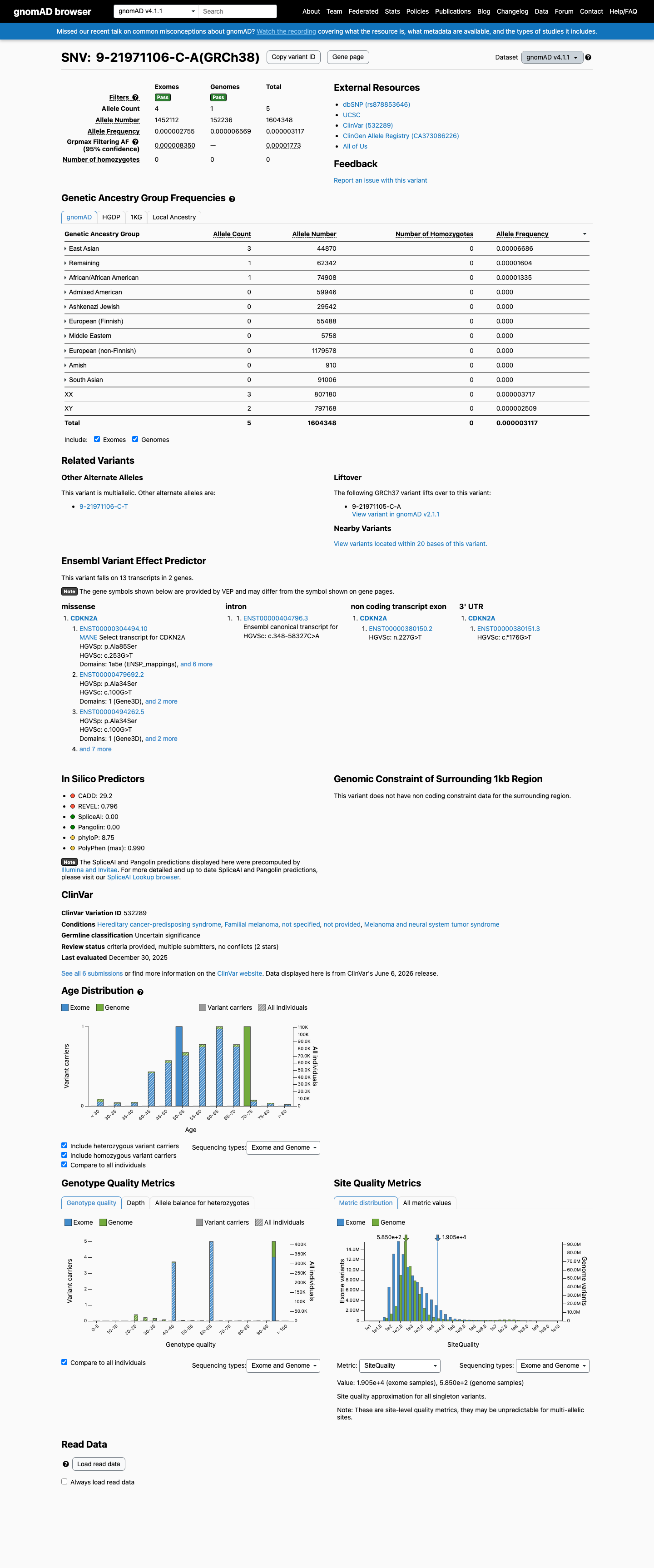
gnomAD v4.1 screenshot
gnomAD v4.1
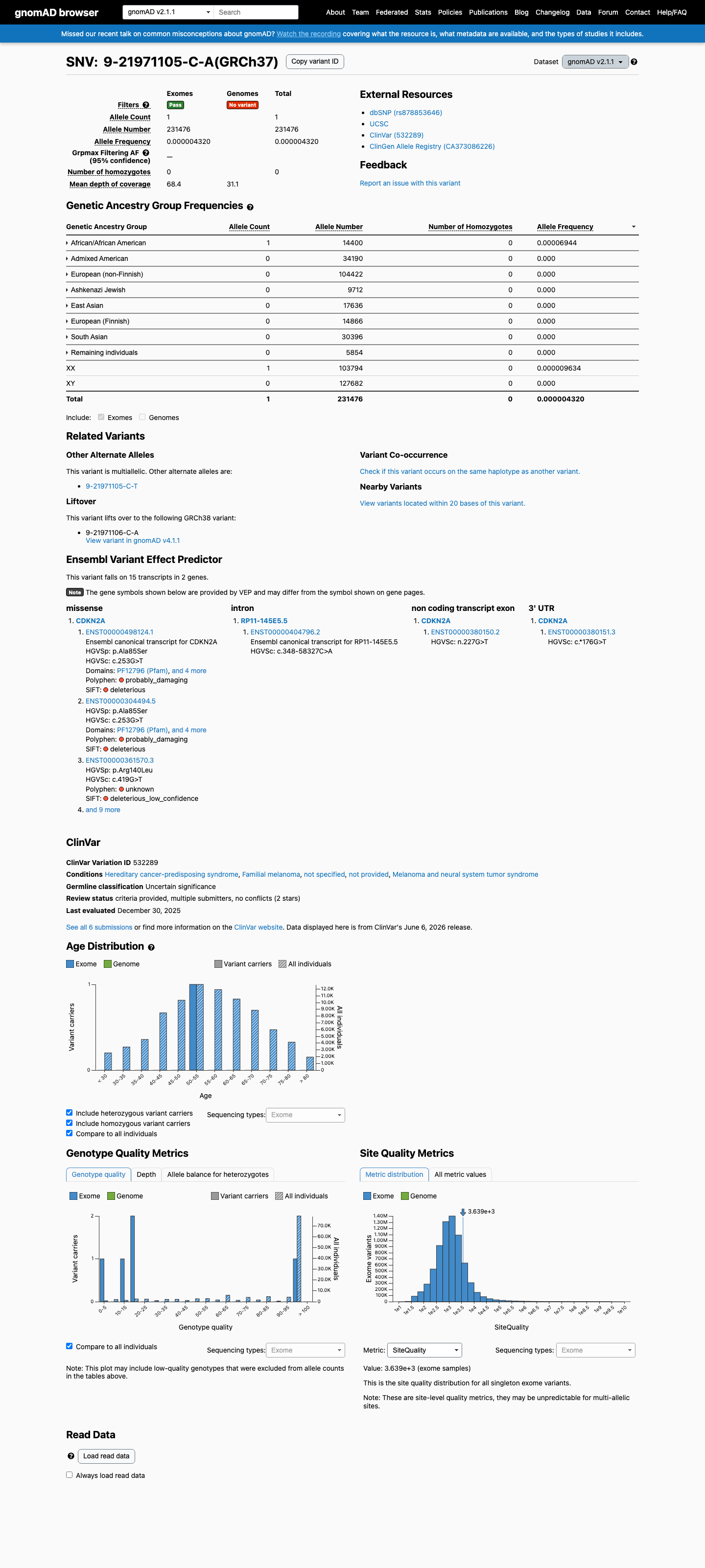
gnomAD v2.1 screenshot
gnomAD v2.1
v4.1
This variant is present in gnomAD v4.1 (AF= 3.11653e-06; MAF= 0.00031%, 5/1604348 alleles, homozygotes = 0) and has highest observed frequency in the East Asian population (AF= 6.68598e-05; MAF= 0.00669%, 3/44870 alleles, homozygotes = 0); grpmax FAF= 1.773e-05.
v2.1
This variant is present in gnomAD v2.1 (AF= 4.3201e-06; MAF= 0.00043%, 1/231476 alleles, homozygotes = 0) and has highest observed frequency in the African/African American population (AF= 6.94444e-05; MAF= 0.00694%, 1/14400 alleles, homozygotes = 0).
🇨🇦 CA
Absent from gnomAD-Canada v1.0.
Allele frequency by ancestry
three datasets · side by side
gnomAD v4.1
0.00031% · 5 / 1,604,348
0 hom · FAF 0.0018%
East Asian
3 / 44,870
0.0067%
Remaining individuals
1 / 62,342
0.0016%
African/African American
1 / 74,908
0.0013%
+ 7 not observed (Admixed American, European (Finnish), Amish, Middle Eastern, South Asian, Ashkenazi Jewish, European (non-Finnish))
gnomAD v2.1
0.00043% · 1 / 231,476
0 hom
African/African American
1 / 14,400
0.0069%
+ 7 not observed (Admixed American, Ashkenazi Jewish, East Asian, European (Finnish), European (non-Finnish), Remaining individuals, South Asian)
gnomAD Canada 🇨🇦
Absent · 0 / ?
0 hom
Not observed in any ancestry group.
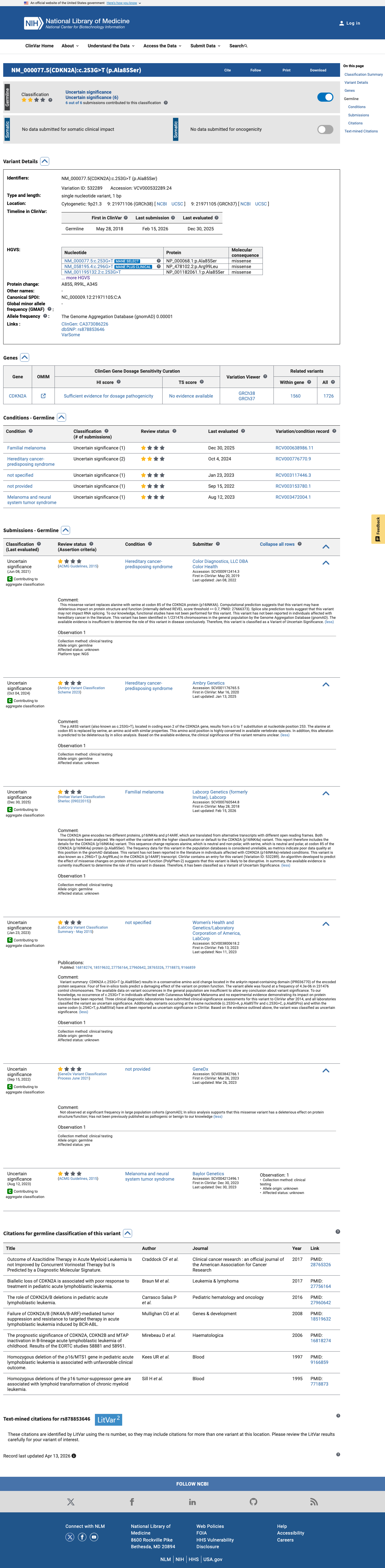
ClinVar screenshot
ClinVar
This variant has been reported in ClinVar as Uncertain significance (6 clinical laboratories). (ClinVarID = 532289)
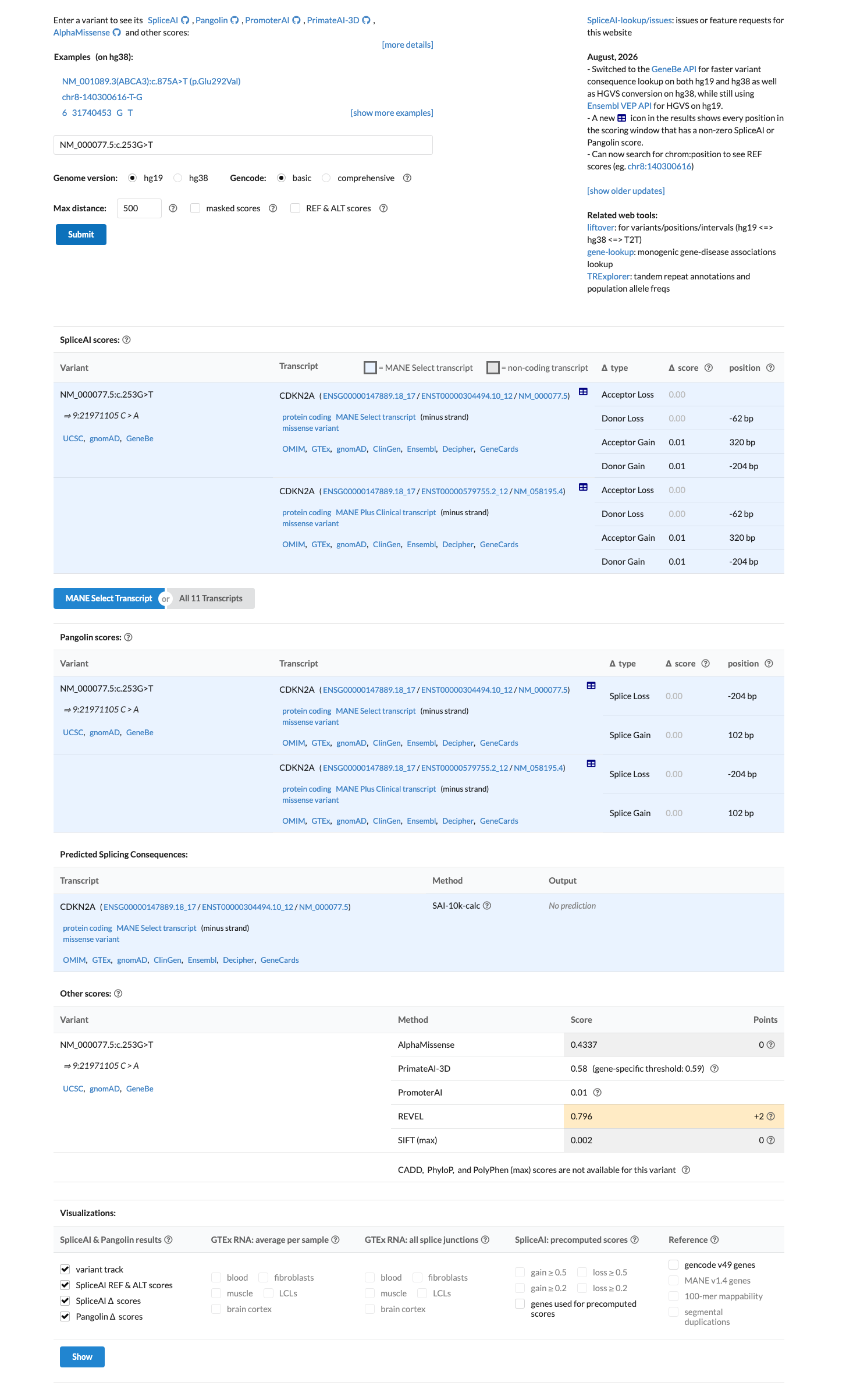
SpliceAI screenshot
In silico
SpliceAI predicts no significant splice impact for this variant (max delta score = 0.07). REVEL score = 0.796. BayesDel score = 0.359592.
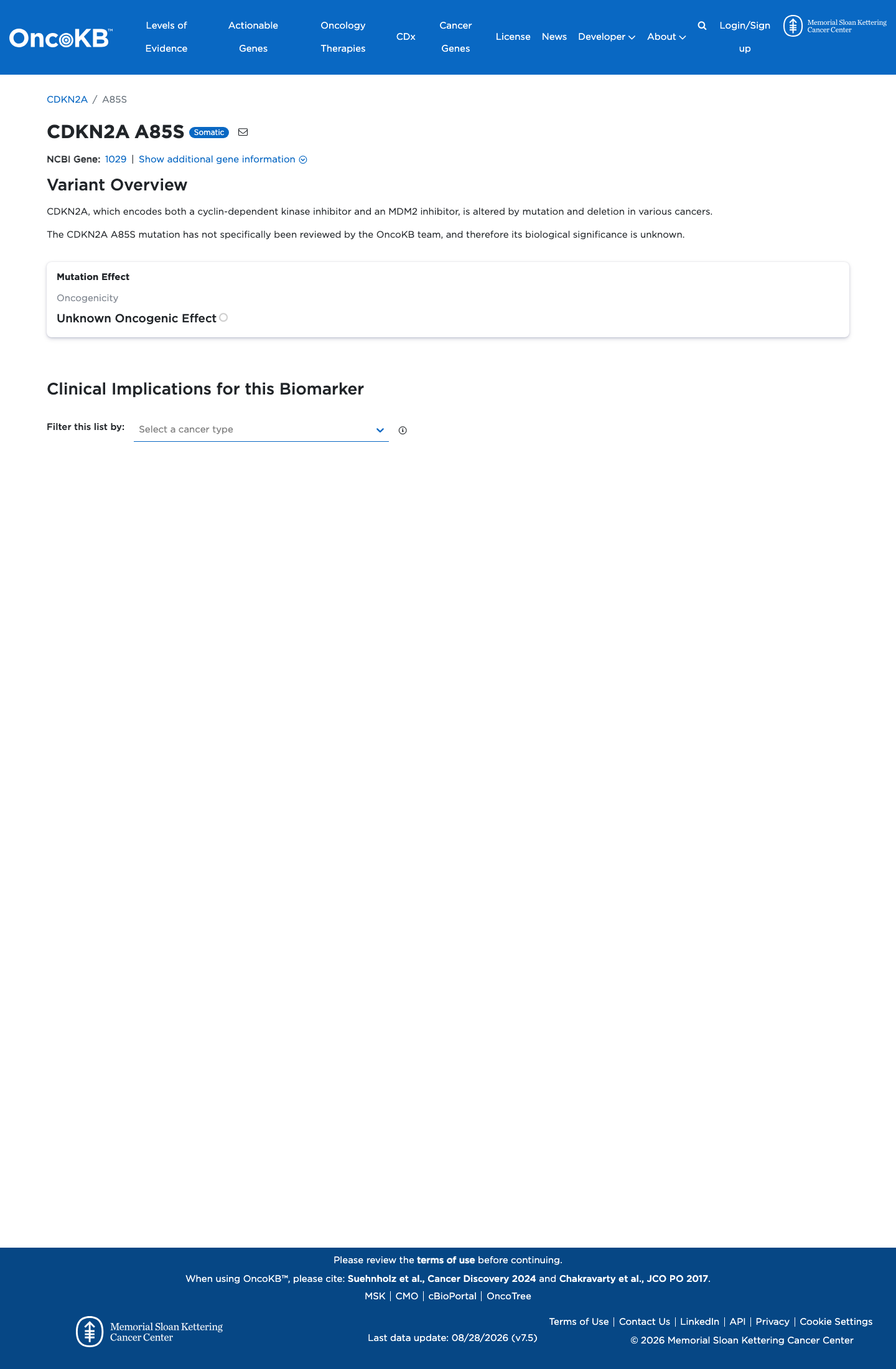
Functional / OncoKB screenshot
Functional Unknown Oncogenic Effect
OncoKB did not identify variant-specific reviewed functional evidence for this variant; gene-level curated context is available for reviewer follow-up. CDKN2A, which encodes both a cyclin-dependent kinase inhibitor and an MDM2 inhibitor, is altered by mutation and deletion in various cancers.
OncoKB ↗
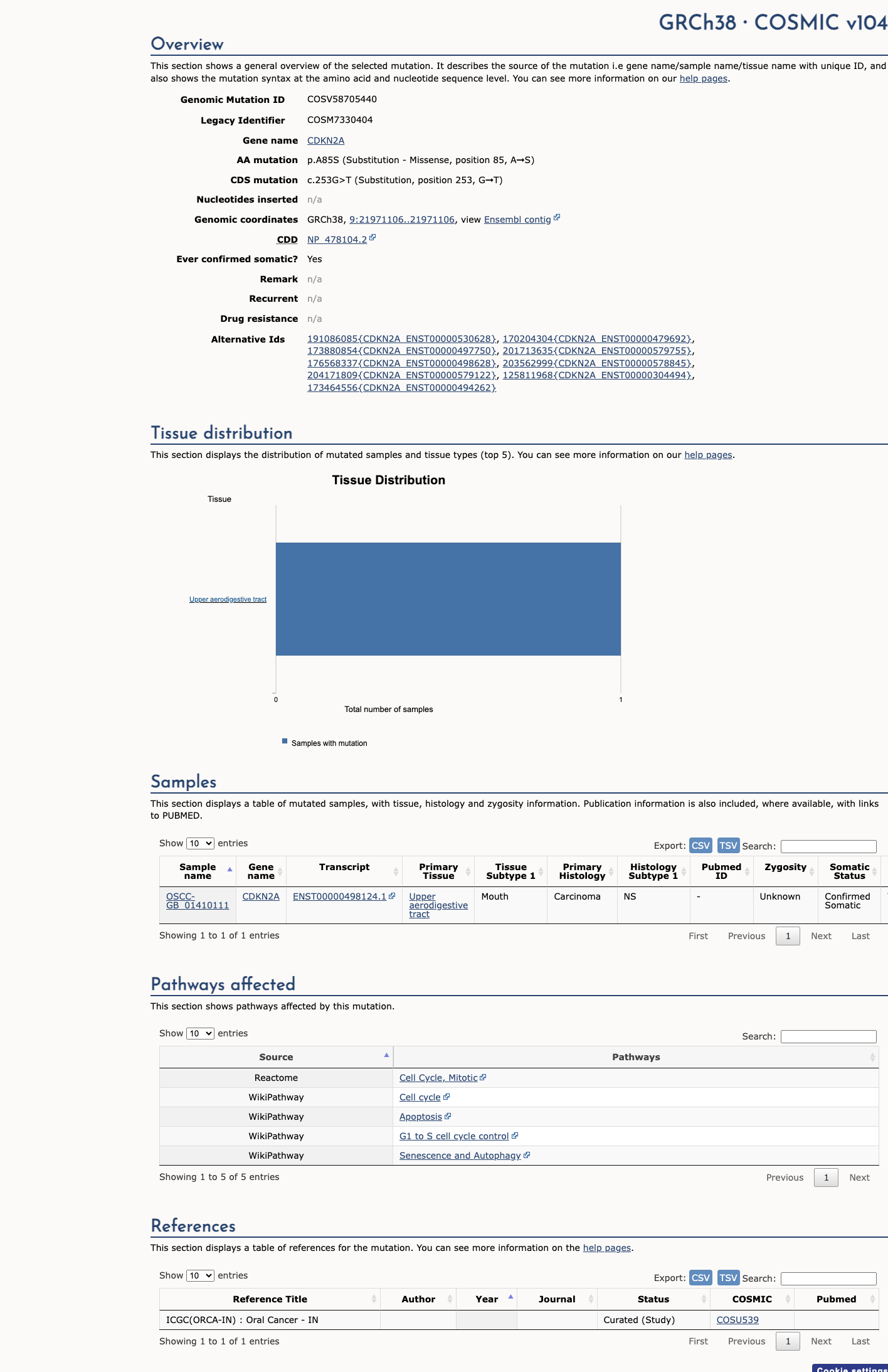
COSMIC screenshot
COSMIC
Cancer hotspots screenshot
Cancer hotspots
Somatic evidence Not in COSMIC / hotspots
COSMIC
This variant does not lie in a statistically significant hotspot. This variant has previously been reported in somatic cancers (COSMIC; COSV58705440, n = 1 times).
Hotspots
This variant does not lie in a statistically significant hotspot.
Literature · how each cited paper was used
1papers cited
Each card is an audit: what was searched, what was found, whether it names the variant, which criteria it fed, and why. 7 further PMIDs triaged but not cited — see Sources & references.
Rule & framework references · cited for criterion definitions, not variant evidence
25741868 ↗ Standards and guidelines for the interpretation of sequence variants: a joint consensus recommendation of the American College of Medical Genetics and Genomics and the Association for Molecular Pathology.
Sources & reference links
8Sources
ClinVar
gnomAD v2.1
gnomAD v4.1
gnomAD-Canada
SpliceAI
OncoKB
COSMIC
Cancer hotspots
Triaged references · 7 PMIDs not cited in assessment
28765326 ↗ Outcome of Azacitidine Therapy in Acute Myeloid Leukemia Is not Improved by Concurrent Vorinostat Therapy but Is Predicted by a Diagnostic Molecular Signature. CLINVAR
31672839 ↗ Management of patients with increased risk for familial pancreatic cancer: updated recommendations from the International Cancer of the Pancreas Screening (CAPS) Consortium. CLINVAR
7718873 ↗ Homozygous deletions of the p16 tumor-suppressor gene are associated with lymphoid transformation of chronic myeloid leukemia. CLINVAR
16818274 ↗ The prognostic significance of CDKN2A, CDKN2B and MTAP inactivation in B-lineage acute lymphoblastic leukemia of childhood. Results of the EORTC studies 58881 and 58951. CLINVAR
18519632 ↗ Failure of CDKN2A/B (INK4A/B-ARF)-mediated tumor suppression and resistance to targeted therapy in acute lymphoblastic leukemia induced by BCR-ABL. CLINVAR
25394175 ↗ A practice guideline from the American College of Medical Genetics and Genomics and the National Society of Genetic Counselors: referral indications for cancer predisposition assessment. CLINVAR
26389258 ↗ Cancer Genetics Risk Assessment and Counseling (PDQ®): Health Professional Version. CLINVAR