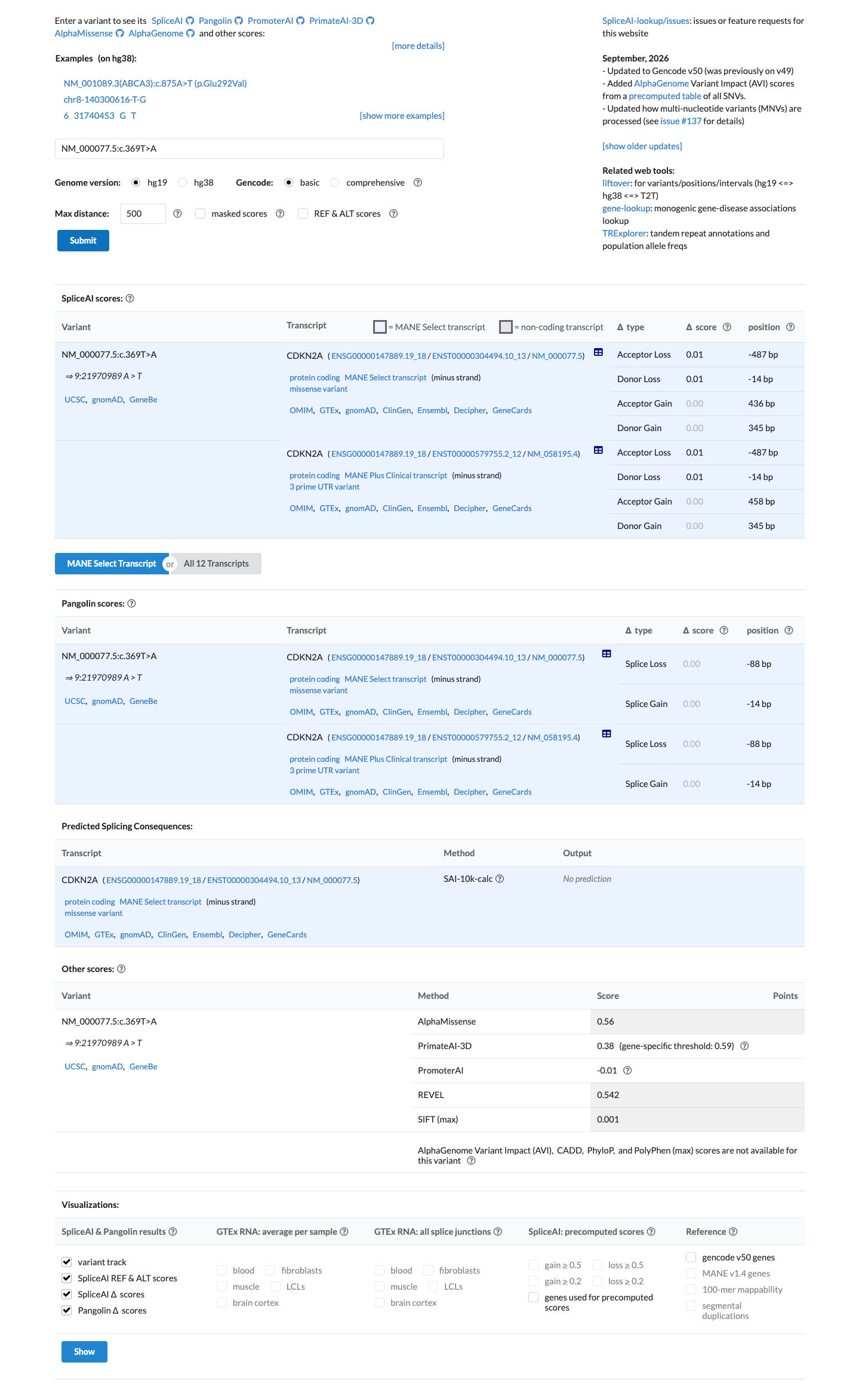
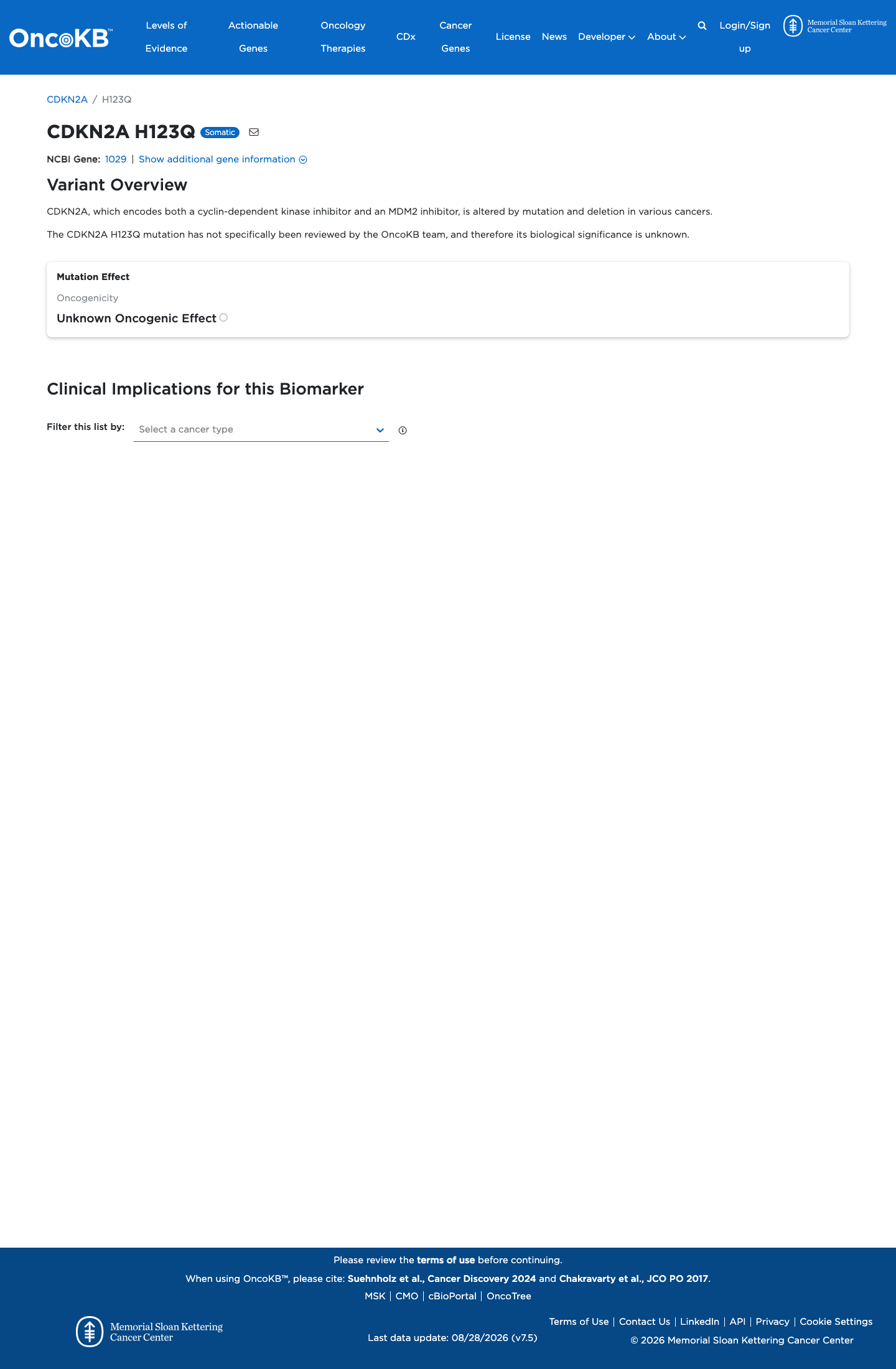
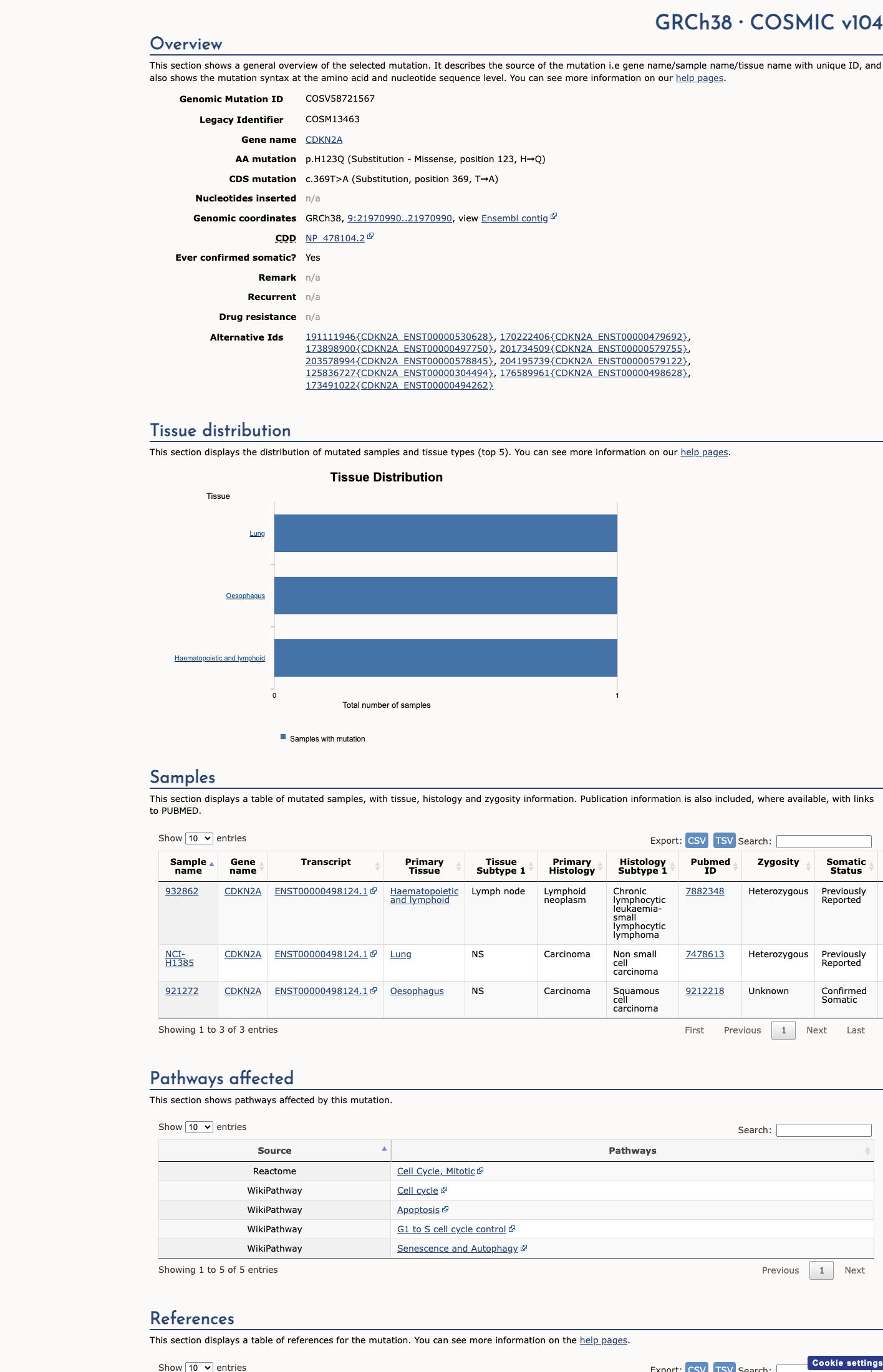
Governing framework: no ClinGen CSPEC was found for CDKN2A (cspec.found=false), no gene VCEP directory exists (gene_vcep_dir=null) and vcep_materials.json provides no domain_tables entry for this gene; framework_mode is generic_acmg, so ACMG/AMP 2015 (PMID:25741868) governs this group. Codon/residue-domain group verdicts: PS1 not met (no established pathogenic assertion for the same amino-acid change p.His123Gln; ClinVar VCV000127526 is Benign/Likely benign by 12 of 15 submitters); PM1 not met (no Cancer Hotspots hotspot for CDKN2A H123, and the residue carries documented benign variation); PM5 not met (no established pathogenic alternate missense at codon His123; automated same-residue harvesting was skipped); PP2 not met (missense is a CDKN2A mechanism, but a low rate of benign missense variation is not supported); BP1 not met (CDKN2A disease is not truncating-predominant). No criterion in this group supplies pathogenic evidence for this variant; the residue-domain picture is consistent with a benign-leaning missense change (gnomAD AF 0.042%, AFR 0.45%; COSMIC somatic count 3; OncoKB 'Unknown Oncogenic Effect'). This variant is curated at the variant level: no proband, phenotype, parental testing, pedigree, or family-member genotype data are present in any case source, so the segregation/de novo criteria PS2, PM6, PP1 and BS4 are all recorded as not_assessed with an explicit evidence gap rather than as met or not met. No ClinGen CSPEC or VCEP specification exists for CDKN2A and no local gene framework is available, so the generic ACMG/AMP 2015 criteria definitions (PMID:25741868) govern, applied with generic ClinGen-SVI strength defaults. The only variant-specific evidence in the case is computational/population based (REVEL 0.542, BayesDel 0.365078, SpliceAI max delta 0.01, gnomAD v2.1/v4.1 frequencies, ClinVar aggregate Likely benign with no expert panel), none of which addresses de novo status or within-family co-segregation; the one publication naming the variant (PMID:18573309) is a pure in-silico study. PS3 and BS3 were adjudicated solely on functional-assay evidence. No ClinGen CSPEC and no gene-specific criteria specification exist for CDKN2A (cspec found=false; vcep_materials.json reports no CSPEC URL and final_classification_framework found=false, source=generic_acmg_fallback), so the generic ACMG/AMP 2015 standard (PMID:25741868) governs both criteria at default strengths. Both criteria are not met, for the same underlying reason: no functional assay - biochemical or cell-based - of NM_000077.5:c.369T>A (p.His123Gln) was found in the retrieved corpus, so there is neither a damaging-effect assay for PS3 nor a no-damaging-effect assay for BS3. The only exact-variant evidence, PMID:18573309, is a computational study whose PolyPhen/structural-modelling output predicts a damaging effect; it is not an assay, so it cannot support PS3, and because it points toward damage it cannot support BS3 either. Net contribution of this group is neutral: no functional evidence is credited in either direction. Any PS3/BS3 input to the final classification would have to come from a variant-specific assay that is not currently available for this variant. Residual uncertainty is limited to five ClinVar-referenced candidate papers whose full texts could not be retrieved (PMID:18519632, PMID:25186627, PMID:9166859, PMID:7718873, PMID:9660926); at abstract level none reports a result for p.His123Gln, and only PMID:9660926 describes variant-level functional work (twelve anonymous tumorigenic p16INK4A mutants). Governing framework: no CDKN2A CSPEC/VCEP specification was found (vcep_materials reports no CSPEC URL and no gene VCEP directory; the repo VCEP database has no CDKN2A entry), so generic ACMG/AMP 2015 (PMID:25741868) governs this group. PS4 is not met: no case-control or cohort study reporting the exact variant c.369T>A (p.His123Gln) was identified; the only paper naming H123Q (PMID:18573309) is in silico, and CDKN2A-containing cohorts (PMID:27978560, PMID:28944238) do not name this variant. PP5 and BP6 are both not met: ClinVar variation 127526 (the exact variant) has review status 'criteria provided, single submitter' (1-star) and 0 expert-panel submissions; its Likely benign aggregate label is ordinary single-submitter laboratory data, which the governing rule forbids using to trigger PP5 or BP6. PP4 and BP5 are not assessed: the case record holds no proband phenotype, family history, or case-level data, so phenotype specificity (PP4) and the presence of an alternate molecular basis (BP5) cannot be evaluated with the available evidence. Both criteria in this group (PM3, BP2) depend on the same missing observation: a pathogenic variant on the opposite (trans) or same (cis) allele as CDKN2A c.369T>A. No source for this case - ClinVar and its submission audit, population genotype data, or the retrieved literature - reports a co-occurring CDKN2A variant or any phase-resolved genotype. PM3 is not assessed rather than not met because the required observation (a pathogenic variant in trans) is entirely absent from the record, not affirmatively excluded; CDKN2A germline predisposition is a dominant carrier syndrome (PMID:31672839), so a recessive trans configuration would also require an unusual biallelic germline context that no source documents. BP2 is likewise not assessed: neither cis nor trans co-occurrence with a pathogenic variant is documented, and the single gnomAD v4.1 homozygote (AF 0.000223, 359/1,610,194 alleles) is a population observation that belongs to the population-frequency criteria rather than to BP2. No CDKN2A CSPEC/VCEP or local gene framework exists for this case (generic_acmg fallback), so the generic ACMG/AMP 2015 definitions of PM3 and BP2 (PMID:25741868) were applied. No proband-level data (phenotype, family history, parental genotypes, inheritance mode) exist for this case, so allelic criteria cannot be positively evaluated in either direction. NM_000077.5:c.369T>A (NP_000068.1:p.(His123Gln)) is a missense substitution (VEP most_severe_consequence = missense_variant), so PP3/BP4 take evidence from the REVEL path only, per the one-path rule selected by consequence type. REVEL v1.3 = 0.542 is a gray-zone result: it is below the PP3 supporting cutoff (>= 0.644) and above the BP4 supporting cutoff (<= 0.29), so PP3 is not_met and BP4 is not_met. The available SpliceAI max delta (0.01) was excluded by scope: it is a splice prediction and cannot support PP3/BP4 for a missense variant; substituting it for the indeterminate REVEL result is not permitted. BayesDel (0.365078) has no established ACMG-strength or gene-specific calibration and is not_available for PP3/BP4. No ClinGen CSPEC and no gene-specific VCEP PP3/BP4 lookup table exists for CDKN2A (framework_mode = generic_acmg), so the generic ClinGen SVI REVEL thresholds govern. No CDKN2A CSPEC/VCEP or local gene-specific framework is available (framework_complete=false); the generic ACMG/AMP 2015 population thresholds were applied (BA1 >= 0.05, BS1 >= 0.01, PM2 <= 0.0001). No non-cancer or exome-only gnomAD subset was present in this case and no VCEP specifies one for CDKN2A, so the all-comers gnomAD v2.1 and v4.1 totals (with gnomAD-Canada as a supplementary genome cohort) were used. NM_000077.5:c.369T>A (p.His123Gln) is a low-frequency polymorphism most notable in African/African American ancestry (~0.46%), far below both the 5% BA1 and 1% BS1 thresholds. One homozygote is present in gnomAD v4.1, but CDKN2A-associated melanoma/pancreatic cancer has reduced, adult-onset penetrance, so BS2's full-penetrance-at-early-age premise is not met. The variant's total AF (0.000163-0.000422) and its African-ancestry AF (~0.46%) both exceed the 0.0001 PM2 threshold, so PM2 is not met. No population criterion in this group is met.
CDKN2A encodes two key proteins, p16(INK4a) and p14(ARF), that help control cell division. p16 blocks the cell cycle by inhibiting CDK4 and CDK6, preventing progression from the G1 to S phase, while p14 stabilizes the tumor suppressor p53 by preventing its degradation. CDKN2A is an important tumor suppressor: it is frequently mutated, deleted, or silenced in many cancers, including melanoma, lymphoma, and pancreatic and lung cancer, and inherited changes in the gene can predispose people to familial melanoma and pancreatic cancer.
CDKN2A encodes the tumour suppressors p16(INK4a), which blocks CDK4/CDK6 to arrest the G1-to-S transition, and p14(ARF), which stabilises p53, so inherited CDKN2A changes confer autosomal dominant susceptibility to familial melanoma and pancreatic cancer; the missense change p.(His123Gln) alters a residue within the p16(INK4a) ankyrin-repeat region through which p16 engages CDK4/CDK6, but no functional assay of this substitution is available.
No criteria were applied for this variant.
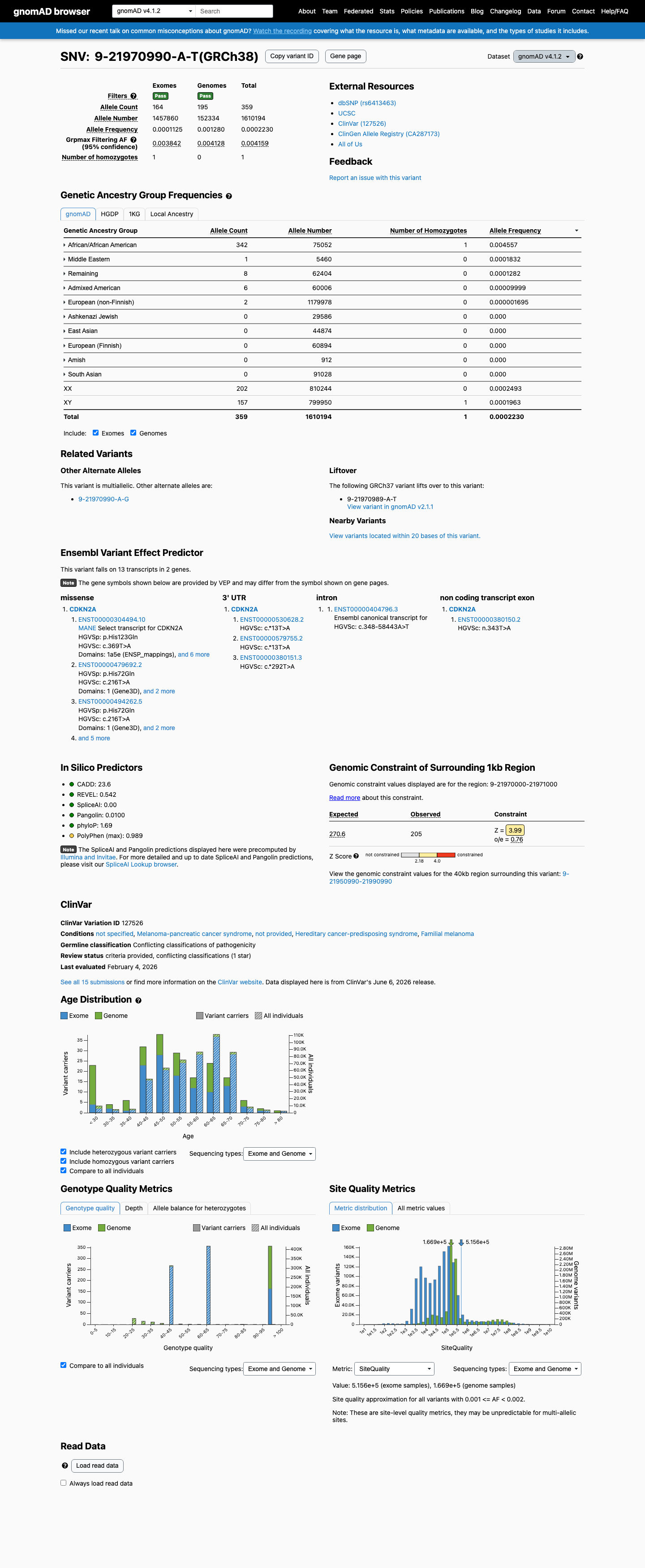
1 hom · FAF 0.42%
African/African American 342 / 75,052 |
0.46% 1 hom |
Middle Eastern 1 / 5,460 |
0.018% |
Remaining individuals 8 / 62,404 |
0.013% |
Admixed American 6 / 60,006 |
0.01% |
European (non-Finnish) 2 / 1,179,978 |
0.00017% |
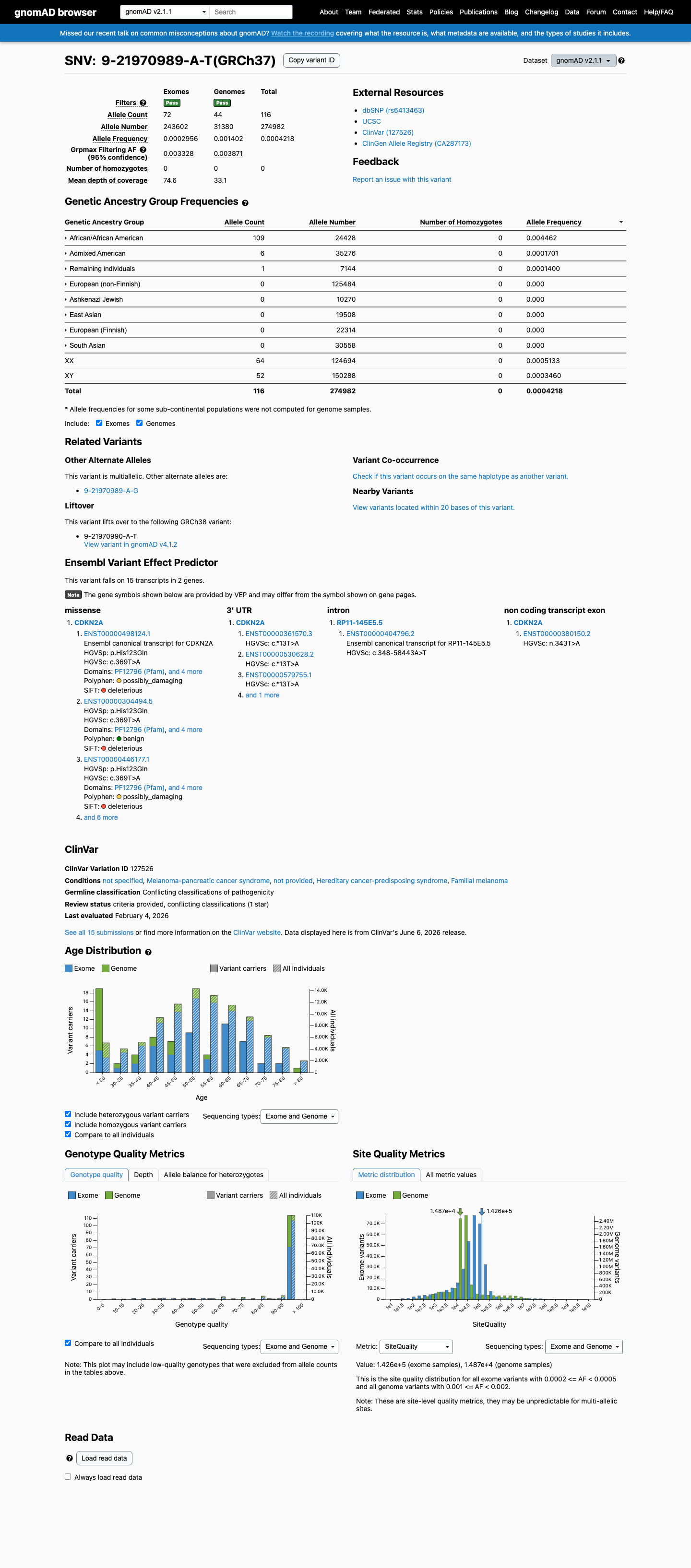
0 hom · FAF 0.39%
African/African American 109 / 24,428 |
0.45% |
Admixed American 6 / 35,276 |
0.017% |
Remaining individuals 1 / 7,144 |
0.014% |
0 hom · FAF 0.035%
African/African American 2 / 1,020 |
0.2% |
Remaining individuals 1 / 1,138 |
0.088% |