This variant was interpreted by pipeline
7.1.0.
The current version is
8.0.0.
Re-running queues a fresh interpretation; the result replaces this page when complete.
Re-runs are not free. Blank = draws on today's public interpretation allowance.
With a code = uses 1 of that code's uses.
FGFR2 encodes a receptor tyrosine kinase in the fibroblast growth factor receptor family that binds fibroblast growth factors and activates signaling pathways (including PI3K/AKT and MAPK) that promote cell growth, division, and differentiation. Germline mutations in FGFR2 cause several inherited craniosynostosis syndromes — including Apert, Crouzon, Pfeiffer, Jackson-Weiss, Beare-Stevenson, and Saethre-Chotzen syndromes — in which the bones of the skull fuse prematurely. FGFR2 also plays an oncogenic role in cancer: somatic mutations, fusions, and amplifications of the gene have been found in endometrial, gastric, and breast cancers and ameloblastomas, and FGFR inhibitors are used as cancer therapies.
This variant
Germline FGFR2 mutations cause autosomal dominant craniosynostosis syndromes, usually through activating missense changes, and this variant is a missense substitution (p.Asp506Tyr) in the kinase-encoding region. Yet it is absent from ClinVar, has no functional or clinical evidence, and is not in a significant hotspot, so the two supporting computational signals are insufficient and it remains a variant of uncertain significance.
Transcript
NM_000141.4
HGVS · transcript:coding
NM_000141.4:c.1516G>T
GRCh38
chr10:121500871 C>A
GRCh37
chr10:123260385 C>A
VUS under generic ACMG/AMP 2015: only PM2 (moderate) and PP3 (supporting) are met, which does not reach any Pathogenic, Likely Pathogenic, or Benign combination threshold.
Classification rationale
PM2PP3VUS
FGFR2 c.1516G>Tmissense
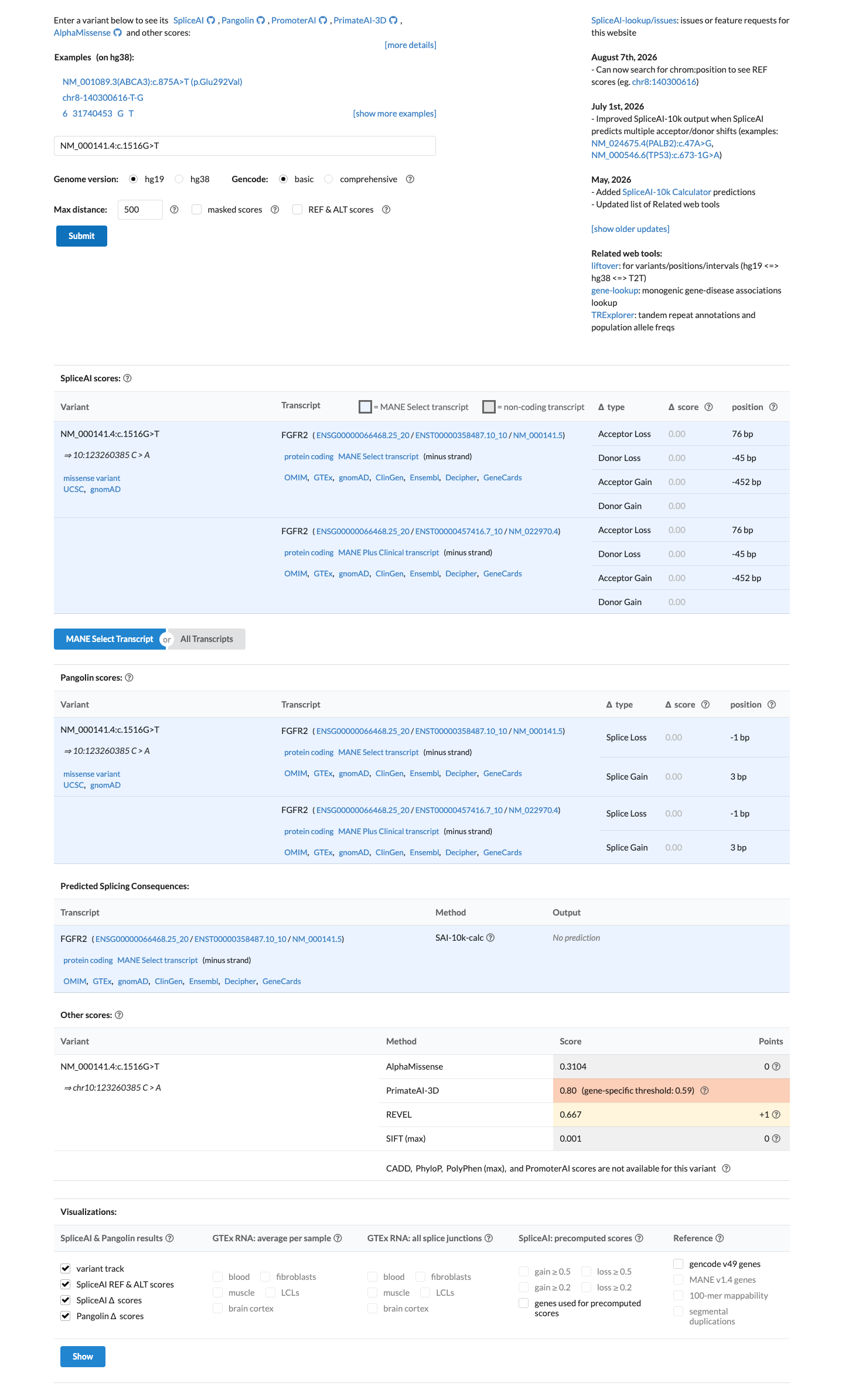
PM2 (Moderate): variant is absent from gnomAD v2.1 and gnomAD-Canada, with a gnomAD v4.1 total allele frequency of 0.00037%, far below the 0.1% PM2 threshold. PP3 (Supporting): REVEL 0.667 and BayesDel noAF 0.100 both fall in the supporting-pathogenic tiers, providing two concordant computational lines for a deleterious effect. Overall classification: VUS, because one moderate (PM2) plus one supporting (PP3) does not satisfy any Pathogenic, Likely Pathogenic, Benign, or Likely Benign combination in the generic ACMG/AMP 2015 rules.
PM2 + PP3→VUS
LYFE Sciences is an AI system, and it can make mistakes. Criteria
may be applied incorrectly, sources may be misread, and a confident-looking
classification can still be wrong. Double-check every criterion and
its underlying evidence before relying on any call.
Gene diagram
· NM_000141.4 · variants mapped to exon structure
FGFR2NM_000141.4
Fetching transcript structure from UCSC…
Exons
—
Transcript span
—
Strand
—
Variants mapped
—
Source
UCSC ncbiRefSeqCurated
All variants in FGFR2—click a row to locate it on the plot · use the link column to open its page
Protein
Location
Classification
Link
Applied criteria · 2 applied · 21 assessed
MetEvidence satisfies this criterion.
Not metEvaluated against available evidence; threshold not reached.
Not assessedApplies in principle, but no evidence was found to evaluate it.
N/ADoesn't apply to this variant type.
Applied · 2
Strength Supporting Moderate Strong Very strong
✓
PM2moderatePathogenic
Met (moderate): absent from gnomAD v2.1 and gnomAD-Canada; gnomAD v4.1 total allele frequency 0.00037%, far below the 0.1% threshold.
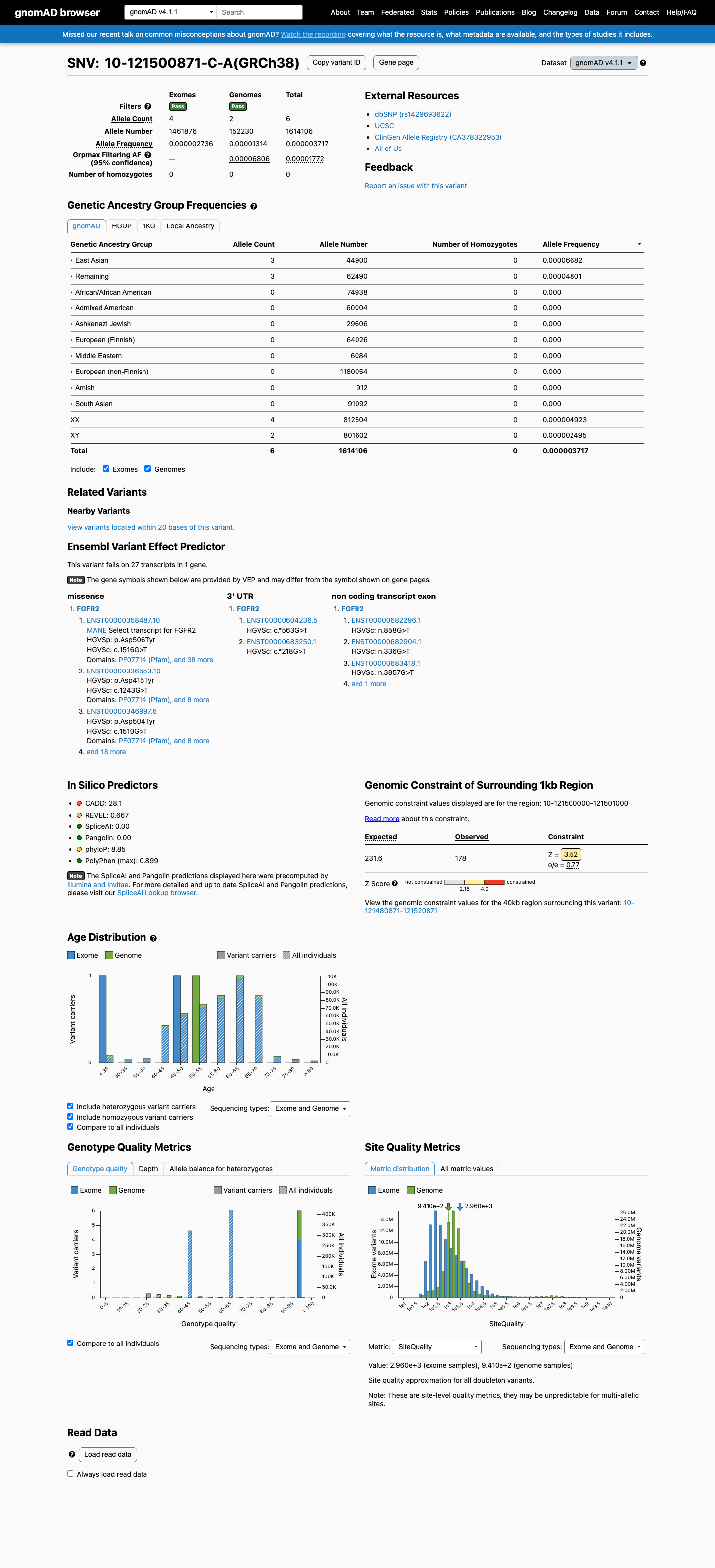
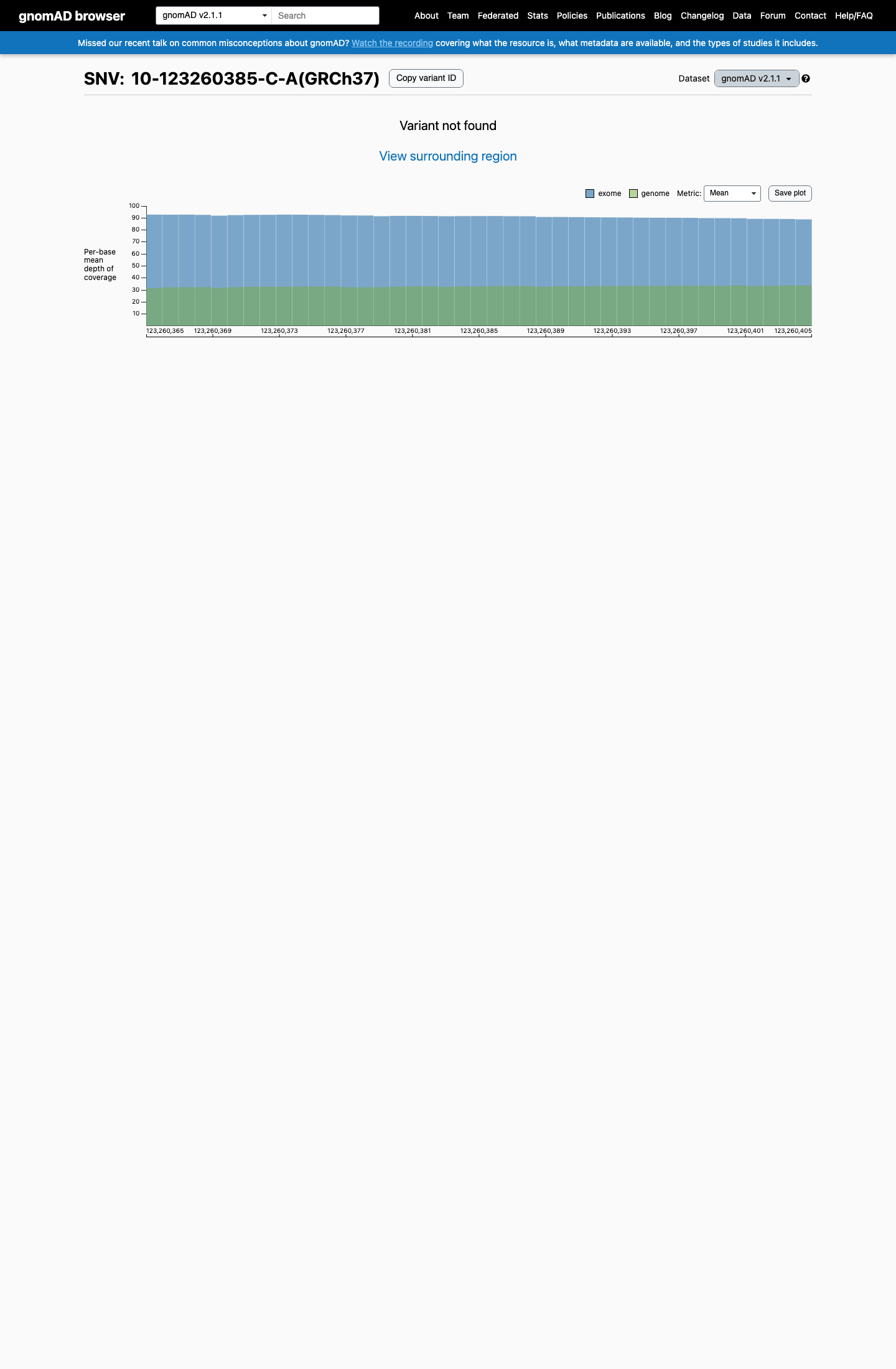
gnomAD v4.1: total AF 3.717e-06 (0.00037%), max subpopulation (East Asian) AF 6.682e-05 (0.00668%), grpmax FAF 1.772e-05, all below 0.1% PM2 thresholdgnomAD v2.1 (GRCh37 10-123260385-C-A): absentgnomAD-Canada v1.0: absent
Assessed · not applied
· 10 not met · 11 not assessed
Pathogenic
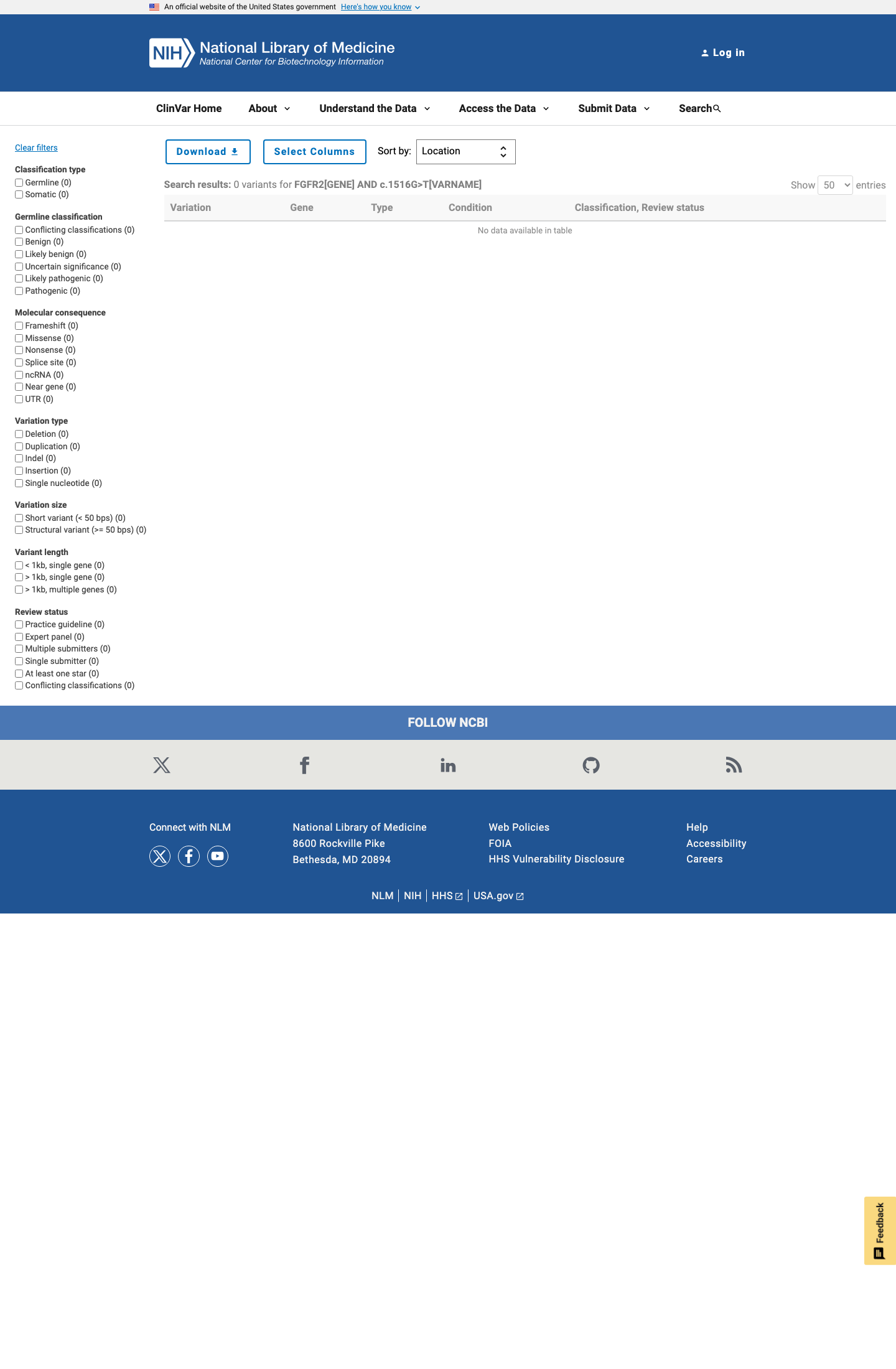
PS1Not met: no previously established pathogenic variant producing p.Asp506Tyr exists; the variant is absent from ClinVar.
PS2Not assessed: no proband or parental-testing data were available to establish a de novo occurrence.
PS3Not assessed: no functional assay evidence exists for this variant; in silico predictions do not qualify as functional studies.
PS4Not assessed: no case-control or cohort data exist; the variant is absent from ClinVar.
PM1Not met: residue 506 is not in a statistically significant Cancer Hotspots region, and no domain-boundary annotation was available.
PM5Not assessed: no established pathogenic missense at residue 506 besides p.Asp506Tyr was available for comparison.
PM6Not assessed: no proband or parental sequencing data exist to support an assumed de novo event.
PP1Not assessed: no family or segregation data exist for this variant.
PP2Not assessed: missense is a common FGFR2 disease mechanism, but no missense-constraint metric (e.g., gnomAD Z-score) was available.
PP4Not assessed: no proband phenotype or family-history data were available.
PP5Not met: no ClinVar expert-panel classification exists for this variant; it is absent from ClinVar.
Benign
BA1Not met: highest population frequency 0.00668% (East Asian), far below the 1% BA1 threshold.
BS1Not met: highest subpopulation frequency 0.00668%, more than 40-fold below the 0.3% BS1 threshold.
BS2Not met: no homozygous carriers in gnomAD v4.1 (0 homozygotes across 1,614,106 alleles).
BS3Not assessed: no functional studies demonstrating a lack of damaging effect were available.
BS4Not assessed: no family testing data exist to evaluate non-segregation.
BP1Not met: FGFR2 germline disease is caused by activating missense variants, so missense is a major disease mechanism.
BP2Not met: no proband, phasing, or co-occurrence data exist; only population allele counts were observed.
BP4Not met: REVEL 0.667 and BayesDel 0.100 both predict a deleterious effect, contradicting a no-impact call.
BP5Not assessed: no proband data exist to determine whether an alternate molecular cause of disease is present.
BP6Not met: no ClinVar expert-panel benign classification exists; the variant is absent from ClinVar.
N/A · 5PVS1 · PM3 · PM4 · BP3 · BP7
Research & evidence
Population frequency
gnomAD v4.1
gnomAD v2.1
v4.1
This variant is present in gnomAD v4.1 (AF= 3.71723e-06; MAF= 0.00037%, 6/1614106 alleles, homozygotes = 0) and has highest observed frequency in the East Asian population (AF= 6.68151e-05; MAF= 0.00668%, 3/44900 alleles, homozygotes = 0); grpmax FAF= 1.772e-05.
v2.1
Absent from gnomAD v2.1.
🇨🇦 CA
Absent from gnomAD-Canada v1.0.
Allele frequency by ancestry
three datasets · side by side
gnomAD v4.1
0.00037%
· 6 / 1,614,106
0 hom · FAF 0.0018%
East Asian
3 / 44,900
0.0067%
Remaining individuals
3 / 62,490
0.0048%
+ 8 not observed (Admixed American, European (Finnish), Amish, Middle Eastern, South Asian, Ashkenazi Jewish, African/African American, European (non-Finnish))
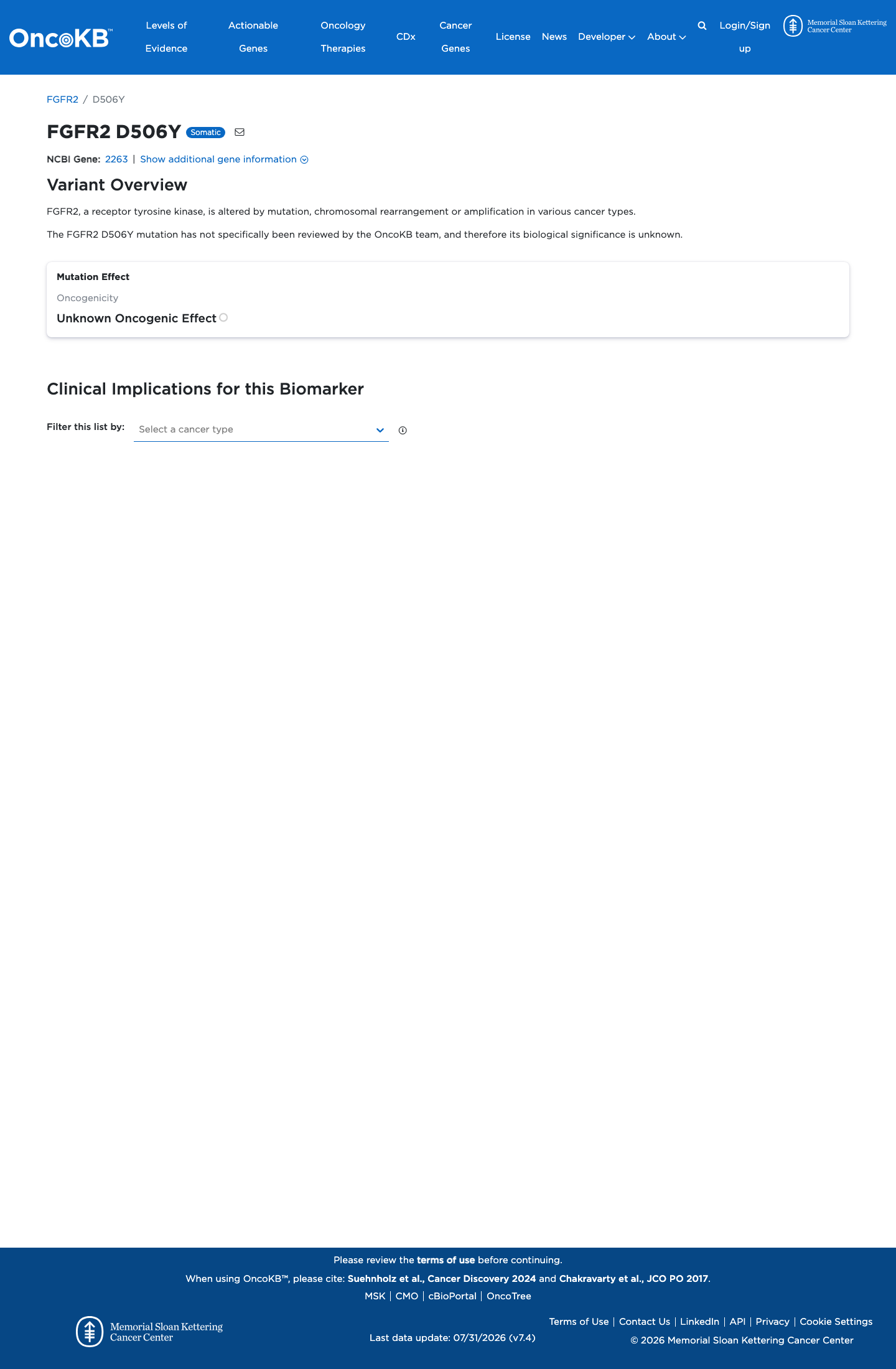
OncoKB did not identify variant-specific reviewed functional evidence for this variant; gene-level curated context is available for reviewer follow-up. FGFR2, a receptor tyrosine kinase, is altered by mutation, chromosomal rearrangement or amplification in various cancer types.