Back
NM_000141.4:c.346G>A
p.Glu116Lys · FGFR2
ACMG/AMP
0%
complete
Final classification
VUS
PM2BP4
FGFR2
c.346G>A
p.Glu116Lys
missense

FGFR2 encodes a receptor tyrosine kinase in the fibroblast growth factor receptor family that binds fibroblast growth factors and activates signaling pathways (including PI3K/AKT and MAPK) that promote cell growth, division, and differentiation. Germline mutations in FGFR2 cause several inherited craniosynostosis syndromes — including Apert, Crouzon, Pfeiffer, Jackson-Weiss, Beare-Stevenson, and Saethre-Chotzen syndromes — in which the bones of the skull fuse prematurely. FGFR2 also plays an oncogenic role in cancer: somatic mutations, fusions, and amplifications of the gene have been found in endometrial, gastric, and breast cancers and ameloblastomas, and FGFR inhibitors are used as cancer therapies.

This variant

FGFR2 germline missense variants cause autosomal dominant craniosynostosis syndromes (Apert, Crouzon, Pfeiffer) through activating effects, and p.Glu116Lys falls in the extracellular ligand-binding region where such variants act. Because no established pathogenic record exists and the evidence is conflicting - ultra-rare population frequency but uniformly benign computational predictions - this variant remains a VUS, neither demonstrated to cause FGFR2-related disease nor shown to be benign.

Transcript
NM_000141.4
HGVS · transcript:coding
NM_000141.4:c.346G>A
GRCh38
chr10:121565468 C>T
GRCh37
chr10:123324982 C>T
VUS: only PM2 (supporting, pathogenic) and BP4 (supporting, benign) are met, and this conflicting one-plus-one combination satisfies no ACMG/AMP 2015 rule.
Classification rationale
PM2 BP4 VUS
FGFR2 c.346G>A missense

PM2 (Supporting): allele frequency 1.24e-06 (2/1,614,194 alleles) is far below the 0.1% threshold, and the variant is absent from gnomAD v2.1. BP4 (Supporting): REVEL 0.26, BayesDel -0.24425, and SpliceAI max delta 0.09 all predict no impact on the gene product. VUS: one supporting pathogenic criterion (PM2) and one supporting benign criterion (BP4) conflict and satisfy no ACMG/AMP 2015 combination rule.

PM2 + BP4 VUS
LYFE Sciences is an AI system, and it can make mistakes. Criteria may be applied incorrectly, sources may be misread, and a confident-looking classification can still be wrong. Double-check every criterion and its underlying evidence before relying on any call.
Gene diagram · NM_000141.4 · variants mapped to exon structure
FGFR2 NM_000141.4
Fetching transcript structure from UCSC…
Applied criteria · 2 applied · 19 assessed
MetEvidence satisfies this criterion.
Not metEvaluated against available evidence; threshold not reached.
Not assessedApplies in principle, but no evidence was found to evaluate it.
N/ADoesn't apply to this variant type.
Applied · 2
Strength Supporting Moderate Strong Very strong
PM2 supporting Pathogenic
Met (supporting): allele frequency 1.24e-06 (2/1,614,194 alleles, 0.00012%) is far below the 0.1% threshold, and the variant is absent from gnomAD v2.1.
gnomad_v4gnomad_v2gnomad_canada
BP4 supporting Benign
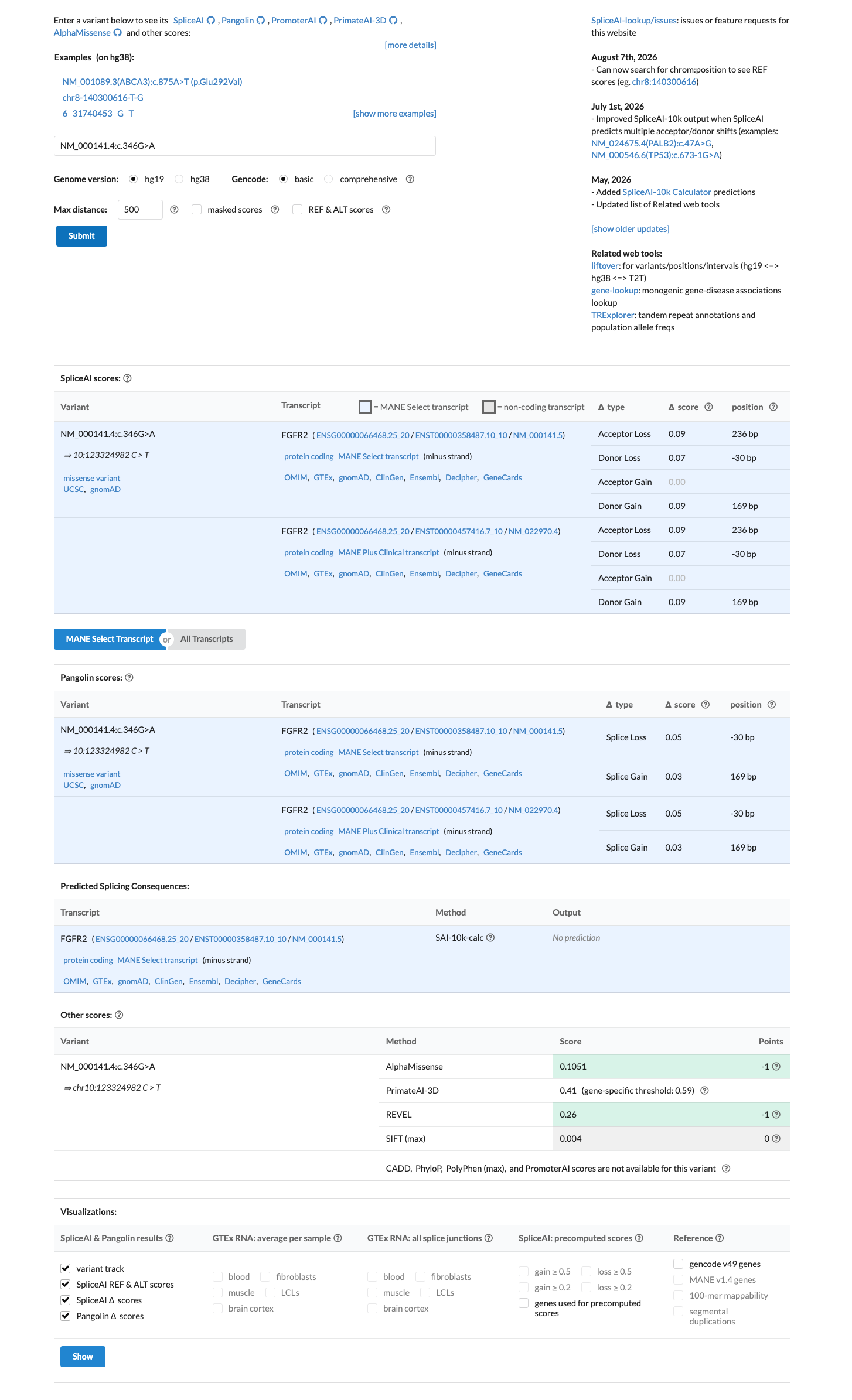
Met (supporting): REVEL 0.26 (benign-supporting band 0.183-0.290), BayesDel -0.24425, and SpliceAI max delta 0.09 (below 0.2) all predict no impact.
REVEL score 0.26 (local lookup, revel-v1.3) - benign-supporting band (0.183-0.290) per ClinGen SVI calibration verified against PMID 36413997; supports no impact on FGFR2BayesDel noAF score -0.24425 (local lookup, BayesDel_170824_noAF_chr10) - benign-supporting tier (-0.36 to -0.18) per pipeline SVCv4 ladder (placeholder calibration); supports no impact, concordant with REVELSpliceAI max delta score 0.09 (DS_AG 0.0, DS_AL 0.09, DS_DG 0.09, DS_DL 0.07; variant_consequence=sequence_variant) - below the 0.2 splice-impact threshold; no predicted splice impact for this exonic missense
Assessed · not applied · 6 not met · 13 not assessed
Pathogenic
PS1 Not assessed: no established pathogenic variant producing p.Glu116Lys is documented in ClinVar or the literature.
PS2 Not assessed: no proband genotype, parental testing, or de novo evidence is available for this variant.
PS3 Not assessed: no well-established functional study of p.Glu116Lys was available.
PS4 Not assessed: no case-control or affected-cohort data exist; the only occurrence is 3 somatic cancer entries in COSMIC.
PM1 Not met: p.Glu116 is not a statistically significant mutation hotspot, and no source places it in a critical functional domain.
PM5 Not assessed: no different pathogenic missense at p.Glu116 (e.g., p.Glu116Val) is documented in ClinVar or the literature.
PM6 Not assessed: no de novo occurrence of c.346G>A is documented in any proband.
PP1 Not assessed: no family or pedigree data exist to evaluate co-segregation of c.346G>A with disease.
PP2 Not assessed: FGFR2 missense variants are a known disease mechanism, but missense constraint metrics needed for the second prong are unavailable.
PP3 Not met: all computational lines are neutral - SpliceAI max delta 0.09 vs 0.2, REVEL 0.26 vs 0.644, BayesDel -0.24425 - so no deleterious effect is predicted.
PP4 Not assessed: no proband phenotype or family history is available to evaluate phenotype specificity.
Benign
BA1 Not met: highest observed allele frequency is 1.69e-06 (0.00017%), roughly 4 orders of magnitude below the 1% BA1 threshold.
BS1 Not met: observed allele frequency 1.24e-06 (0.00012%) is over 3 orders of magnitude below the 0.3% BS1 threshold.
BS2 Not met: only 2 heterozygous carriers (0 homozygotes) among 1,614,194 alleles, far short of the multiple healthy-adult observations BS2 requires.
BS3 Not assessed: no functional study showing absence of a damaging effect is available; in silico predictions do not qualify.
BS4 Not assessed: no family data exist to evaluate non-segregation of the variant.
BP1 Not met: FGFR2 disease is caused by activating missense variants, not truncating variants, so BP1's premise does not apply.
BP2 Not assessed: no proband observation with phase information relative to a pathogenic FGFR2 variant is available.
BP5 Not assessed: no proband molecular workup exists to establish an alternate molecular basis for disease.
N/A · 7 PVS1 · PM3 · PM4 · PP5 · BP3 · BP6 · BP7
Research & evidence
Population frequency
gnomAD v4.1 screenshot
gnomAD v4.1
gnomAD v2.1 screenshot
gnomAD v2.1
v4.1
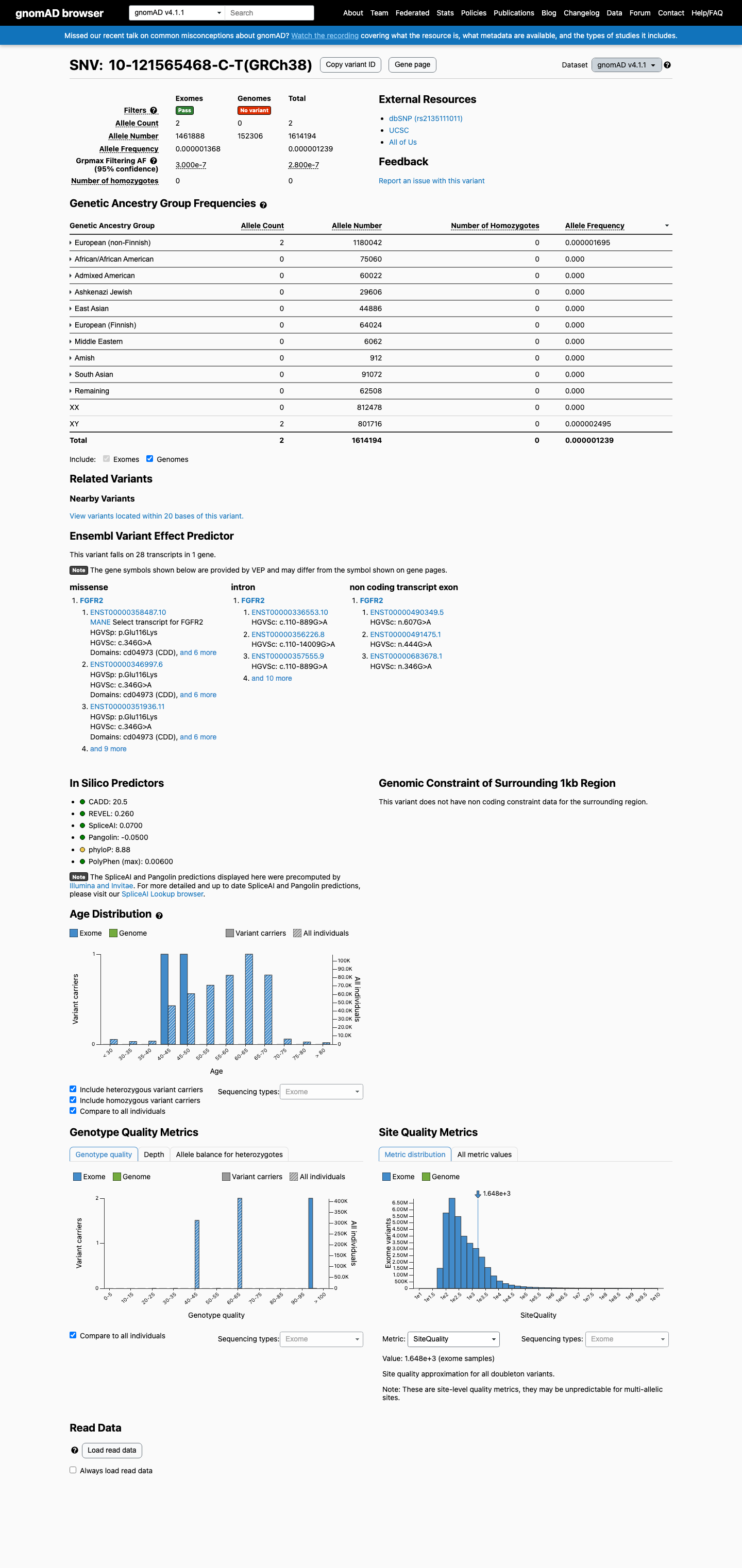
This variant is present in gnomAD v4.1 (AF= 1.23901e-06; MAF= 0.00012%, 2/1614194 alleles, homozygotes = 0) and has highest observed frequency in the European (non-Finnish) population (AF= 1.69485e-06; MAF= 0.00017%, 2/1180042 alleles, homozygotes = 0); grpmax FAF= 2.8e-07.
v2.1
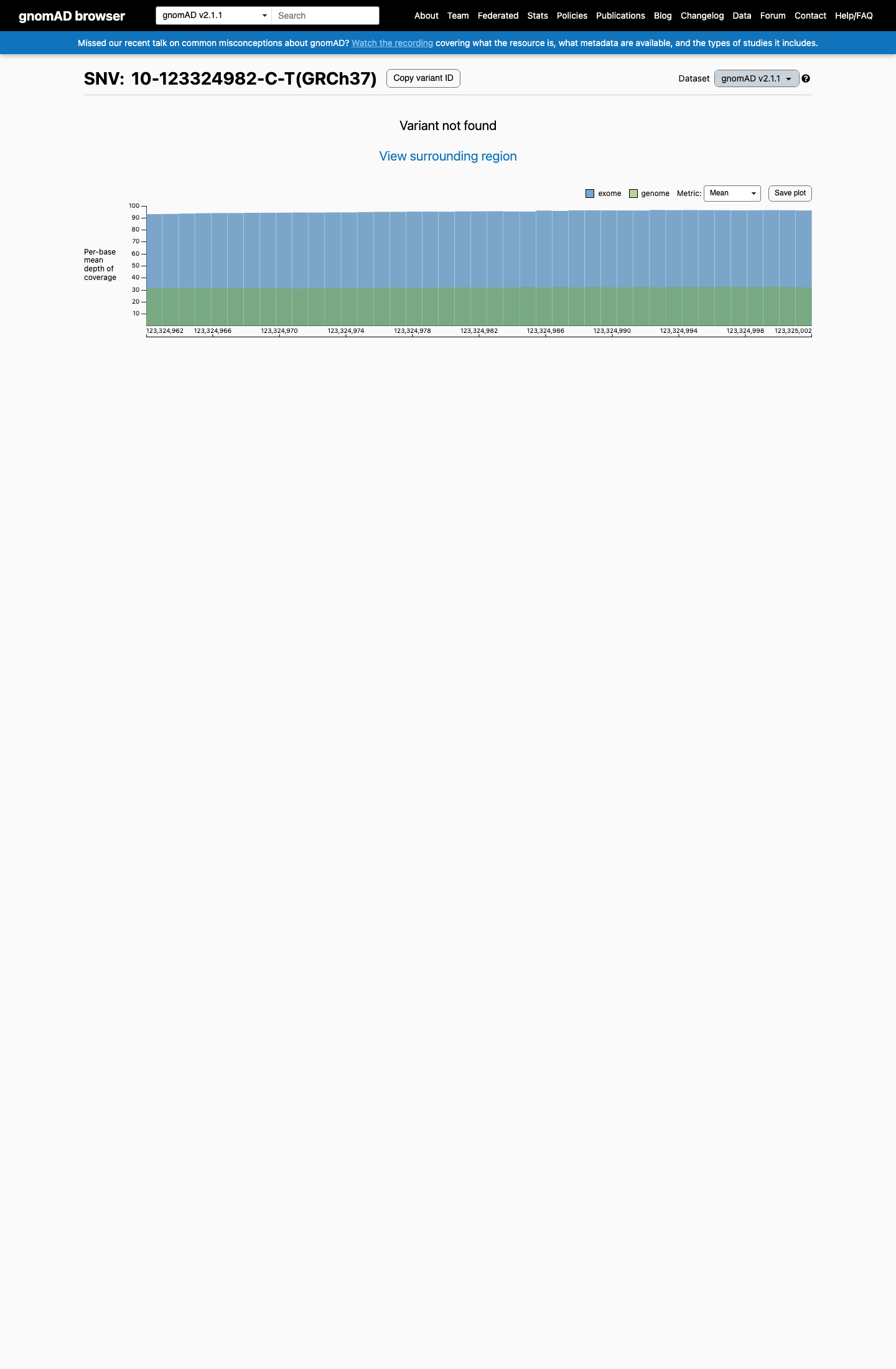
Absent from gnomAD v2.1.
🇨🇦 CA
Absent from gnomAD-Canada v1.0.
Allele frequency by ancestry
three datasets · side by side
gnomAD v4.1
0.00012% · 2 / 1,614,194
0 hom · FAF 2.8e-05%
European (non-Finnish)
2 / 1,180,042
0.00017%
+ 9 not observed (Remaining individuals, Admixed American, European (Finnish), Amish, East Asian, Middle Eastern, South Asian, Ashkenazi Jewish, African/African American)
gnomAD v2.1
Absent · 0 / ?
0 hom
Not observed in any ancestry group.
gnomAD Canada 🇨🇦
Absent · 0 / ?
0 hom
Not observed in any ancestry group.
ClinVar screenshot
ClinVar
This variant is absent from ClinVar.
SpliceAI screenshot
In silico
SpliceAI predicts no significant splice impact for this variant (max delta score = 0.09). REVEL score = 0.26. BayesDel score = -0.24425.
Functional / OncoKB screenshot
Functional Unknown Oncogenic Effect
OncoKB did not identify variant-specific reviewed functional evidence for this variant; gene-level curated context is available for reviewer follow-up. FGFR2, a receptor tyrosine kinase, is altered by mutation, chromosomal rearrangement or amplification in various cancer types.
OncoKB ↗
COSMIC screenshot
COSMIC
Cancer hotspots screenshot
Cancer hotspots
Somatic evidence Not in COSMIC / hotspots
COSMIC
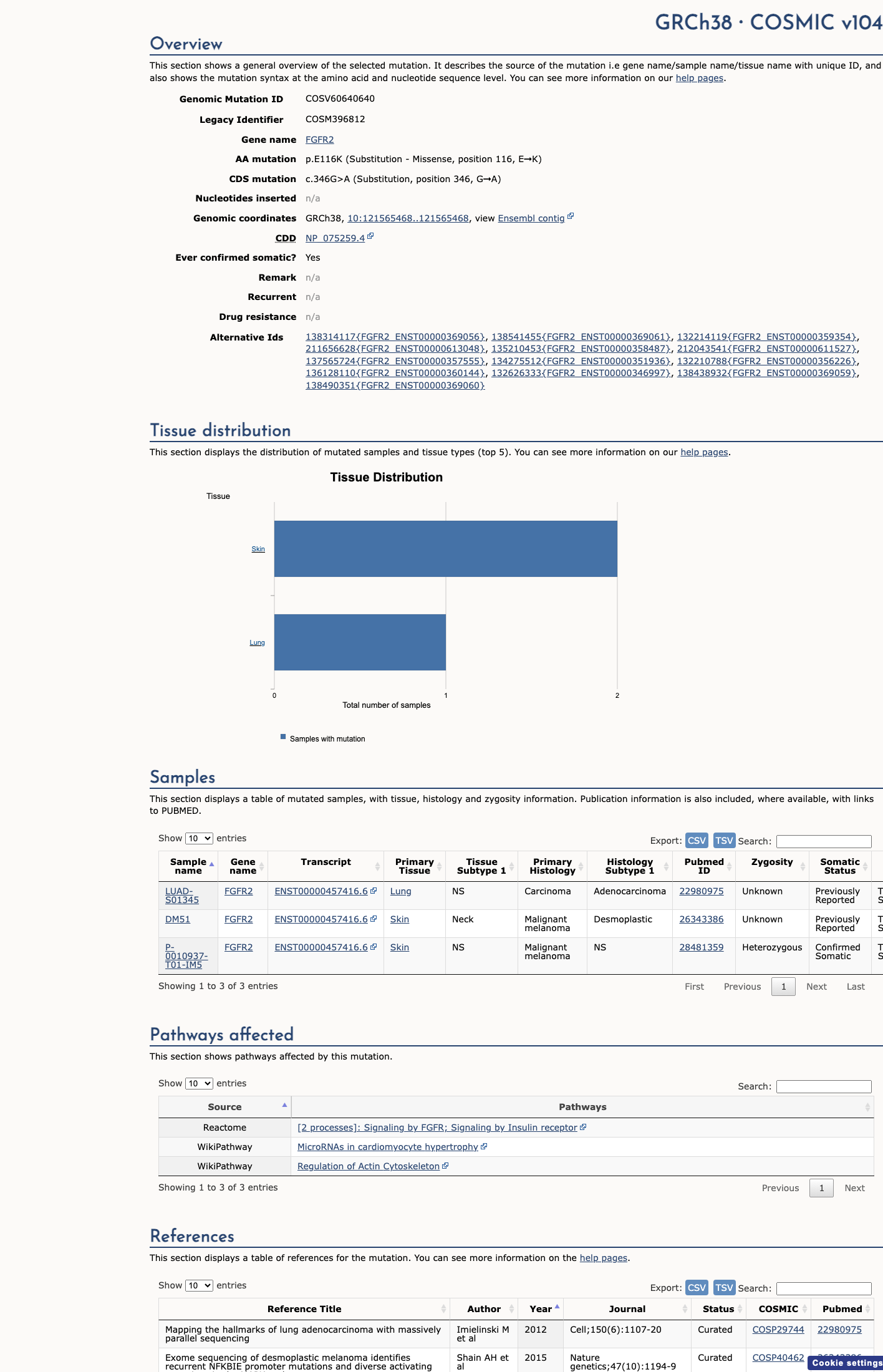
This variant does not lie in a statistically significant hotspot. This variant has previously been reported in somatic cancers (COSMIC; COSV60640640, n = 3 times).
Hotspots
This variant does not lie in a statistically significant hotspot.
Sources & reference links
8Sources
ClinVar
gnomAD v2.1
gnomAD v4.1
gnomAD-Canada
SpliceAI
OncoKB
COSMIC
Cancer hotspots