Back
NM_000142.4:c.1172C>T
p.Ala391Val · FGFR3
ACMG/AMP
0%
complete
Final classification
Likely Pathogenic
PM1PM2PM5PP2BP4
FGFR3
c.1172C>T
p.Ala391Val
missense

FGFR3 is a receptor tyrosine kinase in the fibroblast growth factor receptor family that helps regulate cell growth, differentiation, and bone development and maintenance. Germline mutations in FGFR3 cause craniosynostosis and several forms of skeletal dysplasia, as well as skin and hair follicle disorders. In cancer, activating mutations in FGFR3 are found in a large proportion of bladder cancers and less commonly in other solid tumors, and a specific FGFR3 translocation occurs in about 15% of multiple myeloma cases.

This variant

FGFR3 germline mutations cause craniosynostosis and skeletal dysplasias, and this variant sits in the transmembrane domain at the same residue as the recurrent disease-causing p.Ala391Glu change. The Likely Pathogenic classification therefore places p.Ala391Val within FGFR3's germline skeletal and craniosynostosis disease spectrum, consistent with an activating missense mechanism, rather than FGFR3's cancer-associated mutation pattern.
Transcript
NM_000142.4
HGVS · transcript:coding
NM_000142.4:c.1172C>T
GRCh38
chr4:1804426 C>T
GRCh37
chr4:1806153 C>T
With no FGFR3-specific framework available, generic ACMG/AMP 2015 rules apply: 2 moderate (PM1, PM5) plus 2 supporting (PM2, PP2) pathogenic criteria meet the Likely Pathogenic combination, and the single supporting benign criterion (BP4) does not offset it.
Classification rationale
PM1PM2PM5PP2 BP4 Likely Pathogenic
FGFR3 c.1172C>T missense

PM1 (Moderate): residue 391 lies in the FGFR3 transmembrane domain, a critical functional domain with multiple established disease-causing mutations. PM5 (Moderate): p.Ala391Glu, a different missense change at the same residue, is a well-established recurrent pathogenic mutation causing Crouzon syndrome with acanthosis nigricans. PM2 (Supporting): gnomAD v4.1 allele frequency is 0.00074% with zero homozygotes, well below the 0.1% threshold. PP2 (Supporting): missense mutations are the dominant mechanism of FGFR3 germline disease. BP4 (Supporting): all computational predictors indicate no impact (SpliceAI 0.01, REVEL 0.162, BayesDel -0.317). Final classification: Likely Pathogenic, per the generic ACMG/AMP rule of 2 moderate + 2 supporting pathogenic criteria (PM1, PM5, PM2, PP2); the lone supporting benign criterion (BP4) does not reach a benign or likely-benign threshold.

PM1 + PM2 + PM5 + PP2 + BP4 Likely Pathogenic
LYFE Sciences is an AI system, and it can make mistakes. Criteria may be applied incorrectly, sources may be misread, and a confident-looking classification can still be wrong. Double-check every criterion and its underlying evidence before relying on any call.
Gene diagram · NM_000142.4 · variants mapped to exon structure
FGFR3 NM_000142.4
Fetching transcript structure from UCSC…
Applied criteria · 5 applied · 18 assessed
MetEvidence satisfies this criterion.
Not metEvaluated against available evidence; threshold not reached.
Not assessedApplies in principle, but no evidence was found to evaluate it.
N/ADoesn't apply to this variant type.
Applied · 5
Strength Supporting Moderate Strong Very strong
PM1 moderate Pathogenic
Met (moderate): residue 391 lies in the FGFR3 transmembrane domain, a critical functional domain harboring multiple disease-causing mutations.
PMID:11426459: 'Ala391Glu substitution in the transmembrane domain of FGFR3' and 'Nearby substitutions in the transmembrane domain of FGFR3 (Gly380Arg and Gly375Cys) cause achondroplasia'PMID:8880573: ala391glu 'within the transmembrane region' of FGFR3cancerhotspots.org (evidence.json, hotspots): no statistically significant hotspot at FGFR3 A391 (PM1 met via functional-domain arm, not hotspot arm)
PM2 supporting Pathogenic
Met (supporting): gnomAD v4.1 allele frequency is 0.00074% with zero homozygotes, far below the 0.1% PM2 threshold.
gnomAD v4.1: total AF 7.44e-06 (0.00074%), grpmax FAF 1.83e-06, 0 homozygotesgnomAD v2.1: total AF 3.56e-06 (0.00036%), 0 homozygotesgnomAD v4.1 subpopulations: MID 1/6,052 (0.0165%), EAS 1/44,884, SAS 1/90,940, NFE 6/1,179,488; all <0.1%
PM5 moderate Pathogenic
Met (moderate): a different missense change at the same residue, p.Ala391Glu, is a well-established recurrent pathogenic mutation causing Crouzon syndrome with acanthosis nigricans.
PMID:8880573: 'A recurrent mutation, ala391glu, causes Crouzon syndrome and acanthosis nigricans' - 'a specific gcg to gag transversion, resulting in an amino acid substitution ala391glu within the transmembrane region' (3 unrelated patients)PMID:11426459: 'A recurring mutation (heterozygous C to A transversion at nucleotide 1,172) resulting in an Ala391Glu substitution in the transmembrane domain of FGFR3 has been identified in 10 patients with CAN'PMID:20199409: 'Molecular analysis by sequencing confirmed Ala391Glu substitution' in a newborn with CAN
PP2 supporting Pathogenic
Met (supporting): missense mutations are the established dominant mechanism of FGFR3 germline disease.
PMID:11426459: multiple disease-causing FGFR3 missense mutations - Lys650Met (TD1), Gly380Arg and Gly375Cys (achondroplasia), Ala391Glu (CAN)PMID:8880573: recurrent missense ala391glu causes Crouzon syndrome with acanthosis nigricansPMID:20199409: FGFR3 Ala391Glu missense confirmed in CAN case
BP4 supporting Benign
Met (supporting): all three computational lines predict no impact (SpliceAI 0.01, REVEL 0.162, BayesDel -0.317).
SpliceAI max delta score = 0.01 (DS_AG 0.0, DS_AL 0.0, DS_DG 0.01, DS_DL 0.0) -> no predicted splice impactREVEL score = 0.162 -> low/benign rangeBayesDel noAF score = -0.317094 -> negative/benign range
Assessed · not applied · 8 not met · 10 not assessed
Pathogenic
PS1 Not met: the established pathogenic change at residue 391 is p.Ala391Glu, a different amino acid change from this p.Ala391Val.
PS2 Not assessed: no parental-testing data exists for this exact variant.
PS3 Not assessed: no functional study of this variant was available.
PS4 Not assessed: no case-control or cohort prevalence study of this exact variant was available.
PM6 Not assessed: no de novo evidence for this exact variant was available.
PP1 Not assessed: no co-segregation data for this exact variant was available.
PP3 Not met: all computational tools predict no impact (SpliceAI 0.01, REVEL 0.162, BayesDel -0.317).
PP4 Not assessed: no proband phenotype or family-history data was available.
PP5 Not met: no ClinVar expert-panel classification exists for this variant.
Benign
BA1 Not met: highest allele frequency is 0.0165%, far below the 1% BA1 threshold.
BS1 Not met: highest allele frequency is 0.0165%, below the 0.3% BS1 threshold.
BS2 Not met: no homozygotes are observed and carriers lack phenotype-verified healthy-adult documentation.
BS3 Not assessed: no functional study demonstrating a lack of damaging effect was available.
BS4 Not assessed: no non-segregation evidence for this exact variant was available.
BP1 Not met: FGFR3 germline disease is caused by activating missense mutations, not truncating variants.
BP2 Not assessed: no trans/cis phase data with a pathogenic variant was available.
BP5 Not assessed: no proband-level data was available to evaluate an alternate molecular basis.
BP6 Not met: no ClinVar expert-panel benign classification exists for this variant.
N/A · 5 PVS1 · PM3 · PM4 · BP3 · BP7
Research & evidence
Population frequency · supports pathogenic
gnomAD v4.1 screenshot
gnomAD v4.1
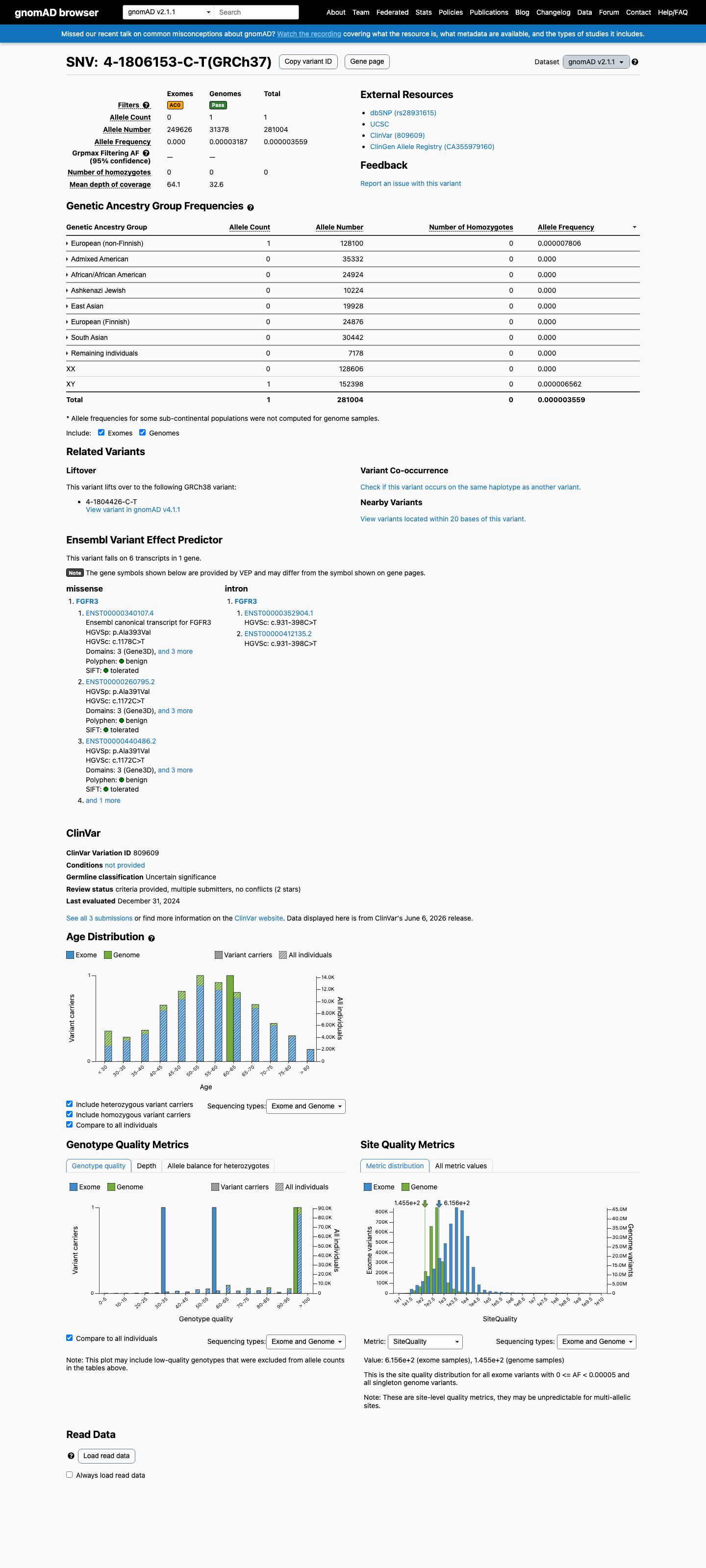
gnomAD v2.1 screenshot
gnomAD v2.1
v4.1
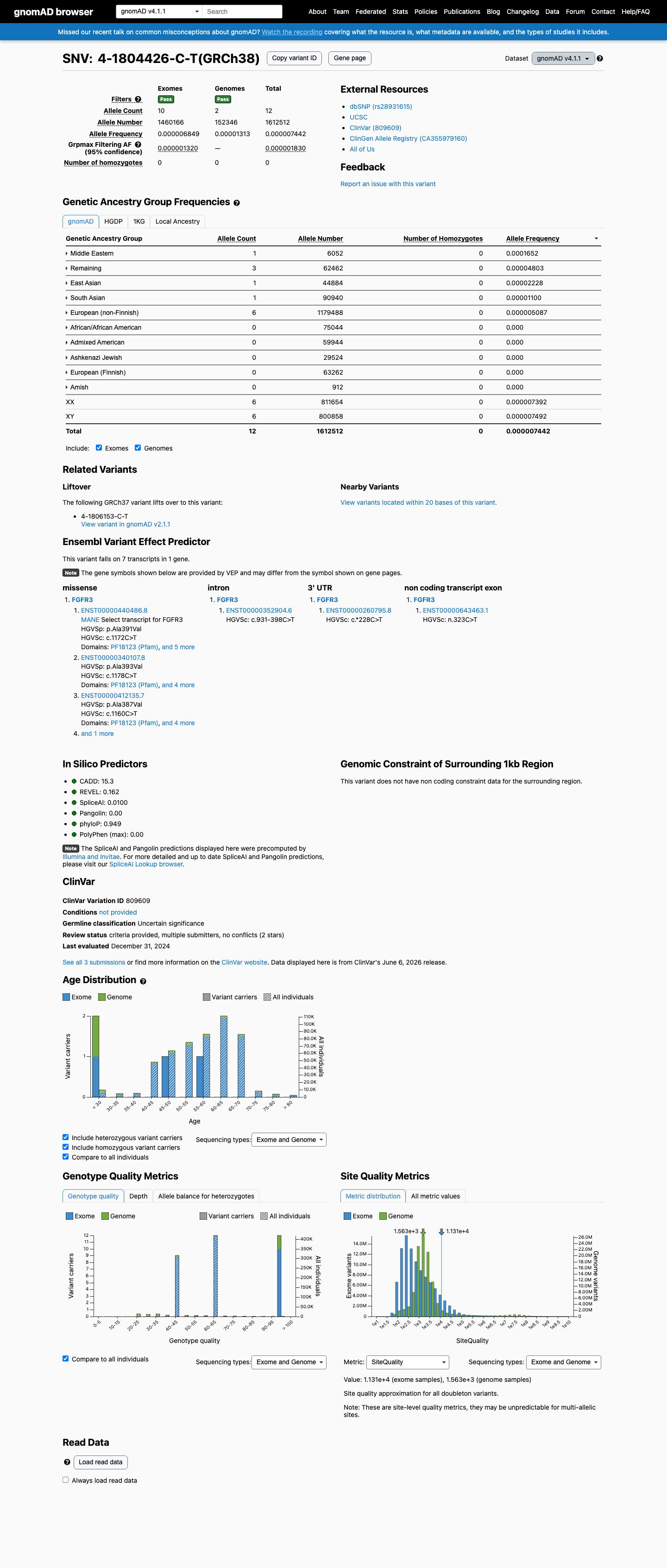
This variant is present in gnomAD v4.1 (AF= 7.44181e-06; MAF= 0.00074%, 12/1612512 alleles, homozygotes = 0) and has highest observed frequency in the Middle Eastern population (AF= 0.000165235; MAF= 0.01652%, 1/6052 alleles, homozygotes = 0); grpmax FAF= 1.83e-06.
v2.1
This variant is present in gnomAD v2.1 (AF= 3.55867e-06; MAF= 0.00036%, 1/281004 alleles, homozygotes = 0) and has highest observed frequency in the European (non-Finnish) population (AF= 7.8064e-06; MAF= 0.00078%, 1/128100 alleles, homozygotes = 0).
🇨🇦 CA
Not available in gnomAD-Canada v1.0.
Allele frequency by ancestry
three datasets · side by side
gnomAD v4.1
0.00074% · 12 / 1,612,512
0 hom · FAF 0.00018%
Middle Eastern
1 / 6,052
0.017%
Remaining individuals
3 / 62,462
0.0048%
East Asian
1 / 44,884
0.0022%
South Asian
1 / 90,940
0.0011%
European (non-Finnish)
6 / 1,179,488
0.00051%
+ 5 not observed (Admixed American, European (Finnish), Amish, Ashkenazi Jewish, African/African American)
gnomAD v2.1
0.00036% · 1 / 281,004
0 hom
European (non-Finnish)
1 / 128,100
0.00078%
+ 7 not observed (African/African American, Admixed American, Ashkenazi Jewish, East Asian, European (Finnish), Remaining individuals, South Asian)
gnomAD Canada 🇨🇦
Absent · 0 / ?
0 hom
Not observed in any ancestry group.
ClinVar screenshot
ClinVar
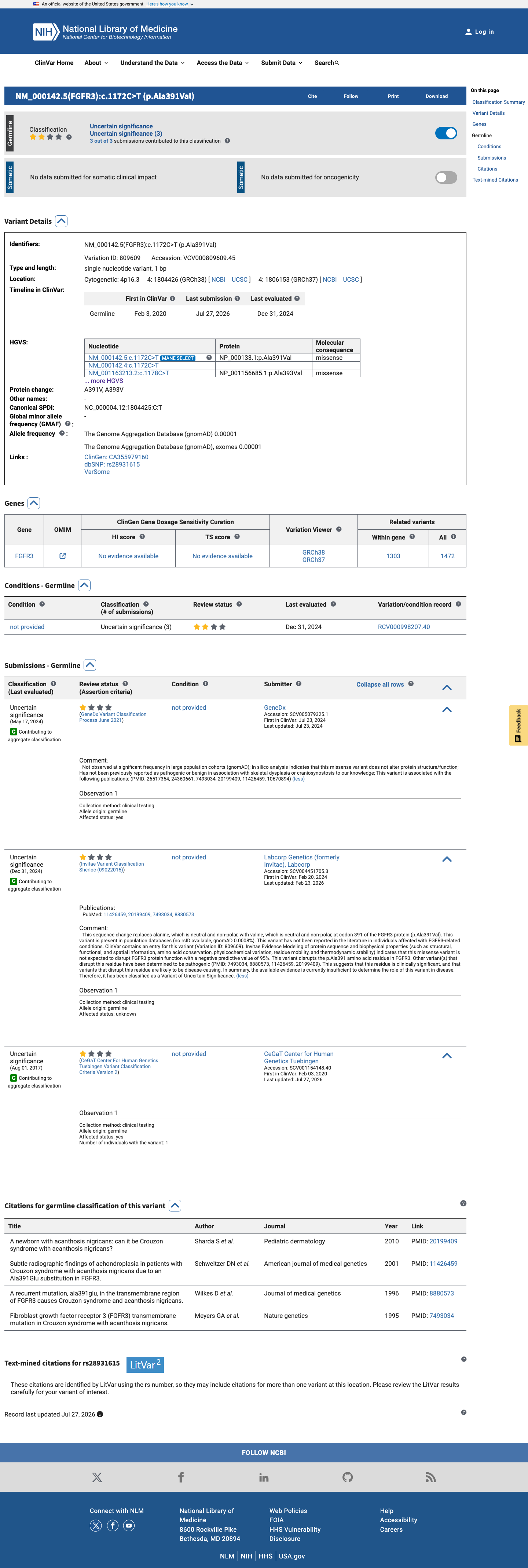
This variant has been reported in ClinVar as Uncertain significance (3 clinical laboratories). (ClinVarID = 809609)
SpliceAI screenshot
In silico
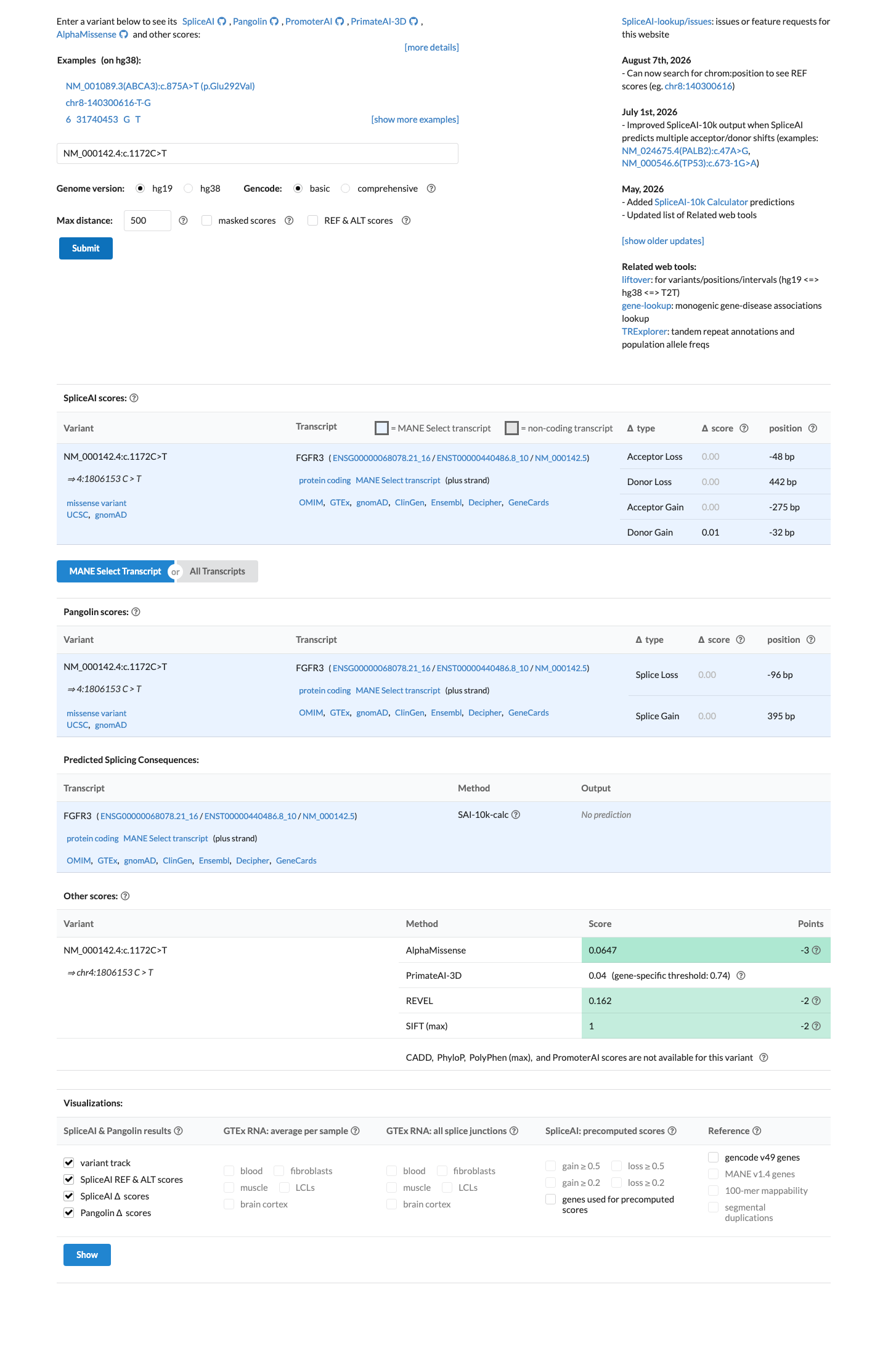
SpliceAI predicts no significant splice impact for this variant (max delta score = 0.01). REVEL score = 0.162. BayesDel score = -0.317094.
Functional / OncoKB screenshot
Functional Inconclusive
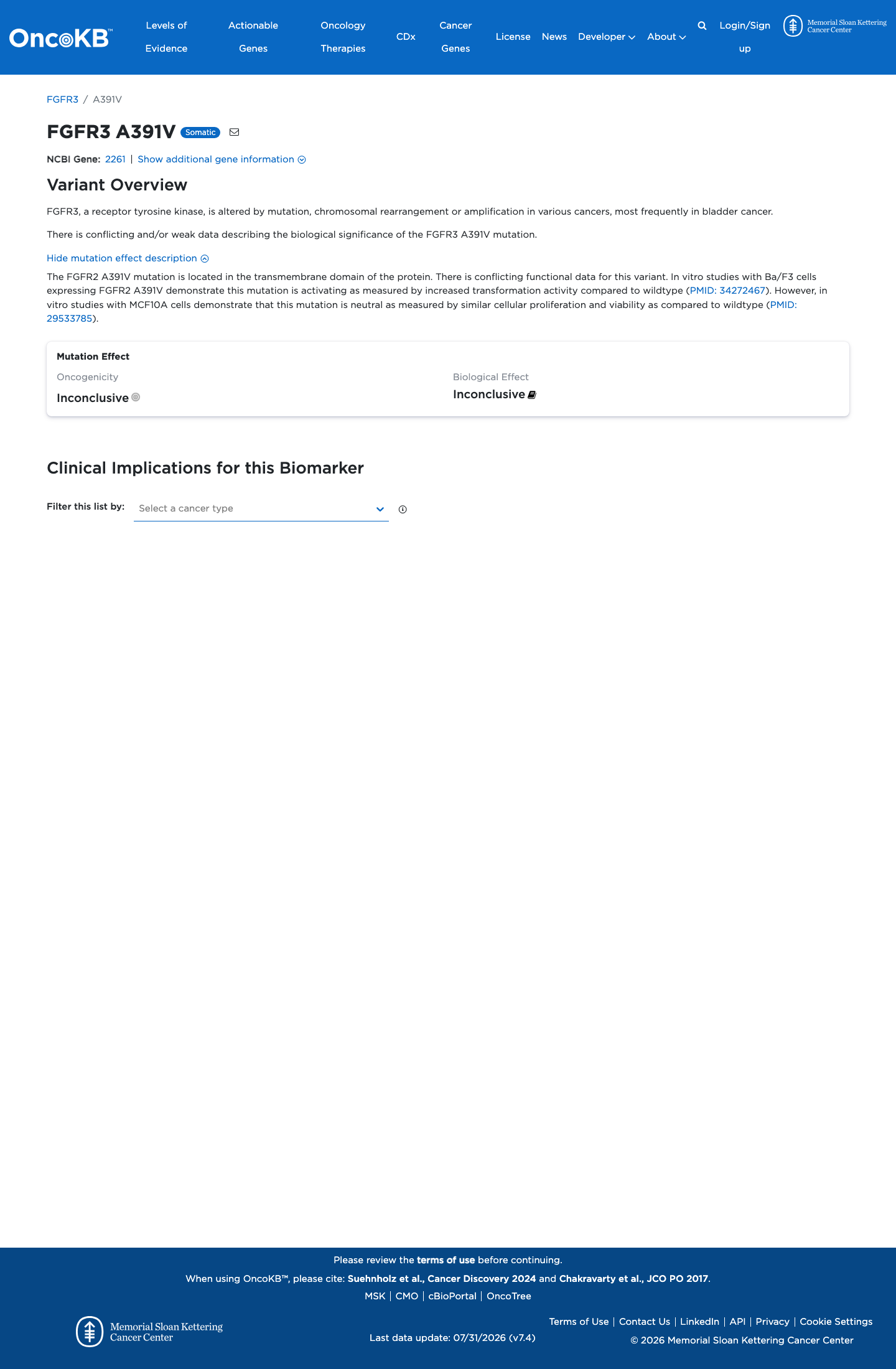
OncoKB identified variant-specific curated literature and context relevant to functional review; biological-effect context: Inconclusive; curated oncogenicity label: Inconclusive.
OncoKB ↗
COSMIC screenshot
COSMIC
Cancer hotspots screenshot
Cancer hotspots
Somatic evidence Not in COSMIC / hotspots
COSMIC
This variant does not lie in a statistically significant hotspot. This variant has not previously been reported in somatic cancers (COSMIC).
Hotspots
This variant does not lie in a statistically significant hotspot.
Literature · how each cited paper was used
6papers cited
Each card is an audit: what was searched, what was found, whether it names the variant, which criteria it fed, and why.
Rule & framework references · cited for criterion definitions, not variant evidence
11426459 ↗ Subtle radiographic findings of achondroplasia in patients with Crouzon syndrome with acanthosis nigricans due to an Ala391Glu substitution in FGFR3.
20199409 ↗ A newborn with acanthosis nigricans: can it be Crouzon syndrome with acanthosis nigricans?
29533785 ↗ Systematic Functional Annotation of Somatic Mutations in Cancer.
34272467 ↗ Comprehensive functional evaluation of variants of fibroblast growth factor receptor genes in cancer.
7493034 ↗ Fibroblast growth factor receptor 3 (FGFR3) transmembrane mutation in Crouzon syndrome with acanthosis nigricans.
8880573 ↗ A recurrent mutation, ala391glu, in the transmembrane region of FGFR3 causes Crouzon syndrome and acanthosis nigricans.
Sources & reference links
8Sources
ClinVar
gnomAD v2.1
gnomAD v4.1
gnomAD-Canada
SpliceAI
OncoKB
COSMIC
Cancer hotspots