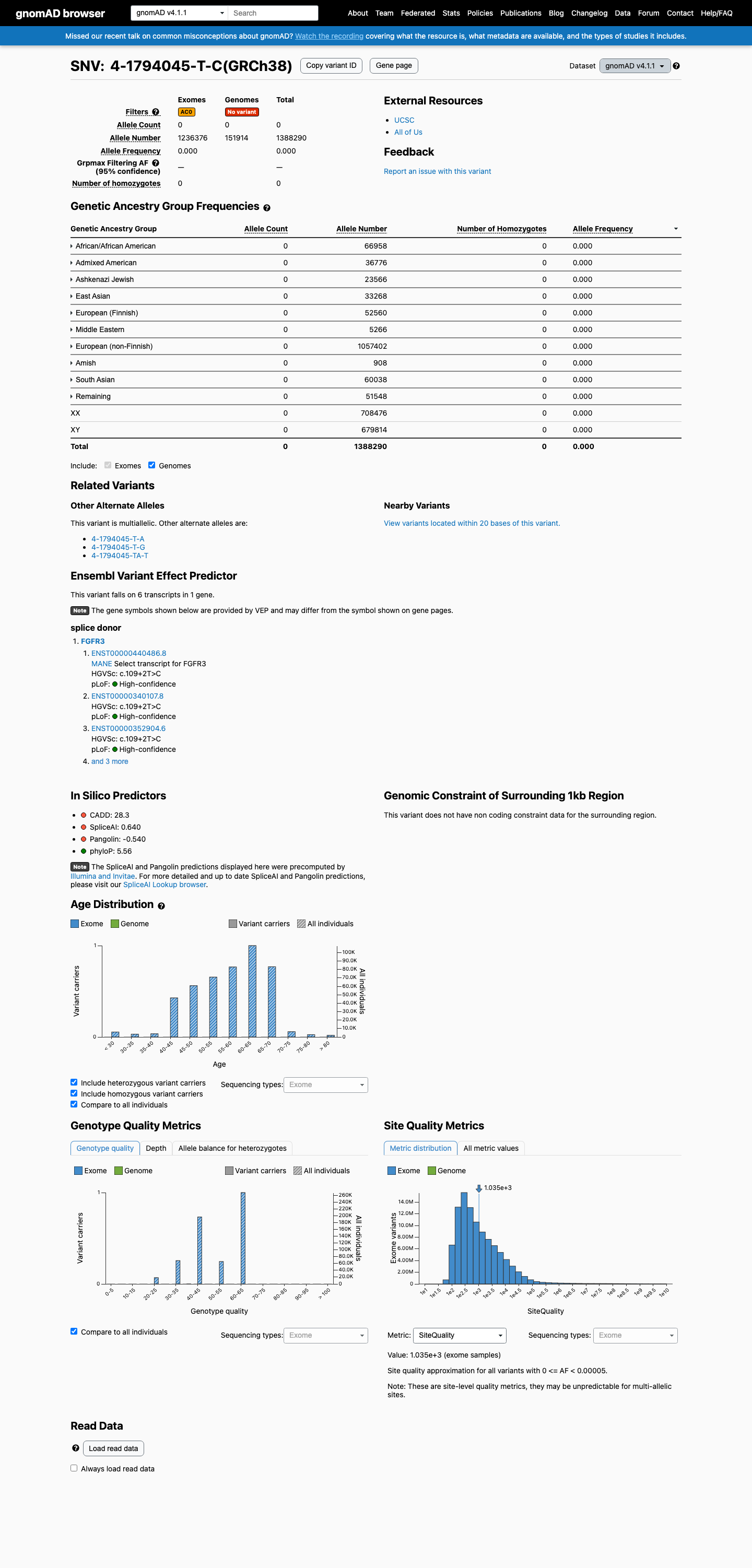
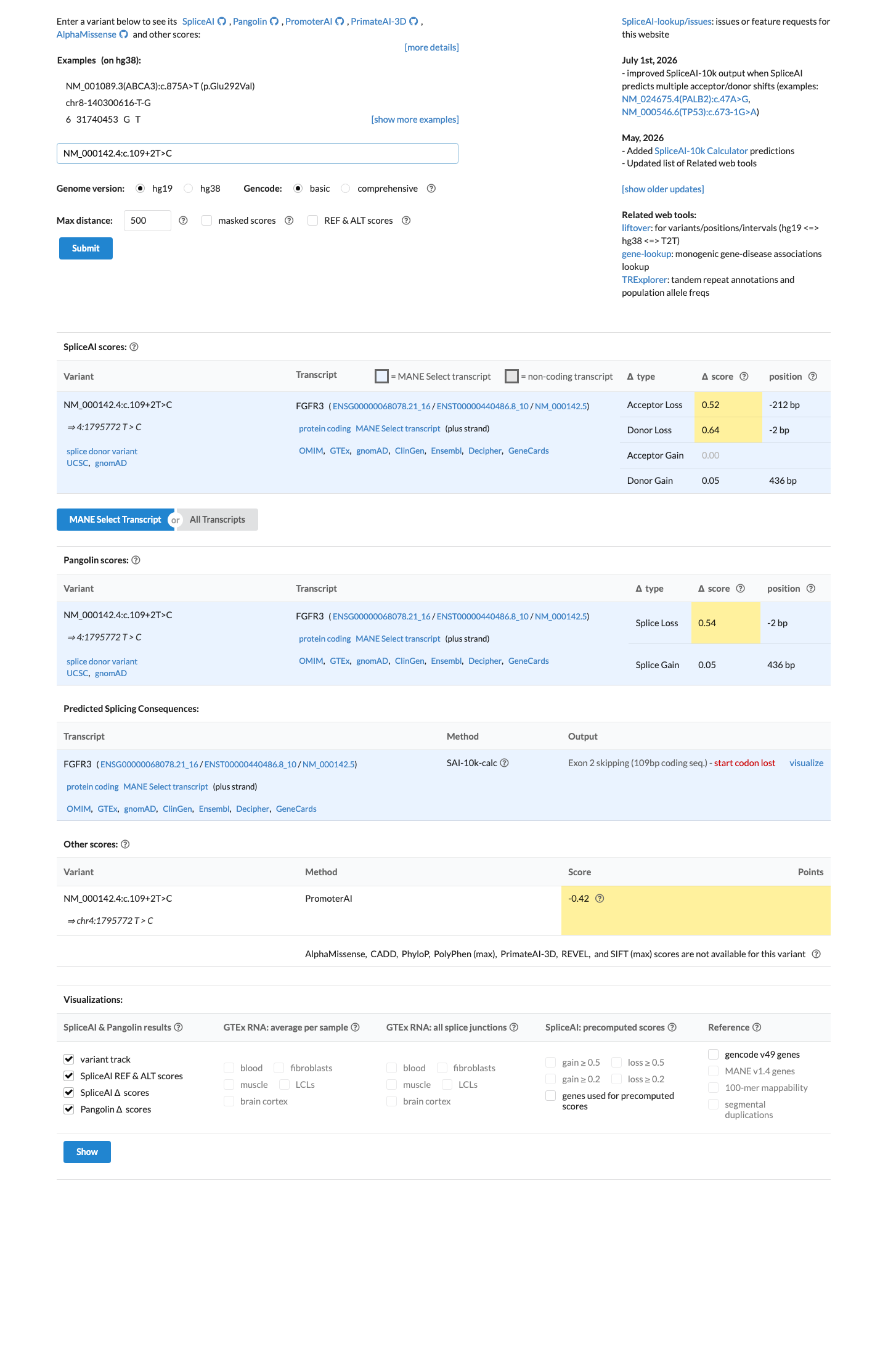
NM_000142.4:c.109+2T>C is a canonical splice donor +2 variant in FGFR3, a gene with an established loss-of-function disease mechanism (CATSHL syndrome). Under the ClinGen SVI PVS1 framework (PMC6185798), this qualifies for PVS1 at very strong strength.1 The variant is absent from gnomAD v2.1 and v4.1 (0/1,388,290 alleles, AF = 0.000%), meeting PM2 at moderate strength.2 No benign criteria are met. BA1, BS1, and BS2 are not met as the variant is absent from population databases. No functional studies or segregation data are available. Computational evidence is mixed (SpliceAI delta = 0.00 vs Pangolin SL = -0.54 and BayesDel = 0.61) and does not support BP4.3 Applying the generic ACMG/AMP 2015 final classification rules (PMID:25741868): 1 Very Strong (PVS1) + 1 Moderate (PM2) = Likely Pathogenic. Two moderate criteria would be required for Pathogenic; only one moderate criterion is met.4
Final classification
Likely Pathogenic
PVS1PM2
FGFR3
c.109+2T>C
p.?
This variant
NM_000142.4:c.109+2T>C is a canonical splice donor +2 variant in FGFR3, a gene with an established loss-of-function disease mechanism (CATSHL syndrome). Under the ClinGen SVI PVS1 framework (PMC6185798), this qualifies for PVS1 at very strong strength.
gene-specific framework lacked a usable explicit final combination framework, so generic ACMG/AMP 2015 final-combination rules were applied as fallback; applied criteria: PVS1 very strong, PM2 moderate; combination = 1 very strong + 1 moderate, which maps to Likely Pathogenic.
Classification rationale
PVS1PM2
Likely Pathogenic
FGFR3 c.109+2T>C
PVS1 + PM2
→
Likely Pathogenic
1
pvs1_generic_framework ↗pvs1_gene_contextpvs1_variant_assessment
3
spliceai ↗bayesdelgnomad_v4 ↗
4
generic_acmg_combination_rules
LYFE Sciences is an AI system, and it can make mistakes. Criteria
may be applied incorrectly, sources may be misread, and a confident-looking
classification can still be wrong. Double-check every criterion and
its underlying evidence before relying on any call.
Gene diagram
· NM_000142.4 · variants mapped to exon structure
FGFR3
NM_000142.4
Fetching transcript structure from UCSC…
Applied criteria · 2 applied · 17 assessed
MetEvidence satisfies this criterion.
Not metEvaluated against available evidence; threshold not reached.
Not assessedApplies in principle, but no evidence was found to evaluate it.
N/ADoesn't apply to this variant type.
Applied · 2
Strength
Supporting
Moderate
Strong
Very strong
PVS1
very strong
review
Pathogenic
NM_000142.4:c.109+2T>C is a canonical splice donor +2 variant in FGFR3. FGFR3 has an established loss-of-function disease mechanism (CATSHL syndrome; camptodactyly, tall stature, scoliosis, hearing loss) in addition to its gain-of-function phenotypes (achondroplasia, thanatophoric dysplasia, hypochondroplasia). Under ClinGen SVI PVS1 recommendations (PMC6185798), canonical ±1,2 splice variants in genes with an established LoF disease mechanism qualify for PVS1. The affected intron 2 donor site is early in the transcript and predicted to result in a null allele via aberrant splicing and nonsense-mediated decay.
Canonical donor +2 splice variant (c.109+2T>C) predicted to abolish the exon 2 donor splice siteFGFR3 loss-of-function is an established disease mechanism (CATSHL syndrome)ClinGen SVI PVS1 framework (PMC6185798) supports PVS1 for canonical splice variants in LoF-eligible genes
PM2
moderate
Pathogenic
NM_000142.4:c.109+2T>C is absent from gnomAD v2.1 (0 alleles) and gnomAD v4.1 (0/1,388,290 alleles). AF is 0.000% across all populations, well below the PM2 threshold of <0.1%. This extremely low frequency in large population databases supports a pathogenic role under ACMG/AMP PM2.
Absent from gnomAD v2.1Absent from gnomAD v4.1 (0/1388
Assessed · not applied
· 17 not met · 0 not assessed
Pathogenic
PS2
No de novo data available.
PS3
No functional studies were identified for NM_000142.4:c.109+2T>C or for a systematically characterized range encompassing this splice position.
PS4
No case-control or cohort data available.
PM6
No de novo reports were identified.
PP1
No co-segregation data available.
PP3
Computational evidence is mixed.
PP4
No patient phenotype data was provided for assessment.
PP5
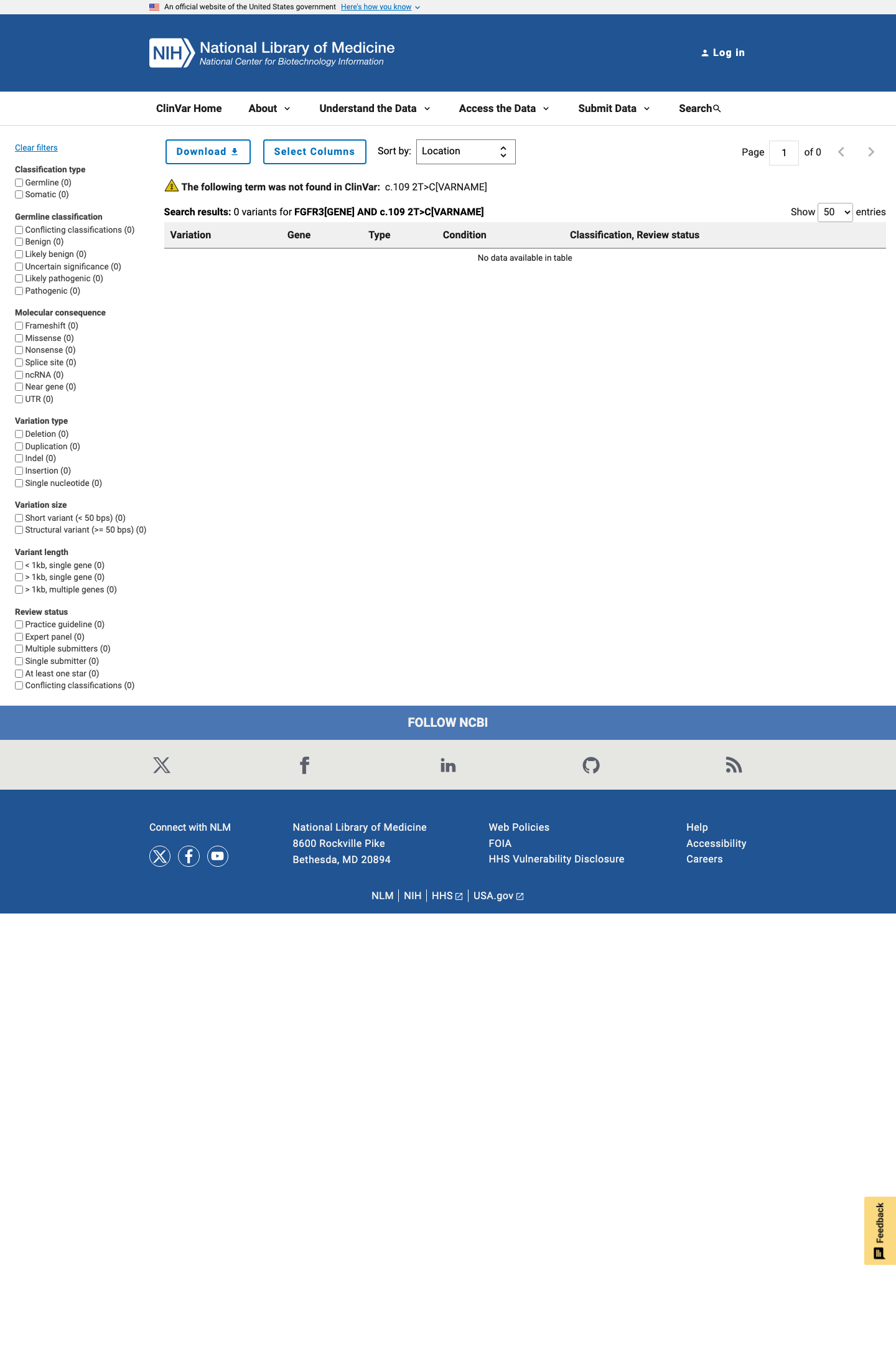
NM_000142.4:c.109+2T>C is absent from ClinVar.
Benign
BA1
Variant is absent from gnomAD (AF = 0.000%, 0/1,388,290 alleles in v4.1).
BS1
Variant is absent from gnomAD (AF = 0.000%).
BS2
No homozygous individuals were observed in gnomAD (homozygotes = 0 across all populations in v4.1).
BS3
No well-established functional studies demonstrating a benign effect were identified for this variant.
BS4
No segregation data available to assess lack of segregation with disease.
BP2
No evidence of this variant observed in trans with a pathogenic FGFR3 variant.
BP4
Multiple lines of computational evidence do not consistently suggest a benign impact.
BP5
No case was identified where an alternative molecular basis for disease was found in an individual harboring this variant.
BP6
This variant is absent from ClinVar.
N/A · 7
PS1 · PM1 · PM5 · PP2 · BP1 · BP3 · BP7
Research & evidence
Population frequency · supports pathogenic
gnomAD v4.1
gnomAD v2.1
v4.1
This variant is present in gnomAD v4.1 (AF= 0; MAF= 0.00000%, 0/1388290 alleles, homozygotes = 0) and has highest observed frequency in the African/African American population (AF= 0; MAF= 0.00000%, 0/66958 alleles, homozygotes = 0).
v2.1
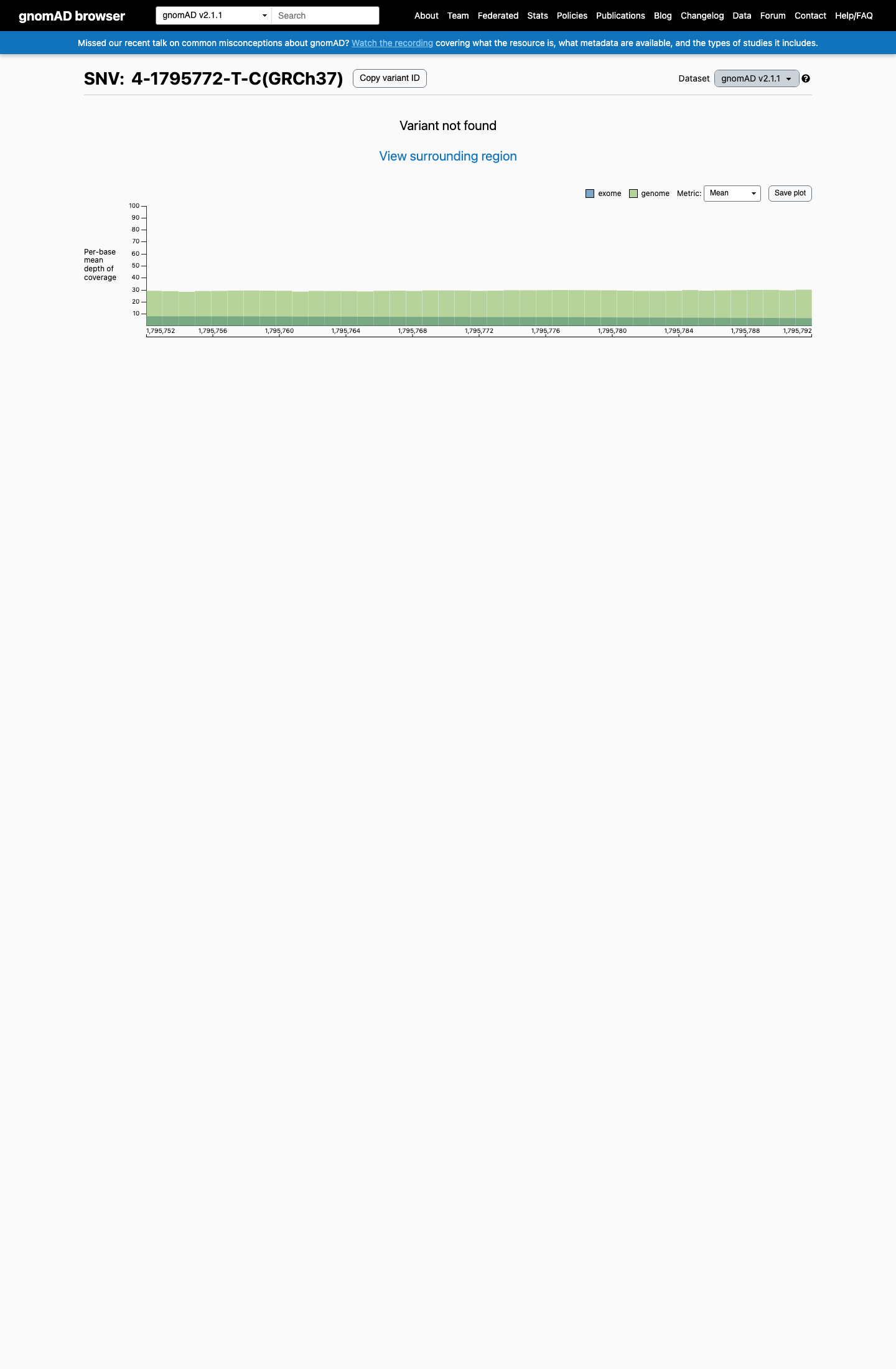
Absent from gnomAD v2.1.
🇨🇦 CA
Absent from gnomAD-Canada v1.0.
Allele frequency by ancestry
three datasets · side by side
gnomAD v4.1
Absent
· 0 / 1,388,290
0 hom
0 hom
Not observed in any ancestry group.
+ 10 not observed (Remaining individuals, Admixed American, European (Finnish), Amish, East Asian, Middle Eastern, South Asian, Ashkenazi Jewish, African/African American, European (non-Finnish))
gnomAD v2.1
Absent
· 0 / ?
0 hom
0 hom
Not observed in any ancestry group.
gnomAD Canada 🇨🇦
Absent
· 0 / ?
0 hom
0 hom
Not observed in any ancestry group.
In silico
SpliceAI predicts no significant splice impact for this variant (max delta score = 0.00). BayesDel score = 0.61.
Functional
No data
No calibrated functional assay or RNA evidence was identified for this variant.

COSMIC
Somatic evidence
COSMIC
This variant has not previously been reported in somatic cancers (COSMIC).
Hotspots
This variant does not lie in a statistically significant cancer hotspot.
Sources & reference links