Analysis in progress
Initialising…
0%
complete
This report is still being assembled — sections appear as each stage finishes. It isn't final yet.
FGFR3
Final classification
Likely Pathogenic
FGFR3 c.1172C>T · p.Ala391Val
FGFR3

PM1 (Moderate): residue 391 lies in the FGFR3 transmembrane domain, a critical functional domain with multiple established disease-causing mutations.

Gene
FGFR3
Transcript
NM_000142.4
HGVS · transcript:coding
NM_000142.4:c.1172C>T
Consequence
N/A
GRCh38
chr4:1804426 C>T
GRCh37
chr4:1806153 C>T
Basis With no FGFR3-specific framework available, generic ACMG/AMP 2015 rules apply: 2 moderate (PM1, PM5) plus 2 supporting (PM2, PP2) pathogenic criteria meet the Likely Pathogenic combination, and the single supporting benign criterion (BP4) does not offset it.
With no FGFR3-specific framework available, generic ACMG/AMP 2015 rules apply: 2 moderate (PM1, PM5) plus 2 supporting (PM2, PP2) pathogenic criteria meet the Likely Pathogenic combination, and the single supporting benign criterion (BP4) does not offset it.
Classification rationale
PM1PM2PM5PP2 BP4 Likely Pathogenic
FGFR3 c.1172C>T

PM1 (Moderate): residue 391 lies in the FGFR3 transmembrane domain, a critical functional domain with multiple established disease-causing mutations. PM5 (Moderate): p.Ala391Glu, a different missense change at the same residue, is a well-established recurrent pathogenic mutation causing Crouzon syndrome with acanthosis nigricans. PM2 (Supporting): gnomAD v4.1 allele frequency is 0.00074% with zero homozygotes, well below the 0.1% threshold. PP2 (Supporting): missense mutations are the dominant mechanism of FGFR3 germline disease. BP4 (Supporting): all computational predictors indicate no impact (SpliceAI 0.01, REVEL 0.162, BayesDel -0.317). Final classification: Likely Pathogenic, per the generic ACMG/AMP rule of 2 moderate + 2 supporting pathogenic criteria (PM1, PM5, PM2, PP2); the lone supporting benign criterion (BP4) does not reach a benign or likely-benign threshold.

PM1 + PM2 + PM5 + PP2 + BP4 Likely Pathogenic
Gene diagram · NM_000142.4 · variants mapped to exon structure
FGFR3 NM_000142.4
Fetching transcript structure from UCSC…
Applied criteria · 5 applied · 18 assessed
Applied · 5
Strength Supporting Moderate Strong Very strong
PM1 moderate Pathogenic
Met (moderate): residue 391 lies in the FGFR3 transmembrane domain, a critical functional domain harboring multiple disease-causing mutations.
PMID:11426459: 'Ala391Glu substitution in the transmembrane domain of FGFR3' and 'Nearby substitutions in the transmembrane domain of FGFR3 (Gly380Arg and Gly375Cys) cause achondroplasia'PMID:8880573: ala391glu 'within the transmembrane region' of FGFR3cancerhotspots.org (evidence.json, hotspots): no statistically significant hotspot at FGFR3 A391 (PM1 met via functional-domain arm, not hotspot arm)
PM2 supporting Pathogenic
Met (supporting): gnomAD v4.1 allele frequency is 0.00074% with zero homozygotes, far below the 0.1% PM2 threshold.
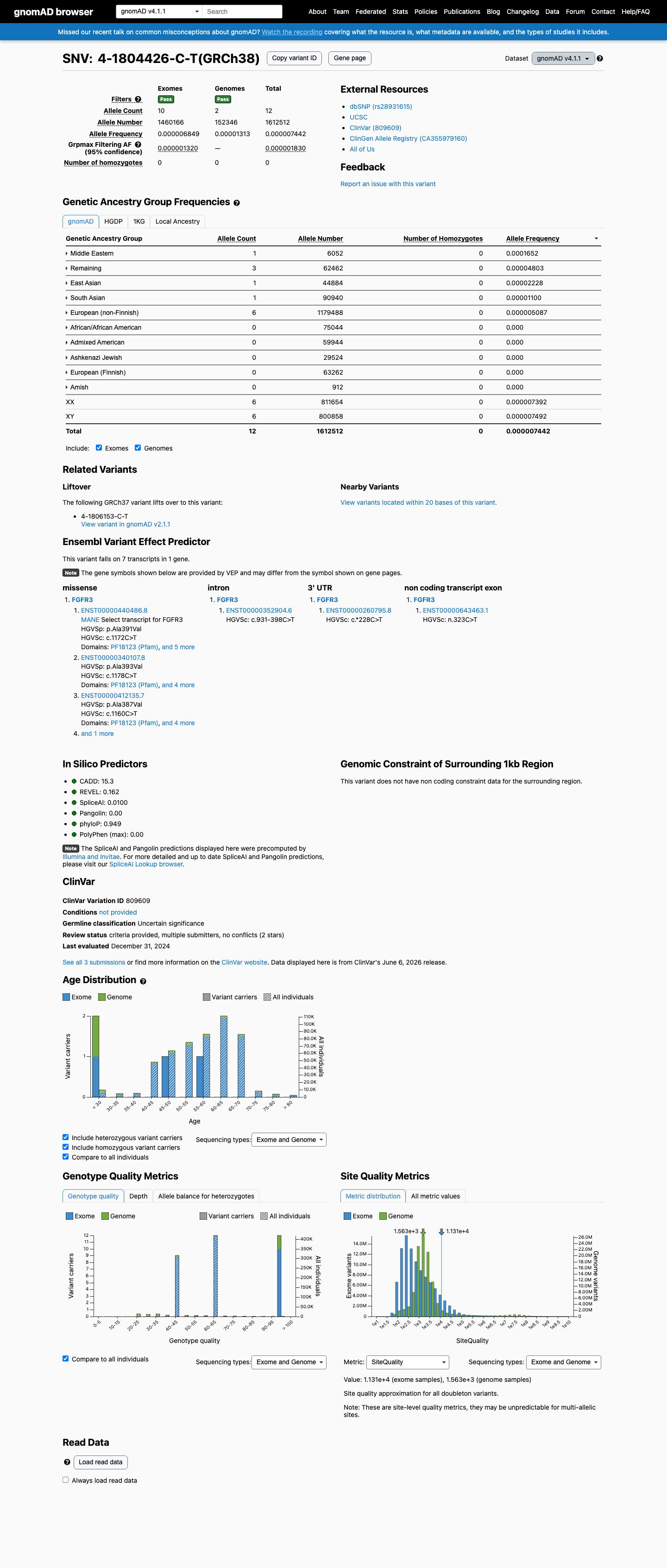
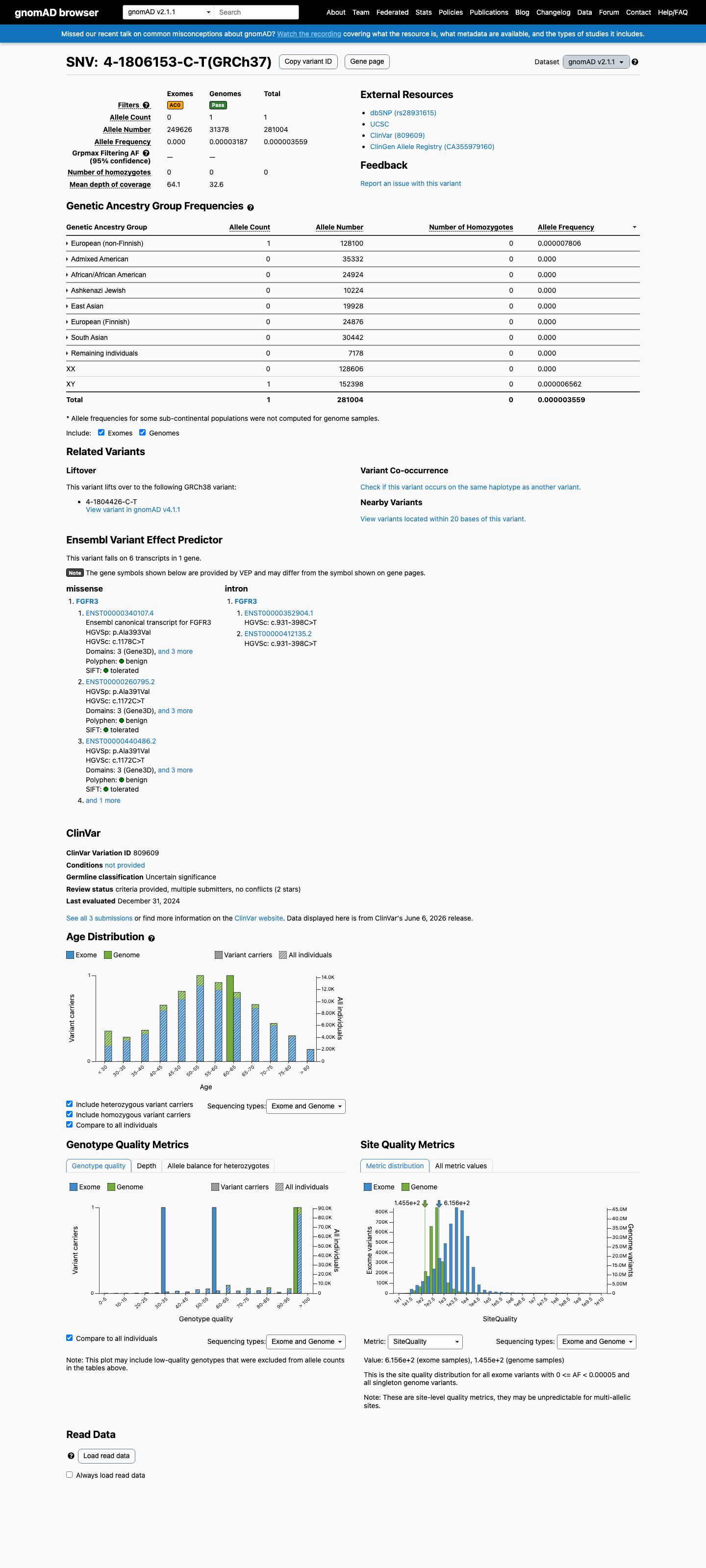
gnomAD v4.1: total AF 7.44e-06 (0.00074%), grpmax FAF 1.83e-06, 0 homozygotesgnomAD v2.1: total AF 3.56e-06 (0.00036%), 0 homozygotesgnomAD v4.1 subpopulations: MID 1/6,052 (0.0165%), EAS 1/44,884, SAS 1/90,940, NFE 6/1,179,488; all <0.1%
PM5 moderate Pathogenic
Met (moderate): a different missense change at the same residue, p.Ala391Glu, is a well-established recurrent pathogenic mutation causing Crouzon syndrome with acanthosis nigricans.
PMID:8880573: 'A recurrent mutation, ala391glu, causes Crouzon syndrome and acanthosis nigricans' - 'a specific gcg to gag transversion, resulting in an amino acid substitution ala391glu within the transmembrane region' (3 unrelated patients)PMID:11426459: 'A recurring mutation (heterozygous C to A transversion at nucleotide 1,172) resulting in an Ala391Glu substitution in the transmembrane domain of FGFR3 has been identified in 10 patients with CAN'PMID:20199409: 'Molecular analysis by sequencing confirmed Ala391Glu substitution' in a newborn with CAN
PP2 supporting Pathogenic
Met (supporting): missense mutations are the established dominant mechanism of FGFR3 germline disease.
PMID:11426459: multiple disease-causing FGFR3 missense mutations - Lys650Met (TD1), Gly380Arg and Gly375Cys (achondroplasia), Ala391Glu (CAN)PMID:8880573: recurrent missense ala391glu causes Crouzon syndrome with acanthosis nigricansPMID:20199409: FGFR3 Ala391Glu missense confirmed in CAN case
BP4 supporting Benign
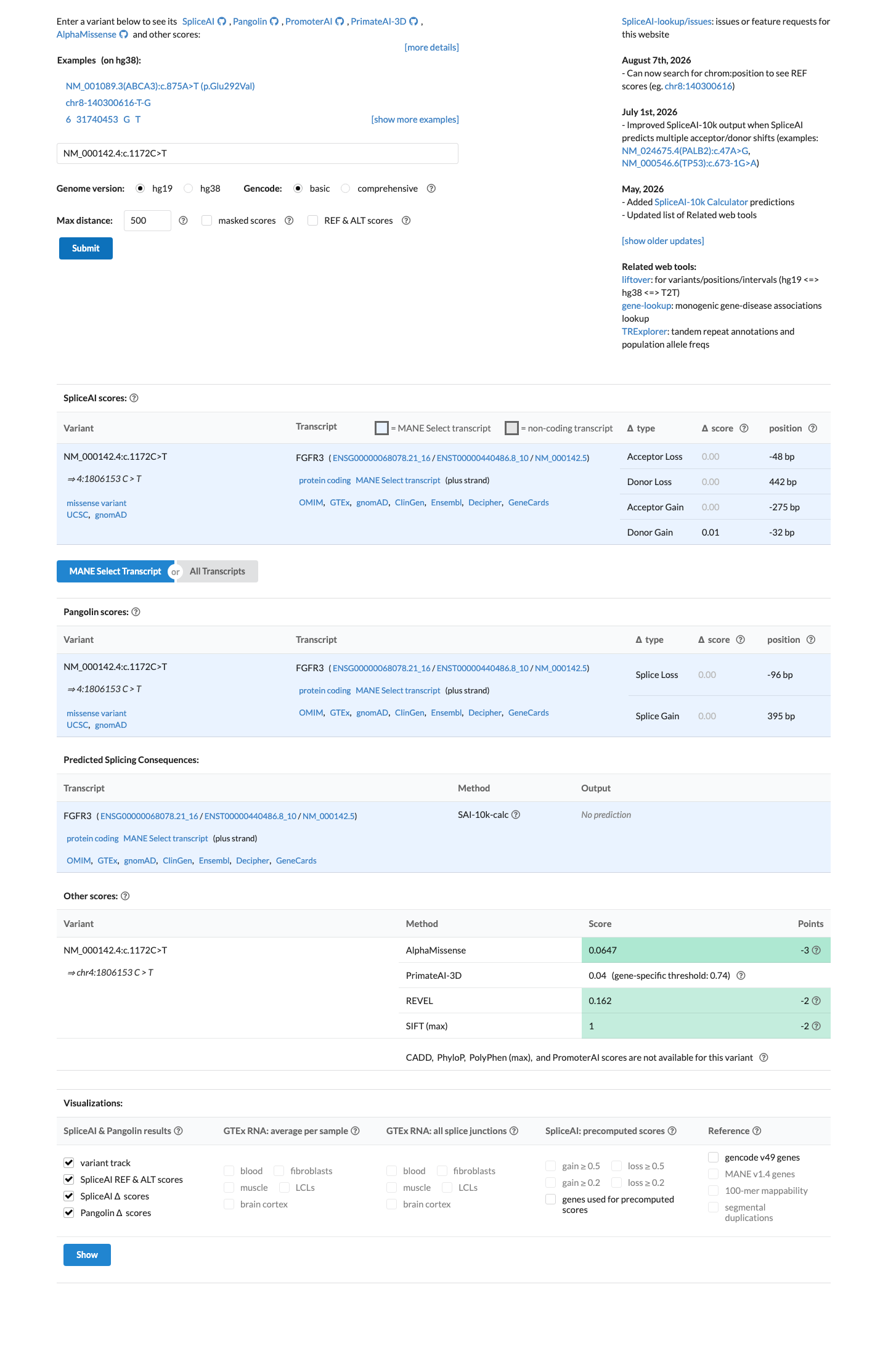
Met (supporting): all three computational lines predict no impact (SpliceAI 0.01, REVEL 0.162, BayesDel -0.317).
SpliceAI max delta score = 0.01 (DS_AG 0.0, DS_AL 0.0, DS_DG 0.01, DS_DL 0.0) -> no predicted splice impactREVEL score = 0.162 -> low/benign rangeBayesDel noAF score = -0.317094 -> negative/benign range
Assessed · not applied
Pathogenic
PS1 Not met: the established pathogenic change at residue 391 is p.Ala391Glu, a different amino acid change from this p.Ala391Val.
PS2 Not assessed: no parental-testing data exists for this exact variant.
PS3 Not assessed: no functional study of this variant was available.
PS4 Not assessed: no case-control or cohort prevalence study of this exact variant was available.
PM6 Not assessed: no de novo evidence for this exact variant was available.
PP1 Not assessed: no co-segregation data for this exact variant was available.
PP3 Not met: all computational tools predict no impact (SpliceAI 0.01, REVEL 0.162, BayesDel -0.317).
PP4 Not assessed: no proband phenotype or family-history data was available.
PP5 Not met: no ClinVar expert-panel classification exists for this variant.
Benign
BA1 Not met: highest allele frequency is 0.0165%, far below the 1% BA1 threshold.
BS1 Not met: highest allele frequency is 0.0165%, below the 0.3% BS1 threshold.
BS2 Not met: no homozygotes are observed and carriers lack phenotype-verified healthy-adult documentation.
BS3 Not assessed: no functional study demonstrating a lack of damaging effect was available.
BS4 Not assessed: no non-segregation evidence for this exact variant was available.
BP1 Not met: FGFR3 germline disease is caused by activating missense mutations, not truncating variants.
BP2 Not assessed: no trans/cis phase data with a pathogenic variant was available.
BP5 Not assessed: no proband-level data was available to evaluate an alternate molecular basis.
BP6 Not met: no ClinVar expert-panel benign classification exists for this variant.
N/A · 5 PVS1 · PM3 · PM4 · BP3 · BP7
Research & evidence
Population frequency · supports pathogenic
gnomAD v4.1 screenshot
gnomAD v4.1
gnomAD v2.1 screenshot
gnomAD v2.1
v4.1
This variant is present in gnomAD v4.1 (AF= 7.44181e-06; MAF= 0.00074%, 12/1612512 alleles, homozygotes = 0) and has highest observed frequency in the Middle Eastern population (AF= 0.000165235; MAF= 0.01652%, 1/6052 alleles, homozygotes = 0); grpmax FAF= 1.83e-06.
v2.1
This variant is present in gnomAD v2.1 (AF= 3.55867e-06; MAF= 0.00036%, 1/281004 alleles, homozygotes = 0) and has highest observed frequency in the European (non-Finnish) population (AF= 7.8064e-06; MAF= 0.00078%, 1/128100 alleles, homozygotes = 0).
🇨🇦 CA
Not available in gnomAD-Canada v1.0.
Allele frequency by ancestry
three datasets · side by side
gnomAD v4.1
0.00074% · 12 / 1,612,512
0 hom · FAF 0.00018%
Middle Eastern
1 / 6,052
0.017%
Remaining individuals
3 / 62,462
0.0048%
East Asian
1 / 44,884
0.0022%
South Asian
1 / 90,940
0.0011%
European (non-Finnish)
6 / 1,179,488
0.00051%
+ 5 not observed (Admixed American, European (Finnish), Amish, Ashkenazi Jewish, African/African American)
gnomAD v2.1
0.00036% · 1 / 281,004
0 hom
European (non-Finnish)
1 / 128,100
0.00078%
+ 7 not observed (African/African American, Admixed American, Ashkenazi Jewish, East Asian, European (Finnish), Remaining individuals, South Asian)
gnomAD Canada 🇨🇦
Absent · 0 / ?
0 hom
Not observed in any ancestry group.
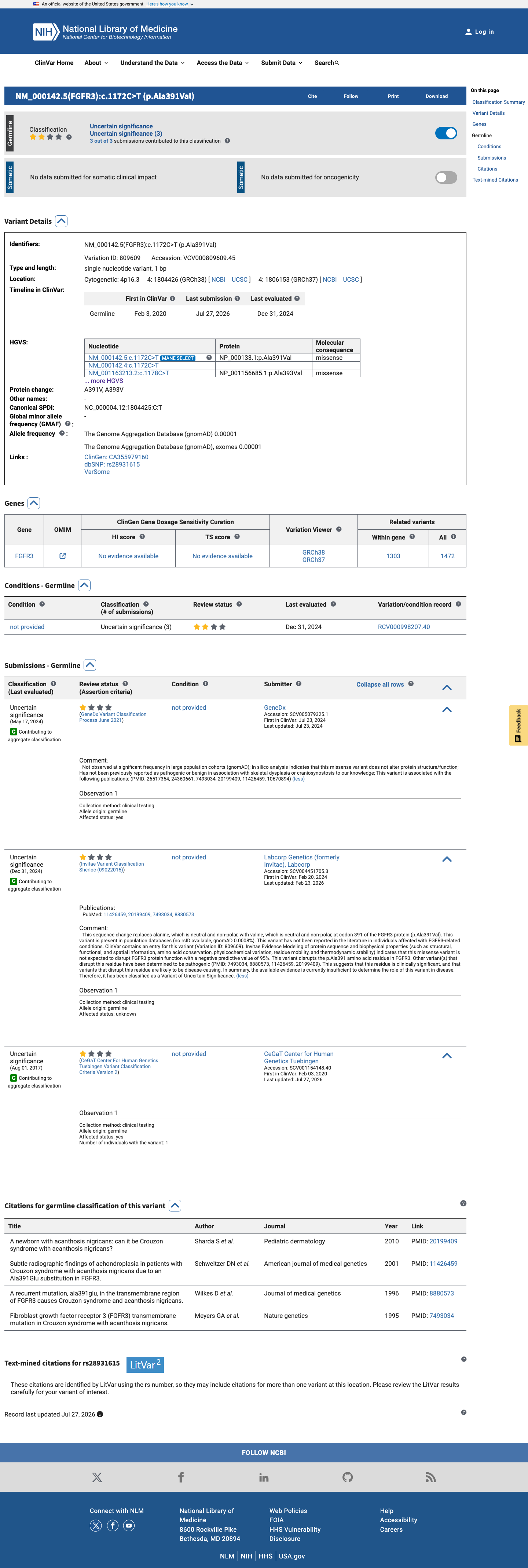
ClinVar screenshot
ClinVar
This variant has been reported in ClinVar as Uncertain significance (3 clinical laboratories). (ClinVarID = 809609)
SpliceAI screenshot
In silico
SpliceAI predicts no significant splice impact for this variant (max delta score = 0.01). REVEL score = 0.162. BayesDel score = -0.317094.
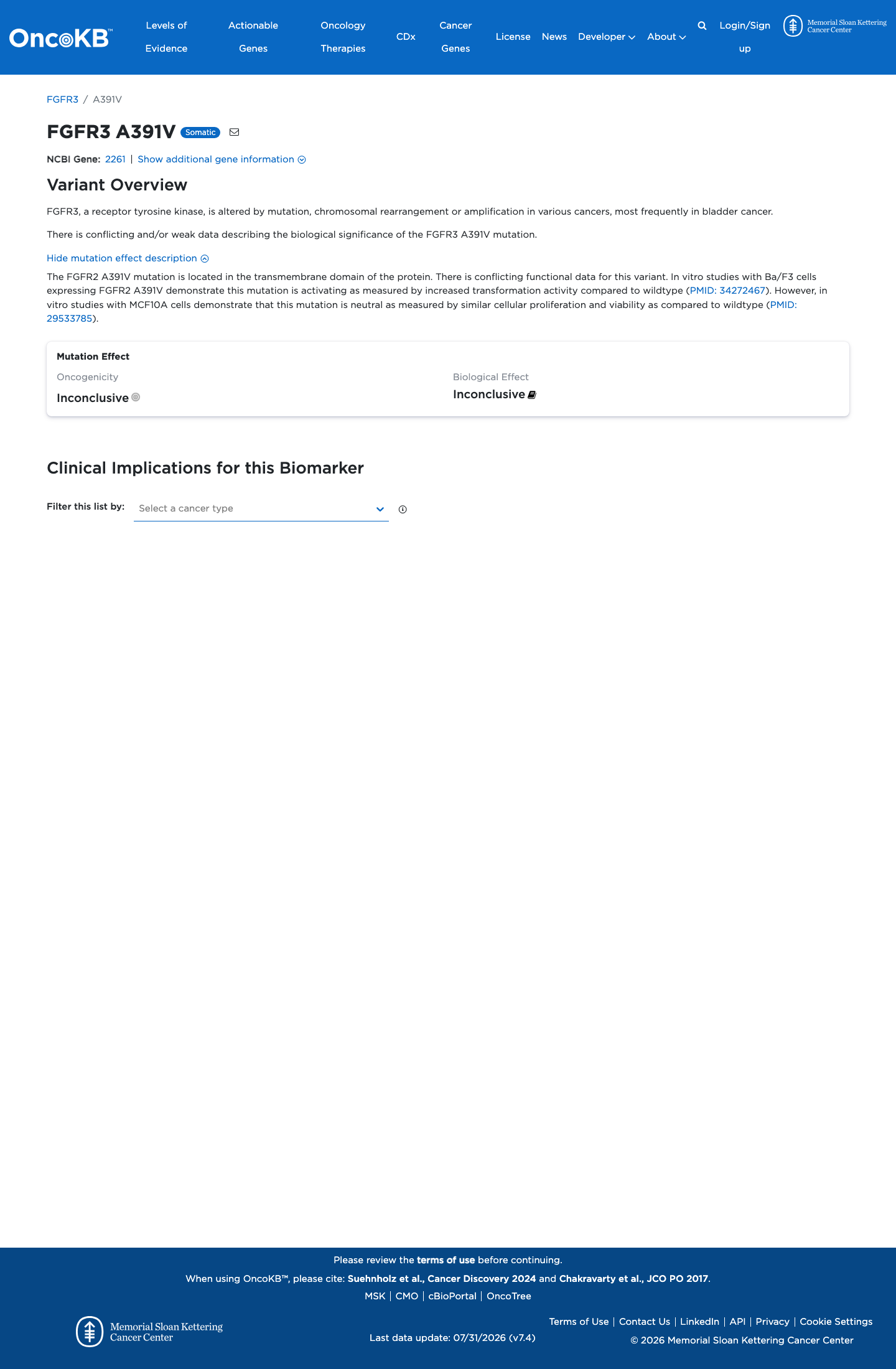
Functional / OncoKB screenshot
Functional Inconclusive
OncoKB identified variant-specific curated literature and context relevant to functional review; biological-effect context: Inconclusive; curated oncogenicity label: Inconclusive.
OncoKB ↗
COSMIC screenshot
COSMIC
Cancer hotspots screenshot
Cancer hotspots
Somatic evidence Not in COSMIC / hotspots
COSMIC
This variant does not lie in a statistically significant hotspot. This variant has not previously been reported in somatic cancers (COSMIC).
Hotspots
This variant does not lie in a statistically significant hotspot.
Literature · how each cited paper was used
6papers cited
Each card is an audit: what was searched, what was found, whether it names the variant, which criteria it fed, and why.
Rule & framework references · cited for criterion definitions, not variant evidence
11426459 ↗ Subtle radiographic findings of achondroplasia in patients with Crouzon syndrome with acanthosis nigricans due to an Ala391Glu substitution in FGFR3.
20199409 ↗ A newborn with acanthosis nigricans: can it be Crouzon syndrome with acanthosis nigricans?
29533785 ↗ Systematic Functional Annotation of Somatic Mutations in Cancer.
34272467 ↗ Comprehensive functional evaluation of variants of fibroblast growth factor receptor genes in cancer.
7493034 ↗ Fibroblast growth factor receptor 3 (FGFR3) transmembrane mutation in Crouzon syndrome with acanthosis nigricans.
8880573 ↗ A recurrent mutation, ala391glu, in the transmembrane region of FGFR3 causes Crouzon syndrome and acanthosis nigricans.
Sources & reference links
8Sources
ClinVar
gnomAD v2.1
gnomAD v4.1
gnomAD-Canada
SpliceAI
OncoKB
COSMIC
Cancer hotspots