NM_000179.2:c.4068_4071dup (p.Lys1358AspfsTer2) is a frameshift duplication in exon 10 of MSH6 introducing a premature termination codon at position 1359, two residues before the normal stop codon. Under the InSiGHT MSH6 VCEP v2.0, this qualifies for PVS1_Moderate (PTC between codons 1342-1360).1 The variant is present at high frequency in population databases: gnomAD v4.1 grpmax filtering allele frequency is 0.022162 (2.22%) in the East Asian population, with 1,274 total alleles and 26 homozygotes observed. This exceeds the VCEP BA1 threshold of 0.0022 (0.22%), meeting BA1 at stand-alone benign strength. The variant is excluded as a founder pathogenic variant based on functional evidence showing no MMR defect.2 Functional data from Martinez and Kolodner (PMID:20176959) directly tested the K1358DfsX1 allele in a yeast-based mutator assay and found no significant increase in mutation rate across three assays (Thr+, Lys+, Canr), demonstrating that this distal truncation does not impair mismatch repair function. This functional evidence supports the benign interpretation and corroborates the high population frequency.3 ClinVar reports this variant as Likely benign, reviewed by the InSiGHT expert panel (Variation ID 89518), with 23 clinical laboratories classifying it as Benign or Likely benign.4 Under the InSiGHT VCEP v2.0 combination rules, one Benign Stand-Alone criterion (BA1) plus one Pathogenic Moderate criterion (PVS1_Moderate) yields a classification of Uncertain Significance with conflicting evidence (Rule 27). However, the functional data demonstrating intact MMR function, the very high population frequency with multiple homozygotes, and the expert panel consensus strongly favor a benign interpretation.5
Final classification
Benign
PVS1BA1BP6
MSH6
c.4068_4071dup
p.Lys1358AspfsTer2
This variant
NM_000179.2:c.4068_4071dup (p.Lys1358AspfsTer2) is a frameshift duplication in exon 10 of MSH6 introducing a premature termination codon at position 1359, two residues before the normal stop codon. Under the InSiGHT MSH6 VCEP v2.0, this qualifies for PVS1_Moderate (PTC between codons 1342-1360).
ClinGen InSiGHT Hereditary Colorectal Cancer/Polyposis Expert Panel Specifications to the ACMG/AMP Variant Interpretation Guidelines for MSH6 Version 2.0 v2.0 criteria-combination framework: matched Rule17 (1 Benign.Stand Alone) with applied criteria: PVS1 moderate, BA1 stand-alone benign, BP6 supporting benign; maps to Benign.
Classification rationale
PVS1
BA1BP6
Benign
MSH6 c.4068_4071dup
PVS1 + BA1 + BP6
→
Benign
LYFE Sciences is an AI system, and it can make mistakes. Criteria
may be applied incorrectly, sources may be misread, and a confident-looking
classification can still be wrong. Double-check every criterion and
its underlying evidence before relying on any call.
Gene diagram
· NM_000179.2 · variants mapped to exon structure
MSH6
NM_000179.2
Fetching transcript structure from UCSC…
Applied criteria · 3 applied · 11 assessed
MetEvidence satisfies this criterion.
Not metEvaluated against available evidence; threshold not reached.
Not assessedApplies in principle, but no evidence was found to evaluate it.
N/ADoesn't apply to this variant type.
Applied · 3
Strength
Supporting
Moderate
Strong
Very strong
PVS1
moderate
review
Pathogenic
NM_000179.2:c.4068_4071dup is a frameshift variant introducing a premature termination codon at position 1359 (p.Lys1358AspfsTer2). Under the InSiGHT MSH6 VCEP v2.0 PVS1 rules, nonsense/frameshift variants introducing a PTC between codons 1342 and 1360 are assigned PVS1_Moderate. The variant falls within this range. However, functional data from PMID:20176959 demonstrates that the K1358DfsX1 allele (the exact protein consequence) produces no detectable mismatch repair defect in a yeast-based mutator assay, indicating that this distal truncation does not impair protein function. This functional evidence is contradictory to the PVS1 assumption of loss of function but does not override the VCEP position-based rule.
Frameshift duplication creating PTC at codon 1359VCEP PVS1 rule assigns Moderate strength for PTC between codons 1342-1360Functional assay (PMID:20176959) shows no MMR defect for K1358DfsX1
BA1
stand-alone
Benign
gnomAD v4.1 grpmax filtering allele frequency is 0.022162 (2.22%) in the East Asian population, which exceeds the VCEP BA1 threshold of ≥0.0022 (0.22%). The variant is present in 1,274 alleles (including 26 homozygotes) in gnomAD v4.1 overall, and in 658 East Asian alleles (12 homozygotes) in gnomAD v2.1 at an AF of 3.3%. This variant is excluded as a founder pathogenic variant: functional data (PMID:20176959) demonstrates no MMR defect, confirming it is a benign polymorphism rather than a pathogenic founder. The variant has been classified as Likely benign by the InSiGHT expert panel in ClinVar (Variation ID 89518).
gnomAD v4.1 grpmax FAF = 0.022162 (2.22%) ≥ BA1 threshold 0.0022gnomAD v2.1 EAS AF = 3.3% (658/19938 alleles
Assessed · not applied
· 11 not met · 0 not assessed
Pathogenic
PS2
No de novo observations have been reported for this variant.
PS3
No well-established functional studies demonstrate a damaging effect for this variant.
PM2
PM2_Supporting under the VCEP requires absent/extremely rare allele frequency (<0.00002, or <1 in 50,000 alleles) in gnomAD v4.
PP1
No co-segregation data is available for this variant.
PP3
PP3 under the VCEP applies to missense variants with HCI prior probability >0.68 or splice variants with SpliceAI delta ≥0.2.
PP4
PP4 requires MSI-H tumor data and/or loss of MMR protein expression consistent with the variant location.
Benign
BS1
The VCEP BS1 rule requires gnomAD v4 grpmax FAF ≥0.00022 and <0.0022 (0.022-0.22%).
BS2
BS2 requires co-occurrence in trans with a known pathogenic variant in a patient with colorectal cancer after age 45 without CMMRD features.
BS3
The VCEP BS3 requires calibrated functional assays with defined odds of pathogenicity, or variant-specific proficient function per the MMR functional assay flowchart.
BS4
No segregation data is available to assess lack of co-segregation with disease.
BP5
BP5 requires CRC/endometrial tumors with MSS and/or no loss of MMR protein expression, or BRAF V600E/MLH1 methylation data.
N/A · 14
PS1 · PS4 · PM1 · PM3 · PM4 · PM5 · PM6 · PP2 · PP5 · BP1 · BP2 · BP3 · BP4 · BP7
Research & evidence
Population frequency · supports benign
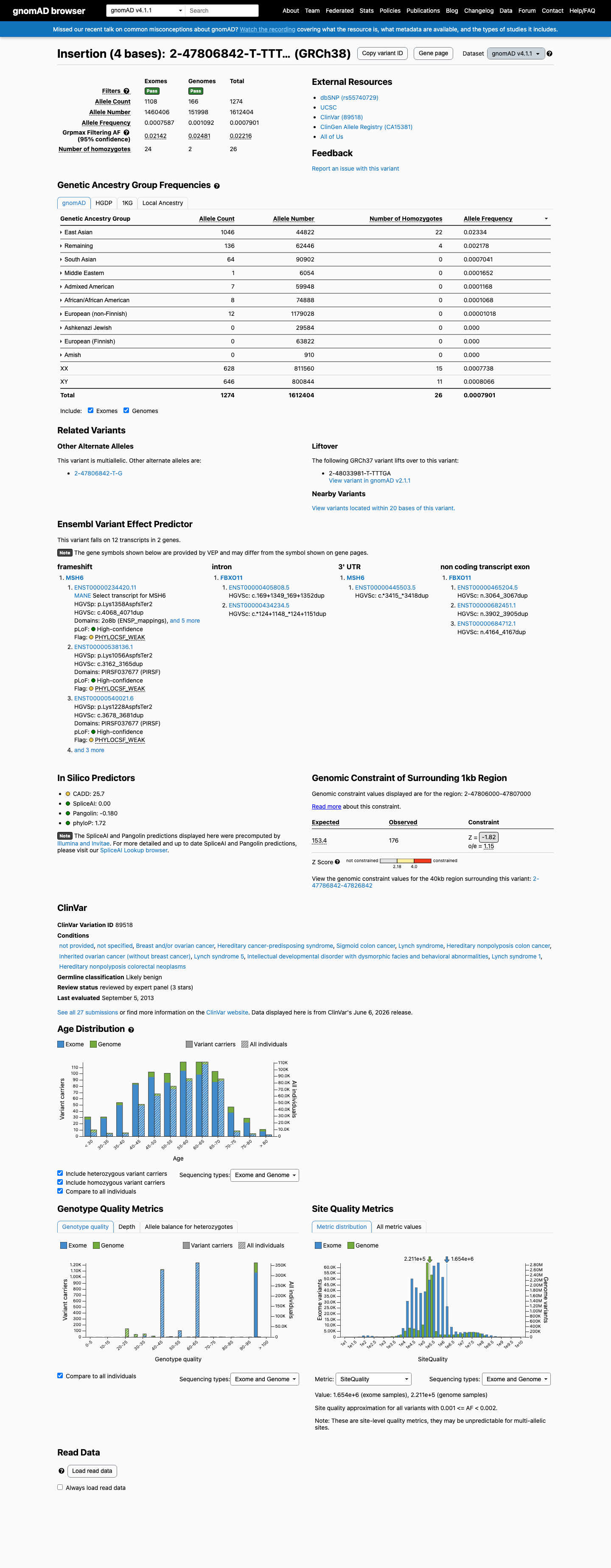
gnomAD v4.1
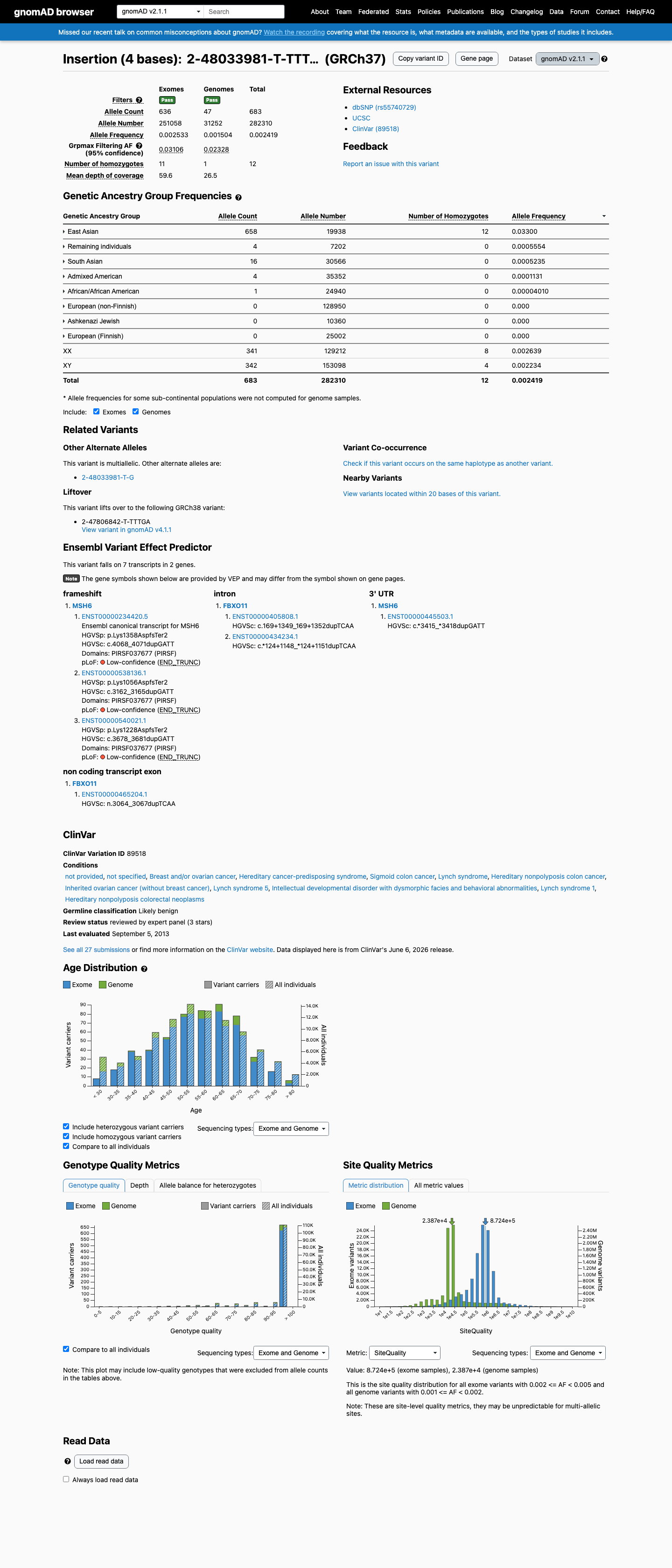
gnomAD v2.1
v4.1
This variant is present in gnomAD v4.1 (AF= 0.000790125; MAF= 0.07901%, 1274/1612404 alleles, homozygotes = 26) and has highest observed frequency in the East Asian population (AF= 0.0233368; MAF= 2.33368%, 1046/44822 alleles, homozygotes = 22); grpmax FAF= 0.022162.
v2.1
This variant is present in gnomAD v2.1 (AF= 0.00241933; MAF= 0.24193%, 683/282310 alleles, homozygotes = 12) and has highest observed frequency in the East Asian population (AF= 0.0330023; MAF= 3.30023%, 658/19938 alleles, homozygotes = 12); grpmax FAF= 0.0310647.
🇨🇦 CA
This variant is present in gnomAD-Canada v1.0 (AF= 0.003367734926670288, 62/18410 alleles, homozygotes = 1).
Allele frequency by ancestry
three datasets · side by side
gnomAD v4.1
0.079%
· 1274 / 1,612,404
26 hom · FAF 2.2%
26 hom · FAF 2.2%
East Asian 1046 / 44,822 |
2.3% 22 hom |
Remaining individuals 136 / 62,446 |
0.22% 4 hom |
South Asian 64 / 90,902 |
0.07% |
Middle Eastern 1 / 6,054 |
0.017% |
Admixed American 7 / 59,948 |
0.012% |
African/African American 8 / 74,888 |
0.011% |
European (non-Finnish) 12 / 1,179,028 |
0.001% |
+ 3 not observed (European (Finnish), Amish, Ashkenazi Jewish)
gnomAD v2.1
0.24%
· 683 / 282,310
12 hom · FAF 3.1%
12 hom · FAF 3.1%
East Asian 658 / 19,938 |
3.3% 12 hom |
Remaining individuals 4 / 7,202 |
0.056% |
South Asian 16 / 30,566 |
0.052% |
Admixed American 4 / 35,352 |
0.011% |
African/African American 1 / 24,940 |
0.004% |
+ 3 not observed (Ashkenazi Jewish, European (Finnish), European (non-Finnish))
gnomAD Canada 🇨🇦
0.34%
· 62 / 18,410
1 hom · FAF 3.2%
1 hom · FAF 3.2%
East Asian 54 / 1,338 |
4% 1 hom |
Remaining individuals 6 / 1,136 |
0.53% |
South Asian 2 / 1,362 |
0.15% |
+ 6 not observed (African/African American, Latino/Admixed American, Ashkenazi Jewish, European (Finnish), Middle Eastern, European (non-Finnish))

ClinVar
This variant has been reported in ClinVar as Benign (13 clinical laboratories) and as Likely benign (10 clinical laboratories) and as Uncertain significance (1 clinical laboratory) and as Likely benign by International Society for Gastrointestinal Hereditary Tumours (InSiGHT) (expert panel). (ClinVarID = 89518)

In silico
SpliceAI predicts no significant splice impact for this variant (max delta score = 0.00).
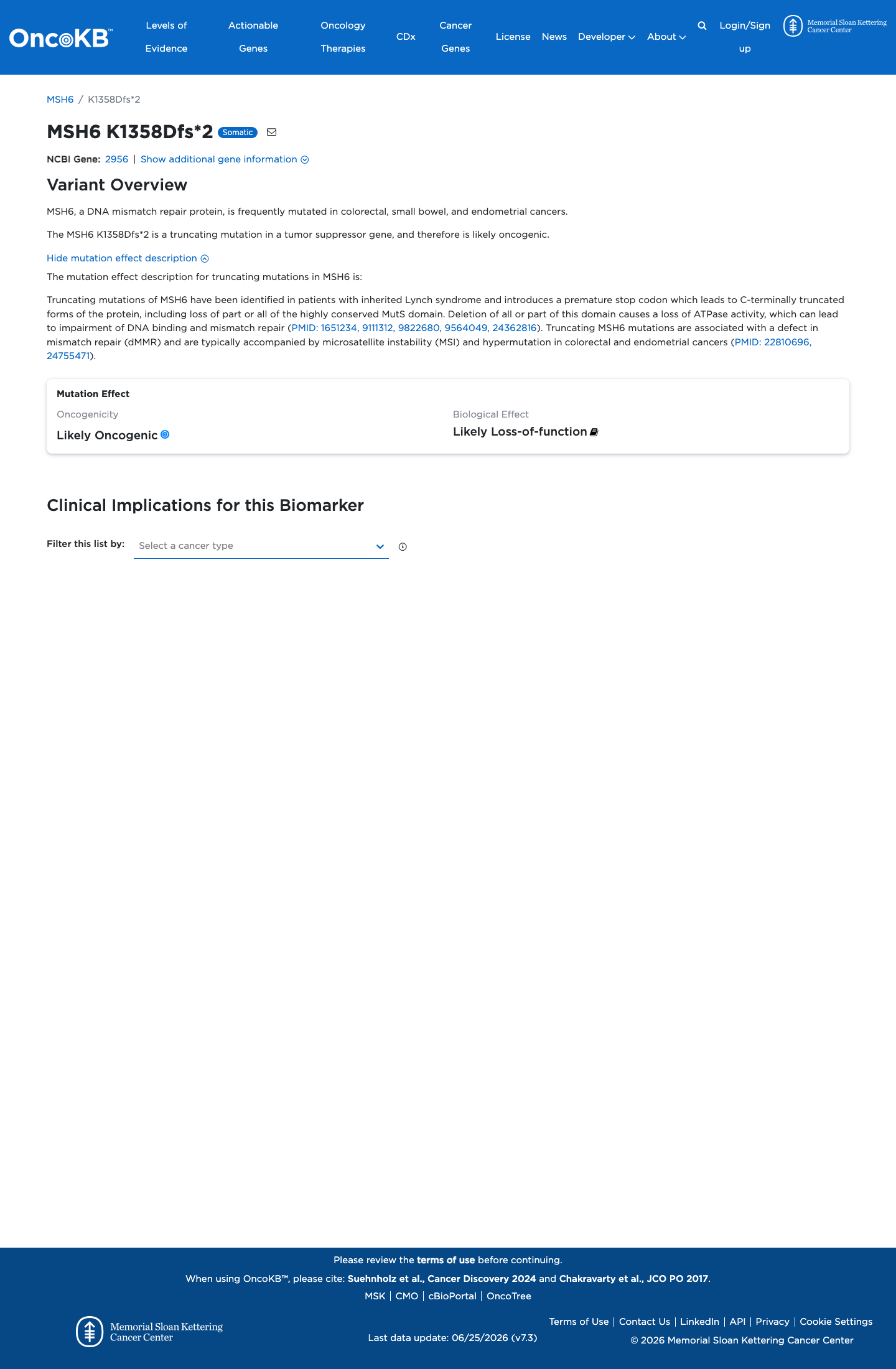
Functional
Likely Oncogenic
OncoKB identified variant-specific curated literature and context relevant to functional review; biological-effect context: Likely Loss-of-function; curated oncogenicity label: Likely Oncogenic.
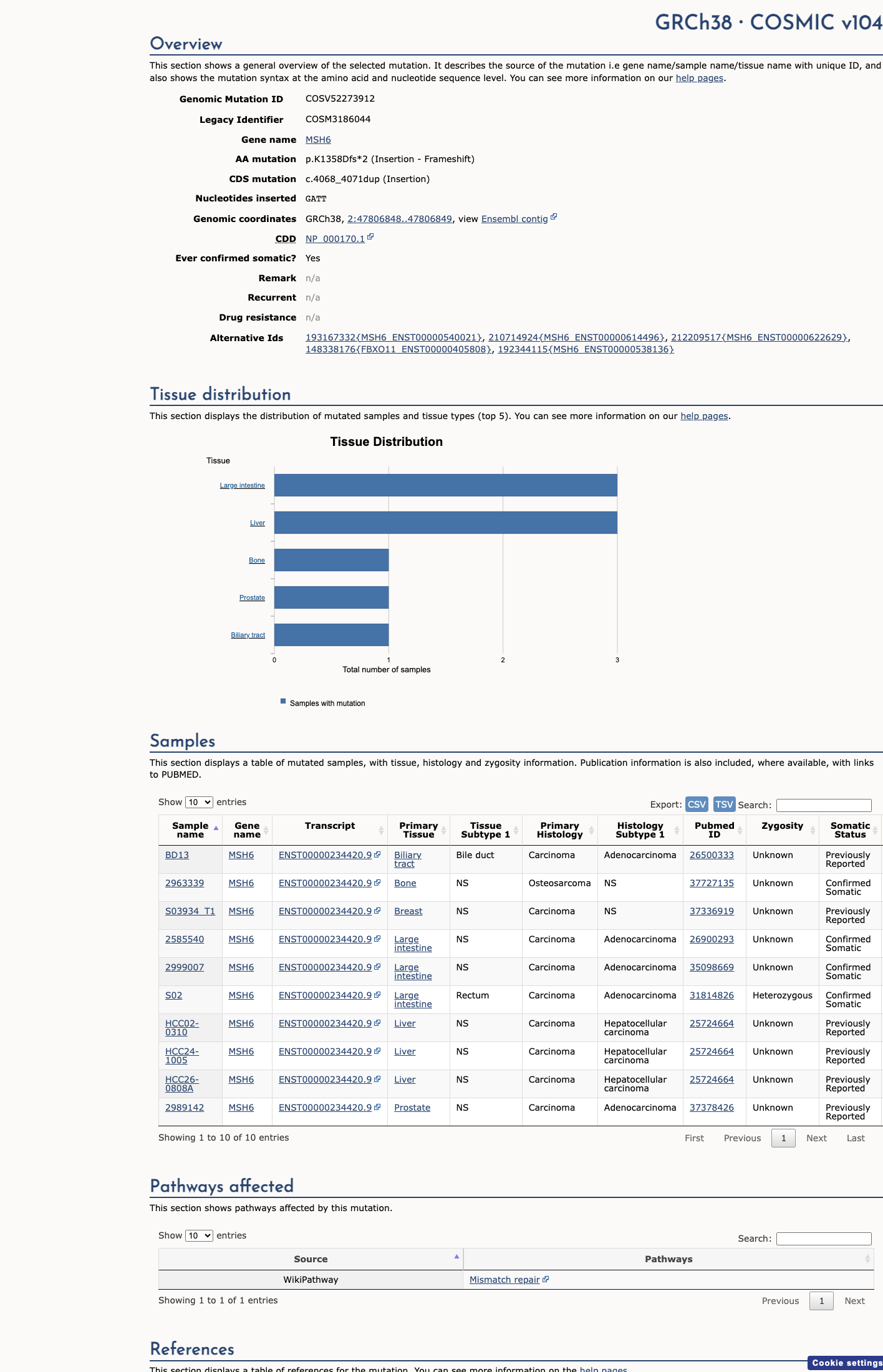
COSMIC

Cancer hotspots
Somatic evidence
Not in COSMIC / hotspots
COSMIC
This variant does not lie in a statistically significant hotspot. This variant has previously been reported in somatic cancers (COSMIC; COSV52273912, n = 10 times).
Hotspots
This variant does not lie in a statistically significant hotspot.
Literature · how each cited paper was used
1papers cited
Each card is an audit: what was searched, what was found, whether it names the variant, which criteria it fed, and why. 7 further PMIDs triaged but not cited — see Sources & references.
Functional analysis of human mismatch repair gene mutations identifies weak alleles and polymorphisms capable of polygenic interactions.
Searched
c.4068_4071dupK1358DfsK1358Lys135840684071
Found
Martinez and Kolodner tested the K1358DfsX1 allele (the exact protein consequence of c.4068_4071dup) in a Saccharomyces cerevisiae-based chromosomal mutator assay. The variant showed no significant increase in mutation rate across all three assays (Thr+, Lys+, Canr), indicating intact mismatch repair function. The authors classified this as one of four mutations that 'caused no apparent defect.'
Variant
✓ Names this variant — characterised directly
Applied to
→PVS1
met
→BA1
met
Why
Variant-specific functional data confirmed no MMR defect. Referenced in PVS1 assessment (contradicts LOF assumption), PS3 assessment (no pathogenic effect), BS3 assessment (benign functional evidence), and BA1 assessment (supports exclusion as founder pathogenic variant).
RDKY7109 / MSH6 / K1358DfsX1 / Asp1239X ... NS / NS / NS
Location Table 1 (chromosomal alleles list, strain RDKY7109); Table 2 (mutation rate data showing NS in all assays); Results section describing four mutations causing no apparent defect · Context Saccharomyces cerevisiae chromosomal mutator assay; human MSH6 alleles integrated at the yeast MSH6 locus; three readouts: CAN1 inactivation (Canr), hom3-10 frameshift reversion (Thr+), lys2-10A frameshift reversion (Lys+) · full text
Sources & reference links
9Sources
Triaged references · 7 PMIDs not cited in assessment
1651234 ↗
Altering the conserved nucleotide binding motif in the Salmonella typhimurium MutS mismatch repair protein affects both its ATPase and mismatch binding activities.
ONCOKB
24362816 ↗
Application of a 5-tiered scheme for standardized classification of 2,360 unique mismatch repair gene variants in the InSiGHT locus-specific database.
ONCOKB
24755471 ↗
Colorectal cancer cell lines are representative models of the main molecular subtypes of primary cancer.
ONCOKB
9111312 ↗
Genetic and biochemical analysis of Msh2p-Msh6p: role of ATP hydrolysis and Msh2p-Msh6p subunit interactions in mismatch base pair recognition.
ONCOKB
12376507 ↗
Identification of 127 amino acid substitution variants in screening 37 DNA repair genes in humans.
CLINVAR
18809606 ↗
Feasibility of screening for Lynch syndrome among patients with colorectal cancer.
CLINVAR