Back
NM_000179.3:c.1019T>C
p.Phe340Ser · MSH6
0%
complete
Final classification
Likely Benign
BP4BP6
MSH6
c.1019T>C
p.Phe340Ser
missense · exon 4

MSH6 encodes a protein in the DNA mismatch repair system, which fixes errors made during DNA replication. Partnering with MSH2, it forms a complex that recognizes and helps correct mismatched DNA bases, keeping the genetic code stable. Inherited mutations in MSH6 cause Lynch syndrome (hereditary nonpolyposis colorectal cancer), raising the risk of colorectal, endometrial, ovarian, and other cancers, while mutations in both copies lead to constitutional mismatch repair deficiency. Because faulty mismatch repair drives tumor development and produces microsatellite instability, MSH6 acts as a tumor suppressor, and cancers with such repair defects often respond well to immune checkpoint inhibitor therapy.

This variant

MSH6 encodes a DNA mismatch-repair protein that partners with MSH2 to maintain genomic stability, and inherited pathogenic variants cause Lynch syndrome and increase the risk of several cancers.

Transcript
NM_000179.3
HGVS · transcript:coding
NM_000179.3:c.1019T>C
GRCh38
chr2:47799002 T>C
GRCh37
chr2:48026141 T>C
Likely Benign: BP4 (supporting) and BP6 (supporting benign) satisfy the InSiGHT MSH6 VCEP's Rule19.
Classification rationale
BP4BP6 Likely Benign
MSH6 c.1019T>C missense · exon 4

Likely Benign: BP4 supporting reflects an MSH6 HCI prior probability of 0.0019, below the VCEP cutoff. Likely Benign: BP6 supporting benign reflects the exact-variant InSiGHT expert-panel Likely benign classification.

BP4 + BP6 → Likely Benign
LYFE Sciences is an AI system, and it can make mistakes. Criteria may be applied incorrectly, sources may be misread, and a confident-looking classification can still be wrong. Double-check every criterion and its underlying evidence before relying on any call.
Gene diagram · NM_000179.3 · variants mapped to exon structure
MSH6 NM_000179.3
Fetching transcript structure from UCSC…
Applied criteria · 2 applied · 16 assessed
MetEvidence satisfies this criterion.
Not metEvaluated against available evidence; threshold not reached.
Not assessedApplies in principle, but no evidence was found to evaluate it.
N/ADoesn't apply to this variant type.
Applied · 2
Strength Supporting Moderate Strong Very strong
BP4 supporting Benign
Met, supporting: MSH6 HCI prior probability 0.0019 is below the VCEP BP4 threshold of <0.11.
The governing MSH6 HCI-PRIORS-MSH6 table was searched for c.1019T>C, p.Phe340Ser, and p.F340S and contains the exact entry with HCI prior probability 0.0019.The MSH6 VCEP specification assigns BP4 supporting to a missense variant with HCI prior probability <0.11; the observed value 0.0019 satisfies this criterion.Because this is a missense variant, SpliceAI no-impact evidence is not used for BP4; the governing HCI assignment is applied directly.
BP6 supporting Benign
Met, supporting: the exact-variant ClinVar expert panel classified NM_000179.3:c.1019T>C as Likely benign with three-star review.
ClinVar records the exact NM_000179.3:c.1019T>C (p.Phe340Ser) variant as Likely benign, reviewed by the International Society for Gastrointestinal Hereditary Tumours (InSiGHT) expert panel with three stars.BP6 was applied only from this exact-variant expert-panel assertion; ordinary laboratory submissions, aggregate ClinVar labels, and non-expert assertions were excluded.ClinVar expert panel classification
Assessed · not applied · 10 not met · 6 not assessed
Pathogenic
PS1 Not met: no different nucleotide change producing the same p.Phe340Ser substitution was established as Pathogenic by the MSH6 VCEP.
PS2 Not assessed: no confirmed de novo observation or parental testing is documented for MSH6 c.1019T>C.
PS3 Not assessed: p.Phe340Ser lacks calibrated functional odds or a documented validated assay sufficient to meet the MSH6 VCEP PS3 thresholds of 2.08, 4.3, and 18.7.
PM2 Not met: gnomAD v4.1 allele frequency 9.10722e-05 exceeds the MSH6 VCEP PM2 cutoff of <0.00002.
PM3 Not assessed: no qualifying affected-proband observation with a pathogenic MSH6 variant confirmed in trans and no PM3 point count is documented.
PM5 Not assessed: no qualifying alternate missense change at residue 340 was identified for comparison under the MSH6 PM5 rule.
PP1 Not met: the exact-variant segregation likelihood ratio was 1.000, below the MSH6 PP1 Supporting threshold of >2.08.
PP3 Not met: MSH6 HCI prior probability 0.0019 is below the VCEP PP3 supporting threshold of >0.68.
PP4 Not met: the reported tumor had MSI at BAT40 only, not documented MSI-H by the VCEP-required standard panel or consistent MMR-protein loss.
PP5 Not met: the exact-variant ClinVar expert panel classified the variant Likely benign, not Pathogenic or Likely pathogenic.
Benign
BA1 Not met: gnomAD v4 Grpmax filtering allele frequency 9.857e-05 is below the MSH6 VCEP BA1 threshold of 0.0022.
BS1 Not met: gnomAD v4 Grpmax filtering allele frequency 9.857e-05 is below the MSH6 VCEP BS1 lower threshold of 0.00022.
BS2 Not assessed: no qualifying in-trans co-occurrence, phase confirmation, and CMMRD exclusion are documented for the BS2 rule.
BS3 Not assessed: the reported p.Phe340Ser "Wild type" result lacks calibrated functional odds and documented concordant protein and mRNA assay evidence required for MSH6 BS3.
BS4 Not met: the segregation likelihood ratio was 1.000, above the MSH6 BS4 Supporting range of >0.05 to ≤0.48.
BP5 Not met: one tumor showed MSI at BAT40 only with positive MSH6 staining, without the VCEP-required qualifying tumor count or alternate molecular basis.
N/A · 10 PVS1 · PS4 · PM1 · PM4 · PM6 · PP2 · BP1 · BP2 · BP3 · BP7
Research & evidence
Population frequency · supports benign
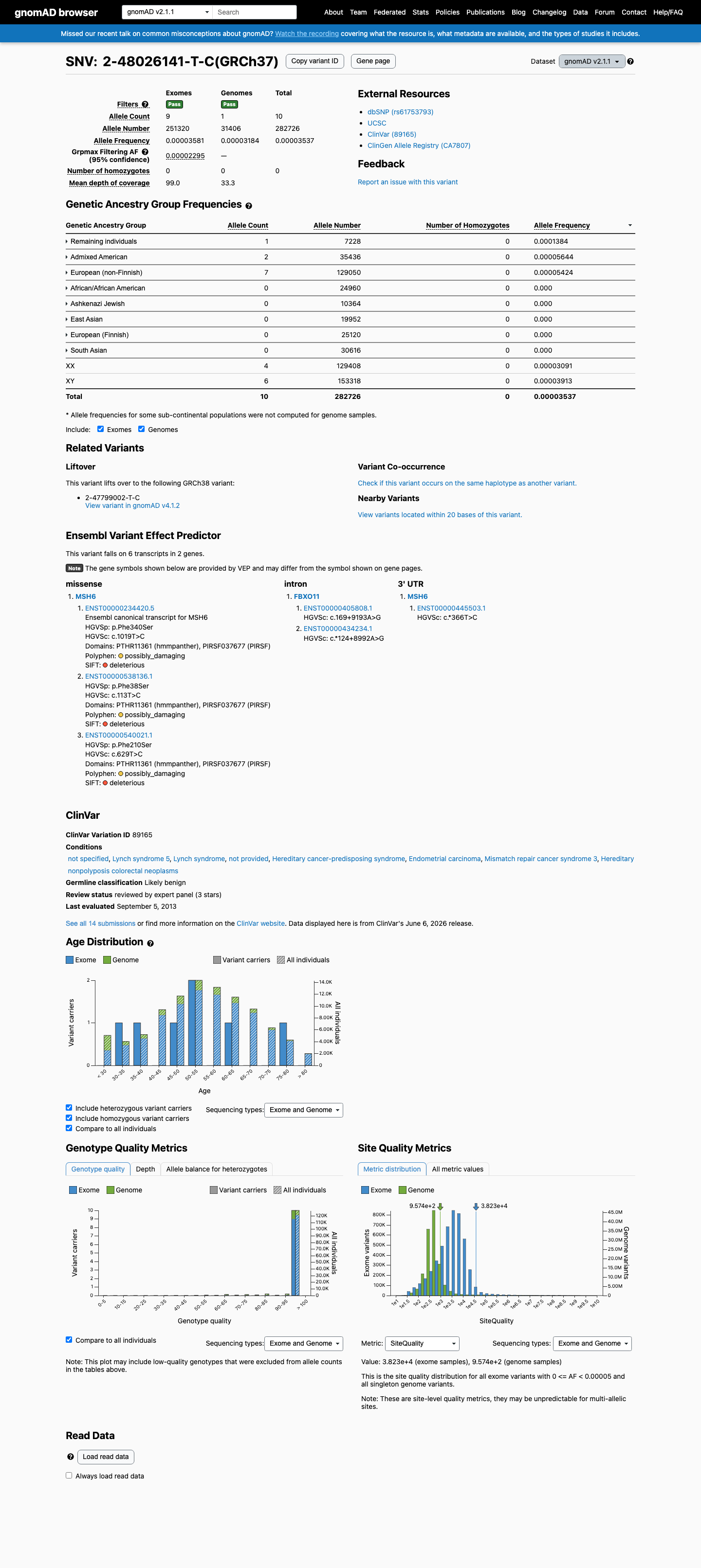
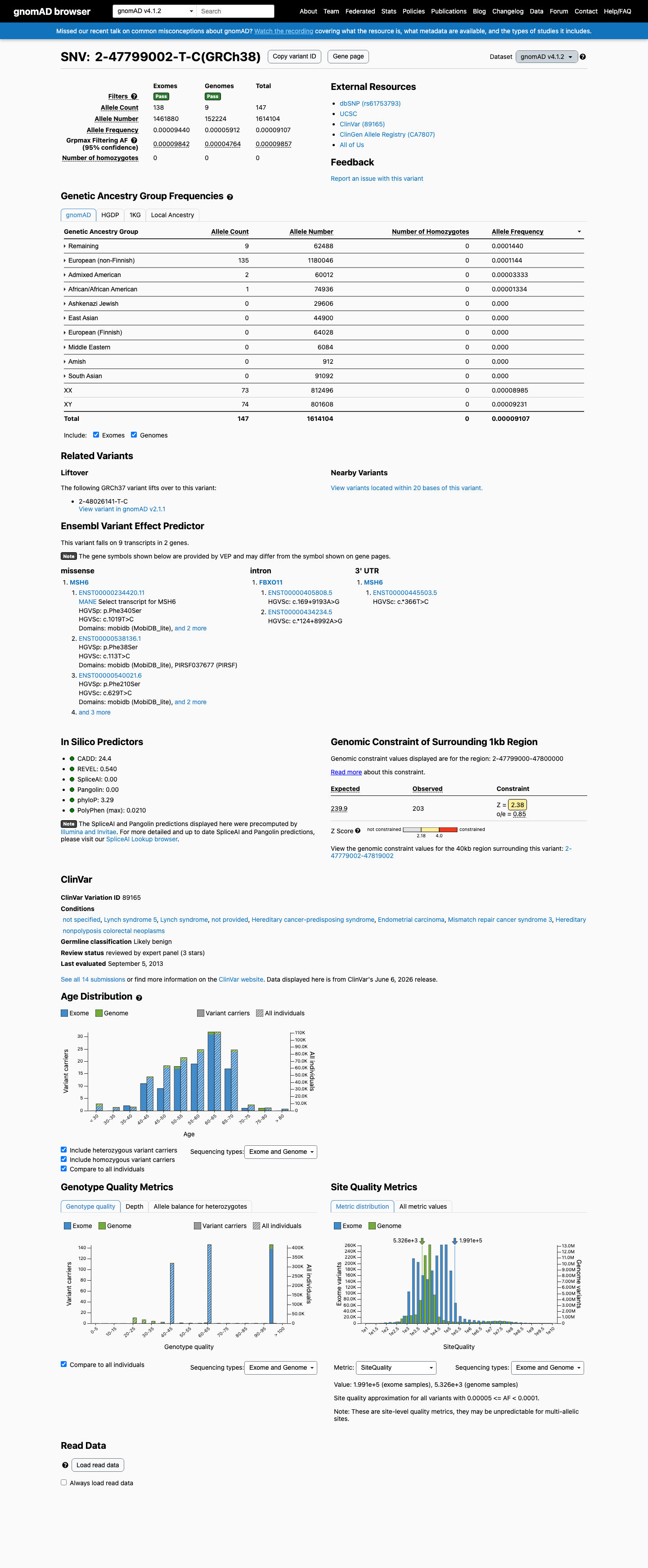
gnomAD v4.1 screenshot
gnomAD v4.1
gnomAD v2.1 screenshot
gnomAD v2.1
v4.1
This variant is present in gnomAD v4.1 (AF= 9.10722e-05; MAF= 0.00911%, 147/1614104 alleles, homozygotes = 0) and has highest observed frequency in the Remaining individuals population (AF= 0.000144028; MAF= 0.01440%, 9/62488 alleles, homozygotes = 0); grpmax FAF= 9.857e-05.
v2.1
This variant is present in gnomAD v2.1 (AF= 3.53699e-05; MAF= 0.00354%, 10/282726 alleles, homozygotes = 0) and has highest observed frequency in the Remaining individuals population (AF= 0.000138351; MAF= 0.01384%, 1/7228 alleles, homozygotes = 0); grpmax FAF= 2.295e-05.
🇨🇦 CA
This variant is present in gnomAD-Canada v1.0 (AF= 0.00010856584518510477, 2/18422 alleles, homozygotes = 0).
Allele frequency by ancestry
three datasets · side by side
gnomAD v4.1
0.0091% · 147 / 1,614,104
0 hom · FAF 0.0099%
Remaining individuals
9 / 62,488
0.014%
European (non-Finnish)
135 / 1,180,046
0.011%
Admixed American
2 / 60,012
0.0033%
African/African American
1 / 74,936
0.0013%
+ 6 not observed (European (Finnish), Amish, East Asian, Middle Eastern, South Asian, Ashkenazi Jewish)
gnomAD v2.1
0.0035% · 10 / 282,726
0 hom · FAF 0.0023%
Remaining individuals
1 / 7,228
0.014%
Admixed American
2 / 35,436
0.0056%
European (non-Finnish)
7 / 129,050
0.0054%
+ 5 not observed (African/African American, Ashkenazi Jewish, East Asian, European (Finnish), South Asian)
gnomAD Canada 🇨🇦
0.011% · 2 / 18,422
0 hom · FAF 0.003%
European (non-Finnish)
2 / 11,742
0.017%
+ 8 not observed (African/African American, Latino/Admixed American, Ashkenazi Jewish, East Asian, European (Finnish), Middle Eastern, Remaining individuals, South Asian)
ClinVar screenshot
ClinVar
This variant has been reported in ClinVar as Likely benign (6 clinical laboratories) and as Uncertain significance (5 clinical laboratories) and as Benign (1 clinical laboratory) and as Likely benign by International Society for Gastrointestinal Hereditary Tumours (InSiGHT) (expert panel). (ClinVarID = 89165)
SpliceAI screenshot
In silico
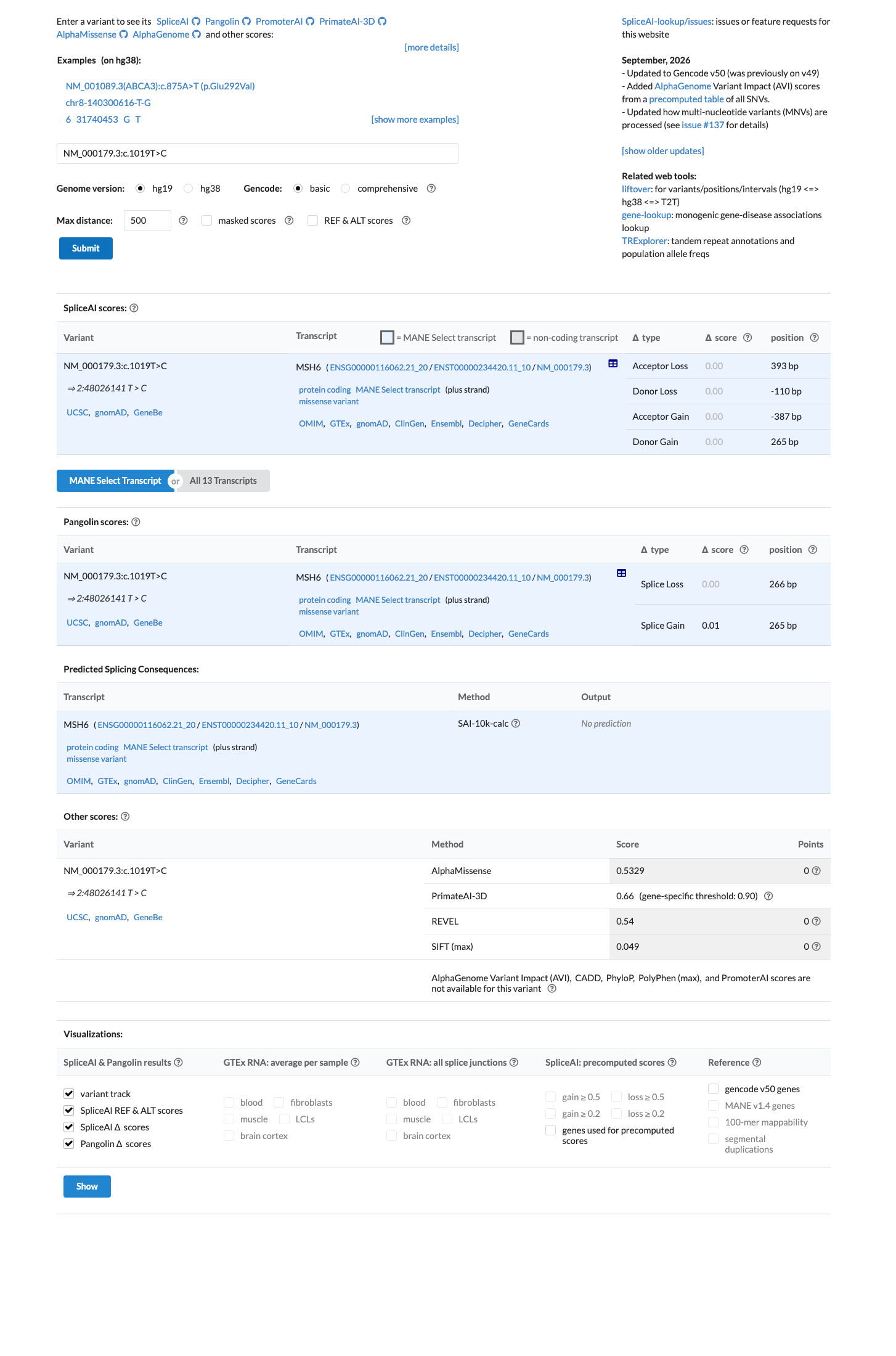
SpliceAI predicts no significant splice impact for this variant (max delta score = 0.00). REVEL score = 0.54. BayesDel score = 0.304735. HCI prior probability for pathogenicity = 0.0019. MAPP score = 3.51. Custom PP2 score = 0.017.
Functional / OncoKB screenshot
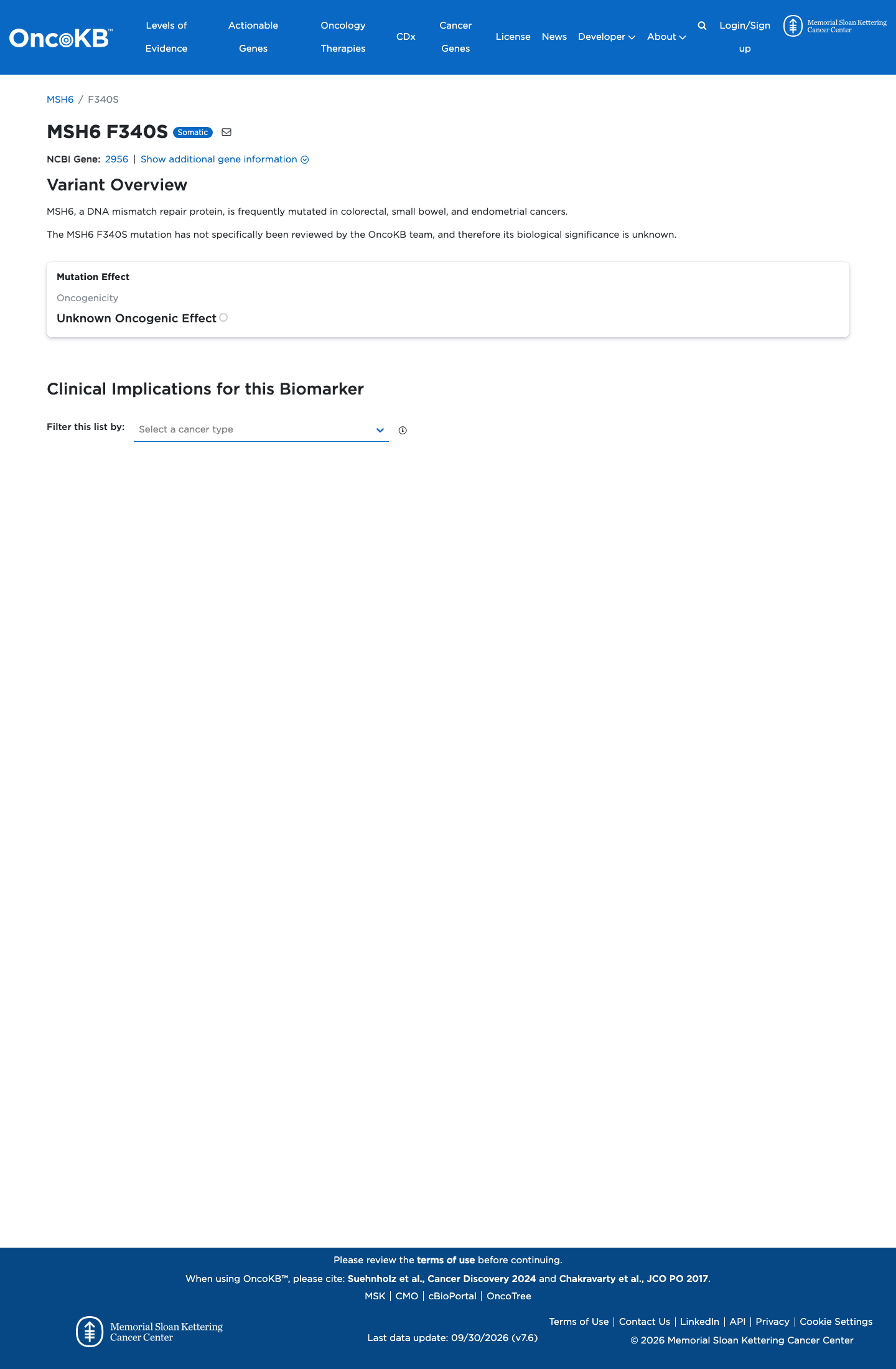
Functional Unknown Oncogenic Effect
OncoKB did not identify variant-specific reviewed functional evidence for this variant; gene-level curated context is available for reviewer follow-up. MSH6, a DNA mismatch repair protein, is frequently mutated in colorectal, small bowel, and endometrial cancers.
OncoKB ↗
COSMIC screenshot
COSMIC
Cancer hotspots screenshot
Cancer hotspots
Somatic evidence Not in COSMIC / hotspots
COSMIC
This variant does not lie in a statistically significant hotspot. This variant has not previously been reported in somatic cancers (COSMIC).
Hotspots
This variant does not lie in a statistically significant hotspot.
Sources & reference links
9Sources
CSpec VCEP
ClinVar
gnomAD v2.1
gnomAD v4.1
gnomAD-Canada
SpliceAI
OncoKB
COSMIC
Cancer hotspots
Triaged references · 8 PMIDs not cited in assessment
10699937 ↗ Sequence analysis of the mismatch repair gene hMSH6 in the germline of patients with familial and sporadic colorectal cancer. CLINVAR
15604628 ↗ Genetic cancer risk assessment and counseling: recommendations of the national s CLINVAR
22290698 ↗ Classification of mismatch repair gene missense variants with PON-MMR. CLINVAR
22949379 ↗ A multifactorial likelihood model for MMR gene variant classification incorporating probabilities based on sequence bioinformatics and tumor characteristics: a report from the Colon Cancer Family Registry. CLINVAR
23621914 ↗ CoDP: predicting the impact of unclassified genetic variants in MSH6 by the combination of different properties of the protein. CLINVAR
24033266 ↗ A systematic approach to assessing the clinical significance of genetic variants CLINVAR
25741868 ↗ Standards and guidelines for the interpretation of sequence variants: a joint co CLINVAR
26389258 ↗ Cancer Genetics Risk Assessment and Counseling (PDQ®): Health Professional Versi CLINVAR