Analysis in progress
Initialising…
0%
complete
This report is still being assembled — sections appear as each stage finishes. It isn't final yet.
MSH6
Final classification
Likely Benign
MSH6 c.1403G>A · p.Arg468His
MSH6

PM2 (Supporting): gnomAD v4.1 total allele frequency 0.00192% is below the 0.002% (1 in 50,000) rarity threshold.

Gene
MSH6
Transcript
NM_000179.3
HGVS · transcript:coding
NM_000179.3:c.1403G>A
Consequence
N/A
GRCh38
chr2:47799386 G>A
GRCh37
chr2:48026525 G>A
Basis Likely Benign: VCEP Rule19 (>=2 Benign.Supporting) is satisfied by BP4 (HCI prior 0.1095 < 0.11) and BP6 (InSiGHT 3-star Likely Benign); the lone pathogenic-direction criterion, PM2 supporting, is insufficient.
Likely Benign: VCEP Rule19 (>=2 Benign.Supporting) is satisfied by BP4 (HCI prior 0.1095 < 0.11) and BP6 (InSiGHT 3-star Likely Benign); the lone pathogenic-direction criterion, PM2 supporting, is insufficient.
Classification rationale
PM2 BP4BP6 Likely Benign
MSH6 c.1403G>A

PM2 (Supporting): gnomAD v4.1 total allele frequency 0.00192% is below the 0.002% (1 in 50,000) rarity threshold. BP4 (Supporting): HCI prior probability of pathogenicity 0.1095 is below the 0.11 benign threshold. BP6 (Supporting Benign): the InSiGHT expert panel classified this exact variant Likely Benign (ClinVar 3-star review). Overall: Likely Benign, by VCEP Rule19 (two or more Benign.Supporting criteria).

PM2 + BP4 + BP6 Likely Benign
Gene diagram · NM_000179.3 · variants mapped to exon structure
MSH6 NM_000179.3
Fetching transcript structure from UCSC…
Applied criteria · 3 applied · 16 assessed
Applied · 3
Strength Supporting Moderate Strong Very strong
PM2 supporting review Pathogenic
Met (supporting): gnomAD v4.1 total allele frequency 0.00192% is below the 0.002% (<1 in 50,000) threshold. Flagged for human review: grpmax FAF and AMR subpopulation frequencies exceed the threshold, leaving essentially no margin.
gnomAD v4.1 total AF = 1.92072e-05 (0.00192%) < 0.00002, 31/1,613,978 alleles, homozygotes = 0; grpmax FAF = 2.256e-05; gnomAD v2.1 total AF = 3.18547e-05 (8/251,140, homozygotes = 0); PMID:18033691 control frequency 0/1008
BP4 supporting review Benign
Met (supporting): HCI prior probability of pathogenicity 0.1095 is below the 0.11 BP4 threshold. Flagged for human review: the value sits only 0.0005 below the cutoff and should be re-confirmed against HCI PRIORS.
HCI prior probability for MSH6 c.1403G>A = 0.1095, which is <0.11 and therefore meets BP4 Supporting per InSiGHT MSH6 VCEP v2.0 rule (cspec doc 1578294885; PRIORS at hci-priors.hci.utah.edu; underlying model PMID 22949387 Thompson et al. 2013). Margin to threshold is 0.0005 - near-boundary, flagged for human review.SpliceAI max delta score = 0.02 (<=0.1) would satisfy the BP4 splice-impact path per Walker et al. 2023 (PMID 37352859), but that path is restricted to intronic and synonymous variants per the VCEP rule; noted as context only, not counted for this missense variant.
BP6 supporting Benign
Met (supporting benign): the InSiGHT expert panel classified this variant Likely Benign (ClinVar 3-star expert-panel review).
clinvar: VCV000089192 classified 'Likely benign' by International Society for Gastrointestinal Hereditary Tumours (InSiGHT) expert panel; review_status 'reviewed by expert panel', review_stars 3; SCV000107856, date_last_evaluated 2013-09-05; VCV date_last_updated 2026-04-13ClinVar expert panel classification
Assessed · not applied
Pathogenic
PVS1 Not met: c.1403G>A is a missense substitution with no protein length change and no splicing impact (SpliceAI max delta 0.02).
PS1 Not met: no alternative nucleotide change producing p.Arg468His has been classified pathogenic; the only such allele, c.1403G>A itself, is InSiGHT Likely Benign.
PS2 Not assessed: no de novo occurrence or parental testing data were available for this variant.
PS3 Not met: four independent laboratory assays report proficient mismatch repair activity similar to wild type, contradicting a damaging effect.
PM3 Not met: no in-trans or biallelic co-occurrence with a pathogenic MSH6 variant is documented; gnomAD reports 0 homozygotes.
PM5 Not met: no pathogenic missense at residue 468 exists, and the PP3 gate fails (HCI prior 0.1095 is below the 0.68 supporting threshold).
PP1 Not assessed: no co-segregation or pedigree data were available to compute a segregation likelihood ratio.
PP3 Not met: the HCI prior probability of pathogenicity is 0.1095, far below the 0.68 supporting threshold, and SpliceAI max delta 0.02 is below 0.2.
PP4 Not assessed: no tumor MSI or MMR immunohistochemistry data were available for carriers of this variant.
PP5 Not met: the only expert-panel classification for this variant is InSiGHT Likely Benign, which supports the benign direction (BP6), not PP5.
Benign
BA1 Not met: gnomAD v4.1 grpmax FAF 0.00226% is roughly 100-fold below the 0.22% BA1 threshold.
BS1 Not met: gnomAD v4.1 grpmax FAF 0.00226% is about 10-fold below the 0.022% BS1 threshold.
BS2 Not met: no in-trans co-occurrence with a pathogenic MSH6 variant is documented; gnomAD reports 0 homozygotes.
BS3 Not assessed: assays indicate proficient MMR activity, but the calibrated FOP values and mRNA-based assay evidence the VCEP requires were unavailable.
BS4 Not assessed: no documented non-segregation exists to compute a lack-of-segregation likelihood ratio.
BP5 Not assessed: no tumor MSI/MSS or MMR immunohistochemistry data were available to count MSS tumors in carriers.
N/A · 9 PS4 · PM1 · PM4 · PM6 · PP2 · BP1 · BP2 · BP3 · BP7
Research & evidence
Population frequency · supports benign
gnomAD v4.1 screenshot
gnomAD v4.1
gnomAD v2.1 screenshot
gnomAD v2.1
v4.1
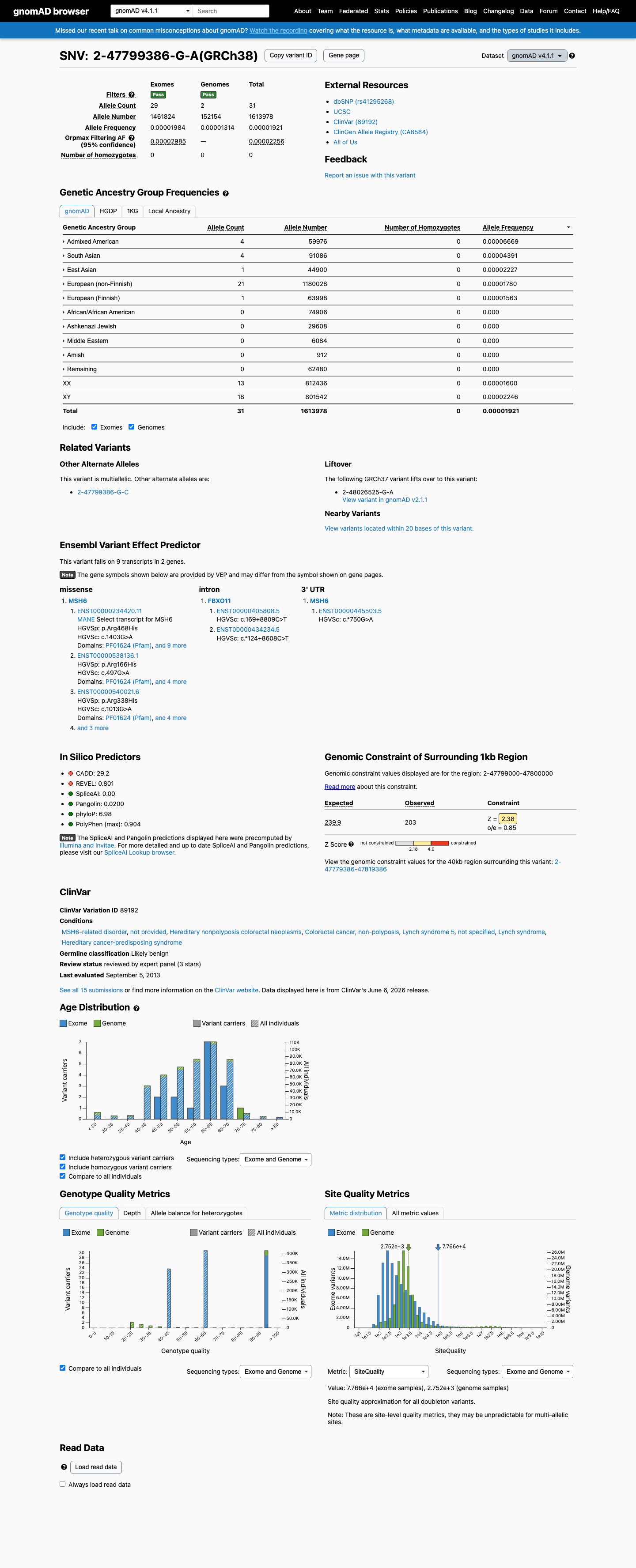
This variant is present in gnomAD v4.1 (AF= 1.92072e-05; MAF= 0.00192%, 31/1613978 alleles, homozygotes = 0) and has highest observed frequency in the Admixed American population (AF= 6.66933e-05; MAF= 0.00667%, 4/59976 alleles, homozygotes = 0); grpmax FAF= 2.256e-05.
v2.1
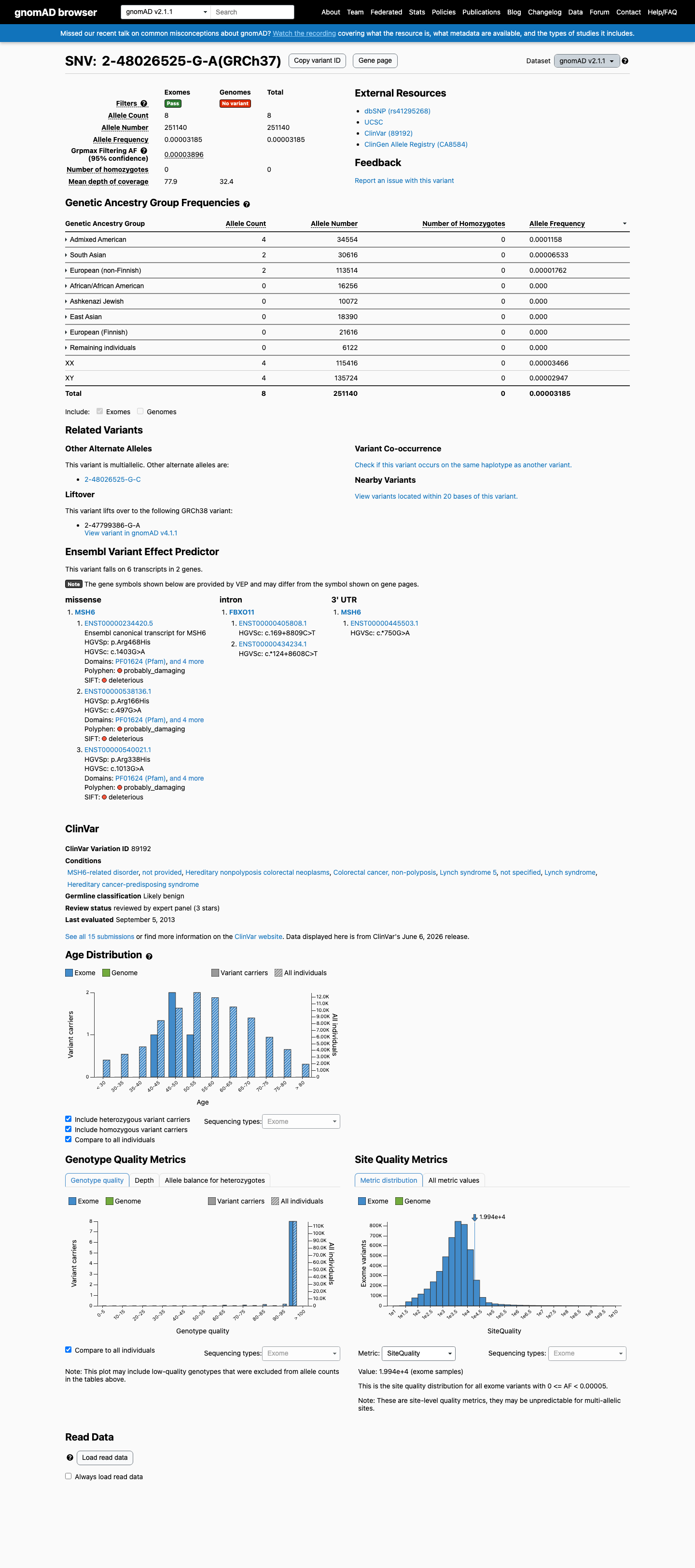
This variant is present in gnomAD v2.1 (AF= 3.18547e-05; MAF= 0.00319%, 8/251140 alleles, homozygotes = 0) and has highest observed frequency in the Admixed American population (AF= 0.000115761; MAF= 0.01158%, 4/34554 alleles, homozygotes = 0); grpmax FAF= 3.896e-05.
🇨🇦 CA
Not available in gnomAD-Canada v1.0.
Allele frequency by ancestry
three datasets · side by side
gnomAD v4.1
0.0019% · 31 / 1,613,978
0 hom · FAF 0.0023%
Admixed American
4 / 59,976
0.0067%
South Asian
4 / 91,086
0.0044%
East Asian
1 / 44,900
0.0022%
European (non-Finnish)
21 / 1,180,028
0.0018%
European (Finnish)
1 / 63,998
0.0016%
+ 5 not observed (Remaining individuals, Amish, Middle Eastern, Ashkenazi Jewish, African/African American)
gnomAD v2.1
0.0032% · 8 / 251,140
0 hom · FAF 0.0039%
Admixed American
4 / 34,554
0.012%
South Asian
2 / 30,616
0.0065%
European (non-Finnish)
2 / 113,514
0.0018%
+ 5 not observed (African/African American, Ashkenazi Jewish, East Asian, European (Finnish), Remaining individuals)
gnomAD Canada 🇨🇦
Absent · 0 / ?
0 hom
Not observed in any ancestry group.
ClinVar screenshot
ClinVar
This variant has been reported in ClinVar as Likely benign (7 clinical laboratories) and as Uncertain significance (3 clinical laboratories) and as Benign (1 clinical laboratory) and as Uncertain Significance (1 clinical laboratory) and as Likely Benign (1 clinical laboratory) and as Likely benign by International Society for Gastrointestinal Hereditary Tumours (InSiGHT) (expert panel). (ClinVarID = 89192)
SpliceAI screenshot
In silico
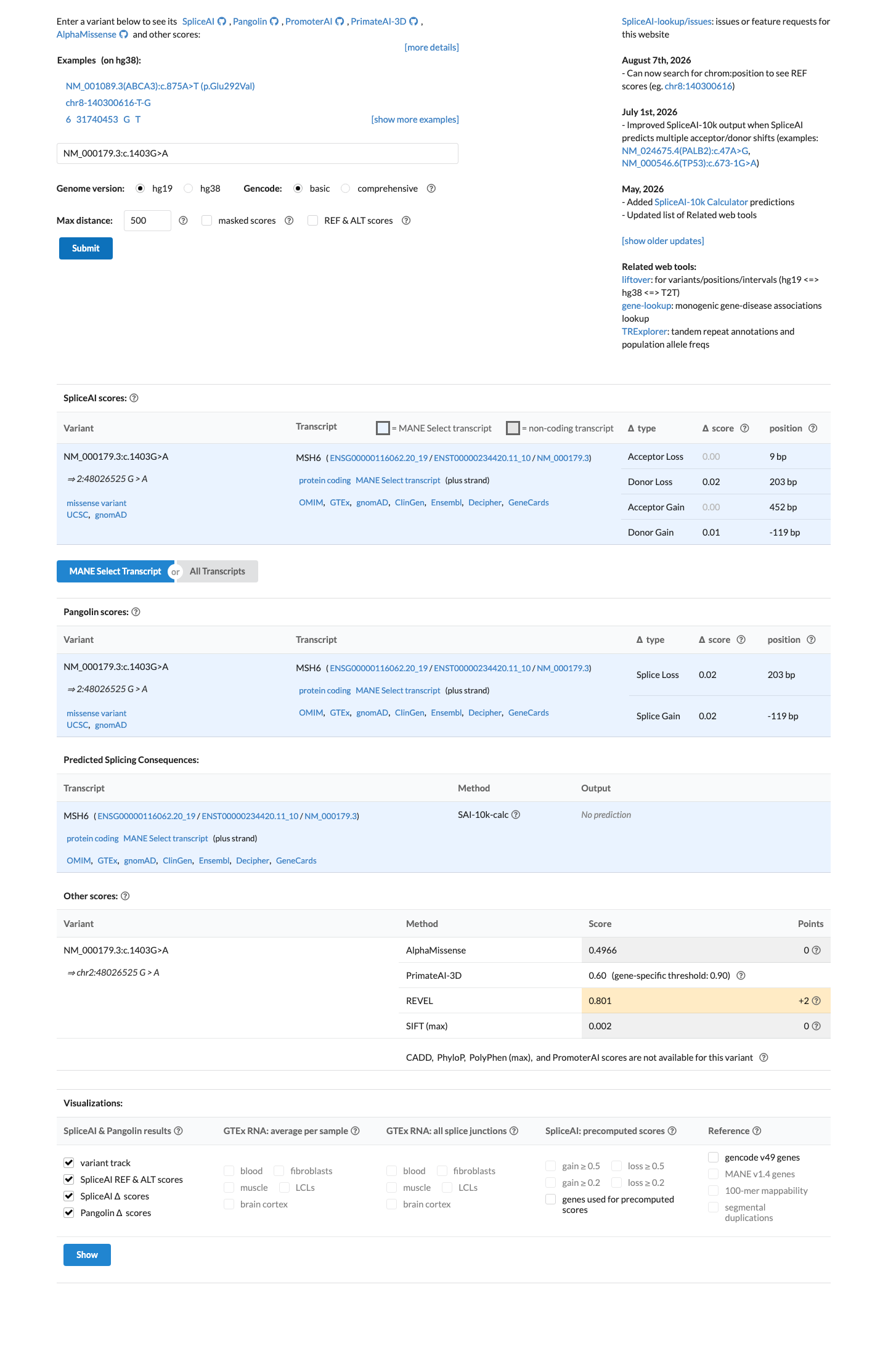
SpliceAI predicts no significant splice impact for this variant (max delta score = 0.02). REVEL score = 0.801. BayesDel score = 0.392893. HCI prior probability for pathogenicity = 0.1095. MAPP score = 14.41. Custom PP2 score = 0.246.
Functional / OncoKB screenshot
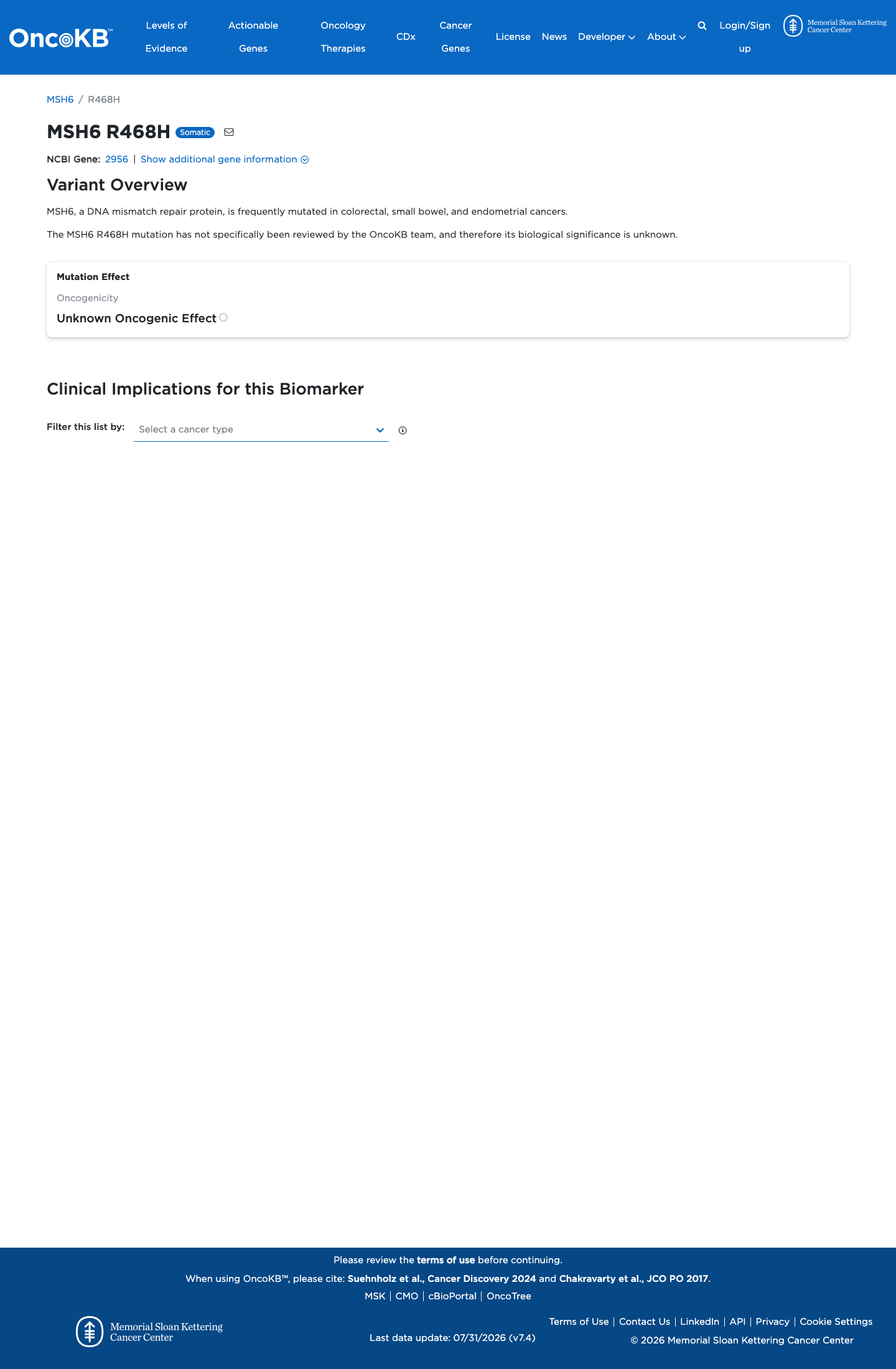
Functional Unknown Oncogenic Effect
OncoKB did not identify variant-specific reviewed functional evidence for this variant; gene-level curated context is available for reviewer follow-up. MSH6, a DNA mismatch repair protein, is frequently mutated in colorectal, small bowel, and endometrial cancers.
OncoKB ↗
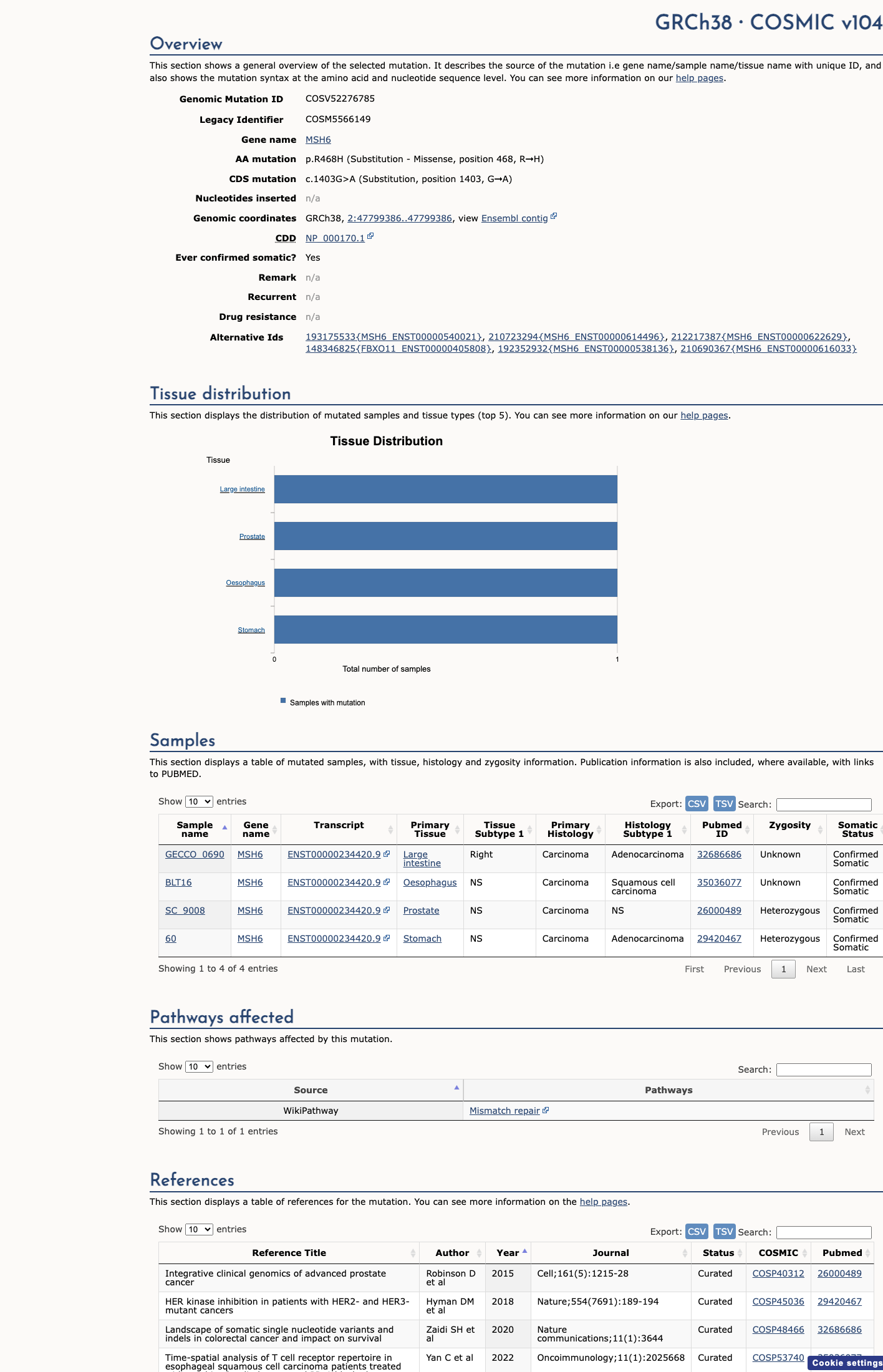
COSMIC screenshot
COSMIC
Cancer hotspots screenshot
Cancer hotspots
Somatic evidence Not in COSMIC / hotspots
COSMIC
This variant does not lie in a statistically significant hotspot. This variant has previously been reported in somatic cancers (COSMIC; COSV52276785, n = 4 times).
Hotspots
This variant does not lie in a statistically significant hotspot.
Literature · how each cited paper was used
1papers cited
Each card is an audit: what was searched, what was found, whether it names the variant, which criteria it fed, and why. 7 further PMIDs triaged but not cited — see Sources & References.
Classification of ambiguous mutations in DNA mismatch repair genes identified in a population-based study of colorectal cancer.
Searched
c.1403G>Ap.Arg468Hisp.R468H1403G
Found
Barnetson et al. (Hum Mutat 2008) report c.1403G>A p.R468H as one of the MSH6 germline variants identified in a population-based study of 932 colorectal cancer patients diagnosed before age 55. In Table 1, the variant is shown in 1 case (case frequency 0.0011) and 0/1008 controls; the single assessed tumor was microsatellite stable (MSS) with normal MLH1, MSH2, and MSH6 immunohistochemical staining. The study's mRNA analysis was performed only for putative splice-site mutations, and no RNA/splicing analysis, in-frame length change, or null-consequence data are reported for this variant. The paper's own pathogenicity category for this variant was not used to infer any criterion in this group. For the consequence/LOF group this source confirms the variant is a missense substitution with no reported splicing aberration and no protein length change, consistent with PVS1 not met and PM4/BP3 not applicable. Note: in the text extraction, '>' is rendered as '4' (e.g., 'c.1403G4A'); quotes preserve the extracted text.
Variant
✓ Names this variant — characterised directly
Applied to
PM2 supporting
Control frequency 0/1008 and case frequency 0.0011 corroborate extreme rarity, consistent with gnomAD v4.1 AF below the 0.00002 PM2 threshold.
MSH6: c.38A4C p.K13T, c.194C4T p.S65L, c.1403G4A p.R468H, c.1739C4T p.S580L, c.2633T4C p.V878A, c.3556-3A4T, c.3694G4C p.V1232L, and c.3961A4G p.R1321G were determined by automated sequence analysis of control DNA samples. / c.1403G4A p.R468H (Table 1 row) / effect on mRNA for putative splice-site mutations
Location Methods, control allele frequency determination (p.368); Table 1, MSH6 'c.1403G4A p.R468H' row (1 case, 0/1008 controls, MSS, IHC 1/1/1); Abstract (mRNA analysis scope)  ·  Context Population-based cohort of 932 colorectal cancer patients diagnosed at age <55 years; germline sequencing of MLH1, MSH2, and MSH6; variant allele frequency determined in control DNA samples; tumor MSI (5-marker panel) and MMR protein IHC; mRNA analysis restricted to putative splice-site mutations; bioinformatic protein-function predictions.  ·  full text
Sources & reference links
9Sources
CSpec VCEP
ClinVar
gnomAD v2.1
gnomAD v4.1
gnomAD-Canada
SpliceAI
OncoKB
COSMIC
Cancer hotspots
Triaged references · 7 PMIDs not cited in assessment
15604628 ↗ Genetic cancer risk assessment and counseling: recommendations of the national s CLINVAR
17854147 ↗ Three novel missense germline mutations in different exons of MSH6 gene in Chinese hereditary non-polyposis colorectal cancer families. CLINVAR
18067074 ↗ [Study on the germline mutation of MSH6 gene in Chinese hereditary nonpolyposis colorectal cancer pedigrees using PCR based sequencing]. CLINVAR
18809606 ↗ Feasibility of screening for Lynch syndrome among patients with colorectal cancer. CLINVAR
19389263 ↗ Investigation on the role of nsSNPs in HNPCC genes--a bioinformatics approach. CLINVAR
20301390 ↗ Lynch Syndrome. CLINVAR
21153778 ↗ Prioritization of candidate SNPs in colon cancer using bioinformatics tools: an alternative approach for a cancer biologist. CLINVAR