Back
NM_000179.3:c.1569_1572del
p.Tyr524ValfsTer46 · MSH6
0%
complete
Final classification
Likely Pathogenic
PVS1PM2
MSH6
c.1569_1572del
p.Tyr524ValfsTer46
frameshift · exon 4

MSH6 encodes a protein in the DNA mismatch repair system, which fixes errors made during DNA replication. Partnering with MSH2, it forms a complex that recognizes and helps correct mismatched DNA bases, keeping the genetic code stable. Inherited mutations in MSH6 cause Lynch syndrome (hereditary nonpolyposis colorectal cancer), raising the risk of colorectal, endometrial, ovarian, and other cancers, while mutations in both copies lead to constitutional mismatch repair deficiency. Because faulty mismatch repair drives tumor development and produces microsatellite instability, MSH6 acts as a tumor suppressor, and cancers with such repair defects often respond well to immune checkpoint inhibitor therapy.

This variant

MSH6 maintains DNA mismatch repair as part of the MutS-alpha complex, so this germline loss-of-function frameshift is expected to raise Lynch-syndrome-spectrum colorectal and endometrial cancer risk in carriers, while loss of both copies underlies constitutional mismatch repair deficiency.

Transcript
NM_000179.3
HGVS · transcript:coding
NM_000179.3:c.1569_1572del
GRCh38
chr2:47799549 GACTT>G
GRCh37
chr2:48026688 GACTT>G
Likely Pathogenic: PVS1 (very strong) plus PM2 (supporting) satisfy the InSiGHT MSH6 Expert Panel's one-Very-Strong-plus-one-Supporting rule.
Classification rationale
PVS1PM2 Likely Pathogenic
MSH6 c.1569_1572del frameshift · exon 4

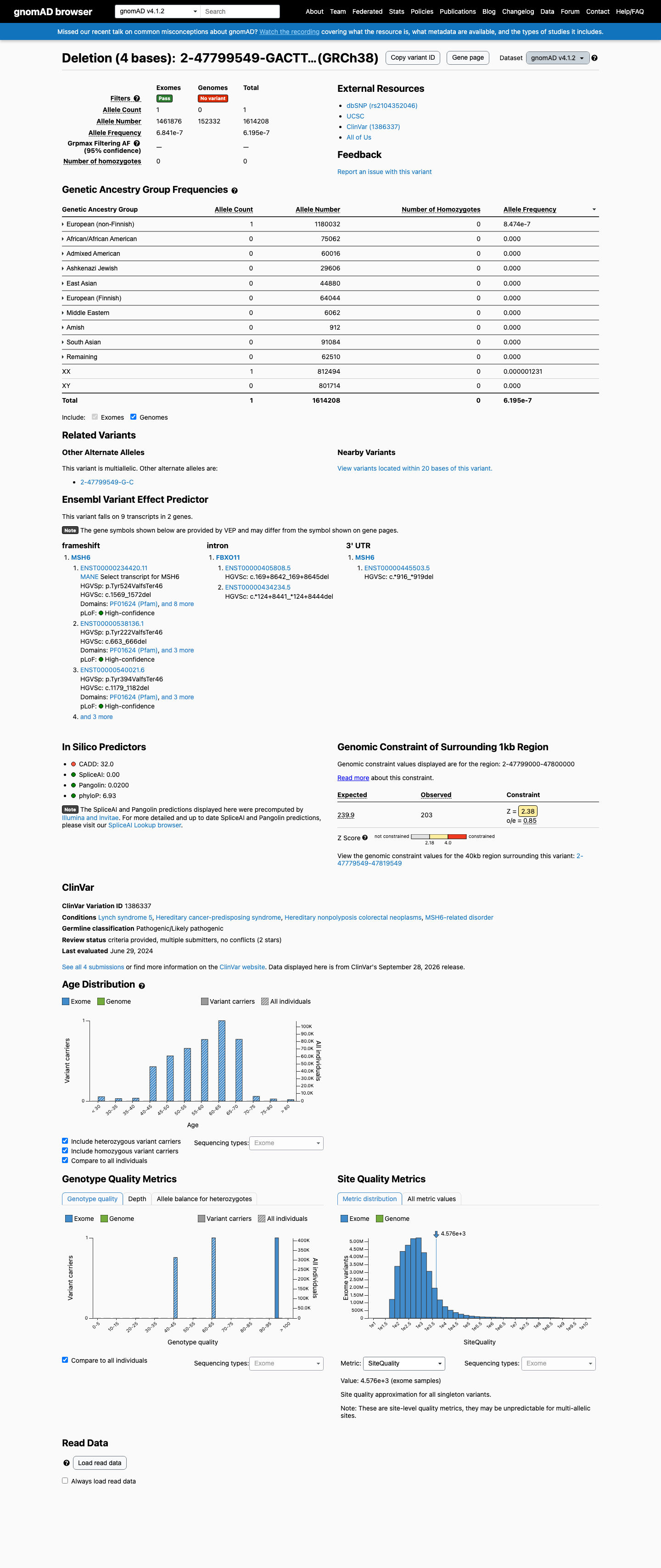
PVS1 very strong: the frameshift truncates MSH6 at codon 569, upstream of the InSiGHT codon 1341 boundary and predicted to undergo nonsense-mediated decay. PM2 supporting: gnomAD v4.1 total allele frequency 6.19e-07 is below the MSH6 specification's rarity threshold of 0.00002.

PVS1 + PM2 → Likely Pathogenic
LYFE Sciences is an AI system, and it can make mistakes. Criteria may be applied incorrectly, sources may be misread, and a confident-looking classification can still be wrong. Double-check every criterion and its underlying evidence before relying on any call.
Gene diagram · NM_000179.3 · variants mapped to exon structure
MSH6 NM_000179.3
Fetching transcript structure from UCSC…
Applied criteria · 2 applied · 13 assessed
MetEvidence satisfies this criterion.
Not metEvaluated against available evidence; threshold not reached.
Not assessedApplies in principle, but no evidence was found to evaluate it.
N/ADoesn't apply to this variant type.
Applied · 2
Strength Supporting Moderate Strong Very strong
PVS1 very strong Pathogenic
Met at very strong: the frameshift introduces a PTC at codon 569, upstream of the MSH6 codon 1341 InSiGHT very-strong threshold and predicted to trigger NMD.
Variant NM_000179.3:c.1569_1572del is a 4-bp deletion in MSH6 exon 4 (c.628-3172) causing an out-of-frame frameshift with a premature termination codon at codon 569 (NP_000170.1:p.(Tyr524ValfsTer46)); the predicted protein terminates at residue 569 (c.1705-1707).NM_000179.3 is the MANE Select transcript and the transcript specified by the governing MSH6 specification (raw_rule_origin preferredTranscript = NM_000179.3), so it is the clinically relevant transcript.Governing framework is the ClinGen InSiGHT Hereditary Colorectal Cancer/Polyposis Expert Panel specification to the ACMG/AMP guidelines for MSH6, Version 2.0 (doc 1578294885), which takes precedence over generic ACMG/AMP defaults.
PM2 supporting Pathogenic
Met (Supporting): gnomAD v4.1 total AF 6.19e-07 is below the MSH6 VCEP PM2 threshold of <0.00002 (<1 in 50,000 alleles).
MSH6 VCEP v2.0 (cspec) PM2 rule: Absent/extremely rare allele frequency <0.00002 (<1 in 50,000 alleles) in gnomAD v4 dataset (applied strength: Supporting).gnomAD v4.1: total AF 6.19499e-07 (AC=1, AN=1,614,208, homozygotes=0); exome AF 6.84053e-07 (AC=1, AN=1,461,876).gnomAD v4.1 highest subpopulation: European (non-Finnish) AF 8.47435e-07 (AC=1, AN=1,180,032, homozygotes=0).
Assessed · not applied · 4 not met · 9 not assessed
Pathogenic
PS1 Not met: c.1569_1572del is a frameshift (p.Tyr524ValfsTer46), not a missense substitution, so the same-amino-acid-change requirement of PS1 cannot be satisfied.
PS2 Not assessed: no proband, parental testing or de novo occurrence is documented, so no MSH6 VCEP de novo points (0.5 to >=4) could be counted.
PS3 Not assessed: no variant-specific calibrated functional-odds or MMR activity result is available for this frameshift, leaving the PS3 threshold unresolved.
PM3 Not assessed: no second pathogenic MSH6 allele, CMMRD-consistent proband, or cis/trans phase evidence exists, so no PM3 points can be assigned.
PM5 Not met: c.1569_1572del is a frameshift with no missense residue context, so the same-residue missense requirement of PM5 cannot be satisfied.
PP1 Not assessed: no pedigree or meiosis data exist, so no combined Bayes likelihood ratio could be tested against the MSH6 VCEP >2.08 PP1 threshold.
PP4 Not assessed: no tumor MSI or MMR-IHC data exist for this case, so PP4's requirement of at least one MSI-H CRC/endometrial tumor cannot be evaluated.
Benign
BA1 Not met: gnomAD v4.1 total AF 6.19e-07 (popmax NFE 8.47e-07) is far below the MSH6 VCEP BA1 threshold of >=0.0022.
BS1 Not met: gnomAD v4.1 total AF 6.19e-07 (popmax NFE 8.47e-07) is below the MSH6 VCEP BS1 lower bound of >=0.00022.
BS2 Not assessed: no trans co-occurrence or phase data for a second MSH6 pathogenic variant is available to evaluate the MSH6 VCEP BS2 rule.
BS3 Not assessed: no variant-specific calibrated functional-odds or proficient-function assay result is available for this frameshift, leaving the BS3 threshold unresolved.
BS4 Not assessed: no genotyped pedigree exists, so no combined Bayes likelihood ratio could be tested against the MSH6 VCEP <=0.48 BS4 threshold.
BP5 Not assessed: no tumor MSI, MMR-IHC, BRAF V600E or MLH1 methylation data exist, so BP5's ≥2 MSS/no-MMR-loss tumor requirement cannot be evaluated.
N/A · 13 PS4 · PM1 · PM4 · PM6 · PP2 · PP3 · PP5 · BP1 · BP2 · BP3 · BP4 · BP6 · BP7
Research & evidence
Population frequency · supports pathogenic
gnomAD v4.1 screenshot
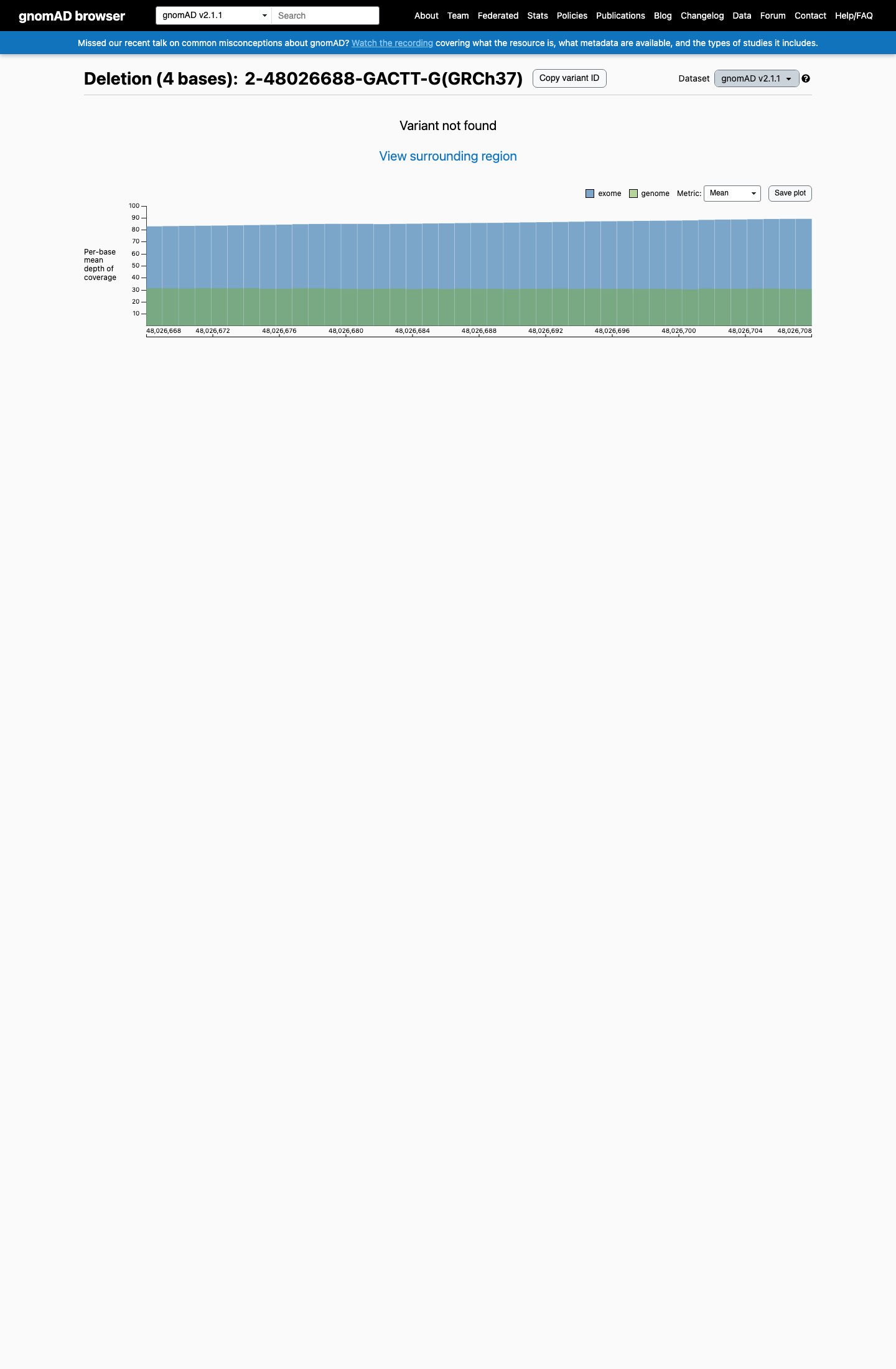
gnomAD v4.1
gnomAD v2.1 screenshot
gnomAD v2.1
v4.1
This variant is present in gnomAD v4.1 (AF= 6.19499e-07; MAF= 0.00006%, 1/1614208 alleles, homozygotes = 0) and has highest observed frequency in the European (non-Finnish) population (AF= 8.47435e-07; MAF= 0.00008%, 1/1180032 alleles, homozygotes = 0).
v2.1
Absent from gnomAD v2.1.
🇨🇦 CA
Absent from gnomAD-Canada v1.0.
Allele frequency by ancestry
three datasets · side by side
gnomAD v4.1
6.2e-05% · 1 / 1,614,208
0 hom
European (non-Finnish)
1 / 1,180,032
8.5e-05%
+ 9 not observed (Remaining individuals, Admixed American, European (Finnish), Amish, East Asian, Middle Eastern, South Asian, Ashkenazi Jewish, African/African American)
gnomAD v2.1
Absent · 0 / ?
0 hom
Not observed in any ancestry group.
gnomAD Canada 🇨🇦
Absent · 0 / ?
0 hom
Not observed in any ancestry group.
ClinVar screenshot
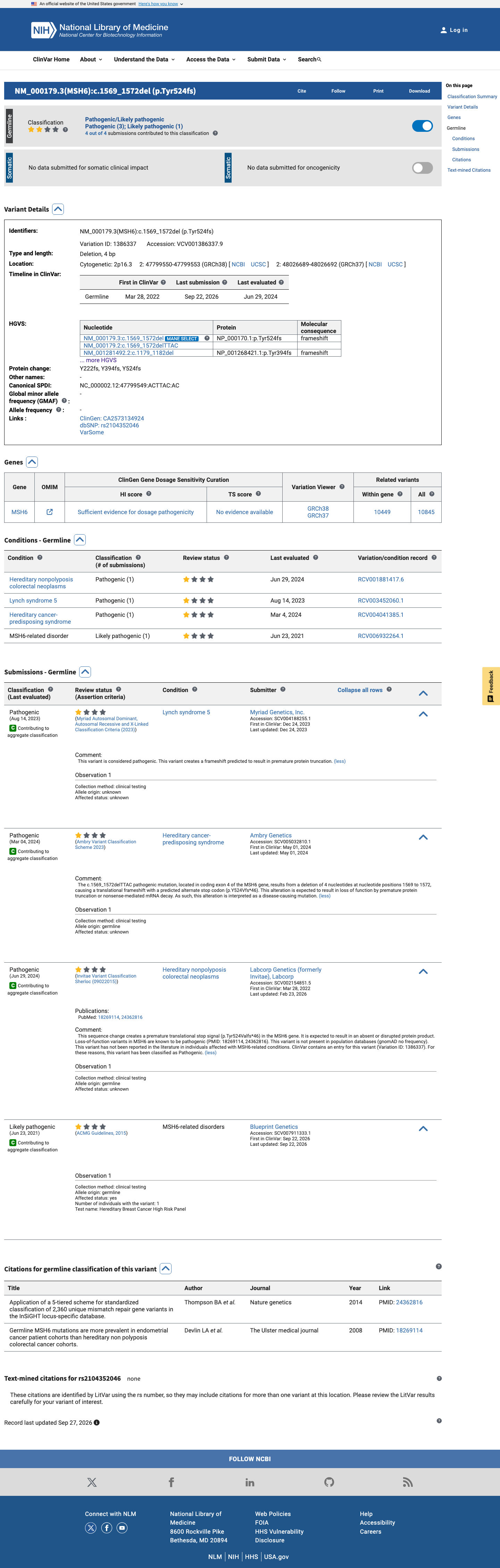
ClinVar
This variant has been reported in ClinVar as Pathogenic (3 clinical laboratories) and as Likely pathogenic (1 clinical laboratory). (ClinVarID = 1386337)
SpliceAI screenshot
In silico
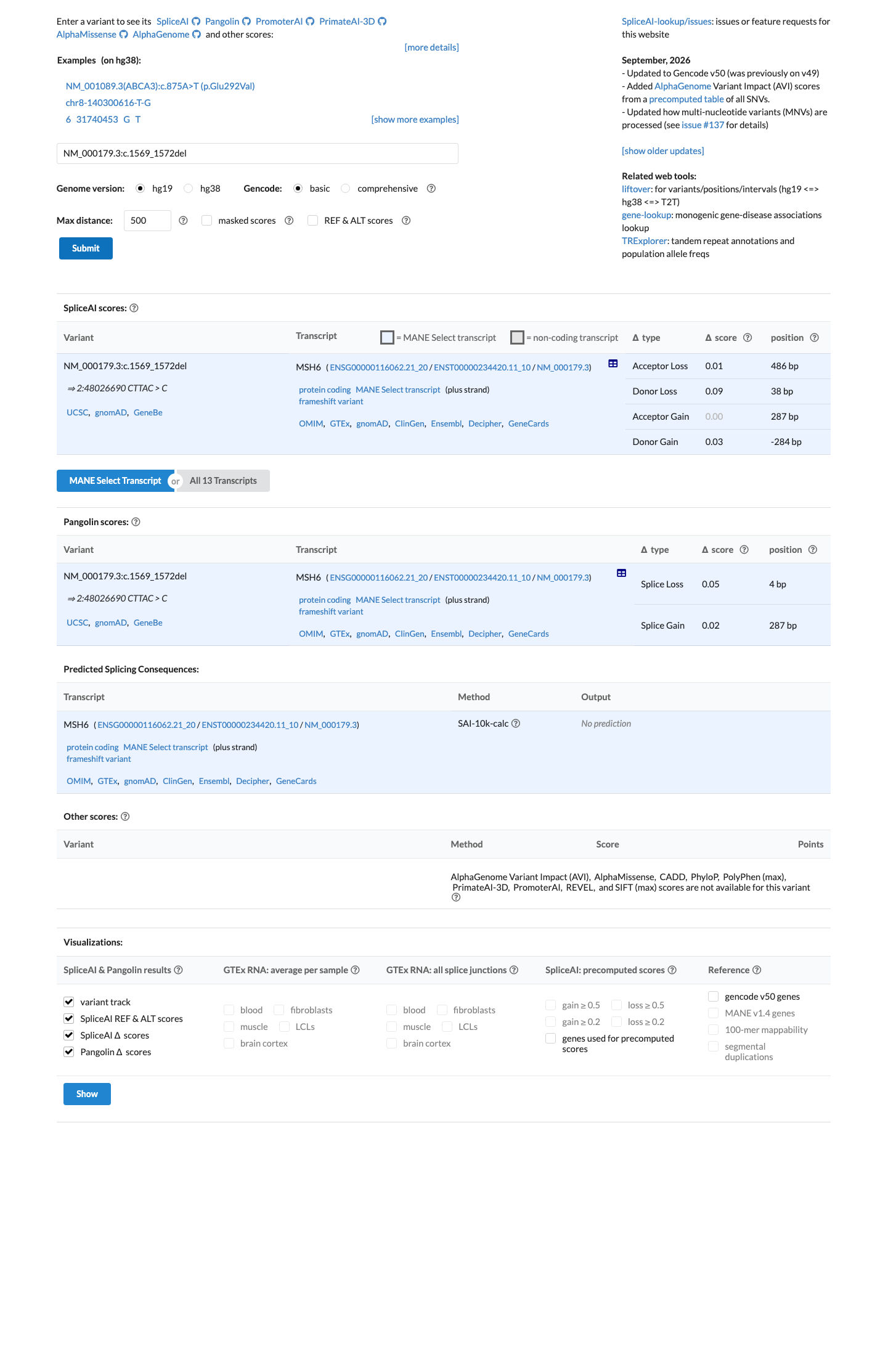
SpliceAI predicts no significant splice impact for this variant (max delta score = 0.09).
Functional / OncoKB screenshot
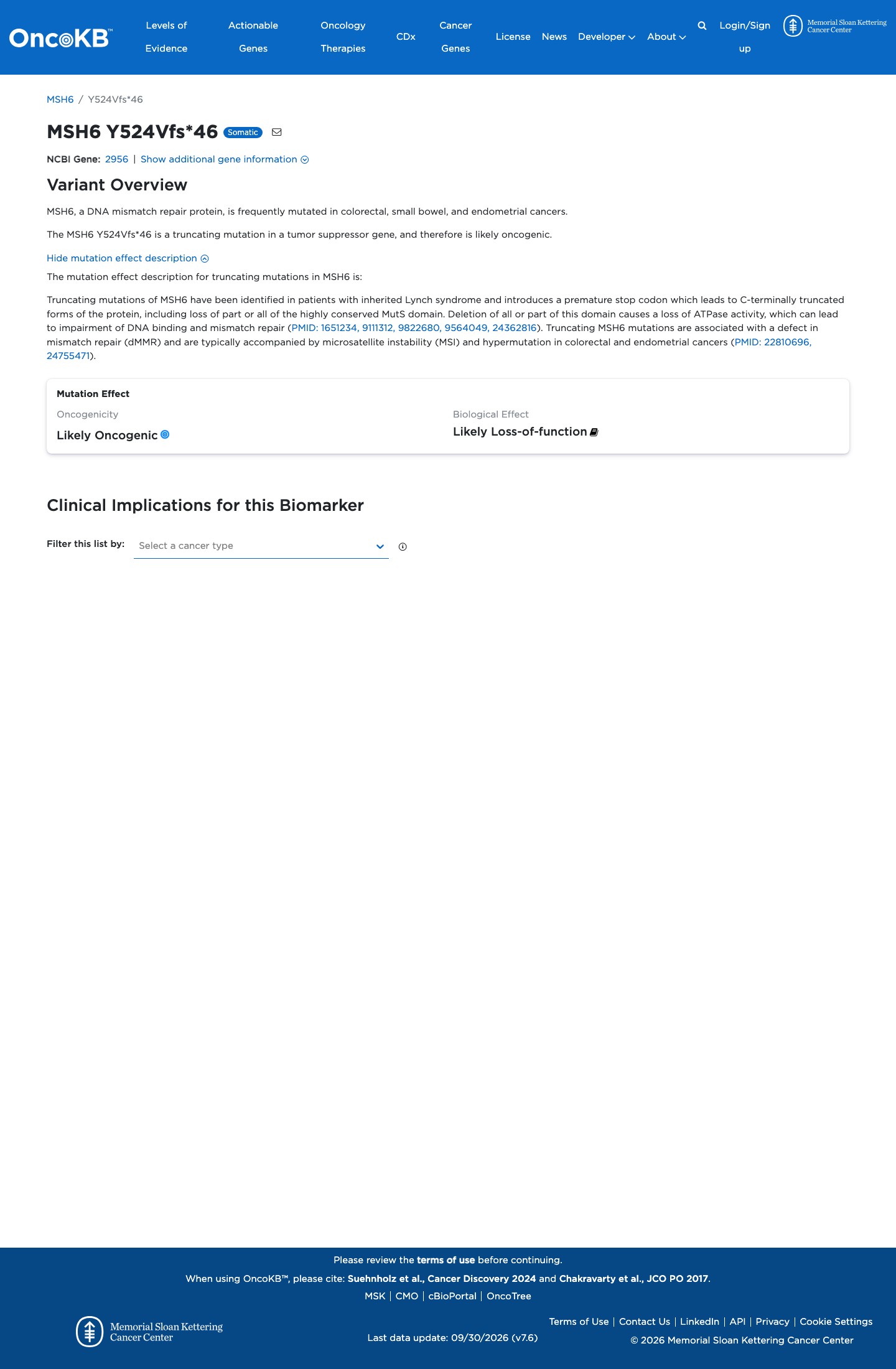
Functional Likely Oncogenic
OncoKB identified variant-specific curated literature and context relevant to functional review; biological-effect context: Likely Loss-of-function; curated oncogenicity label: Likely Oncogenic.
OncoKB ↗
COSMIC screenshot
COSMIC
Cancer hotspots screenshot
Cancer hotspots
Somatic evidence Not in COSMIC / hotspots
COSMIC
This variant does not lie in a statistically significant hotspot. This variant has not previously been reported in somatic cancers (COSMIC).
Hotspots
This variant does not lie in a statistically significant hotspot.
Literature · how each cited paper was used
2papers cited
Each card is an audit: what was searched, what was found, whether it names the variant, which criteria it fed, and why. 5 further PMIDs triaged but not cited — see Sources & references.
Rule & framework references · cited for criterion definitions, not variant evidence
24362816 ↗ Application of a 5-tiered scheme for standardized classification of 2,360 unique mismatch repair gene variants in the InSiGHT locus-specific database.
25741868 ↗ Standards and guidelines for the interpretation of sequence variants: a joint consensus recommendation of the American College of Medical Genetics and Genomics and the Association for Molecular Pathology.
Sources & reference links
9Sources
CSpec VCEP
ClinVar
gnomAD v2.1
gnomAD v4.1
gnomAD-Canada
SpliceAI
OncoKB
COSMIC
Cancer hotspots
Triaged references · 5 PMIDs not cited in assessment
1651234 ↗ Altering the conserved nucleotide binding motif in the Salmonella typhimurium MutS mismatch repair protein affects both its ATPase and mismatch binding activities. ONCOKB
22810696 ↗ Comprehensive molecular characterization of human colon and rectal cancer. ONCOKB
24755471 ↗ Colorectal cancer cell lines are representative models of the main molecular subtypes of primary cancer. ONCOKB
9111312 ↗ Genetic and biochemical analysis of Msh2p-Msh6p: role of ATP hydrolysis and Msh2p-Msh6p subunit interactions in mismatch base pair recognition. ONCOKB
18269114 ↗ Germline MSH6 mutations are more prevalent in endometrial cancer patient cohorts than hereditary non polyposis colorectal cancer cohorts. CLINVAR