This variant was interpreted by pipeline
7.1.0.
The current version is
8.0.0.
Re-running queues a fresh interpretation; the result replaces this page when complete.
Re-runs are not free. Blank = draws on today's public interpretation allowance.
With a code = uses 1 of that code's uses.
MSH6 encodes a protein in the DNA mismatch repair system, which fixes errors made during DNA replication. Partnering with MSH2, it forms a complex that recognizes and helps correct mismatched DNA bases, keeping the genetic code stable. Inherited mutations in MSH6 cause Lynch syndrome (hereditary nonpolyposis colorectal cancer), raising the risk of colorectal, endometrial, ovarian, and other cancers, while mutations in both copies lead to constitutional mismatch repair deficiency. Because faulty mismatch repair drives tumor development and produces microsatellite instability, MSH6 acts as a tumor suppressor, and cancers with such repair defects often respond well to immune checkpoint inhibitor therapy.
This variant
MSH6 is a DNA mismatch repair gene in which inherited mutations predispose to Lynch syndrome colorectal, endometrial, and other cancers. This deep-intronic duplication is a VUS: it lacks the population-frequency evidence for benignity and the splicing or functional evidence for pathogenicity, so its impact on Lynch syndrome risk remains uncertain.
Transcript
NM_000179.3
HGVS · transcript:coding
NM_000179.3:c.4001+32_4001+35dup
GRCh38
chr2:47806677 A>ATAAC
GRCh37
chr2:48033816 A>ATAAC
VUS: only one benign criterion (BP7 supporting) was met, which matches no VCEP combination rule — Likely Benign requires two benign criteria.
Classification rationale
BP7VUS
MSH6 c.4001+32_4001+35dupinframe insertion
BP7 (Supporting): intronic variant at +32 to +35, beyond the VCEP's +7 boundary. Overall: VUS — a single supporting benign criterion reaches neither the Likely Benign (two benign criteria) nor Benign threshold, with zero pathogenic evidence.
BP7→VUS
LYFE Sciences is an AI system, and it can make mistakes. Criteria
may be applied incorrectly, sources may be misread, and a confident-looking
classification can still be wrong. Double-check every criterion and
its underlying evidence before relying on any call.
Gene diagram
· NM_000179.3 · variants mapped to exon structure
MSH6NM_000179.3
Fetching transcript structure from UCSC…
Exons
—
Transcript span
—
Strand
—
Variants mapped
—
Source
UCSC ncbiRefSeqCurated
All variants in MSH6—click a row to locate it on the plot · use the link column to open its page
Protein
Location
Classification
Link
Applied criteria · 1 applied · 15 assessed
MetEvidence satisfies this criterion.
Not metEvaluated against available evidence; threshold not reached.
Not assessedApplies in principle, but no evidence was found to evaluate it.
N/ADoesn't apply to this variant type.
Applied · 1
Strength Supporting Moderate Strong Very strong
✓
BP7supportingBenign
Met (Supporting): the intronic duplication lies at +32 to +35, beyond the +7 boundary the VCEP BP7 rule requires.
Variant normalization: NM_000179.3:c.4001+32_4001+35dup (intronic duplication, +32 to +35 relative to exon 8, beyond +7)InSiGHT MSH6 VCEP v2.0 BP7 rule: intronic variant at or beyond -21/+7 qualifies for BP7_Supporting
Assessed · not applied
· 6 not met · 9 not assessed
Pathogenic
PVS1Not met: the 4-bp duplication lies deep in intron 9 (+32 to +35), outside the canonical splice consensus, with no predicted protein-level consequence.
PS2Not assessed: no de novo occurrence or parental testing data was available for this variant.
PS3Not assessed: no functional assay, mRNA splicing, or allelic-expression data was available for this variant.
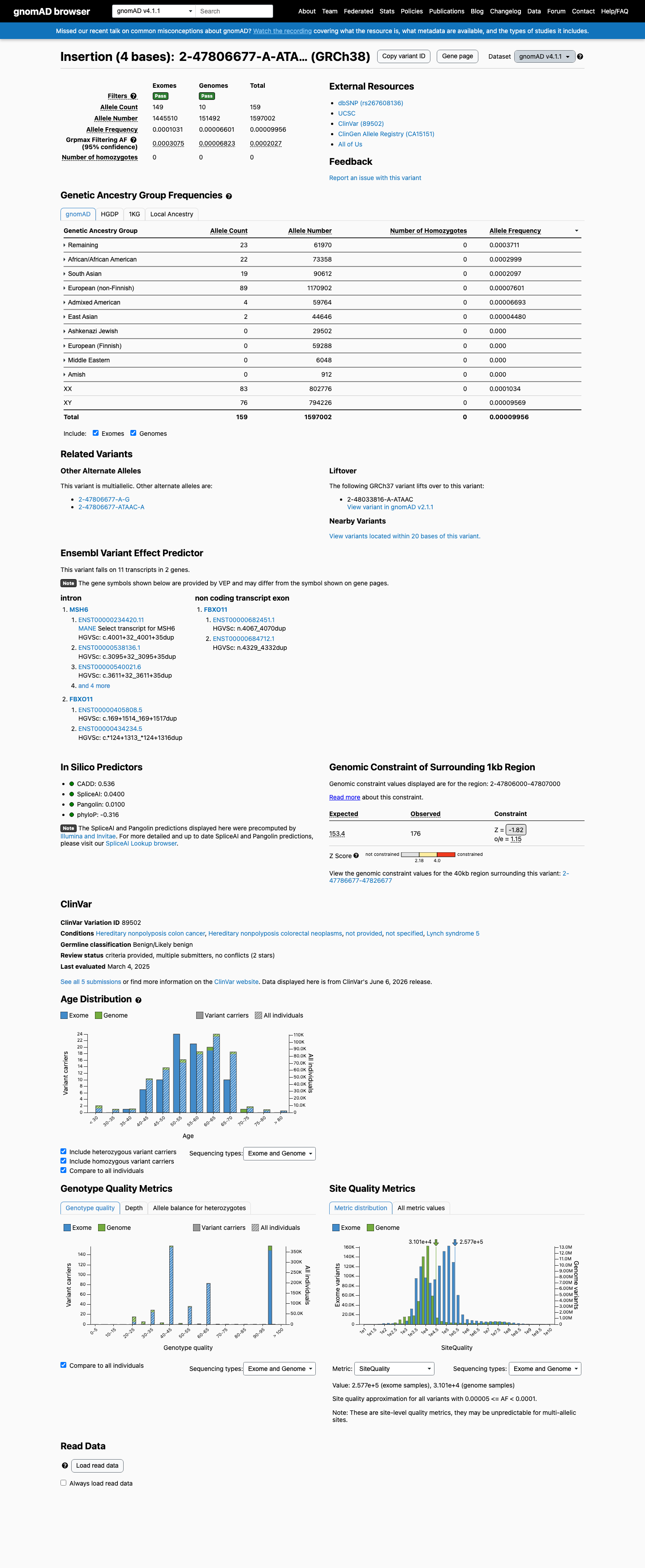
PM2Not met: gnomAD v4 allele frequency of 9.96e-05 is ~5-fold above the <0.00002 extreme-rarity ceiling.
PM3Not assessed: no second MSH6 variant or phase data existed to test trans co-occurrence.
PP1Not assessed: no pedigree or co-segregation data was available for this variant.
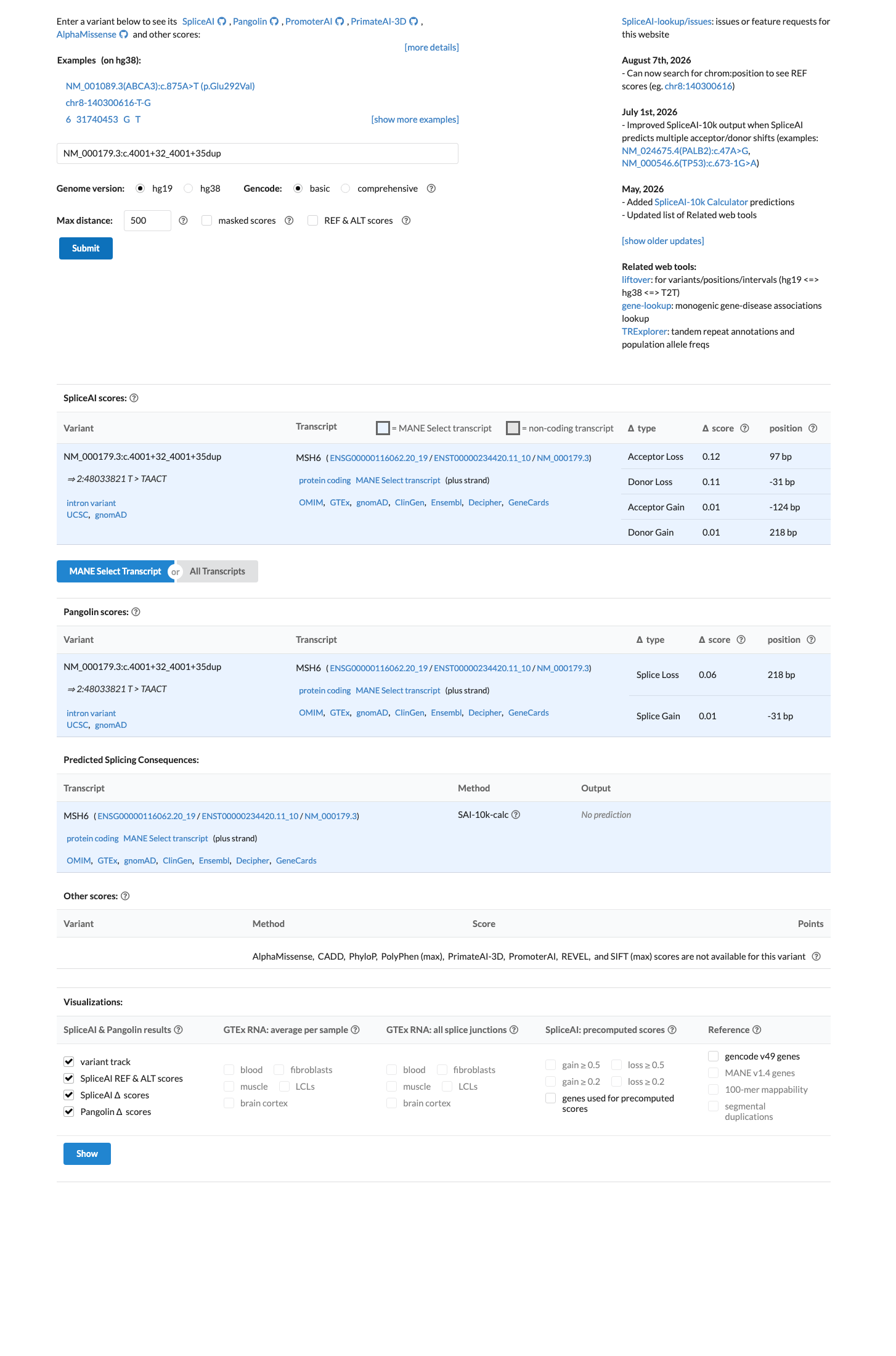
PP3Not met: SpliceAI max delta 0.12 is below the >=0.2 splice-defect threshold.
PP4Not assessed: no MSI, immunohistochemistry, or tumor genome data was available for carriers.
Benign
BA1Not met: gnomAD v4 Grpmax FAF 0.00020269 is ~10.8-fold below the 0.0022 BA1 threshold.
BS1Not met: joint Grpmax FAF 0.00020269 falls just below the 0.00022 BS1 lower bound.
BS2Not assessed: no trans co-occurrence with a pathogenic MSH6 variant or clinical phenotype data was available.
BS3Not assessed: no mRNA aberration, functional, or allelic-expression assay data was available.
BS4Not assessed: no non-segregation or meiosis data was available to test against segregation.
BP4Not met: SpliceAI max delta 0.12 exceeds the <=0.1 BP4 threshold.
BP5Not assessed: no MSS/IHC, BRAF V600E, or MLH1 methylation tumor data was available.
This variant is present in gnomAD v4.1 (AF= 9.95616e-05; MAF= 0.00996%, 159/1597002 alleles, homozygotes = 0) and has highest observed frequency in the Remaining individuals population (AF= 0.000371147; MAF= 0.03711%, 23/61970 alleles, homozygotes = 0); grpmax FAF= 0.00020269.
v2.1
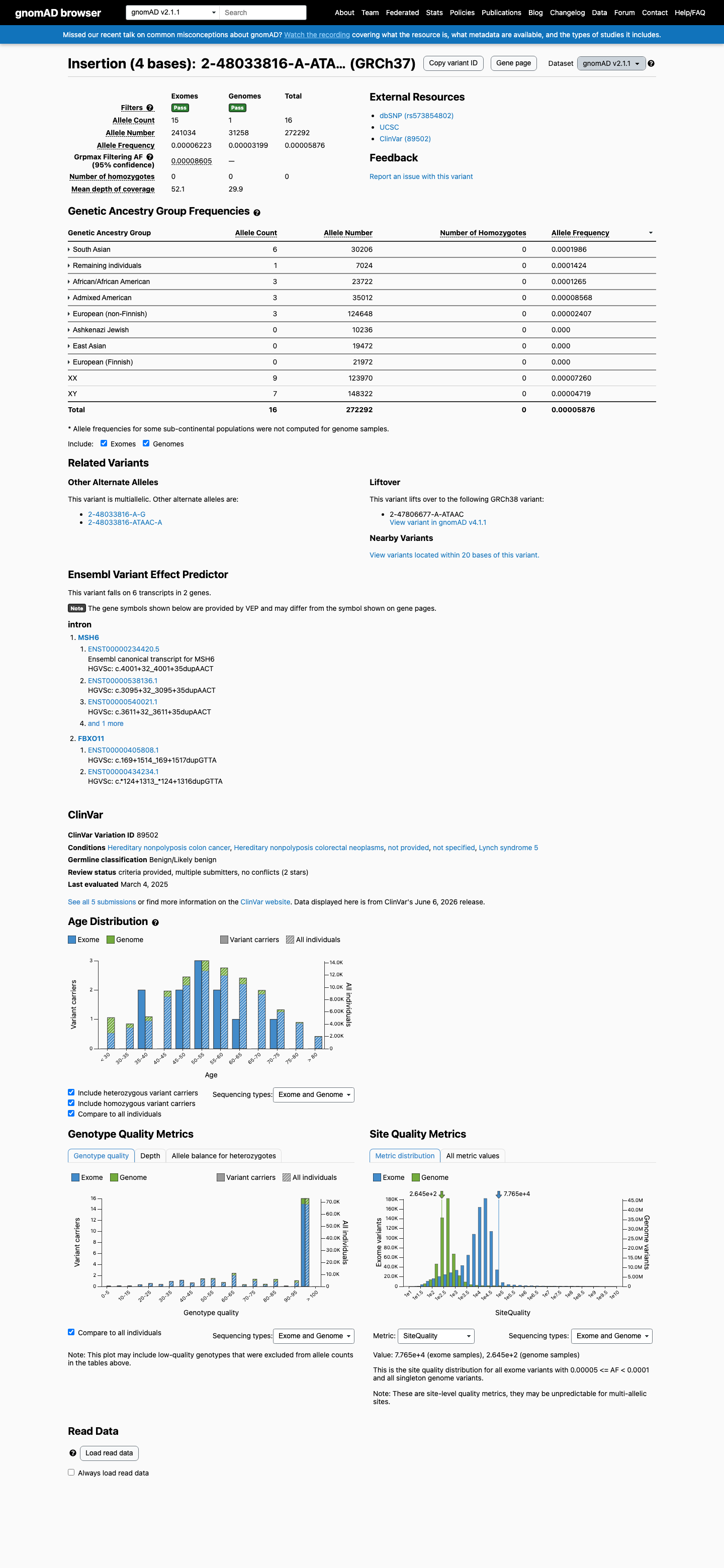
This variant is present in gnomAD v2.1 (AF= 5.87604e-05; MAF= 0.00588%, 16/272292 alleles, homozygotes = 0) and has highest observed frequency in the South Asian population (AF= 0.000198636; MAF= 0.01986%, 6/30206 alleles, homozygotes = 0); grpmax FAF= 8.605e-05.
Triaged references · 8 PMIDs not cited in assessment
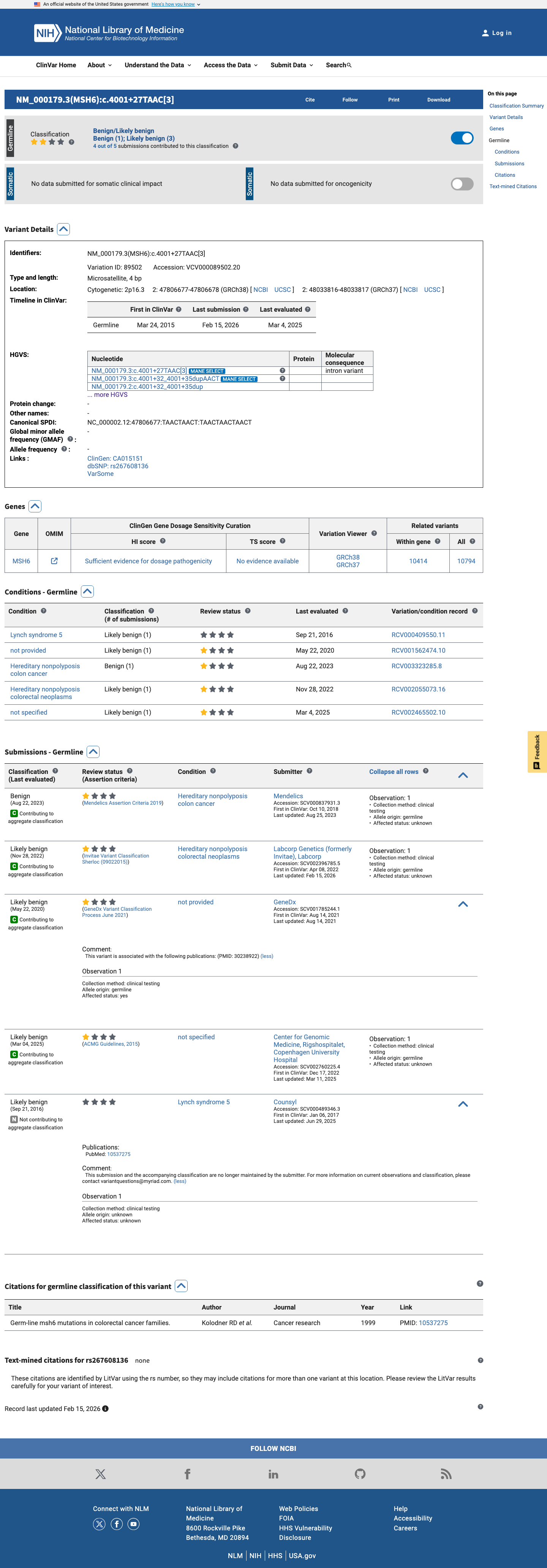
10537275 ↗Germ-line msh6 mutations in colorectal cancer families.CLINVAR
25741868 ↗Standards and guidelines for the interpretation of sequence variants: a joint consensus recommendation of the American College of Medical Genetics and Genomics and the Association for Molecular Pathology.CLINVAR
23788249 ↗ACMG recommendations for reporting of incidental findings in clinical exome and genome sequencing.CLINVAR
25356965 ↗ACMG policy statement: updated recommendations regarding analysis and reporting of secondary findings in clinical genome-scale sequencing.CLINVAR
34012068 ↗ACMG SF v3.0 list for reporting of secondary findings in clinical exome and genome sequencing: a policy statement of the American College of Medical Genetics and Genomics (ACMG).CLINVAR
34043773 ↗European guidelines from the EHTG and ESCP for Lynch syndrome: an updated third edition of the Mallorca guidelines based on gene and gender.CLINVAR
35802134 ↗ACMG SF v3.1 list for reporting of secondary findings in clinical exome and genome sequencing: A policy statement of the American College of Medical Genetics and Genomics (ACMG).CLINVAR
28492532 ↗Sherloc: a comprehensive refinement of the ACMG-AMP variant classification criteria.CLINVAR