Back
NM_000244.3:c.35C>G
p.Pro12Arg · MEN1
ACMG/AMP
0%
complete
Final classification
VUS
PM2PM5PP3
MEN1
c.35C>G
p.Pro12Arg
missense · exon 2

MEN1 encodes menin, a tumor suppressor protein that helps control gene activity by modifying chromatin structure and histones. Loss of menin function causes multiple endocrine neoplasia type 1 (MEN1 syndrome), an inherited disorder marked by tumors of the pituitary, parathyroid, and pancreas. Menin interacts with several proteins that regulate cell growth and division, and its loss contributes to both inherited and sporadic endocrine tumors.

This variant

This MEN1 missense variant affects menin, a tumor-suppressor protein whose loss of function causes the autosomal-dominant multiple endocrine neoplasia type 1 syndrome.

Transcript
NM_000244.3
HGVS · transcript:coding
NM_000244.3:c.35C>G
GRCh38
chr11:64810075 G>C
GRCh37
chr11:64577547 G>C
VUS: PM5 (moderate), PP3 (moderate), and PM2 (supporting) provide two moderate and one supporting criterion, below generic ACMG thresholds for Likely Pathogenic or Pathogenic.
Classification rationale
PM2PM5PP3 VUS
MEN1 c.35C>G missense · exon 2

PM2 supporting: the variant is absent from gnomAD v2.1 and v4.1. PM5 moderate: same-residue p.Pro12Leu impaired menin-RPA2 binding. PP3 moderate: REVEL 0.879 meets the moderate computational-evidence threshold.

PM2 + PM5 + PP3 → VUS
LYFE Sciences is an AI system, and it can make mistakes. Criteria may be applied incorrectly, sources may be misread, and a confident-looking classification can still be wrong. Double-check every criterion and its underlying evidence before relying on any call.
Gene diagram · NM_000244.3 · variants mapped to exon structure
MEN1 NM_000244.3
Fetching transcript structure from UCSC…
Applied criteria · 3 applied · 20 assessed
MetEvidence satisfies this criterion.
Not metEvaluated against available evidence; threshold not reached.
Not assessedApplies in principle, but no evidence was found to evaluate it.
N/ADoesn't apply to this variant type.
Applied · 3
Strength Supporting Moderate Strong Very strong
PM2 supporting Pathogenic
Met at supporting: the variant is absent from gnomAD v2.1 and v4.1, with observed frequency 0 versus the generic PM2 threshold of <=0.0001.
gnomAD v2.1 reports the exact variant as absent; the queried record is the exome dataset.gnomAD v4.1 reports the exact variant as absent.The available gnomAD v2.1 non-cancer exome-only subset reports the variant as absent.
PM5 moderate Pathogenic
Met at moderate strength: disease-associated P12L at the same residue impaired menin-RPA2 binding in a yeast two-hybrid assay.
The study tested 15 disease-associated MEN1 missense mutations and reported that P12L, the alternate substitution at residue 12, impaired menin-RPA2 binding to a variable degree.The P12L result is used as same-residue comparator evidence for PM5 and is not extrapolated as a direct functional assay result for P12R.
PP3 moderate Pathogenic
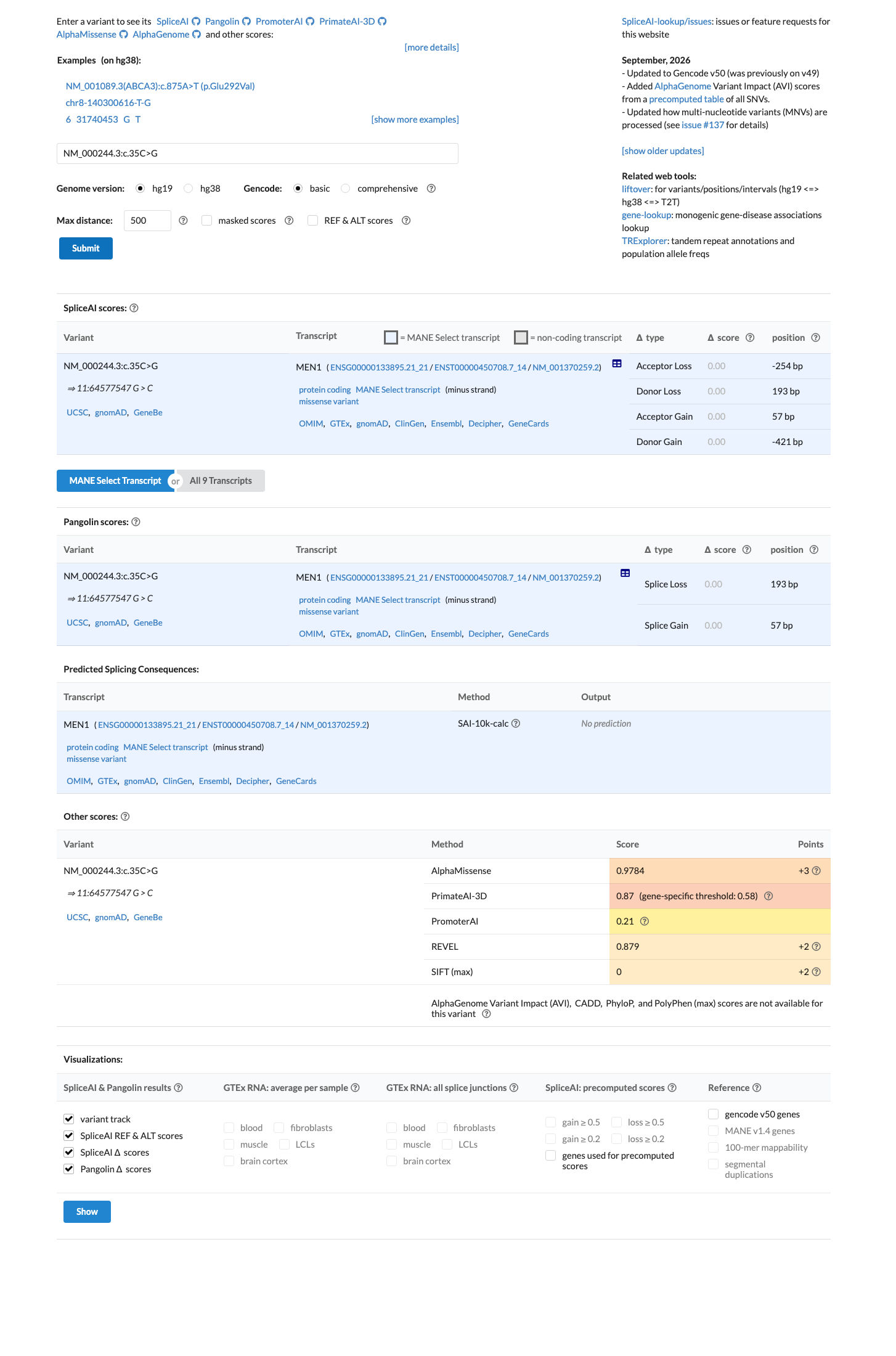
Met at moderate strength: REVEL 0.879 exceeds the >=0.773 moderate PP3 threshold but is below the >=0.932 strong threshold.
The normalized consequence is missense: NM_000244.3:c.35C>G, NP_000235.2:p.(Pro12Arg).The REVEL score is 0.879, meeting the moderate PP3 threshold of >=0.773 and not meeting the strong threshold of >=0.932.The thresholds are the supplied ClinGen SVI REVEL calibration values from Pejaver et al. (2022), PMID:36413997.
Assessed · not applied · 8 not met · 12 not assessed
Pathogenic
PS1 Not assessed: no alternate nucleotide change producing p.Pro12Arg was documented in the available evidence.
PS2 Not assessed: no parental genotypes or confirmed de novo observation are documented for the proband's NM_000244.3:c.35C>G variant.
PS3 Not assessed: no reviewed functional study directly tested MEN1 p.Pro12Arg, while same-codon p.Pro12Leu results cannot establish PS3 for p.Pro12Arg.
PS4 Not assessed: no exact-variant case-control counts or statistically significant phenotype-enrichment metric is available.
PM1 Not assessed: no authoritative MEN1 critical-domain boundary or significant hotspot was available for residue 12.
PM6 Not assessed: no documented phenotype and negative family history support an assumed de novo MEN1 variant in the absence of parental testing.
PP1 Not assessed: no affected relatives, variant-positive family members, or informative meioses are documented for segregation analysis.
PP2 Not met: missense variants comprise approximately 10% of reported MEN1 mutations, so missense is not the predominant disease mechanism.
PP4 Not assessed: no patient-specific, highly specific MEN1 phenotype or family history is documented.
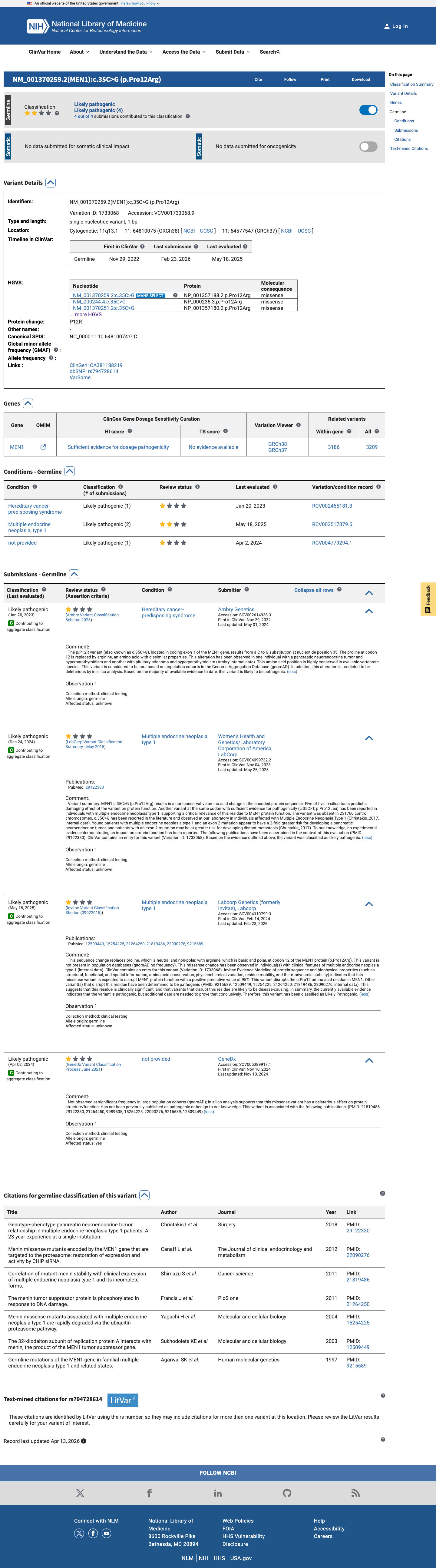
PP5 Not met: zero ClinVar expert-panel submissions exist for this exact variant, despite four Likely pathogenic laboratory records.

Benign
BA1 Not met: the variant is absent from gnomAD v2.1 and v4.1, far below the generic BA1 allele-frequency threshold of 0.05.
BS1 Not met: the variant is absent from gnomAD v2.1 and v4.1, below the generic BS1 allele-frequency threshold of 0.01.
BS2 Not met: no healthy-individual or homozygote observation is reported; population databases instead report the variant as absent.
BS3 Not assessed: no reviewed assay directly demonstrated normal function for MEN1 p.Pro12Arg, and other MEN1 substitutions cannot establish BS3 for this variant.
BS4 Not assessed: no unaffected variant-positive relatives or phenotype-based non-segregation observations are documented.
BP1 Not met: MEN1 includes disease-associated missense variants, including same-residue P12L with impaired menin-RPA2 binding.
BP2 Not assessed: no affected-proband genotype, cis/trans phase, or co-occurring pathogenic/benign allele is documented.
BP4 Not met: REVEL 0.879 exceeds the most permissive <=0.29 supporting BP4 threshold for benign computational evidence.
BP5 Not assessed: no patient-level evidence shows an alternative molecular diagnosis explaining the relevant phenotype.
BP6 Not met: zero ClinVar expert-panel submissions provide an exact-variant Benign or Likely benign classification.
N/A · 5 PVS1 · PM3 · PM4 · BP3 · BP7
Research & evidence
Population frequency
gnomAD v4.1 screenshot
gnomAD v4.1
gnomAD v2.1 screenshot
gnomAD v2.1
v4.1
Absent from gnomAD v4.1.
v2.1
Absent from gnomAD v2.1.
🇨🇦 CA
Not available in gnomAD-Canada v1.0.
Allele frequency by ancestry
three datasets · side by side
gnomAD v4.1
Absent · 0 / ?
0 hom
Not observed in any ancestry group.
gnomAD v2.1
Absent · 0 / ?
0 hom
Not observed in any ancestry group.
gnomAD Canada 🇨🇦
Absent · 0 / ?
0 hom
Not observed in any ancestry group.
ClinVar screenshot
ClinVar
This variant has been reported in ClinVar as Likely pathogenic (4 clinical laboratories). (ClinVarID = 1733068)
SpliceAI screenshot
In silico
SpliceAI predicts no significant splice impact for this variant (max delta score = 0.00). REVEL score = 0.879. BayesDel score = 0.561369.
Functional / OncoKB screenshot
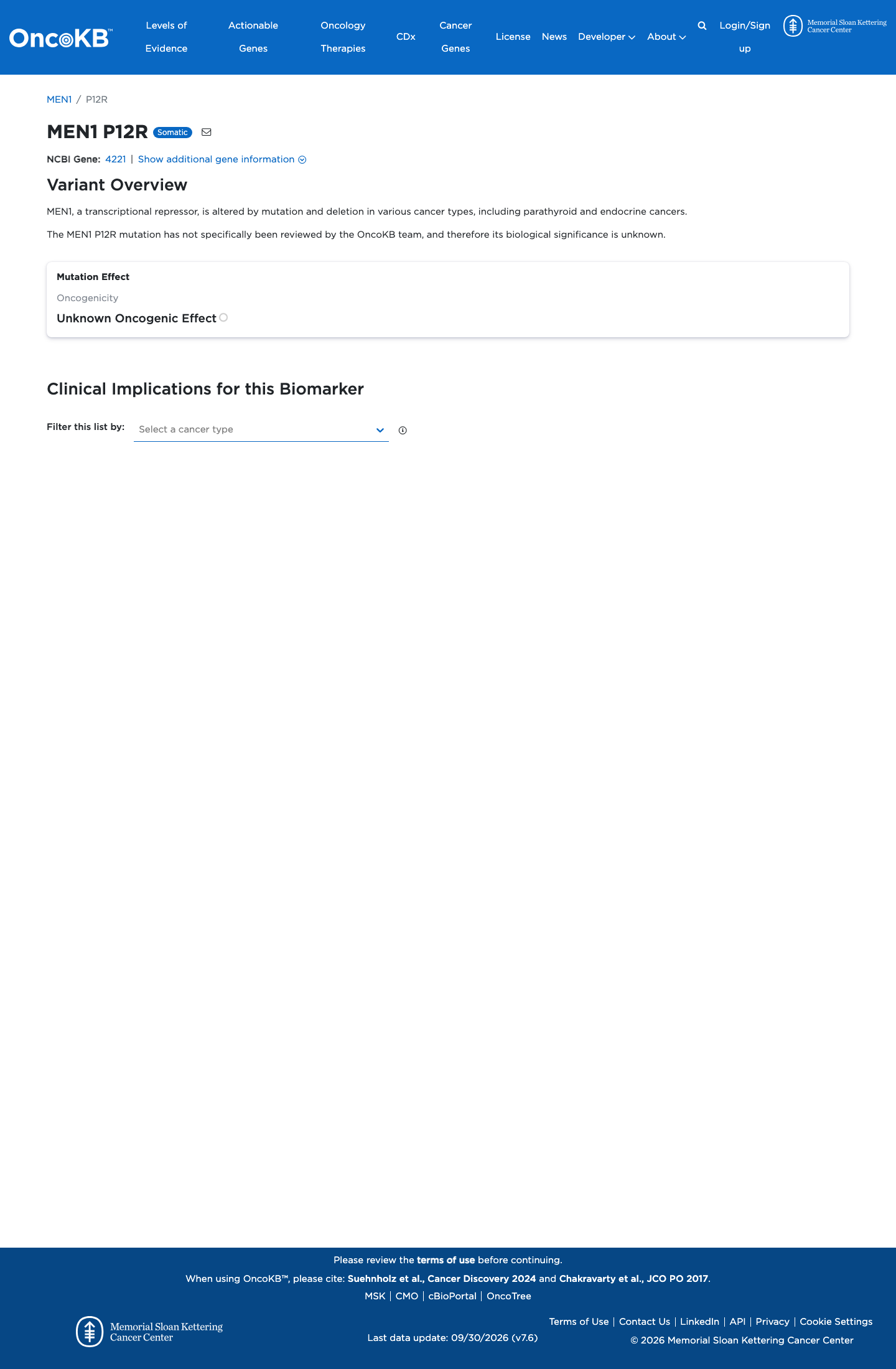
Functional Unknown Oncogenic Effect
OncoKB did not identify variant-specific reviewed functional evidence for this variant; gene-level curated context is available for reviewer follow-up. MEN1, a transcriptional repressor, is altered by mutation and deletion in various cancer types, including parathyroid and endocrine cancers.
OncoKB ↗
COSMIC screenshot
COSMIC
Cancer hotspots screenshot
Cancer hotspots
Somatic evidence Not in COSMIC / hotspots
COSMIC
This variant does not lie in a statistically significant hotspot. This variant has not previously been reported in somatic cancers (COSMIC).
Hotspots
This variant does not lie in a statistically significant hotspot.
Literature · how each cited paper was used
1papers cited
Each card is an audit: what was searched, what was found, whether it names the variant, which criteria it fed, and why. 8 further PMIDs triaged but not cited — see Sources & references.
Rule & framework references · cited for criterion definitions, not variant evidence
12509449 ↗ The 32-kilodalton subunit of replication protein A interacts with menin, the product of the MEN1 tumor suppressor gene.
Sources & reference links
8Sources
ClinVar
gnomAD v2.1
gnomAD v4.1
gnomAD-Canada
SpliceAI
OncoKB
COSMIC
Cancer hotspots
Triaged references · 8 PMIDs not cited in assessment
11739416 ↗ Guidelines for diagnosis and therapy of MEN type 1 and type 2. CLINVAR
15254225 ↗ Menin missense mutants associated with multiple endocrine neoplasia type 1 are rapidly degraded via the ubiquitin-proteasome pathway. CLINVAR
21264250 ↗ The menin tumor suppressor protein is phosphorylated in response to DNA damage. CLINVAR
21819486 ↗ Correlation of mutant menin stability with clinical expression of multiple endocrine neoplasia type 1 and its incomplete forms. CLINVAR
22090276 ↗ Menin missense mutants encoded by the MEN1 gene that are targeted to the proteasome: restoration of expression and activity by CHIP siRNA. CLINVAR
23788249 ↗ ACMG recommendations for reporting of incidental findings in clinical exome and genome sequencing. CLINVAR
25356965 ↗ ACMG policy statement: updated recommendations regarding analysis and reporting of secondary findings in clinical genome-scale sequencing. CLINVAR
28492532 ↗ Sherloc: a comprehensive refinement of the ACMG-AMP variant classification criteria. CLINVAR