Analysis in progress
Initialising…
0%
complete
This report is still being assembled — sections appear as each stage finishes. It isn't final yet.
MLH1
Final classification
Pathogenic
MLH1 c.1989G>A · p.Glu663=
MLH1

PVS1_Very_Strong: c.1989G>A at the last nucleotide of exon 17 results in exon 17 skipping confirmed by patient mRNA analysis in two independent laboratories (Terdiman 2001, Tang 2009). Exon 17 skipping (93 bp, out-of-frame) introduces a premature termination codon predicted to undergo NMD.

Gene
MLH1
Transcript
NM_000249.4
HGVS · transcript:coding
NM_000249.4:c.1989G>A
Consequence
N/A
GRCh38
chr3:37048609 G>A
GRCh37
chr3:37090100 G>A
Basis ClinGen InSiGHT Hereditary Colorectal Cancer/Polyposis Expert Panel Specifications to the ACMG/AMP Variant Interpretation Guidelines for MLH1 Version 2.0 v2.0 criteria-combination framework: matched Rule4 (1 Pathogenic.Very Strong + Pathogenic.Supporting >=2) with applied criteria: PVS1 very strong, PM2 supporting, PP5 supporting; maps to Pathogenic.
ClinGen InSiGHT Hereditary Colorectal Cancer/Polyposis Expert Panel Specifications to the ACMG/AMP Variant Interpretation Guidelines for MLH1 Version 2.0 v2.0 criteria-combination framework: matched Rule4 (1 Pathogenic.Very Strong + Pathogenic.Supporting >=2) with applied criteria: PVS1 very strong, PM2 supporting, PP5 supporting; maps to Pathogenic.
Classification rationale
PVS1PM2PP5 Pathogenic
MLH1 c.1989G>A

PVS1_Very_Strong: c.1989G>A at the last nucleotide of exon 17 results in exon 17 skipping confirmed by patient mRNA analysis in two independent laboratories (Terdiman 2001, Tang 2009). Exon 17 skipping (93 bp, out-of-frame) introduces a premature termination codon predicted to undergo NMD.1 PM2_Supporting: c.1989G>A is absent from gnomAD v2.1, v4.1, and gnomAD-Canada, meeting the InSiGHT VCEP threshold of < 0.00002 (< 1 in 50,000 alleles).2 Final classification: Pathogenic. Per InSiGHT VCEP MLH1 v2.0 combining rules (Rule 1): 1 PVS1_Very_Strong yields a Pathogenic classification. This is concordant with the ClinVar InSiGHT Expert Panel classification of Pathogenic (ClinVar ID 89979).3

PVS1 + PM2 + PP5 Pathogenic
Gene diagram · NM_000249.4 · variants mapped to exon structure
MLH1 NM_000249.4
Fetching transcript structure from UCSC…
Applied criteria · 3 applied · 13 assessed
Applied · 3
Strength Supporting Moderate Strong Very strong
PVS1 very strong Pathogenic
c.1989G>A at the last nucleotide of exon 17 disrupts the splice donor consensus. Patient mRNA analysis in two independent laboratories (Terdiman 2001, Tang 2009) confirms exon 17 skipping, which is out-of-frame (93 bp) and predicted to introduce a premature termination codon subject to NMD. This matches the InSiGHT VCEP PVS1_Very_Strong rule for variants where mRNA from patient constitutional samples demonstrates splicing aberration leading to premature stop codon, confirmed by an independent laboratory.
c.1989G>A at last base of exon 17 (splice donor position -1)mRNA assay from two independent laboratories confirms exon 17 skippingExon 17 is 93 bp
PM2 supporting Pathogenic
c.1989G>A is absent from gnomAD v2.1 (exomes), gnomAD v4.1 (exomes/genomes), and gnomAD-Canada v1.0. This satisfies the InSiGHT VCEP PM2_Supporting threshold of allele frequency < 0.00002 (absent/extremely rare in gnomAD v4).
Absent from gnomAD v2.1Absent from gnomAD v4.1Absent from gnomAD-Canada v1.0
PP5 supporting Pathogenic
Expert panel International Society for Gastrointestinal Hereditary Tumours (InSiGHT) classified as Pathogenic.
ClinVar expert panel classification
Assessed · not applied
Pathogenic
PS2 No de novo data available in the evidence package.
PS3 The VCEP-calibrated functional assay spreadsheet (Functional-assay-SVI-documentation-MMR.xlsx) does not list c.1989G>A.
PP1 No co-segregation data provided.
PP3 VCEP PP3 for MLH1 requires either a missense variant with HCI prior >0.68 (not applicable; this is a synonymous variant not in the HCI table) or a predicted splice defect with SpliceAI delta >= 0.2 (SpliceAI max delta = 0.00, no splice impact predicted).
PP4 No tumor data (MSI status, IHC for MMR protein expression) provided in the evidence package.
Benign
BA1 VCEP BA1 requires gnomAD v4 grpmax filtering allele frequency >= 0.001 (0.1%).
BS1 VCEP BS1 requires gnomAD v4 grpmax filtering allele frequency >= 0.0001 and < 0.001.
BS2 No evidence of co-occurrence in trans with a known pathogenic MLH1 variant.
BS3 VCEP BS3 requires calibrated functional assays with odds for pathogenicity <= 0.05, or variant-specific proficient function in protein/mRNA assays.
BS4 No segregation data available.
BP4 VCEP BP4 for synonymous variants requires SpliceAI delta score <= 0.1 predicting no splicing impact.
BP5 No tumor data (MSS status, MMR protein expression by IHC) provided.
BP7 VCEP BP7 applies to synonymous or intronic variants at or beyond -21/+7 from the splice junction.
N/A · 10 PS1 · PS4 · PM1 · PM5 · PM6 · PP2 · BP1 · BP2 · BP3 · BP6
Research & evidence
Population frequency · supports pathogenic
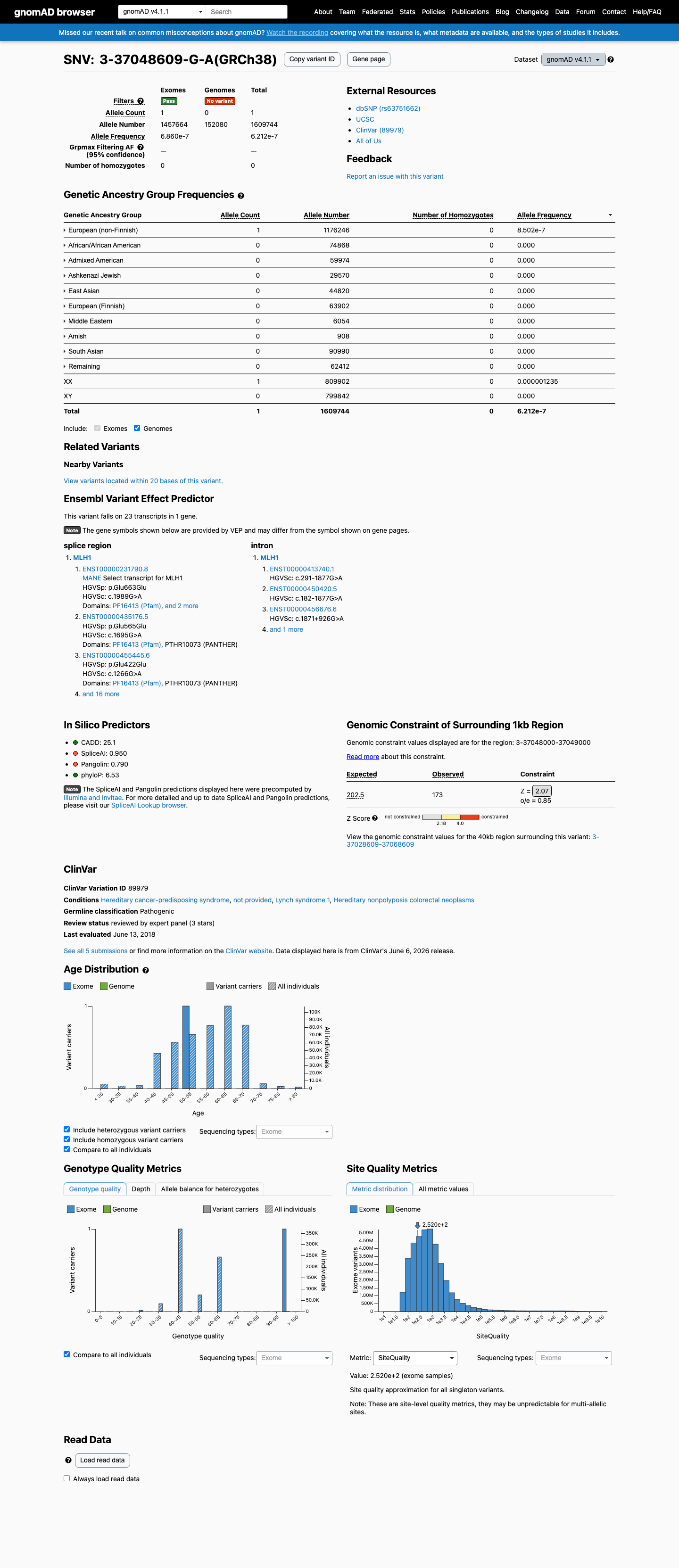
gnomAD v4.1 screenshot
gnomAD v4.1
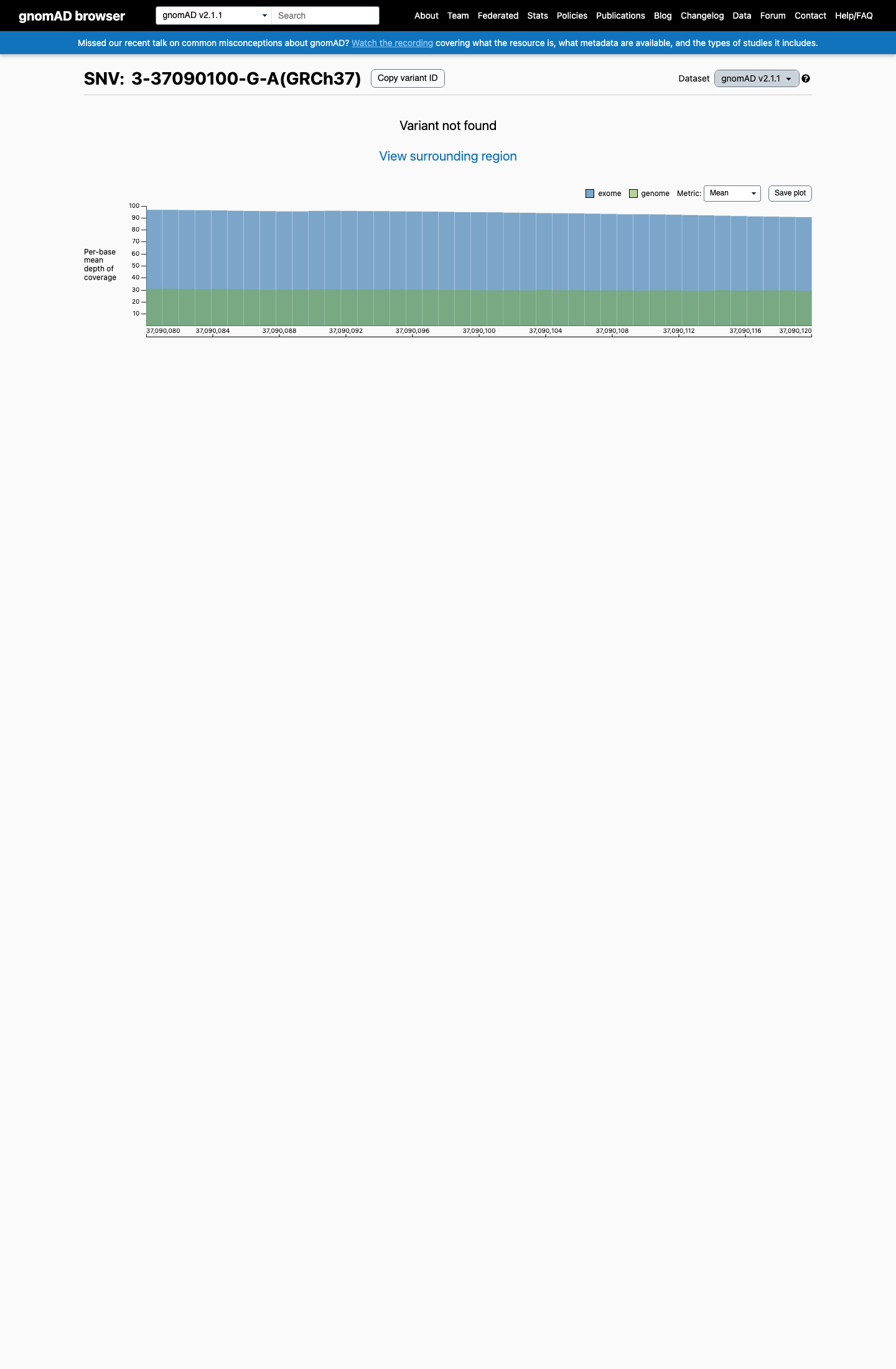
gnomAD v2.1 screenshot
gnomAD v2.1
v4.1
Absent from gnomAD v4.1.
v2.1
Absent from gnomAD v2.1.
🇨🇦 CA
Absent from gnomAD-Canada v1.0.
Allele frequency by ancestry
three datasets · side by side
gnomAD v4.1
Absent · 0 / ?
0 hom
Not observed in any ancestry group.
gnomAD v2.1
Absent · 0 / ?
0 hom
Not observed in any ancestry group.
gnomAD Canada 🇨🇦
Absent · 0 / ?
0 hom
Not observed in any ancestry group.
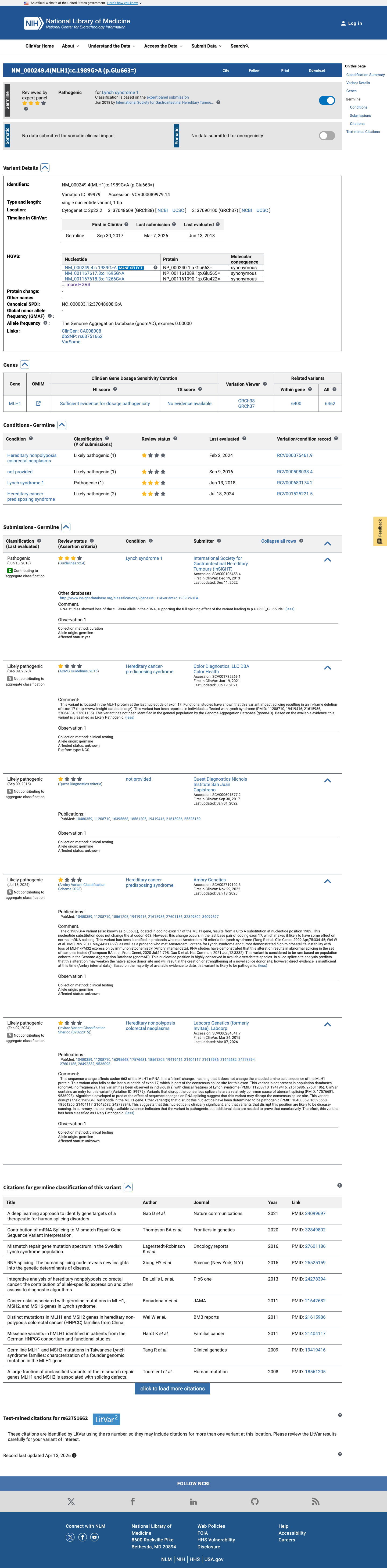
ClinVar screenshot
ClinVar
This variant has been reported in ClinVar as Likely pathogenic (4 clinical laboratories) and as Pathogenic by International Society for Gastrointestinal Hereditary Tumours (InSiGHT) (expert panel). (ClinVarID = 89979)
SpliceAI screenshot
In silico
SpliceAI predicts no significant splice impact for this variant (max delta score = 0.00).
Functional / OncoKB screenshot
Functional Unknown Oncogenic Effect
OncoKB identified curated literature and non-variant-specific oncogenicity context for review; listed oncogenicity label: Unknown Oncogenic Effect.
OncoKB ↗
COSMIC screenshot
COSMIC
Cancer hotspots screenshot
Cancer hotspots
Somatic evidence Not in COSMIC / hotspots
COSMIC
This variant does not lie in a statistically significant hotspot. This variant has not previously been reported in somatic cancers (COSMIC).
Hotspots
This variant does not lie in a statistically significant hotspot.
Literature · how each cited paper was used
2papers cited
Each card is an audit: what was searched, what was found, whether it names the variant, which criteria it fed, and why. 7 further PMIDs triaged but not cited — see Sources & References.
Efficient detection of hereditary nonpolyposis colorectal cancer gene carriers by screening for tumor microsatellite instability before germline genetic testing.
Searched
c.1989G>A1989G>A1989G  A
Found
c.1989G>A at the splice donor of MLH1 exon 17 identified in two independent HNPCC/Lynch syndrome families (2AN7, 5EJ9). mRNA analysis from patient lymphocytes confirmed exon 17 skipping in both families.
Variant
✓ Names this variant — characterised directly
Applied to
PVS1 supports · met
Why
Confirms exon 17 skipping from c.1989G>A in two independent families. Used to support PVS1_Very_Strong.
1989G  A, Splice donor, Exon skipping (M)
Location Table listing mutations with mRNA assay results for MLH1 exon 17  ·  Context RT-PCR mRNA analysis from patient lymphocyte-derived RNA; exon skipping detected by gel electrophoresis  ·  full text
Germ line MLH1 and MSH2 mutations in Taiwanese Lynch syndrome families: characterization of a founder genomic mutation in the MLH1 gene.
Searched
c.1989G>A1989G.A1989G>A
Found
c.1989G>A in MLH1 exon 17 reported in a Taiwanese Lynch syndrome family. Aberrant splicing confirmed as the functional consequence.
Variant
✓ Names this variant — characterised directly
Applied to
PVS1 supports · met
Why
Independent confirmation from a separate laboratory that c.1989G>A causes aberrant splicing. Provides the required independent confirmation for PVS1_Very_Strong application at a non-canonical splice site.
c.1989G.A, 663, Aberrant splicing
Location Table summarizing MLH1 mutations identified in Taiwanese Lynch syndrome families  ·  Context Mutation screening by DHPLC and DNA sequencing in 93 Taiwanese families fulfilling Amsterdam criteria II  ·  full text
Sources & reference links
9Sources
CSpec VCEP
ClinVar
gnomAD v2.1
gnomAD v4.1
gnomAD-Canada
SpliceAI
OncoKB
COSMIC
Cancer hotspots
Triaged references · 7 PMIDs not cited in assessment
10480359 ↗ Prevalence of germline mutations of hMLH1, hMSH2, hPMS1, hPMS2, and hMSH6 genes in 75 French kindreds with nonpolyposis colorectal cancer. CLINVAR
16395668 ↗ Systematic mRNA analysis for the effect of MLH1 and MSH2 missense and silent mutations on aberrant splicing. CLINVAR
17576681 ↗ Aberrant 5' splice sites in human disease genes: mutation pattern, nucleotide structure and comparison of computational tools that predict their utilization. CLINVAR
18561205 ↗ A large fraction of unclassified variants of the mismatch repair genes MLH1 and MSH2 is associated with splicing defects. CLINVAR
21404117 ↗ Missense variants in hMLH1 identified in patients from the German HNPCC consortium and functional studies. CLINVAR
21615986 ↗ Distinct mutations in MLH1 and MSH2 genes in hereditary non-polyposis colorectal cancer (HNPCC) families from China. CLINVAR
28492532 ↗ Sherloc: a comprehensive refinement of the ACMG-AMP variant classification criteria. CLINVAR