NM_000249.4:c.381-1G>A is a canonical splice acceptor variant (IVS4-1) disrupting the invariant AG dinucleotide of MLH1 intron 4, meeting PVS1_Very_Strong under the InSiGHT/ClinGen MLH1 VCEP v2.0.1 The variant is absent from gnomAD v2.1 and v4.1, meeting PM2_Supporting under the VCEP threshold of allele frequency <0.00002.2 A patient with this variant, reported by Roth et al. (2016), had two synchronous colorectal cancers showing loss of MLH1 and PMS2 protein expression by immunohistochemistry, meeting PP4_Moderate under the VCEP rule for 2 independent tumors with MMR protein loss consistent with the variant location.3 This variant was identified as a recurrent mutation in 5 African American families with Lynch syndrome by Guindalini et al. (2015), supporting its enrichment in the Lynch syndrome patient population.4 ClinVar classifies this variant as Pathogenic (4 clinical laboratories) and Likely pathogenic (1 laboratory); however, the VCEP framework does not permit use of PP5 or BP6, and ClinVar classification alone is not used as an independent criterion.5 Combining PVS1_Very_Strong (1) + PP4_Moderate (1) under the InSiGHT/ClinGen MLH1 VCEP v2.0 combination rules (Rule 10) yields a classification of Likely Pathogenic.6
Final classification
Pathogenic
PVS1PM2PP4
MLH1
c.381-1G>A
p.?
This variant
NM_000249.4:c.381-1G>A is a canonical splice acceptor variant (IVS4-1) disrupting the invariant AG dinucleotide of MLH1 intron 4, meeting PVS1_Very_Strong under the InSiGHT/ClinGen MLH1 VCEP v2.0.
ClinGen InSiGHT Hereditary Colorectal Cancer/Polyposis Expert Panel Specifications to the ACMG/AMP Variant Interpretation Guidelines for MLH1 Version 2.0 v2.0 criteria-combination framework: matched Rule3 (1 Pathogenic.Very Strong + 1 Pathogenic.Moderate + 1 Pathogenic.Supporting) with applied criteria: PVS1 very strong, PM2 supporting, PP4 moderate; maps to Pathogenic.
Classification rationale
PVS1PM2PP4
Pathogenic
MLH1 c.381-1G>A
PVS1 + PM2 + PP4
→
Pathogenic
1
cspec ↗pvs1_variant_assessmentpvs1_gene_context
6
final_classification_framework
LYFE Sciences is an AI system, and it can make mistakes. Criteria
may be applied incorrectly, sources may be misread, and a confident-looking
classification can still be wrong. Double-check every criterion and
its underlying evidence before relying on any call.
Gene diagram
· NM_000249.4 · variants mapped to exon structure
MLH1
NM_000249.4
Fetching transcript structure from UCSC…
Applied criteria · 3 applied · 12 assessed
MetEvidence satisfies this criterion.
Not metEvaluated against available evidence; threshold not reached.
Not assessedApplies in principle, but no evidence was found to evaluate it.
N/ADoesn't apply to this variant type.
Applied · 3
Strength
Supporting
Moderate
Strong
Very strong
PVS1
very strong
Pathogenic
NM_000249.4:c.381-1G>A is a canonical splice acceptor variant at IVS4-1 (intron 4), disrupting the invariant AG dinucleotide. Under the InSiGHT/ClinGen MLH1 VCEP v2.0, IVS±1 variants where exon skipping disrupts the reading frame and is predicted to undergo NMD qualify for PVS1_Very_Strong. MLH1 loss of function is an established disease mechanism for Lynch syndrome. SpliceAI max delta score of 0.99 confirms a severe splicing impact. Not combined with PP3 per VCEP rules.
Canonical splice acceptor variant c.381-1G>A (IVS4-1G>A) in MLH1SpliceAI max delta score 0.99predicting severe splicing aberration
PM2
supporting
Pathogenic
NM_000249.4:c.381-1G>A is absent from gnomAD v2.1 (exomes), gnomAD v4.1 (exomes), and gnomAD-Canada v1.0 (genomes). Under the MLH1 VCEP, PM2_Supporting applies when the variant is absent or extremely rare with allele frequency <0.00002 (<1 in 50,000 alleles) in gnomAD v4.
Absent from gnomAD v2.1Absent from gnomAD v4.1Absent from gnomAD-Canada v1.0
PP4
moderate
Pathogenic
A patient with this MLH1 variant (reported as IVS4-1G>A) was described by Roth et al. (2016, PMID:27357288) with two synchronous primary colorectal cancers (cecum and rectosigmoid colon), both demonstrating loss of MLH1 and PMS2 protein expression by immunohistochemistry, consistent with the variant location. Under the MLH1 VCEP, 2 independent CRC tumors with loss of MMR protein expression consistent with the variant location qualifies for PP4_Moderate. Independent tumors can be from the same patient/family per VCEP guidance.
Patient with 2 synchronous colon cancers showing loss of MLH1/PMS2 by IHC (PMID:27357288Patient 2)IHC pattern (MLH1/PMS2 loss) consistent with MLH1 variant location
Assessed · not applied
· 12 not met · 0 not assessed
Pathogenic
PS2
No de novo occurrence data identified for NM_000249.4:c.381-1G>A in the reviewed evidence.
PS3
No variant-specific functional assay data or calibrated functional odds for NM_000249.4:c.381-1G>A were identified.
PP1
No co-segregation data with Bayes Likelihood Ratio calculations were identified in the reviewed evidence.
PP3
The VCEP PVS1 rule for canonical (±1/±2) splice variants explicitly states: 'Not to be combined with PP3.' PP3 for splice prediction is reserved for non-canonical splice variants with SpliceAI delta >= 0.2.
Benign
BA1
NM_000249.4:c.381-1G>A is absent from gnomAD v4.1.
BS1
Variant is absent from gnomAD v4.1.
BS2
No evidence of co-occurrence in trans with a known pathogenic MLH1 variant was identified in the case materials or reviewed literature.
BS3
No functional assay data demonstrating a benign effect for NM_000249.4:c.381-1G>A were identified.
BS4
No lack-of-segregation data were identified for NM_000249.4:c.381-1G>A.
BP4
BP4_Supporting requires either a missense variant with HCI prior probability <0.11 or an intronic/synonymous variant with SpliceAI delta score <= 0.1.
BP5
No evidence was identified of tumors with MSS and/or intact MMR protein expression, or BRAF V600E/MLH1 methylation with MSI-H/MLH1 loss, in patients carrying this variant.
BP7
BP7 applies to synonymous or intronic variants at or beyond -21/+7 (i.e., deep intronic or distal exonic positions).
N/A · 11
PS1 · PS4 · PM1 · PM5 · PM6 · PP2 · PP5 · BP1 · BP2 · BP3 · BP6
Research & evidence
Population frequency · supports pathogenic

gnomAD v4.1
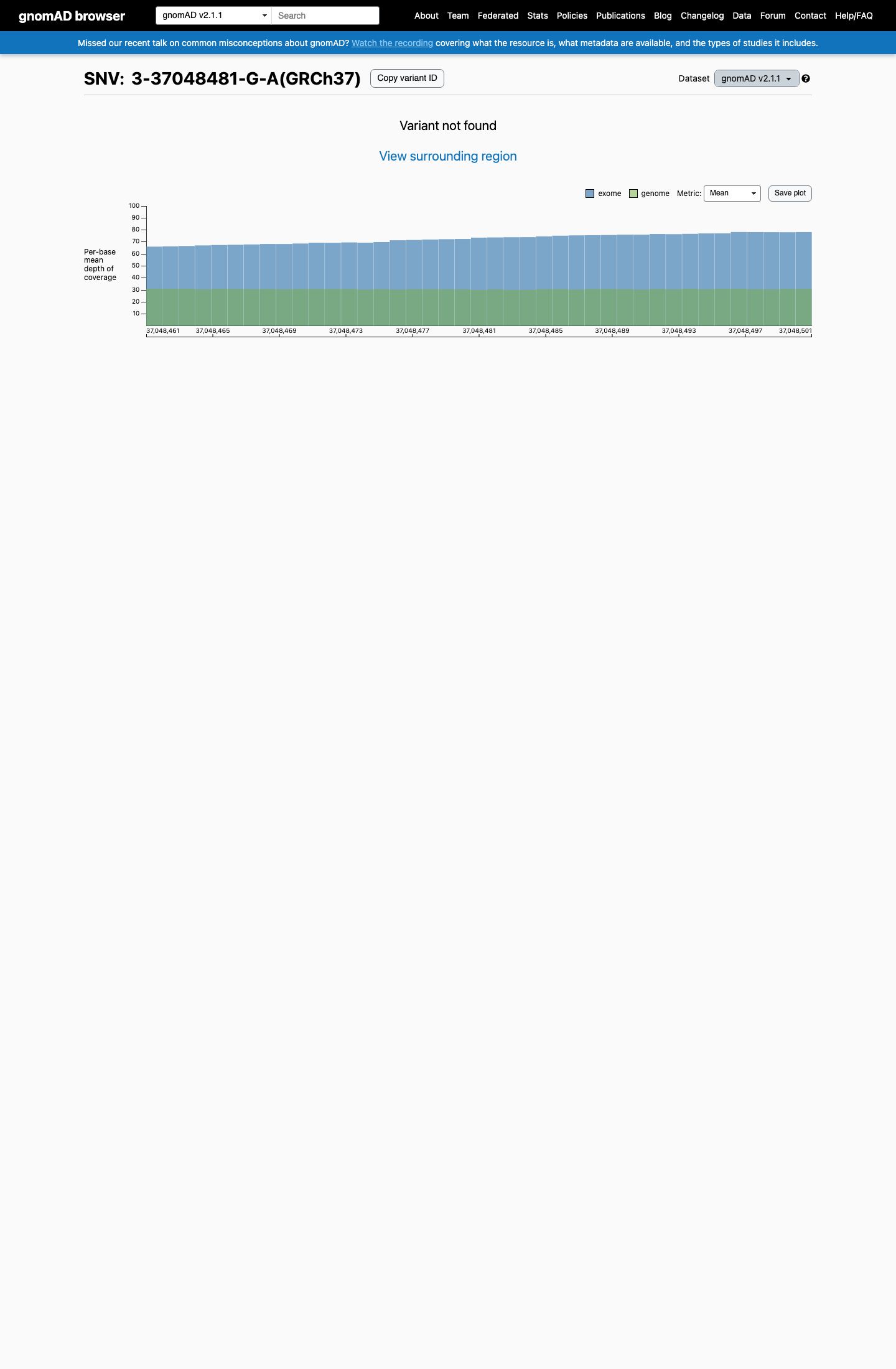
gnomAD v2.1
v4.1
Absent from gnomAD v4.1.
v2.1
Absent from gnomAD v2.1.
🇨🇦 CA
Absent from gnomAD-Canada v1.0.
Allele frequency by ancestry
three datasets · side by side
gnomAD v4.1
Absent
· 0 / ?
0 hom
0 hom
Not observed in any ancestry group.
gnomAD v2.1
Absent
· 0 / ?
0 hom
0 hom
Not observed in any ancestry group.
gnomAD Canada 🇨🇦
Absent
· 0 / ?
0 hom
0 hom
Not observed in any ancestry group.
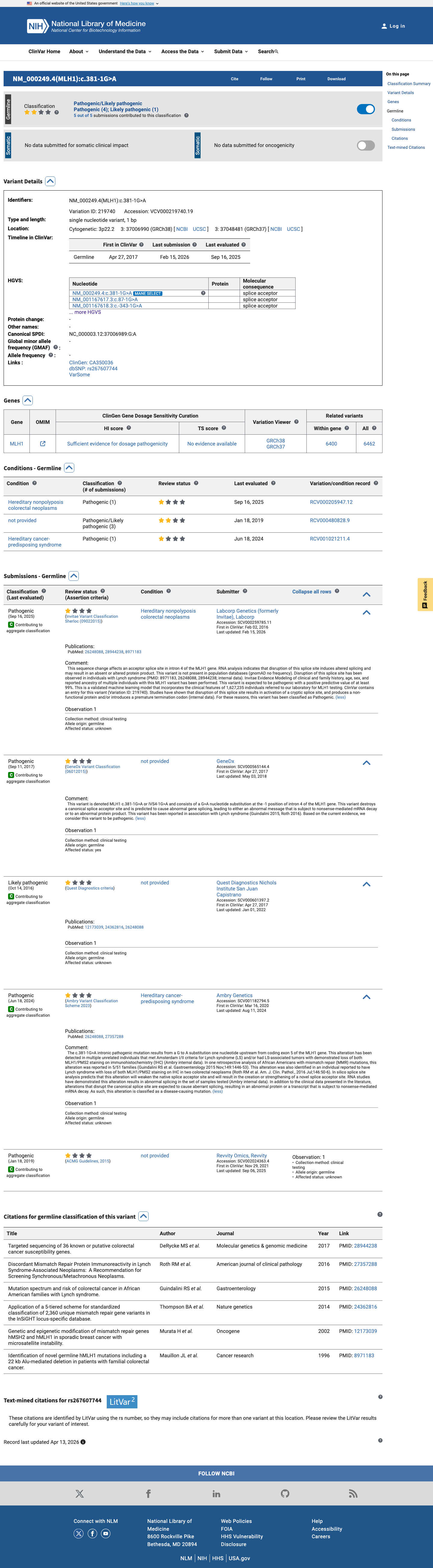
ClinVar
This variant has been reported in ClinVar as Pathogenic (4 clinical laboratories) and as Likely pathogenic (1 clinical laboratory). (ClinVarID = 219740)
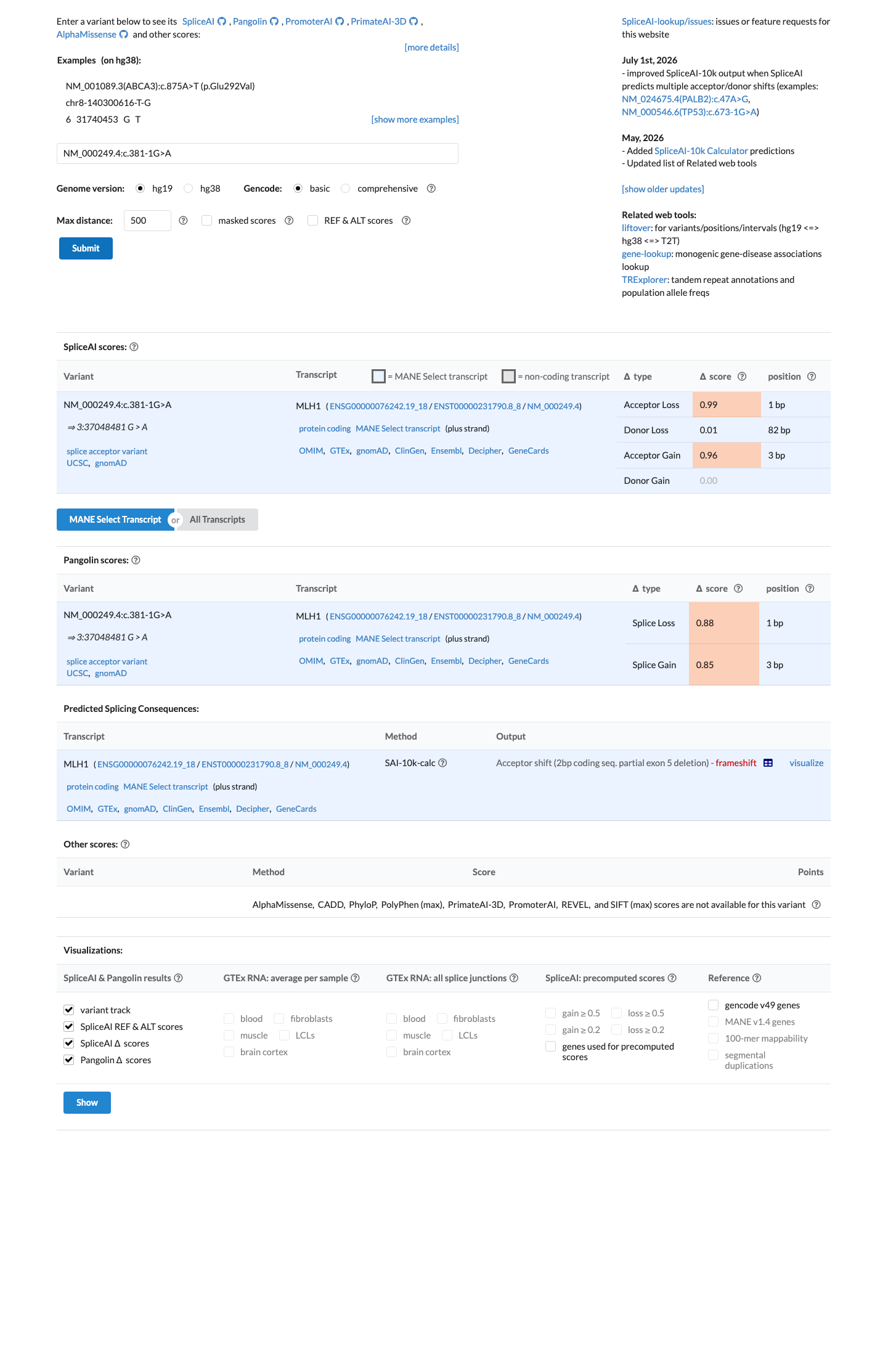
In silico
SpliceAI predicts possible splice impact for this variant (max delta score = 0.99). BayesDel score = 0.66.
Functional
No data
No calibrated functional assay or RNA evidence was identified for this variant.
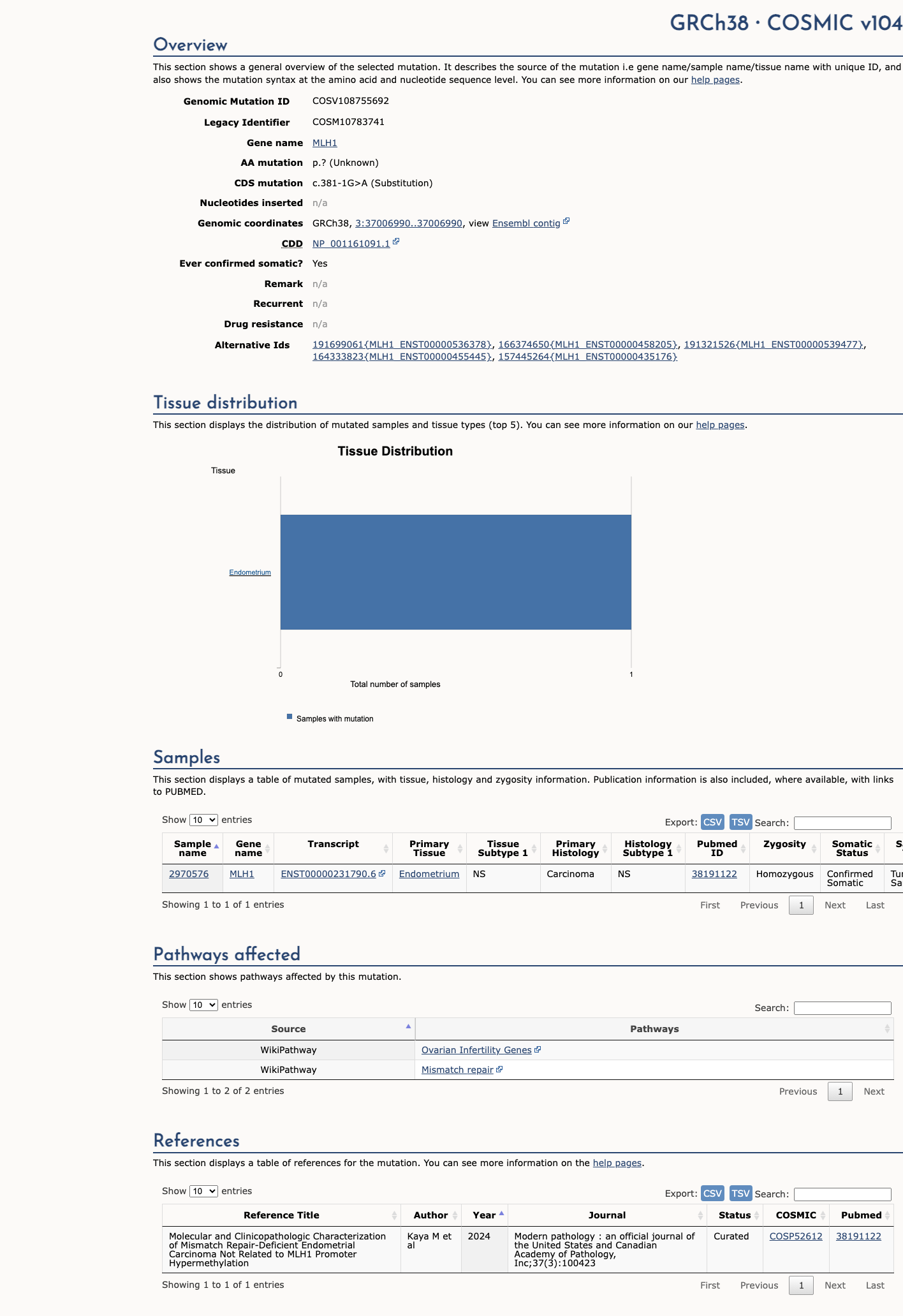
COSMIC
Somatic evidence
COSMIC
This variant has previously been reported in somatic cancers (COSMIC; COSV108755692, n = 1 times).
Hotspots
This variant does not lie in a statistically significant cancer hotspot.
Literature · how each cited paper was used
2papers cited
Each card is an audit: what was searched, what was found, whether it names the variant, which criteria it fed, and why. 6 further PMIDs triaged but not cited — see Sources & references.
Mutation spectrum and risk of colorectal cancer in African American families with Lynch syndrome.
Searched
c.381-1G>A381-1IVS4-1G>A
Found
Characterized the mutation spectrum and CRC risk in 51 African American families with Lynch syndrome. NM_000249.4:c.381-1G>A was identified as a recurrent mutation in 5 unrelated families, the most frequently observed recurrent variant in this cohort. MLH1 mutations predominated (61%) in AA Lynch syndrome families, distinct from the European ancestry spectrum.
Variant
✓ Names this variant — characterised directly
Applied to
→PP4
met
Why
Variant confirmed as recurrent in Lynch syndrome families; supports pathogenic role but does not independently meet additional criteria beyond PP4 and PM2.
Eight recurrent mutations accounted for 37% of all deleterious mutations: 6 in MLH1 [c.117-2A>G (2x), c.199G>A (2x), c.381-1G>A (5x), c.677G>A (2x), c.1772_1775delATAG (2x), c.793C>T (2x)]
Location Results, Spectrum of Deleterious Mutations paragraph · full text
Discordant Mismatch Repair Protein Immunoreactivity in Lynch Syndrome-Associated Neoplasms:  A Recommendation for Screening Synchronous/Metachronous Neoplasms.
Searched
c.381-1G>AIVS4-1G>A381-1
Found
Studied mismatch repair protein immunohistochemistry concordance in synchronous and metachronous Lynch syndrome-associated neoplasms. Patient 2 carried MLH1 c.381-1G>A (reported as IVS4-1G>A) and had two synchronous primary colon cancers (cecum and rectosigmoid), both demonstrating loss of MLH1 and PMS2 protein expression by IHC.
Variant
✓ Names this variant — characterised directly
Applied to
→PP4
met
Why
Variant-specific tumor phenotype data confirmed: 2 synchronous CRC tumors with loss of MLH1/PMS2 by IHC. Referenced in PP4_Moderate assessment.
MLH1 deleterious mutation at exon 4, nucleotide IVS4-1G>A
Location Table 1, Patient 2 · full text
Sources & reference links
Triaged references · 6 PMIDs not cited in assessment
12173039 ↗
Genetic and epigenetic modification of mismatch repair genes hMSH2 and hMLH1 in sporadic breast cancer with microsatellite instability.
CLINVAR
24362816 ↗
Application of a 5-tiered scheme for standardized classification of 2,360 unique mismatch repair gene variants in the InSiGHT locus-specific database.
CLINVAR
25741868 ↗
Standards and guidelines for the interpretation of sequence variants: a joint consensus recommendation of the American College of Medical Genetics and Genomics and the Association for Molecular Pathology.
CLINVAR
26467025 ↗
A Standardized DNA Variant Scoring System for Pathogenicity Assessments in Mendelian Disorders.
CLINVAR
28944238 ↗
Targeted sequencing of 36 known or putative colorectal cancer susceptibility genes.
CLINVAR
8971183 ↗
Identification of novel germline hMLH1 mutations including a 22 kb Alu-mediated deletion in patients with familial colorectal cancer.
CLINVAR