NM_000251.2:c.366+1G>A is a canonical +1 splice donor variant in MSH2 exon 2. Exon 2 skipping is predicted to disrupt the reading frame (155 bp, not divisible by 3) and trigger nonsense-mediated decay, qualifying for PVS1 at very_strong strength under InSiGHT MSH2 VCEP v2.0.1 The variant is absent from all queried population databases (gnomAD v2.1, v4.1, and gnomAD-Canada v1.0), meeting PM2_Supporting under the VCEP threshold of <0.00002 allele frequency.2 The same genomic position with a different nucleotide change (g.47408556G>C, equivalent to c.366+1G>C) was classified as Pathogenic by the InSiGHT VCEP pilot with PVS1 and PM2_Supporting, providing strong precedent for the pathogenicity of splice disruption at this position.3 The variant has been reported in ClinVar as Pathogenic by 6 clinical laboratories and Likely Pathogenic by 2 laboratories (ClinVar ID 245947). It has been observed in COSMIC in 3 somatic cancer specimens (COSV51878772).4 No literature evidence was found mentioning the exact variant (c.366+1G>A). Thirteen publications were triaged and reviewed; none contained variant-specific clinical, functional, segregation, or de novo data. Applying InSiGHT MSH2 VCEP v2.0 classification rules: PVS1 (very_strong) + PM2_Supporting (supporting) meets Rule 4 (1 Very Strong + ≥2 Supporting = Pathogenic) or Rule 1 (1 Very Strong = Pathogenic). The overall classification is Pathogenic.5
Final classification
VUS
PVS1PM2
MSH2
c.366+1G>A
p.?
canonical splice
This variant
NM_000251.2:c.366+1G>A is a canonical +1 splice donor variant in MSH2 exon 2. Exon 2 skipping is predicted to disrupt the reading frame (155 bp, not divisible by 3) and trigger nonsense-mediated decay, qualifying for PVS1 at very_strong strength under InSiGHT MSH2 VCEP v2.0.
ClinGen InSiGHT Hereditary Colorectal Cancer/Polyposis Expert Panel Specifications to the ACMG/AMP Variant Interpretation Guidelines for MSH2 Version 2.0 v2.0 criteria-combination framework was evaluated deterministically with applied criteria: PVS1 very strong, PM2 supporting; no rule matched the adjudicated criteria.
Classification rationale
PVS1PM2
VUS
MSH2 c.366+1G>A
canonical splice
PVS1 + PM2
→
VUS
LYFE Sciences is an AI system, and it can make mistakes. Criteria
may be applied incorrectly, sources may be misread, and a confident-looking
classification can still be wrong. Double-check every criterion and
its underlying evidence before relying on any call.
Gene diagram
· NM_000251.2 · variants mapped to exon structure
MSH2
NM_000251.2
Fetching transcript structure from UCSC…
Applied criteria · 2 applied · 10 assessed
MetEvidence satisfies this criterion.
Not metEvaluated against available evidence; threshold not reached.
Not assessedApplies in principle, but no evidence was found to evaluate it.
N/ADoesn't apply to this variant type.
Applied · 2
Strength
Supporting
Moderate
Strong
Very strong
PVS1
very strong
Pathogenic
NM_000251.2:c.366+1G>A is a canonical splice donor variant (IVS+1) in MSH2 exon 2. Exon 2 spans 155 nucleotides (c.212 to c.366), which is not divisible by 3; skipping or cryptic splice activation is predicted to disrupt the reading frame, introduce a premature termination codon, and trigger nonsense-mediated decay. Under InSiGHT MSH2 VCEP v2.0, IVS±1 variants where exon skipping disrupts the reading frame and is predicted to undergo NMD qualify for PVS1 at very_strong strength. The same genomic position with a G>C substitution (g.47408556G>C) was classified by the VCEP pilot as PVS1, confirming precedent.
Canonical +1 splice donor variant (IVS+1 of intron 2)Exon 2 is 155 bpskipping is out-of-frame and predicted to trigger NMD
PM2
supporting
Pathogenic
NM_000251.2:c.366+1G>A is absent from gnomAD v2.1, gnomAD v4.1, and gnomAD-Canada v1.0. Under InSiGHT MSH2 VCEP v2.0, PM2_Supporting is met when the variant is absent or has an allele frequency <0.00002 (<1 in 50,000 alleles) in gnomAD v4. The VCEP pilot variants spreadsheet also applied PM2_supporting to the same-position variant g.47408556G>C.
Absent from gnomAD v2.1 (exomes)Absent from gnomAD v4.1 (exomes)Absent from gnomAD-Canada v1.0 (genomes)
Assessed · not applied
· 10 not met · 0 not assessed
Pathogenic
PS2
No de novo observations were identified in the reviewed literature.
PS3
No calibrated functional assay data or variant-specific functional studies were identified for NM_000251.2:c.366+1G>A in the reviewed literature.
PP1
No co-segregation data is available for NM_000251.2:c.366+1G>A.
PP4
No patient-specific tumor phenotype data (MSI status or IHC for MMR proteins) is available for carriers of NM_000251.2:c.366+1G>A in the case materials.
Benign
BA1
NM_000251.2:c.366+1G>A is absent from all queried gnomAD datasets.
BS1
NM_000251.2:c.366+1G>A is absent from gnomAD v4.
BS2
No evidence of co-occurrence in trans with a known pathogenic MSH2 variant was identified in the reviewed literature.
BS3
No functional studies demonstrating a benign effect were identified for NM_000251.2:c.366+1G>A.
BS4
No segregation data demonstrating lack of co-segregation with disease was identified for NM_000251.2:c.366+1G>A.
BP5
No tumor phenotype data (MSS tumors, retained MMR protein expression, or BRAF V600E/MLH1 methylation) is available to suggest a benign interpretation for NM_000251.2:c.366+1G>A.
N/A · 13
PS1 · PS4 · PM1 · PM5 · PM6 · PP2 · PP3 · PP5 · BP1 · BP2 · BP4 · BP6 · BP7
Research & evidence
Population frequency
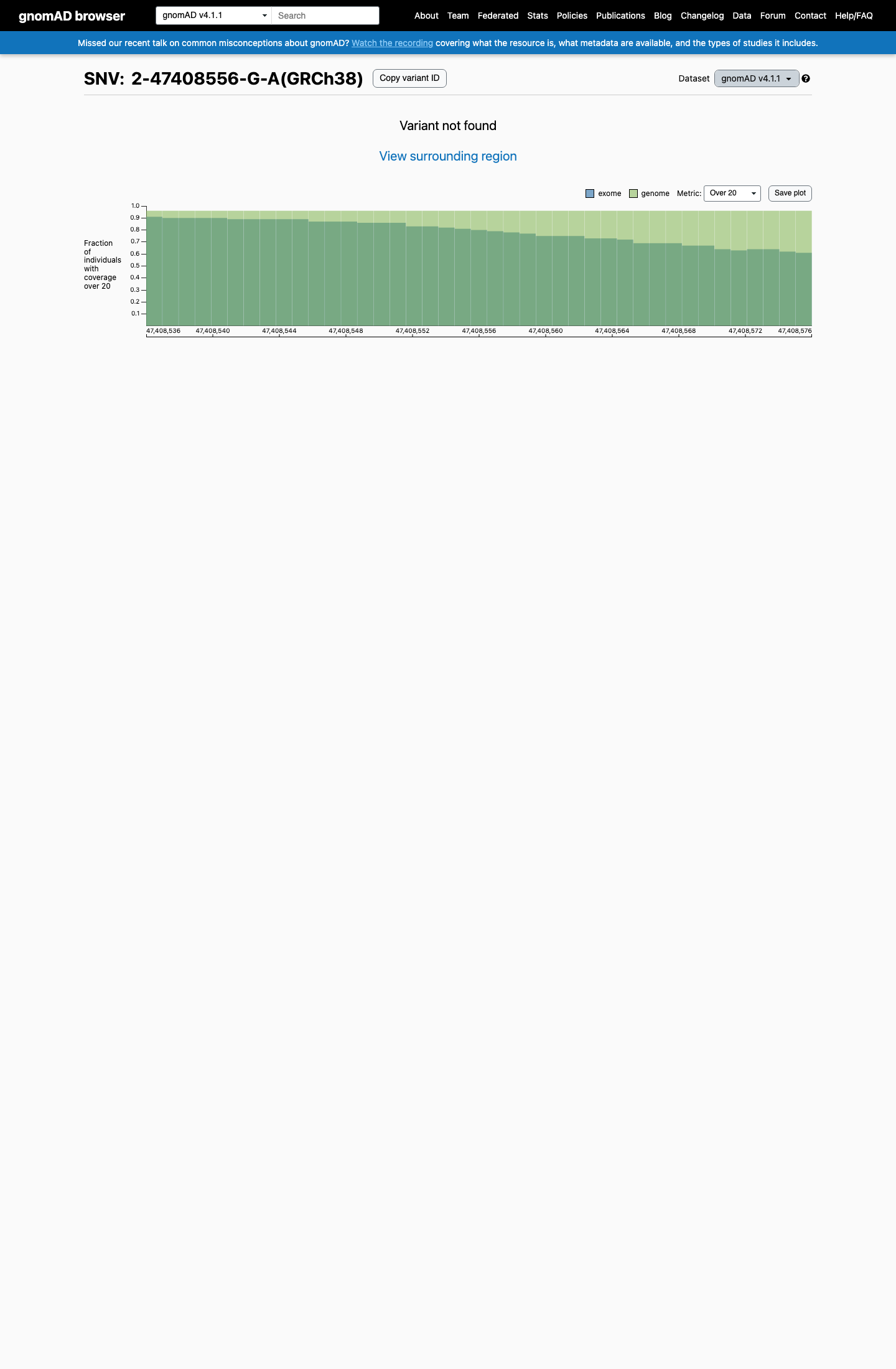
gnomAD v4.1
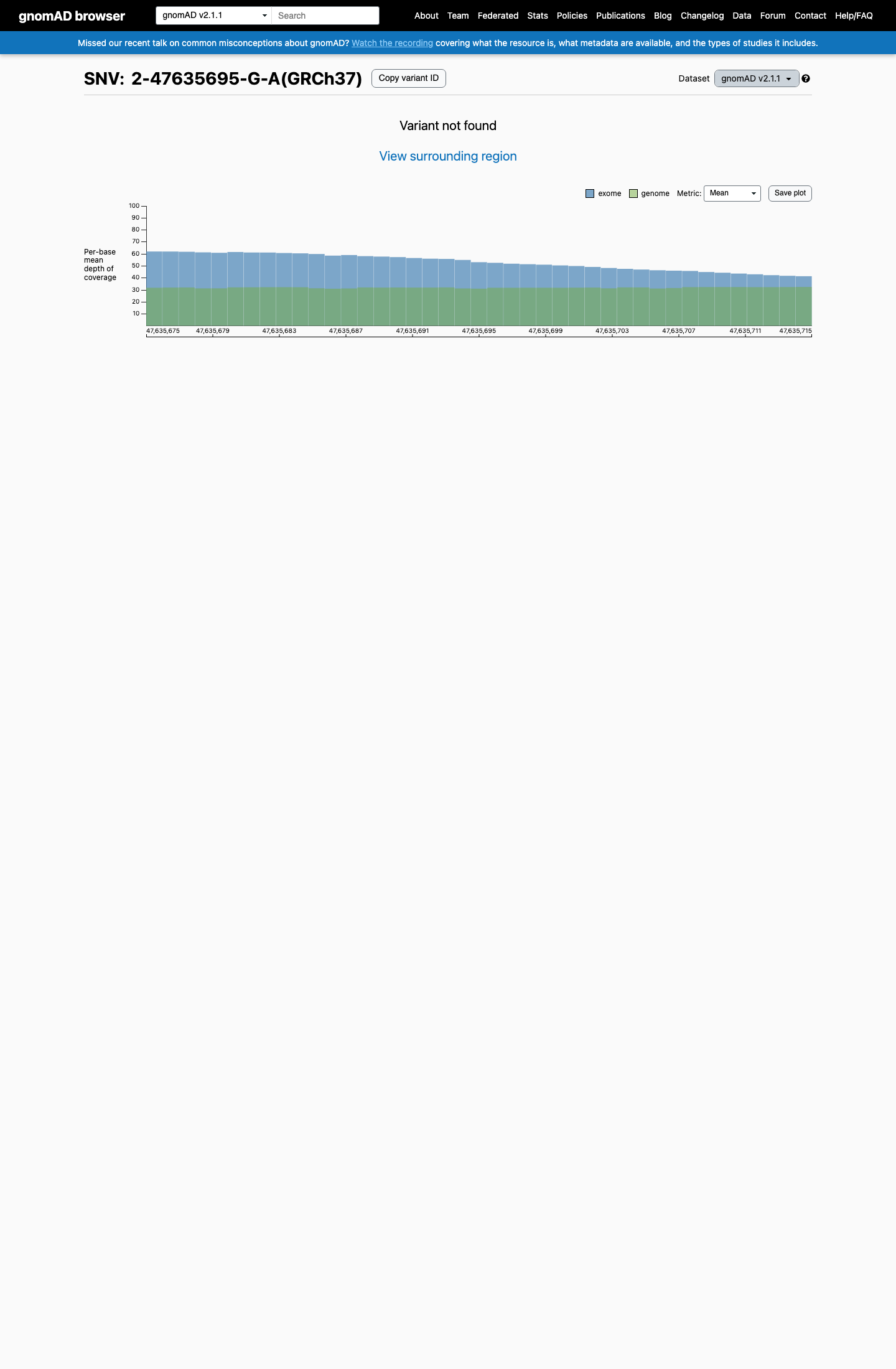
gnomAD v2.1
v4.1
Absent from gnomAD v4.1.
v2.1
Absent from gnomAD v2.1.
🇨🇦 CA
Absent from gnomAD-Canada v1.0.
Allele frequency by ancestry
three datasets · side by side
gnomAD v4.1
Absent
· 0 / ?
0 hom
0 hom
Not observed in any ancestry group.
gnomAD v2.1
Absent
· 0 / ?
0 hom
0 hom
Not observed in any ancestry group.
gnomAD Canada 🇨🇦
Absent
· 0 / ?
0 hom
0 hom
Not observed in any ancestry group.
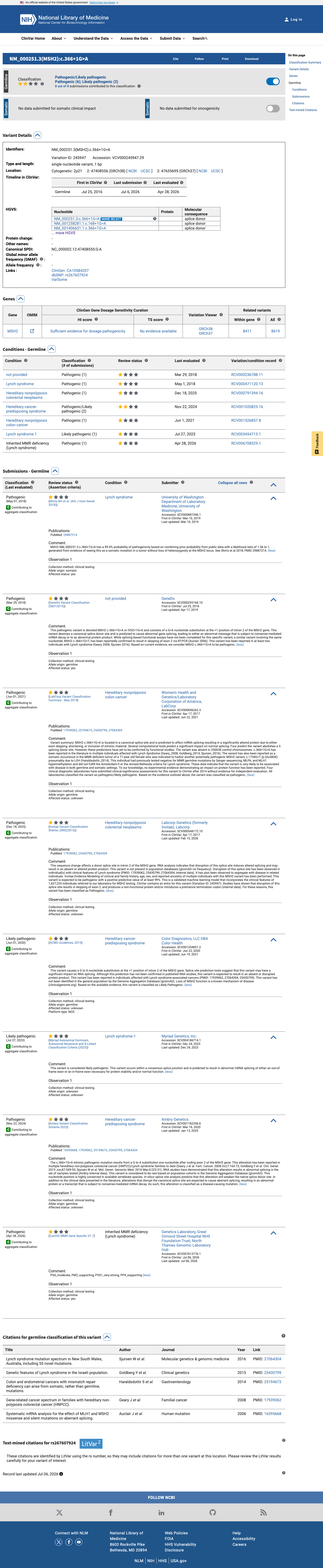
ClinVar
This variant has been reported in ClinVar as Pathogenic (6 clinical laboratories) and as Likely pathogenic (2 clinical laboratories). (ClinVarID = 245947)

In silico
SpliceAI predicts no significant splice impact for this variant (max delta score = 0.00). BayesDel score = 0.66.
Functional
No data
No calibrated functional assay or RNA evidence was identified for this variant.
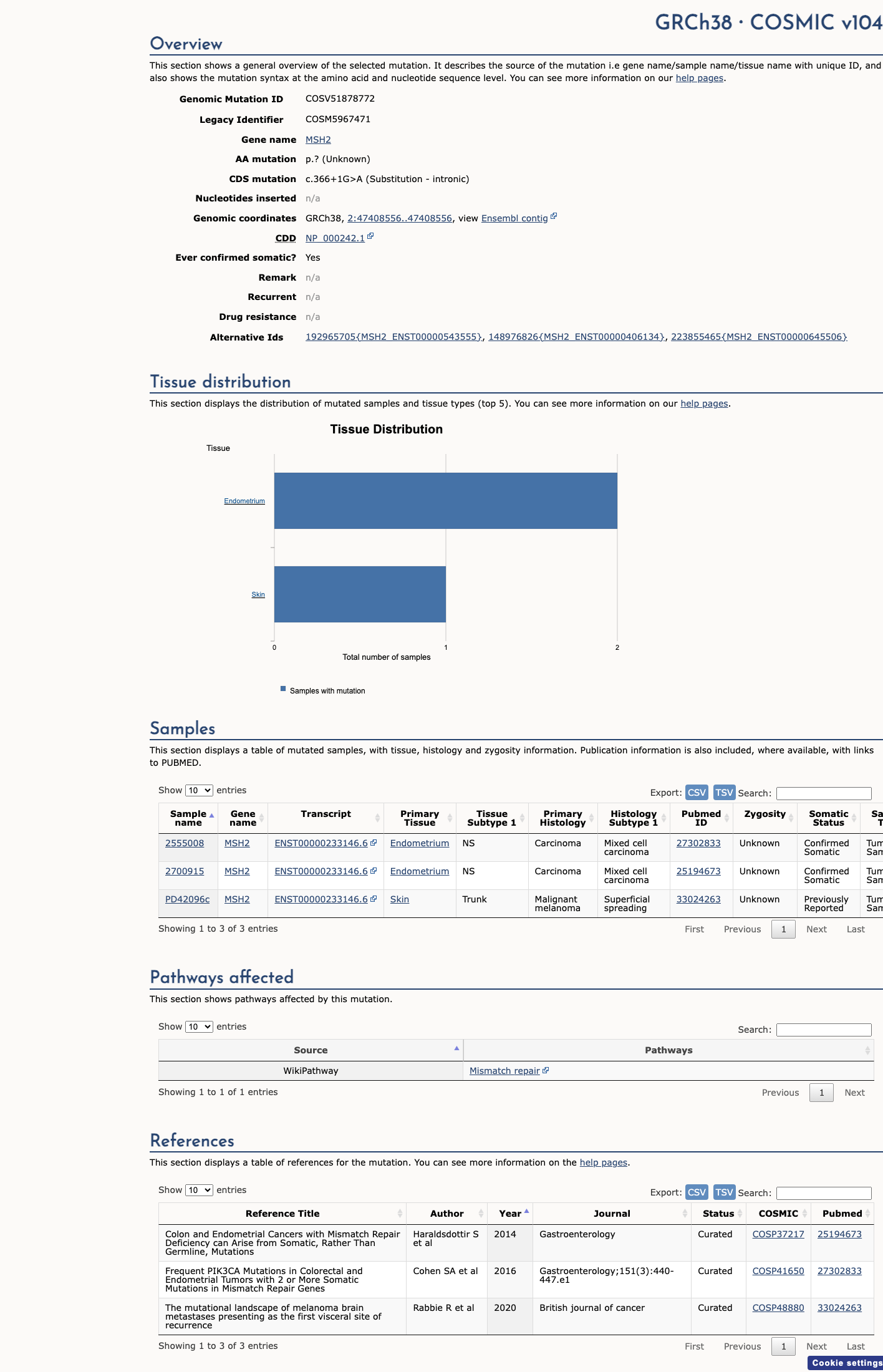
COSMIC
Somatic evidence
COSMIC
This variant has previously been reported in somatic cancers (COSMIC; COSV51878772, n = 3 times).
Hotspots
This variant does not lie in a statistically significant cancer hotspot.
Sources & reference links
Triaged references · 8 PMIDs not cited in assessment
16395668 ↗
Systematic mRNA analysis for the effect of MLH1 and MSH2 missense and silent mutations on aberrant splicing.
CLINVAR
25194673 ↗
Colon and endometrial cancers with mismatch repair deficiency can arise from somatic, rather than germline, mutations.
CLINVAR
25741868 ↗
Standards and guidelines for the interpretation of sequence variants: a joint consensus recommendation of the American College of Medical Genetics and Genomics and the Association for Molecular Pathology.
CLINVAR
29887214 ↗
Using Somatic Mutations from Tumors to Classify Variants in Mismatch Repair Genes.
CLINVAR
11598466 ↗
Practice parameters for the identification and testing of patients at risk for dominantly inherited colorectal cancer--supporting documentation.
CLINVAR
17939062 ↗
Gene-related cancer spectrum in families with hereditary non-polyposis colorectal cancer (HNPCC).
CLINVAR
24310308 ↗
ACMG technical standards and guidelines for genetic testing for inherited colorectal cancer (Lynch syndrome, familial adenomatous polyposis, and MYH-associated polyposis).
CLINVAR