Analysis in progress
Initialising…
0%
complete
This report is still being assembled — sections appear as each stage finishes. It isn't final yet.
MSH2
Final classification
Pathogenic
MSH2 c.1255C>T · p.Gln419Ter
MSH2

PVS1 (Very Strong): nonsense p.Gln419Ter creates a premature termination codon within the VCEP's <= codon 891 window, predicted to trigger nonsense-mediated decay.

Gene
MSH2
Transcript
NM_000251.3
HGVS · transcript:coding
NM_000251.3:c.1255C>T
Consequence
N/A
GRCh38
chr2:47429920 C>T
GRCh37
chr2:47657059 C>T
Basis Pathogenic: PVS1 Very Strong (nonsense PTC at codon 419) plus PM2, PP3, and PP5 supporting satisfies InSiGHT MSH2 VCEP combination Rule4. PP3 carries a human-review flag for mechanistic redundancy with PVS1, but PVS1 + PM2 + PP5 alone still satisfies Rule4.
Pathogenic: PVS1 Very Strong (nonsense PTC at codon 419) plus PM2, PP3, and PP5 supporting satisfies InSiGHT MSH2 VCEP combination Rule4. PP3 carries a human-review flag for mechanistic redundancy with PVS1, but PVS1 + PM2 + PP5 alone still satisfies Rule4.
Classification rationale
PVS1PM2PP3PP5 Pathogenic
MSH2 c.1255C>T

PVS1 (Very Strong): nonsense p.Gln419Ter creates a premature termination codon within the VCEP's <= codon 891 window, predicted to trigger nonsense-mediated decay. PM2 (Supporting): absent from gnomAD v4.1, below the <0.00002 population-frequency threshold. PP3 (Supporting): SpliceAI max delta 0.36 exceeds the >=0.2 predicted-splice-defect threshold (flagged for human review as redundant with PVS1). PP5 (Supporting): this exact variant is classified Pathogenic by the InSiGHT expert panel in ClinVar (3-star). Overall: Pathogenic per InSiGHT MSH2 VCEP combination Rule4 (1 Very Strong + at least 2 Supporting).

PVS1 + PM2 + PP3 + PP5 Pathogenic
Gene diagram · NM_000251.3 · variants mapped to exon structure
MSH2 NM_000251.3
Fetching transcript structure from UCSC…
Applied criteria · 4 applied · 12 assessed
Applied · 4
Strength Supporting Moderate Strong Very strong
PVS1 very strong Pathogenic
Met, Very Strong: nonsense p.Gln419Ter creates a premature termination codon at codon 419, within the VCEP's <= codon 891 window and predicted to trigger nonsense-mediated decay.
InSiGHT MSH2 VCEP v2.0 PVS1 rule: nonsense/frameshift introducing PTC <= codon 891 in MSH2 qualifies for PVS1 Very Strong; PVS1_Moderate reserved for PTC at codons 892-934 (cspec)Variant is a nonsense change c.1255C>T p.(Gln419Ter) at codon 419, within the <=891 Very Strong window (pvs1_variant_assessment)Gene-level PVS1 eligibility: germline LoF established for MSH2, pvs1_gene_gate = 'eligible' (pvs1_gene_context)
PM2 supporting Pathogenic
Met, Supporting: c.1255C>T is absent from gnomAD v4.1 (AF=0), below the 0.00002 (<1 in 50,000 alleles) threshold.
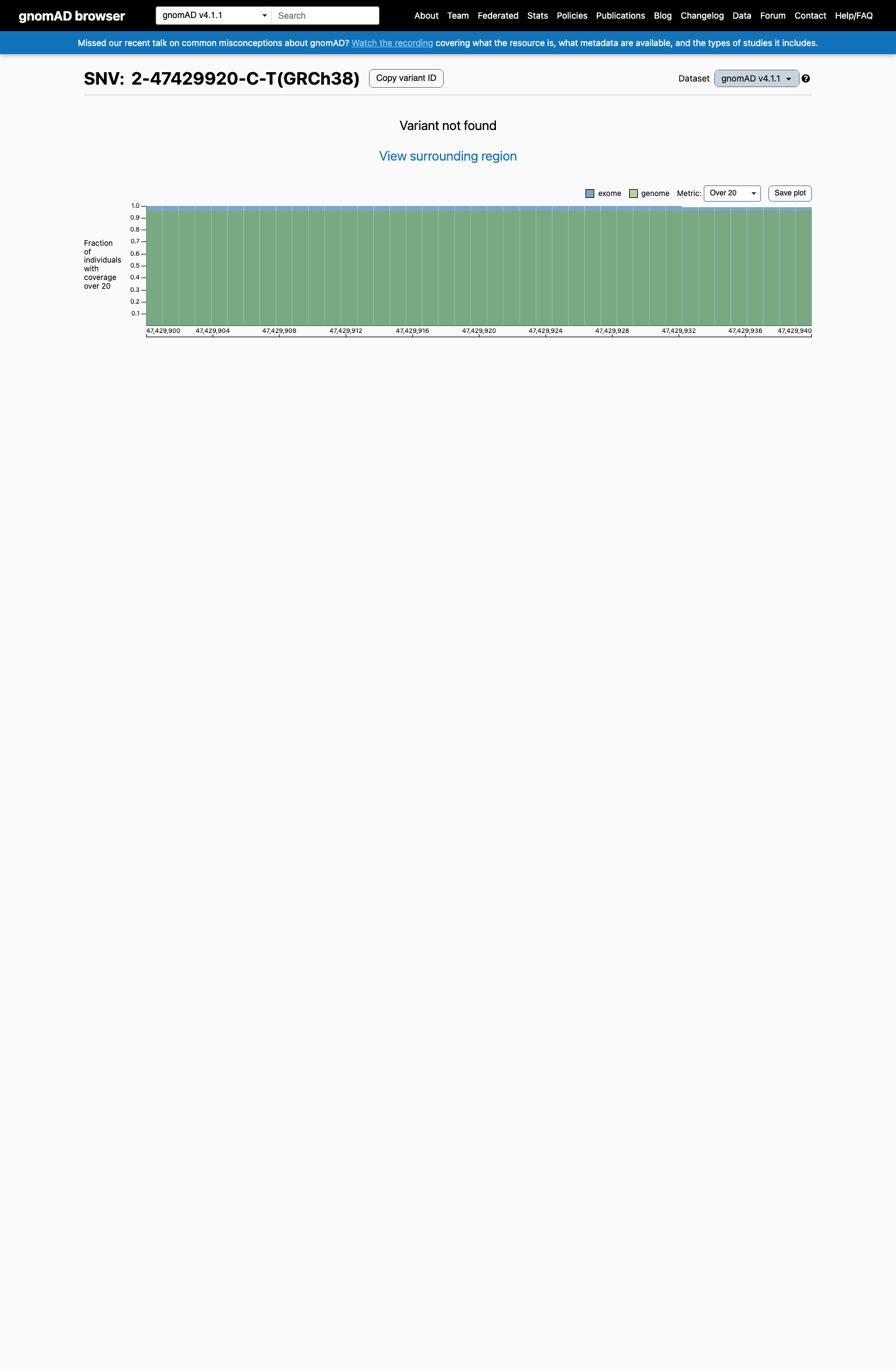
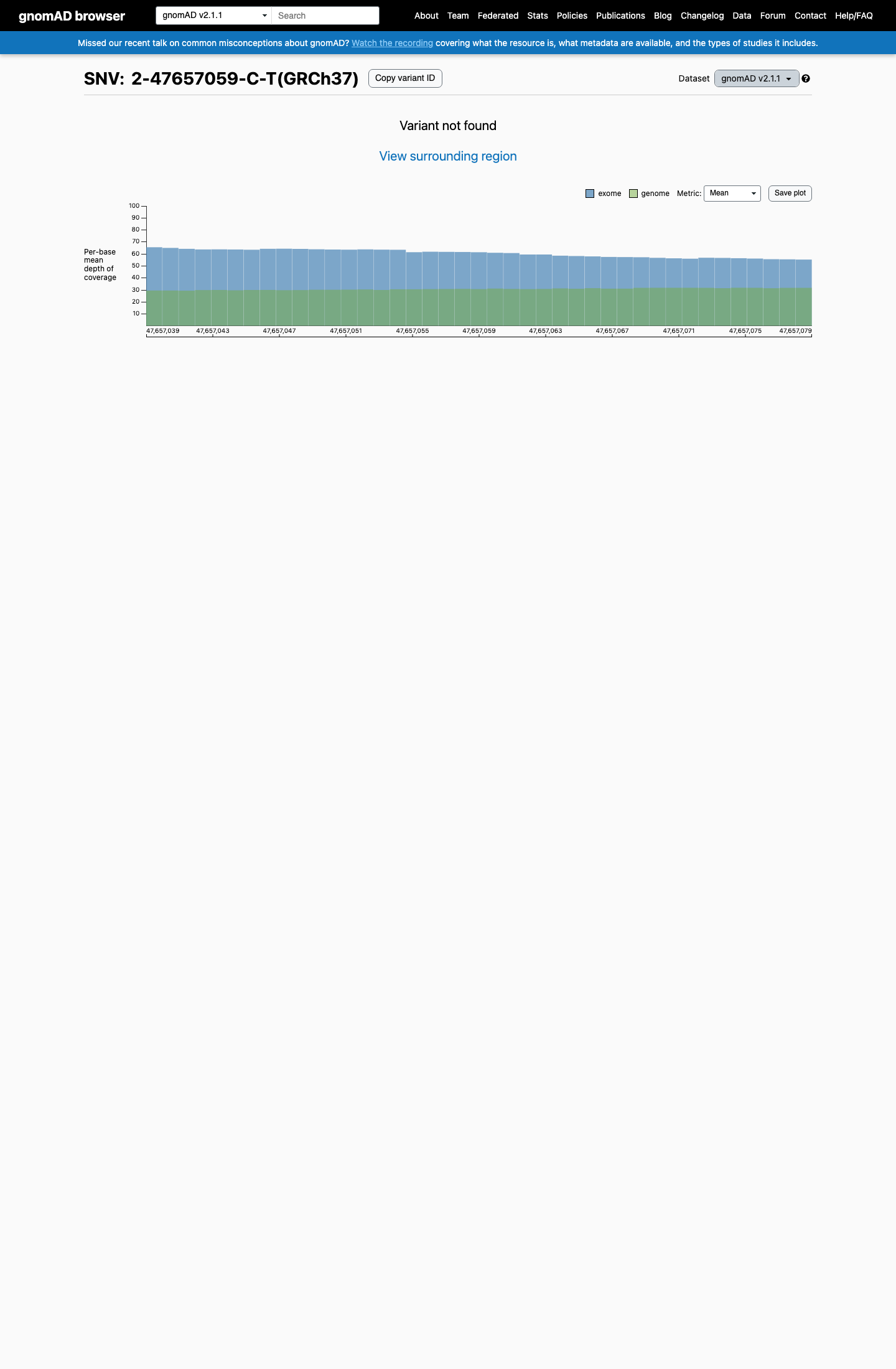
gnomAD v4.1 direct variant query (https://gnomad.broadinstitute.org/variant/chr2-47429920-C-T?dataset=gnomad_r4) returned search_status=absent; AF=0 < 0.00002. Also absent from gnomAD v2.1 (2-47657059-C-T) and gnomAD-Canada v1.0 (AC=0, AN=0, AF=0.0). Threshold from ClinGen InSiGHT MSH2 v2.0 CSPEC (doc 1577628936): PM2 = allele frequency <0.00002 (1 in 50,000 alleles) in gnomAD v4, applied at Supporting strength.
PP3 supporting review Pathogenic
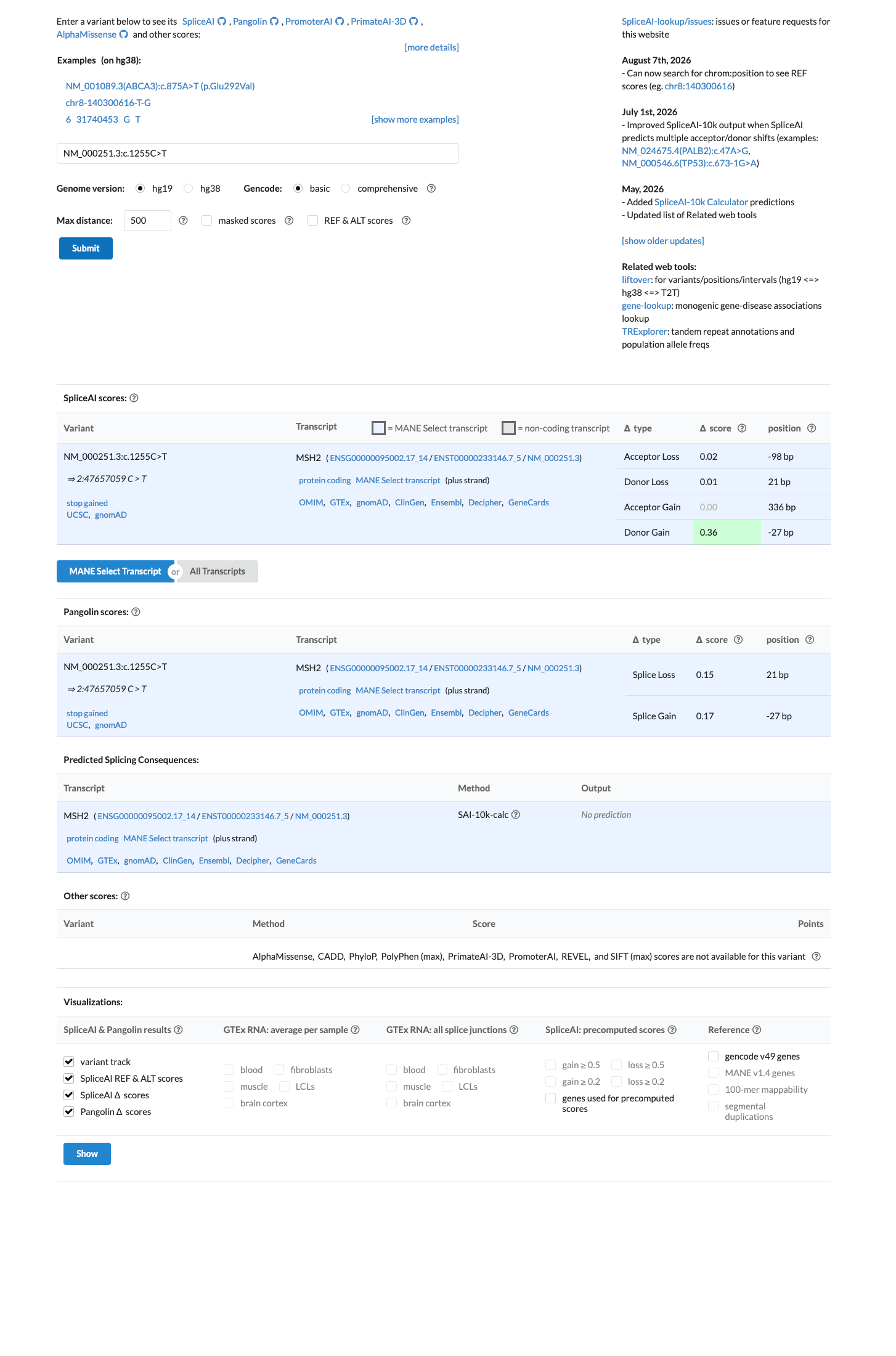
Met, Supporting: SpliceAI max delta 0.36 exceeds the >=0.2 threshold (predicted donor gain at intron 7 +6) per the VCEP PP3 rule. Flagged for human review: this SpliceAI-based support is mechanistically redundant with PVS1 for a nonsense variant.
SpliceAI max delta score 0.36 (DS_DG 0.36, donor-gain predicted 27 nt downstream, intron 7 +6) >= 0.2 PP3 threshold as per Walker et al. 2023 (PMID 37352859), ClinGen SVI Splicing Subgroup recommendations (Am J Hum Genet 110:1046-1067), the publication named in the InSiGHT MSH2 VCEP v2.0 PP3 rule (cspec doc 1577628936).InSiGHT MSH2 VCEP v2.0 PP3_Supporting rule: 'Predicted splice defect for non-canonical splicing nucleotides using SpliceAI with delta score >= 0.2 as per Walker et al 2023'; variant is 21 nt 5' of the exon 7 donor (exon 7 = c.1077-1276) and the predicted cryptic donor is at intronic +6.HCI prior lookup (vcep_hci_priors_msh2): c.1255C>T absent from the MSH2 HCI prior table (variant_not_in_hci_table; table is missense-only, and neighboring alleles c.1255C>A / c.1255C>G with priors 0.002 / 0.001 are different substitutions) - missense HCI paths of PP3 are not applicable.
PP5 supporting Pathogenic
Met, Supporting: the InSiGHT expert panel classified this exact variant as Pathogenic in ClinVar (3-star).
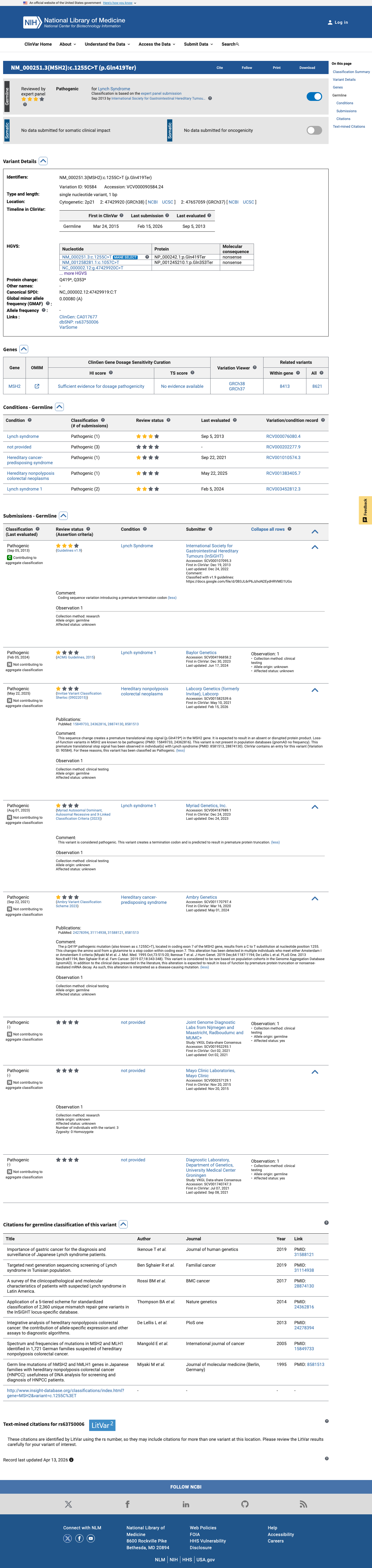
ClinVar VCV000090584: exact variant NM_000251.3(MSH2):c.1255C>T (p.Gln419Ter); review status 'reviewed by expert panel' (3 stars); expert panel Pathogenic by InSiGHT (SCV000107095, germline, Lynch Syndrome, 2013-09-05); 6 clinical-laboratory Pathogenic submissions (aggregate labels, not used as PP5 trigger).Global PP5/BP6 rule: exact-variant ClinVar 3-star expert-panel classification Pathogenic/Likely pathogenic -> PP5 supporting, VCEP 'not applicable' flag ignored.ClinVar expert panel classification
Assessed · not applied
Pathogenic
PS2 Not assessed: no de novo occurrence data exist; no parental testing or de novo assertion is reported for c.1255C>T.
PS3 Not assessed: no calibrated functional assay result exists for c.1255C>T; tumor MSI/IHC evidence belongs to PP4, not PS3.
PM3 Not met: zero PM3 points, below the 0.5-point supporting minimum; no in-trans second pathogenic MSH2 variant or biallelic observation exists.
PP1 Not assessed: no co-segregation data exist; the only report describes a single proband with no meioses or segregation analysis.
PP4 Not assessed: no carrier-level tumor phenotype data (MSI or MMR IHC) were available for c.1255C>T.
Benign
BA1 Not met: allele frequency is 0 (absent from gnomAD v4.1), far below the >=0.001 (0.1%) BA1 threshold.
BS1 Not met: allele frequency is 0 (absent from gnomAD v4.1), below the 0.0001-0.001 BS1 range.
BS2 Not assessed: no in-trans co-occurrence or phase-confirmation data exist for any carrier of c.1255C>T.
BS3 Not assessed: no assay demonstrates proficient function for c.1255C>T, and the mRNA-aberration clause does not apply to nonsense variants.
BS4 Not assessed: no non-segregation data exist; no affected non-carriers or unaffected carriers are reported for any pedigree.
BP5 Not assessed: no tumor evidence of an alternative molecular basis (MSS, intact MMR IHC, BRAF V600E, or MLH1 methylation) was available.
BP6 Not met: the only ClinVar expert-panel classification for this exact variant is Pathogenic (InSiGHT), the opposite direction BP6 requires.
N/A · 12 PS1 · PS4 · PM1 · PM4 · PM5 · PM6 · PP2 · BP1 · BP2 · BP3 · BP4 · BP7
Research & evidence
Population frequency · supports pathogenic
gnomAD v4.1 screenshot
gnomAD v4.1
gnomAD v2.1 screenshot
gnomAD v2.1
v4.1
Absent from gnomAD v4.1.
v2.1
Absent from gnomAD v2.1.
🇨🇦 CA
Absent from gnomAD-Canada v1.0.
Allele frequency by ancestry
three datasets · side by side
gnomAD v4.1
Absent · 0 / ?
0 hom
Not observed in any ancestry group.
gnomAD v2.1
Absent · 0 / ?
0 hom
Not observed in any ancestry group.
gnomAD Canada 🇨🇦
Absent · 0 / ?
0 hom
Not observed in any ancestry group.
ClinVar screenshot
ClinVar
This variant has been reported in ClinVar as Pathogenic (6 clinical laboratories) and as Pathogenic by International Society for Gastrointestinal Hereditary Tumours (InSiGHT) (expert panel). (ClinVarID = 90584)
SpliceAI screenshot
In silico
SpliceAI predicts possible splice impact for this variant (max delta score = 0.36). BayesDel score = 0.66.
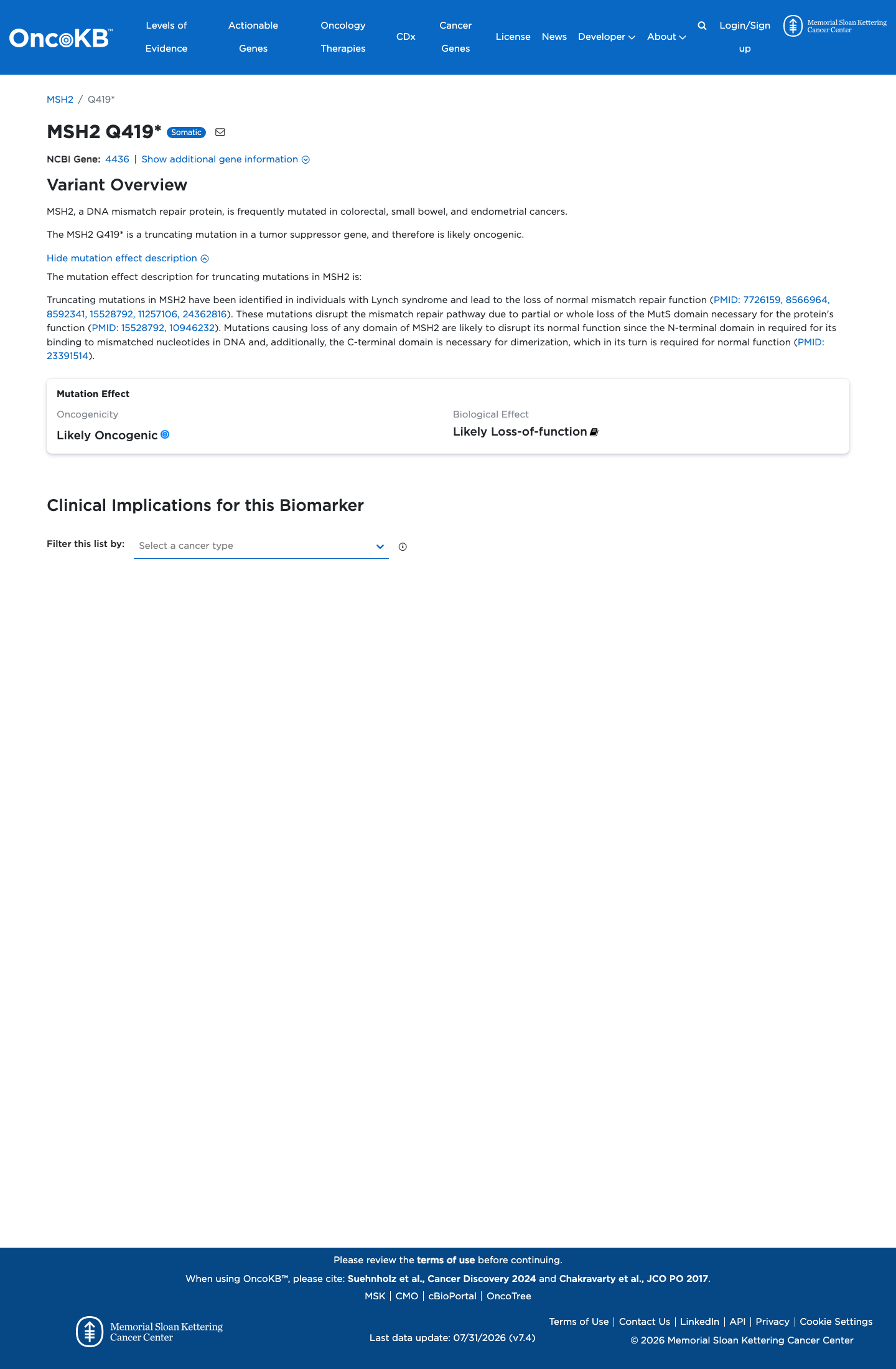
Functional / OncoKB screenshot
Functional Likely Oncogenic
OncoKB identified variant-specific curated literature and context relevant to functional review; biological-effect context: Likely Loss-of-function; curated oncogenicity label: Likely Oncogenic.
OncoKB ↗
COSMIC screenshot
COSMIC
Cancer hotspots screenshot
Cancer hotspots
Somatic evidence Not in COSMIC / hotspots
COSMIC
This variant does not lie in a statistically significant hotspot. This variant has not previously been reported in somatic cancers (COSMIC).
Hotspots
This variant does not lie in a statistically significant hotspot.
Literature · how each cited paper was used
2papers cited
Each card is an audit: what was searched, what was found, whether it names the variant, which criteria it fed, and why. 5 further PMIDs triaged but not cited — see Sources & References.
Integrative analysis of hereditary nonpolyposis colorectal cancer: the contribution of allele-specific expression and other assays to diagnostic algorithms.
Searched
c.1255C>T1255p.Gln419*Q419Gln419
Found
De Lellis et al. (2013) report c.1255C>T (p.Gln419*) as a germline MSH2 nonsense variant in Lynch syndrome proband 1515#3442 (Amsterdam criteria II), detected by sequencing of 132 unrelated HNPCC probands. The patient's tumor was MSI-H with loss of MSH2 expression on immunohistochemistry (IHC). The variant is listed among the 27 loss-of-function nucleotide changes (nonsense and frameshift) introducing premature termination codons identified in the cohort. This independently corroborates that c.1255C>T is a germline, PTC-introducing nonsense allele in a classic MMR-deficient (MSI-H/MSH2-loss) Lynch syndrome context, consistent with the predicted loss-of-function consequence and NMD-expected truncation underlying PVS1.
Variant
✓ Names this variant — characterised directly
Applied to
PVS1 very strong
Reports the exact variant as a germline MSH2 nonsense change (p.Gln419*) introducing a PTC in an MSI-H, MSH2-IHC-loss Lynch syndrome proband - corroborates the predicted loss-of-function (nonsense) consequence evaluated under PVS1.
1515#3442 II MSI-H MSH2 MSH2 c.1255CT (p.Gln419*)
Location Table 1 (Overview of MSI, IHC and mutational status in 132 HNPCC unrelated patients meeting AC), row for patient 1515#3442; supported by Results text: 'These included 27 loss-of-function nucleotide changes (nonsense and frameshift) introducing premature termination codons (PTCs)'  ·  Context Germline screening (SSCP/DGGE, dHPLC, automated sequencing) of 132 unrelated AC-I/AC-II HNPCC probands with tumor MSI and MMR-protein IHC analyses; patient 1515#3442 had an MSI-H tumor and loss of MSH2 expression by IHC  ·  full text
Rule & framework references · cited for criterion definitions, not variant evidence
24362816 ↗ Application of a 5-tiered scheme for standardized classification of 2,360 unique mismatch repair gene variants in the InSiGHT locus-specific database.
Sources & reference links
9Sources
CSpec VCEP
ClinVar
gnomAD v2.1
gnomAD v4.1
gnomAD-Canada
SpliceAI
OncoKB
COSMIC
Cancer hotspots
Triaged references · 5 PMIDs not cited in assessment
10946232 ↗ Structure and function of mismatch repair proteins. ONCOKB
11257106 ↗ Deficient DNA mismatch repair: a common etiologic factor for colon cancer. ONCOKB
15528792 ↗ Mutations associated with HNPCC predisposition -- Update of ICG-HNPCC/INSiGHT mutation database. ONCOKB
23391514 ↗ Structural, molecular and cellular functions of MSH2 and MSH6 during DNA mismatch repair, damage signaling and other noncanonical activities. ONCOKB
15849733 ↗ Spectrum and frequencies of mutations in MSH2 and MLH1 identified in 1,721 German families suspected of hereditary nonpolyposis colorectal cancer. CLINVAR