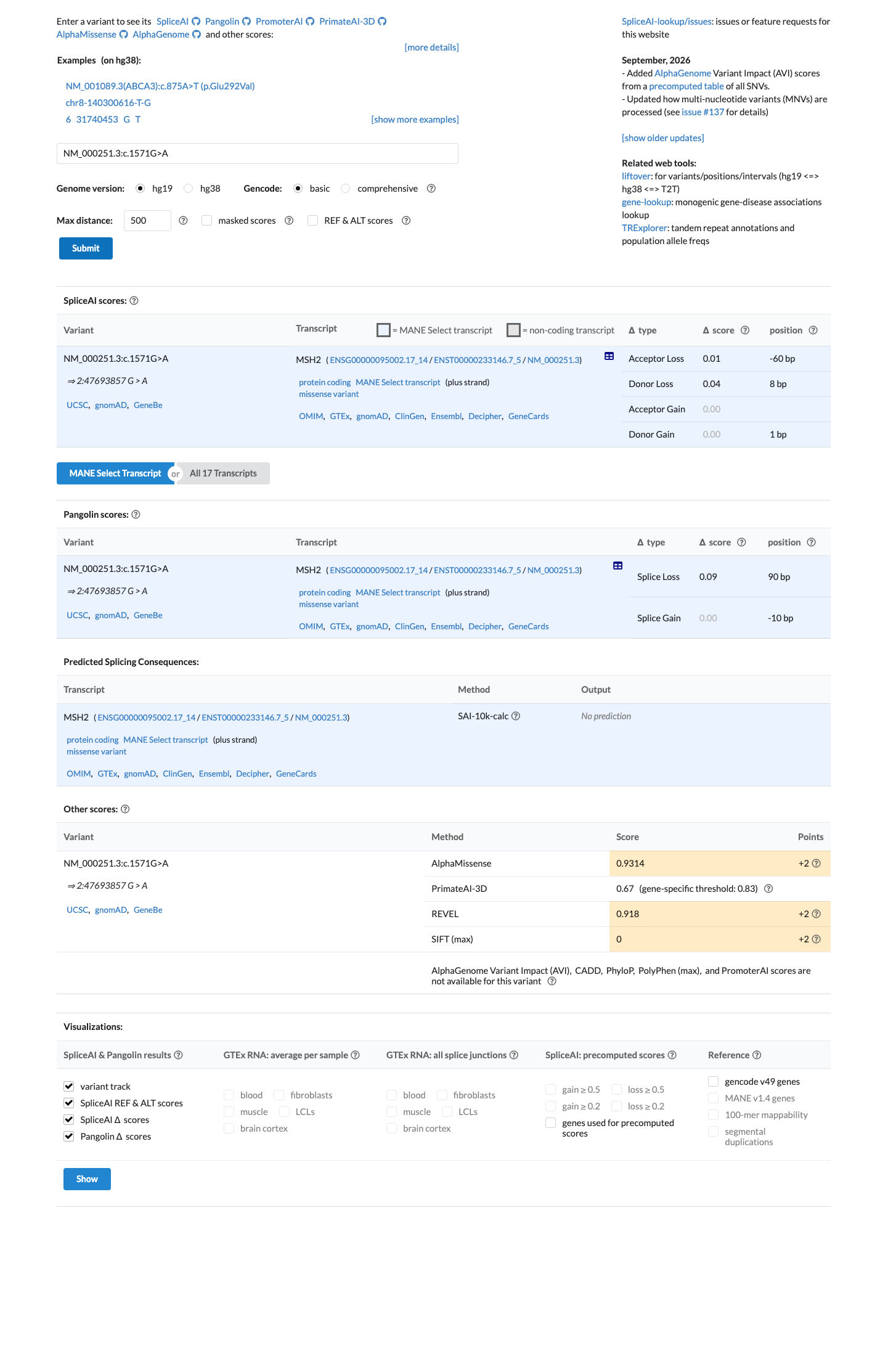
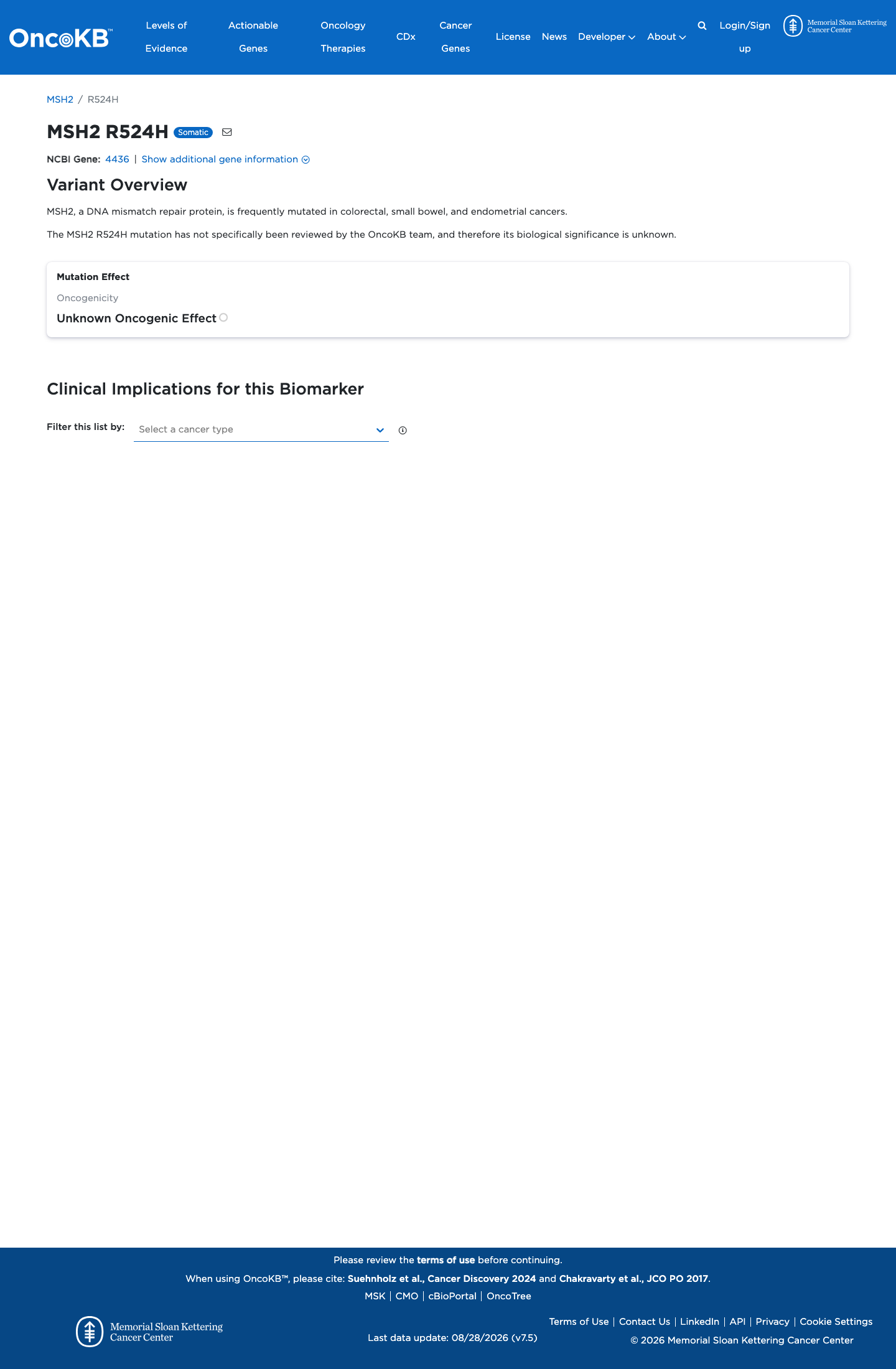
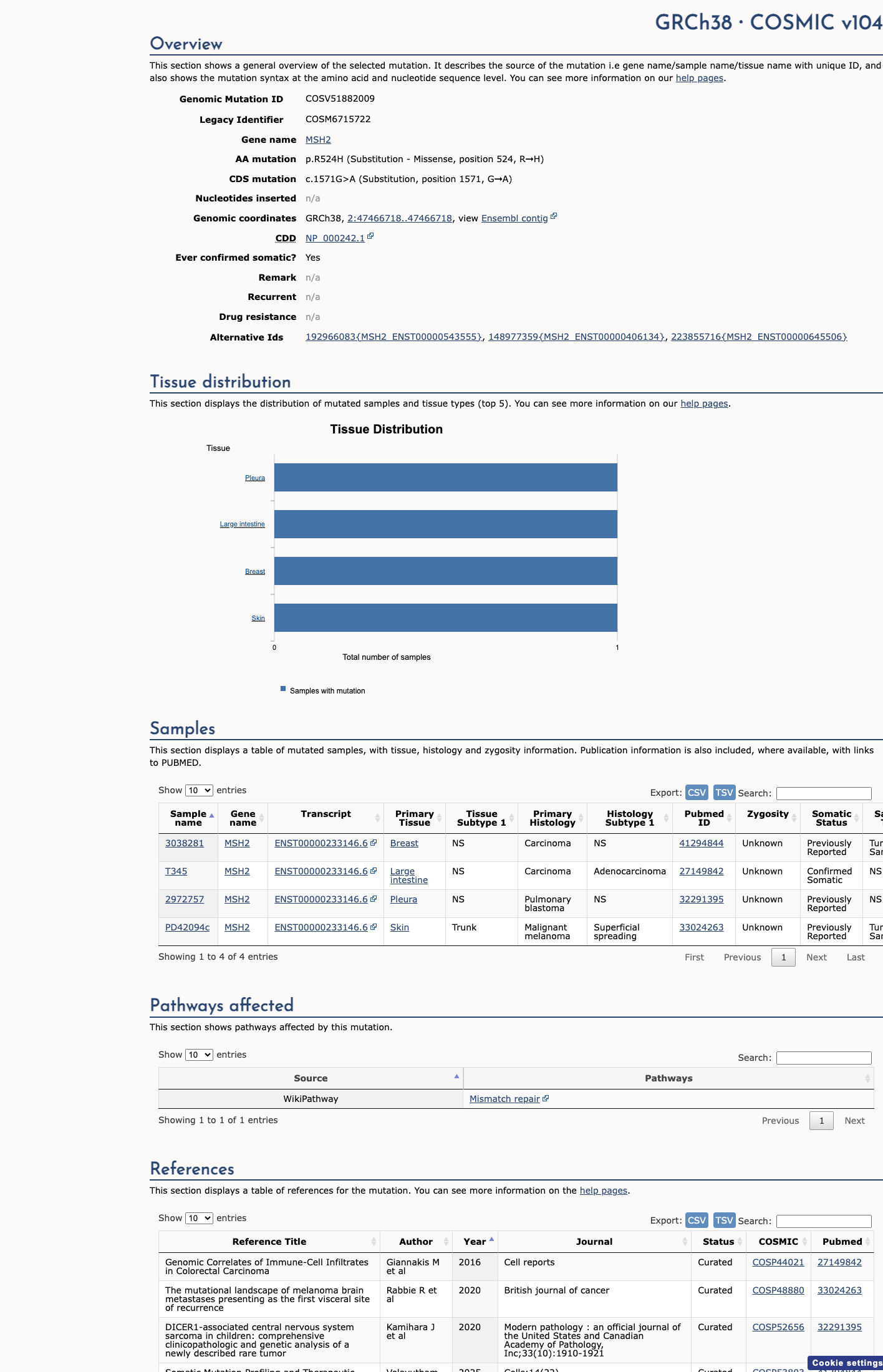
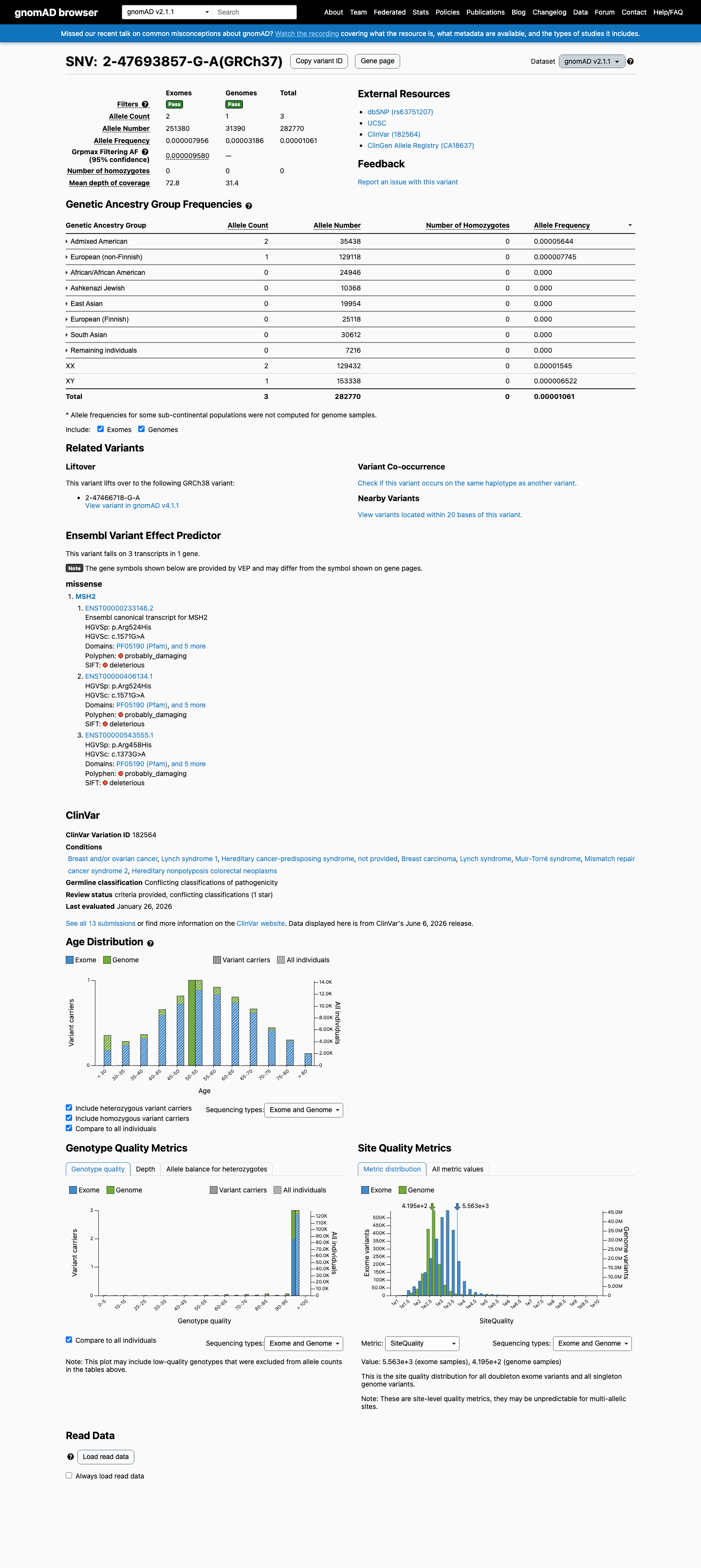
All three criteria assigned to the consequence/loss-of-function group are not applicable to NM_000251.3:c.1571G>A because the variant is a single-nucleotide missense substitution, NP_000242.1:p.(Arg524His), and not a null or length-altering allele. The governing ClinGen InSiGHT Hereditary Colorectal Cancer/Polyposis EP specification for MSH2 v2.0 is the framework applied (framework_mode = vcep, official cspec v2.0); it explicitly sets PM4 and BP3 to 'Not Applicable' for MSH2 and confines PVS1 to nonsense/frameshift at or before codon 891, large single/multi-exon genomic alterations, IVS +/-1 or +/-2 splice variants with exon skipping/cryptic-site use, and mRNA-confirmed splice aberrations. The MMR PVS1 decision tree contains only nonsense/frameshift, GT-AG 1,2 splice site, deletion, duplication and initiation-codon branches; a missense change reaches no PVS1 node, so no strength tier (very strong/strong/moderate/supporting) is assignable and strength is returned as null. Splice-mediated null mechanisms were positively excluded rather than presumed: c.1571 lies internal to MSH2 exon 10 (exon 10 spans c.1511-c.1661), not at a splice-consensus or exon-terminal position, and SpliceAI max delta is 0.038, below the >=0.2 delta this VCEP uses for a predicted splice defect. Neither governing VCEP file (PVS1_DecisionTree_MMR.pdf, VCEP-pilot-variants---MMR.xlsx) contains any variant-specific entry or pre-assigned code for c.1571G>A, p.Arg524His or p.R524H; this is documented in each criterion's gaps_remaining and reflects absent table rows rather than absent evidence. Variant scope: NM_000251.3:c.1571G>A is an exonic missense substitution, NP_000242.1:p.(Arg524His), in MSH2 exon 10 (chr2:47466718 G>A, GRCh38). Governing framework: ClinGen InSiGHT Hereditary Colorectal Cancer/Polyposis Expert Panel specification to the ACMG/AMP guidelines for MSH2 v2.0 (CSPEC doc 1577628936), which takes precedence over generic ACMG/AMP. It scopes PS1 and PM5 as applicable and declares PM1, PP2 and BP1 not applicable for MSH2. PS1 not met: codon 524 is CGT, and the only single-nucleotide substitution in that codon encoding histidine (CAT) is the observed c.1571G>A; the other five substitutions give Ser/Gly/Cys/Pro/Leu and the third-base changes are synonymous Arg. PS1 requires a different nucleotide change encoding the same amino-acid change, so the criterion cannot be satisfied for this variant, and no VCEP-established Pathogenic p.Arg524His classification exists. PM5 met at supporting: a different missense change at the same residue, NM_000251.3:c.1571G>C (p.Arg524Pro), is classified Likely pathogenic by expert-panel review in ClinVar (VCV000001759; InSiGHT submission, Guidelines v2.4, 'Abrogated function & 2 MSI-H tumours'), on protein-level grounds rather than as a splice defect, and the VCEP's PP3 precondition is satisfied for this variant (HCI prior 0.7525, PP3_Supporting band >0.68 and <=0.81). Because the comparator is Likely Pathogenic rather than Pathogenic, the specification directs PM5_Supporting. PM1 not applicable: the MSH2 v2.0 specification states there are no recognised mutational hotspots usable for classification and that pathogenic variants are distributed across all MMR functional domains; the declared PM1 file (MMR-Functional-domains.pdf) contains only its figure caption with no extractable domain coordinates, vcep_materials.json's authoritative domain_tables key is empty for MSH2, and CancerHotspots returns no hotspot row for MSH2 R524. PP2 and BP1 not applicable: the same specification removes both criteria for MSH2 (PP2: low benign-missense-rate premise does not apply; BP1: missense change in a gene where only loss of function causes disease), and BP1 additionally fails structurally because this variant is missense, not truncating. Net contribution of this group: PM5_Supporting only; PS1 not met; PM1, PP2 and BP1 out of scope under the governing specification. Variant scope: NM_000251.3:c.1571G>A is an exonic missense substitution, NP_000242.1:p.(Arg524His); only the two functional evidence codes PS3 and BS3 were adjudicated, and both were judged on protein-level MMR function. Governing framework: ClinGen InSiGHT Hereditary Colorectal Cancer/Polyposis Expert Panel specification to the ACMG/AMP guidelines for MSH2 v2.0 (CSPEC). Its PS3 and BS3 rules are expressed as calibrated functional-assay bands (PS3: odds >18.7 Strong, >4.3 and <=18.7 Moderate, >2.08 and <=4.3 Supporting; BS3: odds <=0.05 Strong, >0.05 and <=0.48 Supporting), with secondary flowchart arms for MMR function defect (PS3_Moderate), complete loss of monoallelic expression (PS3_Moderate) and variant-specific proficient function (BS3_Supporting). The VCEP index declares two files as governing PS3/BS3, and both were searched in full. Governing files: neither Functional-assay-SVI-documentation-MMR.xlsx nor Functional-assay-flowchart.pdf contains an entry for this variant, so no pre-assigned code exists. The documentation is still decisive as calibration data: it approves and calibrates the assay that does carry variant-level data for p.Arg524His - the Jia/Scott massively parallel MSH2 loss-of-function screen (PMID 33357406; 36550560), normal readout LOF <=0, abnormal readout LOF >0.4, 22 P/LP and 26 B/LB validation controls, proposed strength 'PS3, BS3'. Decisive functional result: p.Arg524His scores LOF -0.72 in that VCEP-approved calibrated assay, i.e. a normal, non-loss-of-function readout (below the <=0 normal cutoff and the paper's own a priori cutoff of 0; well below the >0.4 abnormal cutoff). Neighbouring substitutions at the same codon do score as loss of function in the same assay (R524P +3.33, R524D +3.02), so the negative readout is informative for this residue rather than a gap in the map. Net contribution of this group: BS3 is met (benign, variant-specific proficient function from a VCEP-calibrated assay; strong per the assay table's proposed-strength row, and at least supporting on the flowchart path), and PS3 is not met - no available functional readout for this variant is abnormal, so no pathogenic functional evidence is contributed. No functional evidence conflicts with the benign direction of this code. Where the strength sits between supporting and strong is a weighting question only; the code itself (BS3 met, PS3 not met) is stable under either reading and is flagged in warnings. Governing framework is the ClinGen InSiGHT Hereditary Colorectal Cancer/Polyposis Expert Panel Specification for MSH2 v2.0 (cspec), which is gene- and disease-specific and therefore overrides generic ACMG/AMP defaults for this group. PS4: marked Not Applicable by the VCEP; tumor IHC/PP4 replaces proband counting for MMR genes. PP4: not met - 0 documented CRC/endometrial MSI-H tumors (with MSI on a standard 5-10 marker panel or tumor genome and/or MSH2/MSH6-consistent protein loss) versus >=1 required for PP4_Supporting. BP5: not met - 0 documented MSS / no-MMR-loss / inconsistent-IHC tumors versus >=2 (or >=4 for Strong) required by the VCEP's tumor-based BP5 rule. PP5/BP6: neither triggered - ClinVar variation 182564 has zero expert-panel submissions and only 1-star single-submitter records with conflicting classifications; both criteria are additionally listed as Not Applicable by the VCEP. Net effect of this group on the MSH2 c.1571G>A (p.R524H) classification: no pathogenic and no benign phenotype/prevalence assertions are contributed. No tumor phenotype data (MSI/MSS, IHC, BRAF V600E, MLH1 methylation) and no proband cancer history exist in the case materials, which is the reason PP4 and BP5 are unevaluable beyond 'not met' rather than scorable. Neither allelic criterion contributes evidence for MSH2 c.1571G>A (p.Arg524His). BP2 is Not Applicable in the governing InSiGHT MSH2 v2.0 specification, which directs use of BS2 instead, so the criterion cannot be applied to this gene. PM3 is Applicable in the same specification but is points-based and requires a patient with CMMRD-consistent clinical features carrying a known pathogenic/likely pathogenic MSH2 variant in trans (1.0 point) or with unknown phase (0.5 points). This case contains no proband, no second MSH2 variant, no phase determination and no CMMRD-consistent clinical or tumour data, and no retrieved publication names the variant, so zero points accrue and PM3 is not met. Variant scope: NM_000251.3:c.1571G>A is an exonic missense substitution, NP_000242.1:p.(Arg524His), so PP3/BP4 were evaluated on the protein-impact path and BP7 was treated as out of scope. Governing framework: ClinGen InSiGHT Hereditary Colorectal Cancer/Polyposis Expert Panel specification to the ACMG/AMP guidelines for MSH2 v2.0 (CSPEC). For MSH2 missense variants this specification defines PP3 and BP4 by the HCI prior probability for pathogenicity (PP3_Moderate >0.81; PP3_Supporting >0.68 and <=0.81; BP4_Supporting <0.11), and the gene's VCEP index declares HCI-PRIORS-MSH2.txt as the governing supporting file for those two criteria. Governing lookup result: the HCI-PRIORS table contains an exact row for c.1571G>A / p.R524H (exon 10, DBID MSH2_03461, reference PMID22949387) with prior probability 0.7525. That value sits in the supporting pathogenic band, so PP3 is met at Supporting strength and BP4 is not met. Single-path discipline: the available SpliceAI result (max delta 0.038) was not used for PP3/BP4, because a missense substitution takes computational evidence from the protein-impact path only and a clean splice prediction is neither PP3 nor BP4 support for it. REVEL 0.918 was noted but not double-counted, since the gene-specific HCI-prior rule governs for MSH2 missense variants. Population evidence for NM_000251.3:c.1571G>A (p.Arg524His): the variant is extremely rare but not absent — gnomAD v4.1 total AF 1.36322e-05 (22/1,613,824 alleles) with joint grpmax filtering AF 1.03e-05, and gnomAD v2.1 AF 1.06093e-05 (3/282,770 alleles). PM2 is met at Supporting strength under the InSiGHT MSH2 v2.0 threshold (< 0.00002 in gnomAD v4); PM2_Supporting is the strength used throughout the VCEP's own pilot classifications. Neither benign frequency code is met: BA1 (>= 0.001) and BS1 (>= 0.0001) both fail by ~97-fold and ~10-fold respectively on the VCEP-designated gnomAD v4 grpmax filtering AF of 1.03e-05, as do the gnomAD v2.1 result, the gnomAD v2.1/v3.1 non-cancer subsets and every gnomAD v4.1 subpopulation (maximum 3.12402e-05, European Finnish). Zero homozygotes are reported in every dataset; for a dominant, high-penetrance mismatch-repair gene this is consistent with pathogenicity rather than benignity and provides no prevalence/penetrance argument for BA1/BS1. gnomAD-Canada v1.0 (a non-gnomAD HostSeq cohort) gives a 2-allele European non-Finnish grpmax filtering AF of 1.7036e-04 that crosses the BS1 threshold; this is flagged for human review but does not satisfy BS1, which the VCEP defines on gnomAD v4. BS2 is a patient-level co-occurrence/CMMRD rule rather than a frequency rule and is not assessable here: no phase, zygosity, parental-testing or second MSH2 variant information exists in this case. Net effect on the combined classification: the population group contributes PM2_Supporting only; no stand-alone or strong benign population evidence is available.
MSH2 is a tumor suppressor gene that encodes a key protein in the DNA mismatch repair system, which finds and fixes errors made during DNA replication. The MSH2 protein pairs with MSH6 or MSH3 to form complexes that recognize mismatched base pairs and trigger their repair. Inherited mutations in MSH2 cause Lynch syndrome (hereditary nonpolyposis colorectal cancer), predisposing to colorectal, endometrial, ovarian, and other cancers, and biallelic mutations cause constitutional mismatch repair deficiency. Loss of MSH2 function increases the mutation rate and drives tumor development, particularly in colorectal and endometrial cancers, and mismatch-repair-deficient tumors respond particularly well to immune checkpoint inhibitor therapies.
All three criteria assigned to the consequence/loss-of-function group are not applicable to NM_000251.3:c.1571G>A because the variant is a single-nucleotide missense substitution, NP_000242.1:p.(Arg524His), and not a null or length-altering allele.
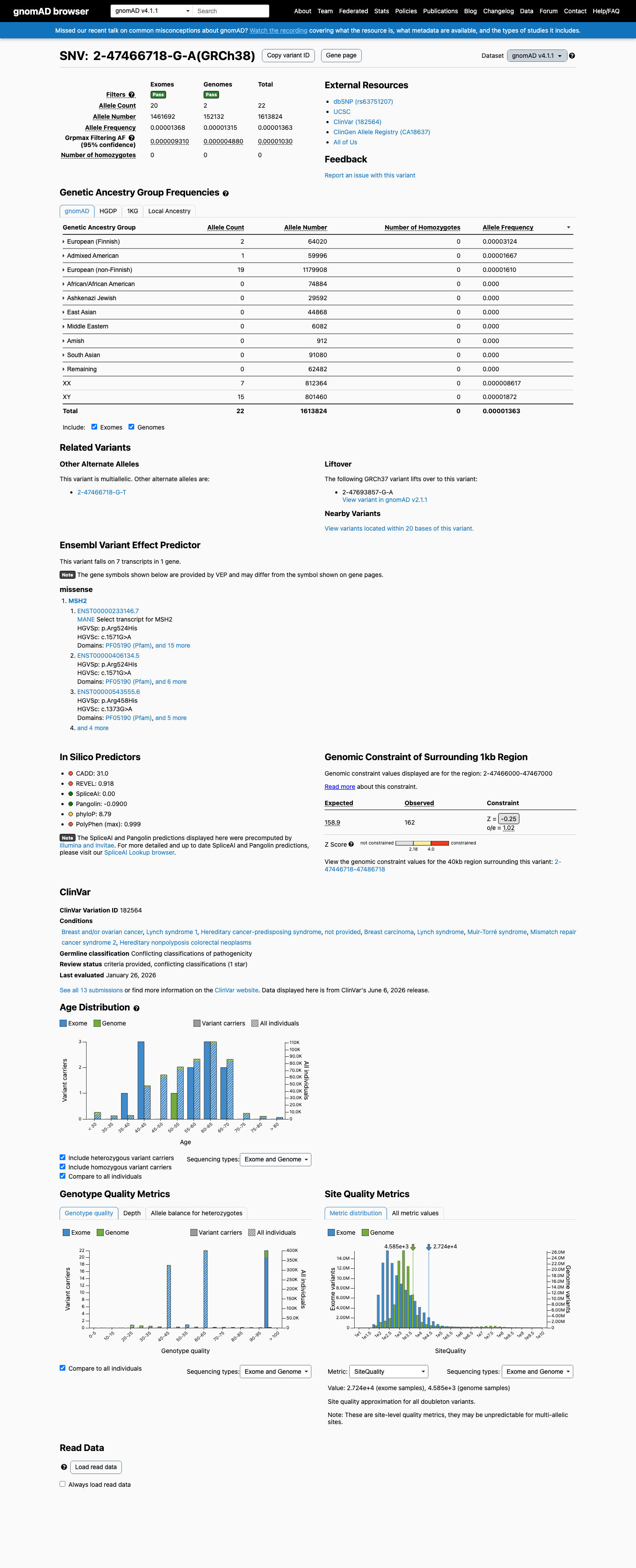
0 hom · FAF 0.001%
European (Finnish) 2 / 64,020 |
0.0031% |
Admixed American 1 / 59,996 |
0.0017% |
European (non-Finnish) 19 / 1,179,908 |
0.0016% |
0 hom · FAF 0.00096%
Admixed American 2 / 35,438 |
0.0056% |
European (non-Finnish) 1 / 129,118 |
0.00077% |
0 hom · FAF 0.003%
European (non-Finnish) 2 / 11,740 |
0.017% |