Back
NM_000251.3:c.23C>G
p.Thr8Arg · MSH2
0%
complete
Final classification
Uncertain Significance - Conflicting Evidence
PM2BP4
MSH2
c.23C>G
p.Thr8Arg
missense · exon 1

MSH2 is a tumor suppressor gene that encodes a key protein in the DNA mismatch repair system, which finds and fixes errors made during DNA replication. The MSH2 protein pairs with MSH6 or MSH3 to form complexes that recognize mismatched base pairs and trigger their repair. Inherited mutations in MSH2 cause Lynch syndrome (hereditary nonpolyposis colorectal cancer), predisposing to colorectal, endometrial, ovarian, and other cancers, and biallelic mutations cause constitutional mismatch repair deficiency. Loss of MSH2 function increases the mutation rate and drives tumor development, particularly in colorectal and endometrial cancers, and mismatch-repair-deficient tumors respond particularly well to immune checkpoint inhibitor therapies.

This variant

All three requested criteria are governed by the MSH2 InSiGHT VCEP framework; the variant is missense p.(Thr8Arg), PVS1 is outside the applicable loss-of-function classes, and PM4 and BP3 are explicitly Not Applicable.
Transcript
NM_000251.3
HGVS · transcript:coding
NM_000251.3:c.23C>G
GRCh38
chr2:47403214 C>G
GRCh37
chr2:47630353 C>G
ClinGen InSiGHT Hereditary Colorectal Cancer/Polyposis Expert Panel Specifications to the ACMG/AMP Variant Interpretation Guidelines for MSH2 Version 2.0 v2.0 criteria-combination framework: matched Rule31 (Benign.Supporting >=1 + Pathogenic.Supporting >=1) with applied criteria: PM2 supporting, BP4 supporting; maps to Uncertain Significance - Conflicting Evidence.
Classification rationale
PM2 BP4 Uncertain Significance - Conflicting Evidence
MSH2 c.23C>G missense · exon 1

All three requested criteria are governed by the MSH2 InSiGHT VCEP framework; the variant is missense p.(Thr8Arg), PVS1 is outside the applicable loss-of-function classes, and PM4 and BP3 are explicitly Not Applicable. The exact variant notations c.23C>G, p.Thr8Arg, and p.T8R were searched in both named governing full-text files; no exact entry was found. For this criterion group, PS4, PP5, and BP6 are not applicable under the governing MSH2 InSiGHT VCEP rules. PP4 and BP5 are applicable in principle but remain not assessed because the case lacks patient-specific tumor phenotype and alternate-molecular-basis data. The exact variant was searched in both declared VCEP full-text files using c.23C>G, p.Thr8Arg, and p.T8R; no exact entry was found. Only PM3 and BP2 were adjudicated. The MSH2-specific VCEP specification governs both criteria. PM3 cannot be assigned without documented affected-proband co-occurrence, a second pathogenic/likely pathogenic MSH2 variant, and phase or CMMRD clinical evidence; BP2 is explicitly not applicable. Population evidence supports PM2 at Supporting strength under the governing MSH2 VCEP; BA1 and BS1 are not met because the gnomAD v4.1 Grpmax FAF is below both benign-frequency thresholds. BS2 remains not assessed because the VCEP requires patient-level confirmed in-trans co-occurrence and clinical context not supplied by the population dataset.

PM2 + BP4 Uncertain Significance - Conflicting Evidence
LYFE Sciences is an AI system, and it can make mistakes. Criteria may be applied incorrectly, sources may be misread, and a confident-looking classification can still be wrong. Double-check every criterion and its underlying evidence before relying on any call.
Gene diagram · NM_000251.3 · variants mapped to exon structure
MSH2 NM_000251.3
Fetching transcript structure from UCSC…
Applied criteria · 2 applied · 14 assessed
MetEvidence satisfies this criterion.
Not metEvaluated against available evidence; threshold not reached.
Not assessedApplies in principle, but no evidence was found to evaluate it.
N/ADoesn't apply to this variant type.
Applied · 2
Strength Supporting Moderate Strong Very strong
PM2 supporting Pathogenic
Met at Supporting: gnomAD v4.1 Grpmax FAF is 4.43e-06, below the MSH2 VCEP PM2 threshold of 0.00002.
The governing MSH2 InSiGHT VCEP Version 2.0 defines PM2 at Supporting strength as allele frequency <0.00002 in gnomAD v4.gnomAD v4.1 reports total AF 1.87498e-06, Grpmax FAF 4.43e-06, 3 of 1,600,016 alleles, and zero homozygotes.The complete converted VCEP-pilot-variants---MMR.xlsx.txt was searched for c.23C>G, p.Thr8Arg, and p.T8R; no exact entry was found.
BP4 supporting Benign
Met, supporting: HCI pathogenicity probability 0.0013 is below the MSH2 VCEP BP4 threshold of <0.11.
The MSH2 InSiGHT VCEP specification (version 2.0) defines BP4_Supporting for a missense variant with HCI prior probability <0.11.The on-record HCI-PRIORS-MSH2 table contains the exact c.23C>G / p.T8R entry and reports pathogenicity probability 0.0013.The local REVEL lookup reports 0.516, which is above the supplied generic BP4 Supporting threshold of <=0.29; this alternative path is not met but does not override the VCEP HCI rule.
Assessed · not applied · 4 not met · 10 not assessed
Pathogenic
PS1 Not assessed: no VCEP-established pathogenic alternative nucleotide encoding p.Thr8Arg was identified in the reviewed evidence.
PS2 Not assessed: no documented proband, parental confirmation, de novo observation, Lynch-spectrum tumor, or de novo point total is available for applying the MSH2 PS2 thresholds.
PS3 Not assessed: the calibrated assay defines abnormal MSH2 function as LOF score >0.4, but no variant-specific LOF score is reported for p.(Thr8Arg).
PM3 Not assessed: no affected-proband co-occurrence, second pathogenic MSH2 variant, phase result, or CMMRD feature assessment is documented for PM3 point assignment.
PM5 Not met: no same-residue comparator was found, and HCI prior 0.0013 is below the VCEP PP3 supporting threshold of >0.68.
PP1 Not assessed: no pedigree data or combined segregation Bayes likelihood ratio is documented, leaving the PP1 Supporting threshold of >2.08 unevaluable.
PP3 Not met: HCI pathogenicity probability 0.0013 is below the MSH2 VCEP PP3 Supporting threshold of >0.68, and REVEL 0.516 is below 0.644.
PP4 Not assessed: no patient-specific MSI, IHC, tumor-genome, or CMMRD score is available to meet the VCEP PP4 thresholds.
Benign
BA1 Not met: gnomAD v4.1 Grpmax FAF is 4.43e-06, below the MSH2 VCEP BA1 threshold of 0.001.
BS1 Not met: gnomAD v4.1 Grpmax FAF is 4.43e-06, below the MSH2 VCEP BS1 lower threshold of 0.0001.
BS2 Not assessed: gnomAD v4.1 has zero homozygotes, but VCEP BS2 requires confirmed in-trans patient co-occurrence and clinical-age evidence.
BS3 Not assessed: the calibrated assay defines normal MSH2 function as LOF score <=0, but no variant-specific LOF score is reported for p.(Thr8Arg).
BS4 Not assessed: no documented non-segregating relatives or combined segregation Bayes likelihood ratio is available to evaluate the BS4 Strong cutoff of <0.05.
BP5 Not assessed: no qualifying MSS, MMR-IHC discordant, BRAF V600E, or MLH1-methylation tumor evidence is documented.
N/A · 12 PVS1 · PS4 · PM1 · PM4 · PM6 · PP2 · PP5 · BP1 · BP2 · BP3 · BP6 · BP7
Research & evidence
Population frequency
gnomAD v4.1 screenshot
gnomAD v4.1
gnomAD v2.1 screenshot
gnomAD v2.1
v4.1
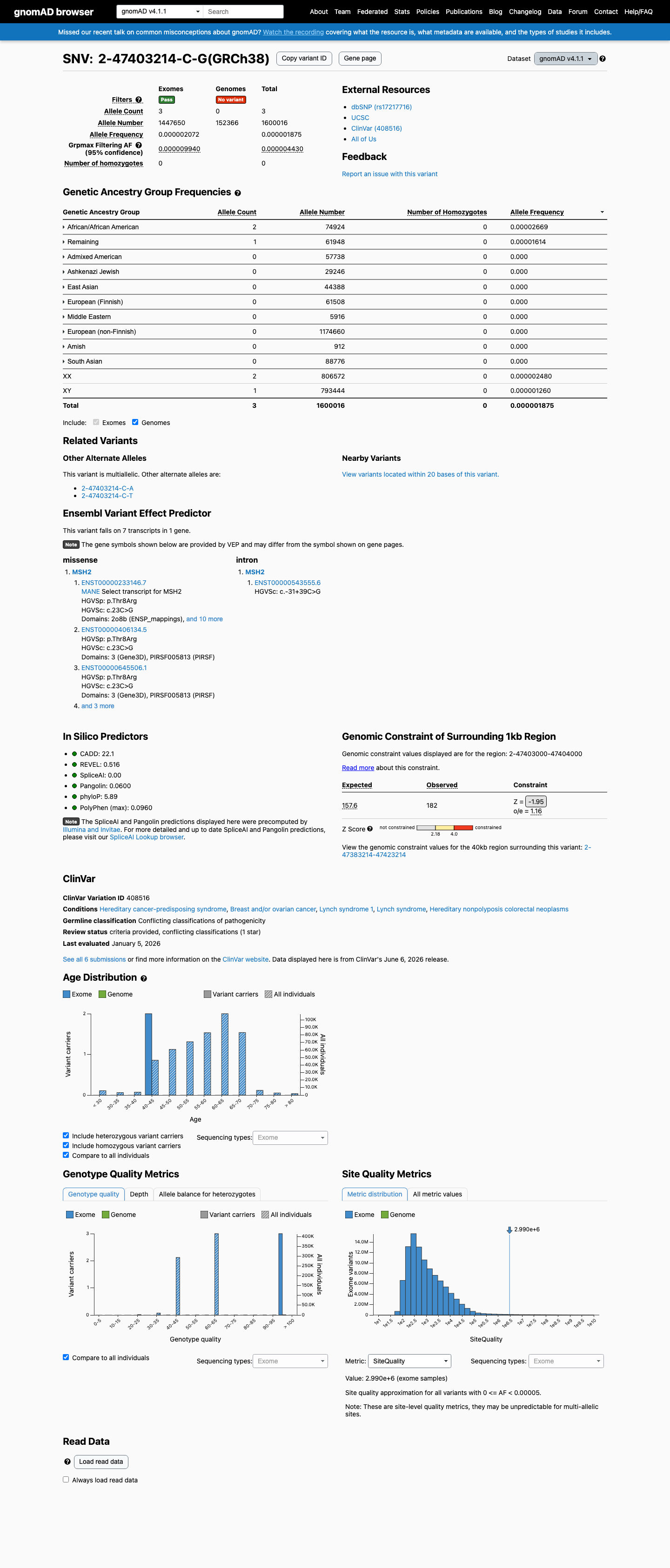
This variant is present in gnomAD v4.1 (AF= 1.87498e-06; MAF= 0.00019%, 3/1600016 alleles, homozygotes = 0) and has highest observed frequency in the African/African American population (AF= 2.66937e-05; MAF= 0.00267%, 2/74924 alleles, homozygotes = 0); grpmax FAF= 4.43e-06.
v2.1
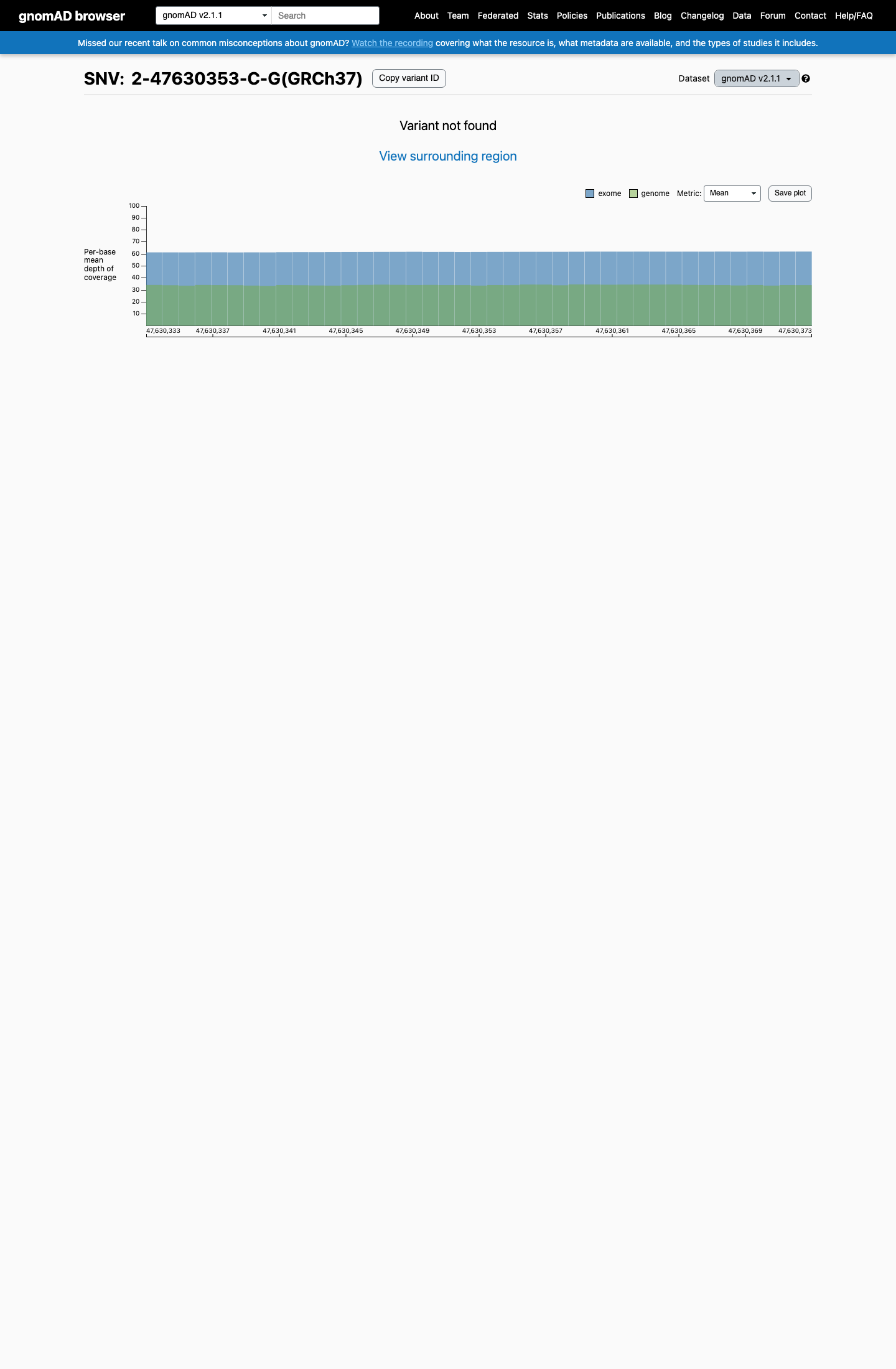
Absent from gnomAD v2.1.
🇨🇦 CA
Not available in gnomAD-Canada v1.0.
Allele frequency by ancestry
three datasets · side by side
gnomAD v4.1
0.00019% · 3 / 1,600,016
0 hom · FAF 0.00044%
African/African American
2 / 74,924
0.0027%
Remaining individuals
1 / 61,948
0.0016%
+ 8 not observed (Admixed American, European (Finnish), Amish, East Asian, Middle Eastern, South Asian, Ashkenazi Jewish, European (non-Finnish))
gnomAD v2.1
Absent · 0 / ?
0 hom
Not observed in any ancestry group.
gnomAD Canada 🇨🇦
Absent · 0 / ?
0 hom
Not observed in any ancestry group.
ClinVar screenshot
ClinVar
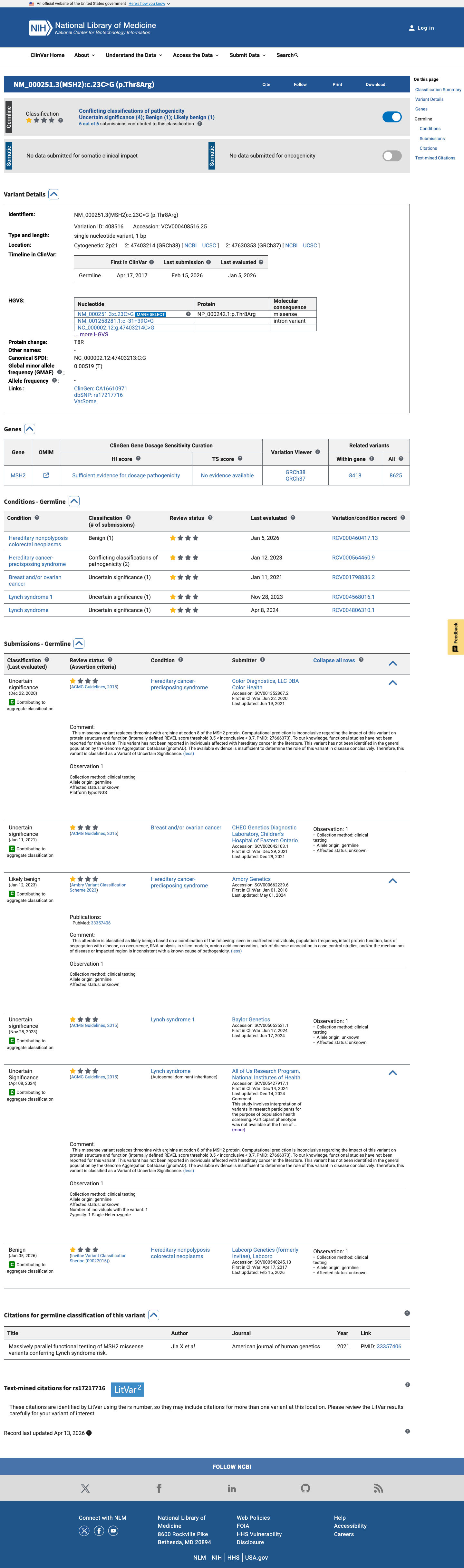
This variant has been reported in ClinVar as Uncertain significance (3 clinical laboratories) and as Likely benign (1 clinical laboratory) and as Uncertain Significance (1 clinical laboratory) and as Benign (1 clinical laboratory). (ClinVarID = 408516)
SpliceAI screenshot
In silico
SpliceAI predicts no significant splice impact for this variant (max delta score = 0.00). REVEL score = 0.516. BayesDel score = 0.0317561. HCI prior probability for pathogenicity = 0.0013. MAPP score = 3.1. Custom PP2 score = 0.001.
Functional / OncoKB screenshot
Functional Unknown Oncogenic Effect
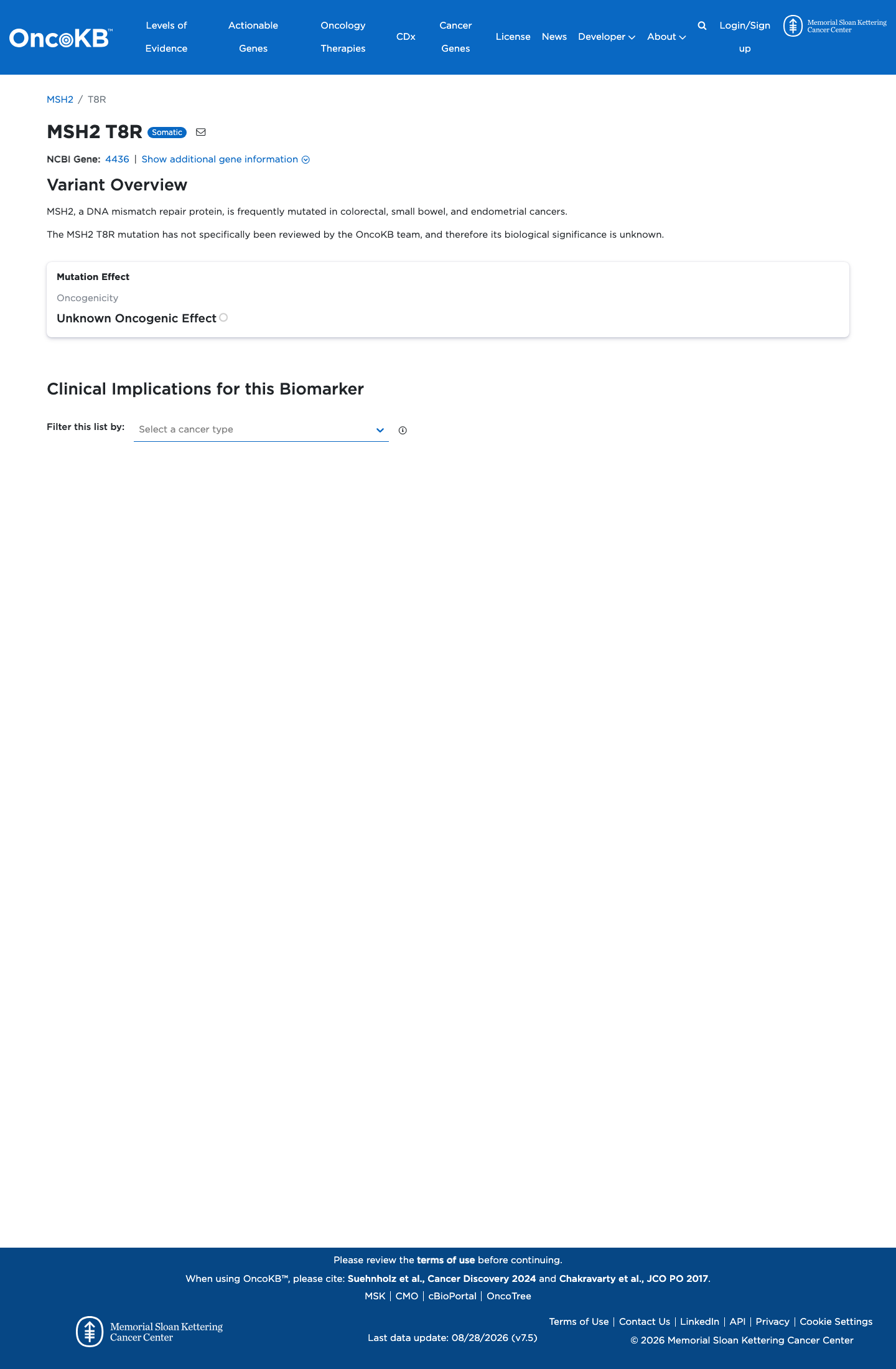
OncoKB did not identify variant-specific reviewed functional evidence for this variant; gene-level curated context is available for reviewer follow-up. MSH2, a DNA mismatch repair protein, is frequently mutated in colorectal, small bowel, and endometrial cancers.
OncoKB ↗
COSMIC screenshot
COSMIC
Cancer hotspots screenshot
Cancer hotspots
Somatic evidence Not in COSMIC / hotspots
COSMIC
This variant does not lie in a statistically significant hotspot. This variant has not previously been reported in somatic cancers (COSMIC).
Hotspots
This variant does not lie in a statistically significant hotspot.
Sources & reference links
9Sources
CSpec VCEP
ClinVar
gnomAD v2.1
gnomAD v4.1
gnomAD-Canada
SpliceAI
OncoKB
COSMIC
Cancer hotspots
Triaged references · 8 PMIDs not cited in assessment
23535968 ↗ Informing family members of individuals with Lynch syndrome: a guideline for cli CLINVAR
23788249 ↗ ACMG recommendations for reporting of incidental findings in clinical exome and genome sequencing. CLINVAR
25452455 ↗ Hereditary colorectal cancer syndromes: American Society of Clinical Oncology Clinical Practice Guideline endorsement of the familial risk-colorectal cancer: European Society for Medical Oncology Clinical Practice Guidelines. CLINVAR
25741868 ↗ Standards and guidelines for the interpretation of sequence variants: a joint co CLINVAR
26389505 ↗ Genetics of Colorectal Cancer (PDQ®): Health Professional Version. CLINVAR
28492532 ↗ Sherloc: a comprehensive refinement of the ACMG-AMP variant classification crite CLINVAR
31302137 ↗ Lynch Syndrome in Urologic Malignancies - What Does the Urologist Need to Know? CLINVAR
33357406 ↗ Massively parallel functional testing of MSH2 missense variants conferring Lynch syndrome risk. CLINVAR