This variant is a missense change (p.Arg638His) in PTCH1, a gene in which loss-of-function is an established mechanism for Gorlin syndrome (nevoid basal cell carcinoma syndrome), an autosomal dominant disorder with high penetrance and early onset.1 The variant is present in gnomAD population databases at low frequency overall (v2.1: 33/282,644 alleles, AF=0.012%; v4.1: 126/1,613,872 alleles, AF=0.008%), with the highest subpopulation frequency in Africans/African Americans (0.112% in v2.1). No homozygotes have been observed.2 The variant meets PM2 at supporting level: overall allele frequency is below the 0.1% threshold, though the African subpopulation frequency is borderline (0.112% in v2.1).3 Five of six clinical diagnostic laboratories in ClinVar classify this variant as Likely benign or Benign (ClinVar ID 220182), providing supporting evidence for a benign interpretation (BP6_supporting).4 Multiple in silico predictors support a benign effect: REVEL score 0.378, BayesDel score -0.243824, and SpliceAI predicts no splicing impact (max delta 0.05). These provide supporting benign evidence (BP4_supporting).5 The variant has been observed in multiple individuals in gnomAD presumed to be healthy adults, which is inconsistent with a fully penetrant early-onset dominant disorder such as Gorlin syndrome, providing additional supporting benign evidence (BS2_supporting).6 No pathogenic evidence criteria were met: there is no functional data supporting a damaging effect (PS3 not met), no case-control enrichment (PS4 not met), no de novo reports (PS2/PM6 not met), no segregation data (PP1 not met), the variant is not in a known hotspot or critical domain (PM1 not met), and no reputable source reports it as pathogenic (PP5 not met).7 No functional studies of p.Arg638His or a systematically characterized range including this residue were identified. The variant has not been experimentally characterized for its effect on Hedgehog signaling, PTCH1-SMO interaction, or protein trafficking.8
Final classification
Likely Benign
PM2BS2BP4BP6
PTCH1
c.1913G>A
p.Arg638His
missense
This variant
This variant is a missense change (p.Arg638His) in PTCH1, a gene in which loss-of-function is an established mechanism for Gorlin syndrome (nevoid basal cell carcinoma syndrome), an autosomal dominant disorder with high penetrance and early onset.
gene-specific framework lacked a usable explicit final combination framework, so generic ACMG/AMP 2015 final-combination rules were applied as fallback; applied criteria: PM2 supporting, BS2 supporting benign, BP4 supporting benign, BP6 supporting benign; combination = 1 supporting + 3 supporting benign, which maps to Likely Benign.
Classification rationale
PM2
BS2BP4BP6
Likely Benign
PTCH1 c.1913G>A
missense
PM2 + BS2 + BP4 + BP6
→
Likely Benign
LYFE Sciences is an AI system, and it can make mistakes. Criteria
may be applied incorrectly, sources may be misread, and a confident-looking
classification can still be wrong. Double-check every criterion and
its underlying evidence before relying on any call.
Gene diagram
· NM_000264.5 · variants mapped to exon structure
PTCH1
NM_000264.5
Fetching transcript structure from UCSC…
Applied criteria · 4 applied · 18 assessed
MetEvidence satisfies this criterion.
Not metEvaluated against available evidence; threshold not reached.
Not assessedApplies in principle, but no evidence was found to evaluate it.
N/ADoesn't apply to this variant type.
Applied · 4
Strength
Supporting
Moderate
Strong
Very strong
PM2
supporting
Pathogenic
This variant is present in gnomAD at very low frequency overall (v2.1: 33/282,644 alleles, AF=0.012%; v4.1: 126/1,613,872 alleles, AF=0.008%), below the 0.1% threshold for PM2. No homozygotes are observed. The African/African American subpopulation AF is 0.112% in v2.1 (borderline above 0.1%) but 0.087% in v4.1, supporting overall rarity.
gnomAD v2.1 overall AF = 0.012% (<0.1%)gnomAD v4.1 overall AF = 0.008% (<0.1%)Zero homozygotes in both datasets
BS2
supporting
Benign
This variant has been observed in multiple individuals within gnomAD population databases (33 alleles in v2.1, 126 alleles in v4.1) who are presumed healthy adults based on gnomAD's exclusion of severe pediatric disease. Gorlin syndrome is a highly penetrant autosomal dominant disorder with early onset; observation of this variant in population controls at this frequency is consistent with a benign or low-penetrance variant.
gnomAD v2.1: 33 heterozygous carriers (0 homozygotes) among 282644 population controlsgnomAD v4.1: 126 heterozygous carriers (0 homozygotes) among 1
BP4
supporting
Benign
Multiple in silico predictors support a benign effect for this variant: REVEL score 0.378 (below the 0.5 pathogenic threshold), BayesDel score -0.243824 (predicting benign), and SpliceAI max delta 0.05 (no predicted splicing impact). These represent multiple independent lines of computational evidence suggesting no functional consequence.
REVEL score 0.378 (<0.5predicting benign)BayesDel score -0.243824 (predicting benign)
BP6
supporting
Benign
Five clinical diagnostic laboratories classify this variant as Likely benign (4 labs: GeneDx, Ambry Genetics, Eurofins Ntd, Sema4) or Benign (1 lab: Labcorp Genetics/Invitae) in ClinVar (ClinVar ID 220182). One additional laboratory (ARUP) classifies as VUS. While the review status is 'criteria provided, single submitter' (1-star, below the 3-star expert panel threshold), the consensus across multiple independent clinical laboratories reporting with criteria supports BP6 at supporting benign level.
ClinVar ID 220182: 5/6 clinical labs classify as Likely benign or BenignLabcorp Genetics/Invitae: Benign (SCV000260535with criteria
Assessed · not applied
· 16 not met · 2 not assessed
Pathogenic
PS1
No evidence identified of a different nucleotide change at c.1913 producing the same p.Arg638His amino acid substitution that has been independently classified as pathogenic.
PS2
No de novo occurrence of this variant has been reported with confirmed maternity and paternity testing.
PS3
No functional data were identified for NM_000264.5:c.1913G>A (p.Arg638His) or for a systematically characterized range that includes this residue.
PS4
No case-control data demonstrate enrichment of this variant in affected individuals compared to population controls.
PM1
Residue Arg638 does not lie within a statistically significant missense mutation hotspot (cancerhotspots.org).
PM6
No de novo observation of this variant has been reported without confirmed maternity and paternity.
PP1
No cosegregation data are available for this variant; no family studies have been reported.
PP2
PTCH1 disease mechanism is primarily loss-of-function, with truncating variants representing the predominant pathogenic variant class.
PP3
Multiple in silico predictors do not support a damaging effect: REVEL score 0.378 (below commonly used 0.5 pathogenic threshold), BayesDel score -0.243824 (predicting benign), and SpliceAI max delta 0.05 (no predicted splicing impact).
PP4
No patient phenotype or clinical history was provided for this assessment.
PP5
ClinVar classification for this variant is Likely benign (4 clinical laboratories) and Benign (1 clinical laboratory), with one VUS.
Benign
BA1
Allele frequency in gnomAD (v2.1: 0.012%; v4.1: 0.008%) is far below the 1% threshold for BA1.
BS1
The maximum subpopulation allele frequency in gnomAD (African/African American: 0.112% in v2.1, 0.087% in v4.1) is below the 0.3% threshold for BS1.
BS3
No functional studies demonstrating a neutral or benign effect for this variant have been identified.
BS4
No family-based segregation data are available to evaluate lack of segregation with disease.
BP1
PTCH1 disease mechanism includes both truncating and missense variants.
BP2
No evidence that this variant has been observed in trans with a known pathogenic PTCH1 variant, or in cis with a pathogenic variant in any inheritance pattern.
BP5
No case has been identified in which this variant is observed in an individual with an alternate molecular explanation for the phenotype.
N/A · 6
PVS1 · PM3 · PM4 · PM5 · BP3 · BP7
Research & evidence
Population frequency · supports benign
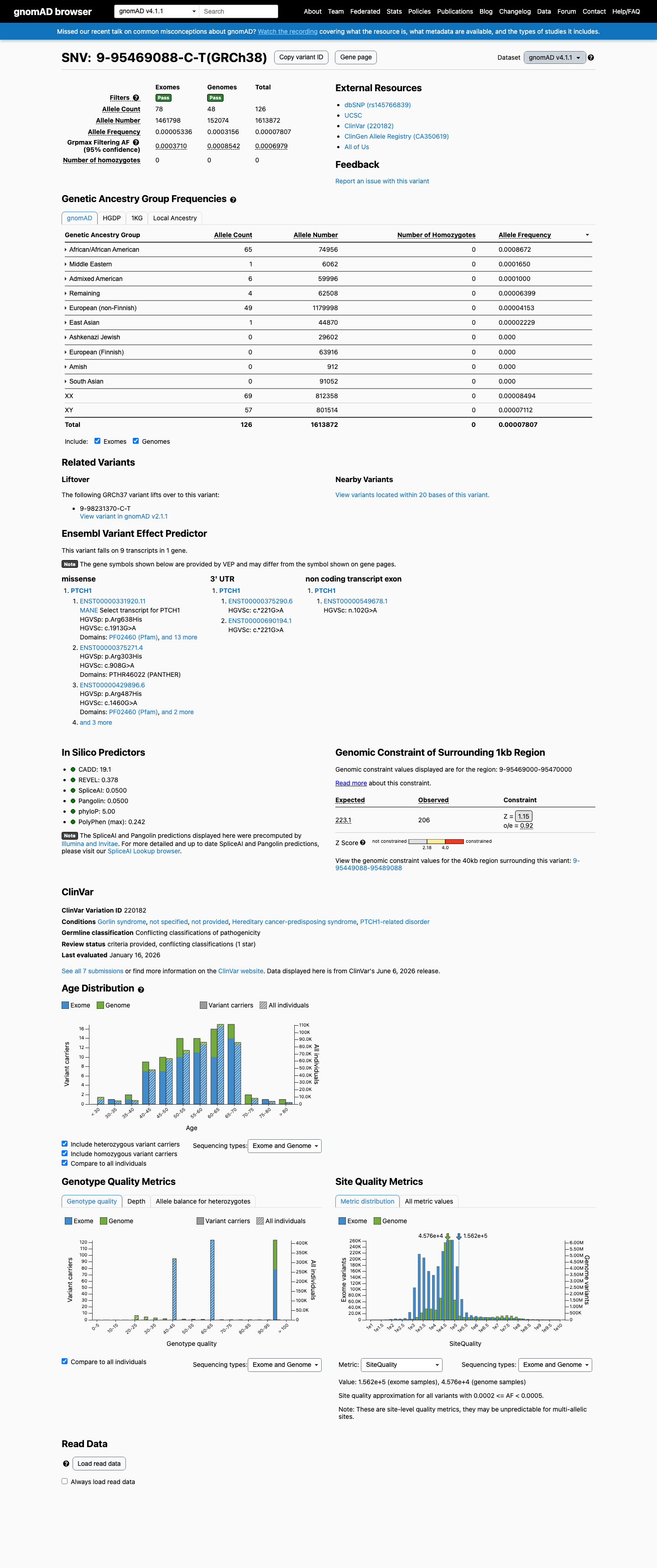
gnomAD v4.1
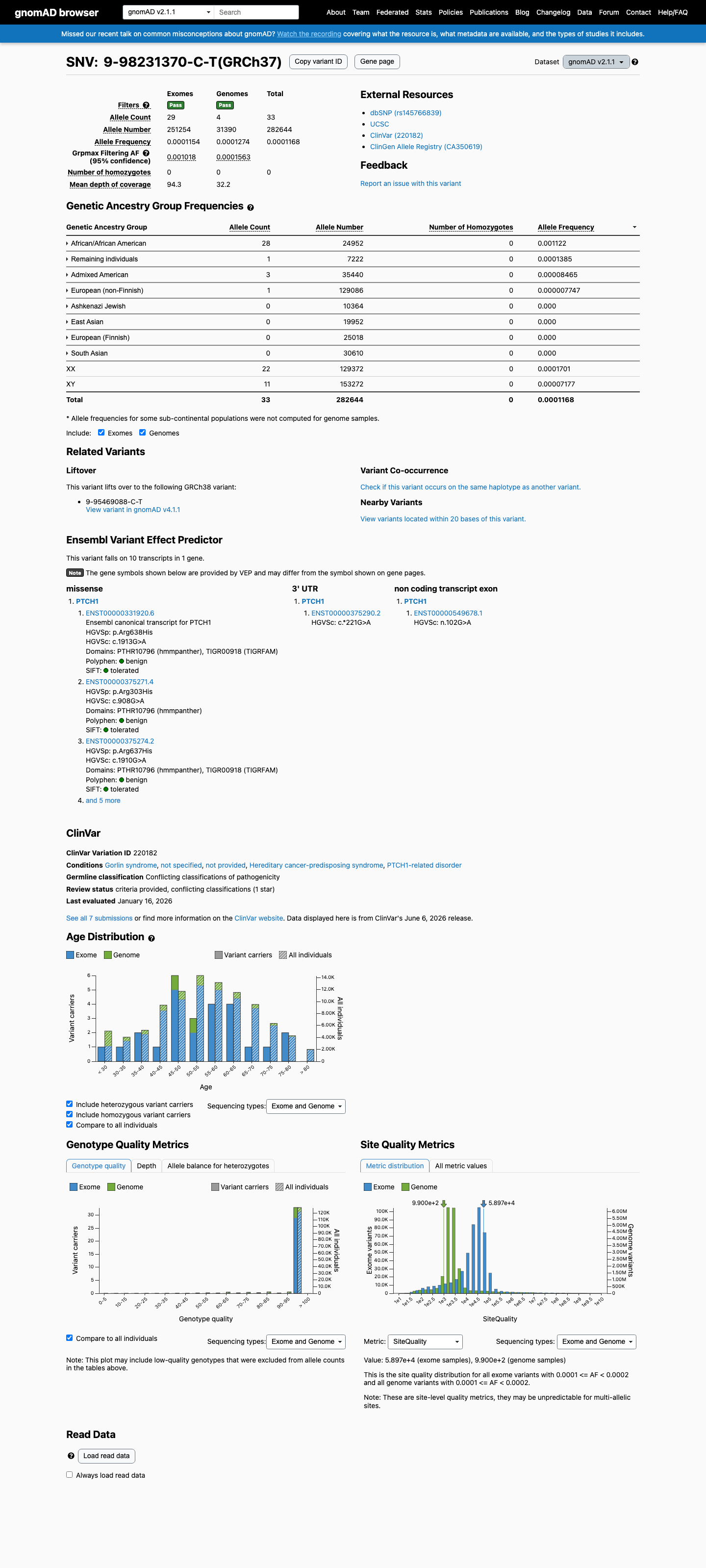
gnomAD v2.1
v4.1
This variant is present in gnomAD v4.1 (AF= 7.80731e-05; MAF= 0.00781%, 126/1613872 alleles, homozygotes = 0) and has highest observed frequency in the African/African American population (AF= 0.000867175; MAF= 0.08672%, 65/74956 alleles, homozygotes = 0); grpmax FAF= 0.0006979.
v2.1
This variant is present in gnomAD v2.1 (AF= 0.000116755; MAF= 0.01168%, 33/282644 alleles, homozygotes = 0) and has highest observed frequency in the African/African American population (AF= 0.00112215; MAF= 0.11222%, 28/24952 alleles, homozygotes = 0); grpmax FAF= 0.00101842.
🇨🇦 CA
Not available in gnomAD-Canada v1.0.
Allele frequency by ancestry
three datasets · side by side
gnomAD v4.1
0.0078%
· 126 / 1,613,872
0 hom · FAF 0.07%
0 hom · FAF 0.07%
African/African American 65 / 74,956 |
0.087% |
Middle Eastern 1 / 6,062 |
0.016% |
Admixed American 6 / 59,996 |
0.01% |
Remaining individuals 4 / 62,508 |
0.0064% |
European (non-Finnish) 49 / 1,179,998 |
0.0042% |
East Asian 1 / 44,870 |
0.0022% |
+ 4 not observed (European (Finnish), Amish, South Asian, Ashkenazi Jewish)
gnomAD v2.1
0.012%
· 33 / 282,644
0 hom · FAF 0.1%
0 hom · FAF 0.1%
African/African American 28 / 24,952 |
0.11% |
Remaining individuals 1 / 7,222 |
0.014% |
Admixed American 3 / 35,440 |
0.0085% |
European (non-Finnish) 1 / 129,086 |
0.00077% |
+ 4 not observed (Ashkenazi Jewish, East Asian, European (Finnish), South Asian)
gnomAD Canada 🇨🇦
Absent
· 0 / ?
0 hom
0 hom
Not observed in any ancestry group.
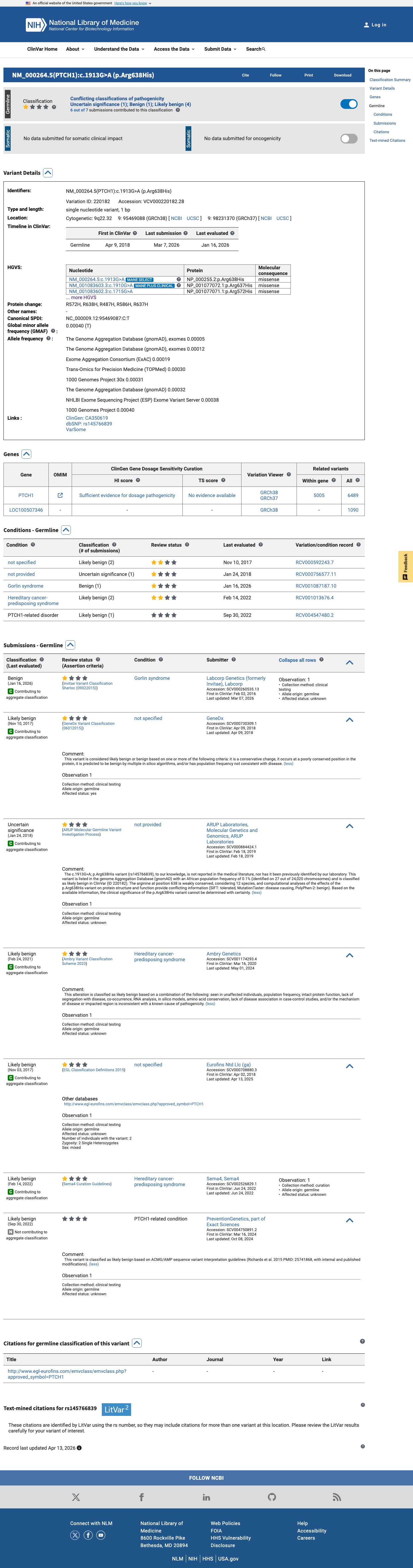
ClinVar
This variant has been reported in ClinVar as Likely benign (4 clinical laboratories) and as Benign (1 clinical laboratory) and as Uncertain significance (1 clinical laboratory). (ClinVarID = 220182)
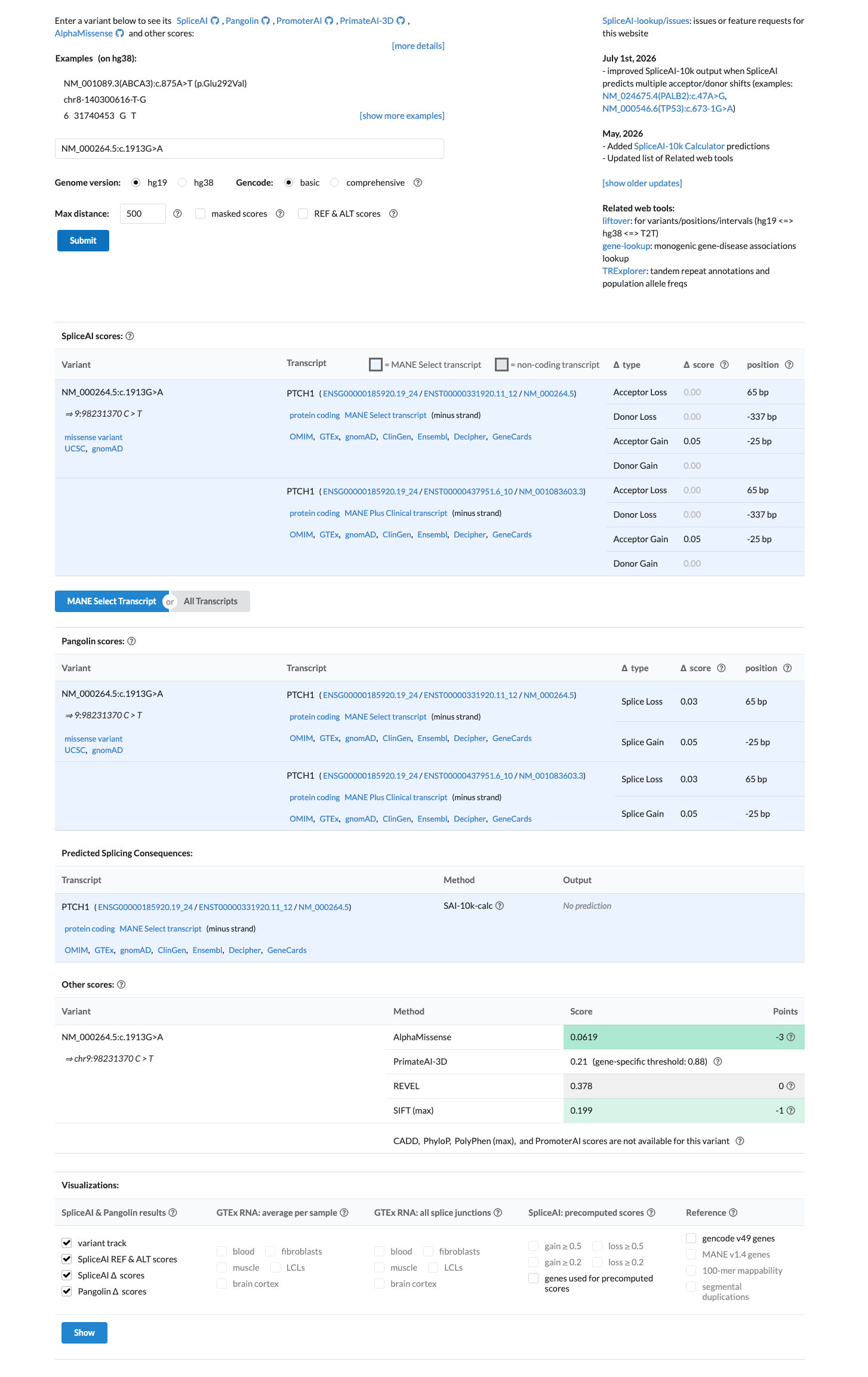
In silico
SpliceAI predicts no significant splice impact for this variant (max delta score = 0.05). REVEL score = 0.378. BayesDel score = -0.243824.
Functional
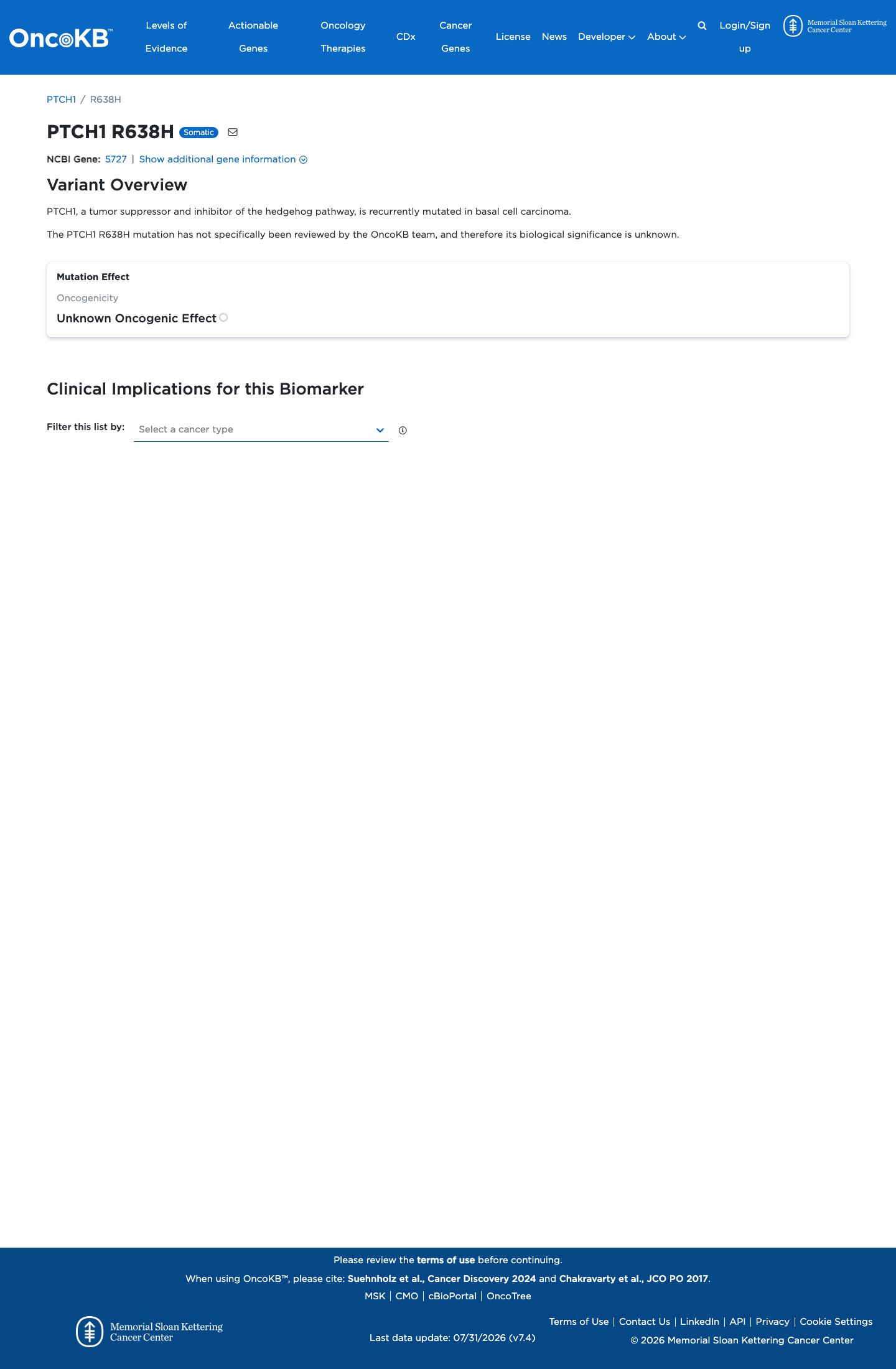
Unknown Oncogenic Effect
OncoKB did not identify variant-specific reviewed functional evidence for this variant; gene-level curated context is available for reviewer follow-up. PTCH1, a tumor suppressor and inhibitor of the hedgehog pathway, is recurrently mutated in basal cell carcinoma.

COSMIC

Cancer hotspots
Somatic evidence
Not in COSMIC / hotspots
COSMIC
This variant does not lie in a statistically significant hotspot. This variant has not previously been reported in somatic cancers (COSMIC).
Hotspots
This variant does not lie in a statistically significant hotspot.
Sources & reference links
Triaged references · 6 PMIDs not cited in assessment
15604628 ↗
Genetic cancer risk assessment and counseling: recommendations of the national society of genetic counselors.
CLINVAR
25394175 ↗
A practice guideline from the American College of Medical Genetics and Genomics and the National Society of Genetic Counselors: referral indications for cancer predisposition assessment.
CLINVAR
26389258 ↗
Cancer Genetics Risk Assessment and Counseling (PDQ®): Health Professional Version.
CLINVAR
28492532 ↗
Sherloc: a comprehensive refinement of the ACMG-AMP variant classification criteria.
CLINVAR